
| REPORT ATTRIBUTE | DETAILS |
|---|---|
| Historical Period | 2019-2022 |
| Base Year | 2023 |
| Forecast Period | 2024-2032 |
| Medical Robotics Market Size 2023 | USD 6125.2 Million |
| Medical Robotics Market, CAGR | 17.20% |
| Medical Robotics Market Size 2032 | USD 25554.5 Million |
Market Insights
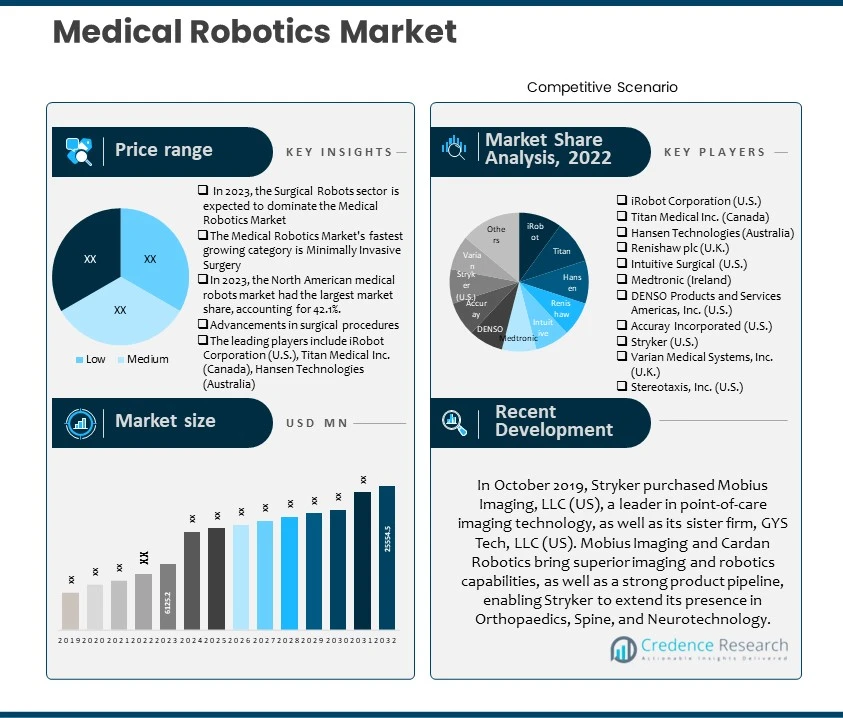
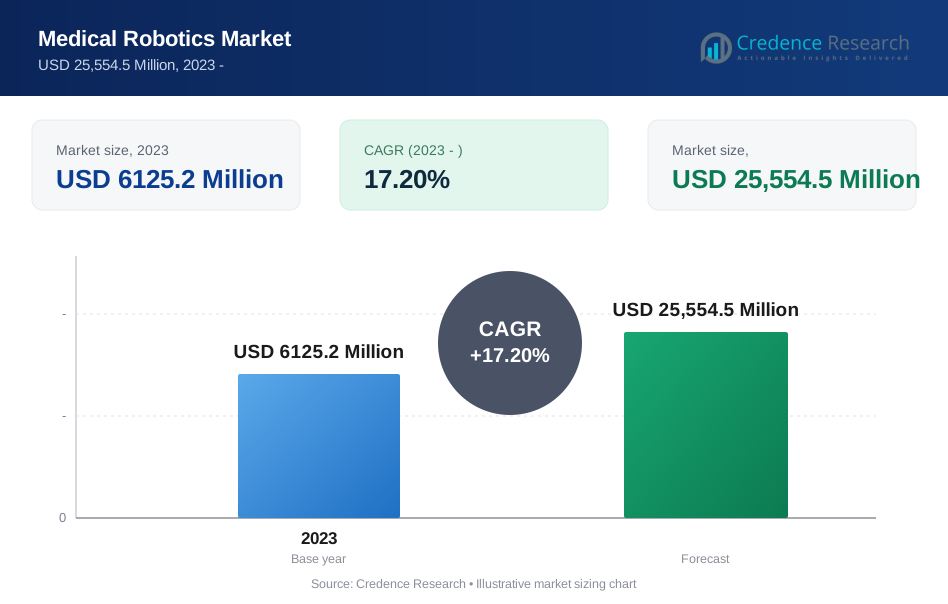
- The global demand for Medical Robotics was valued at USD 6125.2 Million in 2023 and is expected to reach USD 25554.5 Million in 2032, growing at a CAGR of 17.20% between 2024 and 2032.
- In 2023, the Medical Robotics Market is likely to be dominated by surgical robots, with rehabilitation robots also playing a significant role.
- Minimally Invasive Surgery is the fastest-growing category in the Medical Robotics Market, while Rehabilitation Therapy is a substantial market segment.
- In 2023, the instruments and accessories segment dominated the market. This segment is also expected to grow at the fastest CAGR of 18.5% throughout the forecast period.
- In 2023, the hospital and clinics category dominated the market, with rehabilitation centers also becoming increasingly popular.
- Telepresence is the dominant segment of the medical robotics market.
- Orthopedic surgery is the largest segment of the medical robotics market, while cardiovascular surgery is another important market category for medical robots.
- Exoskeleton robots are highly demanded in the medical robotics sector.
- Medication dispensing robots are the fastest-growing segment of the medical robotics market.
- Socially assistive robots account for a significant share of the medical robotics market.
- In 2023, the North American medical robots market had the biggest market share, accounting for 42.1%. The European medical robots market maintains the second-largest market share, while the Asia-Pacific market is predicted to develop the fastest from 2023 to 2032.
- Benefits of robot-assisted surgery and rehabilitation therapy Training stimulates market growth.
- The high cost of robotic systems limits market growth.
Executive Summary
Market Definition
The Medical Robotics Market is the industry that focuses on the development, manufacturing, and use of robotic systems and technologies in healthcare. These robotic devices are intended to help and improve medical operations, diagnoses, and treatments. Medical robots are capable of doing surgical procedures, rehabilitative support, pharmaceutical distribution, and telemedicine. They provide precision, efficiency, and improved patient outcomes. The Medical Robotics Market is expanding as technology progresses and healthcare professionals seek novel ways to improve patient care.
Market Overview
The global Medical Robotics Market has witnessed steady growth in recent years and is expected to grow at a CAGR of 17.20% between 2024 and 2032. The market was valued at USD 6125.2 million in 2023 and is expected to reach USD 25554.5 million in 2032.
The Medical Robotics Market is rapidly increasing and is projected to continue so in the coming years. The market is being pushed by factors such as rising demand for minimally invasive surgeries, advances in robotic technology, and the need for more precision and accuracy in medical treatments. Medical robots are utilized in a variety of applications, including surgery, rehabilitation, telemedicine, and robotic prosthesis. These robots provide advantages such as less intrusive procedures, quicker recovery times, and better patient results. Furthermore, the market is seeing cooperation between medical device manufacturers and technology companies to develop breakthrough robotic solutions for healthcare. With continued advancements and increased usage, the Medical Robotics Market offers great potential for growth and development.
Segmentation by Product Type
- In 2023, the Surgical Robots sector is expected to dominate the Medical Robotics Market in terms of revenue, growing at a CAGR of 6.44%. It is a minimally invasive surgery that uses robotics to execute surgical procedures. Surgeons handle these robotic devices, which are comprised of miniature surgical equipment mounted on robotic arms, allowing surgeons to perform surgeries with precision.
- The rehabilitation robots category is another important segment in 2023. The surgical robots section is further separated into three categories: soft tissue surgery, hard tissue surgery, and microsurgery.
Segmentation by Application
- The Medical Robotics Market's fastest-growing category is Minimally Invasive Surgery. Minimally invasive surgery is performing surgical procedures through small incisions while utilizing robotic technologies for greater precision and control. This method has advantages such as minimal scarring, faster recovery times, and less post-operative pain.
- Rehabilitation Therapy is a significant area of the Medical Robotics Market.
Segmentation by Surgical Robots by Type
- In 2023, the instruments and accessories segment dominated the market. This segment is also predicted to increase at the fastest CAGR of 18.5% throughout the forecast period. This segment's significant share and strong growth rate are mostly driven by recurring purchases of instruments and accessories, as opposed to robotic systems, which are a one-time investment.
- The Robotic Systems segment is expected to see a significant CAGR of roughly 15.0% over the next several years.
Segmentation by End-User
- The hospital and clinics segment dominated the market in 2023. This is because hospitals and clinics provide patients a variety of treatment options and consultations in a single visit.
- Rehabilitation centers are another increasingly popular component of the medical robotics market.
Segmentation by Control Type
- Telepresence is the leading segment in the medical robotics market. Telepresence is the capacity to manage robotic devices remotely and conduct activities in real time, giving the operator a sense of presence and talent. This section is gaining popularity in medical robotics because it enables expert surgeons to execute precise and difficult treatments from a remote location.
Segmentation by Surgical Robots by Application
- Orthopedic Surgery is the dominant segment of the medical robotics market. Orthopedic surgery encompasses the treatment of musculoskeletal diseases and injuries, and the use of robotics in this field has considerably improved surgical precision and outcomes. Robotic technologies let surgeons conduct procedures such as hip replacements and spinal surgery with more accuracy and less invasiveness.
- Cardiovascular surgery is another key market category for medical robotics.
Segmentation by Rehabilitation Robots by Type
- Exoskeleton robots are in high demand in the medical robotics market. Exoskeleton robots are wearable technologies that help people with mobility problems. These robots aid in the improvement of mobility, rehabilitation, and independent movement for patients who have had spinal cord injuries, strokes, or other disorders. The demand for exoskeleton robots is growing due to its potential to improve the quality of life for those with mobility issues. Mobile robots, on the other hand, are in high demand, but they offer a broader range of applications, including patient monitoring, logistics, and hospital automation.
Segmentation by Pharmacy and Hospital Automation Robots by Type
- Medication dispensing robots are the fastest expanding section of the medical robotics market. These robots are intended to deliver pharmaceuticals accurately and effectively in healthcare facilities such as hospitals and pharmacies. They automate the medicine dispensing procedure, lowering the likelihood of errors and increasing patient safety.
Segmentation by Assistive Robots by Type
- Socially Assistive Robots represent a substantial share of the medical robotics market. These robots are intended to provide social and emotional support to people, especially in healthcare and therapeutic situations. They can provide company, reminders for medication or appointments, and even emotional engagement.
Segmentation by Region
- In 2023, the North American medical robots market had the largest market share, accounting for 42.1%.
- The European medical robots market holds the second-largest market share, while the Asia-Pacific market is expected to grow the fastest from 2023 to 2032.
- The rest of the world, including Latin America, the Middle East, and Africa, supplies the remaining demand for Medical Robotics.
The North American medical robots market held the biggest market share in 2023. The increasing efficiency of medical robots in performing jobs such as surgeries in the senior population, as well as the rising number of trauma injuries, are some of the primary reasons driving the growth of the regional medical robotics market.
The European medical robotics market accounted for the second-largest market share because of the growing senior population in industrialized countries and the globalization of healthcare. Furthermore, the German medical robotics market is said to have the greatest market share, while the French medical robotics market is expected to be the fastest-expanding market in Europe.
On the other hand, the Asia-Pacific medical robotics market is predicted to develop the fastest from 2023 to 2032, owing to the growing geriatric population and increased demand for minimally invasive and non-invasive surgical procedures. The growing geriatric population has increased the demand for minimally invasive and non-invasive surgical techniques. Furthermore, China's medical robotics market has the greatest market share, while India's medical robotics market is expected to be the fastest expanding in the Asia-Pacific region.
Key Highlights of the Report
Product Type, Application, Surgical Robots by Type, End-User, Control Type, Surgical Robots by Application, Rehabilitation Robots by Type, Pharmacy and Hospital Automation Robots by Type, Assistive Robots by Type, and region segment the global Medical Robotics Market. Telepresence is the industry leader in medical robotics, while exoskeleton robots are in strong demand. Additionally, in 2023, the Surgical Robots sector is predicted to lead the Medical Robotics Market and be the fastest-growing category. Also, Socially Assistive Robots comprise a significant portion of the medical robotics market, with North America leading the market growth.
The market's primary drivers are rising demand for minimally invasive surgeries, advances in robotic technology, and a growing need for precision and accuracy in medical treatments. Furthermore, high initial prices of medical robotic systems, limited reimbursement policies for robotic treatments, and concerns about patient safety and ethical considerations are the main limitations of the industry.
Nonetheless, In 2023, the North American medical robots market had the greatest market share, followed by the European medical robotics market, while the Asia-Pacific medical robotics market is expected to grow the fastest from 2023 to 2032.
What Are The Main Drivers Of The Global Medical Robotics Market?
The Medical Robotics Market is driven by several factors that contribute to its growth and adoption. There is an increasing demand for minimally invasive surgeries, as patients seek procedures that result in shorter recovery times, reduced scarring, and less pain. Robotic technologies enable surgeons to perform these procedures with enhanced precision and control, leading to improved patient outcomes. Additionally, advancements in robotic technologies, such as robotic-assisted surgery systems, have expanded the capabilities of medical robotics, making complex procedures more feasible and efficient.
What Are The Major Challenges Faced By The Global Medical Robotics Market?
While the Medical Robotics Market shows great potential, some restraints need to be addressed. One of the main challenges is the high initial costs associated with medical robotic systems. The sophisticated technology and infrastructure required for these systems can be expensive to acquire and maintain, limiting their accessibility to some healthcare facilities. Additionally, limited reimbursement policies for robotic procedures can pose a barrier to widespread adoption, as healthcare providers may face challenges in obtaining adequate reimbursement for the use of medical robots.
What Are The Growth Opportunities In The Global Medical Robotics Market?
The Medical Robotics Market presents several opportunities for growth and development. Firstly, there is a significant opportunity for expansion into emerging markets, where the adoption of medical robotics is still in its early stages. These markets offer untapped potential for the implementation of robotic technologies in healthcare, providing opportunities for market players to expand their reach and cater to a larger patient population. Additionally, the integration of artificial intelligence and machine learning in medical robotics holds immense potential. By leveraging these technologies, medical robots can become more intelligent, adaptive, and capable of autonomous decision-making, further enhancing their effectiveness in medical procedures.
Market Drivers
Several factors drive the global Medical Robotics Market. The following are the key drivers of the global Medical Robotics Market:
Advantages of Robotic-Assisted Surgery and Rehabilitation Therapy Training
The demand for minimally invasive surgeries (MIS) is increasing worldwide, owing to the benefits of these treatments, which include smaller incisions, fewer cuts, less scarring, less discomfort, increased safety, shorter recovery times, and significant cost savings. Robotic minimally invasive surgery enhances these benefits by improving precision and repeatability while also giving more control and efficiency. A 2018 publication on a gynecological investigation of laparoscopy hysterectomy found that straight-stick laparoscopy converted to open surgery at a rate of 25%. Procedures performed with a robotic platform, on the other hand, often had a conversion rate of less than 5%, resulting in minimal morbidity and blood loss.
Robotic surgery also has increased visualization capabilities that provide surgeons a better view of the operating region, using HD cameras to show up to tiny structures. These technologies have better dexterity than the human hand; with their capacity to rotate 360 degrees and superior mobility, robots can even reach difficult-to-access locations.
Market Restraints
The global Medical Robotics Market faces some challenges that may hinder its growth. These include the following:
High Cost of Robotic Systems
Robot-assisted surgery is significantly more expensive than minimally invasive surgery. The American Congress of Obstetricians and Gynecologists advises robotic hysterectomy only in rare and difficult clinical situations.
According to the group, implementing robotic surgery for all hysterectomies would increase the yearly cost of hysterectomy surgeries in the United States by around USD 960 million. The da Vinci system, one of the most popular robotic systems, costs between USD 1.5 million and USD 2.5 million, whereas the CyberKnife radiosurgery robotic system costs between USD 4 and 7 million per unit. The typical price of a Lokomat rehabilitation robot is roughly USD 380,000.
In addition, the annual maintenance cost of a robot approaches USD 125,000, adding to the already expensive expense of robotic surgery. A research letter published in the Journal of the American Medical Association (JAMA) in August 2018 indicated that each robotic surgical treatment cost USD 3,568. The rising cost of surgeries as a result of the usage of robotic technology is likely to slow global market growth.
Opportunities
The global Medical Robotics Market offers significant growth opportunities. These include the following:
Emerging Markets and Increasing Medical Tourism
Emerging markets are likely to provide substantial potential for medical robot market players, owing to the increasing use of surgical robots in surgeries. The number of surgical procedures in emerging countries has steadily increased over the last decade, owing to an expanding target patient population and rising medical tourism. As of 2017, Brazil, Russia, India, China, and South Africa were among the world's fastest-growing economies, accounting for one-third of total global healthcare spending by 2022.
Radiotherapy treatment choices are more affordable in emerging countries like India than in established countries. For example, in the United States, patients must pay between USD 50,000 and $100,000 for Cyberknife treatment, however in India, the process costs 60-80% less (Source: Tour2India4Health). In addition to reduced treatment costs, developing markets have fewer severe rules and data requirements. Market players also believe that regulatory regulations in Asia Pacific are more adaptable and business friendly. All of these considerations are driving market participants to focus more on emerging markets in the future years.
Thus, rising healthcare expenditure and surgical operations, together with corporate expansions by leading players in new areas, are expected to provide significant potential possibilities for the global market.
Competitive Landscape
Key Players
The global Medical Robotics Market is highly competitive, with several key players. Some of the major players in the market and their market share are as follows:
- iRobot Corporation (U.S.)
- Titan Medical Inc. (Canada)
- Hansen Technologies (Australia)
- Renishaw plc (U.K.)
- Intuitive Surgical (U.S.)
- Medtronic (Ireland)
- DENSO Products and Services Americas, Inc. (U.S.)
- Accuray Incorporated (U.S.)
- Stryker (U.S.)
- Varian Medical Systems, Inc. (U.K.)
- Stereotaxis, Inc. (U.S.)
- Ekso Bionics (U.S.)
- CYBERDYNE INC. (Japan)
- BIONIK (U.S.)
- Smith+Nephew (U.K.)
- Zimmer Biomet (U.S.)
- Omnicell. Inc. (U.S.)
- ARxIUM (Canada)
These organizations prioritize product innovation, distribution channel expansion, and mergers and acquisitions to stay competitive.
The global Medical Robotics Market's key players continually seek to stay ahead by offering new products and developments.
In October 2021, Medtronic acquired CE mark clearance for the Hugo robotic-assisted surgery (RAS) system, which allows it to be sold in Europe.
In April 2021, Zimmer Biomet's Rosa complete knee system was cleared by the FDA for robotically assisted partial knee replacement procedures.
Summary of Key Findings
- Emerging markets and growing medical tourism.
- Market segmented by Product Type, Application, Surgical Robots by Type, End-User, Control Type, Surgical Robots by Application, Rehabilitation Robots by Type, Pharmacy and Hospital Automation Robots by Type, Assistive Robots by Type, and region.
- Minimally Invasive Surgery is the fastest-growing category in the Medical Robotics Market
- Telepresence is the major segment of the medical robots market.
- North America is leading market growth; the market is highly competitive with key players including iRobot Corporation (U.S.), Titan Medical Inc. (Canada), Hansen Technologies (Australia), and Others.
Future Outlook
- Continued growth and expansion
- Increasing adoption of robotic technologies
- Advancements in surgical procedures
- Rising demand for minimally invasive surgeries
- Collaboration between medical device manufacturers and technology companies
- Development of innovative robotic solutions
- Improved precision and accuracy in medical procedures
How CXOs Can Benefit from the Credence Research Medical Robotics Market Report
The Credence Research Medical Robotics Market Report provides CXOs with a comprehensive overview of the market, including:
- Market size and growth forecast: The report provides detailed estimates of the global Medical Robotics Market size, segmented by Product Type, Application, Surgical Robots by Type, End-User, Control Type, Surgical Robots by Application, Rehabilitation Robots by Type, Pharmacy and Hospital Automation Robots by Type, Assistive Robots by Type, and region. It also includes forecasts for the market through 2032, based on key trends and drivers.
- Market segmentation: The report segments the Medical Robotics Market by Product Type, Application, Surgical Robots by Type, End-User, Control Type, Surgical Robots by Application, Rehabilitation Robots by Type, Pharmacy and Hospital Automation Robots by Type, Assistive Robots by Type, and region. This segmentation provides CXOs with a granular understanding of the market and the opportunities in each segment.
- Competitive landscape: The report profiles the key players in the Medical Robotics Market and provides insights into their strategies, product offerings, and financial performance. This information can help CXOs to identify and assess their competition.
- Key trends and drivers: The report identifies and analyzes the key trends and drivers that are shaping the Medical Robotics Market. This information can help CXOs to make informed decisions about their investments and strategies.
CXOs can use the insights from the Credence Research Medical Robotics Market Report to:
- Identify growth opportunities: The report can help CXOs to identify new growth opportunities in the Medical Robotics Market. For example, it can provide insights into emerging technologies, market trends, and key market players.
- Make informed investment decisions: The report can help CXOs to make informed investment decisions about Medical Robotics. For example, t can provide insights into market trends, growth potential, competitive landscape, and key players in the industry.
- Develop competitive strategies: The report can help CXOs to develop competitive strategies for their Medical Robotics businesses. For example, the report identifies the key strategies that dark fiber providers are using to differentiate themselves from their competitors.
- Track market developments: The report can help CXOs to track market developments and stay ahead of the curve. For example, the report provides insights into the latest trends and innovations in the Medical Robotics Market.
Overall, the Credence Research Medical Robotics Market Report is a valuable resource for CXOs who are looking to gain a deeper understanding of the market and identify opportunities for growth.
Segmentation
- By Product Type:
- Surgical Robots
- Rehabilitation Robots
- Telepresence Robots
- Assistive Robots
- Pharmacy and Hospital Automation Robots
- Others
- By Application:
- Minimally Invasive Surgery
- Rehabilitation Therapy
- Pharmacy Automation
- Radiosurgery
- Telepresence Surgery
- Others
- By Surgical Robots by Type:
- Robotic Systems
- Instruments and Accessories
- By End-User:
- Hospitals and Clinics
- Rehabilitation Centers
- Pharmacies
- Ambulatory Surgical Centers
- Others
- By Control Type:
- Direct Telemanipulation
- Telepresence
- By Surgical Robots by Application:
- Gynecological Surgery
- Orthopedic Surgery
- Neurological Surgery
- Cardiovascular Surgery
- General Surgery
- Others
- By Rehabilitation Robots by Type:
- Exoskeleton Robots
- Mobile Robots
- Others
- By Pharmacy and Hospital Automation Robots by Type:
- Medication Dispensing Robots
- Robotic Prescription Dispensing Systems
- Others
- By Assistive Robots by Type:
- Socially Assistive Robots
- Cognitive Orthoses
- Others
- By Region
- North America
- The U.S.
- Canada
- Mexico
- Europe
- Germany
- France
- The U.K.
- Italy
- Spain
- Rest of Europe
- Asia Pacific
- China
- Japan
- India
- South Korea
- South-east Asia
- Rest of Asia Pacific
- Latin America
- Brazil
- Argentina
- Rest of Latin America
- Middle East & Africa
- GCC Countries
- South Africa
- Rest of Middle East and Africa
- North America
Request a Free Sample
Fill in your details and we'll send you a free sample report.
- Sample data tables & charts
- Research methodology
Need a Custom Version of This Report?
Tailor the scope, geography, or segments to your exact requirements.
- Custom geography or segment scope
- Direct access to our analyst team
Frequently Asked Questions
What is the current size of the global Medical Robotics Market?
What is the expected growth rate of the Medical Robotics Market between 2024 and 2032?
Which segment is leading the market share in terms of End-User?
What are the major market drivers of the Medical Robotics industry?
Who are the major players in the global Medical Robotics Market?
Table of Content
Chapter 1. Report Introduction
- 1.1 Report Description & Purpose
- 1.1.1 Report Title & Market Definition
- 1.1.2 Unique Selling Propositions (USP) & Key Differentiators
- 1.1.3 Value Proposition for Stakeholders
- 1.2 Research Objectives
- 1.2.1 Market Sizing Objectives (Volume & Revenue)
- 1.2.2 Segmentation Objectives
- 1.2.3 Competitive Intelligence Objectives
- 1.2.4 Forecast & Scenario Objectives
- 1.3 Report Scope
- 1.3.1 Medical Robotics Scope – Types & Subtypes Covered
- 1.3.2 Geographic Scope – Regions & Countries Covered
- 1.3.3 Historical Period, Base Year & Forecast Period (2023; forecast to the forecast period)
- 1.3.4 Inclusions & Exclusions
- 1.4 HS Code & Classification Framework
- 1.5 Currency, Units & Pricing Basis
- 1.6 Target Stakeholders
- 1.7 Limitations & Assumptions
Chapter 2. Executive Summary
- 2.1 Global Medical Robotics Market Snapshot
- 2.1.1 Market Size – Historical (2023) & Forecast (the forecast period) (2023: USD 6125.2 Million → forecast year: USD 25,554.5 Million)
- 2.1.2 Volume & Revenue – Global Totals
- 2.1.3 Key Market Highlights – Top Five Facts
- 2.2 Medical Robotics Market Segmentation Snapshot
- 2.2.1 Market Split by Region – 2023 vs.
- 2.3 Competitive Snapshot
- 2.3.1 Top 10 Players by Revenue Share – 2023
- 2.3.2 Top 10 Players by Volume Share – 2023
- 2.3.3 Recent Strategic Developments (18-Month Summary)
- 2.4 Key Investment Highlights & Strategic Conclusions
Chapter 3. Medical Robotics Market Dynamics & Industry Analysis
- 3.1 Market Overview & Context
- 3.1.1 Medical Robotics Market Position in the Broader Automotive Value Chain
- 3.1.2 OEM vs. Replacement Market Dynamics
- 3.1.3 Market Maturity & Development Stage by Region
- 3.2 Medical Robotics Market Drivers
- 3.3 Medical Robotics Market Restraints & Challenges
- 3.4 Medical Robotics Market Opportunities
- 3.5 Porter's Five Forces Analysis
- 3.5.1 Threat of New Entrants
- 3.5.2 Bargaining Power of Suppliers
- 3.5.3 Bargaining Power of Buyers
- 3.5.4 Threat of Substitutes
- 3.5.5 Competitive Rivalry – Intensity Assessment
- 3.6 Medical Robotics Value Chain Analysis
- 3.6.1 Upstream – Raw Material/Input Suppliers
- 3.6.1.1 Raw Material/Input 1
- 3.6.1.2 Raw Material/Input 2
- 3.6.1.3 Raw Material/Input 3
- 3.6.2 Midstream – Production/Manufacturing/Service Delivery
- 3.6.2.1 Production/Process Overview
- 3.6.2.2 Key Facility Locations & Capacity by Manufacturer
- 3.6.3 Downstream – Distribution & End Consumer
- 3.6.3.1 Primary Channel – B2B/OEM
- 3.6.3.2 Secondary Channels – Dealer, Retail, Online, Direct
- 3.6.4 Value Chain Profitability Analysis
- 3.6.1 Upstream – Raw Material/Input Suppliers
- 3.7 PESTEL Analysis
- 3.7.1 Political Factors
- 3.7.2 Economic Factors
- 3.7.3 Social Factors
- 3.7.4 Technological Factors
- 3.7.5 Environmental Factors
- 3.7.6 Legal Factors
- 3.8 Medical Robotics Supply Chain Analysis
- 3.8.1 Raw Material/Input Supply Risk Assessment
- 3.8.2 Manufacturing Concentration Risk (Geographic Exposure)
- 3.8.3 Trade Disruption Impact Analysis
- 3.9 Regulatory & Policy Landscape
Note: The regulatory and policy landscape section covers regulations based on their applicability to the market, Medical Robotics category, geography, and scope of the study. Only regulatory frameworks with a material impact on operations, compliance, trade, sustainability, or market access are analyzed in detail.
Chapter 4. Key Investment Pockets & Opportunity Analysis
- 4.1 Medical Robotics Market Attractiveness Analysis
- 4.1.1 By Region – Investment Attractiveness Matrix (Volume × CAGR)
- 4.2 Absolute Revenue Growth Opportunity
- 4.2.1 By Region – Absolute USD Growth Through the forecast period
- 4.3 Incremental Volume Opportunity
- 4.3.1 By Region – Incremental Volume Through the forecast period
- 4.3.2 Segment – Incremental Volume
- 4.4 Emerging Submarket Opportunity Deep Dive (Subject to Applicability)
- 4.5 Emerging Market Opportunity Scorecards
- 4.5.1 United States
- 4.5.2 Europe
- 4.5.3 Asia
- 4.5.4 Middle East & Africa
Note: Emerging Market Opportunity Scorecards will be included based on relevance and strategic importance. Regions listed are indicative and may vary depending on data availability and market dynamics.
Chapter 5. Medical Robotics Import-Export Analysis & Trade Flows
- 5.1 Global Trade Overview
- 5.1.1 Global Export Value by Country (2023)
- 5.1.2 Global Export Volume by Country (2023)
- 5.1.3 Global Import Value by Country (2023)
- 5.1.4 Global Import Volume by Country (2023)
- 5.1.5 Net Trade Balance by Country (2023)
- 5.2 Export Analysis – Segment
- 5.2.1 Type 1 (HS Code)
- 5.2.2 Type 2 (HS Code)
- 5.2.3 Type 3 (HS Code)
- 5.2.4 Type 4 (HS Code)
- 5.2.5 Type 5 (HS Code)
- 5.3 Import Analysis – Segment
- 5.3.1 Type 1 (HS Code)
- 5.3.2 Type 2 (HS Code)
- 5.3.3 Type 3 (HS Code)
- 5.3.4 Type 4 (HS Code)
- 5.3.5 Type 5 (HS Code)
- 5.4 Average Unit Trade Prices
- 5.4.1 Average Export Price – Segment & Country
- 5.4.2 Average Import Price – Segment & Source Country
- 5.4.3 Price Trends (2023)
- 5.5 Key Trade Route Analysis
- 5.5.1 Trade Route 1
- 5.5.2 Trade Route 2
- 5.5.3 Trade Route 3
- 5.5.4 Trade Route 4
- 5.5.5 Trade Route 5
- 5.6 Trade Policy Impact Assessment
- 5.6.1 US Anti-Dumping & Section 301 Tariffs
- 5.6.2 EU Customs Union Impact
- 5.6.3 Major Free Trade Agreements
- 5.6.4 USMCA Rules of Origin
Note: Trade policy analysis will be included only where relevant to the Medical Robotics market.
Chapter 6. Competitive Landscape & Company Benchmarking
- 6.1 Medical Robotics Market Concentration & Structure
- 6.1.1 Herfindahl-Hirschman Index (HHI) – vs. 2023
- 6.1.2 Tier 1, Tier 2 & Tier 3 Market Structure
- 6.1.3 Global, Regional & Local Player Dynamics
- 6.2 Medical Robotics Market Share Analysis – 2023
- 6.2.1 Global Revenue Share by Company
- 6.2.2 Global Volume Share by Company
- 6.2.3 Regional Revenue Share
- 6.2.4 Market Share Evolution ( vs. 2023)
- 6.2.5 OEM Segment Share by Company
- 6.2.6 Replacement Segment Share by Company
- 6.3 Production/Delivery Capacity & Facility Analysis
- 6.3.1 Global Installed Capacity
- 6.3.2 Capacity Utilization Rates
- 6.3.3 Production/Output Volume
- 6.3.4 Facility Locations & Capacity Map
- 6.3.5 Planned Capacity Additions
- 6.4 Medical Robotics Competitive Benchmarking Matrix
- 6.4.1 Revenue, Volume, CAGR & Profitability Comparison
- 6.4.2 Channel Revenue Mix
- 6.4.3 Geographic Revenue Exposure
- 6.4.4 R&D Intensity
- 6.4.5 Sustainability Maturity
- 6.5 Strategic Developments in Medical Robotics (Last 24 Months)
- 6.5.1 Mergers, Acquisitions & Divestments
- 6.5.2 New Medical Robotics Launches
- 6.5.3 Facility Expansions
- 6.5.4 Strategic Alliances, Joint Ventures & Partnerships
- 6.5.5 Distribution Expansion & Market Entry
- 6.5.6 Sustainability & ESG Initiatives
- 6.6 Competitive Strategy Mapping
- 6.6.1 Leader, Challenger, Follower & Niche Classification
- 6.6.2 Pricing Strategy Comparison
- 6.6.3 Channel Strategy Matrix
Note: Strategic developments are included based on their materiality and the availability of reliable information.
Chapter 7. Global Medical Robotics Market – By Distribution Channel
- 7.1 Segment Overview
- 7.1.1 Volume & Revenue Split by Channel (2023 & )
- 7.1.2 Channel Mix Evolution (the forecast period)
Chapter 8. Regional Market Analysis – Global Overview
- 8.1 Global Regional Overview
- 8.1.1 Regional Volume Share
- 8.1.2 Regional Revenue Share
- 8.1.3 Regional Volume by Region
- 8.1.4 Regional Revenue by Region
- 8.1.5 Regional Forecast Through the forecast period
- 8.2 Cross-Regional Segment Analysis
- 8.2.1 By Distribution Channel
- 8.2.2 By Brand/Price Tier
Chapter 9. North America Medical Robotics Market
- 9.1 United States
- 9.2 Canada
- 9.3 Mexico
Chapter 10. Europe Medical Robotics Market
- 10.1 Germany
- 10.2 France
- 10.3 Italy
- 10.4 United Kingdom
- 10.5 Spain
- 10.6 Poland
- 10.7 Russia
- 10.8 Netherlands
- 10.9 Belgium
- 10.10 Sweden
- 10.11 Denmark
- 10.12 Norway
- 10.13 Rest of Europe
Chapter 11. Asia Pacific Medical Robotics Market
- 11.1 China
- 11.2 India
- 11.3 Japan
- 11.4 South Korea
- 11.5 Thailand
- 11.6 Indonesia
- 11.7 Vietnam
- 11.8 Malaysia
- 11.9 Australia
- 11.10 Rest of Asia Pacific
Chapter 12. Latin America Medical Robotics Market
- 12.1 Brazil
- 12.2 Argentina
- 12.3 Colombia
- 12.4 Chile
- 12.5 Rest of Latin America
Chapter 13. Middle East Medical Robotics Market
- 13.1 Saudi Arabia
- 13.2 United Arab Emirates
- 13.3 Turkey
- 13.4 Israel
- 13.5 Iran
- 13.6 Rest of the Middle East
Chapter 14. Africa Medical Robotics Market
- 14.1 South Africa
- 14.2 Egypt
- 14.3 Nigeria
- 14.4 Morocco
- 14.5 Rest of Africa
Chapter 15. Medical Robotics Company Profiles
- 15.1 [Company 01]
- 15.1.1 Company Overview
- 15.1.2 Key Management Personnel
- 15.1.3 Products & Services Portfolio
- 15.1.4 Financial Performance
- 15.1.5 Key Market Focus & Geographic Presence
- 15.1.6 Recent Developments & Strategic Initiatives
Note: The company profile list is preliminary and may change based on research findings, market developments, data availability, and client requirements.
Chapter 16. Appendices
- Appendix A – List of Abbreviations & Acronyms
- Appendix B – Industry Classification Code Reference – Full Series
- Appendix C – Production & Capacity Data Tables
- Appendix D – End-Use & Demand Base Tables
- Appendix E – Consumption & Replacement Rate Assumptions
- Appendix F – ASP Reference Tables
- Appendix G – Manufacturing & Facility Database
- Appendix H – Import-Export Data Tables
- Appendix I – Regulatory Summary Tables
- Appendix J – Primary Research Participant List (Anonymized)
- Appendix K – Primary Research Questionnaire Framework
- Appendix L – Data Sources & Bibliography
- Appendix M – Market Size Divergence & Source Comparison
Chapter 17. Research Methodology
- 17.1 Research Framework & Philosophy
- 17.2 Secondary Research – Sources, Hierarchy & Data Extraction
- 17.3 Data Modeling – Bottom-Up & Top-Down Market Sizing
- 17.4 Primary Research – Stakeholder Framework, LOI & Sample Sizes
- 17.5 Forecast Methodology – Regression, Scenario & Sensitivity Analysis
- 17.6 Quality Control – Four-Layer Validation Framework
- 17.7 Limitations & Standard Assumptions
- 17.8 Disclaimer
