
Men's Grooming Products Market Overview:
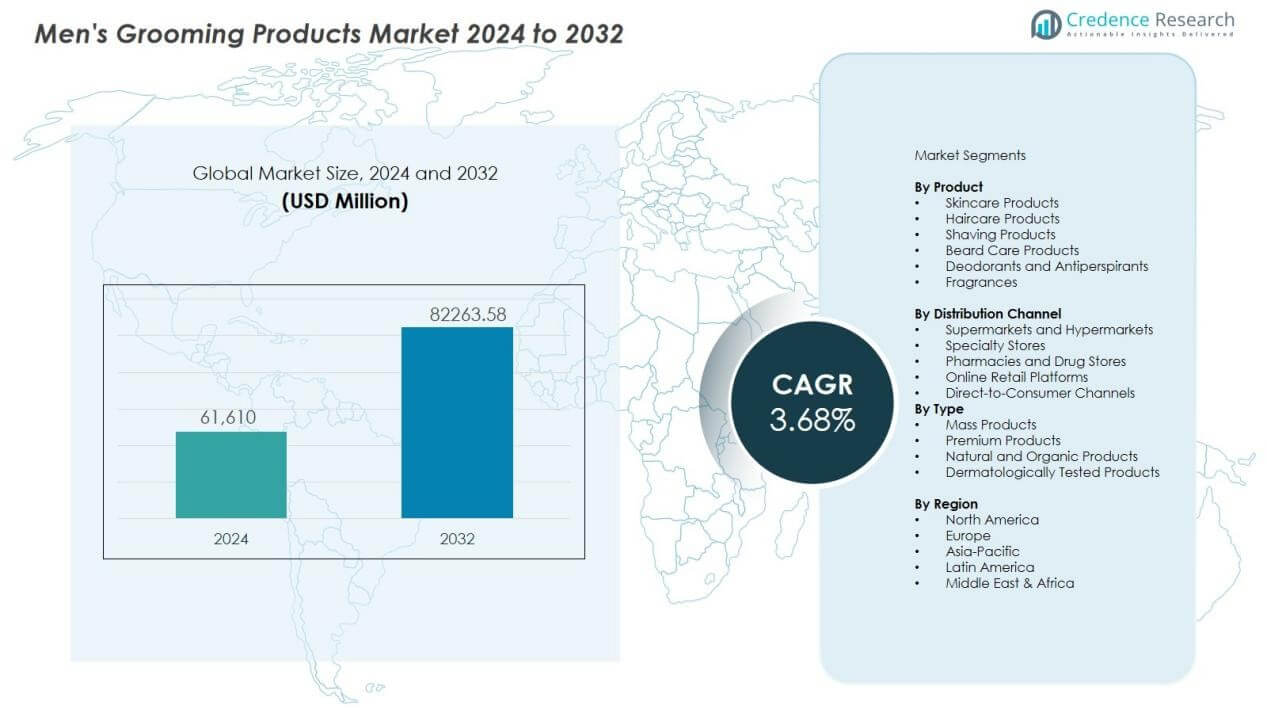
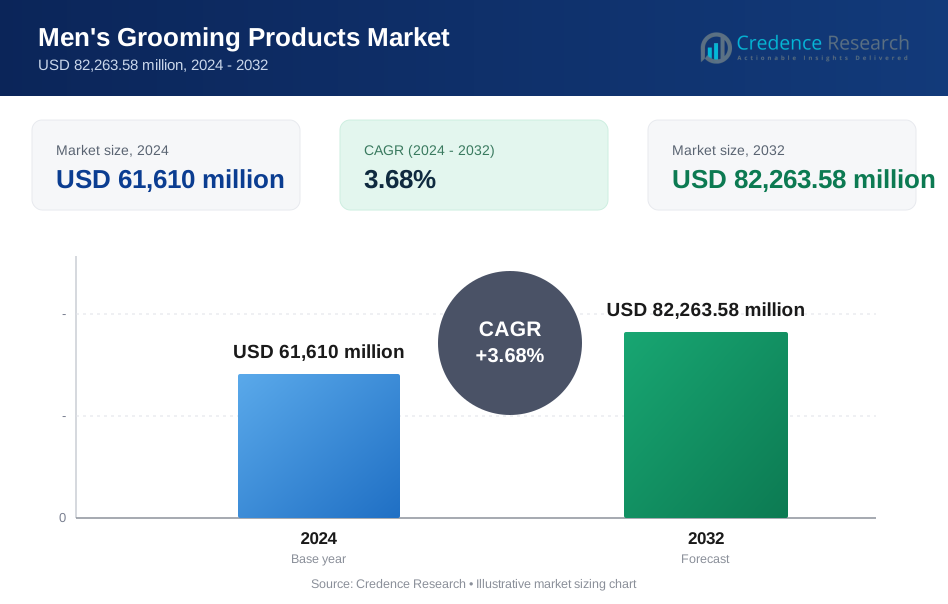
The Men's Grooming Products Market size was valued at USD 61,610 million in 2024 and is anticipated to reach USD 82263.58 million by 2032, at a CAGR of 3.68% during the forecast period.
| REPORT ATTRIBUTE | DETAILS |
|---|---|
| Historical Period | 2020-2024 |
| Base Year | 2025 |
| Forecast Period | 2026-2032 |
| Men's Grooming Products Market Size 2024 | USD 61,610 million |
| Men's Grooming Products Market, CAGR | 3.68 % |
| Men's Grooming Products Market Size 2032 | USD 82263.58 million |
Men's Grooming Products Market Insights:
- North America (34.1%), Europe (28.6%), and Asia-Pacific (26.4%) represent the top regional shares, driven by high grooming awareness, strong premium brand penetration, established retail infrastructure, and rising acceptance of skincare and beard care routines.
- Asia-Pacific, accounting for 26.4%, stands as the fastest-growing region due to large male populations, rapid urbanization, rising disposable income, and strong influence from social media, fashion trends, and e-commerce expansion.
- By product segment, skincare products hold 38.2% share due to daily-use relevance and premium adoption, while haircare products account for 24.7%, supported by routine grooming habits and wide mass-market penetration.
- By distribution channel, offline retail contributes 57.5% share through supermarkets and specialty stores, while online channels capture 42.5%, driven by convenience, subscription models, and direct-to-consumer brand strategies.
Men's Grooming Products Market Drivers:
Rising Awareness of Personal Hygiene and Appearance Among Male Consumers
The Men's Grooming Products Market benefits strongly from increasing awareness of personal hygiene and appearance across diverse age groups. Modern male consumers view grooming as an essential part of daily routines rather than an occasional activity. It supports confidence, professional presentation, and social acceptance in urban and semi-urban settings. Education campaigns and lifestyle media reinforce positive grooming habits and encourage regular product usage. This shift sustains consistent demand across skincare, haircare, and shaving categories.
- For Instance, Gillette originally introduced the Fusion razor system in 2006, featuring five anti-friction blades and a precision trimmer. While individual models like the Fusion5 continue to be staples of the brand's lineup in 2025, the brand as a whole serves approximately 750 million users worldwide.
Expansion of Premiumization and Product Innovation Strategies
Premiumization plays a critical role in shaping purchasing behavior within this market. Brands introduce advanced formulations, clean-label ingredients, and multifunctional solutions to differentiate offerings. It attracts consumers who seek performance, safety, and sensory appeal. Research-driven innovation strengthens brand credibility and supports higher price realization. Premium product launches also improve category value growth.
- For Instance, Vaseline maintained its position as a primary growth driver for Unilever in Q1 2025, delivering strong performance in the Americas through premium innovations and advanced skin barrier technology.
Influence of Digital Media and Celebrity-Endorsed Brand Communication
Digital platforms significantly shape consumer perception and product discovery. The Men's Grooming Products Market gains visibility through influencer marketing, grooming tutorials, and targeted advertising. Celebrity endorsements reinforce aspirational value and accelerate brand recognition. It supports faster adoption among younger demographics. Social commerce channels also enhance purchase convenience and engagement.
Growth of Organized Retail and E-Commerce Distribution Networks
Retail expansion strengthens product accessibility and category penetration. Organized retail outlets offer brand variety, trial options, and professional guidance. E-commerce platforms provide convenience, subscription models, and personalized recommendations. It improves reach across tier-2 and tier-3 cities. Distribution efficiency supports sustained volume growth across regions.
Men's Grooming Products Market Trends:
Shift Toward Natural, Clean-Label, and Skin-Specific Grooming Formulations
The Men's Grooming Products Market shows a clear shift toward natural, clean-label, and skin-specific formulations. Consumers prefer products free from harsh chemicals, parabens, and synthetic fragrances. Brands respond with plant-based actives, dermatologically tested blends, and sensitive-skin solutions. It supports trust, long-term usage, and premium positioning. Demand rises for beard oils, face washes, and moisturizers tailored to different skin types. Sustainability claims and ethical sourcing also influence purchase decisions. Product transparency strengthens brand loyalty and repeat sales.
- For instance, Brickell Men's Products features face washes with 98% natural jojoba and hyaluronic acid, free from sulfates and parabens for all skin types.
Integration of Digital Commerce, Personalization, and Lifestyle-Oriented Brand Positioning
Digital transformation shapes product discovery and purchasing behavior across this market. The Men's Grooming Products Market benefits from data-driven personalization and direct-to-consumer models. Brands use AI tools, virtual consultations, and customized kits to enhance consumer engagement. It improves convenience and supports subscription-based purchasing. Lifestyle-oriented branding aligns grooming with wellness, fitness, and self-care themes. Social media content drives awareness through tutorials and peer reviews. Omnichannel strategies strengthen customer retention and brand recall.
- For instance, Beardo integrates fitness tracking data into its app for tailored beard care routines, resulting in 30% increased subscription retention among active users.
Men's Grooming Products Market Challenges Analysis:
Intense Brand Competition and High Customer Acquisition Pressure Across Categories
The Men's Grooming Products Market faces intense competition from global brands, regional players, and private labels. Price sensitivity limits rapid margin expansion in mass-market segments. It challenges brands to balance quality, pricing, and promotional intensity. High marketing spend raises customer acquisition costs across digital channels. Frequent product launches shorten innovation cycles and strain development budgets. Brand differentiation requires sustained investment in formulation and packaging. Shelf space constraints further intensify retail competition.
Consumer Skepticism Toward Product Claims and Regulatory Compliance Complexity
Trust remains a critical challenge within this market. The Men's Grooming Products Market encounters skepticism toward exaggerated performance and natural claims. It pressures brands to provide clinical validation and transparent labeling. Regulatory variation across regions complicates product approval and compliance processes. Changing ingredient standards increase reformulation costs. Quality control demands consistent sourcing and testing. Non-compliance risks brand reputation and market access.
Men's Grooming Products Market Opportunities:
Expansion Potential Across Emerging Economies and Untapped Male Consumer Segments
The Men's Grooming Products Market presents strong growth potential across emerging economies with rising urban populations. Increasing disposable income supports higher spending on personal care. It enables first-time adoption across grooming categories beyond basic shaving products. Younger consumers show openness toward skincare, beard care, and hair styling solutions. Cultural shifts normalize grooming across broader age groups. Retail expansion improves product access in semi-urban markets. Localized branding supports deeper market penetration.
Innovation Opportunities Through Personalization and Premium Product Development
Product innovation creates meaningful opportunities within this market. The Men's Grooming Products Market benefits from personalized regimens based on skin type, lifestyle, and climate. It encourages premium pricing and higher customer lifetime value. Subscription models support predictable revenue streams. Advanced formulations appeal to consumers seeking performance-driven solutions. Digital diagnostics enhance purchase confidence. Brand-led education strengthens long-term engagement.
Men's Grooming Products Market Segmentation Analysis:
By Product
The Men's Grooming Products Market shows clear differentiation across product categories such as skincare, haircare, shaving products, deodorants, and beard care. Skincare and beard care record strong traction due to daily-use relevance and premium appeal. It supports higher purchase frequency and brand loyalty through routine-based consumption. Hair styling and shaving products retain steady demand across professional and casual users. Deodorants and fragrances contribute consistent volume due to mass adoption. Product portfolios with multifunctional benefits gain preference.
- For Instance, L'Oréal Men Expert launched the Hydra Energetic 24H Anti-Fatigue Moisturiser, which utilizes an energizing formula to provide 24-hour non-stop hydration. In consumer and instrumental tests, the product is proven to instantly refresh skin and maintain moisture for a full 24 hours, specifically targeting five signs of male skin fatigue.
By Distribution Channel
The Men's Grooming Products Market reflects balanced growth across offline and online distribution channels. Supermarkets, specialty stores, and pharmacies maintain strong sales through physical visibility and product trials. It benefits from professional guidance and impulse purchases in organized retail. E-commerce platforms show rapid expansion due to convenience and broader assortments. Direct-to-consumer models strengthen brand control and margins. Subscription services improve repeat purchase behavior and retention.
- For instance, Walmart expanded its Shop men's grooming product line to 1,600 stores across the US, enhancing mass-market accessibility and consumer adoption.
By Type
The Men's Grooming Products Market divides clearly into mass and premium segments. Mass products dominate volume sales due to affordability and wide availability. It supports penetration across price-sensitive consumers and emerging regions. Premium products drive value growth through advanced formulations and brand positioning. Natural, dermatologically tested, and personalized products strengthen premium demand. Segment diversification supports stable growth across income groups.
Segmentations:
By Product
- Skincare Products
- Haircare Products
- Shaving Products
- Beard Care Products
- Deodorants and Antiperspirants
- Fragrances
By Distribution Channel
- Supermarkets and Hypermarkets
- Specialty Stores
- Pharmacies and Drug Stores
- Online Retail Platforms
- Direct-to-Consumer Channels
By Type
- Mass Products
- Premium Products
- Natural and Organic Products
- Dermatologically Tested Products
By Region
- North America
- U.S.
- Canada
- Mexico
- Europe
- Germany
- France
- U.K.
- Italy
- Spain
- Rest of Europe
- Asia Pacific
- China
- Japan
- India
- South Korea
- South-east Asia
- Rest of Asia Pacific
- Latin America
- Brazil
- Argentina
- Rest of Latin America
- Middle East & Africa
- GCC Countries
- South Africa
- Rest of the Middle East and Africa
Regional Analysis:
North America and Europe with Strong Premium Adoption and Brand Maturity
The Men's Grooming Products Market shows high maturity in North America due to strong awareness, premium brand presence, and routine grooming habits. Consumers favor skincare, beard care, and anti-aging solutions with proven efficacy. It benefits from high disposable income and wide availability across organized retail and digital platforms. Product differentiation and brand loyalty shape purchasing decisions. Europe reflects similar characteristics with strong demand for natural and dermatologically tested products. Regulatory clarity supports product trust and consistency. Established supply chains reinforce stable regional performance.
Asia-Pacific as the Fastest-Expanding Consumption and Volume Growth Region
Asia-Pacific records rapid expansion supported by urban lifestyles and a large male population base. The Men's Grooming Products Market gains traction from rising income levels and youth-driven fashion awareness. It experiences strong demand for mass and mid-range products across skincare and haircare categories. E-commerce penetration improves access across tier-2 and tier-3 cities. Local brands compete effectively through pricing and cultural relevance. Social media exposure accelerates product trial. Regional diversity supports broad portfolio strategies.
Latin America and Middle East & Africa with Emerging Retail and Cultural Shifts
Latin America shows growing interest in personal care driven by urbanization and evolving male grooming norms. The Men's Grooming Products Market benefits from expanding organized retail and digital commerce in key economies. It supports steady adoption of deodorants, fragrances, and shaving products. Middle East & Africa reflects gradual growth due to rising youth demographics and lifestyle influence. Premium grooming gains attention in urban centers. Distribution expansion improves market reach. Cultural acceptance continues to strengthen category penetration.
Key Player Analysis:
- Beiersdorf AG
- Procter & Gamble Co.
- L'Oréal SA
- Shiseido Co., Ltd.
- Vi-john Group
- Colgate-Palmolive Company
- Kao Corporation
- Estee Lauder Companies, Inc.
- Reckitt Benckiser
- Coty, Inc.
Competitive Analysis:
The Men's Grooming Products Market features strong competition among global conglomerates, regional brands, and emerging digital-first players. It reflects a mix of mass-market leaders with scale advantages and premium brands that emphasize formulation expertise and brand equity. Large players focus on portfolio breadth, wide distribution networks, and sustained marketing investment to protect market share. Mid-sized and niche brands compete through natural formulations, personalization, and targeted lifestyle positioning. Product differentiation through dermatological claims, clean-label ingredients, and multifunctional benefits shapes competitive strategy. E-commerce and direct-to-consumer models reduce entry barriers and intensify rivalry. It pressures companies to optimize pricing, innovation cycles, and customer engagement. Strategic partnerships, influencer-led branding, and regional expansion support growth objectives. Competitive intensity remains high due to frequent product launches and evolving consumer expectations.
Recent Developments:
- In October 2025, the deal builds on L'Oréal's existing Yves Saint Laurent Beauté success, with a strategic committee to coordinate brands and royalties paid to Kering.
- In February 2025, Colgate-Palmolive Company announced an agreement to acquire Care TopCo Pty Ltd, the owner of the Prime100 pet food brand, to bolster its Hill’s Pet Nutrition division in the fresh pet food market.
Report Coverage:
The research report offers an in-depth analysis based on Product, Distribution Channel, Type and Region. It details leading Market players, providing an overview of their business, product offerings, investments, revenue streams, and key applications. Additionally, the report includes insights into the competitive environment, SWOT analysis, current Market trends, as well as the primary drivers and constraints. Furthermore, it discusses various factors that have driven Market expansion in recent years. The report also explores Market dynamics, regulatory scenarios, and technological advancements that are shaping the industry. It assesses the impact of external factors and global economic changes on Market growth. Lastly, it provides strategic recommendations for new entrants and established companies to navigate the complexities of the Market.
Future Outlook:
- The Men's Grooming Products Market will continue to evolve with grooming positioned as a core component of male wellness and self-care routines.
- Brands will place stronger focus on skin-specific, climate-adapted, and lifestyle-oriented product portfolios.
- Natural, clean-label, and dermatologically validated formulations will gain wider acceptance across income groups.
- Premium and masstige segments will expand through value-driven innovation and improved affordability.
- Digital-first brand strategies will strengthen direct consumer engagement and long-term loyalty.
- Personalization tools and diagnostic-led product selection will shape future purchase behavior.
- E-commerce and subscription-based models will support predictable demand and recurring revenue streams.
- Emerging economies will contribute higher consumption volumes due to urban growth and changing cultural norms.
- Retail strategies will integrate omnichannel experiences to balance physical presence with digital convenience.
- Sustained investment in branding, education, and product trust will define competitive success over the long term.
Request a Free Sample
Fill in your details and we'll send you a free sample report.
- Sample data tables & charts
- Research methodology
Need a Custom Version of This Report?
Tailor the scope, geography, or segments to your exact requirements.
- Custom geography or segment scope
- Direct access to our analyst team
Frequently Asked Questions
What is the current market size of the Men's Grooming Products Market, and what is its projected value by 2032?
At what Compound Annual Growth Rate is the Men's Grooming Products Market expected to grow during the forecast period?
Which product segment held a significant share of the Men's Grooming Products Market in 2024?
What are the key factors driving growth in the Men's Grooming Products Market?
Who are the leading players operating in the Men's Grooming Products Market?
Which region dominated the Men's Grooming Products Market in 2024?
Table of Content
Chapter 1. Report Introduction
- 1.1 Report Description & Purpose
- 1.1.1 Report Title & Market Definition
- 1.1.2 Unique Selling Propositions (USP) & Key Differentiators
- 1.1.3 Value Proposition for Stakeholders
- 1.2 Research Objectives
- 1.2.1 Market Sizing Objectives (Volume & Revenue)
- 1.2.2 Segmentation Objectives
- 1.2.3 Competitive Intelligence Objectives
- 1.2.4 Forecast & Scenario Objectives
- 1.3 Report Scope
- 1.3.1 Men's Grooming Products Scope – Types & Subtypes Covered
- 1.3.2 Geographic Scope – Regions & Countries Covered
- 1.3.3 Historical Period, Base Year & Forecast Period (2024; forecast to 2032)
- 1.3.4 Inclusions & Exclusions
- 1.4 HS Code & Classification Framework
- 1.5 Currency, Units & Pricing Basis
- 1.6 Target Stakeholders
- 1.7 Limitations & Assumptions
Chapter 2. Executive Summary
- 2.1 Global Men's Grooming Products Market Snapshot
- 2.1.1 Market Size – Historical (2024) & Forecast (2024-2032) (2024: USD 61,610 million → 2032: USD 82,263.58 million)
- 2.1.2 Volume & Revenue – Global Totals
- 2.1.3 Key Market Highlights – Top Five Facts
- 2.2 Men's Grooming Products Market Segmentation Snapshot
- 2.2.1 Market Split by Region – 2024 vs. 2032
- 2.3 Competitive Snapshot
- 2.3.1 Top 10 Players by Revenue Share – 2024
- 2.3.2 Top 10 Players by Volume Share – 2024
- 2.3.3 Recent Strategic Developments (18-Month Summary)
- 2.4 Key Investment Highlights & Strategic Conclusions
Chapter 3. Men's Grooming Products Market Dynamics & Industry Analysis
- 3.1 Market Overview & Context
- 3.1.1 Men's Grooming Products Market Position in the Broader Automotive Value Chain
- 3.1.2 OEM vs. Replacement Market Dynamics
- 3.1.3 Market Maturity & Development Stage by Region
- 3.2 Men's Grooming Products Market Drivers
- 3.3 Men's Grooming Products Market Restraints & Challenges
- 3.4 Men's Grooming Products Market Opportunities
- 3.5 Porter's Five Forces Analysis
- 3.5.1 Threat of New Entrants
- 3.5.2 Bargaining Power of Suppliers
- 3.5.3 Bargaining Power of Buyers
- 3.5.4 Threat of Substitutes
- 3.5.5 Competitive Rivalry – Intensity Assessment
- 3.6 Men's Grooming Products Value Chain Analysis
- 3.6.1 Upstream – Raw Material/Input Suppliers
- 3.6.1.1 Raw Material/Input 1
- 3.6.1.2 Raw Material/Input 2
- 3.6.1.3 Raw Material/Input 3
- 3.6.2 Midstream – Production/Manufacturing/Service Delivery
- 3.6.2.1 Production/Process Overview
- 3.6.2.2 Key Facility Locations & Capacity by Manufacturer
- 3.6.3 Downstream – Distribution & End Consumer
- 3.6.3.1 Primary Channel – B2B/OEM
- 3.6.3.2 Secondary Channels – Dealer, Retail, Online, Direct
- 3.6.4 Value Chain Profitability Analysis
- 3.6.1 Upstream – Raw Material/Input Suppliers
- 3.7 PESTEL Analysis
- 3.7.1 Political Factors
- 3.7.2 Economic Factors
- 3.7.3 Social Factors
- 3.7.4 Technological Factors
- 3.7.5 Environmental Factors
- 3.7.6 Legal Factors
- 3.8 Men's Grooming Products Supply Chain Analysis
- 3.8.1 Raw Material/Input Supply Risk Assessment
- 3.8.2 Manufacturing Concentration Risk (Geographic Exposure)
- 3.8.3 Trade Disruption Impact Analysis
- 3.9 Regulatory & Policy Landscape
Note: The regulatory and policy landscape section covers regulations based on their applicability to the market, Men's Grooming Products category, geography, and scope of the study. Only regulatory frameworks with a material impact on operations, compliance, trade, sustainability, or market access are analyzed in detail.
Chapter 4. Key Investment Pockets & Opportunity Analysis
- 4.1 Men's Grooming Products Market Attractiveness Analysis
- 4.1.1 By Region – Investment Attractiveness Matrix (Volume × CAGR)
- 4.2 Absolute Revenue Growth Opportunity
- 4.2.1 By Region – Absolute USD Growth Through 2032
- 4.3 Incremental Volume Opportunity
- 4.3.1 By Region – Incremental Volume Through 2032
- 4.3.2 Segment – Incremental Volume
- 4.4 Emerging Submarket Opportunity Deep Dive (Subject to Applicability)
- 4.5 Emerging Market Opportunity Scorecards
- 4.5.1 United States
- 4.5.2 Europe
- 4.5.3 Asia
- 4.5.4 Middle East & Africa
Note: Emerging Market Opportunity Scorecards will be included based on relevance and strategic importance. Regions listed are indicative and may vary depending on data availability and market dynamics.
Chapter 5. Men's Grooming Products Import-Export Analysis & Trade Flows
- 5.1 Global Trade Overview
- 5.1.1 Global Export Value by Country (2024)
- 5.1.2 Global Export Volume by Country (2024)
- 5.1.3 Global Import Value by Country (2024)
- 5.1.4 Global Import Volume by Country (2024)
- 5.1.5 Net Trade Balance by Country (2024)
- 5.2 Export Analysis – Segment
- 5.2.1 Type 1 (HS Code)
- 5.2.2 Type 2 (HS Code)
- 5.2.3 Type 3 (HS Code)
- 5.2.4 Type 4 (HS Code)
- 5.2.5 Type 5 (HS Code)
- 5.3 Import Analysis – Segment
- 5.3.1 Type 1 (HS Code)
- 5.3.2 Type 2 (HS Code)
- 5.3.3 Type 3 (HS Code)
- 5.3.4 Type 4 (HS Code)
- 5.3.5 Type 5 (HS Code)
- 5.4 Average Unit Trade Prices
- 5.4.1 Average Export Price – Segment & Country
- 5.4.2 Average Import Price – Segment & Source Country
- 5.4.3 Price Trends (2024)
- 5.5 Key Trade Route Analysis
- 5.5.1 Trade Route 1
- 5.5.2 Trade Route 2
- 5.5.3 Trade Route 3
- 5.5.4 Trade Route 4
- 5.5.5 Trade Route 5
- 5.6 Trade Policy Impact Assessment
- 5.6.1 US Anti-Dumping & Section 301 Tariffs
- 5.6.2 EU Customs Union Impact
- 5.6.3 Major Free Trade Agreements
- 5.6.4 USMCA Rules of Origin
Note: Trade policy analysis will be included only where relevant to the Men's Grooming Products market.
Chapter 6. Competitive Landscape & Company Benchmarking
- 6.1 Men's Grooming Products Market Concentration & Structure
- 6.1.1 Herfindahl-Hirschman Index (HHI) – vs. 2024
- 6.1.2 Tier 1, Tier 2 & Tier 3 Market Structure
- 6.1.3 Global, Regional & Local Player Dynamics
- 6.2 Men's Grooming Products Market Share Analysis – 2024
- 6.2.1 Global Revenue Share by Company
- 6.2.2 Global Volume Share by Company
- 6.2.3 Regional Revenue Share
- 6.2.4 Market Share Evolution ( vs. 2024)
- 6.2.5 OEM Segment Share by Company
- 6.2.6 Replacement Segment Share by Company
- 6.3 Production/Delivery Capacity & Facility Analysis
- 6.3.1 Global Installed Capacity
- 6.3.2 Capacity Utilization Rates
- 6.3.3 Production/Output Volume
- 6.3.4 Facility Locations & Capacity Map
- 6.3.5 Planned Capacity Additions
- 6.4 Men's Grooming Products Competitive Benchmarking Matrix
- 6.4.1 Revenue, Volume, CAGR & Profitability Comparison
- 6.4.2 Channel Revenue Mix
- 6.4.3 Geographic Revenue Exposure
- 6.4.4 R&D Intensity
- 6.4.5 Sustainability Maturity
- 6.5 Strategic Developments in Men's Grooming Products (Last 24 Months)
- 6.5.1 Mergers, Acquisitions & Divestments
- 6.5.2 New Men's Grooming Products Launches
- 6.5.3 Facility Expansions
- 6.5.4 Strategic Alliances, Joint Ventures & Partnerships
- 6.5.5 Distribution Expansion & Market Entry
- 6.5.6 Sustainability & ESG Initiatives
- 6.6 Competitive Strategy Mapping
- 6.6.1 Leader, Challenger, Follower & Niche Classification
- 6.6.2 Pricing Strategy Comparison
- 6.6.3 Channel Strategy Matrix
Note: Strategic developments are included based on their materiality and the availability of reliable information.
Chapter 7. Global Men's Grooming Products Market – By Distribution Channel
- 7.1 Segment Overview
- 7.1.1 Volume & Revenue Split by Channel (2024 & 2032)
- 7.1.2 Channel Mix Evolution (2024-2032)
Chapter 8. Regional Market Analysis – Global Overview
- 8.1 Global Regional Overview
- 8.1.1 Regional Volume Share
- 8.1.2 Regional Revenue Share
- 8.1.3 Regional Volume by Region
- 8.1.4 Regional Revenue by Region
- 8.1.5 Regional Forecast Through 2032
- 8.2 Cross-Regional Segment Analysis
- 8.2.1 By Distribution Channel
- 8.2.2 By Brand/Price Tier
Chapter 9. North America Men's Grooming Products Market
- 9.1 United States
- 9.2 Canada
- 9.3 Mexico
Chapter 10. Europe Men's Grooming Products Market
- 10.1 Germany
- 10.2 France
- 10.3 Italy
- 10.4 United Kingdom
- 10.5 Spain
- 10.6 Poland
- 10.7 Russia
- 10.8 Netherlands
- 10.9 Belgium
- 10.10 Sweden
- 10.11 Denmark
- 10.12 Norway
- 10.13 Rest of Europe
Chapter 11. Asia Pacific Men's Grooming Products Market
- 11.1 China
- 11.2 India
- 11.3 Japan
- 11.4 South Korea
- 11.5 Thailand
- 11.6 Indonesia
- 11.7 Vietnam
- 11.8 Malaysia
- 11.9 Australia
- 11.10 Rest of Asia Pacific
Chapter 12. Latin America Men's Grooming Products Market
- 12.1 Brazil
- 12.2 Argentina
- 12.3 Colombia
- 12.4 Chile
- 12.5 Rest of Latin America
Chapter 13. Middle East Men's Grooming Products Market
- 13.1 Saudi Arabia
- 13.2 United Arab Emirates
- 13.3 Turkey
- 13.4 Israel
- 13.5 Iran
- 13.6 Rest of the Middle East
Chapter 14. Africa Men's Grooming Products Market
- 14.1 South Africa
- 14.2 Egypt
- 14.3 Nigeria
- 14.4 Morocco
- 14.5 Rest of Africa
Chapter 15. Men's Grooming Products Company Profiles
- 15.1 [Company 01]
- 15.1.1 Company Overview
- 15.1.2 Key Management Personnel
- 15.1.3 Products & Services Portfolio
- 15.1.4 Financial Performance
- 15.1.5 Key Market Focus & Geographic Presence
- 15.1.6 Recent Developments & Strategic Initiatives
Note: The company profile list is preliminary and may change based on research findings, market developments, data availability, and client requirements.
Chapter 16. Appendices
- Appendix A – List of Abbreviations & Acronyms
- Appendix B – Industry Classification Code Reference – Full Series
- Appendix C – Production & Capacity Data Tables
- Appendix D – End-Use & Demand Base Tables
- Appendix E – Consumption & Replacement Rate Assumptions
- Appendix F – ASP Reference Tables
- Appendix G – Manufacturing & Facility Database
- Appendix H – Import-Export Data Tables
- Appendix I – Regulatory Summary Tables
- Appendix J – Primary Research Participant List (Anonymized)
- Appendix K – Primary Research Questionnaire Framework
- Appendix L – Data Sources & Bibliography
- Appendix M – Market Size Divergence & Source Comparison
Chapter 17. Research Methodology
- 17.1 Research Framework & Philosophy
- 17.2 Secondary Research – Sources, Hierarchy & Data Extraction
- 17.3 Data Modeling – Bottom-Up & Top-Down Market Sizing
- 17.4 Primary Research – Stakeholder Framework, LOI & Sample Sizes
- 17.5 Forecast Methodology – Regression, Scenario & Sensitivity Analysis
- 17.6 Quality Control – Four-Layer Validation Framework
- 17.7 Limitations & Standard Assumptions
- 17.8 Disclaimer
