
Market Overview
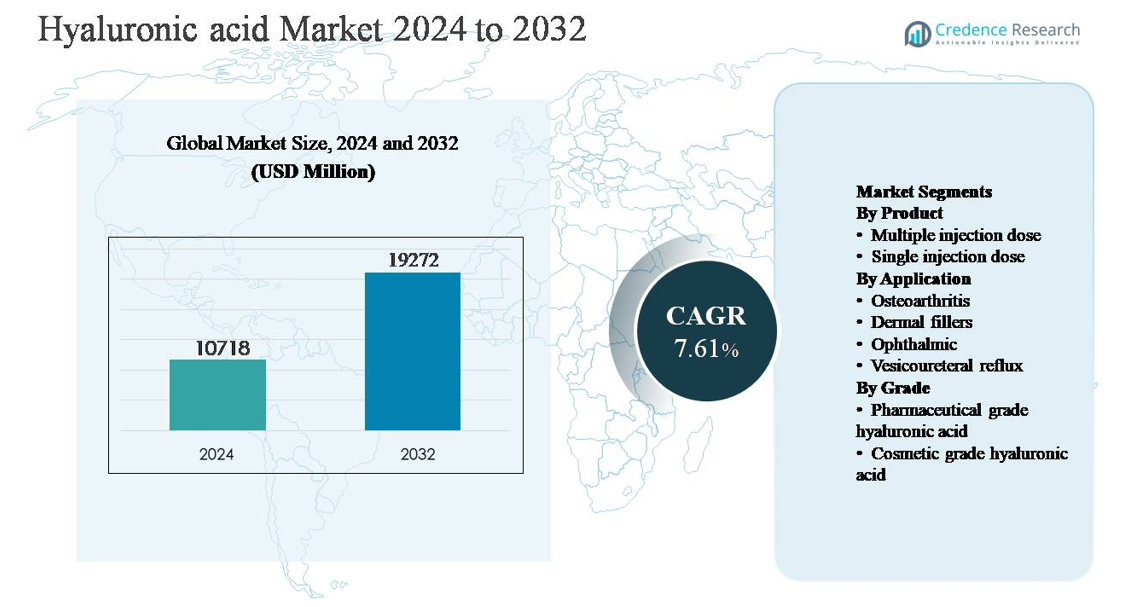
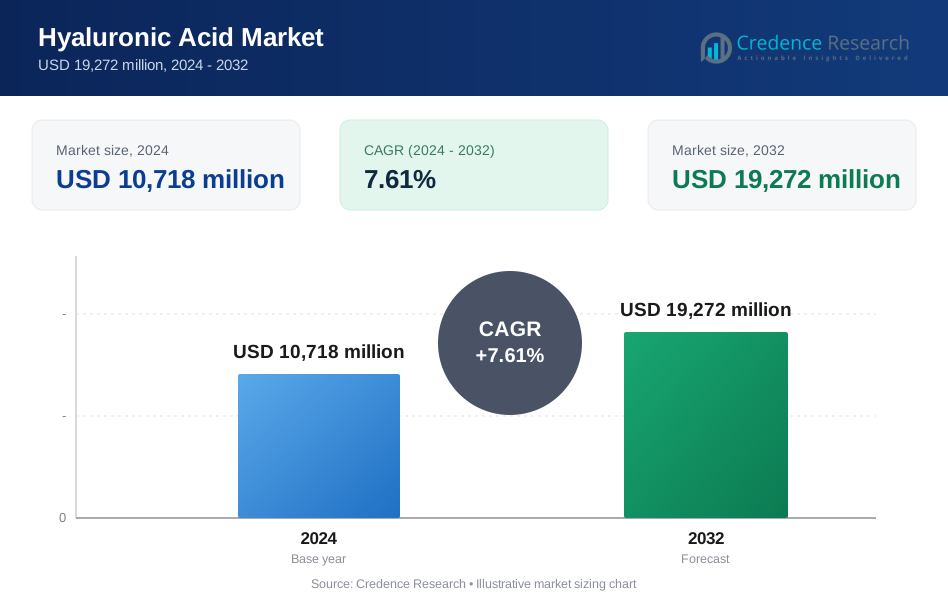
The global hyaluronic acid market was valued at USD 10,718 million in 2024 and is projected to reach USD 19,272 million by 2032, expanding at a compound annual growth rate (CAGR) of 7.61% during the forecast period.
| REPORT ATTRIBUTE | DETAILS |
|---|---|
| Historical Period | 2020-2023 |
| Base Year | 2024 |
| Forecast Period | 2025-2032 |
| Hyaluronic Acid Market Size 2024 | USD 10,718 million |
| Hyaluronic Acid Market, CAGR | 7.61% |
| Hyaluronic Acid Market Size 2032 | USD 19,272 million |
The hyaluronic acid market is led by a group of well-established players, including Allergan Aesthetics, Galderma, ANIKA, Ferring Pharmaceuticals, Bioventus, LG Chem, Lifecore Biomedical, BLOOMAGE, Kewpie, and Altergon, which compete across pharmaceutical, aesthetic, and ophthalmic applications. These companies differentiate through advanced bio-fermentation capabilities, high-purity production, and innovation in cross-linked and long-acting formulations. Strategic focus on regulatory compliance and clinical validation strengthens their positioning in injectable and therapeutic segments. North America is the leading region, accounting for approximately 36% of the global market, supported by high adoption of viscosupplementation therapies, strong demand for dermal fillers, advanced healthcare infrastructure, and the presence of major manufacturers and aesthetic treatment providers.
Market Insights
- The global hyaluronic acid market was valued at USD 10,718 million in 2024 and is projected to reach USD 19,272 million by 2032, expanding at a CAGR of 7.61% during the forecast period.
- Market growth is primarily driven by rising demand for osteoarthritis treatments and minimally invasive aesthetic procedures, with osteoarthritis applications holding ~38% share and single-dose injectables accounting for ~62% due to safety, convenience, and clinical preference.
- Key trends include rapid adoption of bio-fermentation–based production and innovation in cross-linked, long-acting formulations, particularly in dermal fillers, which represent nearly 30% of total application demand.
- Competition is shaped by established pharmaceutical and aesthetic leaders focusing on product purity, formulation longevity, and regulatory compliance, while pricing pressure from regional producers intensifies market rivalry.
- Regionally, North America leads with ~36% share, followed by Europe (~28%) and Asia Pacific (~24%), with Asia Pacific showing the fastest growth driven by expanding cosmetic procedures and healthcare access.
Market Segmentation Analysis:
By Product:
The hyaluronic acid market by product is dominated by single injection dose formulations, which account for an estimated ~62% market share. Their leadership is driven by strong adoption in orthopedic viscosupplementation and aesthetic procedures, where sterility, dosing accuracy, and patient convenience are critical. Single-dose products reduce contamination risk and simplify clinical workflows, making them preferred in hospitals, clinics, and ambulatory surgical centers. In contrast, multiple injection dose formats retain relevance in cost-sensitive settings and high-volume treatments, but regulatory scrutiny around preservative use and handling safety continues to favor single-dose adoption.
- For instance, Anika Therapeutics’ MONOVISC® is supplied as a single prefilled syringe containing 88 mg of hyaluronan in 4 mL, designed for one-time intra-articular administration in knee osteoarthritis, eliminating the need for repeat dosing and reducing procedural handling steps.
By Application:
Among applications, osteoarthritis treatment represents the dominant sub-segment with approximately ~38% market share, supported by the widespread use of hyaluronic acid injections for knee and hip joint viscosupplementation. Rising prevalence of age-related joint disorders, growing preference for minimally invasive pain management, and expanding clinical evidence supporting symptomatic relief drive this segment. Dermal fillers follow closely, propelled by aesthetic procedure growth and longer-lasting cross-linked HA formulations. Ophthalmic uses remain stable due to routine cataract surgeries, while vesicoureteral reflux and other applications contribute niche but consistent demand.
- For instance, Sanofi’s Synvisc®-One delivers a single 6 mL intra-articular injectioncontaining hylan G-F 20 with an average molecular weight for Hylan A of approximately 6 million Daltons (6,000,000 Da).
By Grade:
The market by grade is led by pharmaceutical grade hyaluronic acid, holding an estimated ~68% share, reflecting its extensive use in injectables, ophthalmic solutions, and intra-articular therapies. Stringent regulatory requirements, high purity standards, and clinical safety profiles underpin its dominance. Growth is reinforced by expanding therapeutic indications and rising healthcare expenditure. Cosmetic grade hyaluronic acid continues to gain momentum in topical skincare and non-invasive aesthetic products, driven by consumer awareness of hydration and anti-aging benefits, though its market share remains secondary due to lower pricing and regulatory thresholds.
Key Growth Driver
Rising Prevalence of Osteoarthritis and Musculoskeletal Disorders
The increasing global burden of osteoarthritis and other degenerative joint conditions remains a primary growth driver for the hyaluronic acid market. Aging populations, sedentary lifestyles, obesity prevalence, and sports-related injuries are significantly expanding the patient pool requiring joint pain management solutions. Hyaluronic acid–based viscosupplementation is widely adopted as a minimally invasive treatment that improves joint lubrication, reduces pain, and delays surgical intervention. Its favorable safety profile compared to long-term NSAID or corticosteroid use further strengthens physician and patient acceptance. Growing clinical endorsement, expanded reimbursement coverage in several healthcare systems, and rising awareness of non-surgical orthopedic treatments continue to accelerate demand for pharmaceutical-grade hyaluronic acid across hospitals, specialty clinics, and ambulatory care settings.
- For instance, Ferring Pharmaceuticals’ Durolane® is produced using non-animal stabilized hyaluronic acid technology and supplied as a sterile, prefilled syringe containing 60 mg of hyaluronic acid in 3 mL, designed for single-session viscosupplementation.
Expanding Demand for Aesthetic and Cosmetic Procedures
Rapid growth in minimally invasive aesthetic procedures is strongly driving hyaluronic acid consumption, particularly in dermal fillers and skin rejuvenation applications. Increasing disposable income, urbanization, and heightened focus on appearance across both aging and younger populations have expanded demand for facial volumization, wrinkle reduction, and lip enhancement. Hyaluronic acid’s biocompatibility, reversibility, and natural skin integration make it the preferred material for injectable fillers. Product innovations such as cross-linked formulations with extended longevity and improved viscoelasticity are enhancing treatment outcomes and repeat procedure rates. The proliferation of aesthetic clinics, growing acceptance of cosmetic procedures among men, and strong social media influence continue to support sustained growth in cosmetic-grade and injectable hyaluronic acid markets.
- For instance, Allergan Aesthetics’ JUVÉDERM® VOLUMA® XC is manufactured using Vycross® technology and contains 20 mg/mL of hyaluronic acid, engineered to achieve high gel cohesivity and lifting capacity for deep midface injections, with clinical evaluations demonstrating structural volumization maintained for up to 24 months following treatment.
Growth in Ophthalmic and Drug Delivery Applications
The expanding use of hyaluronic acid in ophthalmic formulations and advanced drug delivery systems is contributing significantly to market growth. In ophthalmology, hyaluronic acid is widely used in artificial tears, post-surgical viscoelastic agents, and intraocular solutions due to its lubrication, moisture retention, and tissue-protective properties. Rising cataract surgery volumes and increasing prevalence of dry eye syndrome are strengthening demand. Beyond ophthalmics, hyaluronic acid is increasingly utilized as a drug carrier for targeted delivery in oncology, dermatology, and regenerative medicine. Its ability to enhance bioavailability and controlled release supports adoption in next-generation therapeutic formulations, broadening its clinical and commercial relevance.
Key Trend & Opportunity
Shift Toward Bio-Fermentation and Sustainable Production
A notable trend shaping the hyaluronic acid market is the shift from animal-derived sources toward bio-fermentation-based production. Manufacturers are increasingly adopting microbial fermentation technologies to ensure consistent molecular weight control, higher purity, and improved batch-to-batch reproducibility. This transition addresses ethical concerns, reduces contamination risks, and aligns with regulatory and sustainability requirements. Bio-fermented hyaluronic acid is particularly favored in pharmaceutical and cosmetic applications, supporting premium product positioning. Opportunities exist for producers investing in scalable fermentation infrastructure and advanced purification technologies. As sustainability becomes a procurement priority for pharmaceutical and personal care brands, bio-based hyaluronic acid is expected to gain stronger market preference.
- For instance, Bloomage Biotech operates large-scale microbial fermentation facilities in China using Streptococcus strains, with individual fermentation tanks exceeding 20 m³ in working volume and downstream purification systems capable of producing pharmaceutical-grade hyaluronic acid with endotoxin levels controlled below 0.5 EU/mg, supporting injectable and ophthalmic applications.
Innovation in Cross-Linked and Long-Acting Formulations
Technological advancements in cross-linking chemistry and molecular modification are creating significant growth opportunities for the hyaluronic acid market. New formulations offer improved stability, prolonged residence time, and enhanced mechanical strength, particularly in dermal fillers and osteoarthritis injections. These innovations reduce injection frequency and improve patient compliance, driving higher adoption rates. Manufacturers are also developing hybrid products that combine hyaluronic acid with anesthetics or regenerative agents to enhance therapeutic outcomes. Continued investment in formulation science and clinical validation is enabling differentiation in competitive markets, supporting premium pricing strategies and expanding use across emerging therapeutic indications.
- For instance, Teoxane’s Teosyal® PureSense range incorporates 0.3% lidocaine hydrochloride into cross-linked hyaluronic acid gels, enabling immediate local anesthesia during injection while preserving elastic modulus and gel cohesivity.
Key Challenge
High Production Costs and Price Sensitivity
High production and purification costs pose a significant challenge to the hyaluronic acid market, particularly for pharmaceutical-grade products. Advanced fermentation processes, stringent quality control requirements, and complex downstream purification steps increase manufacturing expenses. These costs can limit affordability in price-sensitive markets and constrain adoption in emerging economies. Additionally, competitive pressure from low-cost producers intensifies pricing challenges, impacting profit margins for established manufacturers. Balancing cost efficiency with regulatory compliance and product quality remains a critical concern. Companies must optimize production yields, invest in scalable technologies, and improve supply chain efficiency to remain competitive while maintaining product standards.
Regulatory Complexity and Product Differentiation Barriers
The hyaluronic acid market faces regulatory challenges stemming from varying classification frameworks across regions, where products may be regulated as drugs, medical devices, or cosmetics. Navigating these complex regulatory pathways increases approval timelines and compliance costs, particularly for injectable and therapeutic applications. Additionally, market saturation in dermal fillers and viscosupplementation has intensified competition, making product differentiation increasingly difficult. Clinicians often perceive products as interchangeable, limiting brand loyalty. To overcome these challenges, manufacturers must invest in clinical evidence, formulation innovation, and post-market surveillance to clearly demonstrate safety, efficacy, and performance advantages.
Regional Analysis
North America:
North America leads the hyaluronic acid market, accounting for approximately 36% of global market share, driven by strong demand across osteoarthritis treatment, dermal fillers, and ophthalmic applications. The region benefits from advanced healthcare infrastructure, high adoption of minimally invasive aesthetic procedures, and widespread availability of FDA-approved viscosupplementation products. An aging population and rising prevalence of joint disorders continue to support pharmaceutical-grade hyaluronic acid demand. In addition, the presence of major manufacturers, robust clinical research activity, and favorable reimbursement pathways in the U.S. further reinforce market leadership across both therapeutic and cosmetic segments.
Europe:
Europe represents nearly 28% of the global hyaluronic acid market, supported by strong uptake in orthopedic care, aesthetic medicine, and ophthalmology. Countries such as Germany, France, Italy, and the UK drive regional demand due to well-established healthcare systems and growing preference for non-surgical treatments. The region also benefits from high regulatory standards that favor pharmaceutical-grade and bio-fermented hyaluronic acid products. Increasing adoption of dermal fillers, expanding geriatric population, and consistent innovation in cross-linked formulations contribute to steady growth, while rising medical tourism in Southern Europe further supports aesthetic application demand.
Asia Pacific:
Asia Pacific accounts for approximately 24% of the global hyaluronic acid market and is the fastest-growing regional segment. Growth is driven by expanding healthcare access, rising disposable income, and rapidly increasing demand for cosmetic and aesthetic procedures in countries such as China, South Korea, Japan, and India. A growing aging population and increasing incidence of osteoarthritis further boost therapeutic demand. The region also benefits from expanding local manufacturing capacity, particularly for cosmetic-grade hyaluronic acid, and strong consumer awareness of skincare and anti-aging products, supporting broad-based adoption across medical and personal care applications.
Latin America:
Latin America holds around 7% of the global hyaluronic acid market, with growth supported by increasing demand for aesthetic treatments and gradual expansion of orthopedic care services. Brazil and Mexico are the primary contributors, driven by a strong cosmetic surgery culture and rising awareness of minimally invasive facial rejuvenation procedures. Improving healthcare infrastructure and growing private clinic networks support uptake of viscosupplementation therapies. However, price sensitivity and limited reimbursement coverage constrain faster adoption of pharmaceutical-grade products. Despite these challenges, rising urbanization and expanding middle-class populations continue to create steady growth opportunities.
Middle East & Africa:
The Middle East & Africa region accounts for approximately 5% of the global hyaluronic acid market, driven mainly by aesthetic and dermatology applications. Countries such as the UAE and Saudi Arabia lead regional demand due to growing medical tourism, expanding private healthcare facilities, and increasing acceptance of cosmetic procedures. Ophthalmic applications also contribute, supported by rising cataract surgery volumes. However, limited access to advanced orthopedic treatments and uneven healthcare infrastructure across parts of Africa restrict broader market penetration. Gradual improvements in healthcare investment and specialist availability are expected to support moderate long-term growth.
Market Segmentations:
By Product
- Multiple injection dose
- Single injection dose
By Application
- Osteoarthritis
- Dermal fillers
- Ophthalmic
- Vesicoureteral reflux
By Grade
- Pharmaceutical grade hyaluronic acid
- Cosmetic grade hyaluronic acid
By Geography
- North America
- U.S.
- Canada
- Mexico
- Europe
- Germany
- France
- U.K.
- Italy
- Spain
- Rest of Europe
- Asia Pacific
- China
- Japan
- India
- South Korea
- South-east Asia
- Rest of Asia Pacific
- Latin America
- Brazil
- Argentina
- Rest of Latin America
- Middle East & Africa
- GCC Countries
- South Africa
- Rest of the Middle East and Africa
Competitive Landscape
The competitive landscape of the hyaluronic acid market is characterized by the presence of global pharmaceutical companies, specialty biopolymer manufacturers, and aesthetic-focused innovators competing across therapeutic, cosmetic, and ophthalmic segments. Market participants emphasize product purity, molecular weight control, and regulatory compliance to strengthen positioning, particularly in pharmaceutical-grade applications. Companies actively invest in bio-fermentation technologies, advanced cross-linking chemistries, and scalable manufacturing to improve consistency and cost efficiency. Strategic initiatives such as portfolio expansion, clinical validation, and geographic market entry remain central to competition. In the aesthetic segment, differentiation is driven by formulation longevity, viscoelastic performance, and safety profiles. Meanwhile, partnerships with clinics, distributors, and research institutions support market penetration. Overall, competition intensifies as innovation cycles shorten and manufacturers seek to balance premium performance with pricing pressures across diverse end-use markets.
Key Player Analysis
- ANIKA
- Allergan Aesthetics
- altergon
- BLOOMAGE
- bioventus
- FERRING PHARMACEUTICALS
- GALDERMA
- kewpie
- LG Chem
- Lifecore BIOMEDICAL
Recent Developments
- In September 2025,“Allergan Aesthetics Naturally You with Injectable Hyaluronic Acid Fillers” Campaign, Allergan Aesthetics launched a dedicated education campaign centered on HA injectable fillers (“Naturally You with Injectable Hyaluronic Acid Fillers”), anchored by the release of The Hyaluronic Acid Injectable Fillers Report to boost clinical and consumer understanding of HA filler safety, usage, and outcomes.
- In July 29, 2025, Anika highlighted its ongoing leadership in HA innovation across key products including MONOVISC®, ORTHOVISC®, CINGAL®, and HYALOFAST® while reaffirming strategic emphasis on HA-based regenerative solutions in orthopedics.
Report Coverage
The research report offers an in-depth analysis based on Product, Application, Grade and Geography. It details leading market players, providing an overview of their business, product offerings, investments, revenue streams, and key applications. Additionally, the report includes insights into the competitive environment, SWOT analysis, current market trends, as well as the primary drivers and constraints. Furthermore, it discusses various factors that have driven market expansion in recent years. The report also explores market dynamics, regulatory scenarios, and technological advancements that are shaping the industry. It assesses the impact of external factors and global economic changes on market growth. Lastly, it provides strategic recommendations for new entrants and established companies to navigate the complexities of the market.
Future Outlook
- Demand for hyaluronic acid will continue to rise due to the growing aging population and increasing prevalence of joint-related disorders.
- Minimally invasive aesthetic procedures will remain a key growth catalyst, supporting sustained adoption of dermal filler formulations.
- Bio-fermentation–based production will increasingly replace animal-derived sources to improve purity, safety, and regulatory acceptance.
- Pharmaceutical-grade hyaluronic acid will maintain dominance, driven by expanding therapeutic and ophthalmic applications.
- Innovation in cross-linked and long-acting formulations will enhance clinical outcomes and reduce treatment frequency.
- Asia Pacific will emerge as the fastest-growing regional market due to rising healthcare access and cosmetic awareness.
- Integration of hyaluronic acid into advanced drug delivery and regenerative medicine applications will expand clinical relevance.
- Manufacturers will focus on scalable production and cost optimization to address price sensitivity in emerging markets.
- Regulatory scrutiny will intensify, encouraging stronger clinical validation and quality standardization.
- Strategic partnerships and geographic expansion will remain critical for sustaining competitive positioning.
Request a Free Sample
Fill in your details and we'll send you a free sample report.
- Sample data tables & charts
- Research methodology
Need a Custom Version of This Report?
Tailor the scope, geography, or segments to your exact requirements.
- Custom geography or segment scope
- Direct access to our analyst team
Frequently Asked Questions
What is the current market size for Hyaluronic acid, and what is its projected size in 2032?
At what Compound Annual Growth Rate is the Hyaluronic acid market projected to grow between 2024 and 2032?
Which Form segment governs the demand for Distribution Channel?
Who are the major players in the global Hyaluronic Acid Market?
Who are the leading companies in the Hyaluronic acid market?
Table of Content
Chapter 1. Report Introduction
- 1.1 Report Description & Purpose
- 1.1.1 Report Title & Market Definition
- 1.1.2 Unique Selling Propositions (USP) & Key Differentiators
- 1.1.3 Value Proposition for Stakeholders
- 1.2 Research Objectives
- 1.2.1 Market Sizing Objectives (Volume & Revenue)
- 1.2.2 Segmentation Objectives
- 1.2.3 Competitive Intelligence Objectives
- 1.2.4 Forecast & Scenario Objectives
- 1.3 Report Scope
- 1.3.1 Hyaluronic Acid Scope – Types & Subtypes Covered
- 1.3.2 Geographic Scope – Regions & Countries Covered
- 1.3.3 Historical Period, Base Year & Forecast Period (2024; forecast to 2032)
- 1.3.4 Inclusions & Exclusions
- 1.4 HS Code & Classification Framework
- 1.5 Currency, Units & Pricing Basis
- 1.6 Target Stakeholders
- 1.7 Limitations & Assumptions
Chapter 2. Executive Summary
- 2.1 Global Hyaluronic Acid Market Snapshot
- 2.1.1 Market Size – Historical (2024) & Forecast (2024-2032) (2024: USD 10,718 million → 2032: USD 19,272 million)
- 2.1.2 Volume & Revenue – Global Totals
- 2.1.3 Key Market Highlights – Top Five Facts
- 2.2 Hyaluronic Acid Market Segmentation Snapshot
- 2.2.1 Market Split by Region – 2024 vs. 2032
- 2.3 Competitive Snapshot
- 2.3.1 Top 10 Players by Revenue Share – 2024
- 2.3.2 Top 10 Players by Volume Share – 2024
- 2.3.3 Recent Strategic Developments (18-Month Summary)
- 2.4 Key Investment Highlights & Strategic Conclusions
Chapter 3. Hyaluronic Acid Market Dynamics & Industry Analysis
- 3.1 Market Overview & Context
- 3.1.1 Hyaluronic Acid Market Position in the Broader Automotive Value Chain
- 3.1.2 OEM vs. Replacement Market Dynamics
- 3.1.3 Market Maturity & Development Stage by Region
- 3.2 Hyaluronic Acid Market Drivers
- 3.3 Hyaluronic Acid Market Restraints & Challenges
- 3.4 Hyaluronic Acid Market Opportunities
- 3.5 Porter's Five Forces Analysis
- 3.5.1 Threat of New Entrants
- 3.5.2 Bargaining Power of Suppliers
- 3.5.3 Bargaining Power of Buyers
- 3.5.4 Threat of Substitutes
- 3.5.5 Competitive Rivalry – Intensity Assessment
- 3.6 Hyaluronic Acid Value Chain Analysis
- 3.6.1 Upstream – Raw Material/Input Suppliers
- 3.6.1.1 Raw Material/Input 1
- 3.6.1.2 Raw Material/Input 2
- 3.6.1.3 Raw Material/Input 3
- 3.6.2 Midstream – Production/Manufacturing/Service Delivery
- 3.6.2.1 Production/Process Overview
- 3.6.2.2 Key Facility Locations & Capacity by Manufacturer
- 3.6.3 Downstream – Distribution & End Consumer
- 3.6.3.1 Primary Channel – B2B/OEM
- 3.6.3.2 Secondary Channels – Dealer, Retail, Online, Direct
- 3.6.4 Value Chain Profitability Analysis
- 3.6.1 Upstream – Raw Material/Input Suppliers
- 3.7 PESTEL Analysis
- 3.7.1 Political Factors
- 3.7.2 Economic Factors
- 3.7.3 Social Factors
- 3.7.4 Technological Factors
- 3.7.5 Environmental Factors
- 3.7.6 Legal Factors
- 3.8 Hyaluronic Acid Supply Chain Analysis
- 3.8.1 Raw Material/Input Supply Risk Assessment
- 3.8.2 Manufacturing Concentration Risk (Geographic Exposure)
- 3.8.3 Trade Disruption Impact Analysis
- 3.9 Regulatory & Policy Landscape
Note: The regulatory and policy landscape section covers regulations based on their applicability to the market, Hyaluronic Acid category, geography, and scope of the study. Only regulatory frameworks with a material impact on operations, compliance, trade, sustainability, or market access are analyzed in detail.
Chapter 4. Key Investment Pockets & Opportunity Analysis
- 4.1 Hyaluronic Acid Market Attractiveness Analysis
- 4.1.1 By Region – Investment Attractiveness Matrix (Volume × CAGR)
- 4.2 Absolute Revenue Growth Opportunity
- 4.2.1 By Region – Absolute USD Growth Through 2032
- 4.3 Incremental Volume Opportunity
- 4.3.1 By Region – Incremental Volume Through 2032
- 4.3.2 Segment – Incremental Volume
- 4.4 Emerging Submarket Opportunity Deep Dive (Subject to Applicability)
- 4.5 Emerging Market Opportunity Scorecards
- 4.5.1 United States
- 4.5.2 Europe
- 4.5.3 Asia
- 4.5.4 Middle East & Africa
Note: Emerging Market Opportunity Scorecards will be included based on relevance and strategic importance. Regions listed are indicative and may vary depending on data availability and market dynamics.
Chapter 5. Hyaluronic Acid Import-Export Analysis & Trade Flows
- 5.1 Global Trade Overview
- 5.1.1 Global Export Value by Country (2024)
- 5.1.2 Global Export Volume by Country (2024)
- 5.1.3 Global Import Value by Country (2024)
- 5.1.4 Global Import Volume by Country (2024)
- 5.1.5 Net Trade Balance by Country (2024)
- 5.2 Export Analysis – Segment
- 5.2.1 Type 1 (HS Code)
- 5.2.2 Type 2 (HS Code)
- 5.2.3 Type 3 (HS Code)
- 5.2.4 Type 4 (HS Code)
- 5.2.5 Type 5 (HS Code)
- 5.3 Import Analysis – Segment
- 5.3.1 Type 1 (HS Code)
- 5.3.2 Type 2 (HS Code)
- 5.3.3 Type 3 (HS Code)
- 5.3.4 Type 4 (HS Code)
- 5.3.5 Type 5 (HS Code)
- 5.4 Average Unit Trade Prices
- 5.4.1 Average Export Price – Segment & Country
- 5.4.2 Average Import Price – Segment & Source Country
- 5.4.3 Price Trends (2024)
- 5.5 Key Trade Route Analysis
- 5.5.1 Trade Route 1
- 5.5.2 Trade Route 2
- 5.5.3 Trade Route 3
- 5.5.4 Trade Route 4
- 5.5.5 Trade Route 5
- 5.6 Trade Policy Impact Assessment
- 5.6.1 US Anti-Dumping & Section 301 Tariffs
- 5.6.2 EU Customs Union Impact
- 5.6.3 Major Free Trade Agreements
- 5.6.4 USMCA Rules of Origin
Note: Trade policy analysis will be included only where relevant to the Hyaluronic Acid market.
Chapter 6. Competitive Landscape & Company Benchmarking
- 6.1 Hyaluronic Acid Market Concentration & Structure
- 6.1.1 Herfindahl-Hirschman Index (HHI) – vs. 2024
- 6.1.2 Tier 1, Tier 2 & Tier 3 Market Structure
- 6.1.3 Global, Regional & Local Player Dynamics
- 6.2 Hyaluronic Acid Market Share Analysis – 2024
- 6.2.1 Global Revenue Share by Company
- 6.2.2 Global Volume Share by Company
- 6.2.3 Regional Revenue Share
- 6.2.4 Market Share Evolution ( vs. 2024)
- 6.2.5 OEM Segment Share by Company
- 6.2.6 Replacement Segment Share by Company
- 6.3 Production/Delivery Capacity & Facility Analysis
- 6.3.1 Global Installed Capacity
- 6.3.2 Capacity Utilization Rates
- 6.3.3 Production/Output Volume
- 6.3.4 Facility Locations & Capacity Map
- 6.3.5 Planned Capacity Additions
- 6.4 Hyaluronic Acid Competitive Benchmarking Matrix
- 6.4.1 Revenue, Volume, CAGR & Profitability Comparison
- 6.4.2 Channel Revenue Mix
- 6.4.3 Geographic Revenue Exposure
- 6.4.4 R&D Intensity
- 6.4.5 Sustainability Maturity
- 6.5 Strategic Developments in Hyaluronic Acid (Last 24 Months)
- 6.5.1 Mergers, Acquisitions & Divestments
- 6.5.2 New Hyaluronic Acid Launches
- 6.5.3 Facility Expansions
- 6.5.4 Strategic Alliances, Joint Ventures & Partnerships
- 6.5.5 Distribution Expansion & Market Entry
- 6.5.6 Sustainability & ESG Initiatives
- 6.6 Competitive Strategy Mapping
- 6.6.1 Leader, Challenger, Follower & Niche Classification
- 6.6.2 Pricing Strategy Comparison
- 6.6.3 Channel Strategy Matrix
Note: Strategic developments are included based on their materiality and the availability of reliable information.
Chapter 7. Global Hyaluronic Acid Market – By Distribution Channel
- 7.1 Segment Overview
- 7.1.1 Volume & Revenue Split by Channel (2024 & 2032)
- 7.1.2 Channel Mix Evolution (2024-2032)
Chapter 8. Regional Market Analysis – Global Overview
- 8.1 Global Regional Overview
- 8.1.1 Regional Volume Share
- 8.1.2 Regional Revenue Share
- 8.1.3 Regional Volume by Region
- 8.1.4 Regional Revenue by Region
- 8.1.5 Regional Forecast Through 2032
- 8.2 Cross-Regional Segment Analysis
- 8.2.1 By Distribution Channel
- 8.2.2 By Brand/Price Tier
Chapter 9. North America Hyaluronic Acid Market
- 9.1 United States
- 9.2 Canada
- 9.3 Mexico
Chapter 10. Europe Hyaluronic Acid Market
- 10.1 Germany
- 10.2 France
- 10.3 Italy
- 10.4 United Kingdom
- 10.5 Spain
- 10.6 Poland
- 10.7 Russia
- 10.8 Netherlands
- 10.9 Belgium
- 10.10 Sweden
- 10.11 Denmark
- 10.12 Norway
- 10.13 Rest of Europe
Chapter 11. Asia Pacific Hyaluronic Acid Market
- 11.1 China
- 11.2 India
- 11.3 Japan
- 11.4 South Korea
- 11.5 Thailand
- 11.6 Indonesia
- 11.7 Vietnam
- 11.8 Malaysia
- 11.9 Australia
- 11.10 Rest of Asia Pacific
Chapter 12. Latin America Hyaluronic Acid Market
- 12.1 Brazil
- 12.2 Argentina
- 12.3 Colombia
- 12.4 Chile
- 12.5 Rest of Latin America
Chapter 13. Middle East Hyaluronic Acid Market
- 13.1 Saudi Arabia
- 13.2 United Arab Emirates
- 13.3 Turkey
- 13.4 Israel
- 13.5 Iran
- 13.6 Rest of the Middle East
Chapter 14. Africa Hyaluronic Acid Market
- 14.1 South Africa
- 14.2 Egypt
- 14.3 Nigeria
- 14.4 Morocco
- 14.5 Rest of Africa
Chapter 15. Hyaluronic Acid Company Profiles
- 15.1 [Company 01]
- 15.1.1 Company Overview
- 15.1.2 Key Management Personnel
- 15.1.3 Products & Services Portfolio
- 15.1.4 Financial Performance
- 15.1.5 Key Market Focus & Geographic Presence
- 15.1.6 Recent Developments & Strategic Initiatives
Note: The company profile list is preliminary and may change based on research findings, market developments, data availability, and client requirements.
Chapter 16. Appendices
- Appendix A – List of Abbreviations & Acronyms
- Appendix B – Industry Classification Code Reference – Full Series
- Appendix C – Production & Capacity Data Tables
- Appendix D – End-Use & Demand Base Tables
- Appendix E – Consumption & Replacement Rate Assumptions
- Appendix F – ASP Reference Tables
- Appendix G – Manufacturing & Facility Database
- Appendix H – Import-Export Data Tables
- Appendix I – Regulatory Summary Tables
- Appendix J – Primary Research Participant List (Anonymized)
- Appendix K – Primary Research Questionnaire Framework
- Appendix L – Data Sources & Bibliography
- Appendix M – Market Size Divergence & Source Comparison
Chapter 17. Research Methodology
- 17.1 Research Framework & Philosophy
- 17.2 Secondary Research – Sources, Hierarchy & Data Extraction
- 17.3 Data Modeling – Bottom-Up & Top-Down Market Sizing
- 17.4 Primary Research – Stakeholder Framework, LOI & Sample Sizes
- 17.5 Forecast Methodology – Regression, Scenario & Sensitivity Analysis
- 17.6 Quality Control – Four-Layer Validation Framework
- 17.7 Limitations & Standard Assumptions
- 17.8 Disclaimer
