
| REPORT ATTRIBUTE | DETAILS |
|---|---|
| Historical Period | 2020-2023 |
| Base Year | 2024 |
| Forecast Period | 2025-2032 |
| New Energy Vehicles Market Size 2024 | USD 520.0 million |
| New Energy Vehicles Market, CAGR | 19.10% |
| New Energy Vehicles Market Size 2032 | USD 2,120.6 million |
Market Overview:
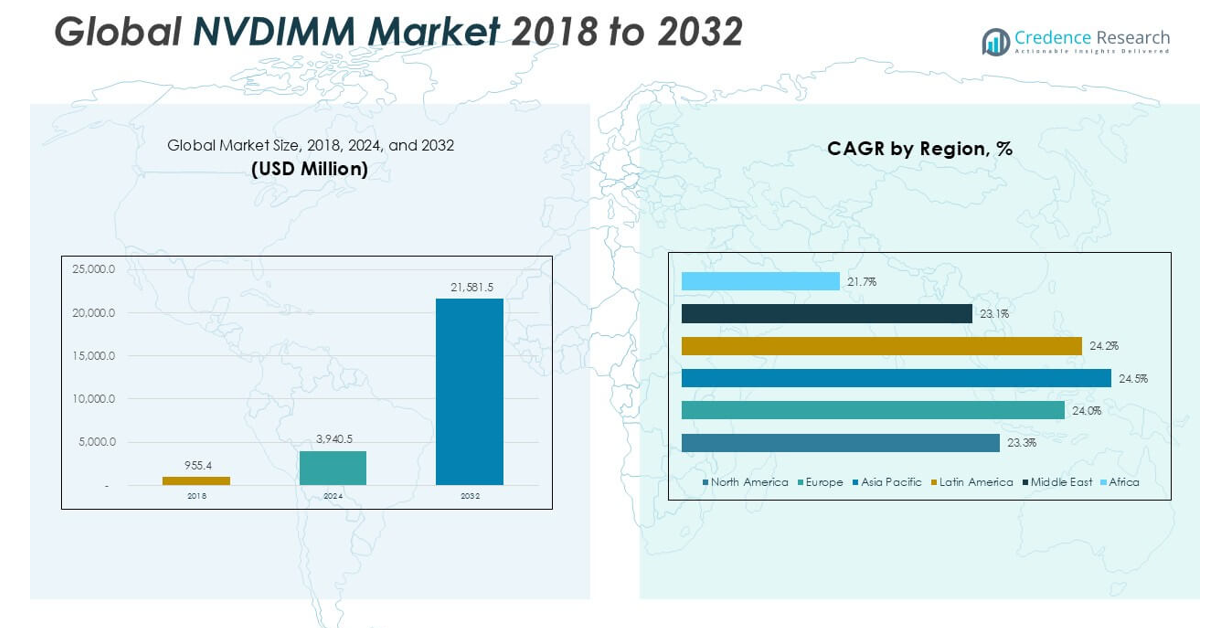
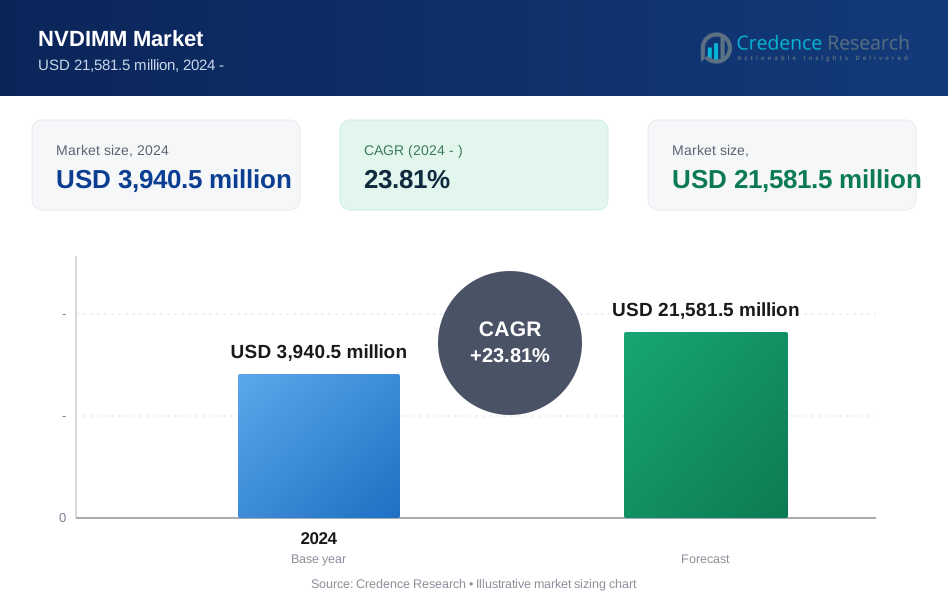
The NVDIMM market size was valued at USD 955.4 million in 2018, reached USD 3,940.5 million in 2024, and is anticipated to reach USD 21,581.5 million by 2032, at a CAGR of 23.81% during the forecast period.
Top players in the NVDIMM market include Viking Technology Inc., AgigA Tech, Inc., Micron Technology Inc., Netlist, Inc., SMART Modular Technologies, Inc., Rambus Inc., SK Hynix, Inc., The Hewlett Packard Company, and Intel Corporation. These companies lead through continuous innovation, strong R&D investment, and strategic alliances with server OEMs, enabling them to address the growing demand for high-performance memory solutions across diverse enterprise applications. North America emerges as the leading region, commanding a 32% market share in 2024, driven by advanced IT infrastructure, rapid cloud adoption, and significant investments from major technology providers.
Market Insights
- The global NVDIMM market reached USD 3,940.5 million in 2024 and is projected to grow to USD 21,581.5 million by 2032, registering a CAGR of 23.81%.
- Growth is primarily driven by rising demand for high-performance, persistent memory solutions in enterprise storage, cloud computing, and hyperscale data centers, with NVDIMM-N accounting for over 65% of the product segment share.
- The market is witnessing trends such as rapid integration with next-generation server platforms, increased adoption in AI and edge computing, and technological advancements that support higher capacity and lower latency modules.
- Leading players such as Viking Technology Inc., Micron Technology Inc., SK Hynix, and Intel Corporation compete on innovation, capacity expansion, and strategic partnerships, while high implementation costs and integration challenges act as key restraints.
- North America holds the largest regional share at 32% in 2024, followed by Europe at 22% and Asia Pacific at 21%, reflecting strong adoption in technologically advanced regions.
Market Segmentation Analysis:
By Product:
Within the NVDIMM market, the NVDIMM-N sub-segment holds the dominant market share, accounting for over 65% of total revenue in 2024. This leadership stems from its ability to offer both DRAM-like speed and persistent storage, making it highly attractive for mission-critical enterprise applications. The robust adoption of NVDIMM-N is further fueled by rising demand for high-performance memory solutions in data centers, where uninterrupted data retention and fast recovery times are essential. Increasing investments in cloud infrastructure and storage modernization continue to reinforce this segment’s strong market position.
- For instance, Micron Technology’s NVDIMM-N solutions have achieved sequential write speeds of up to 2,933 MT/s and are implemented in over 30 tier-one data center facilities worldwide.
By Capacity:
The 32 GB and Above capacity segment leads the NVDIMM market, contributing nearly 60% of total market share in 2024. Organizations prefer high-capacity modules to address growing workloads, advanced analytics, and data-intensive applications across enterprise and cloud environments. This trend is propelled by the proliferation of artificial intelligence, machine learning, and real-time data processing, all of which require large memory pools. High-capacity NVDIMMs support greater scalability, operational efficiency, and future-proofing, making them the preferred choice for enterprises aiming to optimize system performance.
- For instance, SK Hynix launched a 128 GB NVDIMM module used in AI-driven server clusters supporting 400+ concurrent processes per node.
By End Use:
Enterprise Storage and Server applications represent the largest end use segment, capturing approximately 72% of the NVDIMM market share in 2024. The dominance of this sub-segment is driven by the accelerating shift toward digital transformation and the need for reliable, high-speed memory solutions within modern IT infrastructure. Enterprises increasingly deploy NVDIMMs in storage arrays and server platforms to improve transaction speeds, minimize latency, and enhance data resilience. The demand for uninterrupted business operations and robust disaster recovery capabilities further underpins the strong adoption of NVDIMMs in this sector.
Market Overview
Rising Demand for High-Performance Data Storage
Enterprises and data centers are increasingly investing in high-performance memory technologies to support mission-critical operations and real-time analytics. NVDIMMs, with their blend of speed and persistence, meet the need for rapid data access and secure retention, driving robust adoption. As digital transformation accelerates across sectors such as finance, healthcare, and cloud computing, organizations require memory solutions that minimize downtime, optimize transactional performance, and ensure data integrity, positioning NVDIMM as a preferred choice in modern IT environments.
- For instance, Netlist Inc. has deployed NVDIMM technology in transaction systems handling up to 50,000 database queries per second.
Expansion of Cloud Infrastructure and Services
The proliferation of cloud computing and the deployment of hyperscale data centers have created strong demand for reliable, low-latency memory solutions. NVDIMMs enable cloud service providers to deliver enhanced storage performance, seamless data recovery, and improved service continuity for end users. This surge in cloud adoption, combined with the integration of artificial intelligence and big data analytics, further accelerates NVDIMM market growth as providers seek advanced memory modules capable of supporting complex, high-volume workloads.
- For instance, Intel Corporation’s Optane persistent memory has been integrated into cloud data centers that operate 8,000 or more virtual machines per site.
Advancements in Persistent Memory Technology
Continuous innovation in non-volatile memory technologies has significantly enhanced the capabilities of NVDIMMs. New product launches offering higher capacities, improved endurance, and compatibility with emerging server architectures drive market expansion. Vendors’ investments in R&D, along with growing partnerships between memory manufacturers and server OEMs, promote widespread adoption. As memory-intensive applications become more prevalent, these advancements help NVDIMMs deliver both operational reliability and future scalability to customers.
Key Trends & Opportunities
Integration with Next-Generation Server Platforms
A prominent trend in the NVDIMM market is the growing integration with next-generation server platforms designed for AI, machine learning, and big data applications. Enterprises and cloud providers are upgrading to servers that support persistent memory modules to capitalize on faster processing, improved scalability, and reduced latency. This compatibility expands the application scope of NVDIMMs, creating opportunities for vendors to collaborate with leading server manufacturers and to penetrate new market verticals requiring high-speed, resilient memory.
- For instance, Hewlett Packard Enterprise’s ProLiant Gen10 servers support up to 24 NVDIMM modules, allowing system memory expansion to over 3 TB per chassis.
Adoption in Edge Computing and IoT Infrastructure
The rise of edge computing and IoT infrastructure represents a significant opportunity for NVDIMM adoption. As industries move data processing closer to the source, there is a greater need for fast, non-volatile memory that ensures data security and system uptime. NVDIMMs provide reliable power-loss protection and persistent storage, making them ideal for edge devices deployed in remote or harsh environments. This trend is expected to unlock new use cases across manufacturing, automotive, and smart city initiatives.
- For instance, SMART Modular Technologies deployed NVDIMM modules in over 1,200 remote industrial controllers supporting edge analytics in energy grids.
Key Challenges
High Cost of Implementation
One of the primary challenges in the NVDIMM market is the relatively high cost of these modules compared to traditional DRAM and NAND flash solutions. The advanced features, materials, and manufacturing complexities result in a higher price point, which can limit adoption among cost-sensitive enterprises and smaller organizations. This pricing barrier may slow the pace of market penetration, particularly in emerging economies or sectors with tight IT budgets.
Compatibility and Standardization Issues
Widespread deployment of NVDIMMs faces hurdles related to compatibility with existing server architectures and software ecosystems. Not all servers and operating systems natively support NVDIMM modules, which can complicate integration and require additional investment in hardware or software upgrades. Variations in industry standards and a lack of uniform protocols further contribute to market fragmentation, hindering seamless interoperability and limiting adoption in multi-vendor environments.
Limited Awareness and Technical Expertise
Many organizations lack adequate awareness and technical expertise regarding the benefits and integration of NVDIMM technology. The complexity of deploying persistent memory solutions and the need for specialized knowledge can delay adoption, particularly in sectors where IT resources are limited. Addressing this challenge requires ongoing vendor education initiatives and stronger collaboration with channel partners to build market understanding and support broader adoption.
Regional Analysis
North America
North America leads the global NVDIMM market, accounting for the largest market share of 32% in 2024, with market size rising from USD 312.11 million in 2018 to USD 1,259.17 million in 2024. Driven by the region’s advanced data center infrastructure, rapid cloud adoption, and robust enterprise IT investments, the market is expected to reach USD 6,690.26 million by 2032, reflecting a CAGR of 23.3%. The dominance of major technology providers, combined with the accelerated uptake of high-performance computing applications, continues to fuel North America’s strong position in the market.
Europe
Europe captures approximately 22% market share in the NVDIMM landscape in 2024, with revenue expanding from USD 209.32 million in 2018 to USD 872.49 million in 2024. The market is projected to reach USD 4,845.04 million by 2032 at a CAGR of 24.0%. Growth is driven by increased investments in next-generation enterprise infrastructure and stringent data compliance requirements across financial services and industrial sectors. The region’s focus on digital transformation, coupled with active participation of leading memory manufacturers, sustains Europe’s competitive edge in the global market.
Asia Pacific
Asia Pacific represents a significant and fast-growing segment of the NVDIMM market, holding about 21% market share in 2024. The regional market has grown from USD 252.69 million in 2018 to USD 1,079.76 million in 2024 and is anticipated to reach USD 6,187.41 million by 2032, posting the highest CAGR of 24.5%. Rising demand from hyperscale data centers, increasing cloud adoption, and substantial investments in artificial intelligence and IoT infrastructure propel robust expansion. Strong contributions from China, Japan, and South Korea drive the region’s dynamic market outlook.
Latin America
Latin America holds a 7% share of the global NVDIMM market in 2024, with size climbing from USD 77.57 million in 2018 to USD 326.39 million in 2024. The market is forecast to reach USD 1,834.43 million by 2032, registering a CAGR of 24.2%. The adoption of digital technologies across banking, telecom, and government sectors, along with emerging investments in data center modernization, supports regional growth. Increasing enterprise awareness of memory solutions and enhanced technology infrastructure further contribute to Latin America’s expanding role in the NVDIMM market.
Middle East
The Middle East accounts for a 6% market share in 2024, with NVDIMM revenue rising from USD 58.95 million in 2018 to USD 234.69 million in 2024 and projected to reach USD 1,223.67 million by 2032 at a CAGR of 23.1%. Demand is propelled by government digitalization initiatives, increased cloud service adoption, and infrastructure modernization across the GCC states. Growing enterprise investments in IT and a focus on resilient data storage solutions strengthen the Middle East’s presence in the global NVDIMM market.
Africa
Africa represents a smaller yet emerging segment, contributing 4% to the global NVDIMM market share in 2024. The market expanded from USD 44.71 million in 2018 to USD 168.04 million in 2024 and is expected to reach USD 800.67 million by 2032, achieving a CAGR of 21.7%. Rising demand for high-performance memory solutions in urban hubs, increasing digital transformation across education and government, and gradual improvements in IT infrastructure are supporting market expansion. Strategic partnerships and technology transfer initiatives are likely to further accelerate Africa’s future market growth.
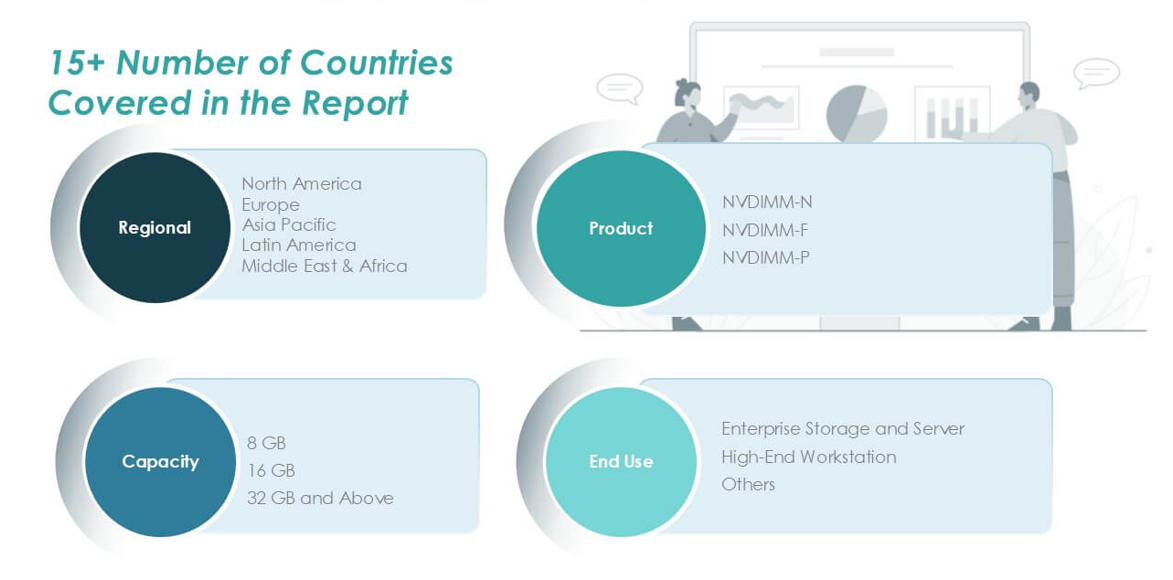
Market Segmentations:
By Product:
- NVDIMM-N
- NVDIMM-F
- NVDIMM-P
By Capacity:
- 8 GB
- 16 GB
- 32 GB and Above
By End Use:
- Enterprise Storage and Server
- High-End Workstation
- Others
By Geography:
- North America
- U.S.
- Canada
- Mexico
- Europe
- Germany
- France
- U.K.
- Italy
- Spain
- Rest of Europe
- Asia Pacific
- China
- Japan
- India
- South Korea
- South-east Asia
- Rest of Asia Pacific
- Latin America
- Brazil
- Argentina
- Rest of Latin America
- Middle East & Africa
- GCC Countries
- South Africa
- Rest of the Middle East and Africa
Competitive Landscape
The competitive landscape of the NVDIMM market is characterized by the presence of established memory solution providers and strategic innovators, all competing to capture a growing demand for high-performance, persistent memory modules. Key players such as Viking Technology Inc., AgigA Tech, Inc., Micron Technology Inc., Netlist, Inc., SMART Modular Technologies, Inc., Rambus Inc., SK Hynix, Inc., The Hewlett Packard Company, and Intel Corporation focus on continuous product innovation, capacity expansion, and technology partnerships to differentiate their offerings. These companies leverage robust research and development capabilities to introduce higher-capacity, lower-latency NVDIMM products tailored to enterprise, cloud, and hyperscale data center requirements. The market also witnesses collaborations between memory manufacturers and server OEMs to ensure compatibility and drive adoption. Competitive dynamics are further influenced by investments in advanced manufacturing processes and a strong emphasis on intellectual property, as players seek to maintain leadership and respond quickly to evolving end-user demands.
Key Player Analysis
- Viking Technology Inc.
- AgigA Tech, Inc.
- Micron Technology Inc.
- Netlist, Inc.
- SMART Modular Technologies, Inc.
- Rambus Inc.
- SK Hynix, Inc.
- The Hewlett Packard Company
- Intel Corporation
Recent Developments
- In May 2025, Rambus released a new set of client chipsets for next-generation AI PC memory modules, including PMICs for LPDDR5 CAMM2 (PMIC5200) and DDR5 CSODIMMs/CUDIMMs (PMIC5120). These chipsets are designed to support high-performance memory modules in AI-enabled notebooks, desktops, and workstations, and they expand Rambus's product line to cover all JEDEC standard DDR5 and LPDDR5 modules for both servers and clients.
- In March 2025, SMART Modular Technologies began sampling its Non-Volatile CXL Memory Module (NV-CMM) to major technology companies (Tier 1 OEMs). This new product combines high-performance DRAM, persistent flash memory, and an energy source within a single, removable EDSFF form factor. It's a significant advancement in memory technology, moving beyond NVDIMM-N and leveraging the CXL 2.0 standard to create persistent memory solutions.
- In October 2024, Rambus unveiled industry-first complete chipsets for next-generation DDR5 MRDIMMs and RDIMMs, featuring the Gen5 DDR5 Registering Clock Driver (RCD) for RDIMMs at 8,000 MT/s, and Multiplexed Registering Clock Driver (MRCD) and Multiplexed Data Buffer (MDB) for MRDIMMs at 12,800 MT/s. This innovation doubles bandwidth for data centers and AI workloads, incorporating advanced clocking, control, and power management for high-capacity modules.
- In April 2023, SK hynix and Rambus announced a ten-year extension of their patent license agreement, allowing for continued collaboration and access to Rambus's wide range of intellectual property, including potentially NVDIMM and other advanced memory technologies.
Market Concentration & Characteristics
The NVDIMM market demonstrates a moderate to high level of concentration, with a handful of major players accounting for the majority of global revenue. Leading companies such as Viking Technology Inc., Micron Technology Inc., SK Hynix, Intel Corporation, Netlist, Inc., and SMART Modular Technologies, Inc. command strong brand presence and benefit from extensive research and development resources. It features high entry barriers due to significant capital requirements, advanced technical expertise, and a need for robust partnerships with server OEMs and enterprise customers. Intellectual property portfolios and proprietary technologies further strengthen the competitive position of top players. The market shows a preference for NVDIMM-N products and large-capacity modules, which cater to the complex requirements of hyperscale data centers and mission-critical enterprise workloads. It remains sensitive to price and compatibility factors, with end users prioritizing reliability, performance, and seamless integration. Regional demand concentrates in North America, Europe, and Asia Pacific, reflecting advanced IT infrastructure and strong digital transformation initiatives.
Report Coverage
The research report offers an in-depth analysis based on Product, Capacity, End Use and Geography. It details leading market players, providing an overview of their business, product offerings, investments, revenue streams, and key applications. Additionally, the report includes insights into the competitive environment, SWOT analysis, current market trends, as well as the primary drivers and constraints. Furthermore, it discusses various factors that have driven market expansion in recent years. The report also explores market dynamics, regulatory scenarios, and technological advancements that are shaping the industry. It assesses the impact of external factors and global economic changes on market growth. Lastly, it provides strategic recommendations for new entrants and established companies to navigate the complexities of the market.
Future Outlook
- Widespread adoption of AI and machine learning will drive further demand for high-speed, persistent memory modules.
- Hyperscale data center expansion will lead to increased deployment of NVDIMM technology.
- Continued innovation in form factors and capacity will support diverse enterprise workload requirements.
- Greater integration of NVDIMM modules into next-generation server architectures will enhance system performance.
- Partnerships between memory module providers and OEMs will optimize compatibility and drive market penetration.
- Edge computing deployments will require NVDIMM for resilient and low-latency data access.
- Standardization efforts will reduce integration complexity and support broader adoption.
- Energy-efficient NVDIMM solutions will gain traction amid sustainability initiatives.
- Licensing of proprietary memory architectures will fuel competitive differentiation.
- Growing awareness of persistent memory benefits will spur new use cases in sectors like finance, healthcare, and telecom.
Request a Free Sample
Fill in your details and we'll send you a free sample report.
- Sample data tables & charts
- Research methodology
Need a Custom Version of This Report?
Tailor the scope, geography, or segments to your exact requirements.
- Custom geography or segment scope
- Direct access to our analyst team
Frequently Asked Questions
What is the current size of the NVDIMM Market?
What factors are driving the growth of the NVDIMM Market?
What are some challenges faced by the NVDIMM Market?
Who are the major players in the NVDIMM Market?
Table of Content
Chapter 1. Report Introduction
- 1.1 Report Description & Purpose
- 1.1.1 Report Title & Market Definition
- 1.1.2 Unique Selling Propositions (USP) & Key Differentiators
- 1.1.3 Value Proposition for Stakeholders
- 1.2 Research Objectives
- 1.2.1 Market Sizing Objectives (Volume & Revenue)
- 1.2.2 Segmentation Objectives
- 1.2.3 Competitive Intelligence Objectives
- 1.2.4 Forecast & Scenario Objectives
- 1.3 Report Scope
- 1.3.1 NVDIMM Scope – Types & Subtypes Covered
- 1.3.2 Geographic Scope – Regions & Countries Covered
- 1.3.3 Historical Period, Base Year & Forecast Period (2024; forecast to the forecast period)
- 1.3.4 Inclusions & Exclusions
- 1.4 HS Code & Classification Framework
- 1.5 Currency, Units & Pricing Basis
- 1.6 Target Stakeholders
- 1.7 Limitations & Assumptions
Chapter 2. Executive Summary
- 2.1 Global NVDIMM Market Snapshot
- 2.1.1 Market Size – Historical (2024) & Forecast (the forecast period) (2024: USD 3,940.5 million → forecast year: USD 21,581.5 million)
- 2.1.2 Volume & Revenue – Global Totals
- 2.1.3 Key Market Highlights – Top Five Facts
- 2.2 NVDIMM Market Segmentation Snapshot
- 2.2.1 Market Split by Region – 2024 vs.
- 2.3 Competitive Snapshot
- 2.3.1 Top 10 Players by Revenue Share – 2024
- 2.3.2 Top 10 Players by Volume Share – 2024
- 2.3.3 Recent Strategic Developments (18-Month Summary)
- 2.4 Key Investment Highlights & Strategic Conclusions
Chapter 3. NVDIMM Market Dynamics & Industry Analysis
- 3.1 Market Overview & Context
- 3.1.1 NVDIMM Market Position in the Broader Automotive Value Chain
- 3.1.2 OEM vs. Replacement Market Dynamics
- 3.1.3 Market Maturity & Development Stage by Region
- 3.2 NVDIMM Market Drivers
- 3.3 NVDIMM Market Restraints & Challenges
- 3.4 NVDIMM Market Opportunities
- 3.5 Porter's Five Forces Analysis
- 3.5.1 Threat of New Entrants
- 3.5.2 Bargaining Power of Suppliers
- 3.5.3 Bargaining Power of Buyers
- 3.5.4 Threat of Substitutes
- 3.5.5 Competitive Rivalry – Intensity Assessment
- 3.6 NVDIMM Value Chain Analysis
- 3.6.1 Upstream – Raw Material/Input Suppliers
- 3.6.1.1 Raw Material/Input 1
- 3.6.1.2 Raw Material/Input 2
- 3.6.1.3 Raw Material/Input 3
- 3.6.2 Midstream – Production/Manufacturing/Service Delivery
- 3.6.2.1 Production/Process Overview
- 3.6.2.2 Key Facility Locations & Capacity by Manufacturer
- 3.6.3 Downstream – Distribution & End Consumer
- 3.6.3.1 Primary Channel – B2B/OEM
- 3.6.3.2 Secondary Channels – Dealer, Retail, Online, Direct
- 3.6.4 Value Chain Profitability Analysis
- 3.6.1 Upstream – Raw Material/Input Suppliers
- 3.7 PESTEL Analysis
- 3.7.1 Political Factors
- 3.7.2 Economic Factors
- 3.7.3 Social Factors
- 3.7.4 Technological Factors
- 3.7.5 Environmental Factors
- 3.7.6 Legal Factors
- 3.8 NVDIMM Supply Chain Analysis
- 3.8.1 Raw Material/Input Supply Risk Assessment
- 3.8.2 Manufacturing Concentration Risk (Geographic Exposure)
- 3.8.3 Trade Disruption Impact Analysis
- 3.9 Regulatory & Policy Landscape
Note: The regulatory and policy landscape section covers regulations based on their applicability to the market, NVDIMM category, geography, and scope of the study. Only regulatory frameworks with a material impact on operations, compliance, trade, sustainability, or market access are analyzed in detail.
Chapter 4. Key Investment Pockets & Opportunity Analysis
- 4.1 NVDIMM Market Attractiveness Analysis
- 4.1.1 By Region – Investment Attractiveness Matrix (Volume × CAGR)
- 4.2 Absolute Revenue Growth Opportunity
- 4.2.1 By Region – Absolute USD Growth Through the forecast period
- 4.3 Incremental Volume Opportunity
- 4.3.1 By Region – Incremental Volume Through the forecast period
- 4.3.2 Segment – Incremental Volume
- 4.4 Emerging Submarket Opportunity Deep Dive (Subject to Applicability)
- 4.5 Emerging Market Opportunity Scorecards
- 4.5.1 United States
- 4.5.2 Europe
- 4.5.3 Asia
- 4.5.4 Middle East & Africa
Note: Emerging Market Opportunity Scorecards will be included based on relevance and strategic importance. Regions listed are indicative and may vary depending on data availability and market dynamics.
Chapter 5. NVDIMM Import-Export Analysis & Trade Flows
- 5.1 Global Trade Overview
- 5.1.1 Global Export Value by Country (2024)
- 5.1.2 Global Export Volume by Country (2024)
- 5.1.3 Global Import Value by Country (2024)
- 5.1.4 Global Import Volume by Country (2024)
- 5.1.5 Net Trade Balance by Country (2024)
- 5.2 Export Analysis – Segment
- 5.2.1 Type 1 (HS Code)
- 5.2.2 Type 2 (HS Code)
- 5.2.3 Type 3 (HS Code)
- 5.2.4 Type 4 (HS Code)
- 5.2.5 Type 5 (HS Code)
- 5.3 Import Analysis – Segment
- 5.3.1 Type 1 (HS Code)
- 5.3.2 Type 2 (HS Code)
- 5.3.3 Type 3 (HS Code)
- 5.3.4 Type 4 (HS Code)
- 5.3.5 Type 5 (HS Code)
- 5.4 Average Unit Trade Prices
- 5.4.1 Average Export Price – Segment & Country
- 5.4.2 Average Import Price – Segment & Source Country
- 5.4.3 Price Trends (2024)
- 5.5 Key Trade Route Analysis
- 5.5.1 Trade Route 1
- 5.5.2 Trade Route 2
- 5.5.3 Trade Route 3
- 5.5.4 Trade Route 4
- 5.5.5 Trade Route 5
- 5.6 Trade Policy Impact Assessment
- 5.6.1 US Anti-Dumping & Section 301 Tariffs
- 5.6.2 EU Customs Union Impact
- 5.6.3 Major Free Trade Agreements
- 5.6.4 USMCA Rules of Origin
Note: Trade policy analysis will be included only where relevant to the NVDIMM market.
Chapter 6. Competitive Landscape & Company Benchmarking
- 6.1 NVDIMM Market Concentration & Structure
- 6.1.1 Herfindahl-Hirschman Index (HHI) – vs. 2024
- 6.1.2 Tier 1, Tier 2 & Tier 3 Market Structure
- 6.1.3 Global, Regional & Local Player Dynamics
- 6.2 NVDIMM Market Share Analysis – 2024
- 6.2.1 Global Revenue Share by Company
- 6.2.2 Global Volume Share by Company
- 6.2.3 Regional Revenue Share
- 6.2.4 Market Share Evolution ( vs. 2024)
- 6.2.5 OEM Segment Share by Company
- 6.2.6 Replacement Segment Share by Company
- 6.3 Production/Delivery Capacity & Facility Analysis
- 6.3.1 Global Installed Capacity
- 6.3.2 Capacity Utilization Rates
- 6.3.3 Production/Output Volume
- 6.3.4 Facility Locations & Capacity Map
- 6.3.5 Planned Capacity Additions
- 6.4 NVDIMM Competitive Benchmarking Matrix
- 6.4.1 Revenue, Volume, CAGR & Profitability Comparison
- 6.4.2 Channel Revenue Mix
- 6.4.3 Geographic Revenue Exposure
- 6.4.4 R&D Intensity
- 6.4.5 Sustainability Maturity
- 6.5 Strategic Developments in NVDIMM (Last 24 Months)
- 6.5.1 Mergers, Acquisitions & Divestments
- 6.5.2 New NVDIMM Launches
- 6.5.3 Facility Expansions
- 6.5.4 Strategic Alliances, Joint Ventures & Partnerships
- 6.5.5 Distribution Expansion & Market Entry
- 6.5.6 Sustainability & ESG Initiatives
- 6.6 Competitive Strategy Mapping
- 6.6.1 Leader, Challenger, Follower & Niche Classification
- 6.6.2 Pricing Strategy Comparison
- 6.6.3 Channel Strategy Matrix
Note: Strategic developments are included based on their materiality and the availability of reliable information.
Chapter 7. Global NVDIMM Market – By Distribution Channel
- 7.1 Segment Overview
- 7.1.1 Volume & Revenue Split by Channel (2024 & )
- 7.1.2 Channel Mix Evolution (the forecast period)
Chapter 8. Regional Market Analysis – Global Overview
- 8.1 Global Regional Overview
- 8.1.1 Regional Volume Share
- 8.1.2 Regional Revenue Share
- 8.1.3 Regional Volume by Region
- 8.1.4 Regional Revenue by Region
- 8.1.5 Regional Forecast Through the forecast period
- 8.2 Cross-Regional Segment Analysis
- 8.2.1 By Distribution Channel
- 8.2.2 By Brand/Price Tier
Chapter 9. North America NVDIMM Market
- 9.1 United States
- 9.2 Canada
- 9.3 Mexico
Chapter 10. Europe NVDIMM Market
- 10.1 Germany
- 10.2 France
- 10.3 Italy
- 10.4 United Kingdom
- 10.5 Spain
- 10.6 Poland
- 10.7 Russia
- 10.8 Netherlands
- 10.9 Belgium
- 10.10 Sweden
- 10.11 Denmark
- 10.12 Norway
- 10.13 Rest of Europe
Chapter 11. Asia Pacific NVDIMM Market
- 11.1 China
- 11.2 India
- 11.3 Japan
- 11.4 South Korea
- 11.5 Thailand
- 11.6 Indonesia
- 11.7 Vietnam
- 11.8 Malaysia
- 11.9 Australia
- 11.10 Rest of Asia Pacific
Chapter 12. Latin America NVDIMM Market
- 12.1 Brazil
- 12.2 Argentina
- 12.3 Colombia
- 12.4 Chile
- 12.5 Rest of Latin America
Chapter 13. Middle East NVDIMM Market
- 13.1 Saudi Arabia
- 13.2 United Arab Emirates
- 13.3 Turkey
- 13.4 Israel
- 13.5 Iran
- 13.6 Rest of the Middle East
Chapter 14. Africa NVDIMM Market
- 14.1 South Africa
- 14.2 Egypt
- 14.3 Nigeria
- 14.4 Morocco
- 14.5 Rest of Africa
Chapter 15. NVDIMM Company Profiles
- 15.1 [Company 01]
- 15.1.1 Company Overview
- 15.1.2 Key Management Personnel
- 15.1.3 Products & Services Portfolio
- 15.1.4 Financial Performance
- 15.1.5 Key Market Focus & Geographic Presence
- 15.1.6 Recent Developments & Strategic Initiatives
Note: The company profile list is preliminary and may change based on research findings, market developments, data availability, and client requirements.
Chapter 16. Appendices
- Appendix A – List of Abbreviations & Acronyms
- Appendix B – Industry Classification Code Reference – Full Series
- Appendix C – Production & Capacity Data Tables
- Appendix D – End-Use & Demand Base Tables
- Appendix E – Consumption & Replacement Rate Assumptions
- Appendix F – ASP Reference Tables
- Appendix G – Manufacturing & Facility Database
- Appendix H – Import-Export Data Tables
- Appendix I – Regulatory Summary Tables
- Appendix J – Primary Research Participant List (Anonymized)
- Appendix K – Primary Research Questionnaire Framework
- Appendix L – Data Sources & Bibliography
- Appendix M – Market Size Divergence & Source Comparison
Chapter 17. Research Methodology
- 17.1 Research Framework & Philosophy
- 17.2 Secondary Research – Sources, Hierarchy & Data Extraction
- 17.3 Data Modeling – Bottom-Up & Top-Down Market Sizing
- 17.4 Primary Research – Stakeholder Framework, LOI & Sample Sizes
- 17.5 Forecast Methodology – Regression, Scenario & Sensitivity Analysis
- 17.6 Quality Control – Four-Layer Validation Framework
- 17.7 Limitations & Standard Assumptions
- 17.8 Disclaimer
