
| REPORT ATTRIBUTE | DETAILS |
|---|---|
| Historical Period | 2019-2022 |
| Base Year | 2023 |
| Forecast Period | 2024-2032 |
| Online Apparel Market Size 2023 | USD 545812.2 million |
| Online Apparel Market, CAGR | 6.00% |
| Online Apparel Market Size 2032 | USD 922138.2 million |
Market Insights
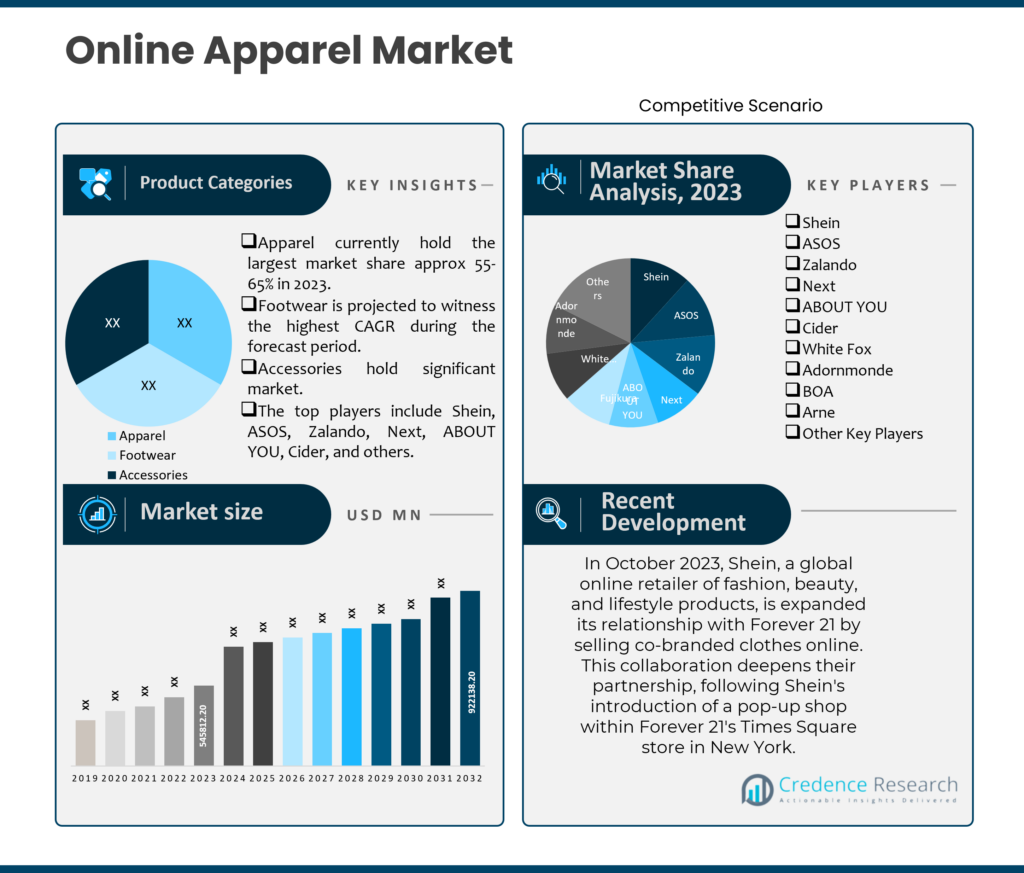
- The Online Apparel Market has demonstrated consistent expansion and is projected to maintain a robust CAGR of 6.00% from 2024 to 2032. Valued at USD 545812.2 million in 2023, this market is expected to reach USD 922138.2 million by 2032.
- Among the key segments, Apparel emerged as the market leader by product category, holding approximately 55-65% of the total market share in 2023. However, Footwear is projected to witness the highest growth rate during the forecast period.
- Women's Apparel and Accessories currently hold the largest market share approx 45-48% in 2023. However, Children's Apparel and Accessories are projected to witness the highest CAGR during the forecast period.
- Adult Apparel currently holds the largest market share approx 45-47% in 2023. However, Teen Apparel holds significant market share in 2023 and is projected to witness growth during the forecast period.
- Casual Wear currently holds the largest market share approx 35-38% in 2023. However, Activewear and Athleisure is projected to witness the highest CAGR during the forecast period.
- Fashion-forward Brands hold the largest market share approx 28-32% in 2023. However, Minimalist and Contemporary is projected to witness the highest CAGR during the forecast period.
- Affordable Fashion holds the largest market share approx 30-35% in 2023. However, Premium and Luxury Fashion is projected to witness the highest CAGR during the forecast period.
- Standard Sizes hold the largest market share approx 55-60% in 2023. However, Plus Sizes are projected to witness the highest CAGR during the forecast period.
- Asia Pacific accounts for the largest share of the market in 2023, followed by North America and Europe with a collective share of just under 55%.
- The rise in demand for online apparel, driven by technological advancements, changing consumer preferences, and convenience in shopping, fuels the growth of the Online Apparel Market.
- Key opportunities in the market include expansion into emerging markets, the use of advanced technologies such as augmented reality, implementation of sustainable practices, and strategic partnerships and collaborations, fostering market expansion.
Executive Summary
Market Definition
Online Apparel market refers to the online buying and selling of clothes, shoes and accessories. It is the fastest growing segment of the overall retail industry, driven by shifting consumer preferences towards convenience, speed and personalization. With online apparel retail growing faster than traditional brick and mortar stores, consumers are increasingly turning to e-commerce channels to meet their shopping needs. The online Apparel market offers a wide range of products including dresses, sportswear, lingerie and children’s clothing. These products are offered by established brands and newcomers, who use digital marketing strategies such as social media advertising, influencer sharing to reach customers. Moreover, many online clothing retailers offer free shipping, easy returns, and customized recommendations based on customer data to enhance the shopping experience. However, the online apparel market also faces challenges such as high return rates due to poor quality garments, the difficulty of replicating the quality of tactile apparel online, and sustainability concerns of regularity and morality.
Market Overview
The Online Apparel Market has demonstrated consistent expansion and is projected to maintain a robust CAGR of 6.00% from 2024 to 2032. Valued at USD 545812.2 million in 2023, this market is expected to reach USD 922138.2 million by 2032.
Among the key segments, Apparel emerged as the market leader by product category, holding approximately 55-65% of the total market share in 2023. However, Footwear is projected to witness the highest growth rate during the forecast period.
Women's Apparel and Accessories emerged as the market leader by gender-based segmentation, holding the largest market share approx 45-48% in 2023. However, Children's Apparel and Accessories are projected to witness the highest CAGR during the forecast period.
Adult Apparel by age-based segmentation hold the largest market share approx 45-47% in 2023. However, Teen Apparel holds significant market share in 2023 and is projected to witness growth during the forecast period.
Casual Wear by occasion-based segmentation holds the largest market share approx 35-38% in 2023. However, Activewear and Athleisure is projected to witness the highest CAGR during the forecast period.
Fashion-forward Brands by style-based segmentation hold the largest market share approx 28-32% in 2023. However, Minimalist and Contemporary is projected to witness the highest CAGR during the forecast period.
Affordable Fashion by price-based segmentation holds the largest market share approx 30-35% in 2023. However, Premium and Luxury Fashion is projected to witness the highest CAGR during the forecast period.
Standard Sizes by size-based segmentation hold the largest market share approx 55-60% in 2023. However, Plus Sizes are projected to witness the highest CAGR during the forecast period.
Asia Pacific accounts for the largest share of the market in 2023, followed by North America and Europe with a collective share of just under 55%.
The rise in demand for online apparel, driven by technological advancements, changing consumer preferences, and convenience in shopping, fuels the growth of the Online Apparel Market.
Key opportunities in the market include expansion into emerging markets, the use of advanced technologies such as augmented reality, implementation of sustainable practices, and strategic partnerships and collaborations, fostering market expansion.
Segmentation by Product Categories
- Apparel currently hold the largest market share approx 55-65% in 2023. Within the apparel segment, there are other sub-categories such as tops, bottoms, dresses, outerwear and activewear. Consumers are buying more clothes online than any other fashion brand, increasing the market share of this segment.
- Footwear is projected to witness the highest CAGR during the forecast period. With the rise of sporty trends and sneaker culture, this segment has experienced steady growth in recent years.
Segmentation by Gender-based Segmentation
- Women's Apparel and Accessories hold the largest market share approx 45-48% in 2023 owing to importance of style and aesthetics amoung women further drive the market.
- Children's Apparel and Accessories is projected to witness the highest CAGR during the forecast period. Parents appreciate what e-commerce offers when buying children’s clothes, as they can compare prices, browse a wide range of brands and shop from home.
Segmentation by Age-based Segmentation
- Adult Apparel hold the largest market share approx 45-47% in 2023. e A wide range of options caters to different lifestyles, catering to professional needs, leisure activities and beauty preferences.
- Teen Apparel hold significant market share in 2023. Social media influence plays an important role in the preferences of young consumers, prompting companies to collaborate with celebrity influencers to promote their products.
Segmentation by Occasion-based Segmentation
- Casual Wear hold the largest market share approx 35-38% in 2023. The convenience offered by e-commerce platforms and the increasing trend of working from home have contributed significantly to the growth of this segment.
- Activewear and Athleisure is projected to witness the highest CAGR during the forecast period. Activewear and athleisure has grown rapidly in recent years due to health and fitness due to increased awareness.
Segmentation by Style-based Segmentation
- Fashion-forward Brands hold the largest market share approx 28-32% in 2023. With constant innovation and customers constantly looking for new clothes, fashion-forward brands have a huge share in the online clothing market drive the segment share.
- Minimalist and Contemporary is projected to witness the highest CAGR during the forecast period. Clean lines, simple shapes and neutral palettes define minimalist contemporary fashion. Although it may seem less glamorous compared to other categories, it caters to individuals who are looking for the stylish yet understated essence of fashion.
Segmentation by Price-based Segmentation
- Affordable Fashion hold the largest market share approx 30-35% in 2023. Due to its accessibility and wide range of product offerings, affordable fashion dominates the online apparel market.
- Premium and Luxury Fashion is projected to witness the highest CAGR during the forecast period. Its value proposition is craftsmanship, brand heritage and exclusivity, appealing to discerning consumers willing to pay a premium for premium products.
Segmentation by Size-based Segmentation
- Standard Sizes hold the largest market share approx 55-60% in 2023.
- Plus Sizes is projected to witness the highest CAGR during the forecast period. E-commerce platforms offer easy access to a wide range of sizes compared to brick and mortar stores. Technology enables personalized shopping experiences, customized services, virtual fitting rooms and data-driven recommendations, enabling consumers to search for the right clothes regardless of body type.
Segmentation by Region
- Asia Pacific held significant share around 32-35% of the market in 2023. This dominance is primarily due to rapid economic growth, increased internet penetration, mobile phone penetration, and a younger and more tech-savvy population are drive the region share.
- North America and Europe collectively account for just under 55% share in 2023, with Europe holding over 20% share in the same year.
- The rest of the world, including Latin America, the Middle East, and Africa, supplies the remaining demand for Online Apparel.
High-end smartphones, easy payment systems and developed logistics infrastructure support the thriving digital fashion landscape are the major factors driving the market growth.
The Asia Pacific region holding the largest market share of Online Apparels market, for several reasons. The explosive economic growth experienced by many Asian countries is a solid foundation for a thriving online apparel market. China and India in particular are leading the way in rolling out most e-commerce transactions in the region, with positive macroeconomic indicators such as growth in gross domestic product (GDP) per capita and living standards improving standards and emphasis. However, the rise of the internet and smartphones is playing an important role in driving the online apparel industry forward. According to GSM Association, the number of unique mobile subscribers Asia Pacific is expected to grow from 1.73 billion in 2022 to 2.11 billion by 2023. Coupled with reliable mobile networks, consumers have greater access to e-commerce platforms, allowing them to browse, compare prices and shop for clothes effortlessly. Moreover, supportive legal environments and government policies stimulate entrepreneurial activity and foreign investment flows, stimulating the establishment of regionally active domestic and international fashion brands operating within the region contributed to the market growth.
The North America is hold prominent share in the Online Apparel Market followed by the US. and Canada are the two main sources of this trend. The region’s large population, high internet penetration and growing e-commerce industry have all contributed to its dominance in the online apparel market. Canada has also seen rapid growth in its online apparel market. The rise in popularity of influencers and bloggers has further boosted online clothing sales in Canada. The success of the online fashion market in North America can be attributed to many key players, such as Amazon, Zappos, ASOS, Forever 21, H&M, Uniqlo, etc. These companies offer competitive pricing , fast shipping, easy returns, user friendly website that make it easier for customers to find what they need quickly and efficiently contributed to the North America region.
Key Highlights of the Report
The Online Apparel Market is segmented by Product Category, Gender-based Segmentation, Age-based Segmentation, Occasion-based Segmentation, Style-based Segmentation, Price-based Segmentation, Size-based Segmentation, and Region. The increasing preference for online shopping, convenience, and a wide range of product offerings is driving the adoption of online apparel across various consumer segments. This surge in demand is largely due to the advantages offered by online apparel shopping, such as accessibility, variety, and personalized shopping experiences.
Apparel holds a dominant position in the market, catering to diverse fashion needs and preferences. Additionally, Footwear is experiencing rapid growth, especially with the rise of sporty trends and sneaker culture. Key user segments include women, men, children, and teenagers, reflecting a diverse adoption of online apparel across various demographics. The rapid growth in internet penetration, technological advancements, and changing consumer preferences indicate an increasing trend toward online apparel shopping for convenience and variety.
Asia Pacific drives the market growth, with major players like Shein, ASOS, and Zalando leading the market. This dominance is attributed to the region's rapid economic growth, increased internet penetration, and a young and tech-savvy population. Additionally, government initiatives, technological advancements, and a shift towards online shopping contribute to the region's leadership in the Online Apparel Market.
What Are The Main Drivers Of The Global Online Apparel Market?
Global Online Apparel Market is primarily driven by growing internet penetration, increasing cellphone adoption, convenience of on-line shopping, and the upward thrust of e-trade platforms. Additionally, changing purchaser possibilities closer to on-line shopping, availability of a wide type of products, aggressive pricing, and competitive advertising and marketing techniques drive the market.
What Are The Major Challenges Faced By The Global Online Apparel Market?
The global Online Apparel market faces challenges including intense competition among e-commerce platforms requires constant innovation and genuine customer experience to stand out, handling stock and deliver chain complexities to make certain well timed deliveries and avoid stockouts is crucial. Fighting counterfeits and ensuring brand authenticity online is an ongoing challenge, affecting consumer trust and brand reputation. Balancing these elements to meet changing consumer expectations is an ongoing challenge for online apparel retailers.
What Are The Growth Opportunities In The Global Online Apparel Market?
The global Online Apparel market presents growth opportunities. First, expansion into emerging markets creates untapped consumers eager for online shopping experiences. Second, the use of advanced technologies such as augmented reality to create authentic efforts can increase customer engagement and satisfaction. Third, implementing sustainable practices can attract environmentally conscious consumers, which can lead to brand loyalty. Fourth, diverse offerings with niche segments and unique collections may appeal to a broader consumer base. Furthermore, strategic partnerships and collaboration among Online Apparel suppliers, manufacturers and retailers can facilitate the market growth.
Market Drivers
Growing internet penetration
Growing internet penetration drive the demand of online apparel market. Access to information on brands, fashion, and prices is easier than ever, allowing shoppers to search through countless items in minutes, no longer having to be a shopper rely on brick-and-mortar stores or catalogs to find new products. Instead, they can simply search for specific products online, compare prices, and read reviews from other customers.However, the widespread use of the internet allows people to stay connected regardless of location, making it possible for international brands to expand into previously untapped markets. Similarly, tourists traveling abroad can buy souvenirs or gifts for friends and family back home without having to worry about limited space in their luggage. Alongwith, features such as one-time payments, stored credit card information, mobile payments, and seamless integration between devices (e.g., smartphones, tablets, laptops) will provide customers with a hassle-free transit experience will buy clothes online.
Market Restraints
Intense competition among e-commerce platforms
Intense competition among e-commerce platforms restraints the Online Apparel market. As platforms compete for market share, they tend to engage in aggressive pricing strategies, reducing profitability for apparel retailers. This competitive environment also drives up marketing and advertising costs, increasing the operating costs of businesses. Moreover, the constant battle for customer acquisition and retention forces platforms to invest heavily in technology and logistics, further complicating financial assets rather than providing them consumers are confused by an increasing number of options, making it harder for brands to stand out and build loyal customers. Ultimately, this fierce competition creates a tough environment comes for the success and growth of online apparel businesses in a sustainable manner.
Opportunities
Adoption of various strategies among market players
The major companies serving the global Online Apparel Market are Shein, ASOS, Zalando, Next, ABOUT YOU, Cider, White Fox, Adornmonde, BOA, Arne, among others. The market players are considerably contributing to the market growth by the adoption of various strategies including mergers & acquisitions, collaborations, funding, and new product launches, to stay competitive in the market. For instance, in February 2023, SHEIN, the global online retailer, recently launched its SHEIN for All Spring/Summer 2023 collection, offering a diverse range of style options for various occasions. This collection caters to individuals exploring tropical destinations, relaxing by the beach, or embarking on day tours, providing them with the confidence-boosting fashion choices they desire.
Competitive Landscape
Key Players
The global Online Apparel market is highly competitive, with several key players. Some of the major players in the market and their market share are as follows:
- Shein
- ASOS
- Zalando
- Next
- ABOUT YOU
- Cider
- White Fox
- Adornmonde
- BOA
- Arne
- Others
These organizations prioritize product innovation, distribution channel expansion, and mergers and acquisitions to stay competitive.
The global Online Apparel market's key players continually seek to stay ahead by offering new products and developments.
In October 2023, Shein, a global online retailer of fashion, beauty, and lifestyle products, is expanded its relationship with Forever 21 by selling co-branded clothes online. This collaboration deepens their partnership, following Shein's introduction of a pop-up shop within Forever 21's Times Square store in New York.
In August 2023, Zalando, a leading European e-commerce platform for fashion and lifestyle, has launched new brands and AI-powered size recommendations for customers in Q2, progressing on its strategy to be the Starting Point for Fashion. The company introduced a new artificial-intelligence tool that enables customers in Germany, Austria, and Switzerland to receive size recommendations for select garments based on their unique body measurements.
Summary of Key Findings
- The Online Apparel Market is experiencing significant growth propelled by the increasing preference for online shopping, convenience, and a wide range of product offerings across various consumer segments such as women, men, children, and teenagers. This growth is driven by the advantages offered by online apparel shopping, including accessibility, variety, and personalized shopping experiences.
- Market segmentation is based on product category, gender-based segmentation, age-based segmentation, occasion-based segmentation, style-based segmentation, price-based segmentation, size-based segmentation, and region, reflecting the diverse preferences and specialized needs within the online apparel industry.
- Apparel dominates the market, catering to diverse fashion needs and preferences. Additionally, Footwear is experiencing rapid growth, especially with the rise of sporty trends and sneaker culture.
- Casual Wear dominates the market, owing to its convenience and increasing trend of working from home. Additionally, Activewear and Athleisure is experiencing rapid growth, especially with increased awareness of health and fitness.
- Affordable Fashion dominates the market, appealing to a broad consumer base due to its accessibility and wide range of product offerings. Additionally, Premium and Luxury Fashion is projected to witness the highest CAGR during the forecast period.
- Key user segments include women, men, children, and teenagers, indicating widespread adoption across various demographics. The increasing trend toward online apparel shopping for convenience and variety drives growth in the online apparel sector.
Future Outlook
- The Online Apparel Market exhibits promising growth prospects, particularly in Asia Pacific, driven by rapid economic growth, increased internet penetration, and a young and tech-savvy population. Market players should capitalize on this growth potential by focusing on innovation and technological advancements.
- Anticipated challenges in the forecast period include addressing competition from traditional brick-and-mortar stores, maintaining brand authenticity, and addressing sustainability concerns.
- To stay competitive, industry players should prioritize digital innovation, technological advancements, and strategic partnerships to meet evolving consumer demands and maintain their position in the dynamic Online Apparel Market.
How CXOs Can Benefit from the Credence Research Online Apparel Market Report
The Credence Research Online Apparel Market Report provides CXOs with a comprehensive overview of the market, including:
- Market size and growth forecast:The report provides detailed estimates of the global Online Apparel market size, segmented by product category, gender-based segmentation, age-based segmentation, occasion-based segmentation, style-based segmentation, price-based segmentation, size-based segmentation, and region. It also includes forecasts for the market through 2032, based on key trends and drivers.
- Market segmentation:The report segments the Online Apparel market by product category, gender-based segmentation, age-based segmentation, occasion-based segmentation, style-based segmentation, price-based segmentation, size-based segmentation, and region. The increasing demand for advanced solutions is driven. This segmentation provides CXOs with a granular understanding of the market and the opportunities in each segment.
- Competitive landscape:The report profiles the key players in the Online Apparel market and provides insights into their strategies, product offerings, and financial performance. This information can help CXOs to identify and assess their competition.
- Key trends and drivers:The report identifies and analyzes the key trends and drivers that are shaping the Online Apparel market. This information can help CXOs to make informed decisions about their investments and strategies.
CXOs can use the insights from the Credence Research Online Apparel Market Report to:
- Identify growth opportunities:The report can help CXOs to identify new growth opportunities in the Online Apparel market. For example, the report identifies the growing demand for Online Apparel from cloud computing providers and telecom companies as a key opportunity.
- Make informed investment decisions:The report can help CXOs to make informed investment decisions about Online Apparel. For example, the report provides insights into the key factors to consider when evaluating Online Apparel providers and selecting Online Apparel solutions.
- Develop competitive strategies:The report can help CXOs to develop competitive strategies for their Online Apparel businesses. For example, the report identifies the key strategies that Online Apparel providers are using to differentiate themselves from their competitors.
- Track market developments:The report can help CXOs to track market developments and stay ahead of the curve. For example, the report provides insights into the latest trends and innovations in the Online Apparel market.
Overall, the Credence Research Online Apparel Market Report is a valuable resource for CXOs who are looking to gain a deeper understanding of the market and identify opportunities for growth.
Segmentation
-
Product Categories:
- Apparel
- Footwear
- Accessories
-
Gender-based Segmentation:
- Men's Apparel and Accessories
- Women's Apparel and Accessories
- Children's Apparel and Accessories
-
Age-based Segmentation:
- Adult Apparel
- Teen Apparel
- Kids' Apparel
-
Occasion-based Segmentation:
- Casual Wear
- Formal Wear
- Activewear and Athleisure
- Seasonal Wear
-
Style-based Segmentation:
- Fashion-forward Brands
- Classic and Timeless Styles
- Streetwear and Urban Fashion
- Bohemian and Boho-chic
- Minimalist and Contemporary
-
Price-based Segmentation:
- Affordable Fashion
- Mid-range Fashion
- Premium and Luxury Fashion
-
Size-based Segmentation:
- Standard Sizes
- Plus Sizes
- Petite Sizes
-
By Region
- North America
- US
- Canada
- Mexico
- Europe
- Germany
- France
- UK.
- Italy
- Spain
- Rest of Europe
- Asia Pacific
- China
- Japan
- India
- South Korea
- South-east Asia
- Rest of Asia Pacific
- Latin America
- Brazil
- Argentina
- Rest of Latin America
- Middle East & Africa
- GCC Countries
- South Africa
- Rest of Middle East and Africa
- North America
Adjacent Markets
In the Online Apparel market, there are several adjacent markets which has high revenue growth opportunities. The key adjacent markets for Online Apparel market -
Adjacent Markets |
||
| Online Footwear Market | Personal Care and Beauty Products | Sustainable and Eco-Friendly Fashion |
| Fashion Accessories Market | Smart Wearables and Tech-Integrated Apparel | Maternity and Kids' Apparel Market |
| Athleisure and Activewear Market | Customized and Personalized Apparel | Luxury and Designer Brands Online |

Request a Free Sample
Fill in your details and we'll send you a free sample report.
- Sample data tables & charts
- Research methodology
Market Dynamics
Growing Internet and Smartphone Penetration
The rapid increase in internet access and smartphone usage, especially in emerging markets, enables more consumers to shop online, expanding the customer base for online apparel retailers.
Convenience and Personalization
Online apparel platforms offer consumers the ability to shop anytime, access a wide variety of products, and receive personalized recommendations, making the shopping experience more attractive compared to traditional retail.
Technological Advancements
Innovations such as augmented reality fitting rooms, AI-driven size recommendations, and seamless payment systems enhance user experience and reduce barriers to online apparel purchases.
Changing Consumer Preferences
Shifts towards casual wear, athleisure, and fashion-forward styles, combined with the influence of social media and digital marketing, are driving consumers to explore and purchase apparel online.
Expansion into Emerging Markets
Rising disposable incomes, improved logistics, and supportive government policies in regions like Asia Pacific are opening new growth opportunities for online apparel retailers.
Need a Custom Version of This Report?
Tailor the scope, geography, or segments to your exact requirements.
- Custom geography or segment scope
- Direct access to our analyst team
Frequently Asked Questions
What is the current size of the global Online Apparel market?
What is the expected growth rate of the Online Apparel market between 2024 and 2032?
Which segment is leading the market share in terms of Product Categories?
Which Gender-based Segments governs the demand for Online Apparels in the world?
Which Occasion-based Specific Online Apparel segment is expected to post the highest CAGR during the forecast period?
Which region is fueling the growth of the Online Apparel industry?
Who are the major players in the global Online Apparel market?
What are the major market drivers of the Online Apparel industry?
What are the major market restraints of the Online Apparel industry?
What are the major market opportunities of the Online Apparel industry?
Table of Content
Chapter 1 Market Segmentation
- 1.1 Segmentation Framework
- 1.1.1 Product and Service Classification
- 1.1.2 Application and End-Use Classification
- 1.1.3 Technology and Solution Classification
- 1.1.4 Customer and Distribution Channel Classification
- 1.1.5 Geographic Segmentation
- 1.1.6 Market Segment Definitions and Boundaries
- 1.2 By Gender
- 1.2.1 Men's Apparel and Accessories
- 1.2.2 Women's Apparel and Accessories
- 1.2.3 Children's Apparel and Accessories
- 1.3 By Occasion
- 1.3.1 Casual Wear
- 1.3.2 Formal Wear
- 1.3.3 Activewear and Athleisure
- 1.3.4 Seasonal Wear
- 1.4 By Price Range
- 1.4.1 Affordable Fashion
- 1.4.2 Mid-range Fashion
- 1.4.3 Premium and Luxury Fashion
- 1.5 By Product Category
- 1.5.1 Apparel
- 1.5.2 Footwear
- 1.5.3 Accessories
Chapter 2 Introduction
- 2.1 Report Objectives and Scope
- 2.2 Product Definition and Industry Terminology
- 2.3 Market Inclusions and Exclusions
- 2.4 Research Process
- 2.4.1 Primary Research and Expert Interviews
- 2.4.2 Secondary Research and Source Review
- 2.4.3 Top-Down and Bottom-Up Estimation
- 2.4.4 Data Triangulation and Verification
- 2.5 Market Size Measurement Basis
- 2.5.1 2023: USD 545812.2 Million → 2032: USD 922,138.2 million
- 2.6 Historical and Forecast Reference Periods
- 2.6.1 Base Year: 2023
- 2.6.2 Forecast Period: 2023-2032
- 2.7 Research Assumptions and Limitations
Chapter 3 Executive Summary
- 3.1 Market Snapshot and Key Findings
- 3.2 Base-Year Market Size, 2023
- 3.3 Forecast Market Size, 2032
- 3.4 Revenue and Volume Growth Outlook
- 3.5 Key Demand and Supply Indicators
- 3.6 Leading Market Segments
- 3.7 Fastest-Growing Market Opportunities
- 3.8 Regional Performance Highlights
- 3.9 Technology and Industry Transformation
- 3.10 Competitive Landscape Summary
- 3.11 Analyst View and Strategic Implications
Chapter 4 Global Online Apparel Market Trends and Developments
- 4.1 Historical Industry Development
- 4.2 Recent Market Trends and Developments
- 4.3 Demand and Customer Behavior Trends
- 4.4 Technology and Product Innovation
- 4.5 Artificial Intelligence, Automation and Digitalization
- 4.6 Local Manufacturing and Supply Chain Realignment
- 4.7 Industry Partnerships, Mergers and Acquisitions
- 4.8 Sustainability and Circular Economy Developments
- 4.9 Government and Private Sector Investment Trends
- 4.10 Emerging Business Models and Commercialization
- 4.11 Industry Developments and Announcements
Chapter 5 Global Online Apparel Market Production, Supply and Demand Analysis
- 5.1 Demand Trend and Consumption Analysis
- 5.2 Demand Forecast, 2023-2032
- 5.3 Production and Output Trend
- 5.4 Production and Output Forecast, 2023-2032
- 5.5 Installed Capacity and Capacity Utilization
- 5.6 Company-Wise Production Plants and Statistics
- 5.6.1 Installed Production Capacity
- 5.6.2 Actual Production
- 5.6.3 Planned Capacity and Expansion Targets
- 5.7 Supply Chain Structure and Procurement Trends
- 5.8 Supply-Demand Gap and Bottlenecks
- 5.9 Import Dependence and Sourcing Structure
- 5.10 Contract Manufacturing and Outsourcing
- 5.11 Regional Supply and Demand Concentration
Chapter 6 Global Online Apparel Market Pricing Analysis
- 6.1 Pricing Structure and Measurement
- 6.2 Historical Pricing Trends
- 6.3 Pricing Outlook, 2023-2032
- 6.4 Average Selling Price and Unit Economics
- 6.5 Pricing by Product and Market Segment
- 6.6 Geographic Pricing Differences
- 6.7 Key Input, Energy, Labor and Logistics Costs
- 6.8 Contract Pricing and Purchasing Models
- 6.9 Pricing Sensitivity and Competitive Positioning
- 6.10 Price, Margin and Profitability Implications
Chapter 7 Global Online Apparel Market Dynamics
- 7.1 Market Growth Drivers
- 7.1.1 Demand-Side Drivers
- 7.1.2 Technology and Innovation Drivers
- 7.1.3 Infrastructure and Investment Drivers
- 7.1.4 Regulatory and Policy Drivers
- 7.2 Market Restraints
- 7.2.1 Cost and Affordability Constraints
- 7.2.2 Technology and Adoption Barriers
- 7.2.3 Supply Chain and Operational Constraints
- 7.3 Market Challenges
- 7.3.1 Competitive Pressure and Margin Erosion
- 7.3.2 Skills, Infrastructure and Implementation Gaps
- 7.4 Emerging Market Opportunities
- 7.5 Market Dynamics Impact and Time-Horizon Assessment
Chapter 8 Global Online Apparel Value Chain Analysis
- 8.1 Industry Value Chain Overview
- 8.2 Upstream Suppliers and Critical Inputs
- 8.3 Technology and Component Providers
- 8.4 Manufacturing or Service Delivery
- 8.5 Distribution, Channel Partners and Integrators
- 8.6 Downstream Applications and End Users
- 8.7 Value Addition and Profit Pools
- 8.8 Vertical Integration and Outsourcing
- 8.9 Supplier Concentration and Risk
- 8.10 Supply Chain Localization and Resilience
Chapter 9 Global Online Apparel Market Regulations and Policies
- 9.1 Relevant Laws, Standards and Compliance Frameworks
- 9.2 Product, Service, Safety and Quality Requirements
- 9.3 Government Policies, Incentives and Subsidies
- 9.4 Imports, Exports and Trade Barriers
- 9.5 Public Procurement and Local Content Requirements
- 9.6 Environmental and Sustainability Compliance
- 9.7 Upcoming Policy Changes and Market Implications
Chapter 10 Global Online Apparel Market Hotspots and Opportunities
- 10.1 Market Opportunity Mapping and Growth Hotspots
- 10.2 High-Growth Applications and Customer Groups
- 10.3 Underserved Markets and White-Space Opportunities
- 10.4 Emerging Technology and Product Opportunities
- 10.5 New Capacity and Investment Hotspots
- 10.6 Market Entry and Expansion Opportunities
- 10.7 Distribution and Partnership Opportunities
- 10.8 Near-Term and Long-Term Commercial Potential
- 10.9 Opportunity Attractiveness and Execution Risks
Chapter 11 Global Online Apparel Market Outlook, 2023-2032
- 11.1 Market Size and Analysis
- 11.1.1 Revenue (Market Measurement: 2023: USD 545812.2 Million → 2032: USD 922,138.2 million)
- 11.1.2 Market Volume and Quantity Sold
- 11.1.3 Historical Market Size
- 11.1.4 Base-Year Market Size, 2023
- 11.2 Market Forecast, 2023-2032
- 11.2.1 Revenue Forecast to 2032
- 11.2.2 Volume Forecast to 2032
- 11.2.3 CAGR and Year-on-Year Growth
- 11.2.4 Incremental Revenue Opportunity
- 11.3 Forecast Assumptions and Scenario Analysis
- 11.3.1 Base-Case Forecast
- 11.3.2 Optimistic and Conservative Scenarios
- 11.3.3 Technology, Pricing and Policy Sensitivities
- 11.4 Market Attractiveness and Growth Outlook
Chapter 12 Global Online Apparel Market Segmentation and Outlook
- 12.1 Segmentation Summary and Market Shares, 2023
- 12.2 Largest and Fastest-Growing Segments
- 12.3 By Gender - Market Size and Forecast, 2023-2032
- 12.3.1 Segment Definition and Scope
- 12.3.2 Historical Market Size
- 12.3.3 Revenue Forecast, 2023-2032
- 12.3.4 Volume Forecast, 2023-2032
- 12.3.5 Base-Year Market Share, 2023
- 12.3.6 Segment CAGR and Growth Drivers
- 12.3.7 Subsegment Market Size and Forecast
- 12.3.7.1 Men's Apparel and Accessories
- 12.3.7.2 Women's Apparel and Accessories
- 12.3.7.3 Children's Apparel and Accessories
- 12.3.8 Subsegment Pricing and Adoption Trends
- 12.3.9 Leading Suppliers and Competition
- 12.3.10 Regional Demand and Opportunities
- 12.4 By Occasion - Market Size and Forecast, 2023-2032
- 12.4.1 Segment Definition and Scope
- 12.4.2 Historical Market Size
- 12.4.3 Revenue Forecast, 2023-2032
- 12.4.4 Volume Forecast, 2023-2032
- 12.4.5 Base-Year Market Share, 2023
- 12.4.6 Segment CAGR and Growth Drivers
- 12.4.7 Subsegment Market Size and Forecast
- 12.4.7.1 Casual Wear
- 12.4.7.2 Formal Wear
- 12.4.7.3 Activewear and Athleisure
- 12.4.7.4 Seasonal Wear
- 12.4.8 Subsegment Pricing and Adoption Trends
- 12.4.9 Leading Suppliers and Competition
- 12.4.10 Regional Demand and Opportunities
- 12.5 By Price Range - Market Size and Forecast, 2023-2032
- 12.5.1 Segment Definition and Scope
- 12.5.2 Historical Market Size
- 12.5.3 Revenue Forecast, 2023-2032
- 12.5.4 Volume Forecast, 2023-2032
- 12.5.5 Base-Year Market Share, 2023
- 12.5.6 Segment CAGR and Growth Drivers
- 12.5.7 Subsegment Market Size and Forecast
- 12.5.7.1 Affordable Fashion
- 12.5.7.2 Mid-range Fashion
- 12.5.7.3 Premium and Luxury Fashion
- 12.5.8 Subsegment Pricing and Adoption Trends
- 12.5.9 Leading Suppliers and Competition
- 12.5.10 Regional Demand and Opportunities
- 12.6 By Product Category - Market Size and Forecast, 2023-2032
- 12.6.1 Segment Definition and Scope
- 12.6.2 Historical Market Size
- 12.6.3 Revenue Forecast, 2023-2032
- 12.6.4 Volume Forecast, 2023-2032
- 12.6.5 Base-Year Market Share, 2023
- 12.6.6 Segment CAGR and Growth Drivers
- 12.6.7 Subsegment Market Size and Forecast
- 12.6.7.1 Apparel
- 12.6.7.2 Footwear
- 12.6.7.3 Accessories
- 12.6.8 Subsegment Pricing and Adoption Trends
- 12.6.9 Leading Suppliers and Competition
- 12.6.10 Regional Demand and Opportunities
- 12.7 Segment Growth Comparison
- 12.8 Segment Attractiveness and Priority Matrix
Chapter 13 Global Online Apparel Geographic Market Outlook, 2023-2032
- 13.1 Regional Market Size and Share, 2023
- 13.2 Regional Market Forecast, 2023-2032
- 13.3 Regional Pricing, Production and Demand Differences
- 13.4 North America
- 13.4.1 United States
- 13.4.2 Canada
- 13.4.3 Mexico
- 13.5 Europe
- 13.5.1 Germany
- 13.5.2 France
- 13.5.3 Italy
- 13.5.4 United Kingdom
- 13.5.5 Spain
- 13.5.6 Poland
- 13.5.7 Russia
- 13.5.8 Netherlands
- 13.5.9 Belgium
- 13.5.10 Sweden
- 13.5.11 Denmark
- 13.5.12 Norway
- 13.5.13 Rest of Europe
- 13.6 Asia Pacific
- 13.6.1 China
- 13.6.2 India
- 13.6.3 Japan
- 13.6.4 South Korea
- 13.6.5 Thailand
- 13.6.6 Indonesia
- 13.6.7 Vietnam
- 13.6.8 Malaysia
- 13.6.9 Australia
- 13.6.10 Rest of Asia Pacific
- 13.7 Latin America
- 13.7.1 Brazil
- 13.7.2 Argentina
- 13.7.3 Colombia
- 13.7.4 Chile
- 13.7.5 Rest of Latin America
- 13.8 Middle East
- 13.8.1 Saudi Arabia
- 13.8.2 United Arab Emirates
- 13.8.3 Turkey
- 13.8.4 Israel
- 13.8.5 Iran
- 13.8.6 Rest of the Middle East
- 13.9 Africa
- 13.9.1 South Africa
- 13.9.2 Egypt
- 13.9.3 Nigeria
- 13.9.4 Morocco
- 13.9.5 Rest of Africa
- 13.10 Regional Investment, Policy and Supply Chain Differences
- 13.11 Regional Competitive Landscape
- 13.12 Geographic Growth Hotspots
Chapter 14 Global Online Apparel Technology, Innovation and Sustainability Outlook
- 14.1 Technology Landscape and Maturity
- 14.2 Product, Process and Service Innovation
- 14.3 AI, Automation and Digital Tools in the Industry
- 14.4 Technology Adoption and Performance Benchmarking
- 14.5 Innovation Pipeline and R&D Investment
- 14.6 Patent and Intellectual Property Trends
- 14.7 Energy Efficiency and Resource Management
- 14.8 Sustainability, Recycling and Circularity
- 14.9 Technology Roadmap, 2023-2032
- 14.10 Risks of Obsolescence and Technology Substitution
Chapter 15 Global Online Apparel Market Key Strategic Imperatives
- 15.1 Growth and Market Entry Priorities
- 15.2 High-Return Products and Segments
- 15.3 Pricing, Profitability and Cost Optimization
- 15.4 Technology Investment and Product Differentiation
- 15.5 Supply Chain Localization and Resilience
- 15.6 Distribution and Customer Acquisition
- 15.7 Partnership, Acquisition and Capacity Strategy
- 15.8 Regional Expansion Priorities
- 15.9 Short-, Medium- and Long-Term Actions
Chapter 16 Competition Outlook
- 16.1 Industry Competition Characteristics
- 16.2 Market Structure and Concentration
- 16.3 Market Share and Competitive Positioning, 2023
- 16.4 Company-Wise Revenue and Product Benchmarking
- 16.5 Production and Service Capacity Benchmarking
- 16.6 Technology, Pricing and Differentiation
- 16.7 Regional Footprint and Distribution Strength
- 16.8 Mergers, Acquisitions and Strategic Alliances
- 16.9 New Entrants and Competitive Threats
- 16.10 Porter's Five Forces and Industry Attractiveness
- 16.11 Competitive Outlook, 2023-2032
Chapter 17 Company Profiles
- 17.1 Company Coverage and Selection Criteria
- 17.2 Shein
- 17.2.1 Business Description
- 17.2.2 Company Ownership and Geographic Presence
- 17.2.3 Product and Service Portfolio
- 17.2.4 Manufacturing and Operating Footprint
- 17.2.5 Production Capacity and Expansion Plans
- 17.2.6 Financial Performance and Investment
- 17.2.7 Market Share and Competitive Position
- 17.2.8 Technology and Innovation Capabilities
- 17.2.9 Strategic Alliances or Partnerships
- 17.2.10 Recent Developments
- 17.2.11 Growth Strategy and Outlook
- 17.3 ASOS
- 17.4 Zalando
- 17.5 Next
- 17.6 ABOUT YOU
- 17.7 Cider
- 17.8 H&M
- 17.9 Uniqlo
- 17.10 Forever 21
- 17.11 Boohoo
- 17.12 Other Relevant Market Participants
Note: Every listed company is profiled on the structure shown under the first company. The company list is preliminary and may change based on research findings, market developments, data availability and client requirements.
Chapter 18 Disclaimer
- 18.1 Research and Forecast Disclaimer
- 18.2 Data Source and Estimation Limitations
Note: The depth of individual sections depends on data availability for this market. Volume, capacity, trade and other unit-based metrics are included where applicable.

