
| REPORT ATTRIBUTE | DETAILS |
|---|---|
| Historical Period | 2020-2023 |
| Base Year | 2024 |
| Forecast Period | 2025-2032 |
| Passenger Service System (PSS) Market Size 2024 | USD 11,127.4 million |
| Passenger Service System (PSS) Market, CAGR | 16.80% |
| Passenger Service System (PSS) Market Size 2032 | USD 38,449.0 million |
Market Overview:
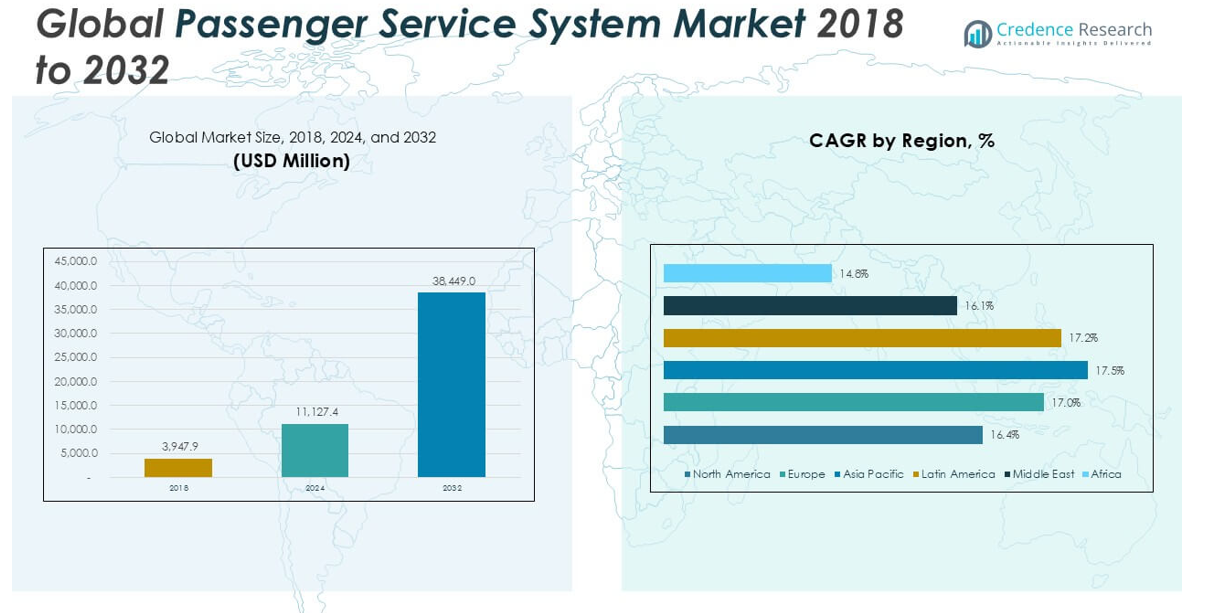
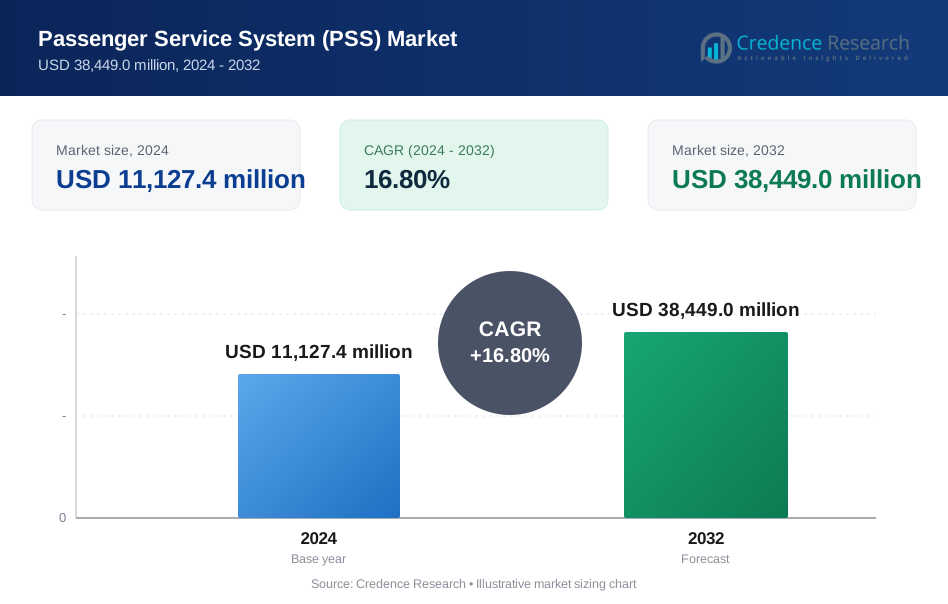
The Passenger Service System market was valued at USD 3,947.9 million in 2018, reached USD 11,127.4 million in 2024, and is anticipated to reach USD 38,449.0 million by 2032, at a CAGR of 16.80% during the forecast period.
Top players in the Passenger Service System market include SITA NV, Amadeus IT Group SA, Sabre Corporation, and Radixx International, all of which command significant influence through broad software portfolios and innovative digital solutions. These companies are recognized for delivering scalable, cloud-based platforms that cater to both global airlines and regional operators. North America stands as the leading region, capturing 32% of the global market share in 2024, driven by early technology adoption and substantial investments in digital infrastructure. Europe and Asia Pacific follow, supported by ongoing modernization of transportation networks and rising passenger volumes.
Market Insights
- The Passenger Service System market was valued at USD 11,127.4 million in 2024 and is projected to reach USD 38,449.0 million by 2032, reflecting a CAGR of 16.80%.
- Market growth is driven by rapid digital transformation, increased demand for seamless travel experiences, and widespread adoption of integrated cloud-based solutions.
- Key trends include the integration of AI and automation in passenger management, the expansion of omnichannel engagement, and a shift toward personalized customer services across airlines and railways.
- The competitive landscape is led by top players such as SITA NV, Amadeus IT Group SA, and Sabre Corporation, who focus on innovation, strategic partnerships, and expanding their software portfolios, while emerging providers target niche regional markets.
- North America holds the largest regional share at 32% in 2024, with software as the dominant segment, followed by Europe at 22% and Asia Pacific at 27%, while high initial investment and legacy integration act as market restraints.
Market Segmentation Analysis:
By Type:
The software segment commands the largest market share in the Passenger Service System market, accounting for more than 60% of total revenue in 2024. This dominance stems from the increasing adoption of integrated digital platforms by airlines, railways, and water transport operators to streamline passenger management and optimize operations. The demand for advanced booking, inventory management, and customer care modules within software solutions remains strong as travel providers prioritize automation and seamless passenger experiences. The surge in online ticket reservations and real-time itinerary modifications drives demand for robust booking platforms. The proliferation of multi-channel service delivery and integration with digital payment systems further strengthens the services segment’s growth trajectory.
- For instance, Sabre Corporation reported that its SabreSonic Passenger Service System handled more than 700 million bookings across multiple channels in 2023, highlighting its technological scale and effectiveness.
By Deployment:
Cloud deployment leads the Passenger Service System market, capturing over 70% of the total market share in 2024. Cloud-based platforms offer scalable infrastructure, lower upfront investment, and enhanced accessibility for global operators. The rapid shift to digitalization, coupled with the need for real-time data sharing and disaster recovery capabilities, propels cloud deployment’s expansion. On-premise solutions still attract some legacy operators but face declining preference due to higher maintenance costs and limited flexibility.
- For instance, SITA NV’s SITA Flex cloud-based platform is deployed at more than 460 airports, enabling real-time integration for over 4,000 airlines and ground handlers
By Application:
The aviation segment remains the dominant application, accounting for nearly 65% of the Passenger Service System market share in 2024. Airlines increasingly rely on advanced passenger service systems to manage high passenger volumes, enable seamless check-in processes, and facilitate personalized communication. The growing need for digital boarding passes, mobile integration, and real-time updates reinforces aviation’s leadership. While railway and water transport segments are expanding, their adoption rates remain modest compared to aviation’s mature infrastructure and investment levels.
Market Overview
Digital Transformation Across the Travel Industry
Rapid digital transformation in the global travel and transportation sector acts as a major growth driver for the Passenger Service System market. Operators increasingly adopt integrated software solutions to modernize reservation, check-in, and boarding processes. Enhanced focus on automation, real-time communication, and seamless digital interfaces improves operational efficiency and customer satisfaction. The shift towards mobile applications and contactless technologies further accelerates adoption, making digitalization a foundational element in reshaping passenger management worldwide.
- For instance, Unisys Corporation’s AirCore platform manages passenger processes for more than 150 million passengers per year, demonstrating the scale and impact of digital transformation.
Rising Demand for Personalized Customer Experiences
The growing expectation for personalized services is fueling investment in advanced passenger service systems. Travel operators leverage data analytics and artificial intelligence to tailor communications, offers, and loyalty programs, enhancing traveler engagement and retention. Modern passenger service platforms enable operators to deliver targeted notifications, flexible rebooking, and individualized support, setting new standards in customer experience. This trend drives market expansion as service differentiation becomes central to competitive strategy.
- For instance, Hitit Computer Services’ Crane solution delivers over 10 million personalized travel notifications each month to users worldwide.
Expansion of Cloud-Based Solutions
The increasing preference for cloud-based passenger service platforms represents a critical growth driver. Cloud deployment allows operators to scale services cost-effectively, support remote operations, and ensure high system availability. With enhanced cybersecurity and data recovery features, cloud solutions reduce IT complexity and improve business continuity. The migration to cloud architectures is particularly pronounced among airlines and transport operators seeking agility, speed, and global accessibility.
Key Trends & Opportunities
Integration of AI and Automation Technologies
A significant trend in the Passenger Service System market is the integration of artificial intelligence and automation. Operators deploy AI-powered chatbots, automated check-in systems, and predictive analytics to streamline passenger interactions and operational workflows. These technologies enhance self-service options and reduce human error, presenting new opportunities for service innovation and operational excellence.
- For instance, Radixx International’s AI-driven passenger service system automates more than 500,000 self-service check-ins per week for low-cost carriers.
Growth in Omnichannel Passenger Engagement
Omnichannel engagement strategies are transforming how operators interact with passengers, opening new market opportunities. The convergence of web, mobile, and in-terminal touchpoints allows seamless booking, support, and notification services. This trend drives adoption of flexible, scalable platforms that facilitate consistent experiences across channels, strengthening customer loyalty and enabling revenue diversification.
- For instance, Bravo Passenger Solutions’ platform supports over 2 million transactions monthly across mobile, web, and airport kiosks, providing a consistent experience for end-users.
Key Challenges
Complex Legacy System Integration
Integrating modern passenger service systems with existing legacy infrastructure poses a significant challenge for many operators. Compatibility issues, high migration costs, and potential service disruptions hinder rapid deployment. Operators must carefully balance innovation with operational continuity, often requiring substantial investment in system upgrades and staff training.
Data Privacy and Cybersecurity Concerns
The rise in digital passenger data collection intensifies privacy and cybersecurity concerns. Operators face increasing regulatory requirements to protect sensitive information and mitigate risks of data breaches. Ensuring robust security protocols and compliance with global data protection standards remains a critical challenge, impacting both system design and vendor selection.
High Initial Investment and Customization Costs
The cost of implementing comprehensive passenger service systems, particularly for smaller operators, presents a barrier to adoption. High upfront investment, ongoing customization, and integration expenses may deter resource-constrained organizations. Achieving a balance between budget constraints and the need for advanced features remains a key challenge for industry participants.
Regional Analysis
North America
North America leads the Passenger Service System market, holding a 32% market share in 2024 with a market value of USD 3,555.67 million, up from USD 1,289.79 million in 2018. The region is projected to reach USD 11,919.18 million by 2032, supported by a CAGR of 16.4%. Widespread adoption of advanced digital platforms by major airlines and robust investment in cloud solutions drive growth. The presence of leading technology providers and a focus on enhancing customer experience position North America as the foremost market for passenger service systems globally.
Europe
Europe accounts for a 22% market share in 2024, with the market growing from USD 864.99 million in 2018 to USD 2,463.76 million in 2024, and anticipated to reach USD 8,631.79 million by 2032 at a CAGR of 17.0%. Regulatory mandates for efficient passenger management and the rapid digital transformation of rail and aviation networks contribute to strong regional expansion. European carriers emphasize innovation, sustainability, and compliance, fostering the adoption of integrated passenger service platforms across both legacy and low-cost operators.
Asia Pacific
Asia Pacific holds a 27% market share in 2024, registering strong growth from USD 1,044.22 million in 2018 to USD 3,049.05 million in 2024, with projections to reach USD 11,023.32 million by 2032. The region boasts the highest CAGR at 17.5%, driven by increasing passenger traffic, significant infrastructure investments, and the emergence of new airline and rail operators. Rapid urbanization, rising disposable income, and digitalization initiatives underpin adoption, positioning Asia Pacific as a pivotal growth market for passenger service systems.
Latin America
Latin America comprises a 7% market share in 2024, with the market expanding from USD 320.57 million in 2018 to USD 921.66 million in 2024, expected to achieve USD 3,268.16 million by 2032, reflecting a CAGR of 17.2%. The region benefits from modernization efforts in national airlines and railways, coupled with a growing focus on passenger convenience. Increasing investments in cloud-based platforms and digital infrastructure further support adoption, although market growth remains moderate compared to more developed regions.
Middle East
The Middle East represents a 6% market share in 2024, with market size rising from USD 243.59 million in 2018 to USD 662.71 million in 2024 and projected to reach USD 2,180.06 million by 2032 at a CAGR of 16.1%. The region’s aviation hubs drive passenger service system uptake as operators prioritize seamless travel experiences and operational efficiency. Strategic investments in digital transformation, coupled with expanding international travel, position the Middle East as an emerging market for advanced passenger management solutions.
Africa
Africa accounts for a 4% market share in 2024, with market value increasing from USD 184.76 million in 2018 to USD 474.50 million in 2024 and forecasted to reach USD 1,426.46 million by 2032, supported by a CAGR of 14.8%. The region’s growth is fueled by gradual modernization of transport networks and increasing adoption of cloud-based systems. While adoption rates lag behind other regions, improving digital infrastructure and investments in passenger experience solutions are expected to drive steady, long-term growth in Africa’s passenger service system market.
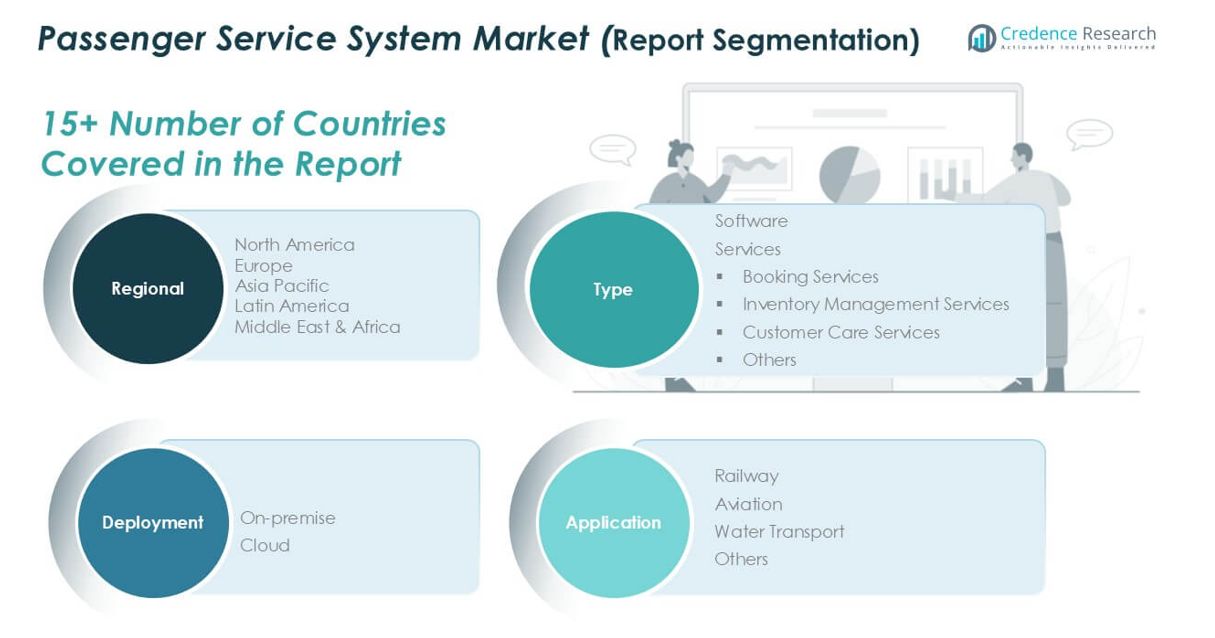
Market Segmentations:
By Type:
- Software
- Services
- Booking Services
- Inventory Management Services
- Customer Care Services
- Others
By Deployment:
- On-premise
- Cloud
By Application:
- Railway
- Aviation
- Water Transport
- Others
By Geography:
- North America
- U.S.
- Canada
- Mexico
- Europe
- Germany
- France
- U.K.
- Italy
- Spain
- Rest of Europe
- Asia Pacific
- China
- Japan
- India
- South Korea
- South-east Asia
- Rest of Asia Pacific
- Latin America
- Brazil
- Argentina
- Rest of Latin America
- Middle East & Africa
- GCC Countries
- South Africa
- Rest of the Middle East and Africa
Competitive Landscape
The competitive landscape of the Passenger Service System market is characterized by the presence of several established global players alongside emerging solution providers, fostering a dynamic and rapidly evolving industry environment. Market leaders such as SITA NV, Amadeus IT Group SA, and Sabre Corporation maintain significant shares through their comprehensive software portfolios, robust cloud deployment capabilities, and extensive customer bases among major airlines and transport operators. These companies continually invest in research and development to enhance their offerings, integrate AI-driven functionalities, and support seamless multi-channel passenger engagement. Emerging firms like Radixx International, Bravo Passenger Solutions, and Hitit Computer Services are gaining traction by focusing on niche markets, providing flexible, cost-effective solutions tailored for regional and low-cost carriers. Strategic alliances, product innovation, and expansion into untapped geographies remain core growth strategies. The market’s competitive intensity is expected to heighten as digital transformation accelerates, compelling both established and new entrants to differentiate through innovation and superior service delivery.
Key Player Analysis
- SITA NV
- Amadeus IT Group SA
- Sabre Corporation
- Radixx International
- Takeflite
- Bravo Passenger Solutions Pte Limited
- Hitit Computer Services A.S
- Unisys Corp.
- Enoya-one Ltd.
- Intelisys Aviation Systems Inc.
- Mercator Ltd.
Recent Developments
- In June 2025, Vietravel Airlines signed a five-year renewal of its Passenger Service System agreement with Sabre, continuing to use Sabre's Radixx platform. This includes Radixx Res (core passenger services), Radixx EzyCommerce (digital experience), Radixx Go (airport operations), and Radixx Insight (analytics). Vietravel Airlines also recently integrated Sabre's Payment Gateway into its Radixx PSS solution.
- In May 2025, Signature Aviation expanded its "BRAVO by Signature" program, which had been launched in August 2024, to include benefits across its entire global network of bases. This program is designed to enhance the experience for small and medium-sized operators. While not a direct Passenger Service System (PSS) development, the program's focus on improving services for this operator group could involve underlying passenger solutions.
- In April 2025, Amadeus finalized the acquisitions of Vision-Box and Voxel, strengthening its position in the travel industry. The Vision-Box acquisition enhances their biometric solutions for airports and airlines, while Voxel, a travel payments expert, expands their financial offerings within the travel ecosystem. Additionally, Amadeus continued to secure agreements for their new airline IT platform, Amadeus Nevio, with several major airlines.
- In November 2024, SITA partnered with SOF Connect to modernize Sofia Airport. This collaboration will see SITA implement its technology over 18 months, enhancing airport efficiency and passenger experience. The project includes installing a high-availability Flight Information Display System (FIDS) and integrating it with over 20 existing airport systems.
Market Concentration & Characteristics
The Passenger Service System Market exhibits a moderate to high level of market concentration, with a few dominant global players accounting for a significant portion of total revenue. Companies such as SITA NV, Amadeus IT Group SA, and Sabre Corporation set industry standards by offering comprehensive and scalable solutions to major airlines and transport operators. It benefits from high barriers to entry due to the complex integration requirements, regulatory compliance needs, and the scale of investment necessary for platform development and support. The market’s characteristics include strong reliance on cloud-based deployment, advanced automation, and real-time data capabilities that support operational efficiency and passenger experience. Vendors maintain a competitive edge through ongoing innovation, strategic alliances, and targeted expansion in high-growth regions. Regional variations reflect differing rates of digital adoption and investment in transportation infrastructure. Segments such as software hold the majority share, reflecting customer demand for end-to-end digitalization and seamless multi-channel service delivery.
Report Coverage
The research report offers an in-depth analysis based on Type, Deployment, Application and Geography. It details leading market players, providing an overview of their business, product offerings, investments, revenue streams, and key applications. Additionally, the report includes insights into the competitive environment, SWOT analysis, current market trends, as well as the primary drivers and constraints. Furthermore, it discusses various factors that have driven market expansion in recent years. The report also explores market dynamics, regulatory scenarios, and technological advancements that are shaping the industry. It assesses the impact of external factors and global economic changes on market growth. Lastly, it provides strategic recommendations for new entrants and established companies to navigate the complexities of the market.
Future Outlook
- The Passenger Service System Market will continue to expand with accelerated digital transformation across global transport networks.
- Vendors will emphasize AI-driven personalization to enhance passenger engagement and satisfaction.
- Cloud-based platforms will gain further dominance, offering scalable and flexible deployment models.
- Integration of biometric and contactless technologies will streamline boarding and check-in processes.
- IoT and real-time analytics will enable proactive maintenance and dynamic resource allocation.
- Emerging markets in Asia Pacific, Latin America, and Africa will drive regional adoption and diversification.
- Strategic collaborations and mergers will strengthen solution portfolios and geographic reach.
- Cybersecurity and regulatory compliance frameworks will mature in response to growing data concerns.
- Mobile-first solutions and self-service kiosks will lead the shift toward decentralized passenger touchpoints.
- Vendors will invest in modular platforms that support multi-modal transportation and adapt to evolving travel patterns.
Request a Free Sample
Fill in your details and we'll send you a free sample report.
- Sample data tables & charts
- Research methodology
Need a Custom Version of This Report?
Tailor the scope, geography, or segments to your exact requirements.
- Custom geography or segment scope
- Direct access to our analyst team
Frequently Asked Questions
What is the current size of the Passenger Service System Market?
What factors are driving the growth of the Passenger Service System Market?
What are the key segments within the Passenger Service System Market?
Who are the major players in the Passenger Service System Market?
Table of Content
Chapter 1. Report Introduction
- 1.1 Report Description & Purpose
- 1.1.1 Report Title & Market Definition
- 1.1.2 Unique Selling Propositions (USP) & Key Differentiators
- 1.1.3 Value Proposition for Stakeholders
- 1.2 Research Objectives
- 1.2.1 Market Sizing Objectives (Volume & Revenue)
- 1.2.2 Segmentation Objectives
- 1.2.3 Competitive Intelligence Objectives
- 1.2.4 Forecast & Scenario Objectives
- 1.3 Report Scope
- 1.3.1 Passenger Service System (PSS) Scope – Types & Subtypes Covered
- 1.3.2 Geographic Scope – Regions & Countries Covered
- 1.3.3 Historical Period, Base Year & Forecast Period (2024; forecast to 2032)
- 1.3.4 Inclusions & Exclusions
- 1.4 HS Code & Classification Framework
- 1.5 Currency, Units & Pricing Basis
- 1.6 Target Stakeholders
- 1.7 Limitations & Assumptions
Chapter 2. Executive Summary
- 2.1 Global Passenger Service System (PSS) Market Snapshot
- 2.1.1 Market Size – Historical (2024) & Forecast (2024-2032) (2024: USD 11,127.4 million → 2032: USD 38,449.0 million)
- 2.1.2 Volume & Revenue – Global Totals
- 2.1.3 Key Market Highlights – Top Five Facts
- 2.2 Passenger Service System (PSS) Market Segmentation Snapshot
- 2.2.1 Market Split by Region – 2024 vs. 2032
- 2.3 Competitive Snapshot
- 2.3.1 Top 10 Players by Revenue Share – 2024
- 2.3.2 Top 10 Players by Volume Share – 2024
- 2.3.3 Recent Strategic Developments (18-Month Summary)
- 2.4 Key Investment Highlights & Strategic Conclusions
Chapter 3. Passenger Service System (PSS) Market Dynamics & Industry Analysis
- 3.1 Market Overview & Context
- 3.1.1 Passenger Service System (PSS) Market Position in the Broader Automotive Value Chain
- 3.1.2 OEM vs. Replacement Market Dynamics
- 3.1.3 Market Maturity & Development Stage by Region
- 3.2 Passenger Service System (PSS) Market Drivers
- 3.3 Passenger Service System (PSS) Market Restraints & Challenges
- 3.4 Passenger Service System (PSS) Market Opportunities
- 3.5 Porter's Five Forces Analysis
- 3.5.1 Threat of New Entrants
- 3.5.2 Bargaining Power of Suppliers
- 3.5.3 Bargaining Power of Buyers
- 3.5.4 Threat of Substitutes
- 3.5.5 Competitive Rivalry – Intensity Assessment
- 3.6 Passenger Service System (PSS) Value Chain Analysis
- 3.6.1 Upstream – Raw Material/Input Suppliers
- 3.6.1.1 Raw Material/Input 1
- 3.6.1.2 Raw Material/Input 2
- 3.6.1.3 Raw Material/Input 3
- 3.6.2 Midstream – Production/Manufacturing/Service Delivery
- 3.6.2.1 Production/Process Overview
- 3.6.2.2 Key Facility Locations & Capacity by Manufacturer
- 3.6.3 Downstream – Distribution & End Consumer
- 3.6.3.1 Primary Channel – B2B/OEM
- 3.6.3.2 Secondary Channels – Dealer, Retail, Online, Direct
- 3.6.4 Value Chain Profitability Analysis
- 3.6.1 Upstream – Raw Material/Input Suppliers
- 3.7 PESTEL Analysis
- 3.7.1 Political Factors
- 3.7.2 Economic Factors
- 3.7.3 Social Factors
- 3.7.4 Technological Factors
- 3.7.5 Environmental Factors
- 3.7.6 Legal Factors
- 3.8 Passenger Service System (PSS) Supply Chain Analysis
- 3.8.1 Raw Material/Input Supply Risk Assessment
- 3.8.2 Manufacturing Concentration Risk (Geographic Exposure)
- 3.8.3 Trade Disruption Impact Analysis
- 3.9 Regulatory & Policy Landscape
Note: The regulatory and policy landscape section covers regulations based on their applicability to the market, Passenger Service System (PSS) category, geography, and scope of the study. Only regulatory frameworks with a material impact on operations, compliance, trade, sustainability, or market access are analyzed in detail.
Chapter 4. Key Investment Pockets & Opportunity Analysis
- 4.1 Passenger Service System (PSS) Market Attractiveness Analysis
- 4.1.1 By Region – Investment Attractiveness Matrix (Volume × CAGR)
- 4.2 Absolute Revenue Growth Opportunity
- 4.2.1 By Region – Absolute USD Growth Through 2032
- 4.3 Incremental Volume Opportunity
- 4.3.1 By Region – Incremental Volume Through 2032
- 4.3.2 Segment – Incremental Volume
- 4.4 Emerging Submarket Opportunity Deep Dive (Subject to Applicability)
- 4.5 Emerging Market Opportunity Scorecards
- 4.5.1 United States
- 4.5.2 Europe
- 4.5.3 Asia
- 4.5.4 Middle East & Africa
Note: Emerging Market Opportunity Scorecards will be included based on relevance and strategic importance. Regions listed are indicative and may vary depending on data availability and market dynamics.
Chapter 5. Passenger Service System (PSS) Import-Export Analysis & Trade Flows
- 5.1 Global Trade Overview
- 5.1.1 Global Export Value by Country (2024)
- 5.1.2 Global Export Volume by Country (2024)
- 5.1.3 Global Import Value by Country (2024)
- 5.1.4 Global Import Volume by Country (2024)
- 5.1.5 Net Trade Balance by Country (2024)
- 5.2 Export Analysis – Segment
- 5.2.1 Type 1 (HS Code)
- 5.2.2 Type 2 (HS Code)
- 5.2.3 Type 3 (HS Code)
- 5.2.4 Type 4 (HS Code)
- 5.2.5 Type 5 (HS Code)
- 5.3 Import Analysis – Segment
- 5.3.1 Type 1 (HS Code)
- 5.3.2 Type 2 (HS Code)
- 5.3.3 Type 3 (HS Code)
- 5.3.4 Type 4 (HS Code)
- 5.3.5 Type 5 (HS Code)
- 5.4 Average Unit Trade Prices
- 5.4.1 Average Export Price – Segment & Country
- 5.4.2 Average Import Price – Segment & Source Country
- 5.4.3 Price Trends (2024)
- 5.5 Key Trade Route Analysis
- 5.5.1 Trade Route 1
- 5.5.2 Trade Route 2
- 5.5.3 Trade Route 3
- 5.5.4 Trade Route 4
- 5.5.5 Trade Route 5
- 5.6 Trade Policy Impact Assessment
- 5.6.1 US Anti-Dumping & Section 301 Tariffs
- 5.6.2 EU Customs Union Impact
- 5.6.3 Major Free Trade Agreements
- 5.6.4 USMCA Rules of Origin
Note: Trade policy analysis will be included only where relevant to the Passenger Service System (PSS) market.
Chapter 6. Competitive Landscape & Company Benchmarking
- 6.1 Passenger Service System (PSS) Market Concentration & Structure
- 6.1.1 Herfindahl-Hirschman Index (HHI) – vs. 2024
- 6.1.2 Tier 1, Tier 2 & Tier 3 Market Structure
- 6.1.3 Global, Regional & Local Player Dynamics
- 6.2 Passenger Service System (PSS) Market Share Analysis – 2024
- 6.2.1 Global Revenue Share by Company
- 6.2.2 Global Volume Share by Company
- 6.2.3 Regional Revenue Share
- 6.2.4 Market Share Evolution ( vs. 2024)
- 6.2.5 OEM Segment Share by Company
- 6.2.6 Replacement Segment Share by Company
- 6.3 Production/Delivery Capacity & Facility Analysis
- 6.3.1 Global Installed Capacity
- 6.3.2 Capacity Utilization Rates
- 6.3.3 Production/Output Volume
- 6.3.4 Facility Locations & Capacity Map
- 6.3.5 Planned Capacity Additions
- 6.4 Passenger Service System (PSS) Competitive Benchmarking Matrix
- 6.4.1 Revenue, Volume, CAGR & Profitability Comparison
- 6.4.2 Channel Revenue Mix
- 6.4.3 Geographic Revenue Exposure
- 6.4.4 R&D Intensity
- 6.4.5 Sustainability Maturity
- 6.5 Strategic Developments in Passenger Service System (PSS) (Last 24 Months)
- 6.5.1 Mergers, Acquisitions & Divestments
- 6.5.2 New Passenger Service System (PSS) Launches
- 6.5.3 Facility Expansions
- 6.5.4 Strategic Alliances, Joint Ventures & Partnerships
- 6.5.5 Distribution Expansion & Market Entry
- 6.5.6 Sustainability & ESG Initiatives
- 6.6 Competitive Strategy Mapping
- 6.6.1 Leader, Challenger, Follower & Niche Classification
- 6.6.2 Pricing Strategy Comparison
- 6.6.3 Channel Strategy Matrix
Note: Strategic developments are included based on their materiality and the availability of reliable information.
Chapter 7. Global Passenger Service System (PSS) Market – By Distribution Channel
- 7.1 Segment Overview
- 7.1.1 Volume & Revenue Split by Channel (2024 & 2032)
- 7.1.2 Channel Mix Evolution (2024-2032)
Chapter 8. Regional Market Analysis – Global Overview
- 8.1 Global Regional Overview
- 8.1.1 Regional Volume Share
- 8.1.2 Regional Revenue Share
- 8.1.3 Regional Volume by Region
- 8.1.4 Regional Revenue by Region
- 8.1.5 Regional Forecast Through 2032
- 8.2 Cross-Regional Segment Analysis
- 8.2.1 By Distribution Channel
- 8.2.2 By Brand/Price Tier
Chapter 9. North America Passenger Service System (PSS) Market
- 9.1 United States
- 9.2 Canada
- 9.3 Mexico
Chapter 10. Europe Passenger Service System (PSS) Market
- 10.1 Germany
- 10.2 France
- 10.3 Italy
- 10.4 United Kingdom
- 10.5 Spain
- 10.6 Poland
- 10.7 Russia
- 10.8 Netherlands
- 10.9 Belgium
- 10.10 Sweden
- 10.11 Denmark
- 10.12 Norway
- 10.13 Rest of Europe
Chapter 11. Asia Pacific Passenger Service System (PSS) Market
- 11.1 China
- 11.2 India
- 11.3 Japan
- 11.4 South Korea
- 11.5 Thailand
- 11.6 Indonesia
- 11.7 Vietnam
- 11.8 Malaysia
- 11.9 Australia
- 11.10 Rest of Asia Pacific
Chapter 12. Latin America Passenger Service System (PSS) Market
- 12.1 Brazil
- 12.2 Argentina
- 12.3 Colombia
- 12.4 Chile
- 12.5 Rest of Latin America
Chapter 13. Middle East Passenger Service System (PSS) Market
- 13.1 Saudi Arabia
- 13.2 United Arab Emirates
- 13.3 Turkey
- 13.4 Israel
- 13.5 Iran
- 13.6 Rest of the Middle East
Chapter 14. Africa Passenger Service System (PSS) Market
- 14.1 South Africa
- 14.2 Egypt
- 14.3 Nigeria
- 14.4 Morocco
- 14.5 Rest of Africa
Chapter 15. Passenger Service System (PSS) Company Profiles
- 15.1 [Company 01]
- 15.1.1 Company Overview
- 15.1.2 Key Management Personnel
- 15.1.3 Products & Services Portfolio
- 15.1.4 Financial Performance
- 15.1.5 Key Market Focus & Geographic Presence
- 15.1.6 Recent Developments & Strategic Initiatives
Note: The company profile list is preliminary and may change based on research findings, market developments, data availability, and client requirements.
Chapter 16. Appendices
- Appendix A – List of Abbreviations & Acronyms
- Appendix B – Industry Classification Code Reference – Full Series
- Appendix C – Production & Capacity Data Tables
- Appendix D – End-Use & Demand Base Tables
- Appendix E – Consumption & Replacement Rate Assumptions
- Appendix F – ASP Reference Tables
- Appendix G – Manufacturing & Facility Database
- Appendix H – Import-Export Data Tables
- Appendix I – Regulatory Summary Tables
- Appendix J – Primary Research Participant List (Anonymized)
- Appendix K – Primary Research Questionnaire Framework
- Appendix L – Data Sources & Bibliography
- Appendix M – Market Size Divergence & Source Comparison
Chapter 17. Research Methodology
- 17.1 Research Framework & Philosophy
- 17.2 Secondary Research – Sources, Hierarchy & Data Extraction
- 17.3 Data Modeling – Bottom-Up & Top-Down Market Sizing
- 17.4 Primary Research – Stakeholder Framework, LOI & Sample Sizes
- 17.5 Forecast Methodology – Regression, Scenario & Sensitivity Analysis
- 17.6 Quality Control – Four-Layer Validation Framework
- 17.7 Limitations & Standard Assumptions
- 17.8 Disclaimer
