
| REPORT ATTRIBUTE | DETAILS |
|---|---|
| Historical Period | 2019-2022 |
| Base Year | 2023 |
| Forecast Period | 2024-2032 |
| Pay TV marketSize 2023 | USD 186,542.09 million |
| Pay TV market, CAGR | 1.63% |
| Pay TV market Size 2032 | USD 215,761.61 million |
Market Overview
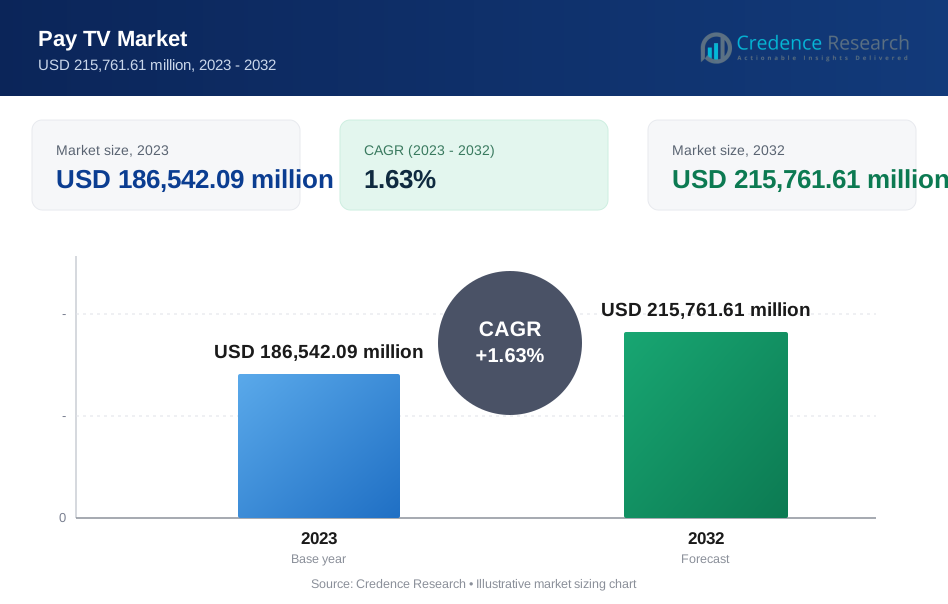
The global Pay TV market is projected to grow from USD 186,542.09 million in 2023 to an estimated USD 215,761.61 million by 2032, with a compound annual growth rate (CAGR) of 1.63% from 2024 to 2032. The market growth is fueled by the increasing demand for high-quality television services, especially in emerging markets.
Market drivers include rising disposable incomes, an increasing preference for on-demand content, and the rapid adoption of advanced technologies such as 4K and OTT integration. Moreover, evolving consumer preferences for personalized content and enhanced viewing experiences are propelling the demand for premium Pay TV services. Trends such as the shift toward hybrid TV models, integration of streaming services, and the growing use of interactive features are also shaping the market landscape.
Geographically, the Pay TV market is dominated by North America, driven by high penetration rates of digital television services. However, significant growth opportunities are emerging in regions such as Asia-Pacific and Latin America, where rising internet penetration and disposable incomes are driving the adoption of Pay TV services. Key players in the global Pay TV market include Comcast Corporation, DISH Network Corporation, Sky Group, and Vodafone Group, among others, who are continuously innovating to stay competitive in the evolving market.
Market Insights
- The global Pay TV market is projected to grow from USD 186,542.09 million in 2023 to USD 215,761.61 million by 2032, at a CAGR of 1.63% from 2024 to 2032, driven by increasing consumer demand for high-quality entertainment.
- Rising disposable incomes, the growing preference for on-demand content, and technological advancements like 4K and OTT integration are key drivers propelling market growth.
- The rise of cord-cutting and intense competition from OTT platforms like Netflix and Amazon Prime Video pose challenges to traditional Pay TV services, threatening subscriber numbers.
- North America remains the dominant market, but significant growth opportunities are emerging in Asia-Pacific and Latin America due to improving internet infrastructure and rising disposable incomes.
- The integration of OTT services with traditional Pay TV is a major trend, offering consumers flexible and bundled subscription options that combine linear TV with on-demand content.
- The shift towards cloud-based services, interactive features, and personalized content through AI and machine learning is enhancing consumer experiences and driving demand for premium Pay TV offerings.
- Key players like Comcast, DISH Network, and Sky Group are adapting to industry changes by innovating with content delivery, interactive features, and flexible subscription models to stay competitive in the market.
Market Trends
Integration of Over-the-Top (OTT) Services with Pay TV
A significant trend in the global Pay TV market is the growing integration of Over-the-Top (OTT) services into traditional Pay TV packages. This hybrid model allows consumers to access both traditional linear television and streaming content through a single platform. Many Pay TV providers are now partnering with popular OTT platforms such as Netflix, Amazon Prime Video, and Disney+ to offer bundled services, thus providing a more diverse and attractive content lineup. For instance, companies like Comcast have successfully bundled their cable services with popular OTT platforms, allowing subscribers to access content from services such as Netflix and Hulu directly through their set-top boxes. This approach simplifies the viewing experience by consolidating multiple subscriptions into one package while enabling users to enjoy a wider variety of content without switching platforms.The inclusion of OTT services within Pay TV subscriptions enhances the appeal of traditional Pay TV by offering on-demand streaming content alongside live TV programming. The rise of hybrid services has also been driven by shifting consumer preferences for on-demand content. Consumers no longer want to be tied to fixed programming schedules and are increasingly opting for the flexibility that OTT services offer. Pay TV operators, recognizing this shift, are adapting by offering greater access to popular streaming content as part of their packages. This integration allows Pay TV providers to compete with standalone streaming platforms while ensuring that they retain their customer base, especially in a market where consumers are increasingly choosing content bundles that provide both live TV and on-demand options.Additionally, the use of AI-driven personalization has become a hallmark of this integration. For example, Netflix utilizes sophisticated algorithms to analyze user behavior and preferences, providing tailored recommendations that keep viewers engaged. Personalization has become a key differentiator for Pay TV services as it improves user engagement and helps providers retain subscribers. By tailoring the content library and recommending relevant programming, Pay TV operators ensure that users have an easier time discovering new shows and films.
Shift Towards Personalized and Interactive Content
As consumer demand for more tailored and interactive viewing experiences grows, Pay TV providers are increasingly offering personalized content recommendations and interactive features. The use of artificial intelligence (AI) and machine learning (ML) algorithms allows service providers to analyze user data and viewing habits to deliver content suggestions that resonate with individual preferences. Personalization has become a key differentiator for Pay TV services as it improves user engagement and helps providers retain subscribers.Additionally, interactive content is gaining traction in the Pay TV market. Interactive TV allows viewers to participate in real-time decisions, such as voting on outcomes in reality shows or accessing additional content through interactive ads. The rise of smart TVs has fueled this trend by providing more engaging and immersive content options. Smart TVs and set-top boxes with advanced features, such as voice search and AI-powered content suggestions, have made it easier for consumers to navigate their Pay TV services and control their viewing experience with a greater level of convenience. With increased adoption of these technologies, Pay TV operators are enhancing their offerings by integrating interactive features and personalized content options to improve the viewer experience.
Rise of Cloud-Based Services and Cloud DVR
Cloud-based services are another growing trend in the global Pay TV market. Traditional Pay TV services often rely on physical hardware, such as set-top boxes and digital video recorders (DVRs), to deliver content and store recordings. However, the adoption of cloud technologies is shifting this paradigm by providing consumers with more flexible and scalable viewing experiences. Cloud-based services allow users to stream content directly from the cloud, eliminating the need for physical infrastructure and offering better scalability for service providers.One of the key aspects of this trend is the rise of cloud DVR services. Cloud DVR eliminates the need for traditional DVR hardware by storing recordings in the cloud, making it easier for consumers to access their recorded content from multiple devices, regardless of location. This advancement also enables viewers to record more content without worrying about limited storage space. With the growth of high-speed internet and the increasing availability of affordable cloud storage, cloud-based services are becoming a key component of the Pay TV industry. The shift towards cloud DVR and other cloud-based features is expected to streamline service delivery, reduce costs for providers, and improve the overall consumer experience.
5G Technology and Mobile Pay TV
The advent of 5G technology is poised to transform the Pay TV market, particularly in the realm of mobile viewing. As 5G networks roll out globally, the increased speed and low latency of these networks will enhance the viewing experience for mobile users. 5G technology will enable high-quality video streaming on mobile devices without buffering or interruptions that often accompany slower internet connections. This is particularly important as consumers increasingly watch content on smartphones, tablets, and other portable devices, seeking seamless and high-definition viewing experiences.Mobile Pay TV services are becoming increasingly popular as they offer flexibility and convenience to users who want to watch their favorite content on the go. The speed and reliability of 5G will make it easier for consumers to stream high-definition or even 4K content on their mobile devices without experiencing interruptions or delays. For Pay TV providers, 5G presents a significant opportunity to expand their customer base by offering mobile-first services and capitalizing on the growing demand for mobile content. Additionally, the rollout of 5G is expected to drive increased adoption of mobile Pay TV subscriptions, further transforming the market and increasing the overall number of Pay TV users globally.
Market Challenges
Intensifying Competition from Over-the-Top (OTT) Platforms
One of the most significant challenges facing the global Pay TV market is the increasing competition from OTT platforms such as Netflix, Amazon Prime Video, Hulu, and Disney+. These streaming services have transformed the entertainment landscape by offering flexible, on-demand content at competitive prices, often without the need for traditional Pay TV subscriptions. With a growing number of consumers opting for the cost-effective and content-rich offerings of OTT platforms, Pay TV operators are facing significant pressure to retain their customer base. OTT services allow for greater flexibility in terms of viewing times, device compatibility, and subscription models, making them a highly attractive alternative to conventional Pay TV. As OTT platforms continue to expand their content libraries and invest in original programming, they are expected to further erode the Pay TV subscriber base, particularly among younger audiences who are more inclined to favor streaming services over traditional television.
Cord-Cutting and Declining Subscriber Numbers
Another challenge is the trend of "cord-cutting," where consumers are increasingly canceling their traditional Pay TV subscriptions in favor of more affordable alternatives like OTT streaming services, digital platforms, and free over-the-air broadcasts. This trend, particularly noticeable in regions such as North America and Europe, is driven by the rising costs of Pay TV subscriptions and the growing availability of alternative content delivery methods. As consumers shift away from traditional cable and satellite services, Pay TV operators are struggling to maintain subscriber growth and revenue streams. This challenge is compounded by the fact that newer generations of consumers, particularly millennials and Gen Z, are more accustomed to digital platforms and on-demand content, leading to lower demand for traditional Pay TV. The market is responding to this trend by exploring new business models, such as bundling OTT services with traditional Pay TV, but the overall decline in subscribers presents a long-term challenge for the industry.
Market Opportunities
Expansion into Emerging Markets
A significant opportunity for growth in the global Pay TV market lies in expanding services to emerging markets, particularly in regions such as Asia-Pacific, Latin America, and the Middle East. These regions are experiencing rapid urbanization, increased disposable incomes, and greater access to high-speed internet, all of which are contributing to the rising demand for Pay TV services. As broadband and mobile internet penetration improves, Pay TV providers can tap into these underserved markets by offering affordable, flexible packages and localized content that appeal to the unique preferences of consumers in these regions. Additionally, partnerships with local content producers and government initiatives to improve infrastructure can help drive the adoption of Pay TV services. As more households in these regions transition from analog to digital television, Pay TV providers have the opportunity to expand their subscriber base and increase market share.
Integration of Advanced Technologies and Interactive Features
The integration of advanced technologies such as Artificial Intelligence (AI), cloud-based services, and interactive TV features presents another key market opportunity for Pay TV providers. By leveraging AI and machine learning, operators can offer personalized content recommendations, improve customer engagement, and enhance the overall viewing experience. Furthermore, the adoption of cloud-based DVR services and smart TV applications allows for more flexible and scalable solutions, attracting tech-savvy consumers who seek on-demand access to content. Interactive features, such as real-time voting, social media integration, and gamification, are also gaining popularity and provide an opportunity for Pay TV services to create more immersive and engaging experiences. By staying ahead of technological advancements, Pay TV providers can differentiate themselves in a competitive market and attract a broader customer base.
Market Segmentation Analysis
By Delivery
The global Pay TV market is shaped by various delivery platforms, each catering to different consumer needs. Digital Terrestrial Broadcast is popular in areas with limited satellite or cable infrastructure, providing reliable TV services at a low setup cost, though its market share is shrinking due to the increasing demand for high-definition and more flexible viewing options. Satellite Broadcast remains dominant in rural or remote regions, offering a broad range of channels and premium content, particularly for live events. IPTV is growing rapidly, providing flexible and customizable content over the internet, often bundled with high-speed broadband services, and expanding with the adoption of fiber-optic networks. Cable Television has traditionally been a significant Pay TV platform, though it now faces strong competition from OTT services, while still being popular in areas with underdeveloped broadband infrastructure. Finally, OTT Television is a major disruptor in the market, delivering flexible, on-demand content via the internet, with platforms like Netflix, Amazon Prime, and Hulu driving significant growth, especially among younger audiences.
By broadcast
The Pay TV market is divided into two primary broadcast platforms: the public domain and the commercial domain. Public broadcasters provide free-to-air content, typically funded by government support or public subscriptions, and while they do not generate significant Pay TV revenues, they play a crucial role in delivering basic television services to a wide audience. On the other hand, commercial broadcasters generate revenue through Pay TV subscriptions and advertising, offering a diverse range of channels, including premium, niche, and on-demand content. The commercial domain serves as the primary revenue driver in the Pay TV market.
Segments
Based on Delivery Platform
- Digital Terrestrial Broadcast
- Satellite Broadcast
- Over Internet Protocol Television (IPTV)
- Cable Television Broadcast
- Over-the-Top (OTT) Television
Based on Broadcast Platform
- Public Domain
- Commercial Domain
Based on Revenue Model
- Subscription-based Revenue Model
- Advertisement-based Revenue Model
Based on Technology
- Bonus Features
- Newer Networks
- Modern Channels
Based on Region
- North America
- U.S.
- Canada
- Mexico
- Europe
- Germany
- France
- U.K.
- Italy
- Spain
- Rest of Europe
- Asia Pacific
- China
- Japan
- India
- South Korea
- South-east Asia
- Rest of Asia Pacific
- Latin America
- Brazil
- Argentina
- Rest of Latin America
- Middle East & Africa
- GCC Countries
- South Africa
- Rest of the Middle East and Africa
Regional Analysis
North America (40%)
North America remains the largest market for Pay TV, accounting for approximately 40% of the global market share. The region is home to highly developed broadband and cable infrastructures, which continue to support the widespread adoption of Pay TV services. The United States and Canada dominate the North American Pay TV market, with a high penetration of cable and satellite services. However, North America is also seeing a shift toward OTT services due to the growing trend of cord-cutting and the increasing preference for on-demand content. This shift is being driven by consumers’ desire for more flexible, lower-cost alternatives to traditional Pay TV subscriptions. Despite this, Pay TV remains a significant contributor to revenue, particularly for premium sports and live broadcasting.
Europe (25%)
Europe represents approximately 25% of the global Pay TV market share. The market is characterized by a high level of competition between traditional Pay TV providers and emerging OTT platforms. Satellite and cable TV services continue to dominate in most European countries, although IPTV adoption is rising rapidly, particularly in Western Europe. The region is also witnessing a growing trend of bundling Pay TV services with high-speed broadband and digital content offerings. Countries such as the UK, Germany, and France have a strong Pay TV subscriber base, but competition from streaming services like Netflix and Amazon Prime Video is intensifying, particularly among younger consumers.
Key players
- DIRECTV
- DISH Network Corporation
- Carter Communications
- Foxtel
- Comcast Corporation
Competitive Analysis
The global Pay TV market is highly competitive, with key players continually adapting to consumer demands and technological innovations. DIRECTV leads in satellite TV services, offering a broad range of content, including sports and premium channels. DISH Network, while also a satellite provider, differentiates itself with its bundled services that include broadband and TV. Carter Communications has a significant presence in specific regions, focusing on providing localized content and services. Foxtel in Australia maintains a strong position by offering tailored packages with exclusive local and international content, including sports. Comcast, a major cable provider, dominates North America and is expanding its services by integrating broadband and streaming platforms into its offerings. As OTT services and cord-cutting become prevalent, all players are increasingly incorporating digital and interactive features, adjusting their business models to remain competitive against streaming platforms and new entrants. Each company's ability to innovate and integrate these technologies will determine its long-term position in the market.
Recent Developments
- In January 2024, Motorola Solutions announced a partnership with various content providers to enhance its video surveillance services, integrating them with pay TV offerings to provide a comprehensive security solution for residential customers.
- In November 2024, DIRECTV launched a new streaming service that combines traditional satellite offerings with over-the-top (OTT) content. This service aims to attract cord-cutters by providing flexible subscription models and a broader range of channels.
- In October 2024, DISH Network completed the acquisition of a regional sports network, enhancing its content library and aiming to boost subscriber numbers in competitive markets. This acquisition is part of DISH's strategy to diversify its offerings amid increasing competition from streaming services.
- In August 2024, Carter Communications expanded its pay TV services by launching a new IPTV platform aimed at rural areas, which allows for customizable channel packages and improved access to high-definition content.
- In September 2024, Foxtel introduced a new subscription model that integrates both live TV and on-demand content, responding to consumer demand for flexibility. This model includes partnerships with local content creators to enhance its programming lineup.
- In December 2024, Comcast announced the launch of a new streaming device that integrates its Xfinity services with popular OTT platforms. This device aims to simplify user experience by providing a single interface for both traditional cable and streaming content.
Market Concentration and Characteristics
The global Pay TV market exhibits a moderate level of concentration, with several key players dominating the market, such as DIRECTV, DISH Network, Comcast, and Foxtel. These players primarily operate in specific geographic regions, with satellite, cable, and IPTV services forming the core of their offerings. Despite the dominance of these large companies, the market remains competitive due to the rapid growth of Over-the-Top (OTT) platforms and shifting consumer preferences toward on-demand content. The market is characterized by continuous innovation, with service providers integrating advanced technologies such as cloud-based DVR, interactive features, and high-definition content to retain and attract subscribers. Additionally, Pay TV providers are increasingly bundling services, offering flexible pricing models, and incorporating OTT platforms to counter the growing trend of cord-cutting and competition from digital streaming services. This dynamic landscape drives both consolidation and new market entrants, ensuring ongoing competition.
Report Coverage
The research report offers an in-depth analysis based on Delivery Platform, Broadcast Platform, Revenue Model, Technology and Region. It details leading market players, providing an overview of their business, product offerings, investments, revenue streams, and key applications. Additionally, the report includes insights into the competitive environment, SWOT analysis, current market trends, as well as the primary drivers and constraints. Furthermore, it discusses various factors that have driven market expansion in recent years. The report also explores market dynamics, regulatory scenarios, and technological advancements that are shaping the industry. It assesses the impact of external factors and global economic changes on market growth. Lastly, it provides strategic recommendations for new entrants and established companies to navigate the complexities of the market.
Future Outlook
- Emerging markets, especially in Asia-Pacific and Latin America, are expected to experience significant Pay TV growth due to improving infrastructure and rising disposable incomes. This presents a substantial opportunity for service providers to expand their reach.
- The convergence of Pay TV with OTT platforms will continue to gain momentum, offering customers hybrid packages that include both traditional broadcast and on-demand streaming. This integration caters to the growing demand for flexible, cost-effective viewing options.
- The implementation of AI, machine learning, and advanced analytics will enhance content personalization, improving viewer satisfaction and driving customer retention. Providers will increasingly leverage these technologies to optimize user experiences and offer tailored content.
- Cloud-based services, including cloud DVR, will become a central part of Pay TV offerings, enabling customers to access their content on multiple devices. This technology reduces infrastructure costs and provides more flexibility in service delivery.
- Mobile Pay TV, driven by the expansion of 5G networks and improved mobile broadband, will see widespread adoption, especially in regions with high mobile penetration. This trend will increase access to Pay TV content on smartphones and tablets.
- Subscription-based models will continue to dominate the Pay TV landscape, with providers focusing on offering comprehensive bundles that include traditional television and OTT services. This model remains attractive due to its predictable revenue streams.
- As 4K and Ultra HD (UHD) content becomes more mainstream, Pay TV providers will focus on upgrading their offerings to meet consumer demand for higher-quality visuals and immersive viewing experiences, especially for sports and live events.
- The rise of cord-cutting, driven by the popularity of OTT platforms, will continue to challenge traditional Pay TV providers. However, hybrid models and content bundling may mitigate some of the impact by offering both linear TV and streaming options.
- Pay TV providers will increasingly focus on offering region-specific content to attract local audiences and retain subscribers. This localized approach will help companies meet the diverse cultural and entertainment needs of global viewers.
- Regulatory changes and price sensitivity in key markets will influence how Pay TV providers structure their offerings. Providers will need to balance competitive pricing with maintaining profitability, particularly in regions facing economic challenges or high regulatory scrutiny.
Request a Free Sample
Fill in your details and we'll send you a free sample report.
- Sample data tables & charts
- Research methodology
Need a Custom Version of This Report?
Tailor the scope, geography, or segments to your exact requirements.
- Custom geography or segment scope
- Direct access to our analyst team
Frequently Asked Questions
What is the market size of the global Pay TV market in 2023 and 2032?
What are the key drivers of growth in the global Pay TV market?
How are regional markets influencing the Pay TV industry?
Who are the major players in the global Pay TV market?
Table of Content
Chapter 1. Report Introduction
- 1.1 Report Description & Purpose
- 1.1.1 Report Title & Market Definition
- 1.1.2 Unique Selling Propositions (USP) & Key Differentiators
- 1.1.3 Value Proposition for Stakeholders
- 1.2 Research Objectives
- 1.2.1 Market Sizing Objectives (Volume & Revenue) (Volume Where Applicable)
- 1.2.2 Segmentation Objectives
- 1.2.3 Competitive Intelligence Objectives
- 1.2.4 Forecast & Scenario Objectives
- 1.3 Report Scope
- 1.3.1 Pay TV Scope – Segments & Subsegments Covered
- 1.3.2 Geographic Scope – Regions & Countries Covered
- 1.3.3 Historical Period, Base Year & Forecast Period (2023; forecast to 2032)
- 1.3.4 Inclusions & Exclusions
- 1.4 Industry Classification & Applicable Codes
- 1.5 Currency, Measurement Units & Valuation Basis
- 1.6 Target Stakeholders
- 1.7 Limitations & Assumptions
Chapter 2. Executive Summary
- 2.1 Global Pay TV Market Snapshot
- 2.1.1 Market Size – Historical (2023) & Forecast (2023-2032) (2023: USD 186,542.09 million → 2032: USD 215,761.61 million)
- 2.1.2 Volume & Revenue – Global Totals (Volume Where Applicable)
- 2.1.3 Key Market Highlights – Top Five Facts
- 2.2 Pay TV Market Segmentation Snapshot
- 2.2.1 Market Split by Region – 2023 vs. 2032
- 2.3 Competitive Snapshot
- 2.3.1 Top 10 Players by Revenue Share – 2023
- 2.3.2 Top 10 Players by Volume Share – 2023 (Volume Where Applicable)
- 2.3.3 Recent Strategic Developments (18-Month Summary)
- 2.4 Key Investment Highlights & Strategic Conclusions
Chapter 3. Pay TV Market Dynamics & Industry Analysis
- 3.1 Market Overview & Context
- 3.1.1 Pay TV Market Position in the Broader Industry Value Chain
- 3.1.2 Demand Structure & Purchasing Dynamics
- 3.1.3 Market Maturity & Development Stage by Region
- 3.2 Pay TV Market Drivers
- 3.3 Pay TV Market Restraints & Challenges
- 3.4 Pay TV Market Opportunities
- 3.5 Porter's Five Forces Analysis
- 3.5.1 Threat of New Entrants
- 3.5.2 Bargaining Power of Suppliers
- 3.5.3 Bargaining Power of Buyers
- 3.5.4 Threat of Substitutes
- 3.5.5 Competitive Rivalry – Intensity Assessment
- 3.6 Pay TV Value Chain Analysis
- 3.6.1 Upstream – Key Inputs, Resources & Suppliers
- 3.6.1.1 Key Input/Resource 1
- 3.6.1.2 Key Input/Resource 2
- 3.6.1.3 Key Input/Resource 3
- 3.6.2 Midstream – Core Operations & Value Creation
- 3.6.2.1 Operating Model & Process Overview
- 3.6.2.2 Key Operating Locations & Capabilities by Company
- 3.6.3 Downstream – Market Channels & End Users
- 3.6.3.1 Direct Sales & Customer Engagement Channels
- 3.6.3.2 Indirect Sales, Intermediaries & Partner Channels
- 3.6.4 Value Chain Profitability Analysis
- 3.6.1 Upstream – Key Inputs, Resources & Suppliers
- 3.7 PESTEL Analysis
- 3.7.1 Political Factors
- 3.7.2 Economic Factors
- 3.7.3 Social Factors
- 3.7.4 Technological Factors
- 3.7.5 Environmental Factors
- 3.7.6 Legal Factors
- 3.8 Pay TV Supply Chain Analysis
- 3.8.1 Critical Input & Resource Availability Risk Assessment
- 3.8.2 Supplier & Operational Concentration Risk (Geographic Exposure)
- 3.8.3 Supply & Service Disruption Impact Analysis
- 3.9 Regulatory & Policy Landscape
Note: The regulatory and policy landscape section covers regulations based on their applicability to the market, Pay TV category, geography, and scope of the study. Only regulatory frameworks with a material impact on operations, compliance, trade, sustainability, or market access are analyzed in detail.
Chapter 4. Key Investment Pockets & Opportunity Analysis
- 4.1 Pay TV Market Attractiveness Analysis
- 4.1.1 By Region – Investment Attractiveness Matrix (Market Size × CAGR)
- 4.2 Absolute Revenue Growth Opportunity
- 4.2.1 By Region – Absolute Revenue Growth Through 2032
- 4.3 Incremental Demand Opportunity
- 4.3.1 By Region – Incremental Demand Through 2032
- 4.3.2 Segment – Incremental Demand
- 4.4 Emerging Submarket Opportunity Deep Dive (Subject to Applicability)
- 4.5 Priority Market Opportunity Scorecards
- 4.5.1 United States
- 4.5.2 Europe
- 4.5.3 Asia
- 4.5.4 Middle East & Africa
Note: Priority market opportunity scorecards reflect the geographic scope and strategic relevance of the study. Listed markets are indicative and may be adapted to the industry.
Chapter 5. Pay TV Cross-Border Trade & Market Access Analysis
- 5.1 International Trade & Cross-Border Activity Overview
- 5.1.1 Global Export Value by Country (2023)
- 5.1.2 Global Export Volume by Country (2023) (Volume Where Applicable)
- 5.1.3 Global Import Value by Country (2023)
- 5.1.4 Global Import Volume by Country (2023) (Volume Where Applicable)
- 5.1.5 Net Trade Balance by Country (2023)
- 5.2 Export Analysis – Segment
- 5.2.1 Category 1 (Applicable Classification Code)
- 5.2.2 Category 2 (Applicable Classification Code)
- 5.2.3 Category 3 (Applicable Classification Code)
- 5.2.4 Category 4 (Applicable Classification Code)
- 5.2.5 Category 5 (Applicable Classification Code)
- 5.3 Import Analysis – Segment
- 5.3.1 Category 1 (Applicable Classification Code)
- 5.3.2 Category 2 (Applicable Classification Code)
- 5.3.3 Category 3 (Applicable Classification Code)
- 5.3.4 Category 4 (Applicable Classification Code)
- 5.3.5 Category 5 (Applicable Classification Code)
- 5.4 Cross-Border Pricing & Transaction Benchmarks
- 5.4.1 Export Pricing – Segment & Country
- 5.4.2 Import Pricing – Segment & Source Country
- 5.4.3 Price Trends (2023)
- 5.5 Key Cross-Border Trade & Delivery Routes
- 5.5.1 Cross-Border Trade/Delivery Route 1
- 5.5.2 Cross-Border Trade/Delivery Route 2
- 5.5.3 Cross-Border Trade/Delivery Route 3
- 5.5.4 Cross-Border Trade/Delivery Route 4
- 5.5.5 Cross-Border Trade/Delivery Route 5
- 5.6 Trade Policy & Market Access Impact Assessment
- 5.6.1 Tariff & Non-Tariff Barriers
- 5.6.2 Regional Trade & Economic Integration Frameworks
- 5.6.3 Bilateral & Multilateral Trade Agreements
- 5.6.4 Cross-Border Operating, Licensing & Localization Requirements
Note: This chapter applies where cross-border trade or delivery is relevant to Pay TV. Goods, services, and digital offerings are assessed using applicable classifications and transaction measures. Import-export volumes, trade balances, and route analyses are included only where meaningful to the market.
Chapter 6. Competitive Landscape & Company Benchmarking
- 6.1 Pay TV Market Concentration & Structure
- 6.1.1 Herfindahl-Hirschman Index (HHI) – vs. 2023
- 6.1.2 Leading, Mid-Sized & Emerging Player Structure
- 6.1.3 Global, Regional & Local Player Dynamics
- 6.2 Pay TV Market Share Analysis – 2023
- 6.2.1 Global Revenue Share by Company
- 6.2.2 Global Volume Share by Company (Volume Where Applicable)
- 6.2.3 Regional Revenue Share
- 6.2.4 Market Share Evolution ( vs. 2023)
- 6.2.5 Company Market Share by Key Segment
- 6.2.6 Company Market Share by Customer Group
- 6.3 Operating Scale, Capacity & Infrastructure Analysis
- 6.3.1 Global Operating Scale & Supply Capacity
- 6.3.2 Resource Utilization & Operating Efficiency
- 6.3.3 Output, Service Delivery & Activity Metrics
- 6.3.4 Operating Footprint & Infrastructure Map
- 6.3.5 Planned Operational & Capacity Expansion
- 6.4 Pay TV Competitive Benchmarking Matrix
- 6.4.1 Revenue, Growth, Profitability & Operating Metric Comparison
- 6.4.2 Channel Revenue Mix
- 6.4.3 Geographic Revenue Exposure
- 6.4.4 R&D Intensity
- 6.4.5 Sustainability Maturity
- 6.5 Strategic Developments in Pay TV (Last 24 Months)
- 6.5.1 Mergers, Acquisitions & Divestments
- 6.5.2 New Products, Services & Solutions in Pay TV
- 6.5.3 Operational & Infrastructure Expansions
- 6.5.4 Strategic Alliances, Joint Ventures & Partnerships
- 6.5.5 Distribution Expansion & Market Entry
- 6.5.6 Sustainability & ESG Initiatives
- 6.6 Competitive Strategy Mapping
- 6.6.1 Leader, Challenger, Follower & Niche Classification
- 6.6.2 Pricing Strategy Comparison
- 6.6.3 Channel Strategy Matrix
Note: Strategic developments are included based on their materiality and the availability of reliable information.
Chapter 7. Global Pay TV Market – By Sales & Delivery Channel
- 7.1 Segment Overview
- 7.1.1 Volume & Revenue Split by Channel (2023 & 2032) (Volume Where Applicable)
- 7.1.2 Channel Mix Evolution (2023-2032)
Chapter 8. Regional Market Analysis – Global Overview
- 8.1 Global Regional Overview
- 8.1.1 Regional Volume Share (Volume Where Applicable)
- 8.1.2 Regional Revenue Share
- 8.1.3 Regional Volume by Region (Volume Where Applicable)
- 8.1.4 Regional Revenue by Region
- 8.1.5 Regional Forecast Through 2032
- 8.2 Cross-Regional Segment Analysis
- 8.2.1 By Sales & Delivery Channel
- 8.2.2 By Competitive Positioning & Price Tier
Chapter 9. North America Pay TV Market
- 9.1 United States
- 9.2 Canada
- 9.3 Mexico
Chapter 10. Europe Pay TV Market
- 10.1 Germany
- 10.2 France
- 10.3 Italy
- 10.4 United Kingdom
- 10.5 Spain
- 10.6 Poland
- 10.7 Russia
- 10.8 Netherlands
- 10.9 Belgium
- 10.10 Sweden
- 10.11 Denmark
- 10.12 Norway
- 10.13 Rest of Europe
Chapter 11. Asia Pacific Pay TV Market
- 11.1 China
- 11.2 India
- 11.3 Japan
- 11.4 South Korea
- 11.5 Thailand
- 11.6 Indonesia
- 11.7 Vietnam
- 11.8 Malaysia
- 11.9 Australia
- 11.10 Rest of Asia Pacific
Chapter 12. Latin America Pay TV Market
- 12.1 Brazil
- 12.2 Argentina
- 12.3 Colombia
- 12.4 Chile
- 12.5 Rest of Latin America
Chapter 13. Middle East Pay TV Market
- 13.1 Saudi Arabia
- 13.2 United Arab Emirates
- 13.3 Turkey
- 13.4 Israel
- 13.5 Iran
- 13.6 Rest of the Middle East
Chapter 14. Africa Pay TV Market
- 14.1 South Africa
- 14.2 Egypt
- 14.3 Nigeria
- 14.4 Morocco
- 14.5 Rest of Africa
Chapter 15. Pay TV Company Profiles
- 15.1 [Company 01]
- 15.1.1 Company Overview
- 15.1.2 Key Management Personnel
- 15.1.3 Products & Services Portfolio
- 15.1.4 Financial Performance
- 15.1.5 Key Market Focus & Geographic Presence
- 15.1.6 Recent Developments & Strategic Initiatives
Note: The company profile list is preliminary and may change based on research findings, market developments, data availability, and client requirements.
Chapter 16. Appendices
- Appendix A – List of Abbreviations & Acronyms
- Appendix B – Industry Classification Code Reference – Full Series
- Appendix C – Supply, Output & Operating Capacity Data Tables
- Appendix D – End-Use & Demand Base Tables
- Appendix E – Demand, Adoption & Usage Assumptions
- Appendix F – Pricing & Revenue Metric Reference Tables
- Appendix G – Company Operations & Infrastructure Database
- Appendix H – Cross-Border Trade & Activity Data Tables (Where Applicable)
- Appendix I – Regulatory Summary Tables
- Appendix J – Primary Research Participant List (Anonymized)
- Appendix K – Primary Research Questionnaire Framework
- Appendix L – Data Sources & Bibliography
- Appendix M – Market Size Divergence & Source Comparison
Chapter 17. Research Methodology
- 17.1 Research Framework & Philosophy
- 17.2 Secondary Research – Sources, Hierarchy & Data Extraction
- 17.3 Data Modeling – Bottom-Up & Top-Down Market Sizing
- 17.4 Primary Research – Stakeholder Framework, LOI & Sample Sizes
- 17.5 Forecast Methodology – Regression, Scenario & Sensitivity Analysis
- 17.6 Quality Control – Four-Layer Validation Framework
- 17.7 Limitations & Standard Assumptions
- 17.8 Disclaimer
