
| REPORT ATTRIBUTE | DETAILS |
|---|---|
| Historical Period | 2019-2022 |
| Base Year | 2023 |
| Forecast Period | 2024-2032 |
| Plant Stem Cell Nutrition Products Market Size 2023 | USD 214.87 Million |
| Plant Stem Cell Nutrition Products Market, CAGR | 10.50% |
| Plant Stem Cell Nutrition Products Market Size 2032 | USD 527.76 Million |
Market Insights
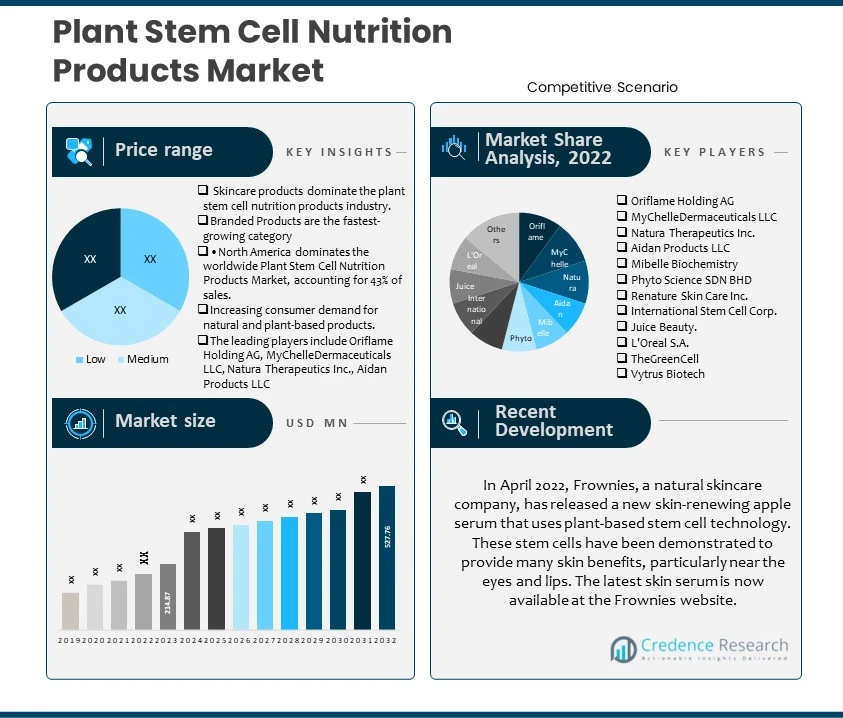
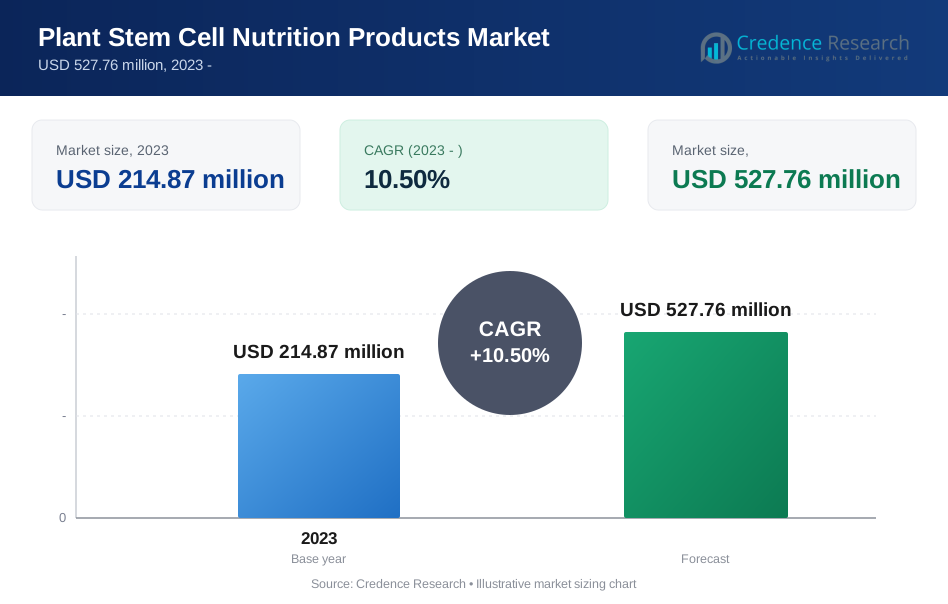
- The global demand for Plant Stem Cell Nutrition Products was valued at USD 214.87 million in 2023 and is expected to reach USD 527.76 million in 2032, growing at a CAGR of 10.50% between 2024 and 2032.
- Skincare products dominate the plant stem cell nutrition product market.
- Apple Stem Cells have the largest market share in the plant stem cell nutrition business, whereas Rose Stem Cells represent a significant sector.
- The Beauty and Skincare Industry is the most popular segment of the plant stem cell nutrition market.
- The plant stem cell nutrition market is dominated by health and wellness stores. Online retail is also a developing component in the plant stem cell feeding business.
- Topical creams dominated the plant stem cell nutrition market.
- The skin rejuvenation industry dominates the global market, valued at US$ 124.32 million by 2023.
- Branded Products is the fastest-growing segment of the plant stem cell feeding industry.
- Fruits are the most popular segment of the plant stem cell nutrition market.
- The organic segment holds a larger market share.
- North America leads the global Plant Stem Cell Nutrition Products Market, accounting for 43% of sales, while Asia Pacific is the fastest expanding market for plant stem cell nutrition products.
- Biotechnology advancements and plant stem cell research are driving market expansion.
- Regulatory challenges impede market growth.
Executive Summary
Market Definition
The Plant Stem Cell Nutrition Products Market includes products that use plant stem cells as a key element in nutritional supplements. These products are intended to deliver a variety of health benefits by leveraging the power of plant stem cells, which are high in antioxidants, vitamins, and other beneficial substances. Plant stem cell nutrition products are thought to improve general health and well-being, and they are becoming increasingly popular among consumers looking for natural, plant-based nutritional solutions.
Market Overview
The global Plant Stem Cell Nutrition Products Market has witnessed steady growth in recent years and is expected to grow at a CAGR of 10.50% between 2024 and 2032. The market was valued at USD 214.87 million in 2023 and is expected to reach USD 527.76 million in 2032.
The plant stem cell nutrition products market is rapidly expanding and gaining popularity among health-conscious customers. These products are generated from plant stem cells and are thought to provide a variety of health benefits, including antioxidant protection, immune system strengthening, and anti-aging effects. The industry is being pushed by rising customer demand for natural, plant-based nutritional supplements. With improvements in biotechnology, more plant species are being studied for possible stem cell applications. Overall, the market for plant stem cell nutrition products is growing as individuals seek out new and natural solutions to their nutritional demands.
Segmentation by Product Type
- Skincare products dominate the plant stem cell nutrition products industry. Plant stem cell-based skin care products have grown in popularity due to their potential skin health and rejuvenating advantages. These products are widely sought after by customers looking for natural and efficient ways to improve their skincare regimen.
Segmentation by Source
- Apple Stem Cells command the highest market share in the plant stem cell nutrition market. Apple stem cells have received a lot of attention and appeal in the beauty and wellness sector because of their potential skin regeneration and anti-aging properties. These stem cells are known for their ability to extend the life of skin cells and protect them from environmental stresses.
- Rose Stem Cells are an important sector of the plant stem cell nutrition market. Rose stem cells have been studied for their potential skincare advantages, such as hydration, calming characteristics, and antioxidant effects.
Segmentation by End-User:
- The Beauty and Skincare Industry is the most popular segment of the plant stem cell nutrition industry. This industry has expressed a significant desire to incorporate plant stem cell technology into its products, notably in skincare and cosmetics formulations. The beauty and skincare industries have acknowledged the potential benefits of plant stem cells in terms of skin health, regeneration, and anti-aging effects.
Segmentation by Distribution Channel
- Health and Wellness Stores represent a major share of the plant stem cell nutrition market. These specialist establishments cater to customers who value their health and well-being, offering a diverse selection of products that support a healthy lifestyle.
- Another growing segment in the plant stem cell feeding industry is online retail.
Segmentation by Formulation
- Topical Creams dominate the plant stem cell nutrition market. Consumers choose topical creams because they are easy to apply and provide focused delivery of plant stem cell nutrition to the skin.
- Capsules are another major segment of the plant stem cell nutrition industry.
Segmentation by Application
- The skin rejuvenation sector dominates the global market, valued at US$ 124.32 million in 2023. This procedure restores damaged skin. A rising trend in cosmetic product manufacture using plant cell culture technologies and anti-aging qualities is driving market expansion.
Segmentation by Brand
- Branded Products are the fastest-growing category of the plant stem cell nutrition market. Branded products are those that are created, marketed, and sold under a particular brand name. These items frequently have established reputations, devoted client bases, and effective marketing methods, all of which contribute to their rapid market expansion.
Segmentation by Plant Part
- Fruits are the most popular section of the plant stem cell nutrition industry. Fruits have long been known for their nutritional worth and health advantages. Fruits are frequently utilized in plant stem cell nutrition to extract beneficial components and combine them into diverse nutritious products.
Segmentation by Certification
- The Organic sector has a bigger market share. Organic plant stem cell nourishment products have grown in popularity in recent years as consumers increasingly demand natural and sustainable solutions.
Segmentation by Region
- North America dominates the worldwide Plant Stem Cell Nutrition Products Market, accounting for 43% of sales.
- Asia Pacific is the fastest growing market for plant stem cell feeding products.
- The rest of the world, including Latin America, the Middle East, and Africa, supplies the remaining demand for Plant Stem Cell Nutrition Productss.
In 2023, North America dominated the market. The key driver of expansion is advanced technology that allows for the cultivation and extraction of plant components for research purposes. Furthermore, rising public desire for naturally derived products, as well as increased awareness, help to drive the plant stem cell market in these developed nations. The plant stem cell industry relies substantially on research. Increasing R&D activities and government financing are creating a research hub, posing a potential market for plant stem cells. In January 2022, "Thermo Fisher Scientific" in the United States reached an agreement with "Henogen S.A., Novasep's viral vector manufacturing business" to stable cell and gene vaccines globally.
Asia Pacific is the fastest expanding area in the plant stem cell nutrition products market. A number of causes contribute to the region's rapid expansion. For starters, consumers in Asia Pacific are becoming more aware of the benefits of plant-based nutrition and plant stem cells' ability to promote health and wellness. This greater knowledge has resulted in increased demand for plant stem cell nutrition products. Furthermore, Asia Pacific is home to a varied spectrum of plant species with distinct features, making it a suitable location for the growth and extraction of plant stem cells. The wealth of natural resources and botanical expertise in nations such as China, India, and Japan has helped to design and manufacture high-quality plant stem cell nutrition products.
Key Highlights of the Report
The global Plant Stem Cell Nutrition Products Market is segmented based on product type, Source, End-User:, Distribution Channel, Formulation, Brand, Plant Part, Certification and region. Health and wellness stores account for a significant portion of the plant stem cell nutrition market, while the skin rejuvenation sector dominates the global market. In addition, Branded Products is the fastest expanding sector, and Apple Stem Cells have the largest market demand. Also, Rose Stem Cells are a significant industry, with North America driving market expansion., with North America driving market growth.
The market is being driven by rising consumer demand for natural and plant-based goods, growing awareness of the potential health advantages of plant stem cell nutrition products, and advancements in biotechnology and plant stem cell research. Furthermore, the limited availability of specific plant species for stem cell extraction, high production costs associated with plant stem cell extraction and Application, and stringent regulatory requirements for product safety and performance are the main market limitations.
In 2023, North America led the market. The primary driver of expansion is advanced technology, which enables the cultivation and extraction of plant components for research purposes. Furthermore, Asia Pacific is the fastest-growing area in the plant stem cell nutrition products market.
What Are The Main Drivers Of The Global Plant Stem Cell Nutrition Products Market?
The plant stem cell nutrition products market is being driven by several factors. Firstly, there is an increasing demand among consumers for natural and plant-based products. People are becoming more conscious about their health and are seeking out alternatives that are derived from natural End-User:s. Additionally, there is a growing awareness about the potential health benefits of plant stem cell nutrition products. These products are believed to offer antioxidant support, immune system enhancement, and anti-aging properties, which are appealing to health-conscious individuals.
What Are The Major Challenges Faced By The Global Plant Stem Cell Nutrition Products Market?
While the plant stem cell nutrition products market is experiencing growth, there are also some restraints to consider. One of the main restraints is the limited availability of specific plant species for stem cell extraction. Not all plants have the same potential for stem cell applications, and finding suitable plant species can be a challenge. Additionally, the production costs associated with plant stem cell extraction and Applicationulation can be high. The process of extracting and preserving stem cells from plants requires specialized equipment and techniques, which can drive up the production costs. .
What Are The Growth Opportunities In The Global Plant Stem Cell Nutrition Products Market?
Within the plant stem cell nutrition products market, there are several opportunities for growth and expansion. One opportunity is to tap into new markets and regions that have a growing focus on health and wellness. As more people become aware of the benefits of plant stem cell nutrition products, there is an opportunity to introduce these products to new demographics and geographic areas. Another opportunity lies in collaboration and partnerships for research and development. By joining forces with other industry players, companies can pool their reEnd-User:s and expertise to advance the development of innovative plant stem cell products.
Market Drivers
Several factors drive the global Plant Stem Cell Nutrition Products Market. The following are the key drivers of the global Plant Stem Cell Nutrition Products Market:
Advancements in Biotechnology and Research in Plant Stem Cell Technology
Biotechnology advancements and plant stem cell research have had a substantial impact on the market for plant stem cell nutrition products. These breakthroughs have permitted the extraction and use of stem cells from numerous plant sources that are high in bioactive chemicals and nutrients.
Scientists have been able to harness plant stem cells' regenerative and rejuvenating powers via biotechnology. This has resulted in the creation of novel plant stem cell nutrition products with potential health benefits such as antioxidant protection, cellular regeneration, and general wellness support.
Plant stem cell technology research has illuminated the unique traits and capacities of plant stem cells, enabling the development of high-quality and effective products. This has piqued the interest of consumers seeking natural and sustainable nutritional options.
Furthermore, these improvements have created new opportunities for product development, resulting in a varied spectrum of plant stem cell nutrition products that address various health concerns. This has helped to drive market growth and expansion as more people discover the potential benefits of adopting plant stem cell-based products into their everyday routines.
Market Restraints
The global Plant Stem Cell Nutrition Products Market faces some challenges that may hinder its growth. These include the following:
Regulatory Challenges
Navigating regulatory hurdles is a significant barrier in the plant stem cell nutrition products business. As with any new business, companies must adhere to a variety of rules and criteria to assure the safety and efficacy of their products. Regulatory organizations worldwide have varying requirements for the approval and marketing of plant stem cell-based products. These restrictions frequently require strict testing, paperwork, and adherence to particular production standards. Meeting these standards can be time-consuming and costly for market players.
Furthermore, the classification of plant stem cell nourishment products may differ between areas, complicating the regulatory environment. Companies must understand and comply with the individual legislation in each market in which they operate, which can be difficult to achieve when expanding internationally. In addition, the science underpinning plant stem cell feeding products is still developing, and regulatory bodies may have differing levels of understanding and acceptance of this technology. This can delay product approvals and create regulatory uncertainty.
Opportunities
The global Plant Stem Cell Nutrition Products Market offers significant growth opportunities. These include the following:
Growing Consumer Demand for Natural and Plant-Based Products
People are becoming more health-conscious and ecologically sensitive, thus they are looking for sustainable and holistic solutions to their nutrition and wellness demands. Plant stem cell nutrition solutions provide a unique value proposition by leveraging the potential benefits of natural chemicals found in plants. These goods include high levels of antioxidants, vitamins, and minerals, which customers value for their possible health advantages.
Furthermore, plant-based diets and lifestyles are becoming increasingly popular, with people shifting their eating patterns to be more plant-centric. Plant stem cell nutrition solutions complement this trend by offering a natural and sustainable alternative to synthetic supplements and additives.
The opportunity comes in meeting the growing customer demand for products free of artificial substances, chemicals, and preservatives. Companies can capitalize on this increasing industry by selling plant stem cell nutrition products, which give customers with a variety of natural and plant-based solutions to support their health and well-being.
Competitive Landscape
Key Players
The global Plant Stem Cell Nutrition Products Market is highly competitive, with several key players. Some of the major players in the market and their market share are as follows:
- Oriflame Holding AG
- MyChelleDermaceuticals LLC
- Natura Therapeutics Inc.
- Aidan Products LLC
- Mibelle Biochemistry
- Phyto Science SDN BHD
- Renature Skin Care Inc.
- International Stem Cell Corp.
- Juice Beauty.
- L'Oreal S.A.
- TheGreenCell
- Vytrus Biotech
These organizations prioritize product innovation, Service Provider expansion, and mergers and acquisitions to stay competitive.
The global Plant Stem Cell Nutrition Products Market's key players continually seek to stay ahead by offering new products and developments.
In April 2019, Tremotyx Biomedical Lab launched a plant stem cell-based eczema treatment that is available over the counter. This novel medication, based on aloe vera, has the potential to relieve millions of Americans who suffer from eczema.
In March 2019, Mibelle Biochemistry introduced PhytoCellTec Goji, a unique active component based on Goji plant stem cells. PhytoCellTec Goji enhances cell-to-cell communication through exosomes.
Summary of Key Findings
- Increasing consumer demand for natural and plant-based products.
- Market segmentation by Product Type, Source, End-User:, Distribution Channel, Formulation, Brand, Plant Part, Certification,and region.
- Topical creams rule the plant stem cell nutrition market.
- The beauty and skincare sector is the most popular subset of the plant stem cell nutrition industry.
- North America is leading market growth. The market is highly competitive, with key players including Oriflame Holding AG, MyChelleDermaceuticals LLC, Natura Therapeutics Inc., Aidan Products LLC, and Others.
Future Outlook
- Growing consumer demand for natural and plant-based nutritional supplements.
- Increasing research and development activities in the field of plant stem cell technology.
- Expanding product offerings and advancements in biotechnology.
- Rising awareness about the potential health benefits of plant stem cell nutrition products.
- Integration of plant stem cell ingredients in various health and wellness sectors.
- Emergence of new plant species with potential stem cell applications.
How CXOs Can Benefit from the Credence Research Plant Stem Cell Nutrition Products Market Report
The Credence Research Plant Stem Cell Nutrition Products Market Report provides CXOs with a comprehensive overview of the market, including:
- Market Product Type and growth forecast: The report provides detailed estimates of the global Plant Stem Cell Nutrition Products Market Product Type, Source, End-User:, Distribution Channel, Formulation, Brand, Plant Part, Certification, and region. It also includes forecasts for the market through 2032 based on key trends and drivers.
- Market segmentation: The report segments the Plant Stem Cell Nutrition Products Market by Product Type, Source, End-User:, Distribution Channel, Formulation, Brand, Plant Part, Certification, and region. This segmentation provides CXOs with a granular understanding of the market and the opportunities in each segment.
- Competitive Landscape: The report profiles the key players in the Plant Stem Cell Nutrition Products Market and provides insights into their strategies, product offerings, and financial performance. This application can help CXOs identify and assess their competition.
- Key trends and drivers: The report identifies and analyzes the key trends and drivers shaping the Plant Stem Cell Nutrition Products Market. This in Application can help CXOs make in Applicational decisions about their investments and strategies.
CXOs can use the insights from the Credence Research Plant Stem Cell Nutrition Products Market Report to:
- Identify growth opportunities: The report can help CXOs identify new growth opportunities in the Plant Stem Cell Nutrition Products Market by providing insights into market trends, the competitive landscape, and customer preferences.
- Make appropriate investment decisions: The report can help CXOs make appropriate investment decisions about Plant Stem Cell Nutrition Products. For example, it analyzes market trends, growth potential, and competitive landscape, allowing CXOs to assess the market's attractiveness and identify investment opportunities.
- Develop competitive strategies: The report can help CXOs develop competitive strategies for their Plant Stem Cell Nutrition Products market. It provides valuable insights into market dynamics, customer preferences, and key competitors.
- Track market developments: The report can help CXOs track market developments and stay ahead of the curve. For example, it provides insights into the latest trends and innovations in the Plant Stem Cell Nutrition Products Market.
Overall, the Credence Research Plant Stem Cell Nutrition Products Market Report is a valuable product for CXOs who want to gain a deeper understanding of the market and identify opportunities for growth.
Segmentation
By Product Type:- Powders
- Liquid Extracts
- Creams and Serums
- Others
- Cosmetics and Personal Care
- Pharmaceuticals
- Nutraceuticals
- Others
- Apple Stem Cells
- Grapes Stem Cells
- Rose Stem Cells
- Edelweiss Stem Cells
- Others
- Skincare Products
- Haircare Products
- Anti-Aging Products
- Health Supplements
- Others
- Online Retail
- Offline Retail
- Pharmacies
- Supermarkets and Hypermarkets
- Specialty Stores
- Others
- Organic
- Conventional
- Leaves
- Fruits
- Flowers
- Others
- Biotechnological Production
- Extraction from Plants
- Others
- North America
- The U.S.
- Canada
- Mexico
- Europe
- Germany
- France
- The U.K.
- Italy
- Spain
- Rest of Europe
- Asia Pacific
- China
- Japan
- India
- South Korea
- South-east Asia
- Rest of Asia Pacific
- Latin America
- Brazil
- Argentina
- Rest of Latin America
- Middle East & Africa
- GCC Countries
- South Africa
- Rest of the Middle East and Africa
Request a Free Sample
Fill in your details and we'll send you a free sample report.
- Sample data tables & charts
- Research methodology
Need a Custom Version of This Report?
Tailor the scope, geography, or segments to your exact requirements.
- Custom geography or segment scope
- Direct access to our analyst team
Frequently Asked Questions
What is the current Product Type of the global Plant Stem Cell Nutrition Products Market?
What is the expected growth rate of the Plant Stem Cell Nutrition Products Market between 2024 and 2032?
Answer- Branded Products is the fastest-growing segment of the plant stem cell feeding industry.
Who are the major players in the global Plant Stem Cell Nutrition Products Market?
What are the major market drivers of the Plant Stem Cell Nutrition Products industry?
Table of Content
Chapter 1. Report Introduction
- 1.1 Report Description & Purpose
- 1.1.1 Report Title & Market Definition
- 1.1.2 Unique Selling Propositions (USP) & Key Differentiators
- 1.1.3 Value Proposition for Stakeholders
- 1.2 Research Objectives
- 1.2.1 Market Sizing Objectives (Volume & Revenue)
- 1.2.2 Segmentation Objectives
- 1.2.3 Competitive Intelligence Objectives
- 1.2.4 Forecast & Scenario Objectives
- 1.3 Report Scope
- 1.3.1 Plant Stem Cell Nutrition Products Scope – Types & Subtypes Covered
- 1.3.2 Geographic Scope – Regions & Countries Covered
- 1.3.3 Historical Period, Base Year & Forecast Period (2023; forecast to the forecast period)
- 1.3.4 Inclusions & Exclusions
- 1.4 HS Code & Classification Framework
- 1.5 Currency, Units & Pricing Basis
- 1.6 Target Stakeholders
- 1.7 Limitations & Assumptions
Chapter 2. Executive Summary
- 2.1 Global Plant Stem Cell Nutrition Products Market Snapshot
- 2.1.1 Market Size – Historical (2023) & Forecast (the forecast period) (2023: USD 214.87 million → forecast year: USD 527.76 million)
- 2.1.2 Volume & Revenue – Global Totals
- 2.1.3 Key Market Highlights – Top Five Facts
- 2.2 Plant Stem Cell Nutrition Products Market Segmentation Snapshot
- 2.2.1 Market Split by Region – 2023 vs.
- 2.3 Competitive Snapshot
- 2.3.1 Top 10 Players by Revenue Share – 2023
- 2.3.2 Top 10 Players by Volume Share – 2023
- 2.3.3 Recent Strategic Developments (18-Month Summary)
- 2.4 Key Investment Highlights & Strategic Conclusions
Chapter 3. Plant Stem Cell Nutrition Products Market Dynamics & Industry Analysis
- 3.1 Market Overview & Context
- 3.1.1 Plant Stem Cell Nutrition Products Market Position in the Broader Automotive Value Chain
- 3.1.2 OEM vs. Replacement Market Dynamics
- 3.1.3 Market Maturity & Development Stage by Region
- 3.2 Plant Stem Cell Nutrition Products Market Drivers
- 3.3 Plant Stem Cell Nutrition Products Market Restraints & Challenges
- 3.4 Plant Stem Cell Nutrition Products Market Opportunities
- 3.5 Porter's Five Forces Analysis
- 3.5.1 Threat of New Entrants
- 3.5.2 Bargaining Power of Suppliers
- 3.5.3 Bargaining Power of Buyers
- 3.5.4 Threat of Substitutes
- 3.5.5 Competitive Rivalry – Intensity Assessment
- 3.6 Plant Stem Cell Nutrition Products Value Chain Analysis
- 3.6.1 Upstream – Raw Material/Input Suppliers
- 3.6.1.1 Raw Material/Input 1
- 3.6.1.2 Raw Material/Input 2
- 3.6.1.3 Raw Material/Input 3
- 3.6.2 Midstream – Production/Manufacturing/Service Delivery
- 3.6.2.1 Production/Process Overview
- 3.6.2.2 Key Facility Locations & Capacity by Manufacturer
- 3.6.3 Downstream – Distribution & End Consumer
- 3.6.3.1 Primary Channel – B2B/OEM
- 3.6.3.2 Secondary Channels – Dealer, Retail, Online, Direct
- 3.6.4 Value Chain Profitability Analysis
- 3.6.1 Upstream – Raw Material/Input Suppliers
- 3.7 PESTEL Analysis
- 3.7.1 Political Factors
- 3.7.2 Economic Factors
- 3.7.3 Social Factors
- 3.7.4 Technological Factors
- 3.7.5 Environmental Factors
- 3.7.6 Legal Factors
- 3.8 Plant Stem Cell Nutrition Products Supply Chain Analysis
- 3.8.1 Raw Material/Input Supply Risk Assessment
- 3.8.2 Manufacturing Concentration Risk (Geographic Exposure)
- 3.8.3 Trade Disruption Impact Analysis
- 3.9 Regulatory & Policy Landscape
Note: The regulatory and policy landscape section covers regulations based on their applicability to the market, Plant Stem Cell Nutrition Products category, geography, and scope of the study. Only regulatory frameworks with a material impact on operations, compliance, trade, sustainability, or market access are analyzed in detail.
Chapter 4. Key Investment Pockets & Opportunity Analysis
- 4.1 Plant Stem Cell Nutrition Products Market Attractiveness Analysis
- 4.1.1 By Region – Investment Attractiveness Matrix (Volume × CAGR)
- 4.2 Absolute Revenue Growth Opportunity
- 4.2.1 By Region – Absolute USD Growth Through the forecast period
- 4.3 Incremental Volume Opportunity
- 4.3.1 By Region – Incremental Volume Through the forecast period
- 4.3.2 Segment – Incremental Volume
- 4.4 Emerging Submarket Opportunity Deep Dive (Subject to Applicability)
- 4.5 Emerging Market Opportunity Scorecards
- 4.5.1 United States
- 4.5.2 Europe
- 4.5.3 Asia
- 4.5.4 Middle East & Africa
Note: Emerging Market Opportunity Scorecards will be included based on relevance and strategic importance. Regions listed are indicative and may vary depending on data availability and market dynamics.
Chapter 5. Plant Stem Cell Nutrition Products Import-Export Analysis & Trade Flows
- 5.1 Global Trade Overview
- 5.1.1 Global Export Value by Country (2023)
- 5.1.2 Global Export Volume by Country (2023)
- 5.1.3 Global Import Value by Country (2023)
- 5.1.4 Global Import Volume by Country (2023)
- 5.1.5 Net Trade Balance by Country (2023)
- 5.2 Export Analysis – Segment
- 5.2.1 Type 1 (HS Code)
- 5.2.2 Type 2 (HS Code)
- 5.2.3 Type 3 (HS Code)
- 5.2.4 Type 4 (HS Code)
- 5.2.5 Type 5 (HS Code)
- 5.3 Import Analysis – Segment
- 5.3.1 Type 1 (HS Code)
- 5.3.2 Type 2 (HS Code)
- 5.3.3 Type 3 (HS Code)
- 5.3.4 Type 4 (HS Code)
- 5.3.5 Type 5 (HS Code)
- 5.4 Average Unit Trade Prices
- 5.4.1 Average Export Price – Segment & Country
- 5.4.2 Average Import Price – Segment & Source Country
- 5.4.3 Price Trends (2023)
- 5.5 Key Trade Route Analysis
- 5.5.1 Trade Route 1
- 5.5.2 Trade Route 2
- 5.5.3 Trade Route 3
- 5.5.4 Trade Route 4
- 5.5.5 Trade Route 5
- 5.6 Trade Policy Impact Assessment
- 5.6.1 US Anti-Dumping & Section 301 Tariffs
- 5.6.2 EU Customs Union Impact
- 5.6.3 Major Free Trade Agreements
- 5.6.4 USMCA Rules of Origin
Note: Trade policy analysis will be included only where relevant to the Plant Stem Cell Nutrition Products market.
Chapter 6. Competitive Landscape & Company Benchmarking
- 6.1 Plant Stem Cell Nutrition Products Market Concentration & Structure
- 6.1.1 Herfindahl-Hirschman Index (HHI) – vs. 2023
- 6.1.2 Tier 1, Tier 2 & Tier 3 Market Structure
- 6.1.3 Global, Regional & Local Player Dynamics
- 6.2 Plant Stem Cell Nutrition Products Market Share Analysis – 2023
- 6.2.1 Global Revenue Share by Company
- 6.2.2 Global Volume Share by Company
- 6.2.3 Regional Revenue Share
- 6.2.4 Market Share Evolution ( vs. 2023)
- 6.2.5 OEM Segment Share by Company
- 6.2.6 Replacement Segment Share by Company
- 6.3 Production/Delivery Capacity & Facility Analysis
- 6.3.1 Global Installed Capacity
- 6.3.2 Capacity Utilization Rates
- 6.3.3 Production/Output Volume
- 6.3.4 Facility Locations & Capacity Map
- 6.3.5 Planned Capacity Additions
- 6.4 Plant Stem Cell Nutrition Products Competitive Benchmarking Matrix
- 6.4.1 Revenue, Volume, CAGR & Profitability Comparison
- 6.4.2 Channel Revenue Mix
- 6.4.3 Geographic Revenue Exposure
- 6.4.4 R&D Intensity
- 6.4.5 Sustainability Maturity
- 6.5 Strategic Developments in Plant Stem Cell Nutrition Products (Last 24 Months)
- 6.5.1 Mergers, Acquisitions & Divestments
- 6.5.2 New Plant Stem Cell Nutrition Products Launches
- 6.5.3 Facility Expansions
- 6.5.4 Strategic Alliances, Joint Ventures & Partnerships
- 6.5.5 Distribution Expansion & Market Entry
- 6.5.6 Sustainability & ESG Initiatives
- 6.6 Competitive Strategy Mapping
- 6.6.1 Leader, Challenger, Follower & Niche Classification
- 6.6.2 Pricing Strategy Comparison
- 6.6.3 Channel Strategy Matrix
Note: Strategic developments are included based on their materiality and the availability of reliable information.
Chapter 7. Global Plant Stem Cell Nutrition Products Market – By Distribution Channel
- 7.1 Segment Overview
- 7.1.1 Volume & Revenue Split by Channel (2023 & )
- 7.1.2 Channel Mix Evolution (the forecast period)
Chapter 8. Regional Market Analysis – Global Overview
- 8.1 Global Regional Overview
- 8.1.1 Regional Volume Share
- 8.1.2 Regional Revenue Share
- 8.1.3 Regional Volume by Region
- 8.1.4 Regional Revenue by Region
- 8.1.5 Regional Forecast Through the forecast period
- 8.2 Cross-Regional Segment Analysis
- 8.2.1 By Distribution Channel
- 8.2.2 By Brand/Price Tier
Chapter 9. North America Plant Stem Cell Nutrition Products Market
- 9.1 United States
- 9.2 Canada
- 9.3 Mexico
Chapter 10. Europe Plant Stem Cell Nutrition Products Market
- 10.1 Germany
- 10.2 France
- 10.3 Italy
- 10.4 United Kingdom
- 10.5 Spain
- 10.6 Poland
- 10.7 Russia
- 10.8 Netherlands
- 10.9 Belgium
- 10.10 Sweden
- 10.11 Denmark
- 10.12 Norway
- 10.13 Rest of Europe
Chapter 11. Asia Pacific Plant Stem Cell Nutrition Products Market
- 11.1 China
- 11.2 India
- 11.3 Japan
- 11.4 South Korea
- 11.5 Thailand
- 11.6 Indonesia
- 11.7 Vietnam
- 11.8 Malaysia
- 11.9 Australia
- 11.10 Rest of Asia Pacific
Chapter 12. Latin America Plant Stem Cell Nutrition Products Market
- 12.1 Brazil
- 12.2 Argentina
- 12.3 Colombia
- 12.4 Chile
- 12.5 Rest of Latin America
Chapter 13. Middle East Plant Stem Cell Nutrition Products Market
- 13.1 Saudi Arabia
- 13.2 United Arab Emirates
- 13.3 Turkey
- 13.4 Israel
- 13.5 Iran
- 13.6 Rest of the Middle East
Chapter 14. Africa Plant Stem Cell Nutrition Products Market
- 14.1 South Africa
- 14.2 Egypt
- 14.3 Nigeria
- 14.4 Morocco
- 14.5 Rest of Africa
Chapter 15. Plant Stem Cell Nutrition Products Company Profiles
- 15.1 [Company 01]
- 15.1.1 Company Overview
- 15.1.2 Key Management Personnel
- 15.1.3 Products & Services Portfolio
- 15.1.4 Financial Performance
- 15.1.5 Key Market Focus & Geographic Presence
- 15.1.6 Recent Developments & Strategic Initiatives
Note: The company profile list is preliminary and may change based on research findings, market developments, data availability, and client requirements.
Chapter 16. Appendices
- Appendix A – List of Abbreviations & Acronyms
- Appendix B – Industry Classification Code Reference – Full Series
- Appendix C – Production & Capacity Data Tables
- Appendix D – End-Use & Demand Base Tables
- Appendix E – Consumption & Replacement Rate Assumptions
- Appendix F – ASP Reference Tables
- Appendix G – Manufacturing & Facility Database
- Appendix H – Import-Export Data Tables
- Appendix I – Regulatory Summary Tables
- Appendix J – Primary Research Participant List (Anonymized)
- Appendix K – Primary Research Questionnaire Framework
- Appendix L – Data Sources & Bibliography
- Appendix M – Market Size Divergence & Source Comparison
Chapter 17. Research Methodology
- 17.1 Research Framework & Philosophy
- 17.2 Secondary Research – Sources, Hierarchy & Data Extraction
- 17.3 Data Modeling – Bottom-Up & Top-Down Market Sizing
- 17.4 Primary Research – Stakeholder Framework, LOI & Sample Sizes
- 17.5 Forecast Methodology – Regression, Scenario & Sensitivity Analysis
- 17.6 Quality Control – Four-Layer Validation Framework
- 17.7 Limitations & Standard Assumptions
- 17.8 Disclaimer
