
| REPORT ATTRIBUTE | DETAILS |
|---|---|
| Historical Period | 2020-2023 |
| Base Year | 2024 |
| Forecast Period | 2025-2032 |
| Polyphthalamide (PPA) Market Size 2024 | USD 1,062.70 Million |
| Polyphthalamide (PPA) Market, CAGR | 7.00% |
| Polyphthalamide (PPA) Market Size 2032 | USD 1,825.91 Million |
Market Overview
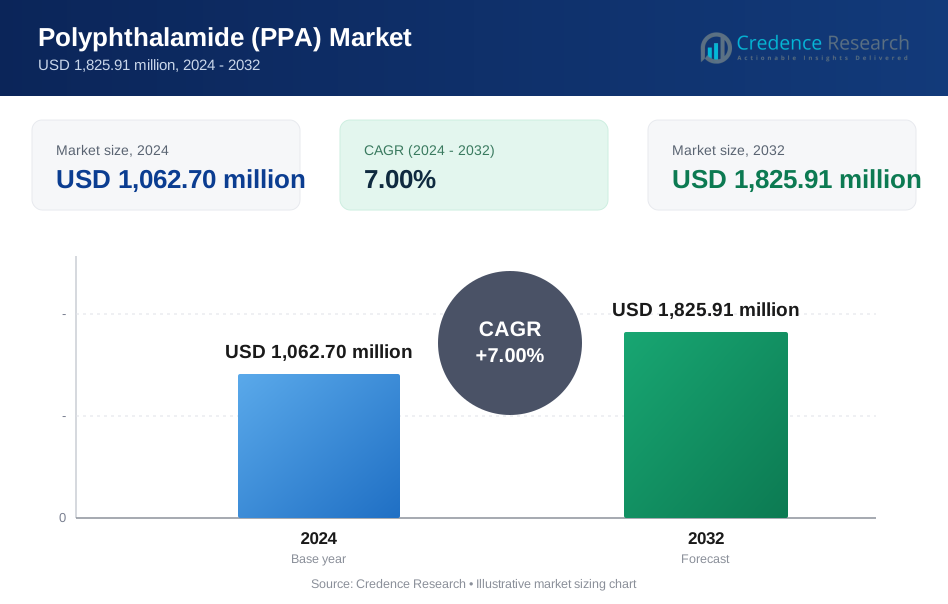
The global Polyphthalamide (PPA) Market is projected to grow from USD 1,062.70 million in 2024 to an estimated USD 1,825.91 million by 2032, reflecting a compound annual growth rate (CAGR) of 7.00% from 2025 to 2032. This growth is driven by the increasing demand for high-performance polymers in various end-use industries.
Key market drivers include the rising adoption of PPA in automotive applications due to its excellent thermal stability and mechanical properties, leading to weight reduction and improved fuel efficiency. Additionally, the growing use of PPA in electrical and electronics sectors for manufacturing connectors and insulators contributes to market expansion. Trends such as the development of bio-based PPAs and advancements in manufacturing technologies further bolster market growth.
Geographically, North America and Europe hold significant shares in the PPA market, attributed to the presence of major automotive and electronics manufacturers. In the Asia-Pacific region, rapid industrialization and increasing demand from emerging economies like China and India are propelling market growth. Key players in the global PPA market include BASF SE, Solvay SA, Evonik Industries AG, DSM Engineering Materials, and Arkema Group, which are focusing on strategic collaborations and product innovations to strengthen their market positions.
Market Insights
- The global PPA market is projected to grow from USD 1,062.70 million in 2024 to USD 1,825.91 million by 2032, with a CAGR of 7.00% from 2025 to 2032.
- The demand for lightweight, durable materials in automotive components, driven by fuel efficiency and environmental regulations, is a key growth driver for the PPA market.
- PPA’s high thermal stability and dielectric properties make it ideal for electrical and electronics applications, further fueling market demand.
- The high production costs of PPA, driven by expensive raw materials and manufacturing processes, may limit its adoption in price-sensitive applications.
- PPA faces competition from alternative engineering plastics, such as polyamides and PEEK, which may offer similar performance at a lower cost.
- Asia-Pacific leads the PPA market, driven by rapid industrialization and growing demand from emerging economies like China and India, particularly in automotive and electronics sectors.
- North America and Europe remain strong markets for PPA, with a significant share attributed to established automotive and electronics industries and ongoing demand for high-performance materials.
Market Drivers
Advancements in Material Science and Development of Bio-based PPA
Innovation in material science is playing a crucial role in driving the PPA market. The development of bio-based PPA, derived from renewable sources, is a significant trend in response to growing environmental concerns and the global push for sustainability. Bio-based PPA offers the same excellent properties as conventional PPA but with a reduced environmental footprint, making it a preferred option for companies striving to meet sustainability goals. These advancements are pushing PPA to become a more attractive alternative to traditional petroleum-based engineering plastics, especially in industries where environmental concerns and corporate social responsibility are becoming more prominent. The development of bio-based PPA aligns with the growing global trend toward greener and more sustainable materials in various industries, including automotive, electronics, and industrial applications. This shift towards more sustainable production practices is expected to further boost demand for PPA in the coming years.
Rising Adoption of PPA in Industrial Applications
Polyphthalamide’s exceptional properties also make it ideal for use in various industrial applications such as filtration, industrial machinery, and consumer goods. Its high strength, thermal stability, and chemical resistance make it suitable for use in harsh environments, where other materials may not perform adequately. In industrial filtration systems, PPA is used for producing filtration media that must withstand high temperatures and aggressive chemicals while maintaining their structural integrity. The demand for more efficient filtration systems across industries such as water treatment, oil and gas, and food processing is thus driving the growth of the PPA market. Furthermore, the increasing use of PPA in industrial machinery is being fueled by its ability to provide long-term durability and cost-effectiveness in equipment that operates under high-stress conditions. As industries continue to focus on improving operational efficiency, reducing downtime, and enhancing product quality, the need for high-performance polymers like PPA will continue to expand.
Growing Demand for Lightweight Materials in Automotive Industry
The automotive sector is a key driver of the global Polyphthalamide (PPA) market. With the increasing emphasis on reducing vehicle weight to improve fuel efficiency and meet stringent environmental regulations, PPA has emerged as an ideal solution due to its excellent mechanical properties and thermal stability. For instance, companies like BMW and Volkswagen are investing heavily in lightweight materials to enhance vehicle performance and comply with emissions standards. PPA’s high resistance to heat, chemicals, and wear makes it suitable for critical automotive components such as engine parts, fuel systems, connectors, and under-the-hood applications. The trend toward electric vehicles (EVs) and hybrid vehicles is also contributing to the demand for high-performance polymers like PPA. These vehicles require lightweight materials that can withstand higher temperatures while maintaining durability and structural integrity. As global vehicle production continues to rise and more automakers embrace lightweight material solutions, the demand for PPA in automotive applications is expected to continue its upward trajectory.
Increased Usage of PPA in Electrical and Electronics Applications
The rapid expansion of the electronics industry has further accelerated the growth of the PPA market. PPA is increasingly being used in manufacturing electrical and electronic components due to its superior dielectric properties, dimensional stability, and resistance to high temperatures. For instance, companies such as Samsung and Huawei are utilizing PPA in components like connectors and circuit boards because of its ability to maintain performance under extreme conditions. Components such as insulators and switchgears often require materials that can handle high temperatures while maintaining performance. Polyphthalamide’s resistance to heat and electrical conductivity makes it a suitable choice for these applications. Additionally, the growing demand for miniaturized and high-performance electronic devices, driven by advancements in telecommunications, computing, and consumer electronics, has further propelled the adoption of PPA in this sector. As the trend toward the development of 5G networks, IoT (Internet of Things) devices, and smart appliances continues to rise, the demand for materials like PPA will only strengthen, ensuring reliable performance in compact electronic designs.
Market Trends
Technological Advancements in PPA Manufacturing
Another critical trend in the PPA market is the ongoing technological advancements in its manufacturing processes. As demand for high-performance polymers continues to increase across multiple industries, manufacturers are continuously looking for ways to enhance the efficiency and cost-effectiveness of PPA production. Innovations such as new polymerization techniques, improved catalysts, and enhanced material formulations are being introduced to increase production capacity, reduce costs, and improve the overall quality of PPA. Additionally, these advancements aim to enable the production of specialized grades of PPA that can meet the specific needs of different industries, from automotive to electronics and industrial applications. The continuous focus on R&D is enabling manufacturers to produce PPA that not only performs better but is also more cost-effective and sustainable. These advancements are expected to expand the range of applications for PPA, driving the growth of the market. Moreover, these innovations may also lead to a reduction in energy consumption and greenhouse gas emissions during production, aligning with global sustainability goals.
Expansion of Polyphthalamide Applications in Emerging Economies
The demand for Polyphthalamide (PPA) is increasing in emerging economies, particularly in Asia-Pacific regions like China and India, which are seeing rapid industrialization and urbanization. As these regions continue to grow, so does the demand for high-performance materials in industries such as automotive, electronics, and industrial machinery. The increasing production of vehicles and electronic devices in these countries is driving the demand for PPA in applications such as connectors, insulators, and lightweight components for automotive and industrial machinery. The shift toward adopting advanced polymers like PPA in these regions is also being driven by a growing awareness of the benefits of using high-performance materials to improve product durability and energy efficiency. In addition to the automotive and electronics sectors, the demand for PPA is also being fueled by the expanding industrial and manufacturing base in these countries, which requires materials that can withstand extreme conditions and provide long-term reliability. Furthermore, with governments in these regions offering incentives and implementing regulations that support the use of advanced materials in manufacturing, the market for PPA is expected to experience significant growth in the coming years.
Shift Toward Bio-based Polyphthalamide (PPA) Solutions
The global trend toward sustainability has led to significant advancements in bio-based Polyphthalamide (PPA) solutions. Companies and governments are increasingly prioritizing the use of renewable resources to reduce environmental impacts. For instance, initiatives like India’s BioE3 policy promote the development of bio-based materials, including biopolymers, to foster a circular bioeconomy. This aligns with global efforts to mitigate climate change and reduce dependency on fossil fuels. Manufacturers are leveraging renewable feedstocks, such as plant-based materials, to produce high-performance bio-based PPA. These materials match the durability, thermal stability, and mechanical strength of conventional PPA while offering reduced carbon footprints. Industries such as automotive, electronics, and consumer goods are particularly benefiting from these innovations as they face stricter environmental regulations. Companies like IMCD have developed bio-based PPA with high bio-content, which is resistant to moisture and hydrolysis, making it suitable for demanding applications. This shift is further supported by government policies encouraging green manufacturing practices and innovation in biomanufacturing hubs. The adoption of bio-based PPA not only helps industries meet regulatory requirements but also caters to an environmentally conscious consumer base, ensuring a sustainable future for industrial applications.
Increased Demand in Electric Vehicles (EVs) and Hybrid Vehicles
The automotive sector's transition toward electric and hybrid vehicles is driving the demand for advanced materials like Polyphthalamide (PPA). Governments worldwide are implementing policies to promote EV adoption, such as India's FAME-II scheme and e-Mobility R&D initiatives. These programs aim to reduce emissions and support the development of lightweight, energy-efficient vehicles. PPA’s exceptional properties—thermal stability, mechanical strength, and resistance to wear—make it indispensable for manufacturing critical components like connectors, fuel systems, and engine parts in EVs. For instance, under-the-hood components made from PPA contribute to weight reduction and improved energy efficiency. The push for EVs is further bolstered by consumer preference for eco-friendly vehicles and incentives provided by governments to manufacturers and buyers alike. Additionally, advancements in charging infrastructure and battery technologies are accelerating the adoption of EVs globally. Regions like North America and Asia-Pacific are witnessing robust growth in EV production due to supportive policies and investments in R&D. As automakers strive for better performance and compliance with stringent emission norms, PPA continues to play a pivotal role in enabling innovation across the automotive industry.
Market Challenges
Competition from Alternative Engineering Plastics
The PPA market faces significant competition from alternative engineering plastics, which may offer similar or even superior properties in certain applications at a lower cost. Polymers such as polyamide (PA), polybutylene terephthalate (PBT), and polyetheretherketone (PEEK) often compete directly with PPA, particularly in sectors like automotive, electronics, and industrial applications. These alternative materials may provide comparable thermal stability, mechanical strength, and chemical resistance but at a more affordable price point. In some cases, these alternatives also have well-established manufacturing processes, which offer cost advantages over the relatively specialized production of PPA. As a result, manufacturers must demonstrate the unique value of PPA, particularly in applications where its superior properties, such as high-performance under extreme conditions, make it the material of choice. The increasing availability of alternative polymers with similar characteristics poses a continual challenge to the growth and market share of Polyphthalamide, especially in industries that are driven by cost-efficiency and ease of production.
High Production Costs and Limited Availability of Raw Materials
High production costs and limited availability of raw materials are significant hurdles for the global Polyphthalamide (PPA) market. PPA manufacturing relies on aromatic diamines and acids, which are expensive and prone to price fluctuations due to supply chain disruptions or geopolitical factors. For instance, disruptions in the petrochemical supply chain have historically affected the availability of these raw materials, leading to increased costs. The specialized equipment and processes required to produce high-quality PPA further elevate production expenses, making it less competitive compared to alternative engineering plastics like polyamide (PA) and polybutylene terephthalate (PBT). In industries such as automotive and consumer goods, where cost-effectiveness is critical, these challenges hinder the adoption of PPA. Additionally, bio-based PPA variants, while gaining traction due to environmental regulations and sustainability goals, face similar issues of high production costs and limited feedstock availability. For instance, despite government incentives promoting bio-based polymers, scaling up production remains a challenge for manufacturers. These economic pressures compel manufacturers to balance performance demands with affordability. As a result, PPA is primarily utilized in high-end applications where its superior thermal stability and mechanical strength justify the costs. However, this restricts its broader market penetration, limiting its growth potential.
Market Opportunities
Expansion in Emerging Markets
The global Polyphthalamide (PPA) market presents significant opportunities in emerging economies, particularly in the Asia-Pacific region, including China, India, and Southeast Asia. These regions are witnessing rapid industrialization, urbanization, and the growth of key sectors such as automotive, electronics, and manufacturing. The increasing demand for lightweight, durable materials in automotive components and electronic devices is driving the need for high-performance polymers like PPA. Additionally, emerging markets are witnessing a shift toward more sustainable manufacturing practices, with governments implementing regulations that encourage the use of advanced materials to improve energy efficiency and reduce environmental impact. As industries in these regions continue to grow, the demand for high-performance, cost-effective polymers will increase, creating vast market opportunities for PPA producers. Manufacturers that can establish a strong presence in these fast-growing markets can capitalize on the increasing demand for engineering plastics in various industrial applications.
Growth in Electric Vehicle (EV) and Hybrid Vehicle Segments
The ongoing shift toward electric vehicles (EVs) and hybrid vehicles presents a significant growth opportunity for the global PPA market. These vehicles require lightweight, high-performance materials to improve energy efficiency and overall performance. PPA's excellent thermal stability, mechanical properties, and resistance to chemicals make it an ideal choice for critical automotive components such as connectors, under-the-hood parts, fuel systems, and insulation materials. As governments around the world push for stricter emission regulations and promote the adoption of EVs, automakers are increasingly turning to advanced polymers like PPA to meet these demands. This trend is expected to accelerate the need for PPA in the automotive sector, particularly as the adoption of electric and hybrid vehicles continues to grow. Manufacturers focusing on providing tailored PPA solutions for the EV market stand to benefit from the growing demand for lightweight, high-performance materials.
Market Segmentation Analysis
By Product Type:
The market includes four main product types: unfilled, mineral filled, glass fiber filled, and carbon fiber filled PPA. Among these, glass fiber filled PPA holds the largest share due to its enhanced mechanical strength, heat resistance, and dimensional stability, making it highly suitable for automotive and electronic applications. Mineral filled PPA is also gaining traction for applications requiring improved thermal conductivity and flame retardancy. Carbon fiber filled PPA, while currently holding a smaller share, is projected to grow steadily owing to its lightweight nature and exceptional stiffness, making it ideal for specialized automotive and aerospace components. Unfilled PPA, typically used in less demanding environments, remains relevant for consumer goods and general industrial applications.
By Application:
Automotive is the leading application segment in the PPA market, driven by the need for lightweight, high-performance materials to enhance fuel efficiency and comply with environmental regulations. PPA is widely used in under-the-hood components, fuel systems, and transmission parts. The electronics & electrical segment is another major consumer, where PPA’s excellent dielectric properties and heat resistance make it ideal for connectors, circuit breakers, and insulating parts. Industrial equipment & apparatus also utilize PPA for parts exposed to harsh environments. Additionally, the consumer & personal care segment leverages PPA in durable products such as toothbrushes and grooming devices, while the “Others” category includes specialized uses in aerospace and medical applications.
Segments
Based on Product Type
- Unfilled
- Mineral Filled
- Glass Fiber Filled
- Carbon Fiber Filled
Based on Application
- Automotive
- Electronics & Electrical
- Industrial Equipment & Apparatus
- Consumer & Personal Care
- Others
Based on Region
- North America
- U.S.
- Canada
- Mexico
- Europe
- Germany
- France
- U.K.
- Italy
- Spain
- Rest of Europe
- Asia Pacific
- China
- Japan
- India
- South Korea
- South-east Asia
- Rest of Asia Pacific
- Latin America
- Brazil
- Argentina
- Rest of Latin America
- Middle East & Africa
- GCC Countries
- South Africa
- Rest of the Middle East and Africa
Regional Analysis
Asia-Pacific (45%)
Asia-Pacific holds the largest share of the global PPA market, accounting for approximately 45% of the total market. The region's dominance can be attributed to rapid industrialization, urbanization, and strong manufacturing sectors in countries like China, Japan, India, and South Korea. The automotive industry, particularly in China and India, is a significant driver of PPA demand, as manufacturers increasingly seek lightweight materials to meet stringent environmental standards. Additionally, the electronics sector in Japan and South Korea is heavily reliant on advanced polymers, including PPA, for high-performance components. The growing demand for electric vehicles (EVs) and hybrid vehicles in the region further contributes to the adoption of PPA, as automakers require durable, heat-resistant materials for critical parts. Moreover, the burgeoning industrial and consumer goods sectors are supporting PPA growth across the region.
North America (25%)
North America holds a substantial share of the PPA market, accounting for approximately 25%. The United States and Canada are key contributors, with a well-established automotive industry, particularly in electric and hybrid vehicles, where PPA is used for under-the-hood components and connectors. The strong focus on technological advancements and the adoption of sustainable materials in the region further boosts the market for bio-based PPA solutions. In addition to automotive, the electrical and electronics sectors in North America drive demand for PPA in applications such as connectors, circuit boards, and insulators. Regulatory pressures regarding emissions and fuel efficiency continue to push automotive manufacturers toward lightweight, high-performance materials like PPA.
Key players
- Celanese Corporation
- Evonik Industries AG
- Arkema
- Solvay
- BASF
Competitive Analysis
The global Polyphthalamide (PPA) market is highly competitive, with several prominent players vying for market share. Celanese Corporation is a key player, known for its strong product portfolio and innovation in high-performance materials. The company’s strategic business initiatives, such as expanding production capacities and enhancing product development, bolster its position in the PPA market. Evonik Industries AG is another major competitor, focusing on sustainable solutions and advanced manufacturing techniques. Arkema, with its diverse chemical offerings, strengthens its market presence by leveraging its expertise in high-performance thermoplastics. Solvay plays a significant role in providing specialized PPA solutions, particularly for automotive and electrical applications, supported by its robust R&D capabilities. BASF, as a global leader in chemicals, capitalizes on its extensive distribution network and strong customer relationships, solidifying its leadership in the PPA market. These companies continuously innovate and collaborate with other industries to maintain a competitive edge in the growing market.
Recent Developments
- In March 2025, BASF introduced new grades of Ultramid Advanced T1000, including hydrolysis-resistant (HR) and electronic-quality (EQ) variants. These materials are optimized for long-term durability in harsh environments such as automotive cooling systems and fuel cell applications.
- In March 2025, Solvay expanded its Amodel PPA resin production capacity by 15% at its Augusta manufacturing site in Georgia. This expansion aims to meet the growing demand for sustainable polymers and aligns with automotive electrification trends.
Market Concentration and Characteristics
The global Polyphthalamide (PPA) market exhibits a moderate level of concentration, with a few key players dominating the industry. Major companies such as Celanese Corporation, Evonik Industries AG, Arkema, Solvay, and BASF hold significant market share due to their strong product portfolios, extensive research and development capabilities, and global reach. These players focus on innovation, expanding production capacities, and meeting the increasing demand for high-performance materials in automotive, electronics, and industrial applications. The market is characterized by technological advancements, a focus on sustainability, and the development of bio-based PPA alternatives, which contribute to the growing competition among industry leaders. While established players control the majority of the market, emerging companies are gradually entering with specialized offerings to cater to niche applications, further intensifying competition. As demand for lightweight and durable materials rises, these key players are expected to continue shaping the market’s competitive landscape.
Report Coverage
The research report offers an in-depth analysis based on Product Type, Application and Region. It details leading market players, providing an overview of their business, product offerings, investments, revenue streams, and key applications. Additionally, the report includes insights into the competitive environment, SWOT analysis, current market trends, as well as the primary drivers and constraints. Furthermore, it discusses various factors that have driven market expansion in recent years. The report also explores market dynamics, regulatory scenarios, and technological advancements that are shaping the industry. It assesses the impact of external factors and global economic changes on market growth. Lastly, it provides strategic recommendations for new entrants and established companies to navigate the complexities of the market.
Future Outlook
- The global PPA market is expected to grow steadily over the next decade, driven by increasing demand for high-performance polymers across industries. This growth will be fueled by automotive, electronics, and industrial applications requiring lightweight, durable materials.
- The rising adoption of electric vehicles will significantly boost PPA demand for lightweight and heat-resistant components. PPA’s use in EVs will be key to enhancing energy efficiency and improving vehicle performance.
- Growing environmental concerns will accelerate the shift toward bio-based PPA alternatives. Manufacturers will focus on developing sustainable materials to meet both regulatory standards and consumer demand for greener solutions.
- Innovations in manufacturing technologies will lower production costs and improve the performance characteristics of PPA. These advancements will enhance the material's competitiveness across various applications.
- The expansion of the automotive industry in emerging markets such as India and China will provide new growth opportunities. Demand for lightweight, cost-effective materials will drive the adoption of PPA in these regions.
- As consumer electronics become more compact and high-performance, the need for PPA in components like connectors and insulators will increase. The electronics sector will be a significant contributor to the market’s growth.
- Leading players in the PPA market are likely to engage in strategic collaborations and partnerships. This will help them expand their product offerings and enter new geographic markets.
- Companies will focus on offering customized PPA solutions tailored to specific industry needs. This trend will drive further innovation, especially in automotive, electronics, and industrial sectors.
- Industrial equipment and apparatus manufacturers will increasingly rely on PPA for its strength and resistance to heat and chemicals. This will expand the use of PPA in machinery, filtration systems, and other critical applications.
- The competitive landscape will evolve with new entrants and established companies increasing their focus on R&D. The demand for PPA will intensify as key players push for greater market share through innovation and strategic expansion.
Request a Free Sample
Fill in your details and we'll send you a free sample report.
- Sample data tables & charts
- Research methodology
Need a Custom Version of This Report?
Tailor the scope, geography, or segments to your exact requirements.
- Custom geography or segment scope
- Direct access to our analyst team
Frequently Asked Questions
What is the projected market size of the global Polyphthalamide (PPA) Market in 2023 and 2032?
What are the key drivers for the growth of the Polyphthalamide (PPA) market?
How is the Polyphthalamide (PPA) market segmented?
Which regions are seeing the highest demand for Polyphthalamide (PPA)?
Who are the leading players in the global Polyphthalamide (PPA) market?
Table of Content
Chapter 1. Report Introduction
- 1.1 Report Description & Purpose
- 1.1.1 Report Title & Market Definition
- 1.1.2 Unique Selling Propositions (USP) & Key Differentiators
- 1.1.3 Value Proposition for Stakeholders
- 1.2 Research Objectives
- 1.2.1 Market Sizing Objectives (Volume & Revenue)
- 1.2.2 Segmentation Objectives
- 1.2.3 Competitive Intelligence Objectives
- 1.2.4 Forecast & Scenario Objectives
- 1.3 Report Scope
- 1.3.1 Polyphthalamide (PPA) Scope – Types & Subtypes Covered
- 1.3.2 Geographic Scope – Regions & Countries Covered
- 1.3.3 Historical Period, Base Year & Forecast Period (2024; forecast to 2032)
- 1.3.4 Inclusions & Exclusions
- 1.4 HS Code & Classification Framework
- 1.5 Currency, Units & Pricing Basis
- 1.6 Target Stakeholders
- 1.7 Limitations & Assumptions
Chapter 2. Executive Summary
- 2.1 Global Polyphthalamide (PPA) Market Snapshot
- 2.1.1 Market Size – Historical (2024) & Forecast (2024-2032) (2024: USD 1,062.70 million → 2032: USD 1,825.91 million)
- 2.1.2 Volume & Revenue – Global Totals
- 2.1.3 Key Market Highlights – Top Five Facts
- 2.2 Polyphthalamide (PPA) Market Segmentation Snapshot
- 2.2.1 Market Split by Region – 2024 vs. 2032
- 2.3 Competitive Snapshot
- 2.3.1 Top 10 Players by Revenue Share – 2024
- 2.3.2 Top 10 Players by Volume Share – 2024
- 2.3.3 Recent Strategic Developments (18-Month Summary)
- 2.4 Key Investment Highlights & Strategic Conclusions
Chapter 3. Polyphthalamide (PPA) Market Dynamics & Industry Analysis
- 3.1 Market Overview & Context
- 3.1.1 Polyphthalamide (PPA) Market Position in the Broader Automotive Value Chain
- 3.1.2 OEM vs. Replacement Market Dynamics
- 3.1.3 Market Maturity & Development Stage by Region
- 3.2 Polyphthalamide (PPA) Market Drivers
- 3.3 Polyphthalamide (PPA) Market Restraints & Challenges
- 3.4 Polyphthalamide (PPA) Market Opportunities
- 3.5 Porter's Five Forces Analysis
- 3.5.1 Threat of New Entrants
- 3.5.2 Bargaining Power of Suppliers
- 3.5.3 Bargaining Power of Buyers
- 3.5.4 Threat of Substitutes
- 3.5.5 Competitive Rivalry – Intensity Assessment
- 3.6 Polyphthalamide (PPA) Value Chain Analysis
- 3.6.1 Upstream – Raw Material/Input Suppliers
- 3.6.1.1 Raw Material/Input 1
- 3.6.1.2 Raw Material/Input 2
- 3.6.1.3 Raw Material/Input 3
- 3.6.2 Midstream – Production/Manufacturing/Service Delivery
- 3.6.2.1 Production/Process Overview
- 3.6.2.2 Key Facility Locations & Capacity by Manufacturer
- 3.6.3 Downstream – Distribution & End Consumer
- 3.6.3.1 Primary Channel – B2B/OEM
- 3.6.3.2 Secondary Channels – Dealer, Retail, Online, Direct
- 3.6.4 Value Chain Profitability Analysis
- 3.6.1 Upstream – Raw Material/Input Suppliers
- 3.7 PESTEL Analysis
- 3.7.1 Political Factors
- 3.7.2 Economic Factors
- 3.7.3 Social Factors
- 3.7.4 Technological Factors
- 3.7.5 Environmental Factors
- 3.7.6 Legal Factors
- 3.8 Polyphthalamide (PPA) Supply Chain Analysis
- 3.8.1 Raw Material/Input Supply Risk Assessment
- 3.8.2 Manufacturing Concentration Risk (Geographic Exposure)
- 3.8.3 Trade Disruption Impact Analysis
- 3.9 Regulatory & Policy Landscape
Note: The regulatory and policy landscape section covers regulations based on their applicability to the market, Polyphthalamide (PPA) category, geography, and scope of the study. Only regulatory frameworks with a material impact on operations, compliance, trade, sustainability, or market access are analyzed in detail.
Chapter 4. Key Investment Pockets & Opportunity Analysis
- 4.1 Polyphthalamide (PPA) Market Attractiveness Analysis
- 4.1.1 By Region – Investment Attractiveness Matrix (Volume × CAGR)
- 4.2 Absolute Revenue Growth Opportunity
- 4.2.1 By Region – Absolute USD Growth Through 2032
- 4.3 Incremental Volume Opportunity
- 4.3.1 By Region – Incremental Volume Through 2032
- 4.3.2 Segment – Incremental Volume
- 4.4 Emerging Submarket Opportunity Deep Dive (Subject to Applicability)
- 4.5 Emerging Market Opportunity Scorecards
- 4.5.1 United States
- 4.5.2 Europe
- 4.5.3 Asia
- 4.5.4 Middle East & Africa
Note: Emerging Market Opportunity Scorecards will be included based on relevance and strategic importance. Regions listed are indicative and may vary depending on data availability and market dynamics.
Chapter 5. Polyphthalamide (PPA) Import-Export Analysis & Trade Flows
- 5.1 Global Trade Overview
- 5.1.1 Global Export Value by Country (2024)
- 5.1.2 Global Export Volume by Country (2024)
- 5.1.3 Global Import Value by Country (2024)
- 5.1.4 Global Import Volume by Country (2024)
- 5.1.5 Net Trade Balance by Country (2024)
- 5.2 Export Analysis – Segment
- 5.2.1 Type 1 (HS Code)
- 5.2.2 Type 2 (HS Code)
- 5.2.3 Type 3 (HS Code)
- 5.2.4 Type 4 (HS Code)
- 5.2.5 Type 5 (HS Code)
- 5.3 Import Analysis – Segment
- 5.3.1 Type 1 (HS Code)
- 5.3.2 Type 2 (HS Code)
- 5.3.3 Type 3 (HS Code)
- 5.3.4 Type 4 (HS Code)
- 5.3.5 Type 5 (HS Code)
- 5.4 Average Unit Trade Prices
- 5.4.1 Average Export Price – Segment & Country
- 5.4.2 Average Import Price – Segment & Source Country
- 5.4.3 Price Trends (2024)
- 5.5 Key Trade Route Analysis
- 5.5.1 Trade Route 1
- 5.5.2 Trade Route 2
- 5.5.3 Trade Route 3
- 5.5.4 Trade Route 4
- 5.5.5 Trade Route 5
- 5.6 Trade Policy Impact Assessment
- 5.6.1 US Anti-Dumping & Section 301 Tariffs
- 5.6.2 EU Customs Union Impact
- 5.6.3 Major Free Trade Agreements
- 5.6.4 USMCA Rules of Origin
Note: Trade policy analysis will be included only where relevant to the Polyphthalamide (PPA) market.
Chapter 6. Competitive Landscape & Company Benchmarking
- 6.1 Polyphthalamide (PPA) Market Concentration & Structure
- 6.1.1 Herfindahl-Hirschman Index (HHI) – vs. 2024
- 6.1.2 Tier 1, Tier 2 & Tier 3 Market Structure
- 6.1.3 Global, Regional & Local Player Dynamics
- 6.2 Polyphthalamide (PPA) Market Share Analysis – 2024
- 6.2.1 Global Revenue Share by Company
- 6.2.2 Global Volume Share by Company
- 6.2.3 Regional Revenue Share
- 6.2.4 Market Share Evolution ( vs. 2024)
- 6.2.5 OEM Segment Share by Company
- 6.2.6 Replacement Segment Share by Company
- 6.3 Production/Delivery Capacity & Facility Analysis
- 6.3.1 Global Installed Capacity
- 6.3.2 Capacity Utilization Rates
- 6.3.3 Production/Output Volume
- 6.3.4 Facility Locations & Capacity Map
- 6.3.5 Planned Capacity Additions
- 6.4 Polyphthalamide (PPA) Competitive Benchmarking Matrix
- 6.4.1 Revenue, Volume, CAGR & Profitability Comparison
- 6.4.2 Channel Revenue Mix
- 6.4.3 Geographic Revenue Exposure
- 6.4.4 R&D Intensity
- 6.4.5 Sustainability Maturity
- 6.5 Strategic Developments in Polyphthalamide (PPA) (Last 24 Months)
- 6.5.1 Mergers, Acquisitions & Divestments
- 6.5.2 New Polyphthalamide (PPA) Launches
- 6.5.3 Facility Expansions
- 6.5.4 Strategic Alliances, Joint Ventures & Partnerships
- 6.5.5 Distribution Expansion & Market Entry
- 6.5.6 Sustainability & ESG Initiatives
- 6.6 Competitive Strategy Mapping
- 6.6.1 Leader, Challenger, Follower & Niche Classification
- 6.6.2 Pricing Strategy Comparison
- 6.6.3 Channel Strategy Matrix
Note: Strategic developments are included based on their materiality and the availability of reliable information.
Chapter 7. Global Polyphthalamide (PPA) Market – By Distribution Channel
- 7.1 Segment Overview
- 7.1.1 Volume & Revenue Split by Channel (2024 & 2032)
- 7.1.2 Channel Mix Evolution (2024-2032)
Chapter 8. Regional Market Analysis – Global Overview
- 8.1 Global Regional Overview
- 8.1.1 Regional Volume Share
- 8.1.2 Regional Revenue Share
- 8.1.3 Regional Volume by Region
- 8.1.4 Regional Revenue by Region
- 8.1.5 Regional Forecast Through 2032
- 8.2 Cross-Regional Segment Analysis
- 8.2.1 By Distribution Channel
- 8.2.2 By Brand/Price Tier
Chapter 9. North America Polyphthalamide (PPA) Market
- 9.1 United States
- 9.2 Canada
- 9.3 Mexico
Chapter 10. Europe Polyphthalamide (PPA) Market
- 10.1 Germany
- 10.2 France
- 10.3 Italy
- 10.4 United Kingdom
- 10.5 Spain
- 10.6 Poland
- 10.7 Russia
- 10.8 Netherlands
- 10.9 Belgium
- 10.10 Sweden
- 10.11 Denmark
- 10.12 Norway
- 10.13 Rest of Europe
Chapter 11. Asia Pacific Polyphthalamide (PPA) Market
- 11.1 China
- 11.2 India
- 11.3 Japan
- 11.4 South Korea
- 11.5 Thailand
- 11.6 Indonesia
- 11.7 Vietnam
- 11.8 Malaysia
- 11.9 Australia
- 11.10 Rest of Asia Pacific
Chapter 12. Latin America Polyphthalamide (PPA) Market
- 12.1 Brazil
- 12.2 Argentina
- 12.3 Colombia
- 12.4 Chile
- 12.5 Rest of Latin America
Chapter 13. Middle East Polyphthalamide (PPA) Market
- 13.1 Saudi Arabia
- 13.2 United Arab Emirates
- 13.3 Turkey
- 13.4 Israel
- 13.5 Iran
- 13.6 Rest of the Middle East
Chapter 14. Africa Polyphthalamide (PPA) Market
- 14.1 South Africa
- 14.2 Egypt
- 14.3 Nigeria
- 14.4 Morocco
- 14.5 Rest of Africa
Chapter 15. Polyphthalamide (PPA) Company Profiles
- 15.1 [Company 01]
- 15.1.1 Company Overview
- 15.1.2 Key Management Personnel
- 15.1.3 Products & Services Portfolio
- 15.1.4 Financial Performance
- 15.1.5 Key Market Focus & Geographic Presence
- 15.1.6 Recent Developments & Strategic Initiatives
Note: The company profile list is preliminary and may change based on research findings, market developments, data availability, and client requirements.
Chapter 16. Appendices
- Appendix A – List of Abbreviations & Acronyms
- Appendix B – Industry Classification Code Reference – Full Series
- Appendix C – Production & Capacity Data Tables
- Appendix D – End-Use & Demand Base Tables
- Appendix E – Consumption & Replacement Rate Assumptions
- Appendix F – ASP Reference Tables
- Appendix G – Manufacturing & Facility Database
- Appendix H – Import-Export Data Tables
- Appendix I – Regulatory Summary Tables
- Appendix J – Primary Research Participant List (Anonymized)
- Appendix K – Primary Research Questionnaire Framework
- Appendix L – Data Sources & Bibliography
- Appendix M – Market Size Divergence & Source Comparison
Chapter 17. Research Methodology
- 17.1 Research Framework & Philosophy
- 17.2 Secondary Research – Sources, Hierarchy & Data Extraction
- 17.3 Data Modeling – Bottom-Up & Top-Down Market Sizing
- 17.4 Primary Research – Stakeholder Framework, LOI & Sample Sizes
- 17.5 Forecast Methodology – Regression, Scenario & Sensitivity Analysis
- 17.6 Quality Control – Four-Layer Validation Framework
- 17.7 Limitations & Standard Assumptions
- 17.8 Disclaimer
