
| REPORT ATTRIBUTE | DETAILS |
|---|---|
| Historical Period | 2019-2022 |
| Base Year | 2023 |
| Forecast Period | 2024-2032 |
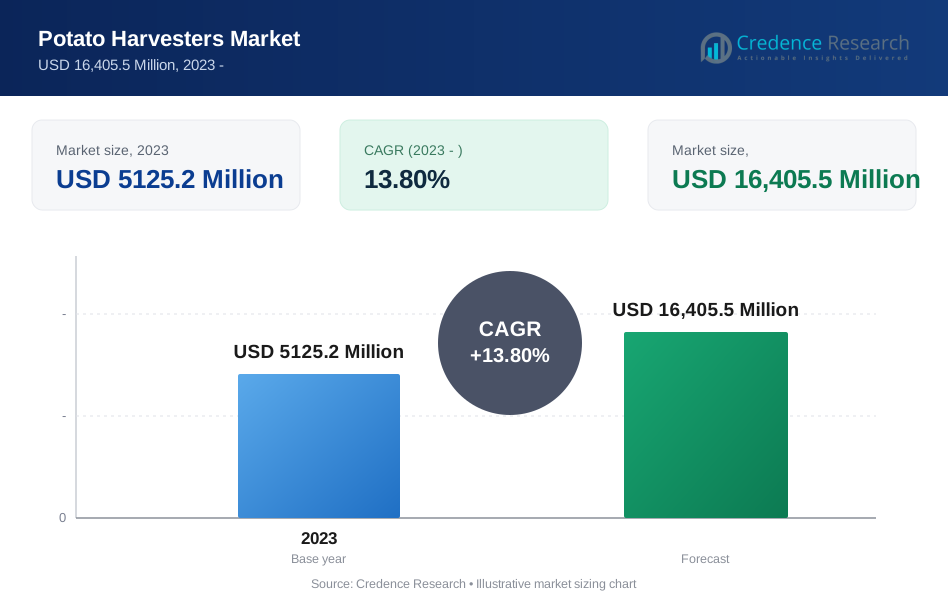
| Potato Harvesters Market Size 2023 | USD 5125.2 Million |
| Potato Harvesters Market, CAGR | 13.80% |
| Potato Harvesters Market Size 2032 | USD 16405.5 Million |
Market Insights
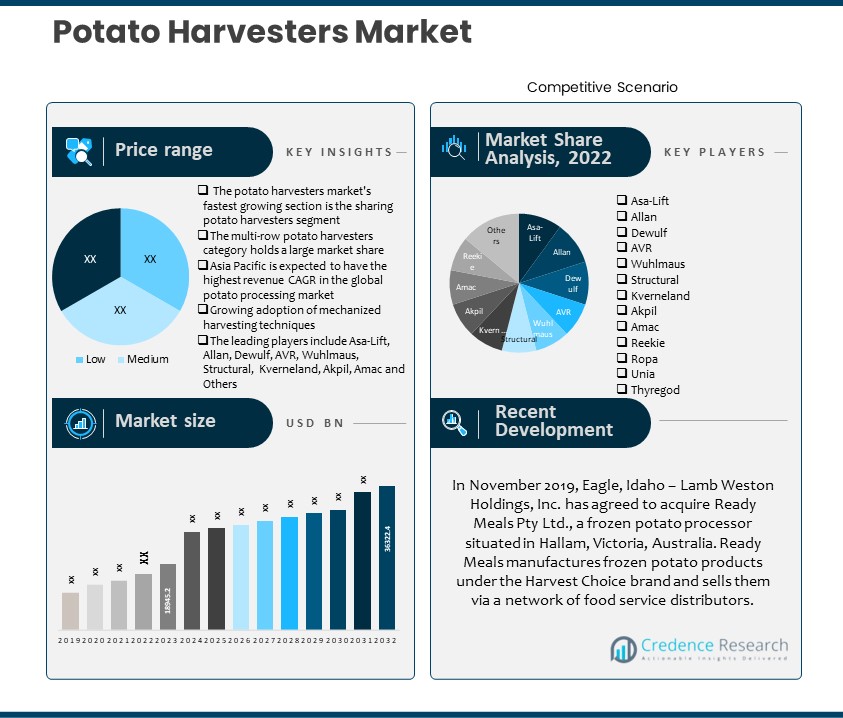
- The demand for Potato Harvesters was valued at USD 5125.2 Million in 2023 and is expected to reach USD 16405.5 Million in 2032, growing at a CAGR of 13.80% between 2024 and 2032.
- Mounted potato harvesters make up the majority of the potato harvesters market.
- Medium-capacity potato harvesters are the most popular sector of the market.
- The mechanical potato harvesters are the most common section.
- The sharing potato harvesters segment is the fastest-growing part of the potato harvesters market.
- The multi-row potato harvester category has a significant market share.
- The Large Farms sector has the largest market share in the potato harvester business.
- Self-propelled potato harvesters dominate the potato harvesting market.
- Hydraulic depth control is the fastest-expanding segment in the potato harvester market.
- Online sales are in high demand.
- The three-point hitch accounts for the majority of the potato harvester market.
- Asia Pacific is likely to have the highest revenue CAGR in the worldwide potato processing market throughout the forecast period, while North America is expected to have significant revenue growth.
- Increased Use of Vegetarian and Vegan Food Products Aids Market Growth
- The increasing prevalence of diseases induced by the usage of fried snacks is limiting industry expansion.
Executive Summary
Market Definition
The Potato Harvesters Market refers to the industry that manufactures and distributes machinery specifically designed to harvest potatoes. These devices are used to efficiently and effectively dig potatoes out of the ground, remove extra soil, and separate them from the plant. Potato harvesters serve an important role in agriculture since they automate the harvesting process, saving farmers time and labor. They come in a variety of shapes and Applications, with diverse functionalities to meet the special needs of potato producers. The potato harvesters market is driven by the demand for enhanced efficiency and production in potato growing operations.
Market Overview
The global Potato Harvesters Market has witnessed steady growth in recent years and is expected to grow at a CAGR of 13.80% between 2024 and 2032. The market was valued at USD 5125.2 million in 2023 and is expected to reach USD 16405.5 million in 2032.
The Potato Harvesters Market is a booming industry that meets the demands of potato producers. It entails the manufacture and distribution of machinery built exclusively for harvesting potatoes. These devices include diggers, conveyors, and separators to extract and separate potatoes from the plant efficiently. The market provides a variety of solutions, including varied Applications and capabilities, to meet the diverse needs of farmers. Potato harvesters are in high demand because farmers want to boost output, cut labor expenses, and improve efficiency. It is a critical industry that contributes to the success of potato farming.
Segmentation by Type
- Mounted potato harvesters account for the majority of the potato harvesters market. Mounted potato harvesters are meant to attach to tractors, enabling for more efficient and precise harvesting. They use specialized mechanics to dig up potatoes, separate them from the dirt, and gather them in a hopper for easier transportation.
- On the other hand, Trailed potato harvesters are drawn by tractors and used to harvest potatoes. Mounted harvesters are more popular because of their maneuverability and ease of usage.
Segmentation by Capacity
- Medium-capacity potato harvesters are the most popular segment in the market. They are also a key player in the potato harvester sector. Medium-capacity potato harvesters strike a compromise between efficiency and flexibility. They can handle a large number of potatoes while being agile in a variety of field situations. This makes them a popular alternative for farmers with medium-sized farms.
- While small-capacity potato harvesters are appropriate for smaller-scale operations and large-capacity harvesters are intended for larger-scale farming operations, the medium-capacity segment serves a wider range of farmers.
Segmentation by Operation Type
- Mechanical potato harvesters are the most popular segment of the potato harvesting market. Mechanical potato harvesters are popular because of their efficiency and ability to automate the potato harvesting process. These machines are outfitted with a variety of gears that dig up potatoes, separate them from soil, and gather them in a hopper for convenient transport.
Segmentation by Harvesting Mechanism
- The potato harvesters market's fastest growing section is the sharing potato harvesters segment. These harvesters are gaining popularity because to their efficiency and adaptability. Share potato harvesters are designed to efficiently extract potatoes from the soil and separate them from plants and dirt. They use blades, belts, and conveyors to gently lift the potatoes from the ground and transfer them to a pickup place..
Segmentation by Number of Rows
- The multi-row potato harvesters category holds a large market share. Farmers prefer multi-row potato harvesters because they are more efficient and productive. These harvesters are designed to harvest numerous rows of potatoes at the same time, which saves time and effort.
Segmentation by Application
- The Large Farms sector holds the largest market share in the potato harvester industry. Large farms, with their vast territory and enormous production volumes, require efficient and high-capacity potato harvesters to meet their demands. These farms frequently have a high demand for potato harvesters that can cover a vast area and harvest a huge quantity of potatoes in a short period.
Segmentation by Drive Type
- Self-propelled potato harvesters are the most popular part of the potato harvesting market. Self-propelled potato harvesters have grown in popularity due to their sophisticated features and improved efficiency. These harvesters have their power source, allowing them to move about without relying on a separate tractor.
Segmentation by Depth Control Mechanism
- Hydraulic depth control is the fastest-growing area in the potato harvester market. This capability has seen substantial expansion due to its multiple benefits and increased efficiency. Farmers can use it to automatically control and maintain the depth to which the harvester penetrates into the soil.
- When compared to manual depth control, hydraulic depth control provides more precise and consistent depth adjustments. It uses hydraulic systems to control the depth of the harvester blades, assuring peak harvesting performance while reducing the danger of injuring the potatoes or the soil.
Segmentation by Distribution Channel
- Online sales are in high demand. Online sales are becoming more popular due to their convenience and accessibility. Farmers can explore and buy potato harvesters from the convenience of their own homes, saving time and effort.
- Retail sales are a significant element of the potato harvesters market.
Segmentation by Hitch Type
- The three-point hitch accounts for the largest share of the potato harvester market. The three-point hitch is a popular choice among farmers in the potato harvester industry due to its adaptability and compatibility with a variety of tractor types. It establishes a secure and stable connection between the harvester and the tractor, enabling effective power transfer and maneuverability during harvesting operations.
Segmentation by Region
- Asia Pacific is expected to have the highest revenue CAGR in the global potato processing market throughout the projected period.
- North America is expected to have considerable revenue growth in the global potato processing market.
- The rest of the world, including Latin America, the Middle East, and Africa, supplies the remaining demand for Potato Harvesters.
Asia Pacific is predicted to have the greatest revenue CAGR in the global potato processing market throughout the forecast period. High volumes of potato production for the potato processing industry in Asia-Pacific countries, particularly India and China, an increase in the number of mergers and acquisitions, and low labor costs are among the major factors driving Asia-Pacific potato processing market revenue growth.
On the other hand, North America is likely to have significant revenue growth in the worldwide potato processing market throughout the forecast period, owing to rising demand for processed potato products such as salad, chips, and French fries. The presence of leading significant players such as McCain Foods Limited and Lamb Weston Holdings, Inc. helps to drive market revenue growth in the region.
Key Highlights of the Report
Type, Capacity, Operation Type, Harvesting Mechanism, Type, Application, Drive Type, Depth Control Mechanism, and Region segment of the global Potato Harvesters Market. The multi-row potato harvester category has a substantial market share, with hydraulic depth control being the fastest-growing segment. In addition, mechanical potato harvesters are the most popular section, with online sales in great demand. Also, small-capacity potato harvesters are suitable for smaller-scale enterprises, with Asia Pacific leading the market growth.
The primary market drivers include increasing demand for mechanization, a growing worldwide population, increased demand for potatoes, and technological advancements. Furthermore, high initial investment costs for purchasing potato harvesters, limited availability of qualified operators, and environmental concerns about fuel consumption and emissions from potato harvesters are the primary restraints of the industry.
Nonetheless, Asia-Pacific is expected to have the highest revenue CAGR in the global potato processing market throughout the forecast period. High potato production volumes for the potato processing sector in Asia-Pacific countries, particularly India and China, increased mergers and acquisitions, and low labor costs are among the primary drivers driving Asia-Pacific potato processing market revenue growth. Furthermore, North America is expected to have considerable revenue growth in the global potato processing market during the forecast period.
What Are The Main Drivers Of The Global Potato Harvesters Market?
One of the primary drivers of the Potato Harvesters Market is the growing desire for dynamic and engaging customer experiences. Businesses understand the value of capturing their audience and creating memorable encounters. Potato Harvesters allows you to broadcast dynamic and visually appealing material that catches attention and increases customer engagement. Another factor is the expanding use of digital signs in a variety of industries, including retail and transportation. Businesses use Potato Harvesters to give real-time information, market their products and services, and create immersive experiences. This widespread use is boosting the market's growth.
What Are The Major Challenges Faced By The Global Potato Harvesters Market?
While the Potato Harvesters Market is experiencing growth, there are also some restraints to consider. One of the main restraints is the high initial investment and installation costs associated with implementing Potato Harvesters systems. This can be a barrier for smaller businesses or organizations with limited budgets. Privacy concerns and data security risks are another restraint. As Potato Harvesters networks collect and process customer data, there is a need to ensure proper data protection and privacy measures are in place. Addressing these concerns is crucial to maintain trust and comply with data protection regulations..
What Are The Growth Opportunities In The Global Potato Harvesters Market?
The Potato Harvesters Market also presents several opportunities for businesses. One opportunity lies in the integration of artificial intelligence (AI) and machine learning (ML) technologies. By leveraging AI and ML algorithms, businesses can deliver personalized content based on user preferences and behavior. This customization enhances the effectiveness of Potato Harvesters campaigns and improves the overall customer experience. Another opportunity is the expansion of Potato Harvesters networks in emerging markets. As economies grow and infrastructure develops, there is an increasing demand for Potato Harvesters solutions. Businesses can tap into these markets and establish a strong presence, offering their products and services to a new customer base.
Market Drivers
Several factors drive the global Potato Harvesters Market. The following are the key drivers of the global Potato Harvesters Market:
Increasing Adoption of Vegetarian and Vegan Food Products
The increased popularity of vegetarian and vegan food items in developed countries due to rising health consciousness and concern for animal welfare is expected to fuel demand for processed potato products over the forecast period. Furthermore, ready-to-cook potato goods such as fries, soups, and snacks are being sold with labels like'vegan' or 'organic' to increase sales. In 2023, it is anticipated that over 1.5 billion individuals, or 22% of the global population, would be vegetarian. In addition, between 2023 and 2032, the number of vegetarians in Germany climbed by 1.19 million. Their growing popularity in the media, combined with several health benefits, is expected to boost the number of vegetarians and vegans during the projected period.
Market Restraints
The global Potato Harvesters Market faces some challenges that may hinder its growth. These include the following:
Increasing Prevalence Of Ailments Caused By The Use Of Fried Snacks
Increased potato chip eating has been linked to hypertension, cardiovascular disease, and cancer. Furthermore, excessive consumption of fried potato products increases the chance of acquiring illnesses such as stroke and obesity. For instance, a study of 4,440 people aged 45 to 79 discovered that those who ate fried potatoes two or more times a week, such as French fries, hash browns, and potato chips, had twice the chance of dying young than those who did not eat fried potatoes. The elevated risk is due to the presence of cooking oil, which contains trans fat, in fried potato products. Trans fat has been linked to elevated levels of LDL cholesterol in the blood, which can lead to heart disease.
Opportunities
The global Potato Harvesters Market offers significant growth opportunities. These include the following:
Growth And Recovery Of The Food Service Sector
The expansion and recovery of restaurant chains and quick-service restaurants are expected to enhance demand for potato processing, as these food services make substantial use of French fries, potato snacks, and other ready-to-cook meals. For instance, Restaurants Canada projects that annual sales at commercial foodservice restaurants in the country will climb from $54.9 billion in 2020 to $61.4 billion in 2023. By 2023, the market is predicted to return to pre-pandemic levels, totaling $78.6 billion. The expansion is aided by the rising use of online meal delivery services, which allow businesses to send food products even when limitations are imposed due to COVID-19.
Competitive Landscape
Key Players
The global Potato Harvesters Market is highly competitive, with several key players. Some of the major players in the market and their market share are as follows:
- Asa-Lift
- Allan
- Dewulf
- AVR
- Wuhlmaus
- Structural
- Kverneland
- Akpil
- Amac
- Reekie
- Ropa
- Unia
- Thyregod
- Fortschritt
- Badalini
- Burgonyakiszedo
- Ecomatic
- Kuxmann Landmaschinen GmbH
- Miedema Landbouwwerktuigenfabriek BV
- Gruse
These organizations prioritize product innovation, Operation Type expansion, and mergers and acquisitions to stay competitive.
The global Potato Harvesters Market's key players continually seek to stay ahead by offering new products and developments.
In October, 2019, KWS SAAT SE and the J.R. Simplot business formed a new joint venture business, Aardevo B.V., to develop high-performance potato cultivars through hybrid breeding. The joint venture combines Simplot's highly advanced potato growing and processing facilities (Boise, USA) with KWS's extensive experience and skill in hybrid plant breeding (Einbeck, Germany). Aardevo will prioritize producing new potato varieties with superior and innovative qualities as soon as feasible. Aardevo will provide growers and consumers new and exciting options by boosting taste and texture, increasing yield, and strengthening disease resistance and processing quality.
In July 2021, Lamb Weston Holdings, Inc. has announced an increase in French fry processing capacity at its American Falls, Idaho facility. They expect to produce more than 350 million pounds of frozen french fries and other potato products each year as a result of this. The new line is expected to be completed by the middle of 2023, creating approximately 130 additional jobs.
Summary of Key Findings
- Market growth is being driven by the food service sector's expansion and recovery.
- The market is segmented by type, Capacity, Operation Type, Harvesting Mechanism, type, Application, Drive Type, Depth Control Mechanism, Distribution Channel, hit type, and region.
- The multi-row potato harvester category has a big market share.
- Mechanical potato harvesters are the most popular part
- Asia Pacific is leading market growth. The market is highly competitive, with key players including Asa-Lift, Allan, Dewulf, AVR, Wuhlmaus, Structural, Kverneland, Akpil, Amac, and Others.
Future Outlook
- Growing adoption of mechanized harvesting techniques
- Increasing focus on precision farming
- Advancements in Number of Rows and automation
- Rising demand for high-capacity and efficient harvesters
- Expansion of potato farming in emerging markets
- Introduction of eco-friendly and sustainable harvesting solutions
How CXOs Can Benefit from the Credence Research Potato Harvesters Market Report
The Credence Research Potato Harvesters Market Report provides CXOs with a comprehensive overview of the market, including:
- Market Application and growth forecast: The report provides detailed estimates of the global Potato Harvesters Market Application, segmented by Type, Capacity, Operation Type, Harvesting Mechanism type, Application, Drive Type, Depth Control Mechanism, and region. It also includes forecasts for the market through 2032 based on key trends and drivers.
- Market segmentation: The report segments the Potato Harvesters Market by Type, Capacity, Operation Type, Harvesting Mechanism, type, Application, Drive Type, Depth Control Mechanism, and Region. This segmentation provides CXOs with a granular understanding of the market and the opportunities in each segment.
- Competitive Landscape: The report profiles the key players in the Potato Harvesters Market and provides insights into their strategies, product offerings, and financial performance. This information can help CXOs to identify and assess their competition.
- Key trends and drivers: The report identifies and analyzes the key trends and drivers that are shaping the Potato Harvesters Market. This information can help CXOs to make informed decisions about their investments and strategies.
CXOs can use the insights from the Credence Research Potato Harvesters Market Report to:
- Identify growth opportunities: The report can help CXOs to identify new growth opportunities in the Potato Harvesters Market. For example, it can provide insights into emerging trends, market dynamics, and competitive landscapes.
- Make informed investment decisions: The report can help CXOs make informed investment decisions about Potato Harvesters. For example, it provides market analysis and insights into key players, market trends, and growth opportunities.
- Develop competitive strategies: The report can help CXOs develop competitive strategies for their Potato Harvesters businesses. It provides insights on market trends, customer preferences, and competitor analysis.
- Track market developments: The report can help CXOs monitor market developments and stay ahead of the curve. For example, it provides insights into the latest trends and innovations in the Potato Harvesters Market.
Overall, the Credence Research Potato Harvesters Market Report is a valuable resource for CXOs who are looking to gain a deeper understanding of the market and identify opportunities for growth.
By Segmentation
By Type:- Mounted Potato Harvesters
- Trailed Potato Harvesters
- Self-Propelled Potato Harvesters
- Small Capacity Potato Harvesters
- Medium Capacity Potato Harvesters
- Large Capacity Potato Harvesters
- Manual Potato Harvesters
- Mechanical Potato Harvesters
- Share Potato Harvesters
- Lift Potato Harvesters
- Windrow Potato Harvesters
- Single-Row Potato Harvesters
- Multi-Row Potato Harvesters
- Large Farms
- Small and Medium-Applicationd Farms
- Others
- Tractor-Driven Potato Harvesters
- Self-Propelled Potato Harvesters
- Manual Depth Control
- Hydraulic Depth Control
- Direct Sales
- Online Sales
- Retail Sales
- Three-Point Hitch
- Drawbar Hitch
- North America
- U.S
- Canada
- Mexico
- Europe
- Germany
- France
- U.K.
- Italy
- Spain
- Rest of Europe
- Asia Pacific
- China
- Japan
- India
- South Korea
- South-east Asia
- Rest of Asia Pacific
- Latin America
- Brazil
- Argentina
- Rest of Latin America
- Middle East & Africa
- GCC Countries
- South Africa
- Rest of the Middle East and Africa
Adjacent Markets |
||
| Corn Harvesters Market | Vegetable Harvesters Market | Olive Harvesters Market |
| Wheat Harvesters Market | Fruit Harvesters Market | Coffee Harvesters Market |
| Rice Harvesters Market | Sugar Beet Harvesters Market | Grape Harvesters Market |
Request a Free Sample
Fill in your details and we'll send you a free sample report.
- Sample data tables & charts
- Research methodology
Need a Custom Version of This Report?
Tailor the scope, geography, or segments to your exact requirements.
- Custom geography or segment scope
- Direct access to our analyst team
Frequently Asked Questions
What is the current Application of the global Potato Harvesters Market?
What is the expected growth rate of the Potato Harvesters Market between 2024 and 2032?
Which segment is leading the market share in terms of Application?
Which Distribution Channel segment governs the demand for Potato Harvesters in the world?
Which Operation Type segment is expected to post the fastest growth during the forecast period?
Which region is fueling the growth of the Potato Harvesters industry?
Who are the major players in the global Potato Harvesters Market?
What are the major market drivers of the Potato Harvesters industry?
What are the major market restraints of the Potato Harvesters industry?
What are the major market opportunities of the Potato Harvesters industry?
Table of Content
Chapter 1. Report Introduction
- 1.1 Report Description & Purpose
- 1.1.1 Report Title & Market Definition
- 1.1.2 Unique Selling Propositions (USP) & Key Differentiators
- 1.1.3 Value Proposition for Stakeholders
- 1.2 Research Objectives
- 1.2.1 Market Sizing Objectives (Volume & Revenue)
- 1.2.2 Segmentation Objectives
- 1.2.3 Competitive Intelligence Objectives
- 1.2.4 Forecast & Scenario Objectives
- 1.3 Report Scope
- 1.3.1 Potato Harvesters Scope – Types & Subtypes Covered
- 1.3.2 Geographic Scope – Regions & Countries Covered
- 1.3.3 Historical Period, Base Year & Forecast Period (2023; forecast to the forecast period)
- 1.3.4 Inclusions & Exclusions
- 1.4 HS Code & Classification Framework
- 1.5 Currency, Units & Pricing Basis
- 1.6 Target Stakeholders
- 1.7 Limitations & Assumptions
Chapter 2. Executive Summary
- 2.1 Global Potato Harvesters Market Snapshot
- 2.1.1 Market Size – Historical (2023) & Forecast (the forecast period) (2023: USD 5125.2 Million → forecast year: USD 16,405.5 Million)
- 2.1.2 Volume & Revenue – Global Totals
- 2.1.3 Key Market Highlights – Top Five Facts
- 2.2 Potato Harvesters Market Segmentation Snapshot
- 2.2.1 Market Split by Region – 2023 vs.
- 2.3 Competitive Snapshot
- 2.3.1 Top 10 Players by Revenue Share – 2023
- 2.3.2 Top 10 Players by Volume Share – 2023
- 2.3.3 Recent Strategic Developments (18-Month Summary)
- 2.4 Key Investment Highlights & Strategic Conclusions
Chapter 3. Potato Harvesters Market Dynamics & Industry Analysis
- 3.1 Market Overview & Context
- 3.1.1 Potato Harvesters Market Position in the Broader Automotive Value Chain
- 3.1.2 OEM vs. Replacement Market Dynamics
- 3.1.3 Market Maturity & Development Stage by Region
- 3.2 Potato Harvesters Market Drivers
- 3.3 Potato Harvesters Market Restraints & Challenges
- 3.4 Potato Harvesters Market Opportunities
- 3.5 Porter's Five Forces Analysis
- 3.5.1 Threat of New Entrants
- 3.5.2 Bargaining Power of Suppliers
- 3.5.3 Bargaining Power of Buyers
- 3.5.4 Threat of Substitutes
- 3.5.5 Competitive Rivalry – Intensity Assessment
- 3.6 Potato Harvesters Value Chain Analysis
- 3.6.1 Upstream – Raw Material/Input Suppliers
- 3.6.1.1 Raw Material/Input 1
- 3.6.1.2 Raw Material/Input 2
- 3.6.1.3 Raw Material/Input 3
- 3.6.2 Midstream – Production/Manufacturing/Service Delivery
- 3.6.2.1 Production/Process Overview
- 3.6.2.2 Key Facility Locations & Capacity by Manufacturer
- 3.6.3 Downstream – Distribution & End Consumer
- 3.6.3.1 Primary Channel – B2B/OEM
- 3.6.3.2 Secondary Channels – Dealer, Retail, Online, Direct
- 3.6.4 Value Chain Profitability Analysis
- 3.6.1 Upstream – Raw Material/Input Suppliers
- 3.7 PESTEL Analysis
- 3.7.1 Political Factors
- 3.7.2 Economic Factors
- 3.7.3 Social Factors
- 3.7.4 Technological Factors
- 3.7.5 Environmental Factors
- 3.7.6 Legal Factors
- 3.8 Potato Harvesters Supply Chain Analysis
- 3.8.1 Raw Material/Input Supply Risk Assessment
- 3.8.2 Manufacturing Concentration Risk (Geographic Exposure)
- 3.8.3 Trade Disruption Impact Analysis
- 3.9 Regulatory & Policy Landscape
Note: The regulatory and policy landscape section covers regulations based on their applicability to the market, Potato Harvesters category, geography, and scope of the study. Only regulatory frameworks with a material impact on operations, compliance, trade, sustainability, or market access are analyzed in detail.
Chapter 4. Key Investment Pockets & Opportunity Analysis
- 4.1 Potato Harvesters Market Attractiveness Analysis
- 4.1.1 By Region – Investment Attractiveness Matrix (Volume × CAGR)
- 4.2 Absolute Revenue Growth Opportunity
- 4.2.1 By Region – Absolute USD Growth Through the forecast period
- 4.3 Incremental Volume Opportunity
- 4.3.1 By Region – Incremental Volume Through the forecast period
- 4.3.2 Segment – Incremental Volume
- 4.4 Emerging Submarket Opportunity Deep Dive (Subject to Applicability)
- 4.5 Emerging Market Opportunity Scorecards
- 4.5.1 United States
- 4.5.2 Europe
- 4.5.3 Asia
- 4.5.4 Middle East & Africa
Note: Emerging Market Opportunity Scorecards will be included based on relevance and strategic importance. Regions listed are indicative and may vary depending on data availability and market dynamics.
Chapter 5. Potato Harvesters Import-Export Analysis & Trade Flows
- 5.1 Global Trade Overview
- 5.1.1 Global Export Value by Country (2023)
- 5.1.2 Global Export Volume by Country (2023)
- 5.1.3 Global Import Value by Country (2023)
- 5.1.4 Global Import Volume by Country (2023)
- 5.1.5 Net Trade Balance by Country (2023)
- 5.2 Export Analysis – Segment
- 5.2.1 Type 1 (HS Code)
- 5.2.2 Type 2 (HS Code)
- 5.2.3 Type 3 (HS Code)
- 5.2.4 Type 4 (HS Code)
- 5.2.5 Type 5 (HS Code)
- 5.3 Import Analysis – Segment
- 5.3.1 Type 1 (HS Code)
- 5.3.2 Type 2 (HS Code)
- 5.3.3 Type 3 (HS Code)
- 5.3.4 Type 4 (HS Code)
- 5.3.5 Type 5 (HS Code)
- 5.4 Average Unit Trade Prices
- 5.4.1 Average Export Price – Segment & Country
- 5.4.2 Average Import Price – Segment & Source Country
- 5.4.3 Price Trends (2023)
- 5.5 Key Trade Route Analysis
- 5.5.1 Trade Route 1
- 5.5.2 Trade Route 2
- 5.5.3 Trade Route 3
- 5.5.4 Trade Route 4
- 5.5.5 Trade Route 5
- 5.6 Trade Policy Impact Assessment
- 5.6.1 US Anti-Dumping & Section 301 Tariffs
- 5.6.2 EU Customs Union Impact
- 5.6.3 Major Free Trade Agreements
- 5.6.4 USMCA Rules of Origin
Note: Trade policy analysis will be included only where relevant to the Potato Harvesters market.
Chapter 6. Competitive Landscape & Company Benchmarking
- 6.1 Potato Harvesters Market Concentration & Structure
- 6.1.1 Herfindahl-Hirschman Index (HHI) – vs. 2023
- 6.1.2 Tier 1, Tier 2 & Tier 3 Market Structure
- 6.1.3 Global, Regional & Local Player Dynamics
- 6.2 Potato Harvesters Market Share Analysis – 2023
- 6.2.1 Global Revenue Share by Company
- 6.2.2 Global Volume Share by Company
- 6.2.3 Regional Revenue Share
- 6.2.4 Market Share Evolution ( vs. 2023)
- 6.2.5 OEM Segment Share by Company
- 6.2.6 Replacement Segment Share by Company
- 6.3 Production/Delivery Capacity & Facility Analysis
- 6.3.1 Global Installed Capacity
- 6.3.2 Capacity Utilization Rates
- 6.3.3 Production/Output Volume
- 6.3.4 Facility Locations & Capacity Map
- 6.3.5 Planned Capacity Additions
- 6.4 Potato Harvesters Competitive Benchmarking Matrix
- 6.4.1 Revenue, Volume, CAGR & Profitability Comparison
- 6.4.2 Channel Revenue Mix
- 6.4.3 Geographic Revenue Exposure
- 6.4.4 R&D Intensity
- 6.4.5 Sustainability Maturity
- 6.5 Strategic Developments in Potato Harvesters (Last 24 Months)
- 6.5.1 Mergers, Acquisitions & Divestments
- 6.5.2 New Potato Harvesters Launches
- 6.5.3 Facility Expansions
- 6.5.4 Strategic Alliances, Joint Ventures & Partnerships
- 6.5.5 Distribution Expansion & Market Entry
- 6.5.6 Sustainability & ESG Initiatives
- 6.6 Competitive Strategy Mapping
- 6.6.1 Leader, Challenger, Follower & Niche Classification
- 6.6.2 Pricing Strategy Comparison
- 6.6.3 Channel Strategy Matrix
Note: Strategic developments are included based on their materiality and the availability of reliable information.
Chapter 7. Global Potato Harvesters Market – By Distribution Channel
- 7.1 Segment Overview
- 7.1.1 Volume & Revenue Split by Channel (2023 & )
- 7.1.2 Channel Mix Evolution (the forecast period)
Chapter 8. Regional Market Analysis – Global Overview
- 8.1 Global Regional Overview
- 8.1.1 Regional Volume Share
- 8.1.2 Regional Revenue Share
- 8.1.3 Regional Volume by Region
- 8.1.4 Regional Revenue by Region
- 8.1.5 Regional Forecast Through the forecast period
- 8.2 Cross-Regional Segment Analysis
- 8.2.1 By Distribution Channel
- 8.2.2 By Brand/Price Tier
Chapter 9. North America Potato Harvesters Market
- 9.1 United States
- 9.2 Canada
- 9.3 Mexico
Chapter 10. Europe Potato Harvesters Market
- 10.1 Germany
- 10.2 France
- 10.3 Italy
- 10.4 United Kingdom
- 10.5 Spain
- 10.6 Poland
- 10.7 Russia
- 10.8 Netherlands
- 10.9 Belgium
- 10.10 Sweden
- 10.11 Denmark
- 10.12 Norway
- 10.13 Rest of Europe
Chapter 11. Asia Pacific Potato Harvesters Market
- 11.1 China
- 11.2 India
- 11.3 Japan
- 11.4 South Korea
- 11.5 Thailand
- 11.6 Indonesia
- 11.7 Vietnam
- 11.8 Malaysia
- 11.9 Australia
- 11.10 Rest of Asia Pacific
Chapter 12. Latin America Potato Harvesters Market
- 12.1 Brazil
- 12.2 Argentina
- 12.3 Colombia
- 12.4 Chile
- 12.5 Rest of Latin America
Chapter 13. Middle East Potato Harvesters Market
- 13.1 Saudi Arabia
- 13.2 United Arab Emirates
- 13.3 Turkey
- 13.4 Israel
- 13.5 Iran
- 13.6 Rest of the Middle East
Chapter 14. Africa Potato Harvesters Market
- 14.1 South Africa
- 14.2 Egypt
- 14.3 Nigeria
- 14.4 Morocco
- 14.5 Rest of Africa
Chapter 15. Potato Harvesters Company Profiles
- 15.1 [Company 01]
- 15.1.1 Company Overview
- 15.1.2 Key Management Personnel
- 15.1.3 Products & Services Portfolio
- 15.1.4 Financial Performance
- 15.1.5 Key Market Focus & Geographic Presence
- 15.1.6 Recent Developments & Strategic Initiatives
Note: The company profile list is preliminary and may change based on research findings, market developments, data availability, and client requirements.
Chapter 16. Appendices
- Appendix A – List of Abbreviations & Acronyms
- Appendix B – Industry Classification Code Reference – Full Series
- Appendix C – Production & Capacity Data Tables
- Appendix D – End-Use & Demand Base Tables
- Appendix E – Consumption & Replacement Rate Assumptions
- Appendix F – ASP Reference Tables
- Appendix G – Manufacturing & Facility Database
- Appendix H – Import-Export Data Tables
- Appendix I – Regulatory Summary Tables
- Appendix J – Primary Research Participant List (Anonymized)
- Appendix K – Primary Research Questionnaire Framework
- Appendix L – Data Sources & Bibliography
- Appendix M – Market Size Divergence & Source Comparison
Chapter 17. Research Methodology
- 17.1 Research Framework & Philosophy
- 17.2 Secondary Research – Sources, Hierarchy & Data Extraction
- 17.3 Data Modeling – Bottom-Up & Top-Down Market Sizing
- 17.4 Primary Research – Stakeholder Framework, LOI & Sample Sizes
- 17.5 Forecast Methodology – Regression, Scenario & Sensitivity Analysis
- 17.6 Quality Control – Four-Layer Validation Framework
- 17.7 Limitations & Standard Assumptions
- 17.8 Disclaimer
