
| REPORT ATTRIBUTE | DETAILS |
|---|---|
| Historical Period | 2019-2022 |
| Base Year | 2023 |
| Forecast Period | 2024-2032 |
| Ready-to-Use Therapeutic Food Market Size 2023 | USD 758.2 Million |
| Ready-to-Use Therapeutic Food Market, CAGR | 6.00% |
| Ready-to-Use Therapeutic Food Market Size 2032 | USD 1280.9 Million |
Market Insights
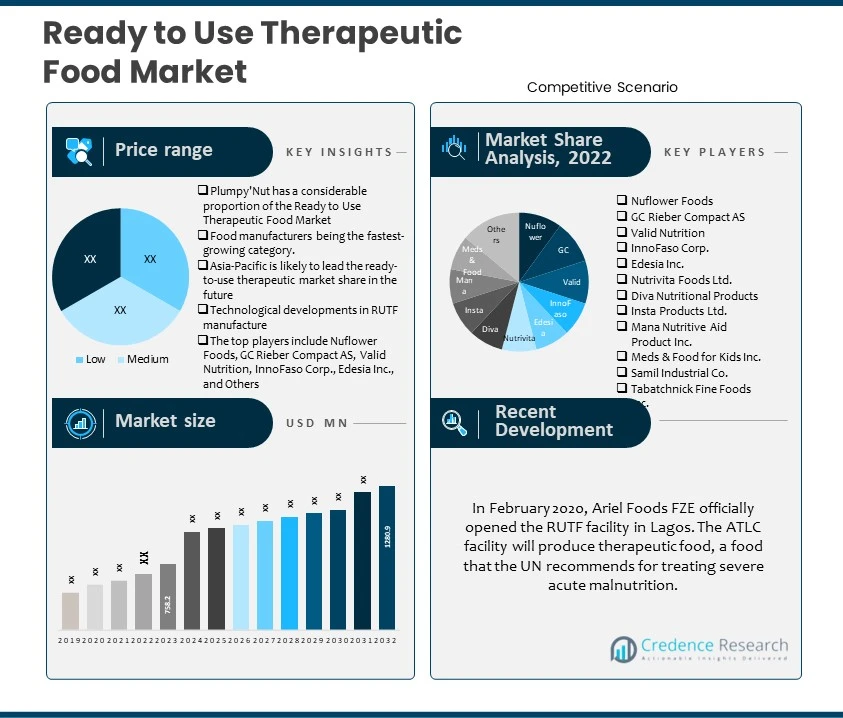
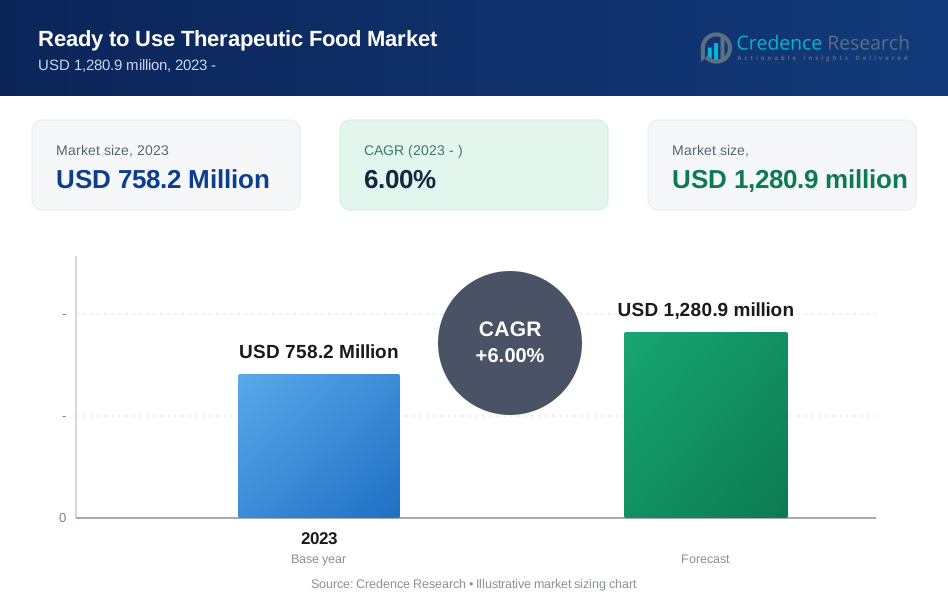
- The global demand for ready-to-use Therapeutic Food was valued at USD 758.2 million in 2023 and is expected to reach USD 1280.9 million in 2032, growing at a CAGR of 6.00% between 2024 and 2032.
- Plumpy'Nut has a considerable proportion of the Ready to Use Therapeutic Food Market, and the Other RUTF Products (e.g., Plumpy'Sup, Nutributter) category is predicted to grow the quickest throughout the projection period.
- The Ready-to-Use Therapeutic Food Market is dominated by non-governmental organizations (NGOs), with food manufacturers being the fastest-growing category.
- Humanitarian aid and emergency relief are key market sectors, and treatment of severe acute malnutrition (SAM) is a major component of them.
- Asia-Pacific is likely to lead the ready-to-use therapeutic market share in the future, while Europe's ready-to-use therapeutic food market is expected to develop at the fastest CAGR by 2023.
- Technological breakthroughs fuel market expansion.
- Supply chain disruptions hinder market growth.
Executive Summary
Market Definition
Ready to use Therapeutic food (RTUF) is a nutrient-dense food used to alleviate malnutrition in children. This food contains essential vitamins and minerals and is high in energy and protein. These delicacies are made with peanut paste, sugar, oil, and powdered milk. Ready to use. Therapeutic food is easy to consume, does not require refrigeration, and is reasonably priced with an excellent shelf life. This invention saves money while also being extremely effective in saving children's lives. The American Journal of Clinical Nutrition reported that 98% of children treated with RUTF were well-nourished at six months and 96% after a year.
Market Overview
The global ready-to-use Therapeutic Food Market has witnessed steady growth in recent years and is expected to grow at a CAGR of 6.00% between 2024 and 2032. The market was valued at USD 758.2 million in 2023 and is expected to reach USD 1280.9 million in 2032.
The market for ready-to-use therapeutic food is expected to grow as a result of expanding government and non-governmental initiatives to combat malnutrition. For instance, the Global Health and Human Rights (GHHR), the Karoli Lwanga Nyakibale Hospital in Uganda's Rukungiri District, and the Harvard College Global Hunger Initiative (GHI) division together to develop the Initiative to End Child Malnutrition (IECM) in 2012. Communities in Uganda had received this by December 2014. Thus, it is anticipated that growing activities of this kind will advance the ready-to-use therapeutic food sector.
UNICEF, WFP, WHO, and other food and non-government health organizations all recommend ready-to-use therapeutic food as one of the most effective supplements for weight gain in malnourished children. Many children in African and Asian countries are malnourished, and governments and non-governmental organizations are subsidizing the provision of ready-to-use therapeutic foods to these children, so moving the ready-to-use therapeutic food sector ahead.
Segmentation By Product Type
- Plumpy'Nut holds a significant share in the Ready to Use Therapeutic Food Market. Plumpy'Nut is a well-known and widely used RUTF product that has gained prominence for its effectiveness in treating severe acute malnutrition, especially in children. Its easy-to-use packaging and high nutritional value have made it a preferred choice in humanitarian aid programs and malnutrition intervention efforts worldwide. The success and recognition of Plumpy'Nut have contributed to its dominant position in the RUTF market segment.
- Throughout the forecast period, the Other RUTF Products (e.g., Plumpy'Sup, Nutributter) category is expected to experience the fastest sales growth.
Segmentation by End-User
- Non-governmental organizations (NGOs) dominate the Ready-to-Use Therapeutic Food Market. NGOs play an important role in the distribution and implementation of ready-to-use Therapeutic Food (RUTF) initiatives, particularly in areas afflicted by malnutrition and food poverty.
- On the other hand, Food Manufacturers represent the fastest-growing segment in the RUTF market. Food manufacturers are actively investing in R&D to develop novel RUTF formulas, improve manufacturing methods, and extend their market presence.
Segmentation by Application
- Humanitarian Aid and Emergency Relief is a major section of the Market. Humanitarian relief groups play an important role in responding to crises, natural disasters, and wars by providing critical nutritional assistance, particularly Ready to Use Therapeutic Food (RUTF).
- Treatment of Severe Acute Malnutrition (SAM) is a significant component of the Ready to Use Therapeutic Food Market.
Segmentation by Region
- Asia-Pacific is predicted to dominate the ready-to-use therapeutic market share in the future.
- In 2023, Europe's ready-to-use therapeutic food market is expected to grow at the quickest CAGR.
- The rest of the world, including Latin America, the Middle East, and Africa, supplies the remaining demand for Ready to Use Therapeutic Food.
Asia-Pacific is expected to dominate the ready-to-use therapeutic market share in the future years. The region's thriving aviation and industrial industries, together with strong economic growth, are driving up demand for adaptable and cost-effective maintenance services. Countries such as China and India are experiencing an increase in air travel and industrial production, driving the demand for services. Additionally, the region's emphasis on technical innovation and the implementation of modern manufacturing processes places Asia-Pacific as a hotbed of ready-to-use therapeutic market growth.
Moreover, Europe's ready-to-use therapeutic food market is projected to be the fastest expanding region in 2023. The market is predicted to grow at the fastest CAGR due to the region's large manufacturing by recognized manufacturers who supply items to other regions. Several European regional enterprises are focusing on growing manufacturing capacity while simultaneously providing RUT to UNICE and other NGOs.
Key Highlights of the Report
Product Type, End-User, Application, and Region segment the global Ready to Use Therapeutic Food Market. In 2023, Non-governmental organizations (NGOs) dominated the industry, with food manufacturers being the fastest-growing category. Furthermore, Humanitarian Aid and Emergency Relief is an important segment of the market, and Treatment of Severe Acute Malnutrition (SAM) is a substantial component and Asia Pacific leading the market growth.
The primary market drivers are growing awareness of nutritional issues, increased assistance from international organizations, and technological breakthroughs in RUTF production. In addition, challenges in accessing distant areas with RUTF, limited funding for malnutrition programs, and regulatory barriers to RUTF distribution in many regions are important market limitations. The market's primary opportunities include expanding into emerging markets, developing new RUTF formulations, and collaborating with local health authorities for widespread use.
Asia-Pacific is likely to lead the ready-to-use therapeutics market in the coming years. The region's growing aviation and industrial sectors, together with robust economic growth, are increasing demand for flexible and cost-effective maintenance services. Furthermore, Europe's ready-to-use therapeutic food market is expected to be the fastest growing region by 2023, expanding at the fastest CAGR.
What Are The Main Drivers Of The Global Ready to Use Therapeutic Food Market?
In the Ready to Use Therapeutic Food (RUTF) market, several main drivers are driving growth. The increased global awareness of malnutrition issues is driving the demand for RUTF products. Furthermore, substantial backing from international organizations and ongoing technological breakthroughs in RUTF production are propelling the market forward.
What Are The Major Challenges Faced By The Global Ready to Use Therapeutic Food Market?
However, the market confronts constraints such as the difficulty of reaching remote locations with RUTF due to logistics concerns. Limited funding for malnutrition programs, as well as regulatory complications in many locations, all constitute substantial barriers to RUTF delivery.
What Are The Growth Opportunities In The Global Ready to Use Therapeutic Food Market?
Despite these limitations, the RUTF market offers exciting potential. The expansion into emerging markets represents a substantial growth opportunity for RUTF makers. Furthermore, the development of new RUTF formulations and collaborations with local health authorities for widespread use provide opportunities for market growth and innovation in the RUTF industry.
Market Drivers
Several factors drive the global Ready to Use Therapeutic Food Market. The following are the key drivers of the global Ready to Use Therapeutic Food Market:
Technological Advancements
One of the key driving forces supporting market growth is the ongoing spike in technical advancements. Artificial intelligence, blockchain, and the Internet of Things (loT) are driving dramatic advances in industries ranging from healthcare to manufacturing. These technologies increase efficiency, lower costs, and provide new opportunities for product creation and service delivery. Companies that accept and integrate these technology improvements into their operations will gain a competitive advantage, resulting in overall industry growth.
Market Restraints
The global Ready to Use Therapeutic Food Market faces some challenges that may hinder its growth. These include the following:
Supply Chain Disruptions
The ongoing difficulty of supply chain interruptions is a significant constraining factor for many sectors. Natural catastrophes, pandemics, and geopolitical tensions have all caused disruptions in the global market. These disturbances cause manufacturing delays, raw material shortages, and higher operating expenses. Companies struggle to maintain regular product availability, which leads to customer unhappiness and hinders overall market growth. Mitigating the impact of supply chain disruptions through strategic planning and resilience-building strategies is critical for industries to overcome these problems and create long-term prosperity.
Opportunities
The global Ready to Use Therapeutic Food Market offers significant growth opportunities. These include the following:
Shift to Sustainable Practices for Establishing an Eco-Friendly Market
The growing emphasis on sustainability. As environmental awareness rises, both consumers and businesses prioritize eco-friendly behaviors and products. Companies are implementing sustainable measures to meet regulatory obligations and consumer expectations, ranging from renewable energy to green supply chain management. This movement is motivated not only by ethical considerations, but also by an understanding that sustainable practices contribute to long-term profitability and resilience in an ever-changing market situation.
Competitive Landscape
Key Players
The global Ready to Use Therapeutic Food Market is highly competitive, with several key players. Some of the major players in the market and their market share are as follows:
- Nuflower Foods
- GC Rieber Compact AS
- Valid Nutrition
- InnoFaso Corp.
- Edesia Inc.
- Nutrivita Foods Ltd.
- Diva Nutritional Products
- Insta Products Ltd.
- Mana Nutritive Aid Product Inc.
- Meds & Food for Kids Inc.
- Samil Industrial Co.
- Tabatchnick Fine Foods Inc.
- Amul India Inc.
- Hilina Enriched Foods PLC
- Société de Transformation Alimentaire
These organizations prioritize product innovation, distribution channel expansion, and mergers and acquisitions to stay competitive.
The global ready-to-use Therapeutic Food Market's key players continually seek to stay ahead by offering new products and developments.
In May 2020, In India, the CMAM Association was established to fight childhood chronic malnutrition. This will be achieved by selling ready-to-use therapeutic foods (RUTF) across the community.
In September 2022, Abbott, a multinational firm based in the United States, announced the establishment of the Abbott Center for Malnutrition Solutions. This innovation cluster will primarily focus on addressing malnutrition globally. The center will collaborate with other nutrition professionals and partners to treat and prevent malnutrition in populations around the world.
Summary of Key Findings
- Transition to Sustainable Practices for Creating an Eco-Friendly Marketplace
- Market Segmented By Product Type, End-User, Application, and region.
- Plumpy'Nut has a considerable proportion of the Ready to Use Therapeutic Food Market
- Humanitarian aid and emergency relief is a key sector of the market
- Asia Pacific is leading in market growth; the market is highly competitive with key players, including Nuflower Foods, GC Rieber Compact AS, Valid Nutrition, InnoFaso Corp., Edesia Inc., and Others.
Future Outlook
- Increasing demand for ready-to-use therapeutic foods (RUTFs).
- Expanding the RUTF market into additional regions.
- Increasing emphasis on malnutrition intervention initiatives.
- Technological developments in RUTF manufacture.
How CXOs Can Benefit from the Credence Research Ready to Use Therapeutic Food Market Report
The Credence Research Ready to Use Therapeutic Food Market Report provides CXOs with a comprehensive overview of the market, including:
- Market size and growth forecast: The report provides detailed estimates of the global ready-to-use Therapeutic Food Market size, segmented by product type, End-User, Application, and region. It also includes forecasts for the market through 2032 based on key trends and drivers.
- Market segmentation: The report segments the ready-to-use Therapeutic Food Market By Type, End-User, Application, and region. This segmentation provides CXOs with a granular understanding of the market and the opportunities in each segment.
- Competitive Landscape: The report profiles the key players in the Ready to Use Therapeutic Food Market and provides insights into their strategies, product offerings, and financial performance. This information can help CXOs to identify and assess their competition.
- Key trends and drivers: The report identifies and analyzes the key trends and drivers that are shaping the Ready to Use Therapeutic Food Market. This information can help CXOs to make informed decisions about their investments and strategies.
CXOs can use the insights from the Credence Research Ready to Use Therapeutic Food Market Report to:
- Identify growth opportunities: The report can help CXOs to identify new growth opportunities in the Ready to Use Therapeutic Food Market. For example, it can pinpoint emerging trends in industries like aerospace and automotive, helping executives make informed decisions on expanding their product lines or entering new market segments where Ready to Use Therapeutic Food's properties can be leveraged for success.
- Make informed investment decisions: The report can help CXOs make informed investment decisions about Ready to Use Therapeutic Food. For example, it can provide crucial insights into market trends, competitive landscape, and potential growth areas, empowering executives to allocate resources strategically and seize opportunities for maximizing returns on investments in the Ready to Use Therapeutic Food sector.
- Develop competitive strategies: The report can help CXOs develop competitive strategies for their Ready to Use Therapeutic Food businesses. For example, it can offer valuable insights into market trends, competitor analysis, and innovative applications of Ready to Use Therapeutic Food, enabling executives to stay ahead of the competition and drive business growth in this dynamic industry.
- Track market developments: The report can help CXOs monitor market developments and stay ahead of the curve. For example, it provides insights into the latest trends and innovations in the Ready to Use Therapeutic Food Market.
Overall, the Credence Research Ready to Use Therapeutic Food Market Report is a valuable resource for CXOs who are looking to gain a deeper understanding of the market and identify opportunities for growth.
Segmentation
- By Product Type:
- Plumpy'Nut
- Other RUTF Products (e.g., Plumpy'Sup, Nutributter)
- By End-User:
- Non-Governmental Organizations (NGOs)
- Government Agencies
- Food Manufacturers
- Relief Organizations
- Others
- By Application:
- Treatment of Severe Acute Malnutrition (SAM)
- Prevention of Moderate Acute Malnutrition (MAM)
- Management of Chronic Malnutrition
- Therapeutic Feeding Programs
- Humanitarian Aid and Emergency Relief
- Others
- By Region
- North America
- The U.S.
- Canada
- Mexico
- Europe
- Germany
- France
- The U.K.
- Italy
- Spain
- Rest of Europe
- Asia Pacific
- China
- Japan
- India
- South Korea
- South-east Asia
- Rest of Asia Pacific
- Latin America
- Brazil
- Argentina
- Rest of Latin America
- Middle East & Africa
- GCC Countries
- South Africa
- Rest of the Middle East and Africa
- North America
Request a Free Sample
Fill in your details and we'll send you a free sample report.
- Sample data tables & charts
- Research methodology
Need a Custom Version of This Report?
Tailor the scope, geography, or segments to your exact requirements.
- Custom geography or segment scope
- Direct access to our analyst team
Frequently Asked Questions
What is the current size of the global Ready to Use Therapeutic Food Market?
What is the expected growth rate of the Ready to Use Therapeutic Food Market between 2024 and 2032?
Which segment is leading the market share in terms of End-User?
Which Application segment governs the demand for Ready to Use Therapeutic Food in the world?
Who are the major players in the global Ready to Use Therapeutic Food Market?
Table of Content
Chapter 1. Report Introduction
- 1.1 Report Description & Purpose
- 1.1.1 Report Title & Market Definition
- 1.1.2 Unique Selling Propositions (USP) & Key Differentiators
- 1.1.3 Value Proposition for Stakeholders
- 1.2 Research Objectives
- 1.2.1 Market Sizing Objectives (Volume & Revenue)
- 1.2.2 Segmentation Objectives
- 1.2.3 Competitive Intelligence Objectives
- 1.2.4 Forecast & Scenario Objectives
- 1.3 Report Scope
- 1.3.1 Ready to Use Therapeutic Food Scope – Types & Subtypes Covered
- 1.3.2 Geographic Scope – Regions & Countries Covered
- 1.3.3 Historical Period, Base Year & Forecast Period (2023; forecast to the forecast period)
- 1.3.4 Inclusions & Exclusions
- 1.4 HS Code & Classification Framework
- 1.5 Currency, Units & Pricing Basis
- 1.6 Target Stakeholders
- 1.7 Limitations & Assumptions
Chapter 2. Executive Summary
- 2.1 Global Ready to Use Therapeutic Food Market Snapshot
- 2.1.1 Market Size – Historical (2023) & Forecast (the forecast period) (2023: USD 758.2 Million → forecast year: USD 1,280.9 million)
- 2.1.2 Volume & Revenue – Global Totals
- 2.1.3 Key Market Highlights – Top Five Facts
- 2.2 Ready to Use Therapeutic Food Market Segmentation Snapshot
- 2.2.1 Market Split by Region – 2023 vs.
- 2.3 Competitive Snapshot
- 2.3.1 Top 10 Players by Revenue Share – 2023
- 2.3.2 Top 10 Players by Volume Share – 2023
- 2.3.3 Recent Strategic Developments (18-Month Summary)
- 2.4 Key Investment Highlights & Strategic Conclusions
Chapter 3. Ready to Use Therapeutic Food Market Dynamics & Industry Analysis
- 3.1 Market Overview & Context
- 3.1.1 Ready to Use Therapeutic Food Market Position in the Broader Automotive Value Chain
- 3.1.2 OEM vs. Replacement Market Dynamics
- 3.1.3 Market Maturity & Development Stage by Region
- 3.2 Ready to Use Therapeutic Food Market Drivers
- 3.3 Ready to Use Therapeutic Food Market Restraints & Challenges
- 3.4 Ready to Use Therapeutic Food Market Opportunities
- 3.5 Porter's Five Forces Analysis
- 3.5.1 Threat of New Entrants
- 3.5.2 Bargaining Power of Suppliers
- 3.5.3 Bargaining Power of Buyers
- 3.5.4 Threat of Substitutes
- 3.5.5 Competitive Rivalry – Intensity Assessment
- 3.6 Ready to Use Therapeutic Food Value Chain Analysis
- 3.6.1 Upstream – Raw Material/Input Suppliers
- 3.6.1.1 Raw Material/Input 1
- 3.6.1.2 Raw Material/Input 2
- 3.6.1.3 Raw Material/Input 3
- 3.6.2 Midstream – Production/Manufacturing/Service Delivery
- 3.6.2.1 Production/Process Overview
- 3.6.2.2 Key Facility Locations & Capacity by Manufacturer
- 3.6.3 Downstream – Distribution & End Consumer
- 3.6.3.1 Primary Channel – B2B/OEM
- 3.6.3.2 Secondary Channels – Dealer, Retail, Online, Direct
- 3.6.4 Value Chain Profitability Analysis
- 3.6.1 Upstream – Raw Material/Input Suppliers
- 3.7 PESTEL Analysis
- 3.7.1 Political Factors
- 3.7.2 Economic Factors
- 3.7.3 Social Factors
- 3.7.4 Technological Factors
- 3.7.5 Environmental Factors
- 3.7.6 Legal Factors
- 3.8 Ready to Use Therapeutic Food Supply Chain Analysis
- 3.8.1 Raw Material/Input Supply Risk Assessment
- 3.8.2 Manufacturing Concentration Risk (Geographic Exposure)
- 3.8.3 Trade Disruption Impact Analysis
- 3.9 Regulatory & Policy Landscape
Note: The regulatory and policy landscape section covers regulations based on their applicability to the market, Ready to Use Therapeutic Food category, geography, and scope of the study. Only regulatory frameworks with a material impact on operations, compliance, trade, sustainability, or market access are analyzed in detail.
Chapter 4. Key Investment Pockets & Opportunity Analysis
- 4.1 Ready to Use Therapeutic Food Market Attractiveness Analysis
- 4.1.1 By Region – Investment Attractiveness Matrix (Volume × CAGR)
- 4.2 Absolute Revenue Growth Opportunity
- 4.2.1 By Region – Absolute USD Growth Through the forecast period
- 4.3 Incremental Volume Opportunity
- 4.3.1 By Region – Incremental Volume Through the forecast period
- 4.3.2 Segment – Incremental Volume
- 4.4 Emerging Submarket Opportunity Deep Dive (Subject to Applicability)
- 4.5 Emerging Market Opportunity Scorecards
- 4.5.1 United States
- 4.5.2 Europe
- 4.5.3 Asia
- 4.5.4 Middle East & Africa
Note: Emerging Market Opportunity Scorecards will be included based on relevance and strategic importance. Regions listed are indicative and may vary depending on data availability and market dynamics.
Chapter 5. Ready to Use Therapeutic Food Import-Export Analysis & Trade Flows
- 5.1 Global Trade Overview
- 5.1.1 Global Export Value by Country (2023)
- 5.1.2 Global Export Volume by Country (2023)
- 5.1.3 Global Import Value by Country (2023)
- 5.1.4 Global Import Volume by Country (2023)
- 5.1.5 Net Trade Balance by Country (2023)
- 5.2 Export Analysis – Segment
- 5.2.1 Type 1 (HS Code)
- 5.2.2 Type 2 (HS Code)
- 5.2.3 Type 3 (HS Code)
- 5.2.4 Type 4 (HS Code)
- 5.2.5 Type 5 (HS Code)
- 5.3 Import Analysis – Segment
- 5.3.1 Type 1 (HS Code)
- 5.3.2 Type 2 (HS Code)
- 5.3.3 Type 3 (HS Code)
- 5.3.4 Type 4 (HS Code)
- 5.3.5 Type 5 (HS Code)
- 5.4 Average Unit Trade Prices
- 5.4.1 Average Export Price – Segment & Country
- 5.4.2 Average Import Price – Segment & Source Country
- 5.4.3 Price Trends (2023)
- 5.5 Key Trade Route Analysis
- 5.5.1 Trade Route 1
- 5.5.2 Trade Route 2
- 5.5.3 Trade Route 3
- 5.5.4 Trade Route 4
- 5.5.5 Trade Route 5
- 5.6 Trade Policy Impact Assessment
- 5.6.1 US Anti-Dumping & Section 301 Tariffs
- 5.6.2 EU Customs Union Impact
- 5.6.3 Major Free Trade Agreements
- 5.6.4 USMCA Rules of Origin
Note: Trade policy analysis will be included only where relevant to the Ready to Use Therapeutic Food market.
Chapter 6. Competitive Landscape & Company Benchmarking
- 6.1 Ready to Use Therapeutic Food Market Concentration & Structure
- 6.1.1 Herfindahl-Hirschman Index (HHI) – vs. 2023
- 6.1.2 Tier 1, Tier 2 & Tier 3 Market Structure
- 6.1.3 Global, Regional & Local Player Dynamics
- 6.2 Ready to Use Therapeutic Food Market Share Analysis – 2023
- 6.2.1 Global Revenue Share by Company
- 6.2.2 Global Volume Share by Company
- 6.2.3 Regional Revenue Share
- 6.2.4 Market Share Evolution ( vs. 2023)
- 6.2.5 OEM Segment Share by Company
- 6.2.6 Replacement Segment Share by Company
- 6.3 Production/Delivery Capacity & Facility Analysis
- 6.3.1 Global Installed Capacity
- 6.3.2 Capacity Utilization Rates
- 6.3.3 Production/Output Volume
- 6.3.4 Facility Locations & Capacity Map
- 6.3.5 Planned Capacity Additions
- 6.4 Ready to Use Therapeutic Food Competitive Benchmarking Matrix
- 6.4.1 Revenue, Volume, CAGR & Profitability Comparison
- 6.4.2 Channel Revenue Mix
- 6.4.3 Geographic Revenue Exposure
- 6.4.4 R&D Intensity
- 6.4.5 Sustainability Maturity
- 6.5 Strategic Developments in Ready to Use Therapeutic Food (Last 24 Months)
- 6.5.1 Mergers, Acquisitions & Divestments
- 6.5.2 New Ready to Use Therapeutic Food Launches
- 6.5.3 Facility Expansions
- 6.5.4 Strategic Alliances, Joint Ventures & Partnerships
- 6.5.5 Distribution Expansion & Market Entry
- 6.5.6 Sustainability & ESG Initiatives
- 6.6 Competitive Strategy Mapping
- 6.6.1 Leader, Challenger, Follower & Niche Classification
- 6.6.2 Pricing Strategy Comparison
- 6.6.3 Channel Strategy Matrix
Note: Strategic developments are included based on their materiality and the availability of reliable information.
Chapter 7. Global Ready to Use Therapeutic Food Market – By Distribution Channel
- 7.1 Segment Overview
- 7.1.1 Volume & Revenue Split by Channel (2023 & )
- 7.1.2 Channel Mix Evolution (the forecast period)
Chapter 8. Regional Market Analysis – Global Overview
- 8.1 Global Regional Overview
- 8.1.1 Regional Volume Share
- 8.1.2 Regional Revenue Share
- 8.1.3 Regional Volume by Region
- 8.1.4 Regional Revenue by Region
- 8.1.5 Regional Forecast Through the forecast period
- 8.2 Cross-Regional Segment Analysis
- 8.2.1 By Distribution Channel
- 8.2.2 By Brand/Price Tier
Chapter 9. North America Ready to Use Therapeutic Food Market
- 9.1 United States
- 9.2 Canada
- 9.3 Mexico
Chapter 10. Europe Ready to Use Therapeutic Food Market
- 10.1 Germany
- 10.2 France
- 10.3 Italy
- 10.4 United Kingdom
- 10.5 Spain
- 10.6 Poland
- 10.7 Russia
- 10.8 Netherlands
- 10.9 Belgium
- 10.10 Sweden
- 10.11 Denmark
- 10.12 Norway
- 10.13 Rest of Europe
Chapter 11. Asia Pacific Ready to Use Therapeutic Food Market
- 11.1 China
- 11.2 India
- 11.3 Japan
- 11.4 South Korea
- 11.5 Thailand
- 11.6 Indonesia
- 11.7 Vietnam
- 11.8 Malaysia
- 11.9 Australia
- 11.10 Rest of Asia Pacific
Chapter 12. Latin America Ready to Use Therapeutic Food Market
- 12.1 Brazil
- 12.2 Argentina
- 12.3 Colombia
- 12.4 Chile
- 12.5 Rest of Latin America
Chapter 13. Middle East Ready to Use Therapeutic Food Market
- 13.1 Saudi Arabia
- 13.2 United Arab Emirates
- 13.3 Turkey
- 13.4 Israel
- 13.5 Iran
- 13.6 Rest of the Middle East
Chapter 14. Africa Ready to Use Therapeutic Food Market
- 14.1 South Africa
- 14.2 Egypt
- 14.3 Nigeria
- 14.4 Morocco
- 14.5 Rest of Africa
Chapter 15. Ready to Use Therapeutic Food Company Profiles
- 15.1 [Company 01]
- 15.1.1 Company Overview
- 15.1.2 Key Management Personnel
- 15.1.3 Products & Services Portfolio
- 15.1.4 Financial Performance
- 15.1.5 Key Market Focus & Geographic Presence
- 15.1.6 Recent Developments & Strategic Initiatives
Note: The company profile list is preliminary and may change based on research findings, market developments, data availability, and client requirements.
Chapter 16. Appendices
- Appendix A – List of Abbreviations & Acronyms
- Appendix B – Industry Classification Code Reference – Full Series
- Appendix C – Production & Capacity Data Tables
- Appendix D – End-Use & Demand Base Tables
- Appendix E – Consumption & Replacement Rate Assumptions
- Appendix F – ASP Reference Tables
- Appendix G – Manufacturing & Facility Database
- Appendix H – Import-Export Data Tables
- Appendix I – Regulatory Summary Tables
- Appendix J – Primary Research Participant List (Anonymized)
- Appendix K – Primary Research Questionnaire Framework
- Appendix L – Data Sources & Bibliography
- Appendix M – Market Size Divergence & Source Comparison
Chapter 17. Research Methodology
- 17.1 Research Framework & Philosophy
- 17.2 Secondary Research – Sources, Hierarchy & Data Extraction
- 17.3 Data Modeling – Bottom-Up & Top-Down Market Sizing
- 17.4 Primary Research – Stakeholder Framework, LOI & Sample Sizes
- 17.5 Forecast Methodology – Regression, Scenario & Sensitivity Analysis
- 17.6 Quality Control – Four-Layer Validation Framework
- 17.7 Limitations & Standard Assumptions
- 17.8 Disclaimer
