
| REPORT ATTRIBUTE | DETAILS |
|---|---|
| Historical Period | 2019-2022 |
| Base Year | 2023 |
| Forecast Period | 2024-2032 |
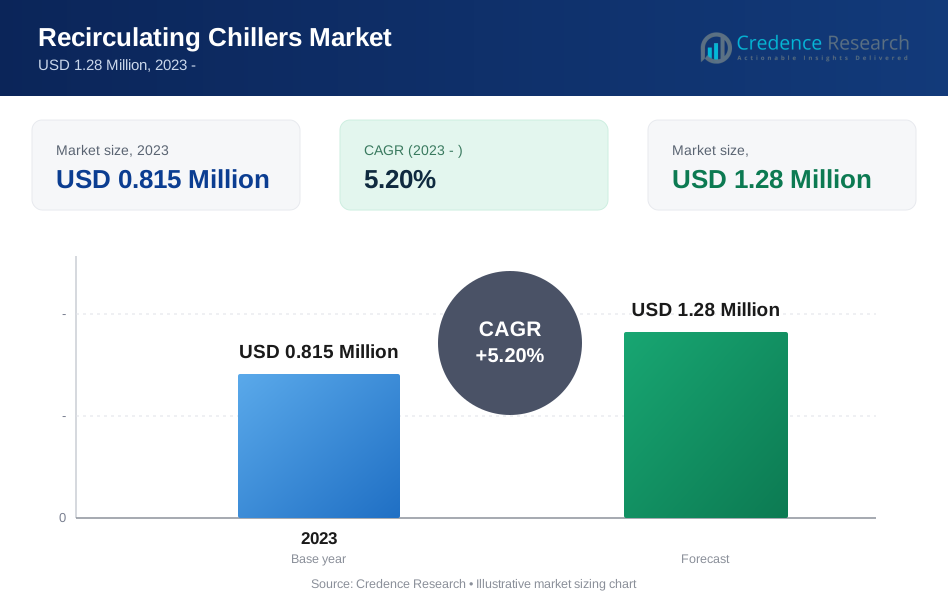
| Recirculating Chillers Market Size 2023 | USD 0.815 Million |
| Recirculating Chillers Market, CAGR | 5.20% |
| Recirculating Chillers Market Size 2032 | USD 1.28 Million |
Market Insights
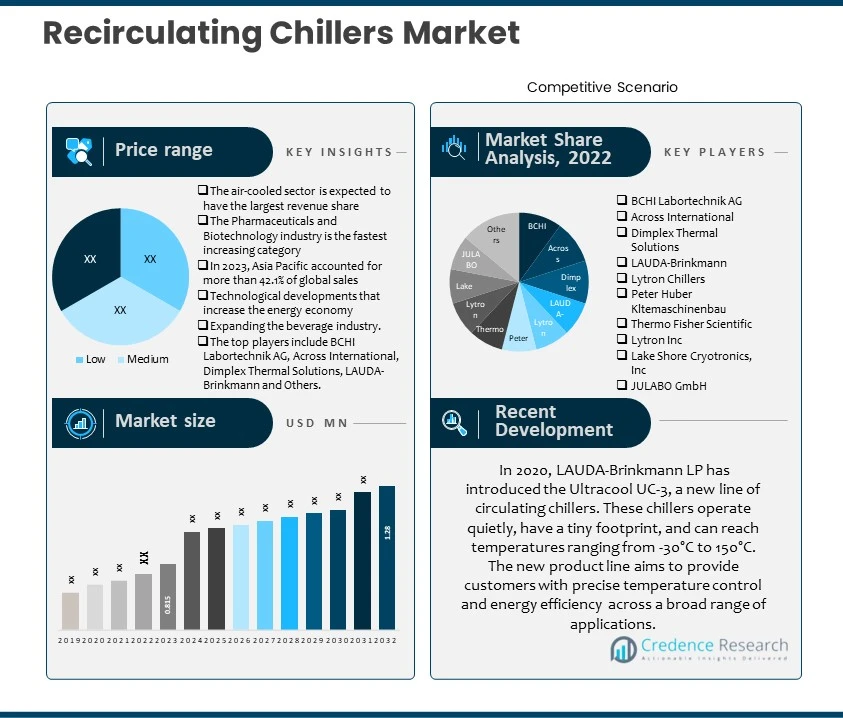
- The global demand for Recirculating Chillers was valued at USD 0.815 Million in 2023 and is expected to reach USD 1.28 Million in 2032, growing at a CAGR of 5.20% between 2024 and 2032.
- The air-cooled sector is expected to have the largest revenue share during the projection period, while the water-cooled category is expected to have faster revenue growth.
- The 5 kW to 20 kW range represents a considerable market share. This category is popular, and the above-50 kW sector is significant in the market.
- High-temperature Chillers (25°C to 150°C) dominated the market with a 50.9% share in 2023, while the Low-temperature Chillers (-40°C to 0°C) segment is expected to rise at a CAGR of more than 4.5% between 2023 and 2032.
- The Laboratory and Analytical Equipment category dominated the market, accounting for more than 35.0% of total revenue in 2023. Industrial Processes is expected to account for a sizable portion of revenue, while the Medical Imaging Equipment segment is expected to grow the fastest in terms of revenue.
- The pharmaceuticals and biotechnology sector is the fastest increasing category, while the healthcare segment is a prominent sector in the market.
- In 2023, Asia Pacific accounted for more than 42.1% of global sales, while the North American market is predicted to see the fastest revenue growth over the projection period.
- Energy efficiency propels market growth.
- Supply chain disruptions impede market growth.
Executive Summary
Market Definition
Recirculating Chillers are closed-loop chillers used to cool equipment and machines. They are also known as Recirculating Coolers. They provide a steady supply of liquid cooling during clinical, laboratory, and industrial activities to optimize temperature conditions. Developments and automation in such businesses have resulted in the use of devices like reservoirs and thermo-scientific equipment.
The heat produced by these equipment must be evacuated for optimal operation and increased efficiency. Thus, automation and technological improvements are projected to propel market growth throughout the forecast period. Recirculating Chillers have numerous applications in the pharmaceutical business. Depending on their cooling capacity, reservoir volumes, and acceptable temperature ranges, various types of chillers are available on the market. Recirculating Chillers are used for chemical reaction control, laboratory automation, separation, and spectroscopy.
Market Overview
The global Recirculating Chillers Market has witnessed steady growth in recent years and is expected to grow at a CAGR of 5.20% between 2024 and 2032. The market was valued at USD 0.815 million in 2023 and is expected to reach USD 1.28 million in 2032.
Growing automation in industrial processes is driving up demand for heat exchangers that provide thermal stability. In addition, the HVAC system makes use of recirculating chillers. Furthermore, data centers are expanding to improve function efficiency. The recirculating chiller market is in high demand. Today, floor-mounted recirculating chillers are widely employed in the semiconductor and plastic industries. Similarly, rack-mounted recirculating chillers are utilized in packing lines, laser machines, x-ray equipment, and atomizing devices, which are driving market expansion in the recirculating chiller industry. Additionally, the high cost of Recirculating Chillers is projected to limit market expansion. Although the use of solar power generators is predicted to lower high power costs and hence mitigate the impact of restraint during the projection period. On the contrary, rising power costs due to increased electricity use are impeding the growth of the Recirculating Chillers Market.
Segmentation By Type of Cooling Technology
- The air-cooled sector is predicted to have the biggest revenue share during the projection period. These chillers are preferred over water-cooled devices in situations where water is scarce or expensive to obtain. Air-cooled systems are also easy to install and maintain, making them an economical choice for a variety of applications. Furthermore, air-cooled units do not require a water source or sophisticated piping, making them extremely portable and easy to transport between places.
- The water-cooled category is predicted to experience faster revenue growth during the projection period. These chillers are extremely efficient and provide precise temperature control across a wide range of operating situations.
Segmentation By Cooling Capacity
- The 5 kW to 20 kW range accounts for a sizable market share. This segment is popular because it is adaptable and flexible, serving a wideits adaptability and flexibility to serve a diverse variety of applications in industries such as research laboratories, medical equipment, and industrial operations.
- On the other hand, the above-50 kW sector is important in the market since it meets the cooling needs of bigger industrial applications that require higher cooling capabilities.
Segmentation By Temperature Control Range
- In terms of revenue, High-temperature Chillers (25°C to 150°C) dominated the market with a 50.9% share in 2023. This high share is due to the increased use of this temperature range in a variety of laboratory and medical applications. Furthermore, the COVID-19 pandemic has expanded the use of recirculating chillers ranging from 25°C to 150°C for specimen storage, whereas test administration demands a constant temperature of 2° to 8°.
- The Low-temperature Chillers (-40°C to 0°C) segment is predicted to grow at a CAGR of more than 4.5% between 2023 and 2032.
Segmentation by Application
- The Laboratory and Analytical Equipment category dominated the market, accounting for more than 35.0% of total revenue in 2023. The segment is likely to dominate the recirculating chiller market over the forecast period. Because of their substantial percentage of industry application types, recirculating chillers improve automation by allowing for temperature change across a wide range of sectors and verticals, including pharmaceuticals, laboratories, oil and gas, and manufacturing.
- The Industrial Processes is predicted to account for a sizable portion of revenue during the projection period. Recirculating chillers have industrial applications such as process chilling in manufacturing, semiconductor manufacturing, and the food and beverage industry. These chillers are used to cool high-temperature fluids, keep equipment at the proper temperature, and assure precise temperature control, all of which increase productivity and save downtime.
- During the projection period, the Medical Imaging Equipment segment is expected to grow the quickest in terms of revenue. Recirculating chillers are used in medical imaging equipment, such as MRI and CT scanners, to keep the temperature stable and assure correct image quality.
Segmentation by End-User Industry
- The pharmaceuticals and biotechnology sector is the fastest expanding category in the recirculating chiller market. This expansion is driven by the growing demand for precise temperature management in research laboratories and medical facilities.
- Also, the Healthcare segment is a key sector in the market.
Segmentation by Region
- In 2023, Asia Pacific accounted for more than 42.1% of worldwide sales.
- The North American market is expected to experience the fastest revenue growth during the projection period
- The rest of the world, including Latin America, the Middle East, and Africa, supplies the remaining demand for Recirculating Chillers.
The Asia Pacific market is predicted to have the greatest revenue share over the projection period. The need for recirculating chillers in this region is likely to increase dramatically in the coming years as cooling systems are being used in a variety of industries, including healthcare, pharmaceuticals, and biotechnology. Rising demand for individualized medicine, as well as an increase in chronic diseases, are driving the region's demand for modern medical equipment, particularly recirculating chillers. Furthermore, increased investments in biotechnology R&D are likely to stimulate demand for recirculating chillers in this region.
Also, throughout the projection period, the North American market is anticipated to have the quickest revenue CAGR because the semiconductor sector is using recirculating chillers more and more. Because of the presence of some of the top semiconductor businesses in the area, like Intel and Qualcomm, there is an increased need for sophisticated cooling systems, like recirculating chillers. In this region, the need for recirculating chillers is being driven by the growing need for advanced semiconductor devices due to the growing demand for high-speed data processing and growing investments in Artificial Intelligence and Machine Learning technologies.
Key Highlights of the Report
Type of Cooling Technology, Cooling Capacity, Temperature Control Range, Application, End-User Industry and region segment the global Recirculating Chillers Market. The laboratory and analytical equipment category dominated the market, with the water-cooled category expected to increase revenue faster. Moreover, the 5 kW to 20 kW range accounts for a significant portion of the market, while the Low-temperature Chillers (-40°C to 0°C) sector has the highest CAGR. Also, the medicines and biotechnology sector is the fastest-growing category, and Asia Pacific is leading the market growth.
The demand for heat exchangers to maintain thermal stability is increasing as industrial processes become more automated. In addition, recirculating chillers are used in the HVAC system. Also, the data center industry is expanding, and the Recirculating Chillers Market is in high demand to improve function efficiency. Moreover, the high cost of recirculating chillers is projected to impede market expansion. Although the use of solar power generators is predicted to minimize high power costs and hence mitigate the impact of restraint during the projection period.
The Asia Pacific market is expected to have the largest revenue share over the projection period. Furthermore, throughout the projection period, the North American market is expected to have the quickest revenue CAGR since the semiconductor sector is employing recirculating chillers increasingly.
.What Are The Main Drivers Of The Global Recirculating Chillers Market?
The market's primary drivers are the number of data centers is growing, and the Recirculating Chillers Market is in high demand to improve operational efficiency. Today, floor-mounted recirculating chillers are widely employed in the semiconductor and plastic industries. Similarly, rack-mounted recirculating chillers are utilized in packing lines, laser machines, x-ray equipment, and atomizing devices, which are driving market expansion in the recirculating chiller industry.
What Are The Major Challenges Faced By The Global Recirculating Chillers Market?
The main market restrictions include rising power costs are expected to limit industry development. Additional electricity consumption by components such as a condenser, compressor, evaporator, and others may be an expensive alternative for a small to medium-sized application. Furthermore, the high cost of Recirculating Chillers is projected to limit market expansion.
What Are The Growth Opportunities In The Global Recirculating Chillers Market?
The market's significant opportunities include the portability of certain recirculating chiller types, such as tabletop and rack-mounted, which allows for greater operational flexibility, leading to growing demand for such chillers. Furthermore, recirculating chillers are used in home HVAC systems. Thus, a diverse variety of applications is expected to drive market expansion.
Market Drivers
Several factors drive the global Recirculating Chillers Market. The following are the key drivers of the global Recirculating Chillers Market:
Energy Efficiency
One of the primary drivers of the worldwide recirculating chiller market is the increased emphasis on energy efficiency. As the global economy prioritizes sustainable practices in response to escalating environmental concerns, demand for recirculating chillers that can maintain precise temperature regulation while using less energy is increasing. Recirculating chiller manufacturers create energy-efficient solutions that incorporate cutting-edge technologies and smart designs to assure lower operating costs while minimizing environmental effect. Recirculating chillers are the best option for businesses seeking a balance of productivity and sustainability in the current market trend of reducing energy consumption and greenhouse gas emissions.
Market Restraints
The global Recirculating Chillers Market faces some challenges that may hinder its growth. These include the following:
Supply Chain Disruptions
Supply chain disruptions are negatively impacting many industries, not just the global recirculating chillers market. The COVID-19 epidemic, trade wars, and natural calamities all contribute to these disruptions. Supply chain interruptions often cause production delays, overdrawn expenses, and difficulty acquiring raw materials. All businesses must take proactive efforts and implement supply chain strategies to address issues, decrease risks, and ensure consistent market supply.
Opportunities
The global Recirculating Chillers Market offers significant growth opportunities. These include the following:
Rise In Demand For Temperature Control Systems In A Variety Of Industries
As businesses strive for more precise and reliable temperature management in their processes, there is a growing demand for efficient and innovative cooling systems such as recirculating chillers. Factors driving this demand include technological improvements that improve energy efficiency, the growth of businesses such as pharmaceuticals and biotechnology that require strict temperature control, and an overall emphasis on sustainable practices. Companies in the Recirculating Chillers Market can capitalize on this potential by innovating and providing eco-friendly, energy-efficient solutions to address the changing needs of industries looking for dependable temperature management solutions.
Competitive Landscape
Key Players
The global Recirculating Chillers Market is highly competitive, with several key players. Some of the major players in the market and their market share are as follows:
- BCHI Labortechnik AG
- Across International
- Dimplex Thermal Solutions
- LAUDA-Brinkmann
- Lytron Chillers
- Peter Huber Kltemaschinenbau
- Thermo Fisher Scientific
- Lytron Inc
- Lake Shore Cryotronics, Inc
- JULABO GmbH
These organizations prioritize product innovation, End-User Industry expansion, and mergers and acquisitions to stay competitive.
The global Recirculating Chillers Market's key players continually seek to stay ahead by offering new products and developments.
In July 2021, BÜCHI Labortechnik AG has introduced two new steam distillation product lines with innovative, modular functionalities that provide the greatest flexibility in analyte willpower. The newly improved tool is available in two versions: BUCHI Kjel Line and Dist Line, each with three separate performance tiers. The Kjel Line is optimized for Kjeldahl packages of nitrogen and protein willpower, providing the maximum accuracy while conserving time and resources. The Dist. Line is intended to cover a wide variety of steam-risky analytes while ensuring optimum flexibility and comfort.
In July 2019, Lytron joined Boyd Agency through its strong point thermal business, Aavid. It announced the acquisition of Lytron Inc. to strengthen Boyd's international manufacturing organization and technical capability for liquid-cooled systems. The Lytron running logo has been discontinued and is now used by Aavid, Boyd's thermal department.
In December 2019, LAUDA DR. R. WOBSER GMBH & CO. KG has announced its acquisition of GFL Gesellschaft für Labortechnik mbH. This is the arena market chief's third takeover since joining Lauda-okönigshofen. While earlier acquisitions typically served to open up new business areas within the industrial environment, LAUDA seeks to expand its expertise in the field of laboratory generation through GFL.
Summary of Key Findings
- Increased demand for temperature control systems in a range of industries.
- Market segmented By Type of Cooling Technology, Cooling Capacity, Temperature Control Range, Application, End-User Industry and region.
- The 5 kW to 20 kW range holds a substantial market share.
- The pharmaceuticals and biotechnology sector is the fastest growing category
- Asia Pacific is leading in market growth; the market is highly competitive with key players, including BCHI Labortechnik AG, Across International, Dimplex Thermal Solutions, LAUDA-Brinkmann and Others.
Future Outlook
- Growing need for solutions for temperature regulation
- Technological developments that increase the energy economy
- The growth of the biotechnology and pharmaceutical industries is driving market expansion.
How CXOs Can Benefit from the Credence Research Recirculating Chillers Market Report
The Credence Research Recirculating Chillers Market Report provides CXOs with a comprehensive overview of the market, including:
- Market size and growth forecast: The report provides detailed estimates of the global Recirculating Chillers Market size, segmented By Type of Cooling Technology, Cooling Capacity, Temperature Control Range, Application , End-User Industry and region. It also includes forecasts for the market through 2032 based on key trends and drivers.
- Market segmentation: The report segments the Recirculating Chillers Market By Type of Cooling Technology, Cooling Capacity, Temperature Control Range, Application , End-User Industry and region. This segmentation provides CXOs with a granular understanding of the market and the opportunities in each segment.
- Competitive Landscape: The report profiles the key players in the Recirculating Chillers Market and provides insights into their strategies, product offerings, and financial performance. This information can help CXOs to identify and assess their competition.
- Key trends and drivers: The report identifies and analyzes the key trends and drivers that are shaping the Recirculating Chillers Market. This information can help CXOs to make informed decisions about their investments and strategies.
CXOs can use the insights from the Credence Research Recirculating Chillers Market Report to:
- Identify growth opportunities: The report can help CXOs identify new growth opportunities in the Recirculating Chillers Market. By analyzing the data and trends in the report, they can make informed decisions about where to invest and expand their business.
- Make informed investment decisions: The report can help CXOs make informed investment decisions about Recirculating Chillers. By examining the insights and trends in the report, they can strategically allocate resources and capitalize on the right opportunities in the market.
- Develop competitive strategies: The report can help CXOs develop competitive strategies for their Recirculating Chillers businesses. For example, by delving into the insights and trends within the report, they can strategically position themselves in the market and stay ahead of the competition.
- Track market developments: The report can help CXOs monitor market developments and stay ahead of the curve. For example, it provides insights into the latest trends and innovations in the Recirculating Chillers Market.
Overall, the Credence Research Recirculating Chillers Market Report is a valuable resource for CXOs who are looking to gain a deeper understanding of the market and identify opportunities for growth.
Segmentation
- By Type of Cooling Technology:
- Air-cooled Chillers
- Water-cooled Chillers
- By Cooling Capacity:
- Below 5 kW
- 5 kW to 20 kW
- 20 kW to 50 kW
- Above 50 kW
- By Temperature Control Range:
- Low-temperature Chillers (-40°C to 0°C)
- Medium-temperature Chillers (0°C to 25°C)
- High-temperature Chillers (25°C to 150°C)
- Others
- By Application:
- Laboratory and Analytical Equipment
- Medical Imaging Equipment
- Semiconductor Manufacturing
- Industrial Processes
- Laser Systems
- Food and Beverage Processing
- Pharmaceuticals
- Automotive Testing
- Others
- By End-User Industry:
- Pharmaceuticals and Biotechnology
- Chemicals and Petrochemicals
- Semiconductor and Electronics
- Healthcare
- Food and Beverage
- Automotive
- Aerospace and Defense
- Research and Academic Institutes
- Others
- By Region
- North America
- The U.S.
- Canada
- Mexico
- Europe
- Germany
- France
- The U.K.
- Italy
- Spain
- Rest of Europe
- Asia Pacific
- China
- Japan
- India
- South Korea
- South-east Asia
- Rest of Asia Pacific
- Latin America
- Brazil
- Argentina
- Rest of Latin America
- Middle East & Africa
- GCC Countries
- South Africa
- Rest of the Middle East and Africa
- North America
Request a Free Sample
Fill in your details and we'll send you a free sample report.
- Sample data tables & charts
- Research methodology
Need a Custom Version of This Report?
Tailor the scope, geography, or segments to your exact requirements.
- Custom geography or segment scope
- Direct access to our analyst team
Frequently Asked Questions
What is the current size of the global Recirculating Chillers Market?
What is the expected growth rate of the Recirculating Chillers Market between 2024 and 2032?
Which segment is leading the market share in terms of Application?
Which Cooling Capacity segment governs the demand for Recirculating Chillers in the world?
Who are the major players in the global Recirculating Chillers Market?
Table of Content
Chapter 1. Report Introduction
- 1.1 Report Description & Purpose
- 1.1.1 Report Title & Market Definition
- 1.1.2 Unique Selling Propositions (USP) & Key Differentiators
- 1.1.3 Value Proposition for Stakeholders
- 1.2 Research Objectives
- 1.2.1 Market Sizing Objectives (Volume & Revenue)
- 1.2.2 Segmentation Objectives
- 1.2.3 Competitive Intelligence Objectives
- 1.2.4 Forecast & Scenario Objectives
- 1.3 Report Scope
- 1.3.1 Recirculating Chillers Scope – Types & Subtypes Covered
- 1.3.2 Geographic Scope – Regions & Countries Covered
- 1.3.3 Historical Period, Base Year & Forecast Period (2023; forecast to the forecast period)
- 1.3.4 Inclusions & Exclusions
- 1.4 HS Code & Classification Framework
- 1.5 Currency, Units & Pricing Basis
- 1.6 Target Stakeholders
- 1.7 Limitations & Assumptions
Chapter 2. Executive Summary
- 2.1 Global Recirculating Chillers Market Snapshot
- 2.1.1 Market Size – Historical (2023) & Forecast (the forecast period) (2023: USD 0.815 Million → forecast year: USD 1.28 Million)
- 2.1.2 Volume & Revenue – Global Totals
- 2.1.3 Key Market Highlights – Top Five Facts
- 2.2 Recirculating Chillers Market Segmentation Snapshot
- 2.2.1 Market Split by Region – 2023 vs.
- 2.3 Competitive Snapshot
- 2.3.1 Top 10 Players by Revenue Share – 2023
- 2.3.2 Top 10 Players by Volume Share – 2023
- 2.3.3 Recent Strategic Developments (18-Month Summary)
- 2.4 Key Investment Highlights & Strategic Conclusions
Chapter 3. Recirculating Chillers Market Dynamics & Industry Analysis
- 3.1 Market Overview & Context
- 3.1.1 Recirculating Chillers Market Position in the Broader Automotive Value Chain
- 3.1.2 OEM vs. Replacement Market Dynamics
- 3.1.3 Market Maturity & Development Stage by Region
- 3.2 Recirculating Chillers Market Drivers
- 3.3 Recirculating Chillers Market Restraints & Challenges
- 3.4 Recirculating Chillers Market Opportunities
- 3.5 Porter's Five Forces Analysis
- 3.5.1 Threat of New Entrants
- 3.5.2 Bargaining Power of Suppliers
- 3.5.3 Bargaining Power of Buyers
- 3.5.4 Threat of Substitutes
- 3.5.5 Competitive Rivalry – Intensity Assessment
- 3.6 Recirculating Chillers Value Chain Analysis
- 3.6.1 Upstream – Raw Material/Input Suppliers
- 3.6.1.1 Raw Material/Input 1
- 3.6.1.2 Raw Material/Input 2
- 3.6.1.3 Raw Material/Input 3
- 3.6.2 Midstream – Production/Manufacturing/Service Delivery
- 3.6.2.1 Production/Process Overview
- 3.6.2.2 Key Facility Locations & Capacity by Manufacturer
- 3.6.3 Downstream – Distribution & End Consumer
- 3.6.3.1 Primary Channel – B2B/OEM
- 3.6.3.2 Secondary Channels – Dealer, Retail, Online, Direct
- 3.6.4 Value Chain Profitability Analysis
- 3.6.1 Upstream – Raw Material/Input Suppliers
- 3.7 PESTEL Analysis
- 3.7.1 Political Factors
- 3.7.2 Economic Factors
- 3.7.3 Social Factors
- 3.7.4 Technological Factors
- 3.7.5 Environmental Factors
- 3.7.6 Legal Factors
- 3.8 Recirculating Chillers Supply Chain Analysis
- 3.8.1 Raw Material/Input Supply Risk Assessment
- 3.8.2 Manufacturing Concentration Risk (Geographic Exposure)
- 3.8.3 Trade Disruption Impact Analysis
- 3.9 Regulatory & Policy Landscape
Note: The regulatory and policy landscape section covers regulations based on their applicability to the market, Recirculating Chillers category, geography, and scope of the study. Only regulatory frameworks with a material impact on operations, compliance, trade, sustainability, or market access are analyzed in detail.
Chapter 4. Key Investment Pockets & Opportunity Analysis
- 4.1 Recirculating Chillers Market Attractiveness Analysis
- 4.1.1 By Region – Investment Attractiveness Matrix (Volume × CAGR)
- 4.2 Absolute Revenue Growth Opportunity
- 4.2.1 By Region – Absolute USD Growth Through the forecast period
- 4.3 Incremental Volume Opportunity
- 4.3.1 By Region – Incremental Volume Through the forecast period
- 4.3.2 Segment – Incremental Volume
- 4.4 Emerging Submarket Opportunity Deep Dive (Subject to Applicability)
- 4.5 Emerging Market Opportunity Scorecards
- 4.5.1 United States
- 4.5.2 Europe
- 4.5.3 Asia
- 4.5.4 Middle East & Africa
Note: Emerging Market Opportunity Scorecards will be included based on relevance and strategic importance. Regions listed are indicative and may vary depending on data availability and market dynamics.
Chapter 5. Recirculating Chillers Import-Export Analysis & Trade Flows
- 5.1 Global Trade Overview
- 5.1.1 Global Export Value by Country (2023)
- 5.1.2 Global Export Volume by Country (2023)
- 5.1.3 Global Import Value by Country (2023)
- 5.1.4 Global Import Volume by Country (2023)
- 5.1.5 Net Trade Balance by Country (2023)
- 5.2 Export Analysis – Segment
- 5.2.1 Type 1 (HS Code)
- 5.2.2 Type 2 (HS Code)
- 5.2.3 Type 3 (HS Code)
- 5.2.4 Type 4 (HS Code)
- 5.2.5 Type 5 (HS Code)
- 5.3 Import Analysis – Segment
- 5.3.1 Type 1 (HS Code)
- 5.3.2 Type 2 (HS Code)
- 5.3.3 Type 3 (HS Code)
- 5.3.4 Type 4 (HS Code)
- 5.3.5 Type 5 (HS Code)
- 5.4 Average Unit Trade Prices
- 5.4.1 Average Export Price – Segment & Country
- 5.4.2 Average Import Price – Segment & Source Country
- 5.4.3 Price Trends (2023)
- 5.5 Key Trade Route Analysis
- 5.5.1 Trade Route 1
- 5.5.2 Trade Route 2
- 5.5.3 Trade Route 3
- 5.5.4 Trade Route 4
- 5.5.5 Trade Route 5
- 5.6 Trade Policy Impact Assessment
- 5.6.1 US Anti-Dumping & Section 301 Tariffs
- 5.6.2 EU Customs Union Impact
- 5.6.3 Major Free Trade Agreements
- 5.6.4 USMCA Rules of Origin
Note: Trade policy analysis will be included only where relevant to the Recirculating Chillers market.
Chapter 6. Competitive Landscape & Company Benchmarking
- 6.1 Recirculating Chillers Market Concentration & Structure
- 6.1.1 Herfindahl-Hirschman Index (HHI) – vs. 2023
- 6.1.2 Tier 1, Tier 2 & Tier 3 Market Structure
- 6.1.3 Global, Regional & Local Player Dynamics
- 6.2 Recirculating Chillers Market Share Analysis – 2023
- 6.2.1 Global Revenue Share by Company
- 6.2.2 Global Volume Share by Company
- 6.2.3 Regional Revenue Share
- 6.2.4 Market Share Evolution ( vs. 2023)
- 6.2.5 OEM Segment Share by Company
- 6.2.6 Replacement Segment Share by Company
- 6.3 Production/Delivery Capacity & Facility Analysis
- 6.3.1 Global Installed Capacity
- 6.3.2 Capacity Utilization Rates
- 6.3.3 Production/Output Volume
- 6.3.4 Facility Locations & Capacity Map
- 6.3.5 Planned Capacity Additions
- 6.4 Recirculating Chillers Competitive Benchmarking Matrix
- 6.4.1 Revenue, Volume, CAGR & Profitability Comparison
- 6.4.2 Channel Revenue Mix
- 6.4.3 Geographic Revenue Exposure
- 6.4.4 R&D Intensity
- 6.4.5 Sustainability Maturity
- 6.5 Strategic Developments in Recirculating Chillers (Last 24 Months)
- 6.5.1 Mergers, Acquisitions & Divestments
- 6.5.2 New Recirculating Chillers Launches
- 6.5.3 Facility Expansions
- 6.5.4 Strategic Alliances, Joint Ventures & Partnerships
- 6.5.5 Distribution Expansion & Market Entry
- 6.5.6 Sustainability & ESG Initiatives
- 6.6 Competitive Strategy Mapping
- 6.6.1 Leader, Challenger, Follower & Niche Classification
- 6.6.2 Pricing Strategy Comparison
- 6.6.3 Channel Strategy Matrix
Note: Strategic developments are included based on their materiality and the availability of reliable information.
Chapter 7. Global Recirculating Chillers Market – By Distribution Channel
- 7.1 Segment Overview
- 7.1.1 Volume & Revenue Split by Channel (2023 & )
- 7.1.2 Channel Mix Evolution (the forecast period)
Chapter 8. Regional Market Analysis – Global Overview
- 8.1 Global Regional Overview
- 8.1.1 Regional Volume Share
- 8.1.2 Regional Revenue Share
- 8.1.3 Regional Volume by Region
- 8.1.4 Regional Revenue by Region
- 8.1.5 Regional Forecast Through the forecast period
- 8.2 Cross-Regional Segment Analysis
- 8.2.1 By Distribution Channel
- 8.2.2 By Brand/Price Tier
Chapter 9. North America Recirculating Chillers Market
- 9.1 United States
- 9.2 Canada
- 9.3 Mexico
Chapter 10. Europe Recirculating Chillers Market
- 10.1 Germany
- 10.2 France
- 10.3 Italy
- 10.4 United Kingdom
- 10.5 Spain
- 10.6 Poland
- 10.7 Russia
- 10.8 Netherlands
- 10.9 Belgium
- 10.10 Sweden
- 10.11 Denmark
- 10.12 Norway
- 10.13 Rest of Europe
Chapter 11. Asia Pacific Recirculating Chillers Market
- 11.1 China
- 11.2 India
- 11.3 Japan
- 11.4 South Korea
- 11.5 Thailand
- 11.6 Indonesia
- 11.7 Vietnam
- 11.8 Malaysia
- 11.9 Australia
- 11.10 Rest of Asia Pacific
Chapter 12. Latin America Recirculating Chillers Market
- 12.1 Brazil
- 12.2 Argentina
- 12.3 Colombia
- 12.4 Chile
- 12.5 Rest of Latin America
Chapter 13. Middle East Recirculating Chillers Market
- 13.1 Saudi Arabia
- 13.2 United Arab Emirates
- 13.3 Turkey
- 13.4 Israel
- 13.5 Iran
- 13.6 Rest of the Middle East
Chapter 14. Africa Recirculating Chillers Market
- 14.1 South Africa
- 14.2 Egypt
- 14.3 Nigeria
- 14.4 Morocco
- 14.5 Rest of Africa
Chapter 15. Recirculating Chillers Company Profiles
- 15.1 [Company 01]
- 15.1.1 Company Overview
- 15.1.2 Key Management Personnel
- 15.1.3 Products & Services Portfolio
- 15.1.4 Financial Performance
- 15.1.5 Key Market Focus & Geographic Presence
- 15.1.6 Recent Developments & Strategic Initiatives
Note: The company profile list is preliminary and may change based on research findings, market developments, data availability, and client requirements.
Chapter 16. Appendices
- Appendix A – List of Abbreviations & Acronyms
- Appendix B – Industry Classification Code Reference – Full Series
- Appendix C – Production & Capacity Data Tables
- Appendix D – End-Use & Demand Base Tables
- Appendix E – Consumption & Replacement Rate Assumptions
- Appendix F – ASP Reference Tables
- Appendix G – Manufacturing & Facility Database
- Appendix H – Import-Export Data Tables
- Appendix I – Regulatory Summary Tables
- Appendix J – Primary Research Participant List (Anonymized)
- Appendix K – Primary Research Questionnaire Framework
- Appendix L – Data Sources & Bibliography
- Appendix M – Market Size Divergence & Source Comparison
Chapter 17. Research Methodology
- 17.1 Research Framework & Philosophy
- 17.2 Secondary Research – Sources, Hierarchy & Data Extraction
- 17.3 Data Modeling – Bottom-Up & Top-Down Market Sizing
- 17.4 Primary Research – Stakeholder Framework, LOI & Sample Sizes
- 17.5 Forecast Methodology – Regression, Scenario & Sensitivity Analysis
- 17.6 Quality Control – Four-Layer Validation Framework
- 17.7 Limitations & Standard Assumptions
- 17.8 Disclaimer
