
Retail POS Terminals Market Overview:
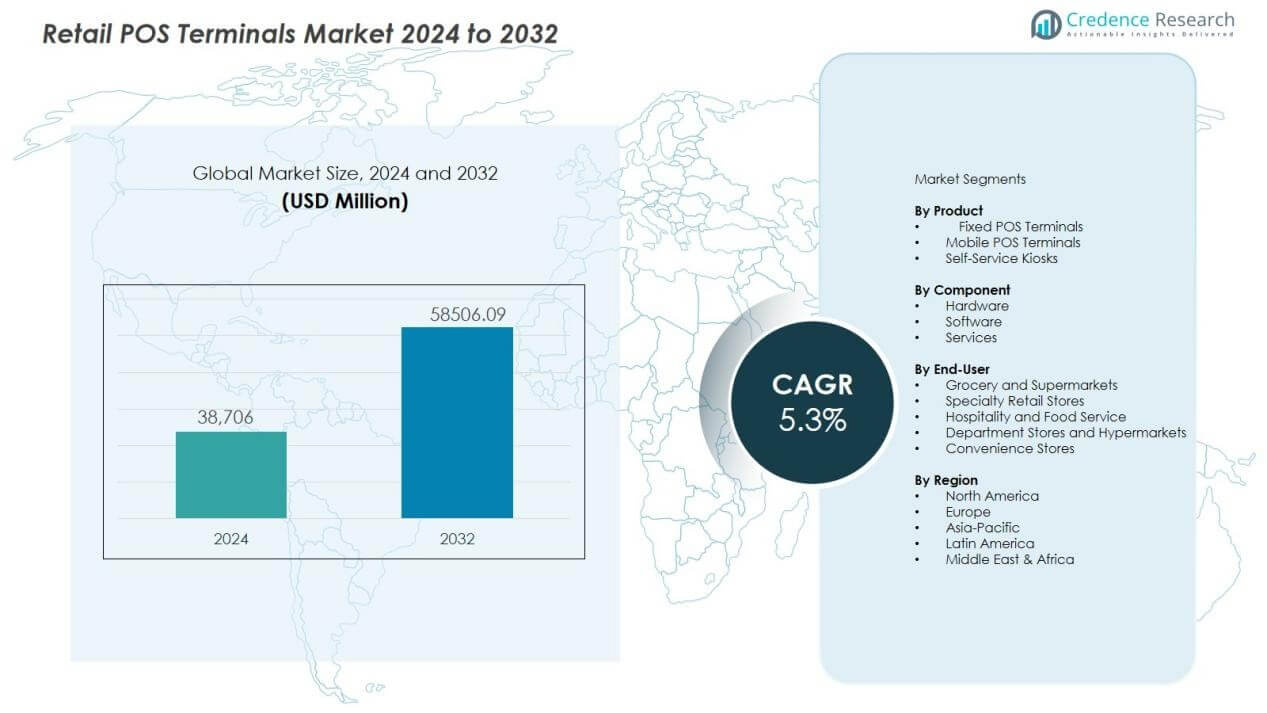
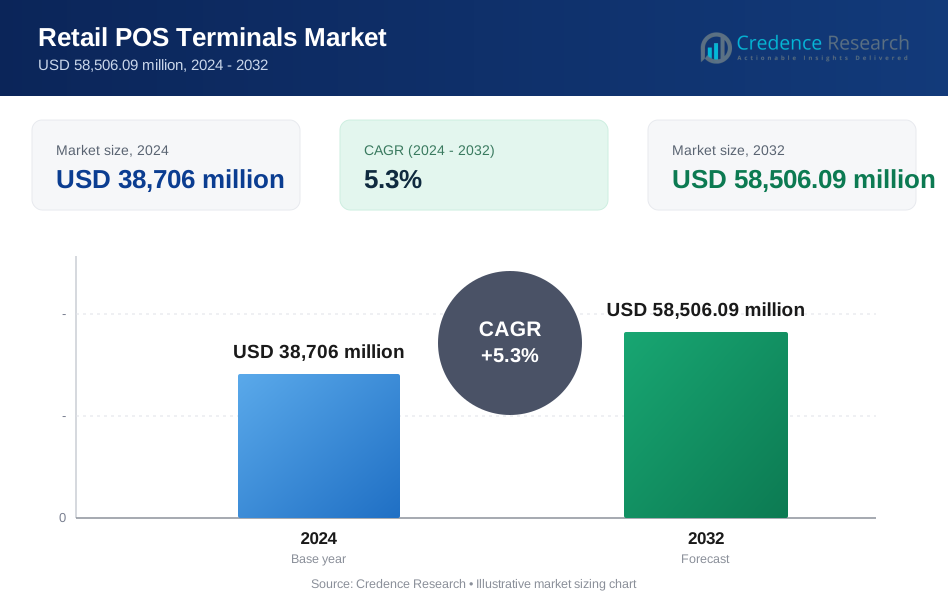
The Retail POS Terminals Market size was valued at USD 38,706 million in 2024 and is anticipated to reach USD 58506.09 million by 2032, at a CAGR of 5.3 % during the forecast period.
| REPORT ATTRIBUTE | DETAILS |
|---|---|
| Historical Period | 2020-2024 |
| Base Year | 2025 |
| Forecast Period | 2026-2032 |
| Retail POS Terminals Market Size 2024 | USD 38,706 million |
| Retail POS Terminals Market, CAGR | 5.3 % |
| Retail POS Terminals Market Size 2032 | USD 58506.09 million |
Retail POS Terminals Market Insights:
- North America (34.1%), Europe (27.6%), and Asia-Pacific (24.8%) represent the top three regional shares, driven by advanced retail infrastructure, strong regulatory frameworks, and high penetration of digital and contactless payment systems.
- Asia-Pacific, holding 24.8% share, is the fastest-growing region due to rapid retail modernization, rising consumer spending, expansion of organized retail, and government-led cashless payment initiatives.
- By product, Fixed POS Terminals account for 48.5% share, followed by Mobile POS Terminals at 32.4%, reflecting continued reliance on stable checkout systems alongside rising demand for flexible, mobile solutions.
- By component, Hardware dominates with 54.7% share, while Software and Services collectively hold 45.3%, supported by increasing adoption of cloud-based platforms, analytics, and managed POS services.
Retail POS Terminals Market Drivers:
Accelerated Digital Payment Adoption and Checkout Modernization
The Retail POS Terminals Market benefits from rapid adoption of digital and contactless payments across global retail formats. Retailers deploy modern terminals to support cards, mobile wallets, QR codes, and NFC-based payments. It improves checkout speed, reduces cash handling, and enhances transaction security. Payment ecosystem maturity and consumer preference for frictionless checkout continue to reinforce demand.
- For instance, Siemens introduced a smart industrial control relay with IoT integration in October 2021, enabling predictive maintenance that reduced downtime by 30% in manufacturing lines.
Omnichannel Retail Expansion and System Integration Requirements
The Retail POS Terminals Market gains momentum from omnichannel retail strategies that connect physical and digital sales channels. Retailers require unified POS platforms that synchronize pricing, inventory, and customer data across stores and online platforms. It enables consistent customer experiences and accurate order fulfillment. Integration with ERP, CRM, and inventory systems further strengthens operational control.
- For instance, Square's POS platform enables near real-time synchronization of transactions across its platform used by millions of businesses worldwide, ensuring seamless data flow between in-store and online channels.
Growing Demand for Real-Time Data Analytics and Store Intelligence
The Retail POS Terminals Market advances through rising demand for actionable, real-time retail analytics. Modern terminals capture transaction-level data that supports demand forecasting, pricing decisions, and inventory optimization. It allows retailers to respond quickly to changing consumer behavior and seasonal trends. Data-driven store management improves margins and reduces stock inefficiencies.
Technology Advancements and Cloud-Based POS Deployment Models
The Retail POS Terminals Market experiences sustained growth due to advancements in cloud computing, mobility, and hardware design. Retailers adopt cloud-based POS platforms for scalability, remote management, and lower upfront costs. It simplifies software updates, compliance management, and multi-store operations. Mobile and tablet-based terminals also support flexible store layouts and pop-up retail formats.
Retail POS Terminals Market Trends:
Rapid Shift Toward Cloud-Native and Software-Centric POS Architectures
The Retail POS Terminals Market reflects a clear shift toward cloud-native, software-centric architectures that prioritize flexibility and scalability. Retailers replace legacy on-premise systems with cloud-based platforms that support centralized control across multiple store locations. It enables real-time data access, remote updates, and faster deployment cycles. Vendors focus on modular software layers that allow customization by store format and transaction volume. Subscription-based pricing models improve cost predictability for retailers. Integration with inventory, loyalty, and analytics platforms strengthens enterprise-wide visibility. Security frameworks embedded within cloud POS systems also address data protection and compliance requirements.
- For instance, Square's cloud-native POS supported over 4.1 million active sellers worldwide by 2025. While the broader Block ecosystem—including Square, Cash App, and Afterpay—processed a record 124 million transactions over the four-day Black Friday/Cyber Monday weekend in 2025, Square's platform enabled continuous, seamless multi-store synchronization of inventory and sales across millions of global locations.
Expansion of Mobile, Self-Service, and Contactless POS Deployment Models
The Retail POS Terminals Market shows strong momentum toward mobile, self-service, and contactless deployment models that reshape in-store experiences. Retailers adopt tablet-based and handheld POS terminals to support assisted selling and flexible checkout locations. It reduces queue congestion and improves staff productivity during peak hours. Self-checkout kiosks gain traction in grocery, convenience, and large-format retail environments. Contactless functionality supports digital wallets, QR payments, and NFC cards across global regions. Hardware designs now emphasize portability, durability, and ergonomic use. These trends align with retailer focus on speed, convenience, and customer autonomy at the point of sale.
- For instance, Square introduced its handheld Square Terminal in October 2018 (or September 2019 in the UK/Canada), enabling merchants to process payments and print receipts anywhere in the store, reducing queue times.
Retail POS Terminals MarketChallenges Analysis:
High Implementation Costs and System Upgrade Complexity Across Retail Networks
The Retail POS Terminals Market faces challenges related to high implementation costs and complex upgrade requirements across distributed retail networks. Retailers must invest in hardware, software licenses, network infrastructure, and staff training. It places financial pressure on small and mid-sized retailers with limited capital budgets. Legacy system replacement often requires data migration and workflow redesign. Integration issues with existing ERP and inventory platforms increase deployment time. Ongoing maintenance and periodic hardware refresh cycles add to total cost of ownership.
Cybersecurity Risks, Compliance Demands, and Operational Reliability Issues
The Retail POS Terminals Market encounters persistent challenges tied to cybersecurity threats and regulatory compliance obligations. POS terminals remain targets for data breaches and payment fraud. It forces retailers to adopt advanced encryption, tokenization, and access controls. Compliance with standards such as PCI DSS raises operational complexity and cost. Network downtime or software failures disrupt checkout operations and customer satisfaction. Dependence on cloud connectivity also introduces service continuity risks in low-bandwidth environments.
Retail POS Terminals Market Opportunities:
Expansion of Digital Retail Ecosystems and Emerging Market Modernization
The Retail POS Terminals Market presents strong opportunities through expansion of digital retail ecosystems in emerging economies. Retailers in Asia-Pacific, Latin America, and Africa invest in formalized payment infrastructure. It supports adoption of modern POS terminals across grocery, apparel, and specialty retail formats. Government-led cashless payment initiatives strengthen demand. Growth of organized retail chains increases system standardization needs. Local partnerships enable scalable deployment and service support. Affordable cloud-based solutions improve market accessibility for small retailers.
Integration of Advanced Analytics, AI, and Value-Added POS Services
The Retail POS Terminals Market offers significant opportunity through integration of advanced analytics and AI-driven capabilities. POS terminals evolve into data intelligence hubs that support demand planning and dynamic pricing. It enables personalized promotions and loyalty engagement at checkout. Vendors introduce embedded financing, inventory optimization, and fraud detection features. Subscription-based service models create recurring revenue streams. Open API frameworks encourage ecosystem expansion. These developments enhance long-term value for retailers and technology providers.
Retail POS Terminals Market Segmentation Analysis:
By Product
The Retail POS Terminals Market by product includes fixed POS terminals, mobile POS terminals, and self-service kiosks. Fixed POS terminals hold strong adoption across supermarkets and large-format retail due to high transaction volumes and system stability. Mobile POS terminals gain traction in specialty retail, hospitality, and pop-up stores because they support flexible checkout and assisted selling. It improves floor-level engagement and reduces queue pressure. Self-service kiosks expand rapidly in grocery and quick-service environments where speed and labor efficiency matter. Product innovation focuses on compact design, contactless capability, and multi-payment compatibility.
- For Instance, NCR Voyix (formerly NCR Corporation) continued to power the checkout infrastructure for Walmart, where a high-volume Supercenter typically processed between 10,000 and 15,000 transactions daily.
By Component
The Retail POS Terminals Market by component covers hardware, software, and services. Hardware accounts for a significant share due to continued demand for terminals, scanners, printers, and payment peripherals. Software demand rises steadily with growth in cloud-based POS platforms, analytics tools, and security layers. It supports centralized management and real-time visibility across store networks. Services such as installation, maintenance, and technical support remain essential for large deployments. Vendors emphasize bundled offerings to improve lifecycle value and system reliability.
- For Instance, Square's cloud-based point-of-sale (POS) ecosystem processed approximately $210 billion in Gross Payment Volume (GPV) for the full year 2025 across more than 4.1 million active sellers worldwide.
By End-User
The Retail POS Terminals Market by end-user includes grocery stores, specialty retail, hospitality, and large retail chains. Grocery and hypermarkets dominate adoption due to high checkout frequency and automation needs. Specialty retail favors mobile and tablet-based POS solutions for personalized service. It aligns well with omnichannel sales models. Hospitality adopts POS systems that integrate payments, ordering, and inventory control. Large retail chains drive demand for scalable, standardized POS platforms across multiple locations.
Segmentations:
By Product
- Fixed POS Terminals
- Mobile POS Terminals
- Self-Service Kiosks
By Component
- Hardware
- Software
- Services
By End-User
- Grocery and Supermarkets
- Specialty Retail Stores
- Hospitality and Food Service
- Department Stores and Hypermarkets
- Convenience Stores
By Region
- North America
- U.S.
- Canada
- Mexico
- Europe
- Germany
- France
- U.K.
- Italy
- Spain
- Rest of Europe
- Asia Pacific
- China
- Japan
- India
- South Korea
- South-east Asia
- Rest of Asia Pacific
- Latin America
- Brazil
- Argentina
- Rest of Latin America
- Middle East & Africa
- GCC Countries
- South Africa
- Rest of the Middle East and Africa
Regional Analysis:
North America and Europe: Mature Retail Infrastructure and Technology Leadership
The Retail POS Terminals Market in North America benefits from advanced retail infrastructure and high digital payment penetration. Retailers deploy sophisticated POS systems that support omnichannel operations and real-time analytics. It strengthens checkout efficiency, fraud control, and customer data utilization. Strong presence of leading POS vendors accelerates technology upgrades across store networks. Europe shows steady demand driven by regulatory compliance, EMV standards, and cashless payment adoption. Retail chains invest in standardized POS platforms to support cross-border operations. Consumer preference for contactless transactions sustains long-term demand.
Asia-Pacific: Rapid Retail Modernization and Digital Payment Expansion
The Retail POS Terminals Market in Asia-Pacific records the fastest expansion due to rapid retail modernization and urban growth. Countries such as China, India, Japan, and South Korea invest heavily in digital payment ecosystems. It supports large-scale deployment of mobile and cloud-based POS solutions. Growth of organized retail and e-commerce integration drives system adoption across store formats. Government-led cashless initiatives strengthen merchant acceptance of modern POS terminals. Local vendors increase market competitiveness through cost-effective solutions. High transaction volumes encourage scalable and flexible POS deployments.
Latin America and Middle East & Africa: Emerging Adoption and Infrastructure Development
The Retail POS Terminals Market in Latin America and the Middle East & Africa shows rising adoption supported by infrastructure development. Retailers focus on replacing manual billing systems with digital POS platforms. It improves transaction transparency and inventory control. Expansion of international retail brands raises demand for standardized POS systems. Payment digitization initiatives promote card and mobile wallet acceptance. Market growth remains uneven due to connectivity and cost constraints. Long-term opportunity exists through cloud-based and mobile POS solutions.
Key Player Analysis:
- VeriFone Systems, Inc.
- Ingenico Group (Worldline)
- PAX Technology Ltd.
- NCR Corporation
- Diebold Nixdorf, Inc.
- NEC Corporation
- Panasonic Corporation
- Samsung Electronics Co. Ltd.
- Epicor Software Corporation
- Square, Inc.
- HP Development Company, L.P.
- Toshiba Commerce Solutions / Toshiba Corporation
Competitive Analysis:
The Retail POS Terminals Market features a competitive landscape defined by global technology providers, specialized POS vendors, and regional solution developers. Leading companies focus on integrated hardware–software ecosystems that support cloud deployment, omnichannel operations, and advanced security standards. It drives differentiation through reliability, scalability, and ease of integration with retail management systems. Vendors invest in mobile and self-service POS portfolios to address evolving store formats and checkout models. Strategic partnerships with payment processors and software platforms strengthen market positioning. Regional players compete through cost-effective solutions and localized service support. Product innovation centers on contactless payments, analytics capabilities, and modular system design. Competitive intensity remains high due to rapid technology cycles and frequent platform upgrades. Long-term success depends on service quality, total cost of ownership, and the ability to support large multi-store retail environments.
Recent Developments:
- In March 2025, Siemens formed the Accenture Siemens Business Group with 7,000 professionals to advance AI and automation in engineering and manufacturing.
- In October 2025, ABB Ltd agreed to sell its robotics business to SoftBank Group for $5.375 billion, with the deal expected to close in mid-to-late 2026 to fund further electrification and automation investments.
Report Coverage:
The research report offers an in-depth analysis based on Product, Component, End-User and Region. It details leading Market players, providing an overview of their business, product offerings, investments, revenue streams, and key applications. Additionally, the report includes insights into the competitive environment, SWOT analysis, current Market trends, as well as the primary drivers and constraints. Furthermore, it discusses various factors that have driven Market expansion in recent years. The report also explores Market dynamics, regulatory scenarios, and technological advancements that are shaping the industry. It assesses the impact of external factors and global economic changes on Market growth. Lastly, it provides strategic recommendations for new entrants and established companies to navigate the complexities of the Market.
Future Outlook:
- The Retail POS Terminals Market will advance through widespread adoption of cloud-native platforms that enable centralized control, rapid updates, and scalable multi-store operations.
- Retailers will prioritize unified commerce capabilities that connect in-store, online, and mobile channels through a single transactional and data backbone.
- Mobile and tablet-based POS deployments will expand to support flexible checkout, assisted selling, and space-efficient store layouts across diverse retail formats.
- Self-service and frictionless checkout solutions will gain broader acceptance, driven by labor optimization goals and customer demand for faster transactions.
- Embedded analytics will mature into decision-support tools that guide pricing, promotions, inventory planning, and store-level performance management.
- Security architectures will strengthen through tokenization, encryption, and identity controls to address evolving payment fraud and compliance requirements.
- Open APIs and modular software design will encourage ecosystem partnerships with loyalty, payments, and retail management solution providers.
- Hardware innovation will emphasize durability, portability, and energy efficiency to support high-traffic environments and extended device lifecycles.
- Emerging markets will accelerate adoption through digital payment initiatives, organized retail growth, and affordable subscription-based POS offerings.
- Service differentiation will shape competition, with vendors emphasizing uptime assurance, remote support, and lifecycle management to retain enterprise clients.
Request a Free Sample
Fill in your details and we'll send you a free sample report.
- Sample data tables & charts
- Research methodology
Need a Custom Version of This Report?
Tailor the scope, geography, or segments to your exact requirements.
- Custom geography or segment scope
- Direct access to our analyst team
Frequently Asked Questions
What is the current market size of the Retail POS Terminals Market, and what is its projected value by 2032?
At what CAGR is the Retail POS Terminals Market expected to grow during the forecast period?
Which product segment held the largest share in the Retail POS Terminals Market in 2024?
What are the key factors driving growth in the Retail POS Terminals Market?
Which end-user segment contributes most to market demand?
Which region dominated the Retail POS Terminals Market in 2024?
Table of Content
Chapter 1. Report Introduction
- 1.1 Report Description & Purpose
- 1.1.1 Report Title & Market Definition
- 1.1.2 Unique Selling Propositions (USP) & Key Differentiators
- 1.1.3 Value Proposition for Stakeholders
- 1.2 Research Objectives
- 1.2.1 Market Sizing Objectives (Volume & Revenue)
- 1.2.2 Segmentation Objectives
- 1.2.3 Competitive Intelligence Objectives
- 1.2.4 Forecast & Scenario Objectives
- 1.3 Report Scope
- 1.3.1 Retail POS Terminals Scope – Types & Subtypes Covered
- 1.3.2 Geographic Scope – Regions & Countries Covered
- 1.3.3 Historical Period, Base Year & Forecast Period (2024; forecast to 2032)
- 1.3.4 Inclusions & Exclusions
- 1.4 HS Code & Classification Framework
- 1.5 Currency, Units & Pricing Basis
- 1.6 Target Stakeholders
- 1.7 Limitations & Assumptions
Chapter 2. Executive Summary
- 2.1 Global Retail POS Terminals Market Snapshot
- 2.1.1 Market Size – Historical (2024) & Forecast (2024-2032) (2024: USD 38,706 million → 2032: USD 58,506.09 million)
- 2.1.2 Volume & Revenue – Global Totals
- 2.1.3 Key Market Highlights – Top Five Facts
- 2.2 Retail POS Terminals Market Segmentation Snapshot
- 2.2.1 Market Split by Region – 2024 vs. 2032
- 2.3 Competitive Snapshot
- 2.3.1 Top 10 Players by Revenue Share – 2024
- 2.3.2 Top 10 Players by Volume Share – 2024
- 2.3.3 Recent Strategic Developments (18-Month Summary)
- 2.4 Key Investment Highlights & Strategic Conclusions
Chapter 3. Retail POS Terminals Market Dynamics & Industry Analysis
- 3.1 Market Overview & Context
- 3.1.1 Retail POS Terminals Market Position in the Broader Automotive Value Chain
- 3.1.2 OEM vs. Replacement Market Dynamics
- 3.1.3 Market Maturity & Development Stage by Region
- 3.2 Retail POS Terminals Market Drivers
- 3.3 Retail POS Terminals Market Restraints & Challenges
- 3.4 Retail POS Terminals Market Opportunities
- 3.5 Porter's Five Forces Analysis
- 3.5.1 Threat of New Entrants
- 3.5.2 Bargaining Power of Suppliers
- 3.5.3 Bargaining Power of Buyers
- 3.5.4 Threat of Substitutes
- 3.5.5 Competitive Rivalry – Intensity Assessment
- 3.6 Retail POS Terminals Value Chain Analysis
- 3.6.1 Upstream – Raw Material/Input Suppliers
- 3.6.1.1 Raw Material/Input 1
- 3.6.1.2 Raw Material/Input 2
- 3.6.1.3 Raw Material/Input 3
- 3.6.2 Midstream – Production/Manufacturing/Service Delivery
- 3.6.2.1 Production/Process Overview
- 3.6.2.2 Key Facility Locations & Capacity by Manufacturer
- 3.6.3 Downstream – Distribution & End Consumer
- 3.6.3.1 Primary Channel – B2B/OEM
- 3.6.3.2 Secondary Channels – Dealer, Retail, Online, Direct
- 3.6.4 Value Chain Profitability Analysis
- 3.6.1 Upstream – Raw Material/Input Suppliers
- 3.7 PESTEL Analysis
- 3.7.1 Political Factors
- 3.7.2 Economic Factors
- 3.7.3 Social Factors
- 3.7.4 Technological Factors
- 3.7.5 Environmental Factors
- 3.7.6 Legal Factors
- 3.8 Retail POS Terminals Supply Chain Analysis
- 3.8.1 Raw Material/Input Supply Risk Assessment
- 3.8.2 Manufacturing Concentration Risk (Geographic Exposure)
- 3.8.3 Trade Disruption Impact Analysis
- 3.9 Regulatory & Policy Landscape
Note: The regulatory and policy landscape section covers regulations based on their applicability to the market, Retail POS Terminals category, geography, and scope of the study. Only regulatory frameworks with a material impact on operations, compliance, trade, sustainability, or market access are analyzed in detail.
Chapter 4. Key Investment Pockets & Opportunity Analysis
- 4.1 Retail POS Terminals Market Attractiveness Analysis
- 4.1.1 By Region – Investment Attractiveness Matrix (Volume × CAGR)
- 4.2 Absolute Revenue Growth Opportunity
- 4.2.1 By Region – Absolute USD Growth Through 2032
- 4.3 Incremental Volume Opportunity
- 4.3.1 By Region – Incremental Volume Through 2032
- 4.3.2 Segment – Incremental Volume
- 4.4 Emerging Submarket Opportunity Deep Dive (Subject to Applicability)
- 4.5 Emerging Market Opportunity Scorecards
- 4.5.1 United States
- 4.5.2 Europe
- 4.5.3 Asia
- 4.5.4 Middle East & Africa
Note: Emerging Market Opportunity Scorecards will be included based on relevance and strategic importance. Regions listed are indicative and may vary depending on data availability and market dynamics.
Chapter 5. Retail POS Terminals Import-Export Analysis & Trade Flows
- 5.1 Global Trade Overview
- 5.1.1 Global Export Value by Country (2024)
- 5.1.2 Global Export Volume by Country (2024)
- 5.1.3 Global Import Value by Country (2024)
- 5.1.4 Global Import Volume by Country (2024)
- 5.1.5 Net Trade Balance by Country (2024)
- 5.2 Export Analysis – Segment
- 5.2.1 Type 1 (HS Code)
- 5.2.2 Type 2 (HS Code)
- 5.2.3 Type 3 (HS Code)
- 5.2.4 Type 4 (HS Code)
- 5.2.5 Type 5 (HS Code)
- 5.3 Import Analysis – Segment
- 5.3.1 Type 1 (HS Code)
- 5.3.2 Type 2 (HS Code)
- 5.3.3 Type 3 (HS Code)
- 5.3.4 Type 4 (HS Code)
- 5.3.5 Type 5 (HS Code)
- 5.4 Average Unit Trade Prices
- 5.4.1 Average Export Price – Segment & Country
- 5.4.2 Average Import Price – Segment & Source Country
- 5.4.3 Price Trends (2024)
- 5.5 Key Trade Route Analysis
- 5.5.1 Trade Route 1
- 5.5.2 Trade Route 2
- 5.5.3 Trade Route 3
- 5.5.4 Trade Route 4
- 5.5.5 Trade Route 5
- 5.6 Trade Policy Impact Assessment
- 5.6.1 US Anti-Dumping & Section 301 Tariffs
- 5.6.2 EU Customs Union Impact
- 5.6.3 Major Free Trade Agreements
- 5.6.4 USMCA Rules of Origin
Note: Trade policy analysis will be included only where relevant to the Retail POS Terminals market.
Chapter 6. Competitive Landscape & Company Benchmarking
- 6.1 Retail POS Terminals Market Concentration & Structure
- 6.1.1 Herfindahl-Hirschman Index (HHI) – vs. 2024
- 6.1.2 Tier 1, Tier 2 & Tier 3 Market Structure
- 6.1.3 Global, Regional & Local Player Dynamics
- 6.2 Retail POS Terminals Market Share Analysis – 2024
- 6.2.1 Global Revenue Share by Company
- 6.2.2 Global Volume Share by Company
- 6.2.3 Regional Revenue Share
- 6.2.4 Market Share Evolution ( vs. 2024)
- 6.2.5 OEM Segment Share by Company
- 6.2.6 Replacement Segment Share by Company
- 6.3 Production/Delivery Capacity & Facility Analysis
- 6.3.1 Global Installed Capacity
- 6.3.2 Capacity Utilization Rates
- 6.3.3 Production/Output Volume
- 6.3.4 Facility Locations & Capacity Map
- 6.3.5 Planned Capacity Additions
- 6.4 Retail POS Terminals Competitive Benchmarking Matrix
- 6.4.1 Revenue, Volume, CAGR & Profitability Comparison
- 6.4.2 Channel Revenue Mix
- 6.4.3 Geographic Revenue Exposure
- 6.4.4 R&D Intensity
- 6.4.5 Sustainability Maturity
- 6.5 Strategic Developments in Retail POS Terminals (Last 24 Months)
- 6.5.1 Mergers, Acquisitions & Divestments
- 6.5.2 New Retail POS Terminals Launches
- 6.5.3 Facility Expansions
- 6.5.4 Strategic Alliances, Joint Ventures & Partnerships
- 6.5.5 Distribution Expansion & Market Entry
- 6.5.6 Sustainability & ESG Initiatives
- 6.6 Competitive Strategy Mapping
- 6.6.1 Leader, Challenger, Follower & Niche Classification
- 6.6.2 Pricing Strategy Comparison
- 6.6.3 Channel Strategy Matrix
Note: Strategic developments are included based on their materiality and the availability of reliable information.
Chapter 7. Global Retail POS Terminals Market – By Distribution Channel
- 7.1 Segment Overview
- 7.1.1 Volume & Revenue Split by Channel (2024 & 2032)
- 7.1.2 Channel Mix Evolution (2024-2032)
Chapter 8. Regional Market Analysis – Global Overview
- 8.1 Global Regional Overview
- 8.1.1 Regional Volume Share
- 8.1.2 Regional Revenue Share
- 8.1.3 Regional Volume by Region
- 8.1.4 Regional Revenue by Region
- 8.1.5 Regional Forecast Through 2032
- 8.2 Cross-Regional Segment Analysis
- 8.2.1 By Distribution Channel
- 8.2.2 By Brand/Price Tier
Chapter 9. North America Retail POS Terminals Market
- 9.1 United States
- 9.2 Canada
- 9.3 Mexico
Chapter 10. Europe Retail POS Terminals Market
- 10.1 Germany
- 10.2 France
- 10.3 Italy
- 10.4 United Kingdom
- 10.5 Spain
- 10.6 Poland
- 10.7 Russia
- 10.8 Netherlands
- 10.9 Belgium
- 10.10 Sweden
- 10.11 Denmark
- 10.12 Norway
- 10.13 Rest of Europe
Chapter 11. Asia Pacific Retail POS Terminals Market
- 11.1 China
- 11.2 India
- 11.3 Japan
- 11.4 South Korea
- 11.5 Thailand
- 11.6 Indonesia
- 11.7 Vietnam
- 11.8 Malaysia
- 11.9 Australia
- 11.10 Rest of Asia Pacific
Chapter 12. Latin America Retail POS Terminals Market
- 12.1 Brazil
- 12.2 Argentina
- 12.3 Colombia
- 12.4 Chile
- 12.5 Rest of Latin America
Chapter 13. Middle East Retail POS Terminals Market
- 13.1 Saudi Arabia
- 13.2 United Arab Emirates
- 13.3 Turkey
- 13.4 Israel
- 13.5 Iran
- 13.6 Rest of the Middle East
Chapter 14. Africa Retail POS Terminals Market
- 14.1 South Africa
- 14.2 Egypt
- 14.3 Nigeria
- 14.4 Morocco
- 14.5 Rest of Africa
Chapter 15. Retail POS Terminals Company Profiles
- 15.1 [Company 01]
- 15.1.1 Company Overview
- 15.1.2 Key Management Personnel
- 15.1.3 Products & Services Portfolio
- 15.1.4 Financial Performance
- 15.1.5 Key Market Focus & Geographic Presence
- 15.1.6 Recent Developments & Strategic Initiatives
Note: The company profile list is preliminary and may change based on research findings, market developments, data availability, and client requirements.
Chapter 16. Appendices
- Appendix A – List of Abbreviations & Acronyms
- Appendix B – Industry Classification Code Reference – Full Series
- Appendix C – Production & Capacity Data Tables
- Appendix D – End-Use & Demand Base Tables
- Appendix E – Consumption & Replacement Rate Assumptions
- Appendix F – ASP Reference Tables
- Appendix G – Manufacturing & Facility Database
- Appendix H – Import-Export Data Tables
- Appendix I – Regulatory Summary Tables
- Appendix J – Primary Research Participant List (Anonymized)
- Appendix K – Primary Research Questionnaire Framework
- Appendix L – Data Sources & Bibliography
- Appendix M – Market Size Divergence & Source Comparison
Chapter 17. Research Methodology
- 17.1 Research Framework & Philosophy
- 17.2 Secondary Research – Sources, Hierarchy & Data Extraction
- 17.3 Data Modeling – Bottom-Up & Top-Down Market Sizing
- 17.4 Primary Research – Stakeholder Framework, LOI & Sample Sizes
- 17.5 Forecast Methodology – Regression, Scenario & Sensitivity Analysis
- 17.6 Quality Control – Four-Layer Validation Framework
- 17.7 Limitations & Standard Assumptions
- 17.8 Disclaimer
