
| REPORT ATTRIBUTE | DETAILS |
|---|---|
| Historical Period | 2019-2022 |
| Base Year | 2023 |
| Forecast Period | 2024-2032 |
| Mobile Wallet Market Size 2023 | USD 7515.2 Million |
| Mobile Wallet Market, CAGR | 30.1% |
| Mobile Wallet Market Size 2032 | USD 80248.4 Million |
Market Insights
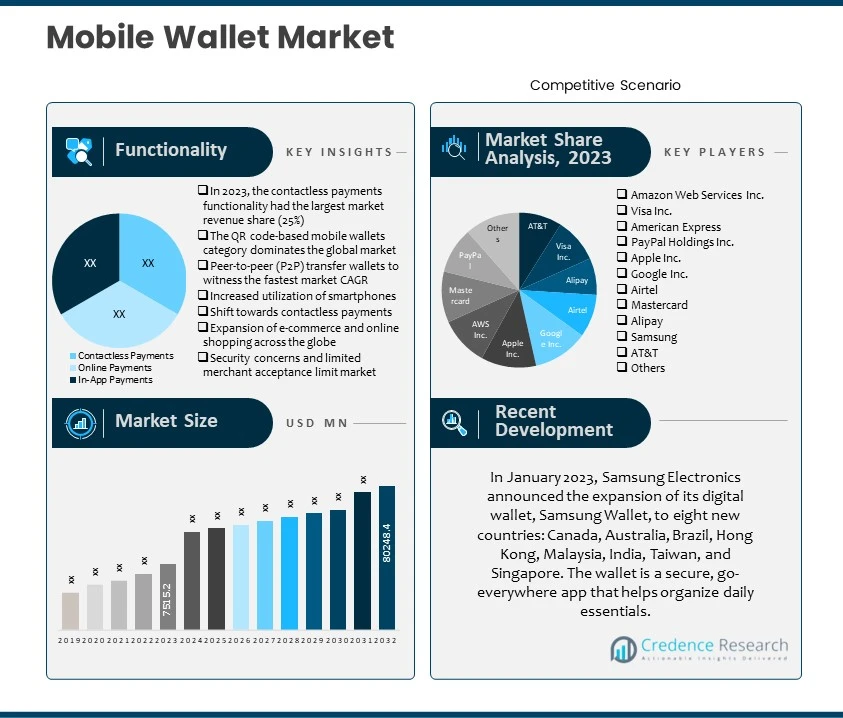
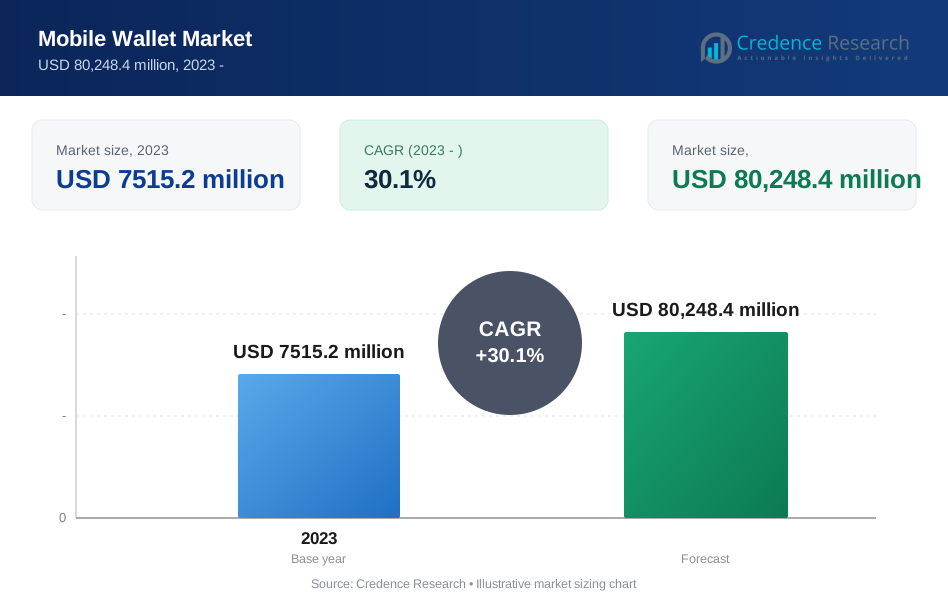
- The global demand for mobile wallets was valued at USD 7515.2 million in 2023 and is expected to reach USD 80248.4 million in 2032, growing at a CAGR of 30.1% between 2024 and 2032.
- The QR code-based wallets are the market leader by technology platform, accounting for more than 29% of total value in 2023, while the cloud-based wallets are predicted to increase substantially over the projected time frame.
- The contactless payments functionality category dominates the global need for mobile wallets, accounting for more than 25% in 2023, and is anticipated to grow at an elevated CAGR.
- The open mobile wallets category continues to grow at the highest pace in the forecast period, while closed mobile wallets lead the global market revenue in 2023 with a 56% share.
- The standalone wallets category dominated the market, accounting for 60% of the total revenue share by the integration level. In contrast, the integrated wallets will expand at the fastest rate.
- Asia Pacific contributes to the rapid growth of the mobile wallet sector, accounting for more than one-third of the market in 2023, while Europe and North America account for slightly less than 55%. Europe accounted for more than 18.5% of the market in 2023.
- Mobile wallets are becoming an integral part of the digital ecosystem, with potential applications beyond retail payments, including public transportation, healthcare, education, and government services. This is leading to a more comprehensive digital wallet experience for a wide range of users.
- The rise of e-commerce and m-commerce (mobile commerce) has also boosted the market demand for mobile wallets, as consumers increasingly prefer seamless and convenient payment options while shopping online.
Executive Summary
Market Definition
A mobile wallet is a digital payment system that assists users in storing their payment information securely on a mobile device, such as a tablet or smartphone, and making transactions electronically. It typically involves the use of mobile applications or platforms provided by financial institutions, technology companies, or other service providers. Mobile wallets can store various types of payment credentials, including credit cards, debit cards, prepaid cards, and digital wallets, enabling users to make purchases in-store, online, or through mobile apps. These wallets often utilize technologies like near-field communication (NFC), QR codes, or barcode scanning to facilitate contactless payments at point-of-sale terminals or to transfer funds between individuals. Mobile wallets also offer extra features such as loyalty card integration, transaction history tracking, bill payments, peer-to-peer (P2P) transfers, and digital receipts, providing users with a convenient and streamlined payment experience.
Market Overview
The global mobile wallet market has witnessed consistent growth over recent years and is set to grow at a CAGR of 30.1% between 2024 and 2032. The market was valued at USD 7515.2 million in 2023 and is expected to reach USD 80248.4 million in 2032.
Payment methods have been increasingly streamlined over time, transitioning from cash to debit cards to online transactions. In addition, the introduction of eCommerce approaches such as PayPal has resulted in widespread mobile wallet use. Since then, the conventional physical-digital wallet has been replaced with an evolving digital wallet concept.
With the increasing integration of smartphones into people's daily lives, the smartphone industry has witnessed rapid technological developments in terms of features offered. These include NFC, biometrics, encryption, 5G adoption, and artificial intelligence (AI). As a result, the banking and finance sector has benefited from the growing number of smartphone users due to the affordability of smartphones. The International Telecommunication Union estimates that 73% of adults globally who are ten years of age or older own a mobile phone in 2022. As more people have access to smartphones, they are more likely to use mobile wallets for a wide range of transactions, from daily shopping to bill payments.
Segmentation by Type of Mobile Wallet
- Closed mobile wallets maintain their dominance as the primary type, commanding over 56% market share in value in 2023. This dominance is attributed to their widespread acceptance, secure transaction capabilities, and integration with specific merchants or service providers.
- The open mobile wallet marketplace is expected to grow rapidly, owing to rising customer demand for flexible payment alternatives, cross-platform interoperability, and better customization features.
Segmentation by Technology Platform
- QR code-based mobile wallets govern the global market demand, capturing a substantial market share of over 29% in 2023. The convenience, accessibility, and cost-effectiveness of QR code transactions contribute to their widespread adoption among merchants and consumers across various sectors.
- Cloud-based wallets are projected to grow at the fastest CAGR, owing to new developments in cloud technology, increased security features, and seamless connectivity with other digital platforms.
Segmentation by Integration Level
- Integrated wallets also contribute significantly to the market demands, largely offering a seamless user experience by combining payment functionalities with other services such as loyalty programs, ticketing, and personal finance management.
- The standalone wallets category led the market with over 60% share in 2023. Standalone wallets provide independent payment capabilities without the need for integration with external platforms, which is widely appealing to users seeking simplicity and autonomy in their payment solutions.
Segmentation by Functionality
- Bill payment functionality is anticipated to grow at the fastest rate, owing to the expanding use of mobile wallets for utility bill payments, subscription services, and recurring transactions.
- Contactless payments held a commanding market revenue share of nearly 25% in 2023. The adoption of near-field communication (NFC) technology, enhanced security protocols, and the convenience of tap-and-go transactions contribute to their popularity among consumers worldwide.
Segmentation by User Demographics
- Consumer mobile wallets hold the majority share in this user demographics category, which largely caters to individual users for personal transactions, online shopping, peer-to-peer transfers, and everyday payments.
- Corporate mobile wallets are primarily designed for businesses, enterprises, and organizations. They facilitate corporate expenses, employee reimbursements, business-to-business transactions, and financial management solutions.
Segmentation by Region
- Asia Pacific emerges as a leading global market, fueling over one-third of the mobile wallet industry's growth in 2023. The rapid digital transformation, expanding smartphone penetration, and innovative fintech solutions fuel the regional market adoption of mobile wallets across diverse sectors and demographics.
- In 2023, North America and Europe combined hold little less than 55% of the market share, with Europe controlling more than 18.5% of that share. These regions have developed their mobile payment ecosystems as a result of solid legal frameworks, extensive merchant acceptance, and shifting consumer preferences.
- The rest of the world, including Latin America, the Middle East, and Africa, represents emerging markets with growing demand for mobile wallets. These regions present opportunities for market players to expand their footprint, innovate tailored solutions, and address evolving consumer needs in digital payments.
Asia Pacific region dominated the mobile wallet market in 2023, with a 36% share, and is likely to grow at the elevated CAGR of 26% within the forecast period. Factors such as the increased population, growing smartphone adoptions, rising number of internet subscribers, and robust growth in the retail and e-commerce sectors across countries such as China, South Korea, Japan, and India are supporting the market growth in this region. Moreover, rising government programs such as Make in India and Digital India are likely to boost smartphone and other smart device usage, further resulting in increased regional demand for mobile wallets.
Europe continues to have a strong market presence, with a higher priority on improved privacy and security of data in mobile wallets. Aside from that, the increasing acceptance of mobile wallets for cashless tickets and transportation payments among Europeans is having a beneficial impact on the market. Apple Pay and Google Pay are the most popular mobile wallet solutions in Europe.
The Latin American mobile wallet industry is estimated to grow at a substantial 22% CAGR over the forecast time frame. This rapid growth is linked to increased smartphone usage, the expansion of e-commerce, and the growing need for convenience in the region. Governments and banking institutions in Latin America facilitate the expansion of mobile wallets by offering infrastructure and regulatory frameworks. The Brazilian government, for example, introduced Pix, a national mobile wallet platform, in November 2020 to encourage the use of mobile wallets among its citizens.
Key Highlights of the Report
The global mobile wallet market is segmented by type, technology platform, integration level, functionality, user demographics, and region. Closed mobile wallets emerge as the primary choice among the various types of mobile wallets, offering a controlled and secure payment environment for consumers and businesses. Within technology platforms, QR code-based mobile wallets witness substantial demand due to their convenience and widespread acceptance among merchants and users. Integrated wallets contribute majorly to market demand by seamlessly integrating with banking systems and enhancing transaction efficiency. In terms of functionality, contactless payments command a significant market share, attributed to the growing preference for quick and secure payment methods.
Mobile wallets make it easy and secure for consumers to make digital payments for numerous goods and services. The convenience of integrating credit cards, bank accounts, and other payment methods into mobile wallets enables users to execute transactions quickly and easily, eliminating the need for real cash or cards. The COVID-19 pandemic has further accelerated the market adoption of contactless payment alternatives, such as mobile wallets, due to hygiene concerns about physical cash and payment cards. According to the BIS Committee on Payments & Market Infrastructures (CPMI) Red Book Statistics, contactless payment transactions contributed to the majority of all card transactions in 2020, surpassing 2015 levels. Mobile wallets provide a touchless approach to complete transactions, which aligns with evolving consumer preferences as well as security measures, propelling the mobile wallet industry's growth.
However, despite developments in safety precautions, concerns over identity theft, data breaches, and unauthorized access to mobile wallets remain. Users are generally hesitant to store important financial information on their smartphones, fearing possible vulnerabilities and security flaws. Certain regions lack sufficient internet access and technological infrastructure, especially those that are rural or less developed. This limits the widespread acceptance of mobile wallets, as users demand consistent connectivity to conduct online transactions and access their digital wallets.
Asia Pacific had the largest percentage of the market due to increased smartphone penetration among the general regional population. Customers in Singapore, China, South Korea, and India are among the most active users of these digital platforms worldwide. China dominates the mobile wallet market in Asia-Pacific. This is due to the higher smartphone penetration rate and the large number of e-commerce platforms in the country. Large corporations such as Alibaba, Tencent, and Baidu are forming partnerships with a variety of retail stores and online platforms in order to increase the accessibility to their products across several channels. China currently has the highest smartphone ownership percentage in the world, with 59.9%. India follows with a utilization rate of 43.5%. These countries have a higher adoption rate of e-wallets. They are now at the forefront of the payments revolution by delivering secure and convenient payment processing.
What Are The Main Drivers Of The Global Mobile Wallet Market?
Mobile wallets provide a completely new dimension to retail commerce, allowing businesses to expand their reach. While mobile devices make it easy for consumers to make payments, they also serve as a new channel for businesses and financial institutions to communicate with their customers. Widespread smartphone use and merchants using multi-channel strategies in response to increased competition from online suppliers are projected to drive mobile wallet industry potential in the coming years. Mobile wallets are anticipated to expand beyond typical transactions that occur online and offline and include in-app payments. This market trend enables users to execute transactions within mobile apps without having to navigate to external payment gateways. This is particularly relevant for e-commerce platforms, app-based services, and digital content producers.
What Are The Major Challenges Faced By The Global Mobile Wallet Market?
As mobile wallet usage grows, mobile wallets and apps for mobile payments have become major targets for fraudsters. Cyberattacks targeting mobile wallets have led to the theft of confidential data and the loss of hundreds of millions of dollars. According to NITI Aayog data, cyberattacks involving malware, phishing, ransomware, and denial of service affected more than 50% of Indian businesses. As a result, many consumers are hesitant to use mobile wallets for contactless payments due to concerns about fraud, such as leaking data, security breaches, and other safety concerns that are anticipated to impede the global mobile wallet market's growth.
What Are The Growth Opportunities In The Global Mobile Wallet Market?
Mobile wallet providers are likely to incorporate more biometric identification methods, such as facial recognition, fingerprint recognition, and iris scanning, to improve security and user experience. Biometrics offers an extra layer of security by directly tying payment permission to the user's specific bodily traits. In May 2023, Dfns, a Paris-based firm that provides infrastructure and security technologies for cryptocurrency wallets, announced plans to incorporate biometrics into its wallet-as-a-service product. The new 'Delegated Signing' feature works with all major browsers and mobile operating systems, and it uses the WebAuthn protocol to offer authentication through native device biometrics such as facial authentication and TouchID, in addition to PIN codes.
Market Drivers
Several factors contribute to the growth of the global mobile wallet market share. The following are the key drivers of the global mobile wallet market:
Increased Smartphone Use and Internet Penetration
The widespread usage of smartphones, combined with the availability of internet access around the world, is contributing to the expansion of the mobile wallet sector. Smartphones are also becoming more affordable and accessible for a wider range of people. According to Leftronic Inc., a real-time data visualization and status monitoring platform for enterprises, there were 2.7 billion smartphone users worldwide in 2019. This extensive smartphone ownership substantially expands the potential consumer base for mobile wallet services. As per the Statcounter Global Stats, Asia Pacific has 30.68% Samsung users, 13.42% Apple users, 12.57% Xiaomi users, 9.81% Huawei users, 8.32 Oppo users, and 6.21% Mobecil users. Thus, the increased number of smartphone users is one of the main factors behind the market's expansion.
Moreover, smartphones are increasingly regarded as necessary gadgets for everyday living, including financial transactions. Increased usage of digital payment methods, which provide greater convenience to customers, is further boosting market developments. Major firms are also making investments in services and apps that are easy to use and meet the varied needs of smartphone users to ensure that these platforms continue to be an essential component of people's digital lives.
Market Restraints
The global mobile wallet market faces challenges that may limit its growth. These consist of the following:
Increasing Security Concerns in Users
Users are more concerned about trusting digital wallets as security breaches expose sensitive information, such as payment information and personal data. Fraudulent activities such as phishing assaults and frauds deceive users into disclosing their mobile wallet credentials, resulting in financial losses. Mobile wallet payments are only accepted by some retailers and service providers, which causes hardship for consumers who must still carry conventional payment methods. The availability of numerous mobile wallet providers with disparate technology and standards causes fragmentation difficulties, as consumers must use multiple digital wallet apps to utilize various services.
Mobile wallets are mostly available on smartphones, which are also inaccessible to some populations, particularly in emerging markets or among older adults. Economic gaps present market barriers to mobile wallet adoption, as low-income users may lack access to bank accounts or smartphones. Different countries and regions have varying legislations and compliance criteria for mobile wallet providers, creating market complexities for international operations. The absence of international standards in the mobile wallet sector restricts cross-border and cross-platform usage by causing issues related to interoperability.
Opportunities
The global mobile wallet market offers significant growth opportunities. These consist of the following:
Emerging Focus on Contactless Payment Transaction Facilities
The increasing demand for mobile wallets, as a result of the growing focus on contactless and seamless payment transaction facilities, is providing a favorable market outlook. Moreover, customers are looking for safer alternatives to traditional cash and card payments, preferring touchless payment methods. Aside from that, mobile wallets are equipped with near-field communication (NFC) technology, which allows users to execute secure and rapid contactless transactions by just tapping their cell phones on payment terminals. In accordance with this, businesses are heavily investing in NFC-enabled terminals to cater to consumer preferences, which promotes industry expansion. Leading mobile wallets, such as Samsung Pay, Apple Pay, and Google Pay, for example, are powered by NFC technology.
Mobile payment solutions are also extending beyond smartphones and tablets to include wearable technologies like smartwatches and rings. Vendors are already embracing IoT while employing disruptive technologies like blockchain to assure seamless transaction security and address data privacy issues. For instance, Apple Inc. provides services such as contactless payment methods, person-to-person payments, and transportation cards via its mobile wallet and Apple Pay on its wristwatch, the Apple Watch.
Competitive Landscape
Key Players
The global mobile wallet market is intensely competitive, with several prominent companies. The following are a few of the major players in the market and their market shares:
- Amazon Web Services Inc.
- Visa Inc.
- American Express
- PayPal Holdings Inc.
- Apple Inc.
- Google Inc.
- Airtel
- Mastercard
- Alipay
- Samsung
- AT&T
- Others
These major market players are using partnerships, collaborations, agreements, acquisitions and mergers, and other strategies to grow their corporate footprints and survive intense competition. They actively collaborate with banks, technology vendors, and payment service providers to deliver the high-tech digital infrastructure needed to enhance the customer experience.
Key market players are also making substantial investments in advanced security methods, such as tokenization, biometric authentication, and encryption technologies, to ensure reliable and safe transactions and secure user data. Several mobile wallet companies are further broadening their services offerings to include cross-border and international payments. This enables users to make global payments and transfers, meeting the demands of travelers and multinational organizations.
In August 2023, First National Bank of Omaha (FNBO) and Visa Inc. partnered to facilitate users with rapid account credential distribution to their mobile wallets without the need to download a separate app. Users also receive an account number that is added to their digital wallet automatically. It eliminates the need to download a specific application, giving users a hassle-free experience.
In June 2023, Google announced that Google Wallet will now be available in Albania, Argentina, Bosnia and Herzegovina, North Macedonia, and Montenegro, among the five other new nations. The company announced the official launch in a forum post, mentioning that the app was expanded to 12 countries in Europe, Asia Pacific, and North America in November of last year.
In June 2023, Alipay, a Chinese smartphone payment platform, and Mastercard, an electronic payment network, collaborated to provide international travelers with another convenient way to make cashless payments in China. Travelers from other countries can use their Alipay digital wallet to link any Mastercard card, which facilitates e-payments in China.
In July 2022, Google Inc. released a multifunctional digital wallet that enables users to store and utilize digital credentials such as identification cards and health permits, transit and event tickets, payment cards, and digital hotel keys.
Summary of Key Findings
- The market is segmented by type of mobile wallet, technology platform, integration level, functionality, user demographics, and region.
- Contactless payments and mobile wallet usage increased during the COVID-19 epidemic due to hygiene concerns and the shift towards cashless transactions, which is further propelling industry growth.
- The Asia Pacific region, particularly countries like China, India, and Southeast Asian nations, is witnessing rapid growth in the mobile wallet market due to a large unbanked population, increasing smartphone penetration, and robust digital infrastructure.
- Key market players in the global mobile wallet market include Apple Inc. (Apple Pay), Google LLC (Google Pay), Samsung Electronics Co., Ltd. (Samsung Pay), PayPal Holdings, Inc., Alipay, WeChat Pay, and others. These companies constantly innovate to capture a larger market revenue share.
- Challenges in the mobile wallet market include security concerns related to data breaches and fraud, interoperability issues across different mobile wallet platforms, and the need for standardized regulations to ensure consumer protection and trust.
Future Outlook
- The rapid adoption of mobile wallets is likely to continue growing as businesses and consumers embrace digital payment solutions. This will lead to a more cashless economy and further innovations in the mobile payments ecosystem.
- Emerging integration of additional services such as loyalty programs, ticketing, and peer-to-peer (P2P) transfers within mobile wallet apps is a key trend observed in the market to enhance user engagement and retention.
How CXOs Can Benefit from the Credence Research Mobile Wallet Market Report:
The Credence Research Mobile Wallet Market Report offers CXOs a comprehensive overview of the market, covering:
- Market Size and Growth Forecast: The report delivers detailed estimates of the global mobile wallet market size, segmented by type of mobile wallet, technology platform, integration level, functionality, user demographics, and region. It also includes forecasts for the market through 2032 based on key trends and drivers.
- Market Segmentation: The report segments the mobile wallet market by type of mobile wallet, technology platform, integration level, functionality, user demographics, and region. This segmentation provides CXOs with a granular understanding of the market and the opportunities in each segment.
- Competitive Landscape: The report profiles the key players in the mobile wallet market and provides insights into their strategies, product offerings, and financial performance. This information empowers CXOs to assess their competition, identify market trends, and make informed decisions about investments and strategic partnerships.
- Key Trends and Drivers: The report identifies and analyses the major trends and drivers shaping the mobile wallet market. This information helps CXOs understand market dynamics, anticipate industry shifts, and develop strategies to capitalize on emerging opportunities.
CXOs can leverage insights from the Credence Research Mobile Wallet Market Report to:
- Identify Growth Opportunities: The report helps CXOs identify new growth opportunities within the mobile wallet market. For example, it highlights the growing demand for contactless payments and the emergence of innovative functionalities in mobile wallets as key growth areas.
- Make Informed Investment Decisions: CXOs can make informed investment decisions based on the report's insights into market trends, competitive landscape, and key success factors for mobile wallet providers. This includes evaluating technology platforms, strategic partnerships, and customer preferences to drive investment decisions.
- Develop competitive strategies: The report assists CXOs in developing competitive strategies for their mobile wallet businesses. This includes identifying differentiation strategies, assessing competitor strengths and weaknesses, and exploring opportunities for market expansion and product innovation.
- Track market developments: The report helps CXOs track market developments and stay ahead of the curve, offering insights into the latest innovations and trends in the mobile wallet market.
Overall, the Credence Research Mobile Wallet Market Report proves to be a valuable resource for CXOs seeking a deeper understanding of the market and identifying growth opportunities.
Segmentation
- By Type of Mobile Wallet
- Open Mobile Wallets
- Closed Mobile Wallets
- By Technology Platform
- NFC (Near Field Communication) Based Wallets
- QR Code Based Wallets
- Peer-to-Peer (P2P) Transfer Wallets
- Cloud-Based Wallets
- By Integration Level
- Integrated Wallets
- Standalone Wallets
- By Functionality
- Contactless Payments
- Online Payments
- In-App Payments
- Bill Payments
- Ticketing and Transit
- Other Value-Added Services
- By User Demographics
- Consumer Mobile Wallets
- Corporate Mobile Wallets
- By Region
- North America
- The U.S.
- Canada
- Mexico
- Europe
- Germany
- France
- The U.K.
- Italy
- Spain
- Rest of Europe
- Asia Pacific
- China
- Japan
- India
- South Korea
- South-east Asia
- Rest of Asia Pacific
- Latin America
- Brazil
- Argentina
- Rest of Latin America
- Middle East & Africa
- GCC Countries
- South Africa
- Rest of the Middle East and Africa
- North America
Request a Free Sample
Fill in your details and we'll send you a free sample report.
- Sample data tables & charts
- Research methodology
Need a Custom Version of This Report?
Tailor the scope, geography, or segments to your exact requirements.
- Custom geography or segment scope
- Direct access to our analyst team
Frequently Asked Questions
What is the current size of the global mobile wallet market?
What is the expected growth rate of the mobile wallet market between 2024 and 2032?
Which segment is leading the market revenue in terms of technology platforms?
Which functionality segment governs the demand for mobile wallets globally?
Who are the major players in the global mobile wallet market?
Table of Content
Chapter 1. Report Introduction
- 1.1 Report Description & Purpose
- 1.1.1 Report Title & Market Definition
- 1.1.2 Unique Selling Propositions (USP) & Key Differentiators
- 1.1.3 Value Proposition for Stakeholders
- 1.2 Research Objectives
- 1.2.1 Market Sizing Objectives (Volume & Revenue)
- 1.2.2 Segmentation Objectives
- 1.2.3 Competitive Intelligence Objectives
- 1.2.4 Forecast & Scenario Objectives
- 1.3 Report Scope
- 1.3.1 Mobile Wallet Scope – Types & Subtypes Covered
- 1.3.2 Geographic Scope – Regions & Countries Covered
- 1.3.3 Historical Period, Base Year & Forecast Period (2023; forecast to the forecast period)
- 1.3.4 Inclusions & Exclusions
- 1.4 HS Code & Classification Framework
- 1.5 Currency, Units & Pricing Basis
- 1.6 Target Stakeholders
- 1.7 Limitations & Assumptions
Chapter 2. Executive Summary
- 2.1 Global Mobile Wallet Market Snapshot
- 2.1.1 Market Size – Historical (2023) & Forecast (the forecast period) (2023: USD 7515.2 million → forecast year: USD 80,248.4 million)
- 2.1.2 Volume & Revenue – Global Totals
- 2.1.3 Key Market Highlights – Top Five Facts
- 2.2 Mobile Wallet Market Segmentation Snapshot
- 2.2.1 Market Split by Region – 2023 vs.
- 2.3 Competitive Snapshot
- 2.3.1 Top 10 Players by Revenue Share – 2023
- 2.3.2 Top 10 Players by Volume Share – 2023
- 2.3.3 Recent Strategic Developments (18-Month Summary)
- 2.4 Key Investment Highlights & Strategic Conclusions
Chapter 3. Mobile Wallet Market Dynamics & Industry Analysis
- 3.1 Market Overview & Context
- 3.1.1 Mobile Wallet Market Position in the Broader Automotive Value Chain
- 3.1.2 OEM vs. Replacement Market Dynamics
- 3.1.3 Market Maturity & Development Stage by Region
- 3.2 Mobile Wallet Market Drivers
- 3.3 Mobile Wallet Market Restraints & Challenges
- 3.4 Mobile Wallet Market Opportunities
- 3.5 Porter's Five Forces Analysis
- 3.5.1 Threat of New Entrants
- 3.5.2 Bargaining Power of Suppliers
- 3.5.3 Bargaining Power of Buyers
- 3.5.4 Threat of Substitutes
- 3.5.5 Competitive Rivalry – Intensity Assessment
- 3.6 Mobile Wallet Value Chain Analysis
- 3.6.1 Upstream – Raw Material/Input Suppliers
- 3.6.1.1 Raw Material/Input 1
- 3.6.1.2 Raw Material/Input 2
- 3.6.1.3 Raw Material/Input 3
- 3.6.2 Midstream – Production/Manufacturing/Service Delivery
- 3.6.2.1 Production/Process Overview
- 3.6.2.2 Key Facility Locations & Capacity by Manufacturer
- 3.6.3 Downstream – Distribution & End Consumer
- 3.6.3.1 Primary Channel – B2B/OEM
- 3.6.3.2 Secondary Channels – Dealer, Retail, Online, Direct
- 3.6.4 Value Chain Profitability Analysis
- 3.6.1 Upstream – Raw Material/Input Suppliers
- 3.7 PESTEL Analysis
- 3.7.1 Political Factors
- 3.7.2 Economic Factors
- 3.7.3 Social Factors
- 3.7.4 Technological Factors
- 3.7.5 Environmental Factors
- 3.7.6 Legal Factors
- 3.8 Mobile Wallet Supply Chain Analysis
- 3.8.1 Raw Material/Input Supply Risk Assessment
- 3.8.2 Manufacturing Concentration Risk (Geographic Exposure)
- 3.8.3 Trade Disruption Impact Analysis
- 3.9 Regulatory & Policy Landscape
Note: The regulatory and policy landscape section covers regulations based on their applicability to the market, Mobile Wallet category, geography, and scope of the study. Only regulatory frameworks with a material impact on operations, compliance, trade, sustainability, or market access are analyzed in detail.
Chapter 4. Key Investment Pockets & Opportunity Analysis
- 4.1 Mobile Wallet Market Attractiveness Analysis
- 4.1.1 By Region – Investment Attractiveness Matrix (Volume × CAGR)
- 4.2 Absolute Revenue Growth Opportunity
- 4.2.1 By Region – Absolute USD Growth Through the forecast period
- 4.3 Incremental Volume Opportunity
- 4.3.1 By Region – Incremental Volume Through the forecast period
- 4.3.2 Segment – Incremental Volume
- 4.4 Emerging Submarket Opportunity Deep Dive (Subject to Applicability)
- 4.5 Emerging Market Opportunity Scorecards
- 4.5.1 United States
- 4.5.2 Europe
- 4.5.3 Asia
- 4.5.4 Middle East & Africa
Note: Emerging Market Opportunity Scorecards will be included based on relevance and strategic importance. Regions listed are indicative and may vary depending on data availability and market dynamics.
Chapter 5. Mobile Wallet Import-Export Analysis & Trade Flows
- 5.1 Global Trade Overview
- 5.1.1 Global Export Value by Country (2023)
- 5.1.2 Global Export Volume by Country (2023)
- 5.1.3 Global Import Value by Country (2023)
- 5.1.4 Global Import Volume by Country (2023)
- 5.1.5 Net Trade Balance by Country (2023)
- 5.2 Export Analysis – Segment
- 5.2.1 Type 1 (HS Code)
- 5.2.2 Type 2 (HS Code)
- 5.2.3 Type 3 (HS Code)
- 5.2.4 Type 4 (HS Code)
- 5.2.5 Type 5 (HS Code)
- 5.3 Import Analysis – Segment
- 5.3.1 Type 1 (HS Code)
- 5.3.2 Type 2 (HS Code)
- 5.3.3 Type 3 (HS Code)
- 5.3.4 Type 4 (HS Code)
- 5.3.5 Type 5 (HS Code)
- 5.4 Average Unit Trade Prices
- 5.4.1 Average Export Price – Segment & Country
- 5.4.2 Average Import Price – Segment & Source Country
- 5.4.3 Price Trends (2023)
- 5.5 Key Trade Route Analysis
- 5.5.1 Trade Route 1
- 5.5.2 Trade Route 2
- 5.5.3 Trade Route 3
- 5.5.4 Trade Route 4
- 5.5.5 Trade Route 5
- 5.6 Trade Policy Impact Assessment
- 5.6.1 US Anti-Dumping & Section 301 Tariffs
- 5.6.2 EU Customs Union Impact
- 5.6.3 Major Free Trade Agreements
- 5.6.4 USMCA Rules of Origin
Note: Trade policy analysis will be included only where relevant to the Mobile Wallet market.
Chapter 6. Competitive Landscape & Company Benchmarking
- 6.1 Mobile Wallet Market Concentration & Structure
- 6.1.1 Herfindahl-Hirschman Index (HHI) – vs. 2023
- 6.1.2 Tier 1, Tier 2 & Tier 3 Market Structure
- 6.1.3 Global, Regional & Local Player Dynamics
- 6.2 Mobile Wallet Market Share Analysis – 2023
- 6.2.1 Global Revenue Share by Company
- 6.2.2 Global Volume Share by Company
- 6.2.3 Regional Revenue Share
- 6.2.4 Market Share Evolution ( vs. 2023)
- 6.2.5 OEM Segment Share by Company
- 6.2.6 Replacement Segment Share by Company
- 6.3 Production/Delivery Capacity & Facility Analysis
- 6.3.1 Global Installed Capacity
- 6.3.2 Capacity Utilization Rates
- 6.3.3 Production/Output Volume
- 6.3.4 Facility Locations & Capacity Map
- 6.3.5 Planned Capacity Additions
- 6.4 Mobile Wallet Competitive Benchmarking Matrix
- 6.4.1 Revenue, Volume, CAGR & Profitability Comparison
- 6.4.2 Channel Revenue Mix
- 6.4.3 Geographic Revenue Exposure
- 6.4.4 R&D Intensity
- 6.4.5 Sustainability Maturity
- 6.5 Strategic Developments in Mobile Wallet (Last 24 Months)
- 6.5.1 Mergers, Acquisitions & Divestments
- 6.5.2 New Mobile Wallet Launches
- 6.5.3 Facility Expansions
- 6.5.4 Strategic Alliances, Joint Ventures & Partnerships
- 6.5.5 Distribution Expansion & Market Entry
- 6.5.6 Sustainability & ESG Initiatives
- 6.6 Competitive Strategy Mapping
- 6.6.1 Leader, Challenger, Follower & Niche Classification
- 6.6.2 Pricing Strategy Comparison
- 6.6.3 Channel Strategy Matrix
Note: Strategic developments are included based on their materiality and the availability of reliable information.
Chapter 7. Global Mobile Wallet Market – By Distribution Channel
- 7.1 Segment Overview
- 7.1.1 Volume & Revenue Split by Channel (2023 & )
- 7.1.2 Channel Mix Evolution (the forecast period)
Chapter 8. Regional Market Analysis – Global Overview
- 8.1 Global Regional Overview
- 8.1.1 Regional Volume Share
- 8.1.2 Regional Revenue Share
- 8.1.3 Regional Volume by Region
- 8.1.4 Regional Revenue by Region
- 8.1.5 Regional Forecast Through the forecast period
- 8.2 Cross-Regional Segment Analysis
- 8.2.1 By Distribution Channel
- 8.2.2 By Brand/Price Tier
Chapter 9. North America Mobile Wallet Market
- 9.1 United States
- 9.2 Canada
- 9.3 Mexico
Chapter 10. Europe Mobile Wallet Market
- 10.1 Germany
- 10.2 France
- 10.3 Italy
- 10.4 United Kingdom
- 10.5 Spain
- 10.6 Poland
- 10.7 Russia
- 10.8 Netherlands
- 10.9 Belgium
- 10.10 Sweden
- 10.11 Denmark
- 10.12 Norway
- 10.13 Rest of Europe
Chapter 11. Asia Pacific Mobile Wallet Market
- 11.1 China
- 11.2 India
- 11.3 Japan
- 11.4 South Korea
- 11.5 Thailand
- 11.6 Indonesia
- 11.7 Vietnam
- 11.8 Malaysia
- 11.9 Australia
- 11.10 Rest of Asia Pacific
Chapter 12. Latin America Mobile Wallet Market
- 12.1 Brazil
- 12.2 Argentina
- 12.3 Colombia
- 12.4 Chile
- 12.5 Rest of Latin America
Chapter 13. Middle East Mobile Wallet Market
- 13.1 Saudi Arabia
- 13.2 United Arab Emirates
- 13.3 Turkey
- 13.4 Israel
- 13.5 Iran
- 13.6 Rest of the Middle East
Chapter 14. Africa Mobile Wallet Market
- 14.1 South Africa
- 14.2 Egypt
- 14.3 Nigeria
- 14.4 Morocco
- 14.5 Rest of Africa
Chapter 15. Mobile Wallet Company Profiles
- 15.1 [Company 01]
- 15.1.1 Company Overview
- 15.1.2 Key Management Personnel
- 15.1.3 Products & Services Portfolio
- 15.1.4 Financial Performance
- 15.1.5 Key Market Focus & Geographic Presence
- 15.1.6 Recent Developments & Strategic Initiatives
Note: The company profile list is preliminary and may change based on research findings, market developments, data availability, and client requirements.
Chapter 16. Appendices
- Appendix A – List of Abbreviations & Acronyms
- Appendix B – Industry Classification Code Reference – Full Series
- Appendix C – Production & Capacity Data Tables
- Appendix D – End-Use & Demand Base Tables
- Appendix E – Consumption & Replacement Rate Assumptions
- Appendix F – ASP Reference Tables
- Appendix G – Manufacturing & Facility Database
- Appendix H – Import-Export Data Tables
- Appendix I – Regulatory Summary Tables
- Appendix J – Primary Research Participant List (Anonymized)
- Appendix K – Primary Research Questionnaire Framework
- Appendix L – Data Sources & Bibliography
- Appendix M – Market Size Divergence & Source Comparison
Chapter 17. Research Methodology
- 17.1 Research Framework & Philosophy
- 17.2 Secondary Research – Sources, Hierarchy & Data Extraction
- 17.3 Data Modeling – Bottom-Up & Top-Down Market Sizing
- 17.4 Primary Research – Stakeholder Framework, LOI & Sample Sizes
- 17.5 Forecast Methodology – Regression, Scenario & Sensitivity Analysis
- 17.6 Quality Control – Four-Layer Validation Framework
- 17.7 Limitations & Standard Assumptions
- 17.8 Disclaimer
