
| REPORT ATTRIBUTE | DETAILS |
|---|---|
| Historical Period | 2020-2023 |
| Base Year | 2024 |
| Forecast Period | 2025-2032 |
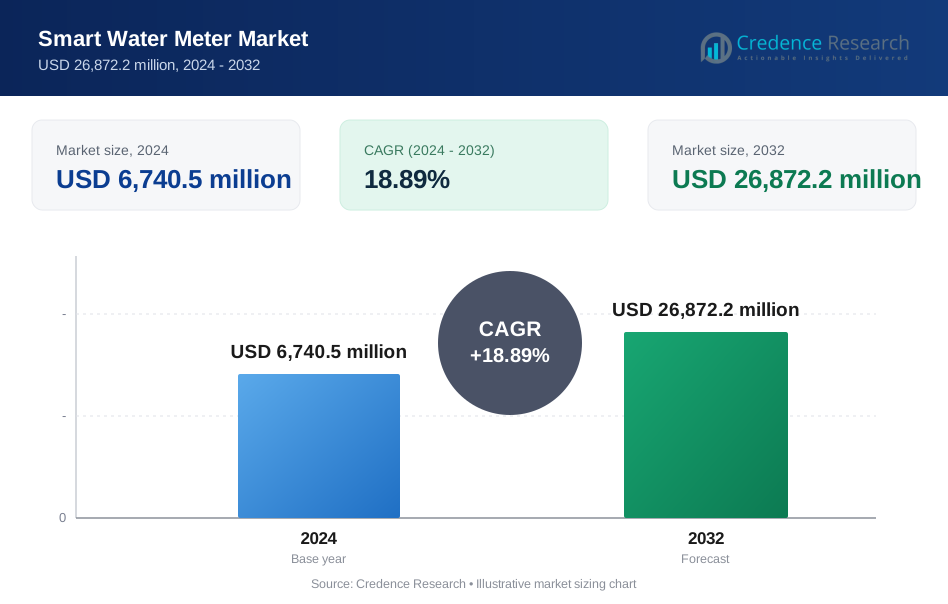
| Smart Water Meter Market Size 2024 | USD 6,740.5 million |
| Smart Water Meter Market, CAGR | 18.89% |
| Smart Water Meter Market Size 2032 | USD 26,872.2 million |
Market Overview:
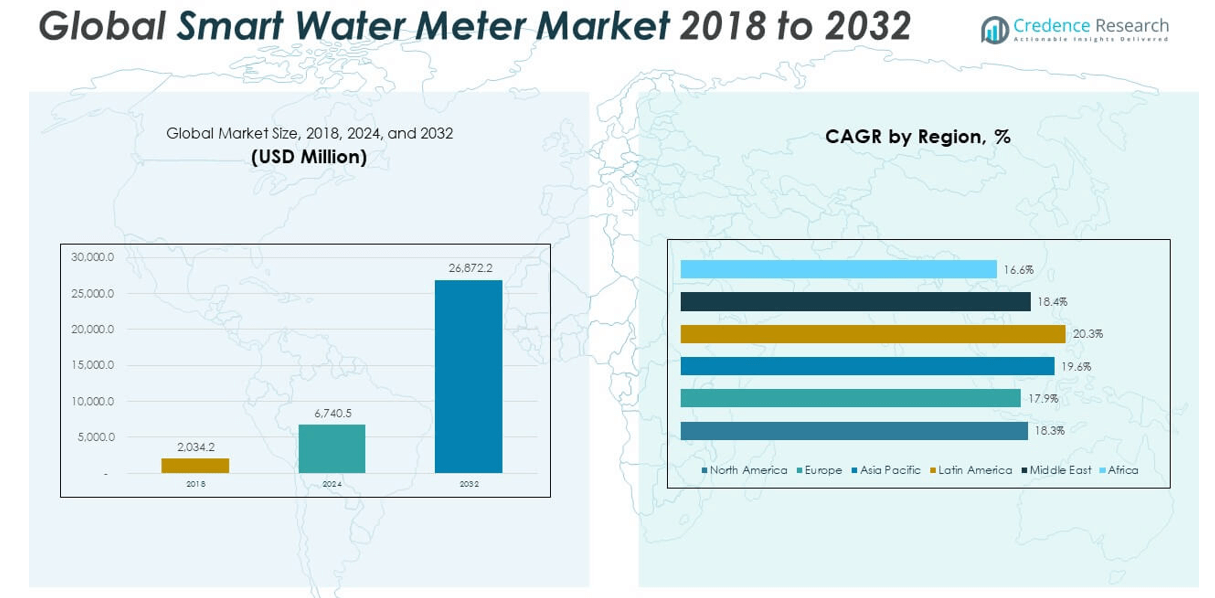
The Smart Water Meter Market size was valued at USD 2,034.2 million in 2018 to USD 6,740.5 million in 2024 and is anticipated to reach USD 26,872.2 million by 2032, at a CAGR of 18.89% during the forecast period.
The growth of the smart water meter market is primarily driven by the increasing need for efficient water management and conservation. Utilities worldwide are adopting smart metering solutions to reduce water loss, detect leaks in real time, and enhance billing accuracy. The push for digital transformation in utility infrastructure has also accelerated the deployment of smart water meters, particularly in urban and semi-urban areas. Integration with IoT platforms allows for continuous data monitoring, enabling predictive maintenance and optimized water usage. Government regulations and sustainability mandates further reinforce market adoption, encouraging utilities to shift from manual to automated metering systems. In addition, growing awareness among consumers regarding water conservation and the availability of mobile applications for usage tracking are fostering demand. Technological advancements in communication protocols, sensor accuracy, and battery life are also enhancing the viability and reliability of these systems, making them a strategic choice for long-term water resource management.
The smart water meter market exhibits strong regional diversity, with deployment patterns varying according to regulatory frameworks, infrastructure maturity, and technological readiness. In North America, widespread adoption is supported by favorable policies, modernization initiatives, and utility-driven pilot programs. Europe demonstrates steady growth, backed by environmental mandates, urban sustainability goals, and a strong emphasis on non-revenue water reduction. Asia-Pacific is emerging as a key growth hub, driven by rapid urbanization, increasing demand for smart city solutions, and rising investments in digital infrastructure. Countries across the Middle East and Africa are also gradually embracing smart water metering to address water scarcity challenges and improve service delivery. Latin America, while still in early stages, is witnessing growing interest due to aging infrastructure and the need for efficient water management. Regional utilities are focusing on scalable, cost-effective solutions, and international collaboration is playing a critical role in transferring knowledge and facilitating the deployment of advanced metering systems.
Market Insights:
- The Smart Water Meter Market is projected to grow significantly, rising from USD 6,740.5 million in 2024 to USD 26,872.2 million by 2032, driven by a strong CAGR of 18.89%.
- Government mandates and sustainability regulations are accelerating adoption, with utilities replacing manual systems to meet conservation and billing transparency standards.
- Advancements in IoT, wireless communication, and sensor technologies are improving meter accuracy, enabling real-time monitoring and reducing operational costs for utilities.
- Urbanization and smart city programs are driving demand for scalable, intelligent water management systems, integrating smart meters into broader utility networks.
- Rising consumer awareness and utility digitalization efforts are pushing the adoption of smart meters for better usage visibility, efficiency, and service reliability.
- Challenges such as high installation costs and legacy infrastructure limitations are slowing deployment, especially in budget-constrained municipalities and developing regions.
- Regional growth is led by Asia-Pacific, North America, and Europe, while Latin America, the Middle East, and Africa show emerging potential through infrastructure modernization and international support.
Market Drivers:
Government Mandates and Regulatory Support Encourage Widespread Adoption
Strict government regulations and policy mandates are driving large-scale deployment of smart water metering systems across utilities. Regulatory bodies are enforcing water conservation initiatives, encouraging utilities to replace outdated infrastructure with intelligent systems. These mandates promote accurate billing, leak detection, and efficient usage tracking. By complying with these standards, utilities can avoid penalties and gain access to public funding and incentives. The Smart Water Meter Market benefits directly from these favorable regulations, especially in regions where water scarcity is a pressing issue. It positions smart meters as essential infrastructure in public utility management.
Technological Advancements Enable Real-Time Monitoring and Data Accuracy
The integration of IoT, low-power wireless communication, and advanced sensors is improving the performance of smart water meters. These technologies support real-time monitoring, enabling utilities to identify leaks, detect anomalies, and manage demand more efficiently. It helps reduce water losses and improve customer satisfaction through accurate and transparent billing. Enhanced connectivity also allows utilities to remotely access usage data without manual intervention. Over time, smart metering systems lower operational costs and simplify network maintenance. The Smart Water Meter Market gains momentum from innovations that strengthen device reliability and communication accuracy.
- For example, Kamstrup’s MULTICAL® 21 smart water meter, for instance, utilizes ultrasonic measurement technology to achieve accuracy within ±2% across its entire flow range and offers a battery life of up to 16 years. Sensus’ FlexNet® communication network enables utilities to receive water usage data at 15-minute intervals, facilitating real-time leak detection and reducing non-revenue water by up to 30% in pilot deployments.
Urban Expansion and Smart City Projects Drive Infrastructure Upgrades
Rapid urbanization and the global push toward smart city development are accelerating the need for modern water management systems. Urban centers require scalable solutions to manage rising water demand, infrastructure stress, and environmental concerns. Smart water meters offer precise consumption insights, allowing utilities to allocate resources effectively. Governments include them in broader smart utility networks to align with city-wide digitization strategies. It creates opportunities for end-to-end integration with electricity, gas, and transportation systems. The Smart Water Meter Market aligns with these urban priorities, supporting smarter, data-driven city planning.
- For example, in Singapore, the Public Utilities Board (PUB) partnered with SUEZ and local tech firms to install 300,000 smart meters, achieving a 5% reduction in per capita household water consumption within the first year of rollout.
Consumer Awareness and Operational Efficiency Fuel Utility Investment
End-users increasingly demand accurate, transparent billing and timely usage updates, prompting utilities to adopt digital metering systems. Smart meters empower consumers with data access, improving usage patterns and promoting conservation. On the utility side, operational efficiency improves through reduced manual labor, fewer complaints, and faster service response. It allows for predictive maintenance and better allocation of technical resources. Utilities recognize the long-term savings and service improvements, leading to higher investment in smart metering solutions. The Smart Water Meter Market continues to expand as consumer engagement and utility optimization converge.
Market Trends:
Integration of Cloud-Based Platforms Enhances Utility Analytics and Scalability
Utilities are increasingly adopting cloud-based platforms to centralize data from smart water meters and analyze it in real time. These platforms offer scalable solutions that support remote access, multi-site management, and advanced visualization tools. It enables utility operators to identify trends, segment users, and manage resources with greater precision. Cloud-based systems simplify software updates and ensure compatibility with evolving communication standards. The Smart Water Meter Market is seeing a shift from traditional on-premise systems to flexible, cloud-enabled infrastructure. This transition helps utilities future-proof their operations and support long-term digital strategies.
- For example, a sector collaboration among De Watergroep, FARYS, and PIDPA in Belgium implemented a cloud-based Smart Meter and Energy Management system, supporting a mass roll-out of smart water meters.
Shift Toward Prepaid Metering Systems Supports Revenue Assurance Models
The demand for prepaid smart water meters is rising in both developed and emerging markets. Prepaid systems give consumers control over their water expenses while helping utilities reduce billing disputes and payment delays. It supports financial planning for low-income households and strengthens revenue collection for service providers. Utilities deploy prepaid meters in regions with inconsistent billing cycles or low collection rates. The Smart Water Meter Market is benefiting from this model, especially in areas where affordability and accountability are central concerns. Prepaid adoption also aligns with consumer trends toward usage-based spending.
Hybrid Communication Technologies Expand Deployment Possibilities
Utilities are embracing hybrid communication models that combine RF, cellular, and LPWAN technologies in a single metering network. This approach allows for better coverage across diverse terrains and building types. It increases network reliability by balancing range, data capacity, and power consumption across multiple nodes. Utilities gain the flexibility to mix technologies based on geography and infrastructure constraints. The Smart Water Meter Market is adapting to this trend with meters designed for multi-protocol compatibility. It ensures seamless integration with existing systems while preparing networks for future expansion.
- For instance, WaterTech S.p.A. has delivered over 250,000 hybrid water meters in Italy, combining traditional mechanical meters with advanced electronic communication modules. These meters support multiple communication protocols-such as NB-IoT, LoRa WAN, 169 MHz, and 868 MHz-enabling utilities to mix and match technologies based on geography and infrastructure needs.
Focus on Sustainable Manufacturing Influences Product Innovation
Manufacturers are incorporating sustainable practices in the production of smart water meters, addressing growing environmental concerns. Materials with lower environmental impact and energy-efficient components are being introduced into new designs. It reflects industry alignment with ESG standards and corporate sustainability goals. Manufacturers highlight recyclable materials, longer product life cycles, and reduced electronic waste in their offerings. The Smart Water Meter Market is evolving to meet procurement preferences that prioritize eco-conscious solutions. This trend is reshaping product development pipelines and supplier relationships within the utility sector.
Market Challenges Analysis:
High Initial Investment and Infrastructure Complexity Hinder Deployment
The upfront cost of smart water meter installation remains a significant barrier for many utilities, particularly in developing regions with limited budgets. Costs related to hardware, software, network integration, and workforce training add pressure to capital expenditure planning. It becomes more challenging when utilities must replace legacy systems or upgrade distribution infrastructure to support advanced metering. Smaller municipalities often struggle to secure funding or justify returns on large-scale smart metering projects. The Smart Water Meter Market faces resistance from cost-conscious buyers who prioritize basic functionality over advanced features. Delays in procurement and phased deployments further extend project timelines and slow overall market momentum.
Data Privacy Concerns and Technical Interoperability Issues Impact Adoption
Utilities and consumers express growing concerns about the privacy and security of real-time water usage data. Any breach or misuse of this information can erode public trust and expose service providers to legal risks. It puts pressure on vendors to meet strict data protection regulations while ensuring secure transmission and storage protocols. At the same time, interoperability challenges arise from the variety of communication protocols, software platforms, and meter models used across regions. Integration becomes complicated when legacy systems must interact with next-generation devices or multi-vendor solutions. The Smart Water Meter Market must address these issues to build confidence and streamline adoption across diverse utility environments.
Market Opportunities:
Rising Demand in Emerging Economies Creates Strong Expansion Potential
Urbanization, population growth, and water stress in emerging markets are driving interest in smart water infrastructure. Governments and utilities in Asia, Africa, and Latin America are beginning to invest in digital water management to improve service delivery and reduce losses. It offers vendors opportunities to introduce scalable and cost-effective smart metering solutions tailored to local needs. Pilot projects supported by international development agencies further accelerate adoption. The Smart Water Meter Market can grow significantly by targeting regions with poor metering coverage and unreliable manual billing systems. Market entrants that offer robust, affordable solutions stand to gain early traction.
Utility Digital Transformation Drives Demand for End-to-End Solutions
Utilities undergoing digital transformation seek integrated platforms that combine hardware, software, and analytics. Smart water meters serve as a gateway for broader operational efficiency and network intelligence. It creates opportunities for companies that can offer bundled solutions with real-time monitoring, predictive maintenance, and user engagement tools. Vendors with strong IoT capabilities and open-platform architecture are well-positioned to capture long-term contracts. The Smart Water Meter Market benefits when utilities prioritize digitization to reduce costs and improve reliability. This shift supports recurring revenue through service models and software subscriptions.
Market Segmentation Analysis:
The Smart Water Meter Market is segmented by type, technology, and end use, each contributing to its dynamic growth.
By type, electromagnetic smart water meters dominate in urban utility applications due to their high accuracy and durability. Ultrasonic smart water meters are gaining traction in both residential and industrial sectors for their ability to measure low flow rates and resist sediment interference. Mechanical smart meters maintain relevance in cost-sensitive markets where infrastructure upgrades are gradual.
- Sensus (a Xylem brand) for example, supplied over 45,000 iPERL™ electromagnetic smart water meters to the City of Waco, Texas. These meters deliver 99.98% accuracy and are designed for high-durability urban utility networks, supporting hourly data transmission and robust performance in challenging environments.
By technology, Automatic Meter Reading (AMR) supports basic one-way communication, offering a reliable solution for utilities transitioning from manual to digital systems. In contrast, Advanced Metering Infrastructure (AMI) enables two-way communication, allowing for real-time data exchange, leak alerts, and remote shutoff capabilities. It supports more sophisticated water management strategies in digitally mature markets.
- For instance, Badger Meter’s ORION® AMR solution was implemented by American Water in several U.S. cities, enabling one-way communication for remote data collection. This technology allowed utilities to transition from manual to digital readings, reducing labor costs and improving billing accuracy without requiring full network upgrades.
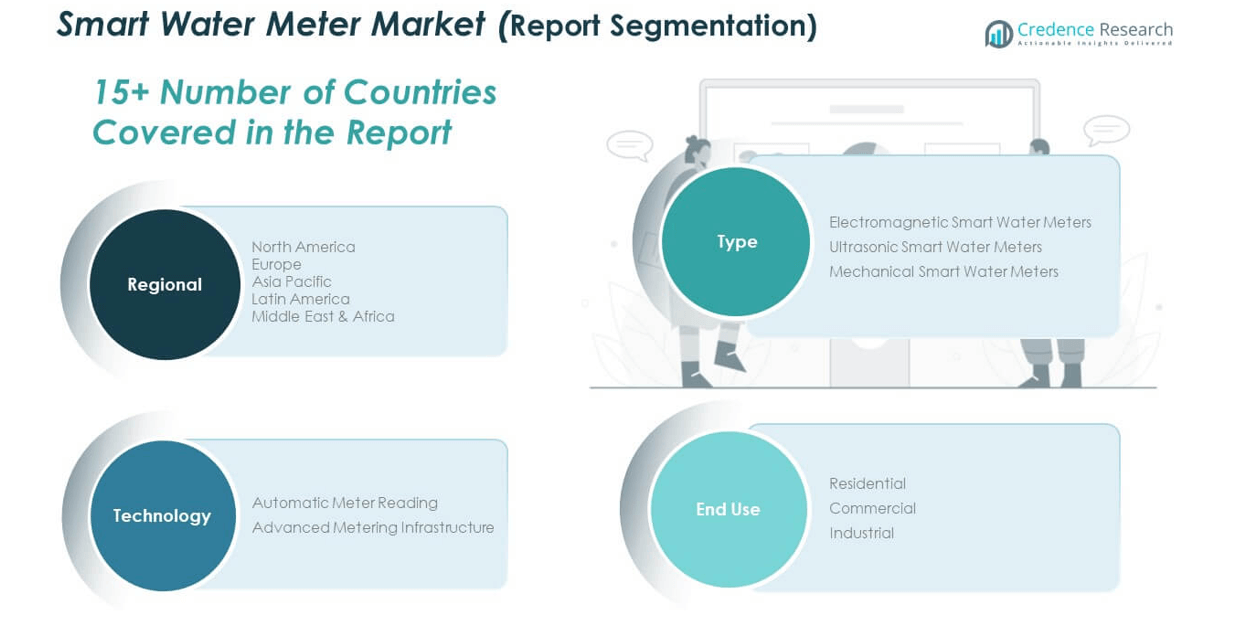
By end use, the residential segment holds the largest share due to increasing demand for accurate billing and usage transparency. The commercial and industrial segments are expanding steadily, driven by sustainability targets and operational efficiency goals. The Smart Water Meter Market benefits from rising deployment across all end-user categories as utilities seek scalable, future-ready solutions.
Segmentation:
By Type:
- Electromagnetic Smart Water Meters
- Ultrasonic Smart Water Meters
- Mechanical Smart Water Meters
By Technology:
- Automatic Meter Reading (AMR)
- Advanced Metering Infrastructure (AMI)
By End Use:
- Residential
- Commercial
- Industrial
By Region:
- North America
- U.S.
- Canada
- Mexico
- Europe
- Germany
- France
- U.K.
- Italy
- Spain
- Rest of Europe
- Asia Pacific
- China
- Japan
- India
- South Korea
- South-east Asia
- Rest of Asia Pacific
- Latin America
- Brazil
- Argentina
- Rest of Latin America
- Middle East & Africa
- GCC Countries
- South Africa
- Rest of the Middle East and Africa
Regional Analysis:
The North America Smart Water Meter Market size was valued at USD 413.75 million in 2018 to USD 1,329.13 million in 2024 and is anticipated to reach USD 5,076.16 million by 2032, at a CAGR of 18.3% during the forecast period. North America holds a leading share in the Smart Water Meter Market, driven by rapid infrastructure upgrades and favorable regulatory frameworks. Utilities across the U.S. and Canada have prioritized digital metering as part of water conservation and sustainability initiatives. It benefits from high utility spending on automation and strong consumer demand for real-time usage insights. Deployment of advanced metering infrastructure (AMI) and integration with smart grid systems have further strengthened market growth. North America’s share accounts for nearly 24% of the global market, supported by large-scale rollouts in urban municipalities. Government incentives and long-term cost-saving models continue to encourage adoption.
The Europe Smart Water Meter Market size was valued at USD 504.06 million in 2018 to USD 1,592.88 million in 2024 and is anticipated to reach USD 5,938.76 million by 2032, at a CAGR of 17.9% during the forecast period. Europe maintains strong momentum in the Smart Water Meter Market due to its commitment to environmental standards and water efficiency policies. Countries such as France, Germany, and the UK have adopted stringent regulations that promote non-revenue water reduction and usage transparency. It shows a consistent preference for smart meters equipped with LPWAN, W-MBus, and other low-energy communication protocols. Utilities are actively replacing mechanical meters with electronic solutions to support smart city objectives. Europe represents 28% of global market share, backed by active R&D efforts and collaborations among EU nations. Continuous innovation in connectivity standards supports large-scale deployment in urban and rural areas alike.
The Asia Pacific Smart Water Meter Market size was valued at USD 707.48 million in 2018 to USD 2,437.37 million in 2024 and is anticipated to reach USD 10,211.45 million by 2032, at a CAGR of 19.6% during the forecast period. Asia Pacific leads in growth pace within the Smart Water Meter Market, driven by large-scale urbanization and increasing investments in digital infrastructure. Countries such as China, India, Japan, and South Korea are rapidly deploying smart meters as part of water management reforms. It benefits from government-backed smart city initiatives and pilot programs in high-density metropolitan areas. The region holds the largest share, accounting for 32% of the global market in 2024. Local manufacturers and global players are investing in cost-effective, scalable solutions to meet the growing demand. Expanding industrial zones and municipal upgrades further support sustained growth.
The Latin America Smart Water Meter Market size was valued at USD 212.57 million in 2018 to USD 758.98 million in 2024 and is anticipated to reach USD 3,316.03 million by 2032, at a CAGR of 20.3% during the forecast period. Latin America shows significant potential in the Smart Water Meter Market, fueled by modernization efforts in water distribution systems. Countries such as Brazil, Mexico, and Chile are prioritizing smart metering to combat water theft and improve billing efficiency. It experiences growing support from international development agencies and regional funding programs. Market penetration remains low but is accelerating with the adoption of prepaid and AMR-enabled meters. The region contributes nearly 10% of global market share and is expected to increase steadily. Infrastructure upgrades in underserved areas are creating long-term opportunities for technology providers.
The Middle East Smart Water Meter Market size was valued at USD 144.63 million in 2018 to USD 467.41 million in 2024 and is anticipated to reach USD 1,800.44 million by 2032, at a CAGR of 18.4% during the forecast period. The Middle East presents a growing Smart Water Meter Market, driven by water scarcity concerns and national sustainability agendas. Governments in the UAE, Saudi Arabia, and Qatar are launching digital water initiatives as part of broader Vision 2030 frameworks. It benefits from a high focus on smart infrastructure, with utilities investing in IoT-enabled solutions to monitor usage and reduce waste. Adoption is gaining traction across both residential and commercial sectors. The region holds roughly 7% of the global market share, with momentum expected to increase. Public-private partnerships are playing a key role in scaling deployment efforts.
The Africa Smart Water Meter Market size was valued at USD 51.67 million in 2018 to USD 154.74 million in 2024 and is anticipated to reach USD 529.38 million by 2032, at a CAGR of 16.6% during the forecast period. Africa remains in the early stages of smart meter adoption but holds long-term promise in the Smart Water Meter Market. Urban growth and pressing water access challenges are prompting interest in more efficient utility management. It is slowly gaining support from development banks and pilot programs across South Africa, Kenya, and Nigeria. Limited infrastructure and budget constraints continue to delay large-scale implementation. Africa accounts for 3% of the market but presents untapped potential in both municipal and peri-urban applications. Technology providers focusing on rugged, cost-effective solutions will find increasing opportunities across the continent.
Key Player Analysis:
- Watertech S.P.A
- Mom Zrt
- Apator SA
- Arad Group
- Axioma Metering
- Badger Meter Inc.
- Diehl Stiftung & Co. KG
- Homerider Systems
- Master Meter
- Mueller Systems
- Sensus (a Xylem brand)
- Other Key Players
Competitive Analysis:
The Smart Water Meter Market features a competitive landscape marked by technological innovation, strategic partnerships, and regional expansion. Leading players focus on enhancing product performance, connectivity standards, and data analytics capabilities to differentiate their offerings. It encourages continuous investment in R&D, particularly in low-power communication technologies and cloud integration. Companies are entering joint ventures with utilities to secure long-term deployment contracts and service agreements. The market sees strong competition from both global manufacturers and emerging regional firms, creating pricing pressure and accelerating innovation cycles. Regulatory compliance, cybersecurity standards, and platform interoperability remain key factors influencing vendor selection. The Smart Water Meter Market continues to evolve as players compete on reliability, scalability, and service flexibility, shaping future growth trajectories across regions.
Recent Developments:
- In June 2025, Geospace Technologies launched AquaLink™, a new multi-device water IoT endpoint designed for commercial and multifamily residential properties. The product integrates submetering and leak detection capabilities into a single platform, offering end users simplified monitoring and real-time water consumption insights. It supports property managers with remote management tools and enhances accountability through immediate alerts and data reporting.
- In May 2024, Water Tech Corp introduced the new Precision® V10 cordless, hoseless pool and spa cleaner. This enhanced version of their popular Precision® 2.0 model features a tamper-proof motor-box and battery assembly, offering improved durability and convenience for pool professionals.
- In May 2024, Diehl Metering introduced the ultrasonic HYDRUS 2.0 smart water meter equipped with LoRaWAN® connectivity. The HYDRUS 2.0 extends long‑range wireless communication and leverages enhanced sensor accuracy for better performance in municipal and residential applications. It supports scalable deployments in smart-city and utility-driven environments.
Market Concentration & Characteristics:
The Smart Water Meter Market shows moderate to high market concentration, with a mix of established global players and regional specialists dominating supply chains. It features strong product differentiation based on communication protocols, analytics capabilities, and integration support. Vendors focus on proprietary technologies and scalable platforms to secure competitive advantage. The market is highly technology-driven, with a growing emphasis on IoT connectivity, cloud infrastructure, and interoperability with smart utility networks. It is characterized by long sales cycles, high capital investment, and strong reliance on public sector contracts. Product lifecycles are long, and buyers prioritize reliability, data security, and post-installation service.
Report Coverage:
The research report offers an in-depth analysis based on Type, Technology and End Use. It details leading market players, providing an overview of their business, product offerings, investments, revenue streams, and key applications. Additionally, the report includes insights into the competitive environment, SWOT analysis, current market trends, as well as the primary drivers and constraints. Furthermore, it discusses various factors that have driven market expansion in recent years. The report also explores market dynamics, regulatory scenarios, and technological advancements that are shaping the industry. It assesses the impact of external factors and global economic changes on market growth. Lastly, it provides strategic recommendations for new entrants and established companies to navigate the complexities of the market.
Future Outlook:
- Utilities will prioritize full-scale AMI rollouts to improve network efficiency and reduce water losses.
- Integration of AI-driven analytics will support predictive maintenance and real-time consumption insights.
- Demand for interoperable platforms will grow as utilities seek vendor-agnostic metering ecosystems.
- Cloud-based management systems will become standard for data storage, monitoring, and diagnostics.
- Prepaid metering adoption will rise in emerging markets to improve billing transparency and collection rates.
- Governments will increase funding for digital water infrastructure under sustainability mandates.
- Private-public partnerships will accelerate smart water projects in underserved regions.
- Smart meters with built-in cybersecurity features will see higher demand amid rising data privacy concerns.
- Manufacturers will focus on sustainable materials and energy-efficient components to meet ESG goals.
- Urban development and smart city initiatives will continue to drive long-term adoption across all regions.
Request a Free Sample
Fill in your details and we'll send you a free sample report.
- Sample data tables & charts
- Research methodology
Need a Custom Version of This Report?
Tailor the scope, geography, or segments to your exact requirements.
- Custom geography or segment scope
- Direct access to our analyst team
Frequently Asked Questions
What is the size of Smart Water Meter Market?
What are the key segments within the Smart Water Meter Market?
What are some challenges faced by the Smart Water Meter Market?
Who are the major players in this market?
Table of Content
Chapter 1. Report Introduction
- 1.1 Report Description & Purpose
- 1.1.1 Report Title & Market Definition
- 1.1.2 Unique Selling Propositions (USP) & Key Differentiators
- 1.1.3 Value Proposition for Stakeholders
- 1.2 Research Objectives
- 1.2.1 Market Sizing Objectives (Volume & Revenue) (Volume Where Applicable)
- 1.2.2 Segmentation Objectives
- 1.2.3 Competitive Intelligence Objectives
- 1.2.4 Forecast & Scenario Objectives
- 1.3 Report Scope
- 1.3.1 Smart Water Meter Scope – Segments & Subsegments Covered
- 1.3.2 Geographic Scope – Regions & Countries Covered
- 1.3.3 Historical Period, Base Year & Forecast Period (2024; forecast to 2032)
- 1.3.4 Inclusions & Exclusions
- 1.4 Industry Classification & Applicable Codes
- 1.5 Currency, Measurement Units & Valuation Basis
- 1.6 Target Stakeholders
- 1.7 Limitations & Assumptions
Chapter 2. Executive Summary
- 2.1 Global Smart Water Meter Market Snapshot
- 2.1.1 Market Size – Historical (2024) & Forecast (2024-2032) (2024: USD 6,740.5 million → 2032: USD 26,872.2 million)
- 2.1.2 Volume & Revenue – Global Totals (Volume Where Applicable)
- 2.1.3 Key Market Highlights – Top Five Facts
- 2.2 Smart Water Meter Market Segmentation Snapshot
- 2.2.1 Market Split by Region – 2024 vs. 2032
- 2.3 Competitive Snapshot
- 2.3.1 Top 10 Players by Revenue Share – 2024
- 2.3.2 Top 10 Players by Volume Share – 2024 (Volume Where Applicable)
- 2.3.3 Recent Strategic Developments (18-Month Summary)
- 2.4 Key Investment Highlights & Strategic Conclusions
Chapter 3. Smart Water Meter Market Dynamics & Industry Analysis
- 3.1 Market Overview & Context
- 3.1.1 Smart Water Meter Market Position in the Broader Industry Value Chain
- 3.1.2 Demand Structure & Purchasing Dynamics
- 3.1.3 Market Maturity & Development Stage by Region
- 3.2 Smart Water Meter Market Drivers
- 3.3 Smart Water Meter Market Restraints & Challenges
- 3.4 Smart Water Meter Market Opportunities
- 3.5 Porter's Five Forces Analysis
- 3.5.1 Threat of New Entrants
- 3.5.2 Bargaining Power of Suppliers
- 3.5.3 Bargaining Power of Buyers
- 3.5.4 Threat of Substitutes
- 3.5.5 Competitive Rivalry – Intensity Assessment
- 3.6 Smart Water Meter Value Chain Analysis
- 3.6.1 Upstream – Key Inputs, Resources & Suppliers
- 3.6.1.1 Key Input/Resource 1
- 3.6.1.2 Key Input/Resource 2
- 3.6.1.3 Key Input/Resource 3
- 3.6.2 Midstream – Core Operations & Value Creation
- 3.6.2.1 Operating Model & Process Overview
- 3.6.2.2 Key Operating Locations & Capabilities by Company
- 3.6.3 Downstream – Market Channels & End Users
- 3.6.3.1 Direct Sales & Customer Engagement Channels
- 3.6.3.2 Indirect Sales, Intermediaries & Partner Channels
- 3.6.4 Value Chain Profitability Analysis
- 3.6.1 Upstream – Key Inputs, Resources & Suppliers
- 3.7 PESTEL Analysis
- 3.7.1 Political Factors
- 3.7.2 Economic Factors
- 3.7.3 Social Factors
- 3.7.4 Technological Factors
- 3.7.5 Environmental Factors
- 3.7.6 Legal Factors
- 3.8 Smart Water Meter Supply Chain Analysis
- 3.8.1 Critical Input & Resource Availability Risk Assessment
- 3.8.2 Supplier & Operational Concentration Risk (Geographic Exposure)
- 3.8.3 Supply & Service Disruption Impact Analysis
- 3.9 Regulatory & Policy Landscape
Note: The regulatory and policy landscape section covers regulations based on their applicability to the market, Smart Water Meter category, geography, and scope of the study. Only regulatory frameworks with a material impact on operations, compliance, trade, sustainability, or market access are analyzed in detail.
Chapter 4. Key Investment Pockets & Opportunity Analysis
- 4.1 Smart Water Meter Market Attractiveness Analysis
- 4.1.1 By Region – Investment Attractiveness Matrix (Market Size × CAGR)
- 4.2 Absolute Revenue Growth Opportunity
- 4.2.1 By Region – Absolute Revenue Growth Through 2032
- 4.3 Incremental Demand Opportunity
- 4.3.1 By Region – Incremental Demand Through 2032
- 4.3.2 Segment – Incremental Demand
- 4.4 Emerging Submarket Opportunity Deep Dive (Subject to Applicability)
- 4.5 Priority Market Opportunity Scorecards
- 4.5.1 United States
- 4.5.2 Europe
- 4.5.3 Asia
- 4.5.4 Middle East & Africa
Note: Priority market opportunity scorecards reflect the geographic scope and strategic relevance of the study. Listed markets are indicative and may be adapted to the industry.
Chapter 5. Smart Water Meter Cross-Border Trade & Market Access Analysis
- 5.1 International Trade & Cross-Border Activity Overview
- 5.1.1 Global Export Value by Country (2024)
- 5.1.2 Global Export Volume by Country (2024) (Volume Where Applicable)
- 5.1.3 Global Import Value by Country (2024)
- 5.1.4 Global Import Volume by Country (2024) (Volume Where Applicable)
- 5.1.5 Net Trade Balance by Country (2024)
- 5.2 Export Analysis – Segment
- 5.2.1 Category 1 (Applicable Classification Code)
- 5.2.2 Category 2 (Applicable Classification Code)
- 5.2.3 Category 3 (Applicable Classification Code)
- 5.2.4 Category 4 (Applicable Classification Code)
- 5.2.5 Category 5 (Applicable Classification Code)
- 5.3 Import Analysis – Segment
- 5.3.1 Category 1 (Applicable Classification Code)
- 5.3.2 Category 2 (Applicable Classification Code)
- 5.3.3 Category 3 (Applicable Classification Code)
- 5.3.4 Category 4 (Applicable Classification Code)
- 5.3.5 Category 5 (Applicable Classification Code)
- 5.4 Cross-Border Pricing & Transaction Benchmarks
- 5.4.1 Export Pricing – Segment & Country
- 5.4.2 Import Pricing – Segment & Source Country
- 5.4.3 Price Trends (2024)
- 5.5 Key Cross-Border Trade & Delivery Routes
- 5.5.1 Cross-Border Trade/Delivery Route 1
- 5.5.2 Cross-Border Trade/Delivery Route 2
- 5.5.3 Cross-Border Trade/Delivery Route 3
- 5.5.4 Cross-Border Trade/Delivery Route 4
- 5.5.5 Cross-Border Trade/Delivery Route 5
- 5.6 Trade Policy & Market Access Impact Assessment
- 5.6.1 Tariff & Non-Tariff Barriers
- 5.6.2 Regional Trade & Economic Integration Frameworks
- 5.6.3 Bilateral & Multilateral Trade Agreements
- 5.6.4 Cross-Border Operating, Licensing & Localization Requirements
Note: This chapter applies where cross-border trade or delivery is relevant to Smart Water Meter. Goods, services, and digital offerings are assessed using applicable classifications and transaction measures. Import-export volumes, trade balances, and route analyses are included only where meaningful to the market.
Chapter 6. Competitive Landscape & Company Benchmarking
- 6.1 Smart Water Meter Market Concentration & Structure
- 6.1.1 Herfindahl-Hirschman Index (HHI) – vs. 2024
- 6.1.2 Leading, Mid-Sized & Emerging Player Structure
- 6.1.3 Global, Regional & Local Player Dynamics
- 6.2 Smart Water Meter Market Share Analysis – 2024
- 6.2.1 Global Revenue Share by Company
- 6.2.2 Global Volume Share by Company (Volume Where Applicable)
- 6.2.3 Regional Revenue Share
- 6.2.4 Market Share Evolution ( vs. 2024)
- 6.2.5 Company Market Share by Key Segment
- 6.2.6 Company Market Share by Customer Group
- 6.3 Operating Scale, Capacity & Infrastructure Analysis
- 6.3.1 Global Operating Scale & Supply Capacity
- 6.3.2 Resource Utilization & Operating Efficiency
- 6.3.3 Output, Service Delivery & Activity Metrics
- 6.3.4 Operating Footprint & Infrastructure Map
- 6.3.5 Planned Operational & Capacity Expansion
- 6.4 Smart Water Meter Competitive Benchmarking Matrix
- 6.4.1 Revenue, Growth, Profitability & Operating Metric Comparison
- 6.4.2 Channel Revenue Mix
- 6.4.3 Geographic Revenue Exposure
- 6.4.4 R&D Intensity
- 6.4.5 Sustainability Maturity
- 6.5 Strategic Developments in Smart Water Meter (Last 24 Months)
- 6.5.1 Mergers, Acquisitions & Divestments
- 6.5.2 New Products, Services & Solutions in Smart Water Meter
- 6.5.3 Operational & Infrastructure Expansions
- 6.5.4 Strategic Alliances, Joint Ventures & Partnerships
- 6.5.5 Distribution Expansion & Market Entry
- 6.5.6 Sustainability & ESG Initiatives
- 6.6 Competitive Strategy Mapping
- 6.6.1 Leader, Challenger, Follower & Niche Classification
- 6.6.2 Pricing Strategy Comparison
- 6.6.3 Channel Strategy Matrix
Note: Strategic developments are included based on their materiality and the availability of reliable information.
Chapter 7. Global Smart Water Meter Market – By Sales & Delivery Channel
- 7.1 Segment Overview
- 7.1.1 Volume & Revenue Split by Channel (2024 & 2032) (Volume Where Applicable)
- 7.1.2 Channel Mix Evolution (2024-2032)
Chapter 8. Regional Market Analysis – Global Overview
- 8.1 Global Regional Overview
- 8.1.1 Regional Volume Share (Volume Where Applicable)
- 8.1.2 Regional Revenue Share
- 8.1.3 Regional Volume by Region (Volume Where Applicable)
- 8.1.4 Regional Revenue by Region
- 8.1.5 Regional Forecast Through 2032
- 8.2 Cross-Regional Segment Analysis
- 8.2.1 By Sales & Delivery Channel
- 8.2.2 By Competitive Positioning & Price Tier
Chapter 9. North America Smart Water Meter Market
- 9.1 United States
- 9.2 Canada
- 9.3 Mexico
Chapter 10. Europe Smart Water Meter Market
- 10.1 Germany
- 10.2 France
- 10.3 Italy
- 10.4 United Kingdom
- 10.5 Spain
- 10.6 Poland
- 10.7 Russia
- 10.8 Netherlands
- 10.9 Belgium
- 10.10 Sweden
- 10.11 Denmark
- 10.12 Norway
- 10.13 Rest of Europe
Chapter 11. Asia Pacific Smart Water Meter Market
- 11.1 China
- 11.2 India
- 11.3 Japan
- 11.4 South Korea
- 11.5 Thailand
- 11.6 Indonesia
- 11.7 Vietnam
- 11.8 Malaysia
- 11.9 Australia
- 11.10 Rest of Asia Pacific
Chapter 12. Latin America Smart Water Meter Market
- 12.1 Brazil
- 12.2 Argentina
- 12.3 Colombia
- 12.4 Chile
- 12.5 Rest of Latin America
Chapter 13. Middle East Smart Water Meter Market
- 13.1 Saudi Arabia
- 13.2 United Arab Emirates
- 13.3 Turkey
- 13.4 Israel
- 13.5 Iran
- 13.6 Rest of the Middle East
Chapter 14. Africa Smart Water Meter Market
- 14.1 South Africa
- 14.2 Egypt
- 14.3 Nigeria
- 14.4 Morocco
- 14.5 Rest of Africa
Chapter 15. Smart Water Meter Company Profiles
- 15.1 [Company 01]
- 15.1.1 Company Overview
- 15.1.2 Key Management Personnel
- 15.1.3 Products & Services Portfolio
- 15.1.4 Financial Performance
- 15.1.5 Key Market Focus & Geographic Presence
- 15.1.6 Recent Developments & Strategic Initiatives
Note: The company profile list is preliminary and may change based on research findings, market developments, data availability, and client requirements.
Chapter 16. Appendices
- Appendix A – List of Abbreviations & Acronyms
- Appendix B – Industry Classification Code Reference – Full Series
- Appendix C – Supply, Output & Operating Capacity Data Tables
- Appendix D – End-Use & Demand Base Tables
- Appendix E – Demand, Adoption & Usage Assumptions
- Appendix F – Pricing & Revenue Metric Reference Tables
- Appendix G – Company Operations & Infrastructure Database
- Appendix H – Cross-Border Trade & Activity Data Tables (Where Applicable)
- Appendix I – Regulatory Summary Tables
- Appendix J – Primary Research Participant List (Anonymized)
- Appendix K – Primary Research Questionnaire Framework
- Appendix L – Data Sources & Bibliography
- Appendix M – Market Size Divergence & Source Comparison
Chapter 17. Research Methodology
- 17.1 Research Framework & Philosophy
- 17.2 Secondary Research – Sources, Hierarchy & Data Extraction
- 17.3 Data Modeling – Bottom-Up & Top-Down Market Sizing
- 17.4 Primary Research – Stakeholder Framework, LOI & Sample Sizes
- 17.5 Forecast Methodology – Regression, Scenario & Sensitivity Analysis
- 17.6 Quality Control – Four-Layer Validation Framework
- 17.7 Limitations & Standard Assumptions
- 17.8 Disclaimer
