
| REPORT ATTRIBUTE | DETAILS |
|---|---|
| Historical Period | 2019-2022 |
| Base Year | 2023 |
| Forecast Period | 2024-2032 |
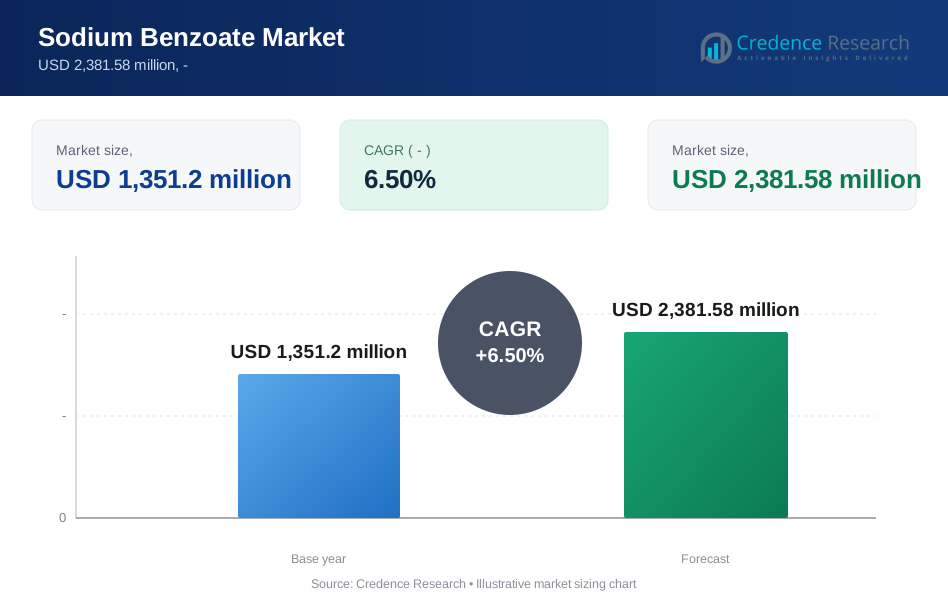
| Sodium Benzoate Market Size 2023 | USD 1351.2 Million |
| Sodium Benzoate Market, CAGR | 6.50% |
| Sodium Benzoate Market Size 2032 | USD 2381.58 Million |
Market Insights
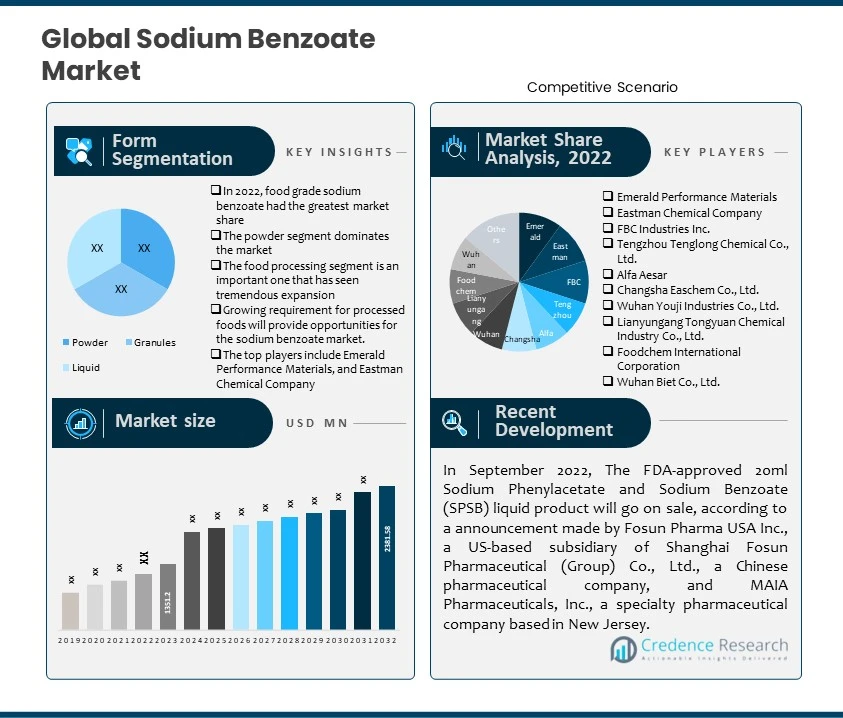
- The global market for sodium benzoate is expected to develop at a compound annual growth rate (CAGR) of 6.50% between 2024 and 2032, from its estimated USD 1351.2 million in 2023 to USD 2381.58 million in 2032.
- The largest category is food-grade sodium benzoate. Pharmaceutical-grade sodium benzoate, on the other hand, is expected to grow at a strong CAGR.
- The powder category will expand at a rapid rate of growth.
- The CAGR for the food and beverage industry is expected to be the highest during the projection period.
- The food processing will have the highest CAGR throughout the prediction period.
- Asia Pacific dominated the sodium benzoate market.
- Regarding the market share of sodium benzoate, Europe is expected to come second.
- In the sodium benzoate market, North America is anticipated to grow fastest.
- The expansion of this industry directly impacts the requirement for sodium benzoate because it is widely utilized as a means of preservation in food and beverage goods.
- Growing consciousness about environmental problems could spur the creation of environmentally friendly preservatives, which could impact the market for sodium benzoate.
Executive Summary
Market Definition
The production, distribution, and retail of sodium benzoate, a chemical compound primarily used as a preservative in a variety of industries, including food and beverage, pharmaceuticals, personal care, and industrial applications, is referred to as the sodium benzoate market. The usual method for producing sodium benzoate, which is the sodium salt of benzoic acid, is to neutralize the acid with sodium hydroxide. It is soluble in water and frequently supplied in granular or powder form.
Market Overview
The sodium benzoate sector is estimated to develop at a 6.50% compound annual growth rate (CAGR) between 2024 and 2032, maintaining its current upward trend. The market will continue to develop, rising from its estimated USD 1351.2 million in 2023 to USD 2381.58 million in 2032.
New compositions of sodium benzoate could be the outcome of ongoing investigation and development. Enhancing sodium benzoate's performance and stability in a range of food and beverage applications is now possible due to advancements in food science and technology. To reduce concerns about interactions with other components, microencapsulation techniques, for example, can improve the stability and performance of sodium benzoate in a variety of food and beverage applications. It is possible to make powdered drink mixes using sodium benzoate microencapsulation. In the capsules, the sodium benzoate that has been microencapsulated is kept secure until it is needed.
Sodium benzoate is released from the capsules when the powdered mix is combined with water, keeping the beverage preserved. By doing this, the preservative is ensured to be efficacious and not to wear out during storage. In order to create functional food products, regulate nutrient release, and encapsulate flavors and preservatives, the food and beverage industry uses microencapsulation. Based on industry research on sodium benzoate, vendors can try out new formulations like microencapsulation to solve issues with the ingredient's stability, reduce concerns about interactions with other ingredients, and increase the number of uses it can have in the food and beverage sector. The industry wants to provide consumers with high-quality, safe products, and these advancements support that goal. These factors are anticipated to support the growth of the sodium benzoate market.
Segmentation by Grade
- Food-grade sodium benzoate is the market leader by grade. Sodium benzoate's antibacterial qualities and range of action are sometimes increased by mixing it with additional preservatives like citric acid or potassium sorbate.
- The pharmaceutical grade sodium benzoate category will exhibit a sizable CAGR during the projected period. The demand for sodium benzoate of pharmaceutical grade can be influenced by the general growth and developments in the pharmaceutical business. The need for pharmaceutical-grade components like sodium benzoate may rise as pharmaceutical companies create and produce more drugs.
- Other grades, including industrial-grade sodium benzoate, also support the need for sodium benzoate.
Segmentation by Form
- Powder is considered the best form category. Because of its antibacterial qualities, sodium benzoate powder is used in many different sectors. In industrial settings, it can prevent corrosion and microbiological growth in cooling water systems.
- The liquid category will likely register a significant CAGR during forecasting. Sodium benzoate liquid is most commonly used in the beverage sector as a preservative, especially in fruit juices and soft beverages. The growth of bacteria, yeast, and mold can be successfully impeded by sodium benzoate, particularly in acidic settings such as fruit juices and soft beverages.
- Other forms, such as granules, also contribute to the demand for sodium benzoate.
Segmentation by Application
- The food and beverage industry category is projected to grow faster over the projection period. This is due to the rising demand for sodium benzoate in this sector.
- Other applications influence the need for sodium benzoate, including the pharmaceutical, personal care, and cosmetics industries and industrial applications.
Segmentation by End-Use Industry
- The food processing category will likely have the highest CAGR during the projection period. Although sodium benzoate has many other applications, it is mainly used as a preservative to increase the shelf life of processed foods.
- Other end-use industries, such as beverage manufacturing, pharmaceutical manufacturing, cosmetics, and personal care products, also contribute to the demand for sodium benzoate.
Segmentation by Region
- The Asia Pacific leads the sodium benzoate industry. Expanding cold chain logistics throughout Asia-Pacific will allow perishable items to be distributed more widely. Thus, in order to maintain product quality throughout transportation, there will be a greater need for preservatives like sodium benzoate.
- Europe is estimated to rank second in market size for sodium benzoate.
- The sodium benzoate industry is predicted to flourish rapidly in North America.
- Regions such as Africa, the Middle East, and Latin America cover the remaining requirement for sodium benzoate.
The production of EU compound feed in the region was reduced by the spread of animal diseases like "African swine fever" in Germany. Consumers in Europe are moving toward healthier products with less artificial additives. Consumer demands for cleaner labeling align with sodium benzoate, which is generally regarded as safe (GRAS). It is recognized as a food additive globally and has been assigned the identification number 211. For instance, it is labeled as E211 in European food goods.
Furthermore, Europe is one of the main producing regions for automobiles worldwide. Sodium benzoate is used as an anti-freeze agent for cars and other vehicles as a rust-prevention or corrosion-inhibiting agent. Recent years have seen an increase in agricultural production in Europe, with countries like Germany, France, Italy, and Turkey contributing significantly to the region's GDP from the agricultural sector. The European market for sodium benzoate is bolstered by robust demand from the food & beverage, pharmaceutical, and personal care sectors.
Based on projections, the sodium benzoate market is anticipated to be controlled by Asia Pacific. The disposable income of people in the Asia-Pacific region is rising. This means that more money will be spent on packaged foods and personal hygiene items, both of which frequently include sodium benzoate. As a preservative, sodium benzoate is also used in medicines and cosmetics. The growing personal care and pharmaceutical sectors in the area support the expansion of the market.
The sodium benzoate market in North America is anticipated to expand fastest throughout the forecast. Preservative demand is constantly high in North America due to the sizeable food and beverage industry. The food and beverage industry in the United States, for instance, has consistently grown over the years and made a significant economic contribution.
Moreover, North America has a big pharmaceutical industry. The pharmaceutical industry in the United States is particularly flourishing, with total sales predicted to surpass 600 billion US dollars by 2024. For many medications to be both safe and effective, sodium benzoate is essential. Additionally, the Food and Drug Administration (FDA) of the United States and other pertinent North American authorities have granted sodium benzoate regulatory certifications for safe use in food and medicine applications. In this area, sodium benzoate is an essential preservative for guaranteeing the security and quality of products.
Key Highlights of the Report
The global sodium benzoate market is segmented by grade segmentation, form segmentation, application segmentation, end-use industry segmentation, and region. As far as the grade segmentation is concerned, food grade sodium benzoate is the market spearhead. Powder is the top category. The food and beverage industry category is anticipated to increase at the highest CAGR throughout the projection period. The food processing category will experience the highest CAGR during the forecast period. The sodium benzoate market is expanding mostly in the Asia Pacific.
The rising need for benzoate from the food and cosmetics industries is anticipated to propel the expansion of the sodium benzoate market. Sodium benzoate occurs naturally in some foods and seasonings, such as apples, cranberries, cinnamon, and prunes. Additionally, the fast growth of the cosmetics and pharmaceutical industries is a major factor in the rising demand for sodium benzoates, which is anticipated to support the market's continued expansion.
Asia Pacific is expected to account for the largest sodium benzoate market globally. As metropolitan areas grow, people's lifestyles are becoming more fast-paced and dependent on easy, pre-packaged goods. Preservatives such as sodium benzoate are necessary for these items to stay fresh. The North American region is also assumed to have the market's sharpest growth. This is due to the growing demand for sodium benzoate from North American countries such as the United States and Canada.
Which Key Factors Are Driving The Global Sodium Benzoate Market?
The market for sodium benzoate is growing for a number of reasons, including the expansion of the pharmaceutical business, customer desire for natural preservatives, and the rise of the food and beverage industry.
What are The Main Challenges Confronting The Sodium Benzoate Market Globally?
Disruptions in the Supply Chain, and Suppliers of sodium benzoate may have less growth prospects as a result of increased market rivalry brought on by natural antimicrobials, alternative preservatives, and product reformulations with fewer or no preservatives. These are the challenges that the sodium benzoate market is facing.
What Market Opportunities Exist For Sodium Benzoate Globally?
Global expansion of the population, breakthroughs in technology, an inclination towards healthier options, and investments in research and development might all contribute to an increase in the sodium benzoate market.
Market Drivers
Multiple factors propel the sodium benzoate industry across the globe. The primary factors propelling the global sodium benzoate market are as follows:
Growing Requirement for Processed Foods
Many people all over the world are searching for quick and easy dinner options as their lifestyles have gotten more chaotic. Because they're easy to prepare and require minimal cooking time, processed foods have become more popular. Examples of prepared foods include canned soups, microwaveable snacks, and frozen dinners. Cities are home to a larger population, which means there is less time for planning ahead. Pre-packaged and processed foods are therefore used more frequently. Because supermarkets, convenience stores, and fast-food restaurants are more prevalent in urban areas, processed food is more widely accessible there.
With a change in consumer dietary habits, the sodium benzoate market is anticipated to undergo significant evolution. The demand for snack foods is a prime example of how processed, handy foods are required to maintain freshness and prolong shelf life. Many of these goods use sodium benzoate. The growth of this market underscores the need for food preservatives to meet consumer expectations by reflecting their need for quick meal solutions and on-the-go snacks.
Market Restraints
There are several obstacles that the global sodium benzoate market must overcome to continue growing. Among them are the following:
Volatility of Raw Material Prices
Manufacturers' production costs are strongly impacted by fluctuations in the price of raw materials, especially benzoic acid, which is essential to the manufacturing of sodium benzoate. Profit margins may be squeezed by abrupt rises in the cost of raw materials unless manufacturers are able to pass these costs on to customers, which may not always be possible in areas with intense competition. For manufacturers, price volatility can lead to uncertainty when projecting expenses and profitability. Manufacturers may find it difficult to sustain profit margins in the event of an unanticipated increase in raw material prices unless they are able to modify their pricing. On the other hand, manufacturers might feel compelled to cut prices in order to stay competitive, which could have an effect on profitability if raw material prices decline. For participants in the sodium benzoate industry, the price fluctuation of raw materials poses a serious problem since it affects supply chain stability, profitability, expenses, and competitive dynamics.
Opportunities
There are plenty of potential prospects in the global sodium benzoate industry. Among these are the following:
Demand from the Cosmetics Industry Drives the Sodium Benzoate Market Growth
The market for sodium benzoate is anticipated to expand in the coming years due to the substantial demand from the cosmetics sector. A class of health and beauty products used to enhance one's physical appearance is called cosmetics. Sodium benzoate is used as a preservative in food products and cosmetics because it prevents the growth of germs and fungi. As per Loreal, a French cosmetic manufacturing firm, the worldwide cosmetics industry was valued at $228 billion in 2021. Thus, the market for sodium benzoate is expanding due to the expanding need for it in the cosmetics industry.
Competitive Landscape
Key Players
Several major competitors exist in the fiercely competitive global sodium benzoate market. The following are a few of the leading market participants and their market shares:
- Emerald Performance Materials
- Eastman Chemical Company
- FBC Industries Inc.
- Tengzhou Tenglong Chemical Co., Ltd.
- Alfa Aesar
- Changsha Easchem Co., Ltd.
- Wuhan Youji Industries Co., Ltd.
- Lianyungang Tongyuan Chemical Industry Co., Ltd.
- Foodchem International Corporation
- Wuhan Biet Co., Ltd.
- Spectrum Chemical Mfg. Corp.
- Nantong Acetic Acid Chemical Co., Ltd.
- Novaphene Specialities Pvt. Ltd.
- Shanxi Wuchan Fine Chemical Co., Ltd.
- Swastik Chemicals
- Jarchem Industries Inc.
- Tianjin Changfu Chemical Co., Ltd.
- Prathista Industries Limited
- Penta Manufacturing Company
- Shandong Tong Tai Wei Run Chemical Co., Ltd.
- Others
These companies prioritize product innovation, distribution channel expansion, mergers, and acquisitions to remain competitive.
The largest suppliers in the global Sodium Benzoate market continuously work to stay one step ahead of the competition by developing innovative concepts and products.
In August 2023, LANXESS, a specialty chemicals company, launched a new "Scopeblue" product. Neolone BioG Preservative, which satisfies ISO 16128 requirements for a naturally produced ingredient, is approved by the COSMOS standard for use in cosmetic and personal care products.
In March 2022, In order to produce ethanol and Extra Neutral Alcohol (ENA), Ganesh Benzoplast Ltd. partnered with Golden Agri International Enterprises Pte. Limited, KN Agri Resources Ltd., and other investors. The company acquired a 100% stake in Sagar Industries, a distillery located in Nasik, Maharashtra, India.
In January 2021, The US-based chemicals business Emerald Kalama introduced Kalama Sodium Benzoate Liquid. It is a powerful preservative that can increase processing efficiency by combining the company's premium sodium benzoate NF/FCC into a special water-based solution. At normal or high process temperatures, this liquid can prevent the growth of bacteria, yeast, and mold in many goods.
Summary of Key Findings
- The packaging sector also uses sodium benzoate, especially for plastics. Sodium benzoate consumption may rise as a result of this industry's expansion.
- The market is segmented by grade segmentation, form segmentation, application segmentation, end-use industry segmentation, and region.
- In the market, food-grade sodium benzoate is the most widely used grade.
- Powder is the foremost category.
- The food and beverage industry is expected to grow fastest in terms of CAGR during the forecast period.
- The food processing category will likely see the highest CAGR during the anticipated time frame.
- Asia Pacific is leading market development; the market is highly competitive with key players including Emerald Performance Materials, Eastman Chemical Company, FBC Industries Inc., Tengzhou Tenglong Chemical Co., Ltd., Alfa Aesar, Changsha Easchem Co., Ltd., Wuhan Youji Industries Co., Ltd., Lianyungang Tongyuan Chemical Industry Co., Ltd., Foodchem International Corporation, Wuhan Biet Co., Ltd., Spectrum Chemical Mfg. Corp., Nantong Acetic Acid Chemical Co., Ltd., Novaphene Specialities Pvt. Ltd., Shanxi Wuchan Fine Chemical Co., Ltd., Swastik Chemicals, Jarchem Industries Inc., Tianjin Changfu Chemical Co., Ltd., Prathista Industries Limited, Penta Manufacturing Company, Shandong Tong Tai Wei Run Chemical Co., Ltd., and Others.
Future Outlook
- The sodium benzoate industry is expected to increase significantly in Asia Pacific, and its outlook is positive worldwide.
- The market for sodium benzoate may be impacted by the increasing consumer appetite for organic food and drink, which normally don't contain artificial preservatives.
- More stringent regulations or consumer avoidance may result from increased knowledge of the possible health hazards connected to sodium benzoate consumption, such as allergic reactions or worries about the production of its metabolite benzene.
- To stay ahead of the competition, key enterprises must develop new products, expand their market reach, and keep their prices competitive.
How CXOs Can Benefit from the Credence Research Sodium Benzoate Market Report
CXOs may get a detailed picture of the market in the Credence Research Sodium Benzoate Market Report, which includes:
- Market size and growth forecast: The report provides detailed estimates of the global sodium benzoate market size, segmented by grade segmentation, form segmentation, application segmentation, end-use industry segmentation, and region. It also includes forecasts for the market through 2032 based on key trends and drivers.
- Market segmentation: The research report breaks down the market for sodium benzoate into segments based on grade segmentation, form segmentation, application segmentation, end-use industry segmentation, and region. This segmentation provides CXOs with a granular understanding of the market and the opportunities in each segment.
- Competitive landscape: The research report offers a detailed analysis of the major companies in the sodium benzoate industry, including information on their business plans, product lines, and earnings. CXOs can use this information to evaluate and identify their competitors.
- Key trends and drivers: The research report identifies and evaluates the main trends and factors influencing the sodium benzoate market. CXOs can use this information to make well-informed choices regarding their plans and investments.
CXOs can use the insights from the Credence Research Sodium Benzoate Market Report to:
- Identify growth opportunities: This analysis may help CXOs identify new growth opportunities in the sodium benzoate sector. For example, the report identifies the growing demand for sodium benzoate from the food & beverage industry as a key opportunity.
- Make informed investment decisions: The report helps CXOs choose sodium benzoate wisely. For example, the research study provides information on the critical factors to consider when selecting sodium benzoate solutions and evaluating suppliers.
- Develop competitive strategies: CXOs can use the research report to develop competitive strategies for their sodium benzoate businesses. For example, the research paper outlines the main strategies that sodium benzoate suppliers utilize to differentiate themselves from competitors.
- Track market developments: This research report may help CXOs stay ahead of the curve by tracking market developments. For instance, it offers insights into the most recent developments and trends in the sodium benzoate market.
CXOs seeking to expand their industry knowledge and spot growth prospects will find the Credence Research Sodium Benzoate Market Report useful.
Segmentation
- By Grade
- Food Grade Sodium Benzoate
- Pharmaceutical Grade Sodium Benzoate
- Industrial Grade Sodium Benzoate
- By Form
- Powder
- Granules
- Liquid
- By Application
- Food and Beverage Industry
- Pharmaceutical Industry
- Personal Care and Cosmetics Industry
- Industrial Applications
- By End-Use Industry
- Food Processing
- Beverage Manufacturing
- Pharmaceutical Manufacturing
- Cosmetics and Personal Care Products
- By Region
- North America
- The U.S.
- Canada
- Mexico
- Europe
- Germany
- France
- The U.K.
- Italy
- Spain
- Rest of Europe
- Asia Pacific
- China
- Japan
- India
- South Korea
- South-east Asia
- Rest of Asia Pacific
- Latin America
- Brazil
- Argentina
- Rest of Latin America
- Middle East & Africa
- GCC Countries
- South Africa
- The Rest of the Middle East and Africa
- North America
Request a Free Sample
Fill in your details and we'll send you a free sample report.
- Sample data tables & charts
- Research methodology
Need a Custom Version of This Report?
Tailor the scope, geography, or segments to your exact requirements.
- Custom geography or segment scope
- Direct access to our analyst team
Frequently Asked Questions
How much does the global market currently hold for sodium benzoate?
What is the sodium benzoate market's projected growth rate between 2024 and 2032?
In terms of grade, which market category is leading?
Which end-use industry segment is estimated to have the highest CAGR throughout the forecast period?
Who are the main players in the sodium benzoate industry globally?
Table of Content
Chapter 1. Report Introduction
- 1.1 Report Description & Purpose
- 1.1.1 Report Title & Market Definition
- 1.1.2 Unique Selling Propositions (USP) & Key Differentiators
- 1.1.3 Value Proposition for Stakeholders
- 1.2 Research Objectives
- 1.2.1 Market Sizing Objectives (Volume & Revenue)
- 1.2.2 Segmentation Objectives
- 1.2.3 Competitive Intelligence Objectives
- 1.2.4 Forecast & Scenario Objectives
- 1.3 Report Scope
- 1.3.1 Sodium Benzoate Scope – Types & Subtypes Covered
- 1.3.2 Geographic Scope – Regions & Countries Covered
- 1.3.3 Historical Period, Base Year & Forecast Period (the historical period; forecast to the forecast period)
- 1.3.4 Inclusions & Exclusions
- 1.4 HS Code & Classification Framework
- 1.5 Currency, Units & Pricing Basis
- 1.6 Target Stakeholders
- 1.7 Limitations & Assumptions
Chapter 2. Executive Summary
- 2.1 Global Sodium Benzoate Market Snapshot
- 2.1.1 Market Size – Historical (the historical period) & Forecast (the forecast period) (base year: USD 1,351.2 million → forecast year: USD 2,381.58 million)
- 2.1.2 Volume & Revenue – Global Totals
- 2.1.3 Key Market Highlights – Top Five Facts
- 2.2 Sodium Benzoate Market Segmentation Snapshot
- 2.2.1 Market Split by Region – vs.
- 2.3 Competitive Snapshot
- 2.3.1 Top 10 Players by Revenue Share –
- 2.3.2 Top 10 Players by Volume Share –
- 2.3.3 Recent Strategic Developments (18-Month Summary)
- 2.4 Key Investment Highlights & Strategic Conclusions
Chapter 3. Sodium Benzoate Market Dynamics & Industry Analysis
- 3.1 Market Overview & Context
- 3.1.1 Sodium Benzoate Market Position in the Broader Automotive Value Chain
- 3.1.2 OEM vs. Replacement Market Dynamics
- 3.1.3 Market Maturity & Development Stage by Region
- 3.2 Sodium Benzoate Market Drivers
- 3.3 Sodium Benzoate Market Restraints & Challenges
- 3.4 Sodium Benzoate Market Opportunities
- 3.5 Porter's Five Forces Analysis
- 3.5.1 Threat of New Entrants
- 3.5.2 Bargaining Power of Suppliers
- 3.5.3 Bargaining Power of Buyers
- 3.5.4 Threat of Substitutes
- 3.5.5 Competitive Rivalry – Intensity Assessment
- 3.6 Sodium Benzoate Value Chain Analysis
- 3.6.1 Upstream – Raw Material/Input Suppliers
- 3.6.1.1 Raw Material/Input 1
- 3.6.1.2 Raw Material/Input 2
- 3.6.1.3 Raw Material/Input 3
- 3.6.2 Midstream – Production/Manufacturing/Service Delivery
- 3.6.2.1 Production/Process Overview
- 3.6.2.2 Key Facility Locations & Capacity by Manufacturer
- 3.6.3 Downstream – Distribution & End Consumer
- 3.6.3.1 Primary Channel – B2B/OEM
- 3.6.3.2 Secondary Channels – Dealer, Retail, Online, Direct
- 3.6.4 Value Chain Profitability Analysis
- 3.6.1 Upstream – Raw Material/Input Suppliers
- 3.7 PESTEL Analysis
- 3.7.1 Political Factors
- 3.7.2 Economic Factors
- 3.7.3 Social Factors
- 3.7.4 Technological Factors
- 3.7.5 Environmental Factors
- 3.7.6 Legal Factors
- 3.8 Sodium Benzoate Supply Chain Analysis
- 3.8.1 Raw Material/Input Supply Risk Assessment
- 3.8.2 Manufacturing Concentration Risk (Geographic Exposure)
- 3.8.3 Trade Disruption Impact Analysis
- 3.9 Regulatory & Policy Landscape
Note: The regulatory and policy landscape section covers regulations based on their applicability to the market, Sodium Benzoate category, geography, and scope of the study. Only regulatory frameworks with a material impact on operations, compliance, trade, sustainability, or market access are analyzed in detail.
Chapter 4. Key Investment Pockets & Opportunity Analysis
- 4.1 Sodium Benzoate Market Attractiveness Analysis
- 4.1.1 By Region – Investment Attractiveness Matrix (Volume × CAGR)
- 4.2 Absolute Revenue Growth Opportunity
- 4.2.1 By Region – Absolute USD Growth Through the forecast period
- 4.3 Incremental Volume Opportunity
- 4.3.1 By Region – Incremental Volume Through the forecast period
- 4.3.2 Segment – Incremental Volume
- 4.4 Emerging Submarket Opportunity Deep Dive (Subject to Applicability)
- 4.5 Emerging Market Opportunity Scorecards
- 4.5.1 United States
- 4.5.2 Europe
- 4.5.3 Asia
- 4.5.4 Middle East & Africa
Note: Emerging Market Opportunity Scorecards will be included based on relevance and strategic importance. Regions listed are indicative and may vary depending on data availability and market dynamics.
Chapter 5. Sodium Benzoate Import-Export Analysis & Trade Flows
- 5.1 Global Trade Overview
- 5.1.1 Global Export Value by Country (the historical period)
- 5.1.2 Global Export Volume by Country (the historical period)
- 5.1.3 Global Import Value by Country (the historical period)
- 5.1.4 Global Import Volume by Country (the historical period)
- 5.1.5 Net Trade Balance by Country (the historical period)
- 5.2 Export Analysis – Segment
- 5.2.1 Type 1 (HS Code)
- 5.2.2 Type 2 (HS Code)
- 5.2.3 Type 3 (HS Code)
- 5.2.4 Type 4 (HS Code)
- 5.2.5 Type 5 (HS Code)
- 5.3 Import Analysis – Segment
- 5.3.1 Type 1 (HS Code)
- 5.3.2 Type 2 (HS Code)
- 5.3.3 Type 3 (HS Code)
- 5.3.4 Type 4 (HS Code)
- 5.3.5 Type 5 (HS Code)
- 5.4 Average Unit Trade Prices
- 5.4.1 Average Export Price – Segment & Country
- 5.4.2 Average Import Price – Segment & Source Country
- 5.4.3 Price Trends (the historical period)
- 5.5 Key Trade Route Analysis
- 5.5.1 Trade Route 1
- 5.5.2 Trade Route 2
- 5.5.3 Trade Route 3
- 5.5.4 Trade Route 4
- 5.5.5 Trade Route 5
- 5.6 Trade Policy Impact Assessment
- 5.6.1 US Anti-Dumping & Section 301 Tariffs
- 5.6.2 EU Customs Union Impact
- 5.6.3 Major Free Trade Agreements
- 5.6.4 USMCA Rules of Origin
Note: Trade policy analysis will be included only where relevant to the Sodium Benzoate market.
Chapter 6. Competitive Landscape & Company Benchmarking
- 6.1 Sodium Benzoate Market Concentration & Structure
- 6.1.1 Herfindahl-Hirschman Index (HHI) – vs.
- 6.1.2 Tier 1, Tier 2 & Tier 3 Market Structure
- 6.1.3 Global, Regional & Local Player Dynamics
- 6.2 Sodium Benzoate Market Share Analysis –
- 6.2.1 Global Revenue Share by Company
- 6.2.2 Global Volume Share by Company
- 6.2.3 Regional Revenue Share
- 6.2.4 Market Share Evolution ( vs. )
- 6.2.5 OEM Segment Share by Company
- 6.2.6 Replacement Segment Share by Company
- 6.3 Production/Delivery Capacity & Facility Analysis
- 6.3.1 Global Installed Capacity
- 6.3.2 Capacity Utilization Rates
- 6.3.3 Production/Output Volume
- 6.3.4 Facility Locations & Capacity Map
- 6.3.5 Planned Capacity Additions
- 6.4 Sodium Benzoate Competitive Benchmarking Matrix
- 6.4.1 Revenue, Volume, CAGR & Profitability Comparison
- 6.4.2 Channel Revenue Mix
- 6.4.3 Geographic Revenue Exposure
- 6.4.4 R&D Intensity
- 6.4.5 Sustainability Maturity
- 6.5 Strategic Developments in Sodium Benzoate (Last 24 Months)
- 6.5.1 Mergers, Acquisitions & Divestments
- 6.5.2 New Sodium Benzoate Launches
- 6.5.3 Facility Expansions
- 6.5.4 Strategic Alliances, Joint Ventures & Partnerships
- 6.5.5 Distribution Expansion & Market Entry
- 6.5.6 Sustainability & ESG Initiatives
- 6.6 Competitive Strategy Mapping
- 6.6.1 Leader, Challenger, Follower & Niche Classification
- 6.6.2 Pricing Strategy Comparison
- 6.6.3 Channel Strategy Matrix
Note: Strategic developments are included based on their materiality and the availability of reliable information.
Chapter 7. Global Sodium Benzoate Market – By Distribution Channel
- 7.1 Segment Overview
- 7.1.1 Volume & Revenue Split by Channel ( & )
- 7.1.2 Channel Mix Evolution (the forecast period)
Chapter 8. Regional Market Analysis – Global Overview
- 8.1 Global Regional Overview
- 8.1.1 Regional Volume Share
- 8.1.2 Regional Revenue Share
- 8.1.3 Regional Volume by Region
- 8.1.4 Regional Revenue by Region
- 8.1.5 Regional Forecast Through the forecast period
- 8.2 Cross-Regional Segment Analysis
- 8.2.1 By Distribution Channel
- 8.2.2 By Brand/Price Tier
Chapter 9. North America Sodium Benzoate Market
- 9.1 United States
- 9.2 Canada
- 9.3 Mexico
Chapter 10. Europe Sodium Benzoate Market
- 10.1 Germany
- 10.2 France
- 10.3 Italy
- 10.4 United Kingdom
- 10.5 Spain
- 10.6 Poland
- 10.7 Russia
- 10.8 Netherlands
- 10.9 Belgium
- 10.10 Sweden
- 10.11 Denmark
- 10.12 Norway
- 10.13 Rest of Europe
Chapter 11. Asia Pacific Sodium Benzoate Market
- 11.1 China
- 11.2 India
- 11.3 Japan
- 11.4 South Korea
- 11.5 Thailand
- 11.6 Indonesia
- 11.7 Vietnam
- 11.8 Malaysia
- 11.9 Australia
- 11.10 Rest of Asia Pacific
Chapter 12. Latin America Sodium Benzoate Market
- 12.1 Brazil
- 12.2 Argentina
- 12.3 Colombia
- 12.4 Chile
- 12.5 Rest of Latin America
Chapter 13. Middle East Sodium Benzoate Market
- 13.1 Saudi Arabia
- 13.2 United Arab Emirates
- 13.3 Turkey
- 13.4 Israel
- 13.5 Iran
- 13.6 Rest of the Middle East
Chapter 14. Africa Sodium Benzoate Market
- 14.1 South Africa
- 14.2 Egypt
- 14.3 Nigeria
- 14.4 Morocco
- 14.5 Rest of Africa
Chapter 15. Sodium Benzoate Company Profiles
- 15.1 [Company 01]
- 15.1.1 Company Overview
- 15.1.2 Key Management Personnel
- 15.1.3 Products & Services Portfolio
- 15.1.4 Financial Performance
- 15.1.5 Key Market Focus & Geographic Presence
- 15.1.6 Recent Developments & Strategic Initiatives
Note: The company profile list is preliminary and may change based on research findings, market developments, data availability, and client requirements.
Chapter 16. Appendices
- Appendix A – List of Abbreviations & Acronyms
- Appendix B – Industry Classification Code Reference – Full Series
- Appendix C – Production & Capacity Data Tables
- Appendix D – End-Use & Demand Base Tables
- Appendix E – Consumption & Replacement Rate Assumptions
- Appendix F – ASP Reference Tables
- Appendix G – Manufacturing & Facility Database
- Appendix H – Import-Export Data Tables
- Appendix I – Regulatory Summary Tables
- Appendix J – Primary Research Participant List (Anonymized)
- Appendix K – Primary Research Questionnaire Framework
- Appendix L – Data Sources & Bibliography
- Appendix M – Market Size Divergence & Source Comparison
Chapter 17. Research Methodology
- 17.1 Research Framework & Philosophy
- 17.2 Secondary Research – Sources, Hierarchy & Data Extraction
- 17.3 Data Modeling – Bottom-Up & Top-Down Market Sizing
- 17.4 Primary Research – Stakeholder Framework, LOI & Sample Sizes
- 17.5 Forecast Methodology – Regression, Scenario & Sensitivity Analysis
- 17.6 Quality Control – Four-Layer Validation Framework
- 17.7 Limitations & Standard Assumptions
- 17.8 Disclaimer
