| REPORT ATTRIBUTE | DETAILS |
|---|---|
| Historical Period | 2019-2022 |
| Base Year | 2023 |
| Forecast Period | 2024-2032 |
| Thermochromic Materials Market Size 2023 | USD 1725.8 Million |
| Thermochromic Materials Market, CAGR | 10.00% |
| Thermochromic Materials Market Size 2032 | USD 4069.34 Million |
Market Insights
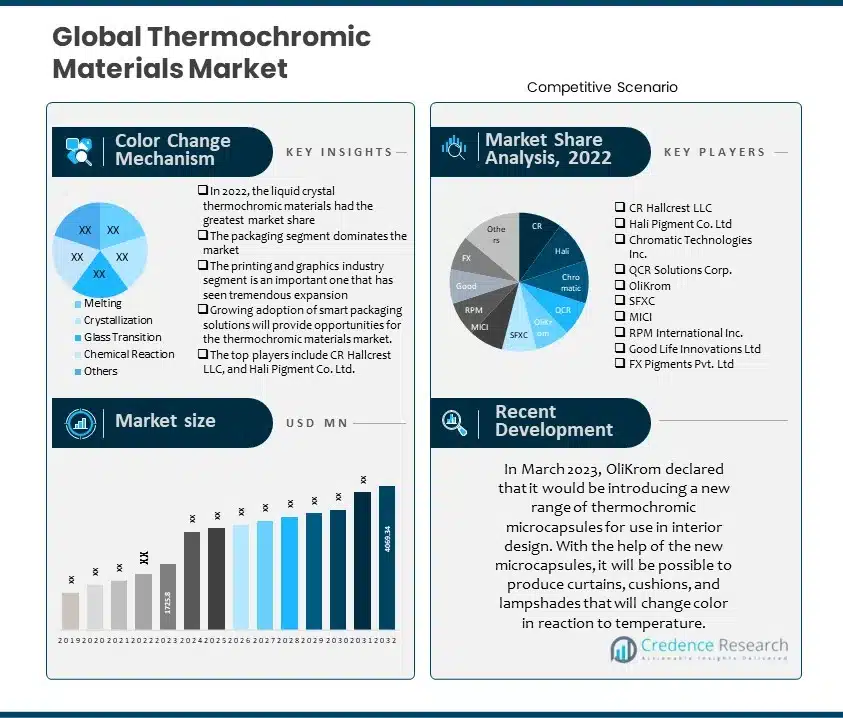
- The global market for thermochromic materials is expected to develop at a compound annual growth rate (CAGR) of 10.00% between 2024 and 2032, from its estimated USD 1725.8 million in 2023 to USD 4069.34 million in 2032.
- The largest category is liquid crystal thermochromic materials. Leuco dye thermochromic materials, on the other hand, are expected to grow at a strong CAGR.
- The leading temperature range segment is the low-temperature thermochromic materials (e.g., below room temperature).
- The CAGR for melting is expected to be the highest during the projection period.
- The packaging will have the highest CAGR throughout the prediction period.
- The printing and graphics industry will have the highest CAGR throughout the forecast period.
- Asia Pacific dominated the thermochromic materials market.
- Regarding the market share of thermochromic materials, Europe is expected to come second.
- North America is anticipated to grow fastest in the thermochromic materials market.
- Growing adoption of smart packaging solutions, safety and quality concerns regarding food, and temperature-sensitive packaging are driving growth in the global market.
- Technological developments in thermochromic materials, the rise of the food and beverage industry globally, and the expansion of the pharmaceutical and healthcare sectors are the factors generating prospects for the global sector.
Executive Summary
Market Definition
The thermochromic materials market produces, distributes, and uses materials that can change color in response to temperature changes. These materials feature reversible color changes and frequently change color as the temperature falls or rises within a certain range. Thermochromic materials are used in many industries, such as toys, smart windows, packaging, textiles, and automotive.
Market Overview
The thermochromic materials sector is estimated to develop at a 10.00% compound annual growth rate (CAGR) between 2024 and 2032, maintaining its current upward trend. The market will continue to develop, rising from its estimated value of USD 1725.8 million in 2023 to USD 4069.34 million in 2032.
In many sectors, thermos-sensors and thermometers are being replaced by thermochromic coatings. In environments where electrical wiring cannot be inserted, thermo-sensors and thermometers are being replaced to map temperature. These coatings are utilized to map an operating engine's temperature gradient in the defense and aerospace industries, which is driving the development of the thermochromic materials market. These materials must be used in other domains, such as the storage of delicate materials for industrial maintenance, where they must function without electricity. They are additionally used in entertainment applications; one example is erasable ink, which transforms into transparent and color-changing material. It's used to adorn nails and hair, as well as entertaining items like coffee cups and mugs.
With more applications in the packaging and textile industries, thermochromic materials are expected to be used more frequently. They are used to make it easier to find instances of security breaches in product labeling and packaging. Chemical heating equipment coatings are evolving increasingly; heat exchangers painted with paint based on thermochromic materials are one example. This serves as a temperature indicator for both stored chemical items and chemical reactions.
Segmentation by Type of Material
- Liquid crystal thermochromic materials lead the market by type of material. Temperature-sensitive thermochromic liquid crystals change color in various ways. The color of liquid crystals changes from red to green to blue as the temperature rises. Liquid crystals are versatile and multi-use, and they offer multiple uses. Temperature variations cause liquid crystal technology to respond.
- The leuco dye thermochromic materials category will exhibit a sizable CAGR during the projected period. Leuco dye thermochromic materials are utilized in printing, textiles, packaging, and security features, among other sectors. They can be used, for instance, in packaging to show how exposed a product is to temperature, guaranteeing the safety and quality of perishable items. They can be added to textiles to create apparel that is functional or sensitive to temperature.
- Other types of materials, such as reversible and irreversible thermochromic materials, influence the need for thermochromic materials.
Segmentation by Temperature Range
- The foremost temperature range category is low-temperature thermochromic materials (e.g., below room temperature). Materials designed to change color within a certain temperature range below room temperature are called low-temperature thermochromic materials. This range typically encompasses temperatures below 20°C (68°F) down to near or even below freezing, though it can vary based on the formulation and intended application.
- The room temperature thermochromic materials category will likely register a significant CAGR during forecasting. Thermochromic materials at room temperature have wide-ranging uses in various industries and goods. Labels or indicators on consumer goods, packaging, or HVAC systems that change color to show temperature fluctuations in indoor spaces.
- Other temperature ranges, such as high-temperature thermochromic materials (e.g., above room temperature), influence the need for thermochromic materials.
Segmentation by Color Change Mechanism
- The melting category is projected to grow faster over the projection period. Thermochromic materials can be included in safety indicators for mechanical or electrical systems to indicate when equipment is about to melt or overheat. To prevent damage or hazards, operators or users may be notified by the color change to take preventive action or to shut down the system.
- Other color change mechanisms, such as crystallization, glass transition, chemical reaction, and others, influence the need for thermochromic materials.
Segmentation by Application
- The packaging category will likely have the highest CAGR during the projection period. Thermochromic packaging may attract customers by making lasting impressions, which increases brand loyalty and engagement.
- Other applications, such as textiles, printing and graphics, cosmetics and personal care, automotive, healthcare, and others, also contribute to the demand for thermochromic materials.
Segmentation by End-Use Industry
- The printing and graphics industry is anticipated to grow at a stronger rate over the forecast period. The creation of temperature-sensitive graphics and designs in printing is a popular application for thermochromic inks. These inks react to temperature changes by changing color, enabling the production of dynamic and interactive printed items.
- Other end-use industries, such as packaging, textile, cosmetics and personal care, automotive, healthcare, and others, influence the need for thermochromic materials.
Segmentation by Region
- Asia Pacific leads the thermochromic materials industry. The Asia-Pacific market is anticipated to grow due to rising demand for security printing, cosmetics, medical thermography, and food packaging.
- Europe is estimated to rank second in market size for thermochromic materials.
- The thermochromic materials industry is predicted to flourish rapidly in North America.
- Regions such as Africa, the Middle East, and Latin America cover the remaining requirement for thermochromic materials.
Growing consumer desire for eye-catching designs in plastic packaging is propelling global revenue expansion. A product's uniqueness is becoming increasingly important because of rising competition, which has made plastic packaging more visually appealing. In addition, the demand for Organic Pigments is driven by the need to make products more appealing to consumers. The broad range of color hues and bespoke colors made possible by the high coloring strength of organic pigments improve the allure and beauty of items.
Based on projections, the thermochromic materials market is anticipated to be controlled by Asia Pacific. The region's market is anticipated to rise in terms of revenue as a result of growing demand for materials from the Japanese auto industry as well as increased use of thermochromic pigments in the textile and novelty goods industries. The Asia Pacific market's revenue growth will be propelled by the increasing need for medical thermography, cosmetics, security printing, and food packaging. The main producers of thermochromic materials are located in Asia Pacific. Among the leading manufacturers of thermochromic materials are LCR Hallcrest LLC, Hali Pigment Co. Ltd, Chromatic Technologies Inc., QCR Solutions Corp, and OliKrom.
The thermochromic materials market in North America is anticipated to expand fastest throughout the forecast. The need for materials in North America is driven by the growing need for pigments in printing applications in the United States. Moreover, the primary driver of the market's revenue growth in this region is anticipated to be the utilization of these pigments in flexographic and screen printing inks.
Key Highlights of the Report
The global thermochromic materials market is segmented by type of material, temperature range, color change mechanism, application, end-use industry, and region. Liquid crystal thermochromic materials are the market spearhead. The melting is the top segment. The packaging category is anticipated to increase at the highest CAGR throughout the projection period. The printing and graphics industry category will experience the highest CAGR during the forecast period. The thermochromic materials market is expanding mostly in Asia Pacific.
During the projection period, it is anticipated that the market's revenue growth will be driven by the increasing use of smart and intelligent packaging. There is a strong demand for the product because it is extensively used in stylish or smart fabrics and home furnishings. The quickly expanding markets for toys, baby diapers, and battery gauges, as well as the growing need for thermochromic materials, are predicted to propel the market's revenue growth. Technical advancements would help the product by expanding development chances in emerging nations.
Asia Pacific is expected to account for the largest thermochromic materials market globally. The growing demand for packaged goods and increasing disposable income in emerging Southeast Asian nations, such as Vietnam, Thailand, and Indonesia, present potential opportunities for thermochromic materials. The North American region is also assumed to have the market's sharpest growth. This is due to the rising demand for thermochromic materials from North American countries like the United States and Canada.
Which Key Factors Are Driving The Global Thermochromic Materials Market?
The industry for thermochromic materials is primarily driven by the need for new display technologies, the growing appeal of textiles with color changes, and government policies that support environmentally friendly packaging.
What are The Main Challenges Confronting the Thermochromic Materials Market Globally?
Limited application knowledge and customer ignorance of the advantages and uses of thermochromic materials are some barriers impeding the industry's expansion.
What Market Opportunities Exist For Thermochromic Materials Globally?
The need for eco-friendly products among consumers, the use of thermochromic materials in car interiors, and the development of new uses for coatings and smart windows are some of the reasons that might accelerate the thermochromic materials market.
Market Drivers
Multiple factors propel the thermochromic materials industry across the globe. The primary factors propelling the global thermochromic materials market are as follows:
Growing Requirements from Different End-Use Sectors
Thermochromic materials have been used in several end-use sectors because of their crystalline phase structure and color transition. The need for smart textiles from the fashion and home furnishings industries drives their market. These include tablecloths that change color in response to heat, ski outfits, chairs whose color indicates the user's position, and apparel with a painted design that changes color. Thermochromic fabrics can also be used as flexible sensors for real-world uses like concealment or defense. Thermochromic inks are applied to promotional packaging, safety printing, and marking applications. Thermochromic materials find widespread application as temperature indicators in chemical processes, where they are used to determine temperature distribution in chemical heating equipment like heat exchangers and reactors and to evaluate temperature differences and heat responses in chemical reactions. The demand for thermochromic materials across various end-use sectors is being driven by these different applications.
Market Restraints
There are several obstacles that the global thermochromic materials market must overcome to continue growing. Among them are the following:
Thermochromic Materials' Inadequate Light Fastness
One significant drawback of thermochromic materials is that their light fastness is usually minimal, which limits the market for these substances globally. Some materials deteriorate and experience photochemical fading when exposed to UV radiation. In addition, thermochromic inks are more expensive than conventional inks. The extremely sophisticated and intricate manufacturing of thermochromic materials is responsible for this. Furthermore, to prevent accidental activation during printing, sophisticated printing techniques may be required to print using irreversible thermochromic ink, which significantly raises costs. Companies utilizing thermochromic inks for packaging in the event of direct food contact must adhere to regulatory rules and carry out particular testing to guarantee that thermochromic inks meet regulatory criteria. The market for thermochromic materials is severely challenged by each of these factors.
Opportunities
There are many potential prospects in the global thermochromic materials industry. Among these are the following:
Strong Growth in the Construction Sector is Driving up Demand for Thermochromic Materials
The building's thermochromic polymer coating transmits visible radiation and reflects solar radiation, particularly the infrared spectrum. This makes thermochromic materials suitable for use in construction. The need for solar management alternatives for architectural applications has been emphasized by rules that have been implemented in response to rising energy costs and worries about global warming. Additionally, governments worldwide are making significant investments to grow the building industry. For example, the Thai government funded five affordable housing projects totaling THB4 billion (US$125.6 million) in 2019. The Department of Human Settlements approved R95.9 billion in funding in February 2020, enabling the provision of 22,696 housing subsidies in South Africa for the 2020–2021 period. Building supplies, including standard white coatings, colored paints, and white textile membrane coverings with TiO2 added, are integrated with thermochromic pigments. As a result, as construction activity rises, so will the need for thermochromic materials to give windows, exterior walls, and other construction components the ability to control heat and change color. This will ultimately support market growth.
Competitive Landscape
Key Players
Several major competitors exist in the fiercely competitive global thermochromic materials market. The following are a few of the leading market participants and their market shares:
- CR Hallcrest LLC
- Hali Pigment Co. Ltd
- Chromatic Technologies Inc.
- QCR Solutions Corp.
- OliKrom
- SFXC
- MICI
- RPM International Inc.
- Good Life Innovations Ltd
- FX Pigments Pvt. Ltd
- Smarol Industry Co. Ltd
- Kolortek Co. Ltd
- Kolorjet Chemicals Pvt. Ltd
- Colour change
- Others
These companies prioritize product innovation, distribution channel expansion, mergers, and acquisitions to remain competitive.
The largest suppliers in the global thermochromic materials market continuously work to stay one step ahead of the competition by developing innovative concepts and products.
In June 2023, A new line of thermochromic microcapsules for use in food and beverage packaging was introduced by Good Life Innovations Ltd. The packaging that responds to temperature can be made with these new microcapsules, which are safe to touch food.
In May 2023, Matsui International Company revealed the introduction of a new range of thermochromic microcapsules intended for use in industrial settings. It is possible to make industrial components that change color in response to temperature using these new microcapsules, which are made to tolerate high temperatures and harsh chemicals.
Summary of Key Findings
- The thermochromic materials market is expanding due to the increasing use of thermochromic inks in security printing.
- The market is segmented by type of material, temperature range, color change mechanism, application, end-use industry, and region.
- The most popular material in the market is liquid crystal thermochromic materials.
- The melting is the foremost color change mechanism category.
- The packaging category is expected to grow fastest in terms of CAGR during the forecast period.
- The printing and graphics industry category will likely see the highest CAGR during the anticipated time frame.
- Asia Pacific is leading market development; the market is highly competitive with key players including CR Hallcrest LLC, Hali Pigment Co. Ltd, Chromatic Technologies Inc., QCR Solutions Corp., OliKrom, SFXC, MICI, RPM International Inc., Good Life Innovations Ltd, FX Pigments Pvt. Ltd, Smarol Industry Co. Ltd, Kolortek Co. Ltd, Kolorjet Chemicals Pvt. Ltd, Colourchange, and Others.
Future Outlook
- The thermochromic materials industry is expected to increase significantly in Asia Pacific and has a positive outlook worldwide.
- Wearables and flexible electronics are advancing at an increasing rate, which is driving industry growth.
- The market for thermochromic materials is anticipated to face significant growth challenges during the forecast period due to the intricate integration requirements.
- To stay ahead of the competition, key enterprises must develop new products, expand their market reach, and keep their prices competitive.
How CXOs Can Benefit from the Credence Research Thermochromic Materials Market Report
CXOs may get a detailed picture of the market in the Credence Research Thermochromic Materials Market Report, which includes:
- Market size and growth forecast: The report provides detailed estimates of the global thermochromic materials market size, segmented by type of material, temperature range, color change mechanism, application, end-use industry, and region. It also includes forecasts for the market through 2032 based on key trends and drivers.
- Market segmentation: The research report breaks down the market for thermochromic materials into segments based on the type of material, temperature range, color change mechanism, application, end-use industry, and region. This segmentation provides CXOs with a granular understanding of the market and the opportunities in each segment.
- Competitive landscape: The research report offers a detailed analysis of the major companies in the thermochromic materials industry, including information on their business plans, product lines, and earnings. CXOs can use this information to evaluate and identify their competitors.
- Key trends and drivers: The research report identifies and evaluates the main trends and factors influencing the thermochromic materials market. CXOs can use this information to make well-informed choices regarding their plans and investments.
CXOs can use the insights from the Credence Research Thermochromic Materials Market Report to:
- Identify growth opportunities: This analysis may help CXOs identify new growth opportunities in the thermochromic materials sector. For example, the report identifies the growing demand for thermochromic materials from the printing and graphics industry as a key opportunity.
- Make informed investment decisions: The report helps CXOs choose thermochromic materials wisely. For example, the research study provides information on the critical factors to consider while selecting thermochromic materials solutions and evaluating thermochromic materials suppliers.
- Develop competitive strategies: CXOs can use the research report to develop competitive strategies for thermochromic materials businesses. For example, the research paper outlines the main strategies that thermochromic materials suppliers utilize to differentiate themselves from competitors.
- Track market developments: This research report may help CXOs stay ahead of the curve by tracking market developments. For instance, it offers insights into the most recent developments and trends in the thermochromic materials market.
CXOs seeking to expand their industry knowledge and spot growth prospects will find the Credence Research Thermochromic Materials Market Report useful.
Segmentation
- By Type of Material
- Liquid Crystal Thermochromic Materials
- Leuco Dye Thermochromic Materials
- Reversible Thermochromic Materials
- Irreversible Thermochromic Materials
- By Temperature Range
- Low-temperature thermochromic Materials (e.g., below room temperature)
- Room Temperature Thermochromic Materials
- High-temperature thermochromic Materials (e.g., above room temperature)
- By Color Change Mechanism
- Melting
- Crystallization
- Glass Transition
- Chemical Reaction
- Others
- By Application
- Packaging
- Temperature-sensitive labels for food and beverage packaging
- Temperature indicators for cold chain logistics
- Security features for tamper-evident packaging
- Textiles
- Color-changing fabrics for apparel and accessories
- Thermochromic inks for screen printing on textiles
- Smart textiles for temperature monitoring and control
- Printing and Graphics
- Thermochromic inks for promotional materials and novelty items
- Temperature-sensitive inks for mood-changing products
- Thermochromic coatings for security printing applications
- Cosmetics and Personal Care
- Color-changing cosmetics (e.g., lipsticks, nail polishes)
- Thermochromic hair dyes and styling products
- Temperature-sensitive skincare products
- Automotive
- Thermochromic coatings for car exteriors and interiors
- Temperature-sensitive indicators for engine parts and components
- Smart coatings for automotive sensors and displays
- Healthcare
- Thermochromic labels for medical devices and equipment
- Temperature-sensitive indicators for healthcare products (e.g., vaccines, drugs)
- Smart materials for temperature monitoring in patient care
- Others
- Packaging
- By End-Use Industry
- Packaging Industry
- Textile Industry
- Printing and Graphics Industry
- Cosmetics and Personal Care Industry
- Automotive Industry
- Healthcare Industry
- Others
- By Region
- North America
- The U.S.
- Canada
- Mexico
- Europe
- Germany
- France
- The U.K.
- Italy
- Spain
- Rest of Europe
- Asia Pacific
- China
- Japan
- India
- South Korea
- Southeast Asia
- Rest of Asia Pacific
- Latin America
- Brazil
- Argentina
- Rest of Latin America
- Middle East & Africa
- GCC Countries
- South Africa
- Rest of Middle East and Africa
- North America

Request a Free Sample
Fill in your details and we'll send you a free sample report.
- Sample data tables & charts
- Research methodology
Market Dynamics
Expansion of Smart Packaging Solutions
Thermochromic materials are increasingly used in packaging to provide temperature-sensitive indicators and tamper-evident features, supporting food safety and quality assurance in logistics and retail.
Technological Advancements in Thermochromic Materials
Ongoing innovation in material science has led to more durable, versatile, and application-specific thermochromic products, enabling broader adoption in industries such as automotive, healthcare, and construction.
Growth in Printing and Graphics Industry
The demand for interactive and security-enhanced printing, including novelty items and anti-counterfeiting measures, is driving the use of thermochromic inks and coatings.
Rising Demand from Asia Pacific End-Use Industries
Rapid industrialization, increased disposable income, and the expansion of sectors like automotive, textiles, and consumer goods in Asia Pacific are fueling significant market growth for thermochromic materials.
Increased Focus on Food Safety and Cold Chain Logistics
Thermochromic indicators are being adopted to monitor temperature exposure in perishable goods, pharmaceuticals, and vaccines, ensuring compliance with safety standards and reducing spoilage.
Need a Custom Version of This Report?
Tailor the scope, geography, or segments to your exact requirements.
- Custom geography or segment scope
- Direct access to our analyst team
Frequently Asked Questions
How much does the global market currently hold for thermochromic materials?
What is the thermochromic materials market's projected growth rate between 2024 and 2032?
In terms of type of material, which market category is leading?
Which end-use industry segment is estimated to have the highest CAGR throughout the forecast period?
Who are the main players in the global thermochromic materials industry?
Table of Content
Chapter 1 Market Segmentation
- 1.1 Segmentation Framework
- 1.1.1 Product and Service Classification
- 1.1.2 Application and End-Use Classification
- 1.1.3 Technology and Solution Classification
- 1.1.4 Customer and Distribution Channel Classification
- 1.1.5 Geographic Segmentation
- 1.1.6 Market Segment Definitions and Boundaries
- 1.2 By Application
- 1.2.1 Packaging
- 1.2.2 Textiles
- 1.2.3 Printing and Graphics
- 1.2.4 Cosmetics and Personal Care
- 1.2.5 Automotive
- 1.2.6 Healthcare
- 1.3 By Type of Material
- 1.3.1 Liquid Crystal Thermochromic Materials
- 1.3.2 Leuco Dye Thermochromic Materials
- 1.3.3 Reversible Thermochromic Materials
- 1.3.4 Irreversible Thermochromic Materials
- 1.4 By Temperature Range
- 1.4.1 Low-temperature Thermochromic Materials
- 1.4.2 Room Temperature Thermochromic Materials
- 1.4.3 High-temperature Thermochromic Materials
Chapter 2 Introduction
- 2.1 Report Objectives and Scope
- 2.2 Product Definition and Industry Terminology
- 2.3 Market Inclusions and Exclusions
- 2.4 Research Process
- 2.4.1 Primary Research and Expert Interviews
- 2.4.2 Secondary Research and Source Review
- 2.4.3 Top-Down and Bottom-Up Estimation
- 2.4.4 Data Triangulation and Verification
- 2.5 Market Size Measurement Basis
- 2.5.1 2023: USD 1,725.8 million → 2032: USD 4,069.34 million
- 2.6 Historical and Forecast Reference Periods
- 2.6.1 Base Year: 2023
- 2.6.2 Forecast Period: 2023-2032
- 2.7 Research Assumptions and Limitations
Chapter 3 Executive Summary
- 3.1 Market Snapshot and Key Findings
- 3.2 Base-Year Market Size, 2023
- 3.3 Forecast Market Size, 2032
- 3.4 Revenue and Volume Growth Outlook
- 3.5 Key Demand and Supply Indicators
- 3.6 Leading Market Segments
- 3.7 Fastest-Growing Market Opportunities
- 3.8 Regional Performance Highlights
- 3.9 Technology and Industry Transformation
- 3.10 Competitive Landscape Summary
- 3.11 Analyst View and Strategic Implications
Chapter 4 Global Thermochromic Materials Market Trends and Developments
- 4.1 Historical Industry Development
- 4.2 Recent Market Trends and Developments
- 4.3 Demand and Customer Behavior Trends
- 4.4 Technology and Product Innovation
- 4.5 Artificial Intelligence, Automation and Digitalization
- 4.6 Local Manufacturing and Supply Chain Realignment
- 4.7 Industry Partnerships, Mergers and Acquisitions
- 4.8 Sustainability and Circular Economy Developments
- 4.9 Government and Private Sector Investment Trends
- 4.10 Emerging Business Models and Commercialization
- 4.11 Industry Developments and Announcements
Chapter 5 Global Thermochromic Materials Market Production, Supply and Demand Analysis
- 5.1 Demand Trend and Consumption Analysis
- 5.2 Demand Forecast, 2023-2032
- 5.3 Production and Output Trend
- 5.4 Production and Output Forecast, 2023-2032
- 5.5 Installed Capacity and Capacity Utilization
- 5.6 Company-Wise Production Plants and Statistics
- 5.6.1 Installed Production Capacity
- 5.6.2 Actual Production
- 5.6.3 Planned Capacity and Expansion Targets
- 5.7 Supply Chain Structure and Procurement Trends
- 5.8 Supply-Demand Gap and Bottlenecks
- 5.9 Import Dependence and Sourcing Structure
- 5.10 Contract Manufacturing and Outsourcing
- 5.11 Regional Supply and Demand Concentration
Chapter 6 Global Thermochromic Materials Market Pricing Analysis
- 6.1 Pricing Structure and Measurement
- 6.2 Historical Pricing Trends
- 6.3 Pricing Outlook, 2023-2032
- 6.4 Average Selling Price and Unit Economics
- 6.5 Pricing by Product and Market Segment
- 6.6 Geographic Pricing Differences
- 6.7 Key Input, Energy, Labor and Logistics Costs
- 6.8 Contract Pricing and Purchasing Models
- 6.9 Pricing Sensitivity and Competitive Positioning
- 6.10 Price, Margin and Profitability Implications
Chapter 7 Global Thermochromic Materials Market Dynamics
- 7.1 Market Growth Drivers
- 7.1.1 Demand-Side Drivers
- 7.1.2 Technology and Innovation Drivers
- 7.1.3 Infrastructure and Investment Drivers
- 7.1.4 Regulatory and Policy Drivers
- 7.2 Market Restraints
- 7.2.1 Cost and Affordability Constraints
- 7.2.2 Technology and Adoption Barriers
- 7.2.3 Supply Chain and Operational Constraints
- 7.3 Market Challenges
- 7.3.1 Competitive Pressure and Margin Erosion
- 7.3.2 Skills, Infrastructure and Implementation Gaps
- 7.4 Emerging Market Opportunities
- 7.5 Market Dynamics Impact and Time-Horizon Assessment
Chapter 8 Global Thermochromic Materials Value Chain Analysis
- 8.1 Industry Value Chain Overview
- 8.2 Upstream Suppliers and Critical Inputs
- 8.3 Technology and Component Providers
- 8.4 Manufacturing or Service Delivery
- 8.5 Distribution, Channel Partners and Integrators
- 8.6 Downstream Applications and End Users
- 8.7 Value Addition and Profit Pools
- 8.8 Vertical Integration and Outsourcing
- 8.9 Supplier Concentration and Risk
- 8.10 Supply Chain Localization and Resilience
Chapter 9 Global Thermochromic Materials Market Regulations and Policies
- 9.1 Relevant Laws, Standards and Compliance Frameworks
- 9.2 Product, Service, Safety and Quality Requirements
- 9.3 Government Policies, Incentives and Subsidies
- 9.4 Imports, Exports and Trade Barriers
- 9.5 Public Procurement and Local Content Requirements
- 9.6 Environmental and Sustainability Compliance
- 9.7 Upcoming Policy Changes and Market Implications
Chapter 10 Global Thermochromic Materials Market Hotspots and Opportunities
- 10.1 Market Opportunity Mapping and Growth Hotspots
- 10.2 High-Growth Applications and Customer Groups
- 10.3 Underserved Markets and White-Space Opportunities
- 10.4 Emerging Technology and Product Opportunities
- 10.5 New Capacity and Investment Hotspots
- 10.6 Market Entry and Expansion Opportunities
- 10.7 Distribution and Partnership Opportunities
- 10.8 Near-Term and Long-Term Commercial Potential
- 10.9 Opportunity Attractiveness and Execution Risks
Chapter 11 Global Thermochromic Materials Market Outlook, 2023-2032
- 11.1 Market Size and Analysis
- 11.1.1 Revenue (Market Measurement: 2023: USD 1,725.8 million → 2032: USD 4,069.34 million)
- 11.1.2 Market Volume and Quantity Sold
- 11.1.3 Historical Market Size
- 11.1.4 Base-Year Market Size, 2023
- 11.2 Market Forecast, 2023-2032
- 11.2.1 Revenue Forecast to 2032
- 11.2.2 Volume Forecast to 2032
- 11.2.3 CAGR and Year-on-Year Growth
- 11.2.4 Incremental Revenue Opportunity
- 11.3 Forecast Assumptions and Scenario Analysis
- 11.3.1 Base-Case Forecast
- 11.3.2 Optimistic and Conservative Scenarios
- 11.3.3 Technology, Pricing and Policy Sensitivities
- 11.4 Market Attractiveness and Growth Outlook
Chapter 12 Global Thermochromic Materials Market Segmentation and Outlook
- 12.1 Segmentation Summary and Market Shares, 2023
- 12.2 Largest and Fastest-Growing Segments
- 12.3 By Application - Market Size and Forecast, 2023-2032
- 12.3.1 Segment Definition and Scope
- 12.3.2 Historical Market Size
- 12.3.3 Revenue Forecast, 2023-2032
- 12.3.4 Volume Forecast, 2023-2032
- 12.3.5 Base-Year Market Share, 2023
- 12.3.6 Segment CAGR and Growth Drivers
- 12.3.7 Subsegment Market Size and Forecast
- 12.3.7.1 Packaging
- 12.3.7.2 Textiles
- 12.3.7.3 Printing and Graphics
- 12.3.7.4 Cosmetics and Personal Care
- 12.3.7.5 Automotive
- 12.3.7.6 Healthcare
- 12.3.8 Subsegment Pricing and Adoption Trends
- 12.3.9 Leading Suppliers and Competition
- 12.3.10 Regional Demand and Opportunities
- 12.4 By Type of Material - Market Size and Forecast, 2023-2032
- 12.4.1 Segment Definition and Scope
- 12.4.2 Historical Market Size
- 12.4.3 Revenue Forecast, 2023-2032
- 12.4.4 Volume Forecast, 2023-2032
- 12.4.5 Base-Year Market Share, 2023
- 12.4.6 Segment CAGR and Growth Drivers
- 12.4.7 Subsegment Market Size and Forecast
- 12.4.7.1 Liquid Crystal Thermochromic Materials
- 12.4.7.2 Leuco Dye Thermochromic Materials
- 12.4.7.3 Reversible Thermochromic Materials
- 12.4.7.4 Irreversible Thermochromic Materials
- 12.4.8 Subsegment Pricing and Adoption Trends
- 12.4.9 Leading Suppliers and Competition
- 12.4.10 Regional Demand and Opportunities
- 12.5 By Temperature Range - Market Size and Forecast, 2023-2032
- 12.5.1 Segment Definition and Scope
- 12.5.2 Historical Market Size
- 12.5.3 Revenue Forecast, 2023-2032
- 12.5.4 Volume Forecast, 2023-2032
- 12.5.5 Base-Year Market Share, 2023
- 12.5.6 Segment CAGR and Growth Drivers
- 12.5.7 Subsegment Market Size and Forecast
- 12.5.7.1 Low-temperature Thermochromic Materials
- 12.5.7.2 Room Temperature Thermochromic Materials
- 12.5.7.3 High-temperature Thermochromic Materials
- 12.5.8 Subsegment Pricing and Adoption Trends
- 12.5.9 Leading Suppliers and Competition
- 12.5.10 Regional Demand and Opportunities
- 12.6 Segment Growth Comparison
- 12.7 Segment Attractiveness and Priority Matrix
Chapter 13 Global Thermochromic Materials End-Use and Application Market Outlook
- 13.1 End-Use Industry and Customer Demand Structure
- 13.2 Leading Applications and Customer Groups
- 13.3 End-Use Market Size, Share and Forecast
- 13.4 Major End-Use Industry Deep Dives
- 13.4.1 Customer Requirements and Use Cases
- 13.4.2 Demand and Replacement Cycles
- 13.4.3 Technical and Regulatory Considerations
- 13.4.4 Purchasing and Procurement Models
- 13.4.5 Leading Vendors and Distribution Channels
- 13.4.6 Forecast and Commercial Opportunities
- 13.5 Emerging Applications and Cross-Segment Demand
- 13.6 End-Use Industry Investment Priorities
Chapter 14 Global Thermochromic Materials Geographic Market Outlook, 2023-2032
- 14.1 Regional Market Size and Share, 2023
- 14.2 Regional Market Forecast, 2023-2032
- 14.3 Regional Pricing, Production and Demand Differences
- 14.4 North America
- 14.4.1 United States
- 14.4.2 Canada
- 14.4.3 Mexico
- 14.5 Europe
- 14.5.1 Germany
- 14.5.2 France
- 14.5.3 Italy
- 14.5.4 United Kingdom
- 14.5.5 Spain
- 14.5.6 Poland
- 14.5.7 Russia
- 14.5.8 Netherlands
- 14.5.9 Belgium
- 14.5.10 Sweden
- 14.5.11 Denmark
- 14.5.12 Norway
- 14.5.13 Rest of Europe
- 14.6 Asia Pacific
- 14.6.1 China
- 14.6.2 India
- 14.6.3 Japan
- 14.6.4 South Korea
- 14.6.5 Thailand
- 14.6.6 Indonesia
- 14.6.7 Vietnam
- 14.6.8 Malaysia
- 14.6.9 Australia
- 14.6.10 Rest of Asia Pacific
- 14.7 Latin America
- 14.7.1 Brazil
- 14.7.2 Argentina
- 14.7.3 Colombia
- 14.7.4 Chile
- 14.7.5 Rest of Latin America
- 14.8 Middle East
- 14.8.1 Saudi Arabia
- 14.8.2 United Arab Emirates
- 14.8.3 Turkey
- 14.8.4 Israel
- 14.8.5 Iran
- 14.8.6 Rest of the Middle East
- 14.9 Africa
- 14.9.1 South Africa
- 14.9.2 Egypt
- 14.9.3 Nigeria
- 14.9.4 Morocco
- 14.9.5 Rest of Africa
- 14.10 Regional Investment, Policy and Supply Chain Differences
- 14.11 Regional Competitive Landscape
- 14.12 Geographic Growth Hotspots
Chapter 15 Global Thermochromic Materials Technology, Innovation and Sustainability Outlook
- 15.1 Technology Landscape and Maturity
- 15.2 Product, Process and Service Innovation
- 15.3 AI, Automation and Digital Tools in the Industry
- 15.4 Technology Adoption and Performance Benchmarking
- 15.5 Innovation Pipeline and R&D Investment
- 15.6 Patent and Intellectual Property Trends
- 15.7 Energy Efficiency and Resource Management
- 15.8 Sustainability, Recycling and Circularity
- 15.9 Technology Roadmap, 2023-2032
- 15.10 Risks of Obsolescence and Technology Substitution
Chapter 16 Global Thermochromic Materials Market Key Strategic Imperatives
- 16.1 Growth and Market Entry Priorities
- 16.2 High-Return Products and Segments
- 16.3 Pricing, Profitability and Cost Optimization
- 16.4 Technology Investment and Product Differentiation
- 16.5 Supply Chain Localization and Resilience
- 16.6 Distribution and Customer Acquisition
- 16.7 Partnership, Acquisition and Capacity Strategy
- 16.8 Regional Expansion Priorities
- 16.9 Short-, Medium- and Long-Term Actions
Chapter 17 Competition Outlook
- 17.1 Industry Competition Characteristics
- 17.2 Market Structure and Concentration
- 17.3 Market Share and Competitive Positioning, 2023
- 17.4 Company-Wise Revenue and Product Benchmarking
- 17.5 Production and Service Capacity Benchmarking
- 17.6 Technology, Pricing and Differentiation
- 17.7 Regional Footprint and Distribution Strength
- 17.8 Mergers, Acquisitions and Strategic Alliances
- 17.9 New Entrants and Competitive Threats
- 17.10 Porter's Five Forces and Industry Attractiveness
- 17.11 Competitive Outlook, 2023-2032
Chapter 18 Company Profiles
- 18.1 Company Coverage and Selection Criteria
- 18.2 LCR Hallcrest LLC
- 18.2.1 Business Description
- 18.2.2 Company Ownership and Geographic Presence
- 18.2.3 Product and Service Portfolio
- 18.2.4 Manufacturing and Operating Footprint
- 18.2.5 Production Capacity and Expansion Plans
- 18.2.6 Financial Performance and Investment
- 18.2.7 Market Share and Competitive Position
- 18.2.8 Technology and Innovation Capabilities
- 18.2.9 Strategic Alliances or Partnerships
- 18.2.10 Recent Developments
- 18.2.11 Growth Strategy and Outlook
- 18.3 Hali Pigment Co. Ltd
- 18.4 Chromatic Technologies Inc.
- 18.5 QCR Solutions Corp.
- 18.6 OliKrom
- 18.7 RPM International Inc.
- 18.8 Good Life Innovations Ltd
- 18.9 FX Pigments Pvt. Ltd
- 18.10 Kolortek Co. Ltd
- 18.11 SFXC
- 18.12 Other Relevant Market Participants
Note: Every listed company is profiled on the structure shown under the first company. The company list is preliminary and may change based on research findings, market developments, data availability and client requirements.
Chapter 19 Disclaimer
- 19.1 Research and Forecast Disclaimer
- 19.2 Data Source and Estimation Limitations
Note: The depth of individual sections depends on data availability for this market. Volume, capacity, trade and other unit-based metrics are included where applicable.