
| REPORT ATTRIBUTE | DETAILS |
|---|---|
| Historical Period | 2019-2022 |
| Base Year | 2023 |
| Forecast Period | 2024-2032 |
| Umbilical Cord Blood Banking Market Size 2024 | USD 5,710 Million |
| Umbilical Cord Blood Banking Market, CAGR | 10% |
| Umbilical Cord Blood Banking Market Size 2032 | USD 12,239.89 Million |
Market Overview:
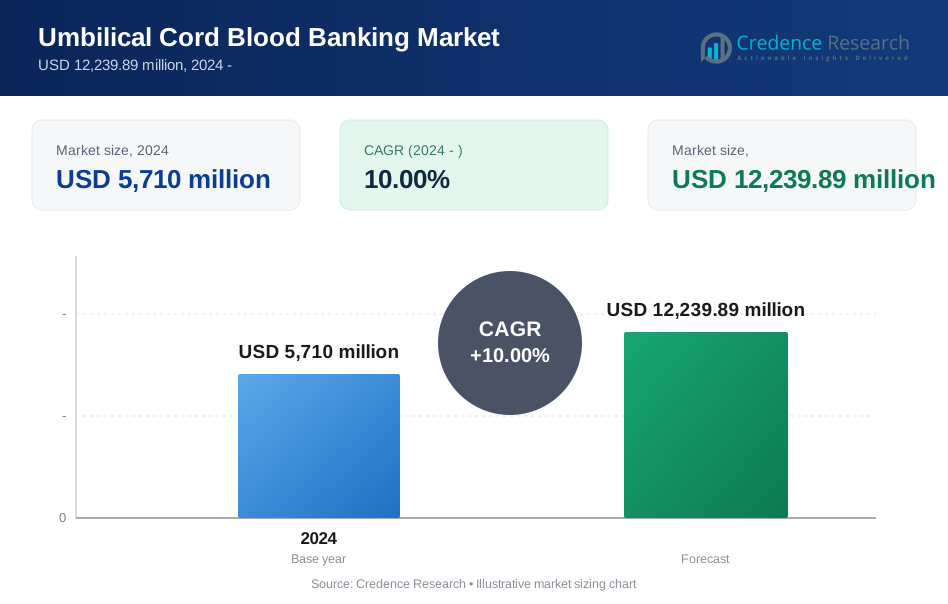
The global Umbilical Cord Blood Banking Market is projected to expand from USD 5,710 million in 2024 to approximately USD 12,239.89 million by 2032, at a compound annual growth rate (CAGR) of 10%. Umbilical cord blood banking involves collecting and storing blood from a newborn's umbilical cord and placenta, rich in hematopoietic stem cells, which are critical in treating various blood and immune disorders. Increasing awareness of the medical potential of cord blood and advancements in regenerative medicine drive the market’s growth. Demand is particularly strong in developed regions, where awareness and healthcare infrastructure support cord blood banking for current and potential future therapeutic applications.
Key market drivers include rising investments in healthcare infrastructure, growing awareness of stem cell therapies, and the increasing prevalence of genetic and autoimmune diseases. Government initiatives and public and private investments also support the growth of both private and public cord blood banks. Additionally, ongoing research in regenerative medicine highlights the potential applications of stem cells in treating conditions such as leukemia, lymphoma, and certain metabolic disorders, further encouraging parents to bank their newborns' cord blood for potential future use. Technological advancements, such as improved cryopreservation methods, are also enhancing the viability and longevity of stored cord blood, driving the appeal of these services.
Regionally, North America holds the largest market share due to advanced healthcare infrastructure, high awareness of stem cell benefits, and robust investments in healthcare innovation. The United States leads within this region, where both public and private banking services are widely available. Europe follows closely, with countries like the U.K., Germany, and France increasingly adopting cord blood banking services driven by favorable regulations and public funding initiatives. The Asia-Pacific region is expected to witness the fastest growth, spurred by increasing healthcare investments, growing awareness, and supportive government policies in countries like China, Japan, and India. This regional distribution reflects a growing global interest in regenerative medicine and proactive health measures.
Market Drivers:
Rising Awareness of Stem Cell Therapies:
The increasing recognition of stem cell therapies' potential is a significant driver in the umbilical cord blood banking market. Cord blood stem cells, rich in hematopoietic properties, are crucial for treating various diseases, including leukemia, lymphoma, and certain autoimmune disorders. For instance, the American Academy of Paediatrics (AAP) emphasizes that cord blood offers promising applications for regenerative medicine, leading parents to consider banking for future medical needs. Such growing awareness, supported by public health campaigns, has significantly expanded the appeal of cord blood banking among expectant parents.
Government Initiatives and Funding Support:
Government funding and supportive policies are playing a vital role in advancing the cord blood banking market. In the United States, the Health Resources and Services Administration (HRSA) supports public cord blood banking through grants, increasing accessibility for families. Similarly, countries in Europe, such as the U.K., provide funding for cord blood research and banking, which drives the public sector's growth. These initiatives highlight governmental commitment to expanding healthcare options, particularly in regenerative medicine, thereby strengthening cord blood banking infrastructure globally.
Expanding Research in Regenerative Medicine: Advances in regenerative medicine are amplifying interest in cord blood banking, as researchers explore its use for non-hematologic conditions. Numerous clinical trials investigate the potential of cord blood stem cells in treating neurological disorders, such as cerebral palsy, and certain metabolic conditions. For example, studies funded by The National Institutes of Health (NIH) explore cord blood's regenerative properties, providing insight into its therapeutic potential beyond traditional uses. This research has prompted parents to view cord blood banking as an investment in future health, further driving the market.
Technological Advancements in Cryopreservation:
Technological advancements, particularly in cryopreservation, have significantly improved cord blood viability over extended periods. Innovations in freezing techniques and storage containers help maintain the quality and potency of stem cells for decades, enhancing the reliability of stored cord blood for future medical applications. Companies like ViaCord are at the forefront of implementing these advancements, ensuring higher survival rates of preserved cells, which adds substantial value to their banking services. Enhanced storage capabilities support the growth of the market by providing parents with greater confidence in long-term cord blood banking reliability.
Market Trends:
Growth of Private Cord Blood Banks:
One significant trend in the umbilical cord blood banking market is the rise of private cord blood banks, as more parents opt to store cord blood specifically for family use. Unlike public banks, which make donations available for various patients, private banks allow families exclusive access to their stored samples. This exclusivity appeals to parents seeking potential future treatments for hereditary diseases. For instance, companies like Cryo-Cell International and ViaCord report a steady increase in private banking enrollments, reflecting an expanding preference for personalized healthcare.
Emergence of Hybrid Banking Models:
The emergence of hybrid models combining both private and public banking services is also transforming the industry. These hybrid models allow families to donate a portion of the cord blood to public banks for community use while retaining some for private family use. For example, Cord Blood Registry has introduced hybrid models that cater to parents wanting both altruistic options and family security. This model offers flexibility and broadens appeal by addressing both personal and public health needs.
Advancements in Stem Cell Expansion Techniques:
Advancements in stem cell expansion techniques are further shaping the cord blood banking market. Traditional cord blood samples are limited in cell count, sometimes restricting their applicability in adult patients. Recent research, funded by the National Institutes of Health (NIH) and European Union’s Horizon 2020 program, focuses on expanding stem cell volumes from cord blood samples to support a wider range of applications. These innovations increase the potential of cord blood banking to serve more extensive therapeutic needs, including adult treatments, thereby enhancing the long-term value of stored samples.
Increased Focus on Educating Expectant Parents:
Education initiatives targeting expectant parents have become a crucial trend, as awareness grows around the potential of cord blood. Public health organizations, such as the American Academy of Paediatrics (AAP), along with companies like Americord, actively provide resources to educate parents on the benefits and options available in cord blood banking. By providing detailed information on the potential uses and safety of stored cord blood, these programs help parents make informed decisions, thereby increasing engagement with both private and public cord blood banking services.
Market Challenges Analysis:
High Costs of Collection and Storage:
One of the primary challenges in the umbilical cord blood banking market is the high cost associated with the collection, processing, and long-term storage of cord blood. Many families are deterred by the initial fees for collection and the recurring costs of cryogenic storage, which are often not covered by health insurance. This financial barrier limits accessibility, particularly for middle- and low-income families. For example, the U.S. Centers for Medicare & Medicaid Services (CMS) does not cover private cord blood banking, making it a cost-prohibitive option for many households. These high costs constrain market growth and limit the potential for widespread adoption of private banking services.
Regulatory Compliance and Quality Standards:
Stringent regulatory requirements and quality standards add complexity and cost to cord blood banking operations. Authorities such as the U.S. Food and Drug Administration (FDA) and the European Medicines Agency (EMA) impose rigorous standards to ensure the safety, efficacy, and quality of stored cord blood units. Compliance involves significant investments in laboratory infrastructure, regular audits, and certifications, which can be burdensome for smaller companies. These requirements are essential for consumer safety but create operational challenges and increase costs, often passed on to consumers.
Lack of Awareness and Misconceptions:
Despite growing interest, public awareness of cord blood banking remains limited, and misconceptions about its potential uses persist. Many expectant parents are unaware of the therapeutic benefits of cord blood or hold misunderstandings regarding the viability and applications of stored cells. For instance, a study supported by the American Academy of Paediatrics (AAP) found that only a fraction of eligible parents considered cord blood banking due to a lack of information. This knowledge gap, particularly in developing regions, restricts market potential and reduces participation in both public and private banking options.
Ethical and Logistical Issues in Public Banking:
Public cord blood banks face ethical and logistical challenges, including limited storage space and selective criteria for stored samples, leading to high discard rates. Public banks also navigate ethical considerations around informed consent and donor privacy. According to the World Health Organization (WHO), these challenges complicate operations and limit public banks' ability to store a sufficient and diverse range of samples, impacting their capacity to meet rising demand.
Market Segmentation Analysis:
By Type, the market is divided into private cord blood banks and public cord blood banks. Private banks allow exclusive family access to stored cord blood, providing a safety net for potential future personal use, which appeals to families seeking control over medical resources. Public banks, on the other hand, make donations accessible to the general public, benefiting individuals with compatible matches and supporting community healthcare initiatives. The hybrid model is emerging as a middle ground, combining the advantages of both private and public banking.
By Technology, the market includes segments based on cryopreservation and cord blood stem cell expansion. Cryopreservation is widely adopted for its efficacy in preserving stem cell viability over extended periods, ensuring cells remain functional for future use. Stem cell expansion, an emerging technology, is increasingly relevant as it amplifies cell counts from smaller cord blood samples, making them applicable for treatments requiring larger cell volumes, such as in adult therapies.
By End User, the market serves hospitals, research institutions, and specialty clinics. Hospitals account for a substantial share as they frequently partner with cord blood banks for collection and storage, supporting both private and public options. Research institutions also play a critical role, utilizing stored cord blood for clinical trials and regenerative medicine studies. Specialty clinics, focused on stem cell therapies, contribute to demand by offering treatments that incorporate cord blood-based solutions. This segmentation reflects the versatility of cord blood banking in both therapeutic and research applications.
Segmentations:
By Storage Option
- Public UCB banks
- Private UCB banks
By Application
- Leukemia
- Bone marrow failure syndrome
- Metabolic disorder
- Lymphoma
- Immune deficiencies
By Service Type
- Sample Preservation & Storage
- Sample Analysis
- Sample Processing
- Sample Collection & Transportation
By Region
- North America
- U.S.
- Canada
- Mexico
- Europe
- Germany
- France
- U.K.
- Italy
- Spain
- Rest of Europe
- Asia Pacific
- China
- Japan
- India
- South Korea
- South-east Asia
- Rest of Asia Pacific
- Latin America
- Brazil
- Argentina
- Rest of Latin America
- Middle East & Africa
- GCC Countries
- South Africa
- Rest of the Middle East and Africa
Regional Analysis:
North America
North America holds the largest share of the global umbilical cord blood banking market, accounting for approximately 40% of total revenue. This dominance is attributed to the well-established healthcare infrastructure, high awareness of stem cell benefits, and significant investment in public and private cord blood banks. The United States, in particular, leads the region, driven by extensive marketing efforts by private cord blood banks and robust public funding for regenerative medicine research. Government bodies, such as the Health Resources and Services Administration (HRSA), support public cord blood banks through grants, increasing access to stored units. Canada also contributes to this stronghold with its own network of public and private banks, aligning with high awareness and accessibility.
Europe
Europe represents around 25% of the umbilical cord blood banking market, with major contributions from the U.K., Germany, and France. The European market benefits from government initiatives and public funding in countries with strong regulatory frameworks for regenerative medicine. The European Union’s regulatory support, particularly through the European Medicines Agency (EMA), encourages safe collection and storage practices, enhancing consumer trust in public and private cord blood banking. Many European countries promote public banking systems, leading to a high participation rate in public cord blood donations. The U.K. and Germany have also witnessed rising demand for private cord blood banking, as consumers increasingly prioritize personalized healthcare options.
Asia-Pacific
Asia-Pacific is projected to be the fastest-growing region, anticipated to capture approximately 20% of the global market share by 2032. Rapid population growth, increasing healthcare expenditure, and expanding awareness of stem cell therapies drive demand in countries like China, Japan, and India. In China, government-led campaigns promote awareness of stem cell storage, resulting in increased enrollments in private banks. Japan’s advanced healthcare system and proactive stance on regenerative medicine contribute significantly to market growth, with rising numbers of hospitals collaborating with cord blood banks. India has also seen a surge in interest due to a growing middle class willing to invest in private banking options for personalized healthcare.
Latin America and Middle East & Africa
Latin America and the Middle East & Africa (MEA) hold smaller shares in the global umbilical cord blood banking market, accounting for about 10% collectively. In Latin America, Brazil and Mexico lead with increasing awareness and investment in healthcare infrastructure. Public banks dominate in Brazil, while Mexico sees gradual growth in both public and private banking. In the MEA region, the UAE and South Africa drive demand with high-income populations and government investment in healthcare. Although these regions face challenges such as lower awareness and limited access, growth is anticipated as infrastructure improves and awareness of cord blood banking benefits expands.
Key Player Analysis:
- Caladrius Biosciences
- Cord Blood America, Inc.
- Cordlife Group Limited
- American Type Culture Collection (ATCC)
- Cord Blood Registry (CBR)
- China Cord Blood Corporation
- Smart Cells International
- Esperite N.V.
- ViaCord, LLC
- Cryo-Cell International, Inc.
Competitive Analysis:
The umbilical cord blood banking market is moderately competitive, led by prominent players such as Cord Blood Registry (CBR), Cryo-Cell International, China Cord Blood Corporation, and ViaCord. These companies hold a strong market position due to extensive networks, robust marketing efforts, and advanced cryopreservation technologies. Larger players capitalize on established brand recognition and partnerships with healthcare providers, which enhance consumer awareness and accessibility. Meanwhile, companies like Cordlife Group and Smart Cells International bring competitive differentiation by focusing on regional expansion, quality certifications, and targeted educational initiatives for expectant parents. As the market evolves, the focus on expanding private banking options and hybrid models is increasing, driven by rising interest in personalized healthcare. Regulatory support and growing awareness of regenerative medicine applications further intensify competition as companies invest in R&D to improve the viability and applicability of stored cord blood for future treatments.
Recent Developments:
- Cordlife Group introduced advanced cryopreservation techniques in 2023, aimed at extending the viability and functionality of stored stem cells. This improvement enhances the long-term therapeutic potential of stored samples, particularly in treatments for blood and immune disorders.
- Cryo-Cell International launched an educational program in early 2024 to increase awareness among expectant parents about the benefits of cord blood banking. This initiative aims to bridge the knowledge gap, encouraging more families to consider cord blood banking as part of their healthcare plans.
- China Cord Blood Corporation expanded its services in 2023 by increasing its storage capacity and developing partnerships with hospitals across China. This expansion supports rising demand in the Asia-Pacific region, driven by greater awareness and improved accessibility.
- ViaCord began offering a new hybrid banking model in 2022, allowing parents to store a portion of the cord blood privately while donating the remaining portion to a public bank. This model addresses the dual demand for family exclusivity and community support in regenerative medicine.
Market Concentration & Characteristics:
The umbilical cord blood banking market is moderately concentrated, with key players like Cord Blood Registry (CBR), Cryo-Cell International, and China Cord Blood Corporation holding substantial shares due to their expansive infrastructure, advanced cryopreservation technologies, and established networks across private and public banking sectors. Larger firms focus on integrating advanced storage technologies and expanding partnerships with hospitals to improve accessibility, while mid-sized companies, such as Cordlife Group and Smart Cells International, differentiate by targeting specific regional needs and investing in consumer education. Market competition centers around offering hybrid banking models, advanced cell viability techniques, and educational initiatives that emphasize long-term storage value. The market’s competitive landscape reflects a balance between large players capitalizing on broad brand recognition and smaller firms expanding into emerging markets, where rising awareness of stem cell benefits and supportive government policies are creating new opportunities.
Report Coverage:
The research report offers an in-depth analysis based on Storage Option, Application, Service Type, and Region. It details leading market players, providing an overview of their business, product offerings, investments, revenue streams, and key applications. Additionally, the report includes insights into the competitive environment, SWOT analysis, current market trends, as well as the primary drivers and constraints. Furthermore, it discusses various factors that have driven market expansion in recent years. The report also explores market dynamics, regulatory scenarios, and technological advancements that are shaping the industry. It assesses the impact of external factors and global economic changes on market growth. Lastly, it provides strategic recommendations for new entrants and established companies to navigate the complexities of the market.
Future Outlook:
- The umbilical cord blood banking market is projected to grow as awareness of stem cell therapies expands, especially for treating blood and immune disorders.
- Increasing governmental support and funding in developed countries will continue to promote both public and private cord blood banking, enhancing accessibility.
- Rising investments in cryopreservation technology are anticipated to improve the long-term viability of stored cord blood, ensuring higher quality for future therapeutic applications.
- The adoption of hybrid banking models is expected to increase, appealing to parents who seek both private and community-focused storage options.
- Asia-Pacific is forecasted to witness rapid growth due to rising healthcare infrastructure, population size, and increasing awareness of regenerative medicine in countries like China and India.
- Partnerships between hospitals and cord blood banks will likely expand, integrating cord blood collection into standard delivery procedures.
- Advances in stem cell expansion techniques are anticipated to broaden cord blood applications, making it viable for adult treatments.
- Efforts to educate expectant parents about cord blood benefits will continue, supported by targeted initiatives from both government and private entities.
- Personalized medicine trends will boost demand for private cord blood storage, as families seek future therapeutic options for potential genetic conditions.
- Continuous R&D investment in regenerative medicine is expected to create new applications for cord blood, potentially supporting treatments for conditions beyond current uses.
Request a Free Sample
Fill in your details and we'll send you a free sample report.
- Sample data tables & charts
- Research methodology
Need a Custom Version of This Report?
Tailor the scope, geography, or segments to your exact requirements.
- Custom geography or segment scope
- Direct access to our analyst team
Frequently Asked Questions
What is the current size of the Umbilical Cord Blood Banking Market?
What factors are driving the growth of the Umbilical Cord Blood Banking Market?
What are some challenges faced by the Umbilical Cord Blood Banking Market?
Who are the major players in the Umbilical Cord Blood Banking Market?
Which segment is leading the market share?
Table of Content
Chapter 1. Report Introduction
- 1.1 Report Description & Purpose
- 1.1.1 Report Title & Market Definition
- 1.1.2 Unique Selling Propositions (USP) & Key Differentiators
- 1.1.3 Value Proposition for Stakeholders
- 1.2 Research Objectives
- 1.2.1 Market Sizing Objectives (Volume & Revenue)
- 1.2.2 Segmentation Objectives
- 1.2.3 Competitive Intelligence Objectives
- 1.2.4 Forecast & Scenario Objectives
- 1.3 Report Scope
- 1.3.1 Umbilical Cord Blood Banking Scope – Types & Subtypes Covered
- 1.3.2 Geographic Scope – Regions & Countries Covered
- 1.3.3 Historical Period, Base Year & Forecast Period (2024; forecast to the forecast period)
- 1.3.4 Inclusions & Exclusions
- 1.4 HS Code & Classification Framework
- 1.5 Currency, Units & Pricing Basis
- 1.6 Target Stakeholders
- 1.7 Limitations & Assumptions
Chapter 2. Executive Summary
- 2.1 Global Umbilical Cord Blood Banking Market Snapshot
- 2.1.1 Market Size – Historical (2024) & Forecast (the forecast period) (2024: USD 5,710 million → forecast year: USD 12,239.89 million)
- 2.1.2 Volume & Revenue – Global Totals
- 2.1.3 Key Market Highlights – Top Five Facts
- 2.2 Umbilical Cord Blood Banking Market Segmentation Snapshot
- 2.2.1 Market Split by Region – 2024 vs.
- 2.3 Competitive Snapshot
- 2.3.1 Top 10 Players by Revenue Share – 2024
- 2.3.2 Top 10 Players by Volume Share – 2024
- 2.3.3 Recent Strategic Developments (18-Month Summary)
- 2.4 Key Investment Highlights & Strategic Conclusions
Chapter 3. Umbilical Cord Blood Banking Market Dynamics & Industry Analysis
- 3.1 Market Overview & Context
- 3.1.1 Umbilical Cord Blood Banking Market Position in the Broader Automotive Value Chain
- 3.1.2 OEM vs. Replacement Market Dynamics
- 3.1.3 Market Maturity & Development Stage by Region
- 3.2 Umbilical Cord Blood Banking Market Drivers
- 3.3 Umbilical Cord Blood Banking Market Restraints & Challenges
- 3.4 Umbilical Cord Blood Banking Market Opportunities
- 3.5 Porter's Five Forces Analysis
- 3.5.1 Threat of New Entrants
- 3.5.2 Bargaining Power of Suppliers
- 3.5.3 Bargaining Power of Buyers
- 3.5.4 Threat of Substitutes
- 3.5.5 Competitive Rivalry – Intensity Assessment
- 3.6 Umbilical Cord Blood Banking Value Chain Analysis
- 3.6.1 Upstream – Raw Material/Input Suppliers
- 3.6.1.1 Raw Material/Input 1
- 3.6.1.2 Raw Material/Input 2
- 3.6.1.3 Raw Material/Input 3
- 3.6.2 Midstream – Production/Manufacturing/Service Delivery
- 3.6.2.1 Production/Process Overview
- 3.6.2.2 Key Facility Locations & Capacity by Manufacturer
- 3.6.3 Downstream – Distribution & End Consumer
- 3.6.3.1 Primary Channel – B2B/OEM
- 3.6.3.2 Secondary Channels – Dealer, Retail, Online, Direct
- 3.6.4 Value Chain Profitability Analysis
- 3.6.1 Upstream – Raw Material/Input Suppliers
- 3.7 PESTEL Analysis
- 3.7.1 Political Factors
- 3.7.2 Economic Factors
- 3.7.3 Social Factors
- 3.7.4 Technological Factors
- 3.7.5 Environmental Factors
- 3.7.6 Legal Factors
- 3.8 Umbilical Cord Blood Banking Supply Chain Analysis
- 3.8.1 Raw Material/Input Supply Risk Assessment
- 3.8.2 Manufacturing Concentration Risk (Geographic Exposure)
- 3.8.3 Trade Disruption Impact Analysis
- 3.9 Regulatory & Policy Landscape
Note: The regulatory and policy landscape section covers regulations based on their applicability to the market, Umbilical Cord Blood Banking category, geography, and scope of the study. Only regulatory frameworks with a material impact on operations, compliance, trade, sustainability, or market access are analyzed in detail.
Chapter 4. Key Investment Pockets & Opportunity Analysis
- 4.1 Umbilical Cord Blood Banking Market Attractiveness Analysis
- 4.1.1 By Region – Investment Attractiveness Matrix (Volume × CAGR)
- 4.2 Absolute Revenue Growth Opportunity
- 4.2.1 By Region – Absolute USD Growth Through the forecast period
- 4.3 Incremental Volume Opportunity
- 4.3.1 By Region – Incremental Volume Through the forecast period
- 4.3.2 Segment – Incremental Volume
- 4.4 Emerging Submarket Opportunity Deep Dive (Subject to Applicability)
- 4.5 Emerging Market Opportunity Scorecards
- 4.5.1 United States
- 4.5.2 Europe
- 4.5.3 Asia
- 4.5.4 Middle East & Africa
Note: Emerging Market Opportunity Scorecards will be included based on relevance and strategic importance. Regions listed are indicative and may vary depending on data availability and market dynamics.
Chapter 5. Umbilical Cord Blood Banking Import-Export Analysis & Trade Flows
- 5.1 Global Trade Overview
- 5.1.1 Global Export Value by Country (2024)
- 5.1.2 Global Export Volume by Country (2024)
- 5.1.3 Global Import Value by Country (2024)
- 5.1.4 Global Import Volume by Country (2024)
- 5.1.5 Net Trade Balance by Country (2024)
- 5.2 Export Analysis – Segment
- 5.2.1 Type 1 (HS Code)
- 5.2.2 Type 2 (HS Code)
- 5.2.3 Type 3 (HS Code)
- 5.2.4 Type 4 (HS Code)
- 5.2.5 Type 5 (HS Code)
- 5.3 Import Analysis – Segment
- 5.3.1 Type 1 (HS Code)
- 5.3.2 Type 2 (HS Code)
- 5.3.3 Type 3 (HS Code)
- 5.3.4 Type 4 (HS Code)
- 5.3.5 Type 5 (HS Code)
- 5.4 Average Unit Trade Prices
- 5.4.1 Average Export Price – Segment & Country
- 5.4.2 Average Import Price – Segment & Source Country
- 5.4.3 Price Trends (2024)
- 5.5 Key Trade Route Analysis
- 5.5.1 Trade Route 1
- 5.5.2 Trade Route 2
- 5.5.3 Trade Route 3
- 5.5.4 Trade Route 4
- 5.5.5 Trade Route 5
- 5.6 Trade Policy Impact Assessment
- 5.6.1 US Anti-Dumping & Section 301 Tariffs
- 5.6.2 EU Customs Union Impact
- 5.6.3 Major Free Trade Agreements
- 5.6.4 USMCA Rules of Origin
Note: Trade policy analysis will be included only where relevant to the Umbilical Cord Blood Banking market.
Chapter 6. Competitive Landscape & Company Benchmarking
- 6.1 Umbilical Cord Blood Banking Market Concentration & Structure
- 6.1.1 Herfindahl-Hirschman Index (HHI) – vs. 2024
- 6.1.2 Tier 1, Tier 2 & Tier 3 Market Structure
- 6.1.3 Global, Regional & Local Player Dynamics
- 6.2 Umbilical Cord Blood Banking Market Share Analysis – 2024
- 6.2.1 Global Revenue Share by Company
- 6.2.2 Global Volume Share by Company
- 6.2.3 Regional Revenue Share
- 6.2.4 Market Share Evolution ( vs. 2024)
- 6.2.5 OEM Segment Share by Company
- 6.2.6 Replacement Segment Share by Company
- 6.3 Production/Delivery Capacity & Facility Analysis
- 6.3.1 Global Installed Capacity
- 6.3.2 Capacity Utilization Rates
- 6.3.3 Production/Output Volume
- 6.3.4 Facility Locations & Capacity Map
- 6.3.5 Planned Capacity Additions
- 6.4 Umbilical Cord Blood Banking Competitive Benchmarking Matrix
- 6.4.1 Revenue, Volume, CAGR & Profitability Comparison
- 6.4.2 Channel Revenue Mix
- 6.4.3 Geographic Revenue Exposure
- 6.4.4 R&D Intensity
- 6.4.5 Sustainability Maturity
- 6.5 Strategic Developments in Umbilical Cord Blood Banking (Last 24 Months)
- 6.5.1 Mergers, Acquisitions & Divestments
- 6.5.2 New Umbilical Cord Blood Banking Launches
- 6.5.3 Facility Expansions
- 6.5.4 Strategic Alliances, Joint Ventures & Partnerships
- 6.5.5 Distribution Expansion & Market Entry
- 6.5.6 Sustainability & ESG Initiatives
- 6.6 Competitive Strategy Mapping
- 6.6.1 Leader, Challenger, Follower & Niche Classification
- 6.6.2 Pricing Strategy Comparison
- 6.6.3 Channel Strategy Matrix
Note: Strategic developments are included based on their materiality and the availability of reliable information.
Chapter 7. Global Umbilical Cord Blood Banking Market – By Distribution Channel
- 7.1 Segment Overview
- 7.1.1 Volume & Revenue Split by Channel (2024 & )
- 7.1.2 Channel Mix Evolution (the forecast period)
Chapter 8. Regional Market Analysis – Global Overview
- 8.1 Global Regional Overview
- 8.1.1 Regional Volume Share
- 8.1.2 Regional Revenue Share
- 8.1.3 Regional Volume by Region
- 8.1.4 Regional Revenue by Region
- 8.1.5 Regional Forecast Through the forecast period
- 8.2 Cross-Regional Segment Analysis
- 8.2.1 By Distribution Channel
- 8.2.2 By Brand/Price Tier
Chapter 9. North America Umbilical Cord Blood Banking Market
- 9.1 United States
- 9.2 Canada
- 9.3 Mexico
Chapter 10. Europe Umbilical Cord Blood Banking Market
- 10.1 Germany
- 10.2 France
- 10.3 Italy
- 10.4 United Kingdom
- 10.5 Spain
- 10.6 Poland
- 10.7 Russia
- 10.8 Netherlands
- 10.9 Belgium
- 10.10 Sweden
- 10.11 Denmark
- 10.12 Norway
- 10.13 Rest of Europe
Chapter 11. Asia Pacific Umbilical Cord Blood Banking Market
- 11.1 China
- 11.2 India
- 11.3 Japan
- 11.4 South Korea
- 11.5 Thailand
- 11.6 Indonesia
- 11.7 Vietnam
- 11.8 Malaysia
- 11.9 Australia
- 11.10 Rest of Asia Pacific
Chapter 12. Latin America Umbilical Cord Blood Banking Market
- 12.1 Brazil
- 12.2 Argentina
- 12.3 Colombia
- 12.4 Chile
- 12.5 Rest of Latin America
Chapter 13. Middle East Umbilical Cord Blood Banking Market
- 13.1 Saudi Arabia
- 13.2 United Arab Emirates
- 13.3 Turkey
- 13.4 Israel
- 13.5 Iran
- 13.6 Rest of the Middle East
Chapter 14. Africa Umbilical Cord Blood Banking Market
- 14.1 South Africa
- 14.2 Egypt
- 14.3 Nigeria
- 14.4 Morocco
- 14.5 Rest of Africa
Chapter 15. Umbilical Cord Blood Banking Company Profiles
- 15.1 [Company 01]
- 15.1.1 Company Overview
- 15.1.2 Key Management Personnel
- 15.1.3 Products & Services Portfolio
- 15.1.4 Financial Performance
- 15.1.5 Key Market Focus & Geographic Presence
- 15.1.6 Recent Developments & Strategic Initiatives
Note: The company profile list is preliminary and may change based on research findings, market developments, data availability, and client requirements.
Chapter 16. Appendices
- Appendix A – List of Abbreviations & Acronyms
- Appendix B – Industry Classification Code Reference – Full Series
- Appendix C – Production & Capacity Data Tables
- Appendix D – End-Use & Demand Base Tables
- Appendix E – Consumption & Replacement Rate Assumptions
- Appendix F – ASP Reference Tables
- Appendix G – Manufacturing & Facility Database
- Appendix H – Import-Export Data Tables
- Appendix I – Regulatory Summary Tables
- Appendix J – Primary Research Participant List (Anonymized)
- Appendix K – Primary Research Questionnaire Framework
- Appendix L – Data Sources & Bibliography
- Appendix M – Market Size Divergence & Source Comparison
Chapter 17. Research Methodology
- 17.1 Research Framework & Philosophy
- 17.2 Secondary Research – Sources, Hierarchy & Data Extraction
- 17.3 Data Modeling – Bottom-Up & Top-Down Market Sizing
- 17.4 Primary Research – Stakeholder Framework, LOI & Sample Sizes
- 17.5 Forecast Methodology – Regression, Scenario & Sensitivity Analysis
- 17.6 Quality Control – Four-Layer Validation Framework
- 17.7 Limitations & Standard Assumptions
- 17.8 Disclaimer
