| REPORT ATTRIBUTE | DETAILS |
|---|---|
| Historical Period | 2019-2022 |
| Base Year | 2023 |
| Forecast Period | 2024-2032 |
| Veterinary Endoscopy Market Size 2023 | USD 975.16 million |
| Veterinary Endoscopy Market, CAGR | 5% |
| Veterinary Endoscopy Market Size 2032 | USD1579.32 million |
Market Overview
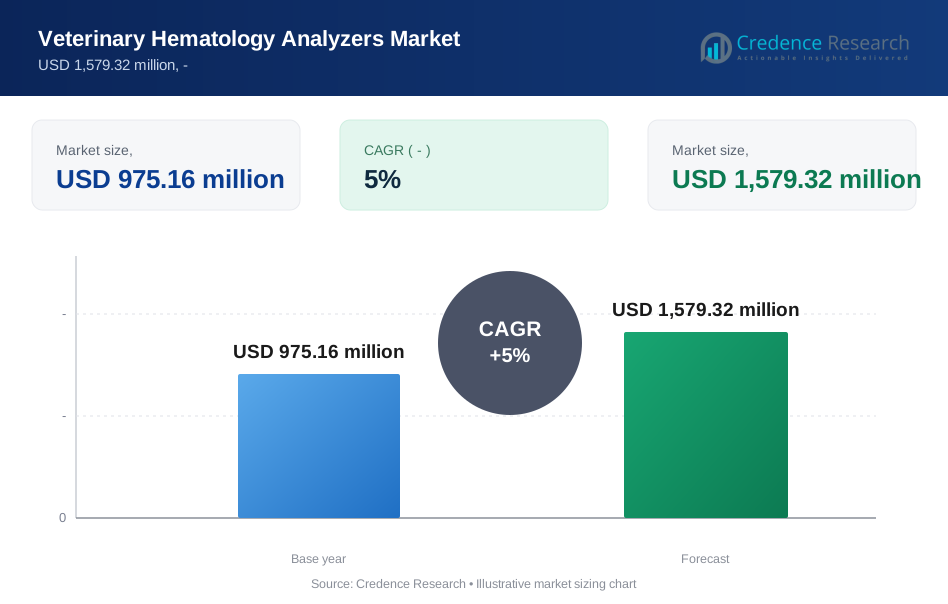
The Veterinary Hematology Analyzers Market has witnessed steady growth over the past decade, marked by technological advancements, increasing pet adoption rates, and rising awareness about animal healthcare. As of 2023, the market size for veterinary hematology analyzers stood at $975.16 million. This significant figure underscores the growing importance of diagnostic tools in veterinary medicine and reflects the expanding scope of hematology analysis in animal healthcare. The market has been fueled by the growing need for accurate and efficient diagnostic solutions to address a variety of hematological disorders and diseases in companion animals and livestock.
With a compound annual growth rate (CAGR) of 5%, the Veterinary Hematology Analyzers Market is poised for continued expansion in the coming years. Factors such as the rising prevalence of chronic diseases among animals, increasing investments in research and development activities, and the introduction of innovative hematology analyzers are expected to drive market growth. Moreover, the growing emphasis on preventive healthcare measures for pets and livestock, coupled with the implementation of stringent regulations regarding animal health and welfare, further augments the demand for advanced hematology analyzers in veterinary practices and diagnostic laboratories.
Looking ahead, the Veterinary Hematology Analyzers Market is projected to reach a size of $1579.32 million by 2032, reflecting a substantial increase in market value and indicating promising opportunities for stakeholders and industry players. The anticipated growth trajectory can be attributed to several factors, including the growing adoption of point-of-care testing solutions, the integration of artificial intelligence and machine learning technologies in hematology analyzers, and the rising demand for portable and user-friendly diagnostic devices in remote veterinary clinics and animal shelters.
The Veterinary Hematology Analyzers Market presents a dynamic landscape characterized by sustained growth, technological innovation, and evolving healthcare needs in the veterinary domain. As the market continues to expand, manufacturers and developers are expected to focus on enhancing product functionalities, improving diagnostic accuracy, and catering to the diverse requirements of veterinary professionals and pet owners. Moreover, collaborations, partnerships, and strategic initiatives aimed at addressing unmet medical needs and expanding market presence are likely to play a pivotal role in shaping the future trajectory of the veterinary hematology analyzers industry.
Segmentation Analysis
By Product
- Benchtop Analyzers: These analyzers are designed for use in centralized laboratories and offer high throughput and accuracy in hematological analysis.
- Portable Analyzers: Compact and lightweight, portable analyzers provide convenience and flexibility for on-the-go testing in remote or mobile veterinary settings.
- Fully Automated Analyzers: These systems offer comprehensive hematology testing capabilities with minimal manual intervention, enhancing efficiency and workflow automation in veterinary clinics and laboratories.
By Point of Care
- In-House Testing: Point-of-care analyzers enable rapid on-site testing, facilitating immediate diagnosis and treatment decisions in veterinary clinics and emergency care settings.
- Reference Laboratory Testing: Some veterinary practices opt for outsourcing hematology testing to specialized reference laboratories, which offer comprehensive diagnostic services and expertise.
By Application
- Anemia Screening: Hematology analyzers are widely used for screening and monitoring anemia, a common hematologic disorder in companion animals and livestock.
- Leukemia Detection: These analyzers play a crucial role in detecting and monitoring leukemia and other hematological malignancies in veterinary patients.
- Platelet Disorders: Hematology analysis helps identify platelet disorders and thrombocytopenia, enabling timely intervention and management of bleeding disorders in animals.
By End User
- Veterinary Hospitals and Clinics: These facilities are primary users of veterinary hematology analyzers, conducting routine blood tests and diagnostics for a wide range of animal patients.
- Research Institutes and Universities: Academic institutions and research organizations utilize hematology analyzers for veterinary research, teaching, and clinical studies.
By Region
- North America: The largest market for veterinary hematology analyzers, driven by a high prevalence of pet ownership, advanced healthcare infrastructure, and technological advancements.
- Europe: A significant market characterized by increasing pet adoption rates, stringent regulatory standards, and investments in veterinary healthcare.
- Asia Pacific: Emerging economies in the region witness growing demand for veterinary hematology analyzers, driven by rising disposable incomes, urbanization, and awareness about animal health and welfare.
Segments
By Product
- Benchtop Analyzers
- Portable Analyzers
- Fully Automated Analyzers
By Point of Care
- In-House Testing
- Reference Laboratory Testing
By Application
- Anemia Screening.
- Leukemia Detection
- Platelet Disorders
By End User
- Veterinary Hospitals and Clinics
- Research Institutes and Universities
By Region
- North America
- The U.S.
- Canada
- Mexico
- Europe
- Germany
- France
- The U.K.
- Italy
- Spain
- Rest of Europe
- Asia Pacific
- China
- Japan
- India
- South Korea
- South-east Asia
- Rest of Asia Pacific
- Latin America
- Brazil
- Argentina
- Rest of Latin America
- Middle East & Africa
- GCC Countries
- South Africa
- The Rest of the Middle East and Africa
Market Drivers
The Veterinary Hematology Analyzers Market is propelled by several key market drivers that are instrumental in shaping its growth trajectory. One significant driver is the increasing prevalence of hematological disorders and diseases among companion animals and livestock. As the incidence of conditions such as anemia, thrombocytopenia, and leukopenia continues to rise, there is a growing need for accurate and efficient diagnostic solutions in veterinary medicine. Hematology analyzers play a crucial role in diagnosing and monitoring these disorders, enabling veterinarians to provide timely and effective treatment interventions. Moreover, the aging pet population and the expanding pet ownership demographic further contribute to the demand for advanced hematology analyzers, as older animals are more susceptible to hematologic conditions necessitating regular monitoring and management.
Another key driver of the Veterinary Hematology Analyzers Market is the rapid technological advancements in diagnostic technologies and laboratory equipment. Manufacturers are continually innovating to develop hematology analyzers that offer enhanced functionalities, improved accuracy, and streamlined workflow automation. The integration of features such as artificial intelligence, machine learning algorithms, and cloud-based connectivity has revolutionized hematology analysis in veterinary practice, enabling faster turnaround times, comprehensive data analysis, and seamless integration with electronic health records. Furthermore, the development of portable and point-of-care hematology analyzers has expanded access to diagnostic testing in remote or underserved veterinary settings, facilitating prompt diagnosis and treatment even in resource-limited environments. These technological innovations not only improve diagnostic capabilities but also drive operational efficiency and enhance the overall quality of veterinary care, thereby fueling the adoption of hematology analyzers across veterinary practices, diagnostic laboratories, and research institutions.
Market Trends
Rise in Point-of-Care Testing
There is a growing trend towards point-of-care testing solutions in veterinary medicine, driven by the need for rapid diagnostics and immediate treatment decisions. Point-of-care hematology analyzers enable veterinarians to obtain quick and accurate results without the need for sample transportation to centralized laboratories.
Integration of Advanced Technologies
The market is witnessing increased integration of advanced technologies such as artificial intelligence (AI) and machine learning (ML) algorithms into hematology analyzers. These technologies enhance the accuracy of diagnostics, enable predictive analytics, and facilitate data-driven decision-making in veterinary practices.
Miniaturization and Portability
Manufacturers are focusing on developing compact and portable hematology analyzers that offer convenience and flexibility in veterinary settings. Portable analyzers allow for on-the-go testing in remote locations, emergency situations, and mobile veterinary clinics, enabling timely diagnosis and treatment.
Expansion of Veterinary Specialty Care
With the rising demand for specialized veterinary care, there is a growing need for hematology analyzers capable of performing comprehensive diagnostic tests for specific animal species, breeds, and conditions. Manufacturers are catering to this demand by offering specialized hematology analyzers tailored to the unique requirements of different veterinary specialties.
Emphasis on User-Friendly Design
There is a shift towards user-friendly design and intuitive interfaces in hematology analyzers, aimed at improving ease of use and enhancing operator experience. User-friendly features such as touchscreen displays, automated sample processing, and customizable settings contribute to efficient workflow management and reduced operator errors.
Remote Monitoring and Connectivity
Hematology analyzers with remote monitoring capabilities and cloud-based connectivity are gaining popularity in the market. These features enable real-time access to test results, remote troubleshooting, and seamless integration with electronic health records (EHR) systems, facilitating collaborative care and telemedicine initiatives in veterinary practice.
Demand for Multiparameter Analysis
There is an increasing demand for hematology analyzers capable of performing multiparameter analysis, including complete blood count (CBC), reticulocyte count, and differential leukocyte count. Multiparameter analyzers provide comprehensive diagnostic insights and enable veterinarians to assess the overall health status of animals more accurately.
Focus on Preventive Healthcare
Veterinary practices are placing greater emphasis on preventive healthcare measures, including routine blood screening and wellness testing. Hematology analyzers play a crucial role in early disease detection, monitoring of chronic conditions, and assessment of treatment efficacy, supporting proactive management of animal health and well-being.
Market Expansion in Emerging Economies
The Veterinary Hematology Analyzers Market is experiencing significant growth in emerging economies, driven by rising pet ownership rates, increasing disposable incomes, and expanding veterinary healthcare infrastructure. Manufacturers are exploring opportunities in these markets and adapting their product offerings to meet the evolving needs of veterinarians and pet owners.
Regulatory Compliance and Quality Assurance
With stringent regulatory standards governing veterinary diagnostics, manufacturers are prioritizing compliance with regulatory requirements and implementing robust quality assurance measures in product development and manufacturing processes. Ensuring product safety, accuracy, and reliability remains paramount in the Veterinary Hematology Analyzers Market to maintain consumer trust and regulatory compliance.
Market Restraints and Challenges
High Initial Investment Costs:
One of the primary challenges in the Veterinary Hematology Analyzers Market is the high initial investment costs associated with purchasing, installing, and maintaining hematology analyzers. The capital expenditure required for acquiring advanced analyzers with integrated technologies and features can pose a barrier to entry for small veterinary clinics and practices with limited financial resources.
Limited Accessibility in Rural Areas:
Accessibility to veterinary healthcare services and diagnostic facilities remains limited in rural and remote areas, posing a significant challenge for the adoption of hematology analyzers. Lack of infrastructure, inadequate veterinary expertise, and logistical constraints contribute to the underutilization of diagnostic technologies in these regions, hindering timely diagnosis and treatment of animal diseases.
Complexity of Interpretation and Training Requirements:
Despite advancements in hematology analyzer technology, the complexity of interpreting test results and the need for specialized training pose challenges for veterinary professionals. Interpreting hematological parameters and identifying abnormalities require expertise and proficiency in veterinary hematology, which may not be readily available in all veterinary practices and laboratories.
Quality Control and Standardization Issues:
Maintaining consistent quality control and standardization protocols across different hematology analyzer platforms is a significant challenge in the Veterinary Hematology Analyzers Market. Variability in sample processing techniques, calibration methods, and reagent formulations can impact the accuracy and reliability of test results, leading to inconsistencies in diagnostic outcomes and potential misdiagnosis of animal health conditions.
Regulatory Compliance and Certification Requirements:
Compliance with regulatory standards and certification requirements for veterinary hematology analyzers poses challenges for manufacturers and distributors. Adherence to stringent quality assurance standards, product labeling regulations, and validation processes is essential to ensure product safety, efficacy, and regulatory compliance, adding complexity and time constraints to the product development and commercialization process.
Competition from Alternative Diagnostic Technologies:
The Veterinary Hematology Analyzers Market faces competition from alternative diagnostic technologies, including point-of-care testing devices, molecular diagnostics, and imaging modalities. These alternative technologies offer rapid and specific diagnostic capabilities for certain veterinary applications, challenging the market share and growth potential of traditional hematology analyzers.
Risk of Inaccurate Diagnosis and Treatment:
Inaccurate diagnosis and treatment stemming from errors in sample handling, instrument calibration, or interpretation of test results pose risks to animal health and welfare. The potential for false-positive or false-negative results, as well as misinterpretation of hematological parameters, underscores the importance of rigorous quality control measures and ongoing training and education for veterinary professionals.
Key Players
- Abaxis, Inc.
- Beckman Coulter, Inc.
- HORIBA, Ltd.
- IDEXX Laboratories, Inc.
- Sysmex Corporation
- Boule Diagnostics AB
- Drew Scientific Inc.
- Scil Animal Care Company GmbH
- Heska Corporation
- Diatron Group
- Mindray Medical International Limited
Recent Developments
Beckman Coulter recently announced the launch of its next-generation veterinary hematology analyzer, featuring advanced automation capabilities and enhanced user-friendly interfaces. The new system aims to streamline veterinary diagnostic workflows, providing faster and more accurate results. Additionally, the company has expanded its connectivity options, allowing seamless integration with electronic health record systems for improved data management.
HORIBA unveiled a breakthrough in veterinary hematology analysis with the introduction of a compact point-of-care hematology analyzer. This portable device offers rapid on-site testing, providing veterinarians with immediate access to critical diagnostic information. The company's focus on miniaturization and portability aligns with the industry trend towards point-of-care solutions, facilitating quicker decision-making and treatment for animals in diverse veterinary settings.
IDEXX Laboratories has recently invested in research and development initiatives to enhance the capabilities of its veterinary hematology analyzers. The company introduced an updated version of its hematology analyzer, featuring improved sensitivity and specificity in detecting various blood parameters. IDEXX continues to prioritize innovation to address evolving veterinary diagnostic needs and ensure its products remain at the forefront of technology.
Sysmex has been actively involved in collaborative projects with leading veterinary research institutions to advance the field of veterinary hematology. The company has contributed to studies focused on expanding the diagnostic capabilities of hematology analyzers for specific animal species and conditions. Sysmex's commitment to research and development underscores its dedication to providing cutting-edge solutions for comprehensive veterinary diagnostics.
Diatron Group has recently introduced a modular veterinary hematology analyzer system designed to meet the evolving needs of veterinary practices. The modular system allows customization based on the specific requirements of different veterinary settings, providing flexibility and cost-effectiveness. Diatron's emphasis on modular solutions reflects its commitment to offering tailored options for diverse end-users in the veterinary hematology analyzers market.
Regional Analysis
- North America dominates the Veterinary Hematology Analyzers Market, accounting for the largest market share percentage among all regions. The region's leadership position can be attributed to several factors, including a high prevalence of pet ownership, advanced veterinary healthcare infrastructure, and robust investment in research and development activities. The United States, in particular, leads the market with a significant contribution from veterinary hospitals, clinics, and diagnostic laboratories. The presence of key market players and a favorable regulatory environment further bolster market growth in North America. The increasing adoption of advanced hematology analyzers, coupled with rising awareness about animal health and welfare, continues to drive market expansion in the region.
- Europe holds a substantial market share percentage in the Veterinary Hematology Analyzers Market, driven by factors such as increasing pet adoption rates, growing demand for preventive healthcare services, and stringent regulatory standards governing veterinary diagnostics. Countries like Germany, France, and the United Kingdom are key contributors to market growth, with well-established veterinary healthcare systems and a strong emphasis on quality assurance and standardization. The region's focus on research and development initiatives, coupled with collaborations between academic institutions and industry players, fosters innovation and technological advancements in veterinary hematology analyzers.
- Asia Pacific is witnessing rapid growth in the Veterinary Hematology Analyzers Market, fueled by rising disposable incomes, urbanization, and a burgeoning pet population across emerging economies. China, Japan, and India emerge as key markets in the region, driven by increasing awareness about pet healthcare, expanding veterinary infrastructure, and a growing trend towards companion animal adoption. Market players are capitalizing on opportunities in Asia Pacific by introducing affordable and technologically advanced hematology analyzers tailored to the unique needs of the region's veterinary practitioners. Moreover, strategic partnerships and collaborations with local distributors and healthcare providers are facilitating market penetration and expansion in Asia Pacific.
- Latin America represents a significant market share percentage in the Veterinary Hematology Analyzers Market, driven by a growing demand for advanced diagnostic solutions and increasing investments in veterinary healthcare infrastructure. Brazil, Mexico, and Argentina are key markets in the region, characterized by a rising prevalence of zoonotic diseases, expanding pet ownership rates, and government initiatives promoting animal health and welfare. Market players are focusing on product innovation and affordability to cater to the diverse needs of Latin American veterinarians and pet owners, driving market growth and adoption of hematology analyzers across the region.
- The Middle East and Africa region exhibit promising growth prospects in the Veterinary Hematology Analyzers Market, propelled by increasing urbanization, rising pet adoption rates, and improving access to veterinary healthcare services. Countries like South Africa, Saudi Arabia, and the United Arab Emirates are key markets, witnessing a surge in demand for diagnostic testing and specialized veterinary services. Market players are expanding their presence in the region through strategic collaborations, distribution partnerships, and product customization initiatives tailored to local market dynamics, contributing to the overall growth of the Veterinary Hematology Analyzers Market in the Middle East and Africa.
Future Outlook
- Continuous innovation in hematology analyzer technology is expected to drive market growth, with the integration of AI, machine learning, and cloud-based solutions enhancing diagnostic capabilities.
- Emerging economies, particularly in Asia-Pacific and Latin America, present lucrative opportunities for market expansion due to increasing pet ownership rates and growing awareness about veterinary healthcare.
- There will be a growing emphasis on point-of-care testing solutions, enabling rapid diagnostics and immediate treatment decisions in veterinary clinics and mobile settings.
- The market is likely to witness a shift towards personalized medicine approaches, with hematology analyzers offering tailored diagnostic solutions based on the unique needs of individual animal patients.
- Stricter regulatory standards and quality assurance requirements will drive manufacturers to ensure compliance and uphold product safety and efficacy in veterinary diagnostics.
- The increasing adoption of pet insurance plans is expected to fuel demand for advanced diagnostic tools, including hematology analyzers, as pet owners seek comprehensive healthcare coverage for their animals.
- Collaborations between industry players, veterinary associations, and research institutions will foster innovation, knowledge exchange, and the development of novel diagnostic technologies.
- Veterinary practices will increasingly prioritize preventive healthcare measures, driving the demand for hematology analyzers for early disease detection and wellness monitoring in animals.
- There will be a surge in demand for hematology analyzers with remote monitoring capabilities, allowing veterinarians to access real-time test results and provide telemedicine consultations for remote patient care.
- Hematology analyzers will be integrated with electronic health record systems, facilitating seamless data exchange, comprehensive patient profiles, and improved clinical decision support in veterinary practice.
Request a Free Sample
Fill in your details and we'll send you a free sample report.
- Sample data tables & charts
- Research methodology
Market Dynamics
Rising Prevalence of Animal Hematological Disorders
Increasing cases of anemia, thrombocytopenia, and other blood-related diseases in companion animals and livestock are driving the need for accurate and efficient hematology analyzers in veterinary practices.
Technological Advancements in Diagnostic Equipment
Continuous innovation, including the integration of artificial intelligence, machine learning, and cloud connectivity, is enhancing the accuracy, speed, and usability of veterinary hematology analyzers, making them more attractive to clinics and laboratories.
Growth in Pet Ownership and Preventive Healthcare
Expanding pet populations and a shift toward preventive veterinary care are increasing the demand for routine blood screening and wellness testing, fueling adoption of hematology analyzers.
Expansion of Point-of-Care and Portable Solutions
The development and adoption of portable and point-of-care hematology analyzers enable rapid diagnostics in remote, mobile, and emergency veterinary settings, broadening market reach and utility.
Stringent Regulatory Standards and Quality Assurance
Tighter regulations and a focus on quality assurance are prompting veterinary facilities to invest in advanced, compliant hematology analyzers to ensure reliable diagnostics and maintain high standards of animal care.
Need a Custom Version of This Report?
Tailor the scope, geography, or segments to your exact requirements.
- Custom geography or segment scope
- Direct access to our analyst team
Frequently Asked Questions
What is the current market size of the Veterinary Hematology Analyzers Market? How is the market projected to evolve by 2032?
What factors are driving the growth of the Veterinary Hematology Analyzers Market?
What is the compound annual growth rate (CAGR) of the Veterinary Hematology Analyzers Market?
What are the key trends shaping the Veterinary Hematology Analyzers Market?
What are the major challenges faced by the Veterinary Hematology Analyzers Market?
What recent developments have occurred among key players in the market?
Table of Content
Chapter 1 Market Segmentation
- 1.1 Segmentation Framework
- 1.1.1 Product and Service Classification
- 1.1.2 Application and End-Use Classification
- 1.1.3 Technology and Solution Classification
- 1.1.4 Customer and Distribution Channel Classification
- 1.1.5 Geographic Segmentation
- 1.1.6 Market Segment Definitions and Boundaries
- 1.2 By Product
- 1.2.1 Benchtop Analyzers
- 1.2.2 Portable Analyzers
- 1.2.3 Fully Automated Analyzers
- 1.3 By End User
- 1.3.1 Veterinary Hospitals and Clinics
- 1.3.2 Research Institutes and Universities
- 1.4 By Application
- 1.4.1 Anemia Screening
- 1.4.2 Leukemia Detection
- 1.4.3 Platelet Disorders
- 1.5 By Point of Care
- 1.5.1 In-House Testing
- 1.5.2 Reference Laboratory Testing
Chapter 2 Introduction
- 2.1 Report Objectives and Scope
- 2.2 Product Definition and Industry Terminology
- 2.3 Market Inclusions and Exclusions
- 2.4 Research Process
- 2.4.1 Primary Research and Expert Interviews
- 2.4.2 Secondary Research and Source Review
- 2.4.3 Top-Down and Bottom-Up Estimation
- 2.4.4 Data Triangulation and Verification
- 2.5 Market Size Measurement Basis
- 2.5.1 2023: USD 975.16 million → 2032: USD 1,579.32 million
- 2.6 Historical and Forecast Reference Periods
- 2.6.1 Base Year: 2023
- 2.6.2 Forecast Period: 2023-2032
- 2.7 Research Assumptions and Limitations
Chapter 3 Executive Summary
- 3.1 Market Snapshot and Key Findings
- 3.2 Base-Year Market Size, 2023
- 3.3 Forecast Market Size, 2032
- 3.4 Revenue and Volume Growth Outlook
- 3.5 Key Demand and Supply Indicators
- 3.6 Leading Market Segments
- 3.7 Fastest-Growing Market Opportunities
- 3.8 Regional Performance Highlights
- 3.9 Technology and Industry Transformation
- 3.10 Competitive Landscape Summary
- 3.11 Analyst View and Strategic Implications
Chapter 4 Global Veterinary Hematology Analyzers Market Trends and Developments
- 4.1 Historical Industry Development
- 4.2 Recent Market Trends and Developments
- 4.3 Demand and Customer Behavior Trends
- 4.4 Technology and Product Innovation
- 4.5 Artificial Intelligence, Automation and Digitalization
- 4.6 Local Manufacturing and Supply Chain Realignment
- 4.7 Industry Partnerships, Mergers and Acquisitions
- 4.8 Sustainability and Circular Economy Developments
- 4.9 Government and Private Sector Investment Trends
- 4.10 Emerging Business Models and Commercialization
- 4.11 Industry Developments and Announcements
Chapter 5 Global Veterinary Hematology Analyzers Market Production, Supply and Demand Analysis
- 5.1 Demand Trend and Consumption Analysis
- 5.2 Demand Forecast, 2023-2032
- 5.3 Production and Output Trend
- 5.4 Production and Output Forecast, 2023-2032
- 5.5 Installed Capacity and Capacity Utilization
- 5.6 Company-Wise Production Plants and Statistics
- 5.6.1 Installed Production Capacity
- 5.6.2 Actual Production
- 5.6.3 Planned Capacity and Expansion Targets
- 5.7 Supply Chain Structure and Procurement Trends
- 5.8 Supply-Demand Gap and Bottlenecks
- 5.9 Import Dependence and Sourcing Structure
- 5.10 Contract Manufacturing and Outsourcing
- 5.11 Regional Supply and Demand Concentration
Chapter 6 Global Veterinary Hematology Analyzers Market Pricing Analysis
- 6.1 Pricing Structure and Measurement
- 6.2 Historical Pricing Trends
- 6.3 Pricing Outlook, 2023-2032
- 6.4 Average Selling Price and Unit Economics
- 6.5 Pricing by Product and Market Segment
- 6.6 Geographic Pricing Differences
- 6.7 Key Input, Energy, Labor and Logistics Costs
- 6.8 Contract Pricing and Purchasing Models
- 6.9 Pricing Sensitivity and Competitive Positioning
- 6.10 Price, Margin and Profitability Implications
Chapter 7 Global Veterinary Hematology Analyzers Market Dynamics
- 7.1 Market Growth Drivers
- 7.1.1 Demand-Side Drivers
- 7.1.2 Technology and Innovation Drivers
- 7.1.3 Infrastructure and Investment Drivers
- 7.1.4 Regulatory and Policy Drivers
- 7.2 Market Restraints
- 7.2.1 Cost and Affordability Constraints
- 7.2.2 Technology and Adoption Barriers
- 7.2.3 Supply Chain and Operational Constraints
- 7.3 Market Challenges
- 7.3.1 Competitive Pressure and Margin Erosion
- 7.3.2 Skills, Infrastructure and Implementation Gaps
- 7.4 Emerging Market Opportunities
- 7.5 Market Dynamics Impact and Time-Horizon Assessment
Chapter 8 Global Veterinary Hematology Analyzers Value Chain Analysis
- 8.1 Industry Value Chain Overview
- 8.2 Upstream Suppliers and Critical Inputs
- 8.3 Technology and Component Providers
- 8.4 Manufacturing or Service Delivery
- 8.5 Distribution, Channel Partners and Integrators
- 8.6 Downstream Applications and End Users
- 8.7 Value Addition and Profit Pools
- 8.8 Vertical Integration and Outsourcing
- 8.9 Supplier Concentration and Risk
- 8.10 Supply Chain Localization and Resilience
Chapter 9 Global Veterinary Hematology Analyzers Market Regulations and Policies
- 9.1 Relevant Laws, Standards and Compliance Frameworks
- 9.2 Product, Service, Safety and Quality Requirements
- 9.3 Government Policies, Incentives and Subsidies
- 9.4 Imports, Exports and Trade Barriers
- 9.5 Public Procurement and Local Content Requirements
- 9.6 Environmental and Sustainability Compliance
- 9.7 Upcoming Policy Changes and Market Implications
Chapter 10 Global Veterinary Hematology Analyzers Market Hotspots and Opportunities
- 10.1 Market Opportunity Mapping and Growth Hotspots
- 10.2 High-Growth Applications and Customer Groups
- 10.3 Underserved Markets and White-Space Opportunities
- 10.4 Emerging Technology and Product Opportunities
- 10.5 New Capacity and Investment Hotspots
- 10.6 Market Entry and Expansion Opportunities
- 10.7 Distribution and Partnership Opportunities
- 10.8 Near-Term and Long-Term Commercial Potential
- 10.9 Opportunity Attractiveness and Execution Risks
Chapter 11 Global Veterinary Hematology Analyzers Market Outlook, 2023-2032
- 11.1 Market Size and Analysis
- 11.1.1 Revenue (Market Measurement: 2023: USD 975.16 million → 2032: USD 1,579.32 million)
- 11.1.2 Market Volume and Quantity Sold
- 11.1.3 Historical Market Size
- 11.1.4 Base-Year Market Size, 2023
- 11.2 Market Forecast, 2023-2032
- 11.2.1 Revenue Forecast to 2032
- 11.2.2 Volume Forecast to 2032
- 11.2.3 CAGR and Year-on-Year Growth
- 11.2.4 Incremental Revenue Opportunity
- 11.3 Forecast Assumptions and Scenario Analysis
- 11.3.1 Base-Case Forecast
- 11.3.2 Optimistic and Conservative Scenarios
- 11.3.3 Technology, Pricing and Policy Sensitivities
- 11.4 Market Attractiveness and Growth Outlook
Chapter 12 Global Veterinary Hematology Analyzers Market Segmentation and Outlook
- 12.1 Segmentation Summary and Market Shares, 2023
- 12.2 Largest and Fastest-Growing Segments
- 12.3 By Product - Market Size and Forecast, 2023-2032
- 12.3.1 Segment Definition and Scope
- 12.3.2 Historical Market Size
- 12.3.3 Revenue Forecast, 2023-2032
- 12.3.4 Volume Forecast, 2023-2032
- 12.3.5 Base-Year Market Share, 2023
- 12.3.6 Segment CAGR and Growth Drivers
- 12.3.7 Subsegment Market Size and Forecast
- 12.3.7.1 Benchtop Analyzers
- 12.3.7.2 Portable Analyzers
- 12.3.7.3 Fully Automated Analyzers
- 12.3.8 Subsegment Pricing and Adoption Trends
- 12.3.9 Leading Suppliers and Competition
- 12.3.10 Regional Demand and Opportunities
- 12.4 By End User - Market Size and Forecast, 2023-2032
- 12.4.1 Segment Definition and Scope
- 12.4.2 Historical Market Size
- 12.4.3 Revenue Forecast, 2023-2032
- 12.4.4 Volume Forecast, 2023-2032
- 12.4.5 Base-Year Market Share, 2023
- 12.4.6 Segment CAGR and Growth Drivers
- 12.4.7 Subsegment Market Size and Forecast
- 12.4.7.1 Veterinary Hospitals and Clinics
- 12.4.7.2 Research Institutes and Universities
- 12.4.8 Subsegment Pricing and Adoption Trends
- 12.4.9 Leading Suppliers and Competition
- 12.4.10 Regional Demand and Opportunities
- 12.5 By Application - Market Size and Forecast, 2023-2032
- 12.5.1 Segment Definition and Scope
- 12.5.2 Historical Market Size
- 12.5.3 Revenue Forecast, 2023-2032
- 12.5.4 Volume Forecast, 2023-2032
- 12.5.5 Base-Year Market Share, 2023
- 12.5.6 Segment CAGR and Growth Drivers
- 12.5.7 Subsegment Market Size and Forecast
- 12.5.7.1 Anemia Screening
- 12.5.7.2 Leukemia Detection
- 12.5.7.3 Platelet Disorders
- 12.5.8 Subsegment Pricing and Adoption Trends
- 12.5.9 Leading Suppliers and Competition
- 12.5.10 Regional Demand and Opportunities
- 12.6 By Point of Care - Market Size and Forecast, 2023-2032
- 12.6.1 Segment Definition and Scope
- 12.6.2 Historical Market Size
- 12.6.3 Revenue Forecast, 2023-2032
- 12.6.4 Volume Forecast, 2023-2032
- 12.6.5 Base-Year Market Share, 2023
- 12.6.6 Segment CAGR and Growth Drivers
- 12.6.7 Subsegment Market Size and Forecast
- 12.6.7.1 In-House Testing
- 12.6.7.2 Reference Laboratory Testing
- 12.6.8 Subsegment Pricing and Adoption Trends
- 12.6.9 Leading Suppliers and Competition
- 12.6.10 Regional Demand and Opportunities
- 12.7 Segment Growth Comparison
- 12.8 Segment Attractiveness and Priority Matrix
Chapter 13 Global Veterinary Hematology Analyzers End-Use and Application Market Outlook
- 13.1 End-Use Industry and Customer Demand Structure
- 13.2 Leading Applications and Customer Groups
- 13.3 End-Use Market Size, Share and Forecast
- 13.4 Major End-Use Industry Deep Dives
- 13.4.1 Customer Requirements and Use Cases
- 13.4.2 Demand and Replacement Cycles
- 13.4.3 Technical and Regulatory Considerations
- 13.4.4 Purchasing and Procurement Models
- 13.4.5 Leading Vendors and Distribution Channels
- 13.4.6 Forecast and Commercial Opportunities
- 13.5 Emerging Applications and Cross-Segment Demand
- 13.6 End-Use Industry Investment Priorities
Chapter 14 Global Veterinary Hematology Analyzers Geographic Market Outlook, 2023-2032
- 14.1 Regional Market Size and Share, 2023
- 14.2 Regional Market Forecast, 2023-2032
- 14.3 Regional Pricing, Production and Demand Differences
- 14.4 North America
- 14.4.1 United States
- 14.4.2 Canada
- 14.4.3 Mexico
- 14.5 Europe
- 14.5.1 Germany
- 14.5.2 France
- 14.5.3 Italy
- 14.5.4 United Kingdom
- 14.5.5 Spain
- 14.5.6 Poland
- 14.5.7 Russia
- 14.5.8 Netherlands
- 14.5.9 Belgium
- 14.5.10 Sweden
- 14.5.11 Denmark
- 14.5.12 Norway
- 14.5.13 Rest of Europe
- 14.6 Asia Pacific
- 14.6.1 China
- 14.6.2 India
- 14.6.3 Japan
- 14.6.4 South Korea
- 14.6.5 Thailand
- 14.6.6 Indonesia
- 14.6.7 Vietnam
- 14.6.8 Malaysia
- 14.6.9 Australia
- 14.6.10 Rest of Asia Pacific
- 14.7 Latin America
- 14.7.1 Brazil
- 14.7.2 Argentina
- 14.7.3 Colombia
- 14.7.4 Chile
- 14.7.5 Rest of Latin America
- 14.8 Middle East
- 14.8.1 Saudi Arabia
- 14.8.2 United Arab Emirates
- 14.8.3 Turkey
- 14.8.4 Israel
- 14.8.5 Iran
- 14.8.6 Rest of the Middle East
- 14.9 Africa
- 14.9.1 South Africa
- 14.9.2 Egypt
- 14.9.3 Nigeria
- 14.9.4 Morocco
- 14.9.5 Rest of Africa
- 14.10 Regional Investment, Policy and Supply Chain Differences
- 14.11 Regional Competitive Landscape
- 14.12 Geographic Growth Hotspots
Chapter 15 Global Veterinary Hematology Analyzers Technology, Innovation and Sustainability Outlook
- 15.1 Technology Landscape and Maturity
- 15.2 Product, Process and Service Innovation
- 15.3 AI, Automation and Digital Tools in the Industry
- 15.4 Technology Adoption and Performance Benchmarking
- 15.5 Innovation Pipeline and R&D Investment
- 15.6 Patent and Intellectual Property Trends
- 15.7 Energy Efficiency and Resource Management
- 15.8 Sustainability, Recycling and Circularity
- 15.9 Technology Roadmap, 2023-2032
- 15.10 Risks of Obsolescence and Technology Substitution
Chapter 16 Global Veterinary Hematology Analyzers Market Key Strategic Imperatives
- 16.1 Growth and Market Entry Priorities
- 16.2 High-Return Products and Segments
- 16.3 Pricing, Profitability and Cost Optimization
- 16.4 Technology Investment and Product Differentiation
- 16.5 Supply Chain Localization and Resilience
- 16.6 Distribution and Customer Acquisition
- 16.7 Partnership, Acquisition and Capacity Strategy
- 16.8 Regional Expansion Priorities
- 16.9 Short-, Medium- and Long-Term Actions
Chapter 17 Competition Outlook
- 17.1 Industry Competition Characteristics
- 17.2 Market Structure and Concentration
- 17.3 Market Share and Competitive Positioning, 2023
- 17.4 Company-Wise Revenue and Product Benchmarking
- 17.5 Production and Service Capacity Benchmarking
- 17.6 Technology, Pricing and Differentiation
- 17.7 Regional Footprint and Distribution Strength
- 17.8 Mergers, Acquisitions and Strategic Alliances
- 17.9 New Entrants and Competitive Threats
- 17.10 Porter's Five Forces and Industry Attractiveness
- 17.11 Competitive Outlook, 2023-2032
Chapter 18 Company Profiles
- 18.1 Company Coverage and Selection Criteria
- 18.2 Abaxis, Inc.
- 18.2.1 Business Description
- 18.2.2 Company Ownership and Geographic Presence
- 18.2.3 Product and Service Portfolio
- 18.2.4 Manufacturing and Operating Footprint
- 18.2.5 Production Capacity and Expansion Plans
- 18.2.6 Financial Performance and Investment
- 18.2.7 Market Share and Competitive Position
- 18.2.8 Technology and Innovation Capabilities
- 18.2.9 Strategic Alliances or Partnerships
- 18.2.10 Recent Developments
- 18.2.11 Growth Strategy and Outlook
- 18.3 Beckman Coulter, Inc.
- 18.4 HORIBA, Ltd.
- 18.5 IDEXX Laboratories, Inc.
- 18.6 Sysmex Corporation
- 18.7 Boule Diagnostics AB
- 18.8 Drew Scientific Inc.
- 18.9 Scil Animal Care Company GmbH
- 18.10 Heska Corporation
- 18.11 Diatron Group
- 18.12 Other Relevant Market Participants
Note: Every listed company is profiled on the structure shown under the first company. The company list is preliminary and may change based on research findings, market developments, data availability and client requirements.
Chapter 19 Disclaimer
- 19.1 Research and Forecast Disclaimer
- 19.2 Data Source and Estimation Limitations
Note: The depth of individual sections depends on data availability for this market. Volume, capacity, trade and other unit-based metrics are included where applicable.