
Key Highlights of the Report
How are the major segments performing in Video Conferencing in the Healthcare market?
- In 2022, the hardware segment held the largest share of the market. The segment is experiencing growth due to the proliferation of mobile devices, desktop computers, and laptops with cameras, microphones, and speakers.
- In 2022, the telepresence system segment accounted for the largest share of the market. The system uses cutting-edge technology to transmit the conference's high-definition audio and video feed.
- In 2022, the on-premises segment was anticipated to hold a prominent share in the global video conferencing in the healthcare market. Due to growing concerns regarding data theft and efficient maintenance of information security systems, many organizations are increasing their on-premise deployments.
- In 2022, the large enterprises segment accounted for the largest share of the market. The market is expected to be driven by the increasing usage of solutions that facilitate collaboration among remote employees.
- In 2022, the small room segment was anticipated to hold a prominent share in the global video conferencing in the healthcare market. Increasingly, video communication solutions are used to communicate in small spaces because of their ease of use and low cost.
- In 2022, the IT & telecom segment accounted for the largest share of the market. Investing heavily in advanced technologies will boost the IT and telecom market share.
What is the Market Size of Video Conferencing in Healthcare regarding value?
The global video conferencing in the healthcare market is anticipated to grow at a substantial CAGR of 5.20% in the upcoming years. Global video conferencing in the healthcare industry was estimated to be worth USD 85.3 million in 2022 and was expected to be worth USD 121.6 million by 2030.
Which region dominated the Video Conferencing Healthcare market?
In 2022, the North American region was anticipated to hold a prominent share of global video conferencing in the healthcare market. Demand for these conferencing solutions in the U.S. and Canada is increasing due to the early adoption of emerging technologies and major companies such as Microsoft Corporation, Zoom Video Communications, Inc., Cisco Systems, Inc., and others. This will boost the North American market growth in the near future.
Which are the key countries in the Video Conferencing in the Healthcare market?
It has been estimated that 66% of business decision-makers in the U.S. will alter their physical workspaces to meet hybrid workplace requirements, according to Microsoft's Work Trend Index 2021. As a result of these factors, video conferencing adoption in the U.S. is expected to increase. In addition, several private companies are investing in video conferencing platforms to improve team collaboration and enhance customer satisfaction, thereby driving market growth. In October 2021, the video infrastructure platform 100ms raised USD 4.50 billion in seed funding led by Accel with Strive. vc participation. 100ms allows companies to integrate Zoom-style video conferencing into their applications within hours. It was founded by the team that built live video infrastructure for Facebook and Disney, which powered billions of video minutes daily.
The market in India is expected to grow at a significant rate over the forecast period due to the introduction of WiMAX and High-Speed Downlink Packed Access (HSDPA) networks, among other mobile broadband technologies. Additionally, the market is expected to grow due to increasing awareness of the benefits of video conferencing solutions in the healthcare sector.
How is the economy impacting the global Video Conferencing in Healthcare growth?
There has been a decline in growth for several industries due to the outbreak of COVID-19. The World Health Organization has declared it a global health emergency. To mitigate the suffering brought on by the pandemic, various nations have instituted strict lockdown guidelines. Governments have taken several strict measures to contain the spread of this highly contagious virus, such as a lockdown, a ban on travel, and maintaining social distancing. Due to the travel ban, the global supply chain has been disrupted. Several companies focused on digitalizing their operations during the pandemic.
What is the competitive environment of Video Conferencing in the Healthcare market?
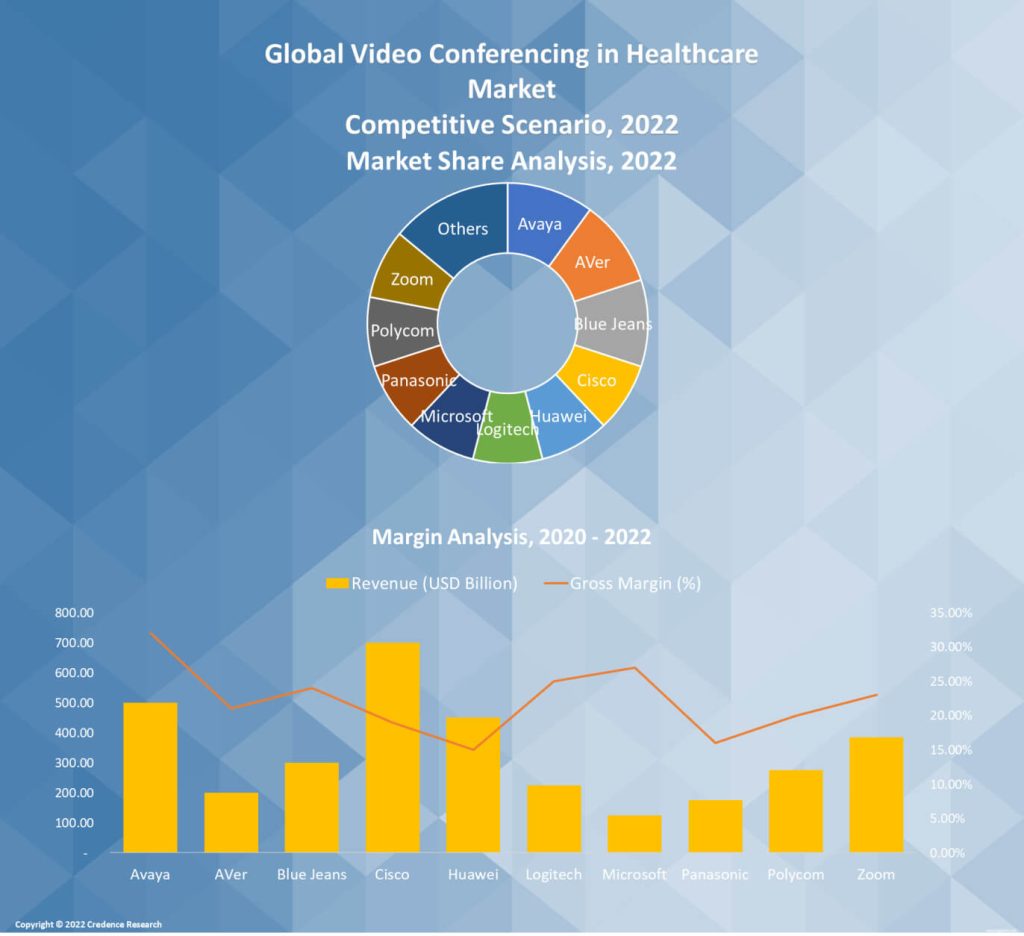
The competitive environment of the video conferencing in healthcare market provides data on the total economic profit made by suppliers and businesses, sales and revenues generated in this industry, global market share of video conferencing in healthcare, business organisation summary, launch of new products, and opportunities for the industrial video conferencing in healthcare market. For instance, in February 2023, with its new video conferencing solution, Qualcomm Technologies is offering a more immersive communication experience. It eliminates distractions and enhances user participation by using artificial intelligence. In January 2023, a new offering from Cordoniq, a provider of smart video collaboration platforms, allows enterprises to access secured video conferencing services beyond standard offerings.
Executive Summary
What are the key trends in the Video Conferencing Healthcare market?
- Institutions, schools, universities, and K-12 have adopted conferencing solutions to use distance learning as a substitute for traditional classrooms. During the pandemic, educational institutions collaborate with video communication services to expand remote learning. In order to provide students with an efficient learning experience, educational institutions implement software. For instance, In January 2023, the European School of Osteopathy in England announced that it would provide international and local video conferencing to students via YuJa Enterprise Video Platform. In addition, software programs like Adobe, Microsoft Office, and others allow users to access online classes via their smart devices. Additionally, administrators can share displays, papers, and files with their students while they teach. As a result of such initiatives, the video conferencing market is expected to grow worldwide.
How are Food Manufacturers Teaming Up with Stakeholders in Video Conferencing in Healthcare Market?
Organizations and corporations are embracing video collaboration solutions to make faster decisions and avoid travel costs. In addition, increased demand for remote learning is expected to drive market growth. RingCentral, Inc. launched a new education product portfolio to support hybrid learning for educational institutes in January 2022. A visual conferencing solution series from Plantronics, Inc. is included in the study, including G80-T, Poly G40-T, and G10-T, which are designed for Microsoft Teams rooms. Also, Facebook, Inc. launched Messenger Rooms, which allows users to hold video conferences with up to 50 people. Logitech also launched the Logitech StreamCam for content creators and broadcasters. Market growth is anticipated from such initiatives.
Which are the key investments in Video Conferencing in Healthcare market players?
Leading players operating in video conferencing in the healthcare market are focusing on expansion in production capacities for video conferencing in healthcare. Aside from that, businesses are focusing on strategic mergers & acquisitions, partnerships, and raising vendor awareness through various organisations founded to encourage wise practises in order to service more end users in the domestic market and acquire a competitive edge. For instance, in March 2023, a collaboration between Zerify Inc. and SpeakSpace LLC will boost the company's sales and raise its brand recognition. The company offers cybersecurity solutions for video conferencing that help businesses communicate securely.
Some major players in the video conferencing in the healthcare market are Avaya, Inc. (U.S.), AVer Information, Inc. (Taiwan), Blue Jeans Network, Inc. (U.S.), Cisco Systems, Inc. (U.S.), Huawei Technologies Co. Ltd. (China), Logitech International S.A. (Switzerland), Microsoft Corporation (U.S.), Panasonic Corporation (Japan), Polycom, Inc. (Plantronics, Inc.) (U.S.), and Zoom Video Communications, Inc. (U.S.)
What are the Major Driving Factors for the Video Conferencing Healthcare Market?
Growth in the market is expected to be fueled by the increased adoption of telemedicine solutions and technological advancements, such as 5G technology. Furthermore, robust urbanization is predicted to fuel growth in the market. Global video conferencing in the healthcare market is trending due to the increasing application of video conferencing in healthcare. Furthermore, healthcare IT systems will be increasingly used in the healthcare sector, contributing to the growth of global video conferencing in the healthcare market.
What are the Major Risks of the Video Conferencing in Healthcare Market?
Patients and doctors must be equipped with video conferencing skills, as technical glitches frequently occur during video conferences. Video conferencing calls may also present problems such as integration problems, network issues, user issues, audio and video issues, and system and functionality problems. Sometimes, video conference users cannot detect and resolve these problems during video conference sessions.
Which is the key application in the Video Conferencing Healthcare market?
The small rooms segment is expected to hold a prominent share of the global video conferencing in the healthcare market during the forecast period. Video communication solutions for small rooms are becoming increasingly popular because they are affordable and easy to use. They enable users to create online conferences using their connected devices, including their computers, laptops, or cellphones, without the need for any additional peripherals.
How is Video Conferencing in the Healthcare market performing in regions?
Asia Pacific market is anticipated to witness a significant growth in the global video conferencing in the healthcare market during the forecast period. The Asia Pacific region is anticipated to grow rapidly during the forecast period due to advancements in mobile broadband technologies, such as High-Speed Downlink Packet Access (HSDPA) networks and WiMAX. Furthermore, video conferencing solutions are expected to expand in the healthcare sector as consumers become aware of their advantages.
What is the regulatory landscape for Video Conferencing in the Healthcare market?
As telemedicine has become more popular, PHI security has become increasingly important when scheduling virtual appointments and completing paperwork. Video conferencing facilitates the transmission of protected health information (PHI) & electronic protected health information (ePHI) by remote providers. A video conferencing app that is HIPAA-compliant takes a proactive approach to data protection to ensure confidentiality, integrity, and data availability.
What are the major players planning for the future of Video Conferencing in the Healthcare market?
Growing regional presence and investment in downstream applications are expected to provide the company a competitive advantage in the industry. For instance, the business announced the acquisition of Karlsruhe Information Technology Solutions - Kites GmbH, a machine translation business that creates real-time translation software, in June 2021. Zoom's expansion plans for opening a research and development center in Germany are expected to be strengthened due to this acquisition.
| REPORT ATTRIBUTE | DETAILS |
|---|---|
| Video Conferencing in Healthcare Market by Value | Yes |
| Video Conferencing in Healthcare Market, Tornado Analysis | Yes |
| Video Conferencing in Healthcare Market, STAR Analysis | Yes |
| Video Conferencing in Healthcare Market, SRC Analysis | Yes |
| Video Conferencing in Healthcare Market Pricing Analysis | Yes (On Demand) |
| Video Conferencing in Healthcare Market Segment Analysis | By Component (Hardware and Software) By Conference Type (Telepresence System, Integrated System, Desktop System, Service-based System, and Others) By Deployment (Cloud and On-premises) By Enterprise Type (Small and Medium Enterprises and Large Enterprises) By Application (Small Room, Huddle Rooms, Middle Rooms, and Large Rooms) |
| Video Conferencing in Healthcare Market, Regional Analysis | North America (US, Canada, Mexico) Europe (Germany, UK, France, Italy, Spain, and Rest of Europe) Asia Pacific (China, India, Japan, South Korea, South East Asia, and Rest of Asia Pacific) Latin America (Brazil, Argentina, and Rest of Latin America) Middle East and Africa (GCC Countries, South Africa, and Rest of the Middle East and Africa) |
| Video Conferencing in Healthcare Market Key Companies | Avaya, Inc. (U.S.), AVer Information, Inc. (Taiwan), Blue Jeans Network, Inc. (U.S.), Cisco Systems, Inc. (U.S.), Huawei Technologies Co. Ltd. (China), Logitech International S.A. (Switzerland), Microsoft Corporation (U.S.), Panasonic Corporation (Japan), Polycom, Inc. (Plantronics, Inc.) (U.S.), and Zoom Video Communications, Inc. (U.S.) |
| Video Conferencing in Healthcare Market Competitive Landscape | Market Share Analysis Competitive Benchmarking Key Players Market Positioning Geographical Presence Analysis Major Strategies Adopted |
Segmentation of Global Video Conferencing in Healthcare Market-
Global Video Conferencing in Healthcare Market – By Component
- Hardware
- Software
Global Video Conferencing in Healthcare Market – By Conference Type
- Telepresence System
- Integrated System
- Desktop System
- Service-based System
- Others (Multiway Technology, etc.)
Global Video Conferencing in Healthcare Market – By Deployment
- Cloud
- On-premises
Global Video Conferencing in Healthcare Market – By Enterprise Type
- Small and Medium Enterprises
- Large Enterprises
Global Video Conferencing in Healthcare Market – By Application
- Small Room
- Huddle Rooms
- Middle Rooms
- Large Rooms
Global Video Conferencing in Healthcare Market – By Region
- North America
- U.S.
- Canada
- Mexico
- Europe
- Germany
- France
- U.K.
- Italy
- Spain
- Rest of Europe
- Asia Pacific
- China
- Japan
- India
- South Korea
- South-east Asia
- Rest of Asia Pacific
- Latin America
- Brazil
- Argentina
- Rest of Latin America
- Middle East & Africa
- GCC Countries
- South Africa
- Rest of the Middle East and Africa
Request a Free Sample
Fill in your details and we'll send you a free sample report.
- Sample data tables & charts
- Research methodology
Need a Custom Version of This Report?
Tailor the scope, geography, or segments to your exact requirements.
- Custom geography or segment scope
- Direct access to our analyst team
Frequently Asked Questions
How does COVID-19 Impact global video conferencing in the healthcare market?
What are the key drivers for the growth of Video Conferencing in the Healthcare market?
Which is the major video conferencing in the healthcare market segment by component?
What is the base year considered for Video Conferencing in Healthcare Market?
Which is the major segment in video conferencing in the healthcare market by application?
Table of Content
Chapter 1. Report Introduction
- 1.1 Report Description & Purpose
- 1.1.1 Report Title & Market Definition
- 1.1.2 Unique Selling Propositions (USP) & Key Differentiators
- 1.1.3 Value Proposition for Stakeholders
- 1.2 Research Objectives
- 1.2.1 Market Sizing Objectives (Volume & Revenue) (Volume Where Applicable)
- 1.2.2 Segmentation Objectives
- 1.2.3 Competitive Intelligence Objectives
- 1.2.4 Forecast & Scenario Objectives
- 1.3 Report Scope
- 1.3.1 Video Conferencing in Healthcare Scope – Segments & Subsegments Covered
- 1.3.2 Geographic Scope – Regions & Countries Covered
- 1.3.3 Historical Period, Base Year & Forecast Period (the historical period; forecast to the forecast period)
- 1.3.4 Inclusions & Exclusions
- 1.4 Industry Classification & Applicable Codes
- 1.5 Currency, Measurement Units & Valuation Basis
- 1.6 Target Stakeholders
- 1.7 Limitations & Assumptions
Chapter 2. Executive Summary
- 2.1 Global Video Conferencing in Healthcare Market Snapshot
- 2.1.1 Market Size – Historical (the historical period) & Forecast (the forecast period) (base year: NULL → forecast year: NULL)
- 2.1.2 Volume & Revenue – Global Totals (Volume Where Applicable)
- 2.1.3 Key Market Highlights – Top Five Facts
- 2.2 Video Conferencing in Healthcare Market Segmentation Snapshot
- 2.2.1 Market Split by Region – vs.
- 2.3 Competitive Snapshot
- 2.3.1 Top 10 Players by Revenue Share –
- 2.3.2 Top 10 Players by Volume Share – (Volume Where Applicable)
- 2.3.3 Recent Strategic Developments (18-Month Summary)
- 2.4 Key Investment Highlights & Strategic Conclusions
Chapter 3. Video Conferencing in Healthcare Market Dynamics & Industry Analysis
- 3.1 Market Overview & Context
- 3.1.1 Video Conferencing in Healthcare Market Position in the Broader Industry Value Chain
- 3.1.2 Demand Structure & Purchasing Dynamics
- 3.1.3 Market Maturity & Development Stage by Region
- 3.2 Video Conferencing in Healthcare Market Drivers
- 3.3 Video Conferencing in Healthcare Market Restraints & Challenges
- 3.4 Video Conferencing in Healthcare Market Opportunities
- 3.5 Porter's Five Forces Analysis
- 3.5.1 Threat of New Entrants
- 3.5.2 Bargaining Power of Suppliers
- 3.5.3 Bargaining Power of Buyers
- 3.5.4 Threat of Substitutes
- 3.5.5 Competitive Rivalry – Intensity Assessment
- 3.6 Video Conferencing in Healthcare Value Chain Analysis
- 3.6.1 Upstream – Key Inputs, Resources & Suppliers
- 3.6.1.1 Key Input/Resource 1
- 3.6.1.2 Key Input/Resource 2
- 3.6.1.3 Key Input/Resource 3
- 3.6.2 Midstream – Core Operations & Value Creation
- 3.6.2.1 Operating Model & Process Overview
- 3.6.2.2 Key Operating Locations & Capabilities by Company
- 3.6.3 Downstream – Market Channels & End Users
- 3.6.3.1 Direct Sales & Customer Engagement Channels
- 3.6.3.2 Indirect Sales, Intermediaries & Partner Channels
- 3.6.4 Value Chain Profitability Analysis
- 3.6.1 Upstream – Key Inputs, Resources & Suppliers
- 3.7 PESTEL Analysis
- 3.7.1 Political Factors
- 3.7.2 Economic Factors
- 3.7.3 Social Factors
- 3.7.4 Technological Factors
- 3.7.5 Environmental Factors
- 3.7.6 Legal Factors
- 3.8 Video Conferencing in Healthcare Supply Chain Analysis
- 3.8.1 Critical Input & Resource Availability Risk Assessment
- 3.8.2 Supplier & Operational Concentration Risk (Geographic Exposure)
- 3.8.3 Supply & Service Disruption Impact Analysis
- 3.9 Regulatory & Policy Landscape
Note: The regulatory and policy landscape section covers regulations based on their applicability to the market, Video Conferencing in Healthcare category, geography, and scope of the study. Only regulatory frameworks with a material impact on operations, compliance, trade, sustainability, or market access are analyzed in detail.
Chapter 4. Key Investment Pockets & Opportunity Analysis
- 4.1 Video Conferencing in Healthcare Market Attractiveness Analysis
- 4.1.1 By Region – Investment Attractiveness Matrix (Market Size × CAGR)
- 4.2 Absolute Revenue Growth Opportunity
- 4.2.1 By Region – Absolute Revenue Growth Through the forecast period
- 4.3 Incremental Demand Opportunity
- 4.3.1 By Region – Incremental Demand Through the forecast period
- 4.3.2 Segment – Incremental Demand
- 4.4 Emerging Submarket Opportunity Deep Dive (Subject to Applicability)
- 4.5 Priority Market Opportunity Scorecards
- 4.5.1 United States
- 4.5.2 Europe
- 4.5.3 Asia
- 4.5.4 Middle East & Africa
Note: Priority market opportunity scorecards reflect the geographic scope and strategic relevance of the study. Listed markets are indicative and may be adapted to the industry.
Chapter 5. Video Conferencing in Healthcare Cross-Border Trade & Market Access Analysis
- 5.1 International Trade & Cross-Border Activity Overview
- 5.1.1 Global Export Value by Country (the historical period)
- 5.1.2 Global Export Volume by Country (the historical period) (Volume Where Applicable)
- 5.1.3 Global Import Value by Country (the historical period)
- 5.1.4 Global Import Volume by Country (the historical period) (Volume Where Applicable)
- 5.1.5 Net Trade Balance by Country (the historical period)
- 5.2 Export Analysis – Segment
- 5.2.1 Category 1 (Applicable Classification Code)
- 5.2.2 Category 2 (Applicable Classification Code)
- 5.2.3 Category 3 (Applicable Classification Code)
- 5.2.4 Category 4 (Applicable Classification Code)
- 5.2.5 Category 5 (Applicable Classification Code)
- 5.3 Import Analysis – Segment
- 5.3.1 Category 1 (Applicable Classification Code)
- 5.3.2 Category 2 (Applicable Classification Code)
- 5.3.3 Category 3 (Applicable Classification Code)
- 5.3.4 Category 4 (Applicable Classification Code)
- 5.3.5 Category 5 (Applicable Classification Code)
- 5.4 Cross-Border Pricing & Transaction Benchmarks
- 5.4.1 Export Pricing – Segment & Country
- 5.4.2 Import Pricing – Segment & Source Country
- 5.4.3 Price Trends (the historical period)
- 5.5 Key Cross-Border Trade & Delivery Routes
- 5.5.1 Cross-Border Trade/Delivery Route 1
- 5.5.2 Cross-Border Trade/Delivery Route 2
- 5.5.3 Cross-Border Trade/Delivery Route 3
- 5.5.4 Cross-Border Trade/Delivery Route 4
- 5.5.5 Cross-Border Trade/Delivery Route 5
- 5.6 Trade Policy & Market Access Impact Assessment
- 5.6.1 Tariff & Non-Tariff Barriers
- 5.6.2 Regional Trade & Economic Integration Frameworks
- 5.6.3 Bilateral & Multilateral Trade Agreements
- 5.6.4 Cross-Border Operating, Licensing & Localization Requirements
Note: This chapter applies where cross-border trade or delivery is relevant to Video Conferencing in Healthcare. Goods, services, and digital offerings are assessed using applicable classifications and transaction measures. Import-export volumes, trade balances, and route analyses are included only where meaningful to the market.
Chapter 6. Competitive Landscape & Company Benchmarking
- 6.1 Video Conferencing in Healthcare Market Concentration & Structure
- 6.1.1 Herfindahl-Hirschman Index (HHI) – vs.
- 6.1.2 Leading, Mid-Sized & Emerging Player Structure
- 6.1.3 Global, Regional & Local Player Dynamics
- 6.2 Video Conferencing in Healthcare Market Share Analysis –
- 6.2.1 Global Revenue Share by Company
- 6.2.2 Global Volume Share by Company (Volume Where Applicable)
- 6.2.3 Regional Revenue Share
- 6.2.4 Market Share Evolution ( vs. )
- 6.2.5 Company Market Share by Key Segment
- 6.2.6 Company Market Share by Customer Group
- 6.3 Operating Scale, Capacity & Infrastructure Analysis
- 6.3.1 Global Operating Scale & Supply Capacity
- 6.3.2 Resource Utilization & Operating Efficiency
- 6.3.3 Output, Service Delivery & Activity Metrics
- 6.3.4 Operating Footprint & Infrastructure Map
- 6.3.5 Planned Operational & Capacity Expansion
- 6.4 Video Conferencing in Healthcare Competitive Benchmarking Matrix
- 6.4.1 Revenue, Growth, Profitability & Operating Metric Comparison
- 6.4.2 Channel Revenue Mix
- 6.4.3 Geographic Revenue Exposure
- 6.4.4 R&D Intensity
- 6.4.5 Sustainability Maturity
- 6.5 Strategic Developments in Video Conferencing in Healthcare (Last 24 Months)
- 6.5.1 Mergers, Acquisitions & Divestments
- 6.5.2 New Products, Services & Solutions in Video Conferencing in Healthcare
- 6.5.3 Operational & Infrastructure Expansions
- 6.5.4 Strategic Alliances, Joint Ventures & Partnerships
- 6.5.5 Distribution Expansion & Market Entry
- 6.5.6 Sustainability & ESG Initiatives
- 6.6 Competitive Strategy Mapping
- 6.6.1 Leader, Challenger, Follower & Niche Classification
- 6.6.2 Pricing Strategy Comparison
- 6.6.3 Channel Strategy Matrix
Note: Strategic developments are included based on their materiality and the availability of reliable information.
Chapter 7. Global Video Conferencing in Healthcare Market – By Sales & Delivery Channel
- 7.1 Segment Overview
- 7.1.1 Volume & Revenue Split by Channel ( & ) (Volume Where Applicable)
- 7.1.2 Channel Mix Evolution (the forecast period)
Chapter 8. Regional Market Analysis – Global Overview
- 8.1 Global Regional Overview
- 8.1.1 Regional Volume Share (Volume Where Applicable)
- 8.1.2 Regional Revenue Share
- 8.1.3 Regional Volume by Region (Volume Where Applicable)
- 8.1.4 Regional Revenue by Region
- 8.1.5 Regional Forecast Through the forecast period
- 8.2 Cross-Regional Segment Analysis
- 8.2.1 By Sales & Delivery Channel
- 8.2.2 By Competitive Positioning & Price Tier
Chapter 9. North America Video Conferencing in Healthcare Market
- 9.1 United States
- 9.2 Canada
- 9.3 Mexico
Chapter 10. Europe Video Conferencing in Healthcare Market
- 10.1 Germany
- 10.2 France
- 10.3 Italy
- 10.4 United Kingdom
- 10.5 Spain
- 10.6 Poland
- 10.7 Russia
- 10.8 Netherlands
- 10.9 Belgium
- 10.10 Sweden
- 10.11 Denmark
- 10.12 Norway
- 10.13 Rest of Europe
Chapter 11. Asia Pacific Video Conferencing in Healthcare Market
- 11.1 China
- 11.2 India
- 11.3 Japan
- 11.4 South Korea
- 11.5 Thailand
- 11.6 Indonesia
- 11.7 Vietnam
- 11.8 Malaysia
- 11.9 Australia
- 11.10 Rest of Asia Pacific
Chapter 12. Latin America Video Conferencing in Healthcare Market
- 12.1 Brazil
- 12.2 Argentina
- 12.3 Colombia
- 12.4 Chile
- 12.5 Rest of Latin America
Chapter 13. Middle East Video Conferencing in Healthcare Market
- 13.1 Saudi Arabia
- 13.2 United Arab Emirates
- 13.3 Turkey
- 13.4 Israel
- 13.5 Iran
- 13.6 Rest of the Middle East
Chapter 14. Africa Video Conferencing in Healthcare Market
- 14.1 South Africa
- 14.2 Egypt
- 14.3 Nigeria
- 14.4 Morocco
- 14.5 Rest of Africa
Chapter 15. Video Conferencing in Healthcare Company Profiles
- 15.1 [Company 01]
- 15.1.1 Company Overview
- 15.1.2 Key Management Personnel
- 15.1.3 Products & Services Portfolio
- 15.1.4 Financial Performance
- 15.1.5 Key Market Focus & Geographic Presence
- 15.1.6 Recent Developments & Strategic Initiatives
Note: The company profile list is preliminary and may change based on research findings, market developments, data availability, and client requirements.
Chapter 16. Appendices
- Appendix A – List of Abbreviations & Acronyms
- Appendix B – Industry Classification Code Reference – Full Series
- Appendix C – Supply, Output & Operating Capacity Data Tables
- Appendix D – End-Use & Demand Base Tables
- Appendix E – Demand, Adoption & Usage Assumptions
- Appendix F – Pricing & Revenue Metric Reference Tables
- Appendix G – Company Operations & Infrastructure Database
- Appendix H – Cross-Border Trade & Activity Data Tables (Where Applicable)
- Appendix I – Regulatory Summary Tables
- Appendix J – Primary Research Participant List (Anonymized)
- Appendix K – Primary Research Questionnaire Framework
- Appendix L – Data Sources & Bibliography
- Appendix M – Market Size Divergence & Source Comparison
Chapter 17. Research Methodology
- 17.1 Research Framework & Philosophy
- 17.2 Secondary Research – Sources, Hierarchy & Data Extraction
- 17.3 Data Modeling – Bottom-Up & Top-Down Market Sizing
- 17.4 Primary Research – Stakeholder Framework, LOI & Sample Sizes
- 17.5 Forecast Methodology – Regression, Scenario & Sensitivity Analysis
- 17.6 Quality Control – Four-Layer Validation Framework
- 17.7 Limitations & Standard Assumptions
- 17.8 Disclaimer
