
| REPORT ATTRIBUTE | DETAILS |
|---|---|
| Historical Period | 2019-2022 |
| Base Year | 2023 |
| Forecast Period | 2024-2032 |
| Voice Recognition Market Size 2024 | USD 14,939.5 Million |
| Voice Recognition Market, CAGR | 22.48% |
| Voice Recognition Market Size 2032 | USD 75,658.45 Million |
Market Overview
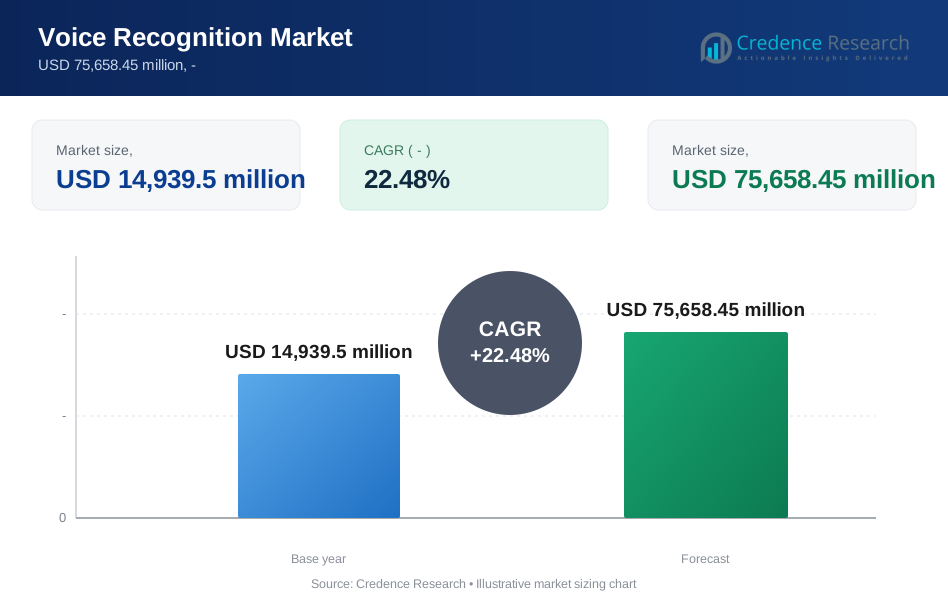
The Voice Recognition Market is projected to grow significantly from USD 14,939.5 million in 2024 to USD 75,658.45 million by 2032, reflecting a robust compound annual growth rate (CAGR) of 22.48%.
The Voice Recognition market is primarily driven by the increasing adoption of smart devices and the demand for hands-free technology across various applications. Enhanced accuracy and efficiency in voice recognition systems are attracting businesses to integrate this technology into their operations, improving customer engagement and service delivery. Key trends include the growing implementation of AI and machine learning to refine voice recognition capabilities and support multilingual applications. Additionally, the rise of virtual assistants and voice-activated applications in sectors like healthcare, automotive, and retail further fuels market growth, highlighting the technology's versatility and effectiveness in enhancing user experiences.
The voice recognition market is witnessing significant growth across regions, particularly in North America and Asia-Pacific. North America dominates the market due to the presence of major players like Microsoft, IBM, Apple, and Amazon, supported by advanced technology infrastructure and high adoption rates. Meanwhile, Asia-Pacific is experiencing rapid expansion, driven by the growing use of voice-enabled devices in countries like China with key players such as Baidu and iFlytek. Additionally, companies like SESTEK in Turkey and speak2web in the US are also contributing to market advancements, expanding the global competitive landscape.
Market Drivers
Advancements in Technology
Recent advancements in artificial intelligence (AI) and machine learning have significantly enhanced the accuracy of voice recognition systems, rendering them more reliable for everyday applications. Improved algorithms allow these systems to understand and process complex language patterns, thanks to sophisticated natural language processing (NLP) capabilities. For instance, a review of recent advances on deep learning methods for audio-visual speech recognition highlights the progress made in the last decade, emphasizing the role of deep learning in improving speech decoding accuracy. As a result, interactions with voice recognition technology have become increasingly natural and intuitive, facilitating smoother communication between users and devices.
Rising Demand for Hands-Free Interfaces The growing demand for hands-free interfaces is a crucial driver of the voice recognition market. This technology offers convenience, enabling users to interact with devices effortlessly, especially in situations where manual operation is challenging. For instance, the integration of voice user interfaces with IoT devices allows users to control smart home devices like thermostats and lighting systems using voice commands, enhancing user experience and accessibility. Additionally, voice recognition enhances accessibility for individuals with disabilities, making technology more inclusive and promoting broader usage across diverse demographics.
Integration with IoT Devices
The integration of voice recognition technology with Internet of Things (IoT) devices has transformed the way users manage their smart homes. Voice-activated assistants and smart speakers have gained popularity for controlling various IoT devices, allowing users to perform tasks like adjusting lights and setting alarms with simple voice commands. For instance, voice assistants like Amazon Alexa and Google Assistant are widely used to control smart home devices, providing a seamless and efficient user experience. This automation not only improves efficiency but also enhances convenience, contributing to a more integrated and user-friendly living environment.
Growing Adoption of Virtual Assistants
Virtual assistants such as Siri, Alexa, and Google Assistant are increasingly becoming integral components of smartphones, smart speakers, and other devices. Their ability to perform a wide array of tasks—from providing information to scheduling appointments—drives demand for voice recognition technology. The growing reliance on these personal assistants highlights the technology's significance in enhancing user experience and efficiency across various sectors, including automotive, business, and industry.
Market Trends
Increased Accuracy and Natural Language Understanding
Advancements in deep learning algorithms have dramatically improved the accuracy of voice recognition systems, enabling more natural and intuitive interactions. For instance, a recent survey by the Korea Institute of Fusion Energy highlighted that these systems are now capable of better contextual understanding, allowing them to grasp nuances in language, which enhances their effectiveness across various applications. This growing capability not only makes voice recognition more reliable but also allows it to adapt to different user needs and preferences. As these systems evolve, their ability to interpret and respond to complex language patterns is fostering a more user-friendly experience, increasing adoption rates in everyday scenarios.
Expanding Applications and Integration
Voice recognition technology is experiencing a surge in applications across multiple sectors, highlighting its expanding integration into various devices and environments. For instance, a report by the International Data Corporation (IDC) noted that in smart homes, voice-activated assistants and smart speakers have become ubiquitous, controlling an array of connected devices and services with simple voice commands. This trend extends into the automotive sector, where voice recognition is increasingly integrated into car infotainment systems, allowing for hands-free control of navigation, music, and other features, thus enhancing driver safety. In healthcare, voice recognition systems streamline operations by documenting patient records, transcribing medical notes, and assisting in diagnoses, contributing to improved efficiency and accuracy in patient care. Furthermore, businesses are adopting voice recognition for customer service interactions, leveraging the technology to enhance operational efficiency and reduce costs. The expansion of voice recognition applications illustrates its versatility and the growing reliance on this technology across various industries, demonstrating its potential to revolutionize how users interact with devices and services.
Market Challenges Analysis
Accuracy and Noise Tolerance
Voice recognition systems face significant challenges in maintaining accuracy, particularly in noisy environments such as crowded rooms or outdoor settings. For instance, a survey conducted by the International Journal of Speech Technology found that integrated noise suppression techniques can enhance voice activity detection in degraded environments. Background noise can interfere with the system's ability to accurately capture speech, leading to misunderstandings and errors. Additionally, variations in accents and dialects pose a considerable challenge, especially in multilingual regions. The diverse linguistic landscape complicates the ability of voice recognition technology to consistently deliver reliable performance. As the demand for voice recognition applications grows, these challenges highlight the necessity for continued advancements in technology to enhance noise tolerance and improve accuracy across different languages and accents.
Privacy and Security Concerns
The collection and storage of voice data raise significant privacy concerns, particularly regarding how this information can be used for identification or unauthorized purposes. Users may feel uneasy about the potential misuse of their voice data, leading to hesitancy in adopting voice recognition technology. Furthermore, the risk of data breaches and unauthorized access adds another layer of complexity to security challenges within the industry. Companies must implement robust security measures to protect user data and prevent breaches, thereby ensuring the trust and confidence of their user base. Additionally, addressing these privacy and security issues is crucial for the long-term viability and acceptance of voice recognition technology, especially in sectors that handle sensitive information.
Market Segmentation Analysis:
By Technology:
The voice recognition market can be segmented by technology into various categories, including speech recognition, automatic speech recognition (ASR), text-to-speech (TTS), voice recognition, speaker identification, and speaker verification. Speech recognition and ASR technologies have gained widespread adoption, especially in personal assistants, smart speakers, and mobile applications, enabling devices to interpret and respond to human speech. Text-to-speech technology has been increasingly used in educational tools, accessibility solutions, and customer service applications, where converting text to human-like speech enhances user engagement. Voice recognition enables personalized experiences by identifying specific voices, while speaker identification and speaker verification technologies are becoming vital in security-sensitive sectors like banking and healthcare for user authentication, contributing to the market’s growth. The diverse technological offerings allow voice recognition systems to be tailored to various industries, driving broader adoption.
By Deployment mode:
Voice recognition systems are deployed in two primary modes: on-cloud and on-premises/embedded solutions. On-cloud deployment is increasingly favored due to its scalability, flexibility, and ability to process vast amounts of data in real-time. It’s ideal for applications like virtual assistants, smart home devices, and enterprise solutions, where continuous connectivity is required for smooth operation. On the other hand, on-premises or embedded deployment is suitable for industries with stringent security and privacy concerns, such as healthcare, finance, and defense. These solutions offer greater control over data and minimize security risks by keeping sensitive information within the organization. Both deployment modes offer distinct advantages, allowing businesses to choose based on their operational needs and security preferences.
Segments:
Based on Technology:
- Speech Recognition
- Automatic Speech Recognition
- Text-To-Speech
- Voice Recognition
- Speaker Identification
- Speaker Verification
Based on Deployment mode:
- On Cloud
- On-Premises/Embedded
Based on Vertical:
- Automotive
- Enterprise
- Consumer
- Banking, Finance Service & Insurance (BFSI)
- Government
- Retail
- Healthcare
- Military
- Legal
- Education
- Others
Based on the Geography:
- North America
- U.S.
- Canada
- Mexico
- Europe
- Germany
- France
- U.K.
- Italy
- Spain
- Rest of Europe
- Asia Pacific
- China
- Japan
- India
- South Korea
- South-east Asia
- Rest of Asia Pacific
- Latin America
- Brazil
- Argentina
- Rest of Latin America
- Middle East & Africa
- GCC Countries
- South Africa
- Rest of the Middle East and Africa
Regional Analysis
North America
North America holds a significant share of the global voice recognition market, accounting for over 35% of the total market revenue. The region's dominance is driven by the widespread adoption of advanced technologies like artificial intelligence, machine learning, and natural language processing (NLP). For instance, a survey conducted by the Consumer Technology Association (CTA) revealed that over 60% of U.S. households own at least one smart home device, with voice recognition being a key feature in these devices. The United States leads this regional market due to the presence of major tech giants such as Google, Apple, Amazon, and Microsoft, which have integrated voice recognition technologies into their devices and platforms. Moreover, the increasing demand for hands-free interfaces in sectors like automotive, healthcare, and consumer electronics has further fueled growth. The region also benefits from high consumer demand for smart home devices, virtual assistants, and automotive applications, contributing to the expanding use of voice recognition systems.
Asia Pacific
The Asia Pacific region is emerging as one of the fastest-growing markets for voice recognition, with a projected market share exceeding 25%. This growth is primarily driven by rising investments in AI and speech recognition technologies in countries like China, Japan, and South Korea. The region's growing population, increasing smartphone penetration, and expanding e-commerce industry have created a fertile environment for voice-enabled technologies. In particular, China is becoming a major player, with companies like Baidu and iFLYTEK leading advancements in voice recognition technology. Additionally, the integration of voice recognition into IoT devices, automotive systems, and customer service platforms in the region is boosting adoption. The growing demand for multilingual voice recognition systems is also driving innovation and market expansion in Asia Pacific.
Key Player Analysis
- iFlytek (China)
- SESTEK (Turkey)
- speak2web (US)
- Microsoft (US)
- Baidu (China)
- Alphabet (US)
- IBM (US)
- Verint (US)
- Apple (US)
- Amazon (US)
Competitive Analysis
The voice recognition market is highly competitive, with leading players such as Apple, Microsoft, IBM, Alphabet, Amazon, Baidu, iFlytek, SESTEK, speak2web, and Verint driving innovation. These companies are at the forefront of technological advancements, leveraging artificial intelligence (AI) and machine learning (ML) to enhance the accuracy and natural language processing capabilities of voice recognition systems. Companies focus on improving user experience, integrating voice assistants, and expanding applications across industries such as healthcare, automotive, and smart homes. Additionally, firms are addressing challenges like privacy and security concerns, while enhancing support for multilingual and regional variations. Competitive strategies include continuous innovation, strategic partnerships, and acquisitions, all aimed at expanding their global reach and maintaining a leadership position in this rapidly evolving market.
Recent Developments
- In April 2024, iFlytek launched the iFlytek Smart Recorder, a groundbreaking all-in-one device revolutionizing voice recording with offline AI technology.
- In March 2024, SESTEK conducted a Speech Recognition Accuracy Test 2024, showcasing advancements in end-to-end (E2E) models for speech recognition.
- In January 2024, IBM introduced the watsonx Large Speech Model (LSM), bringing generative AI to phone-based customer care with advanced speech recognition.
- In November 2023, Microsoft introduced 7 new realistic AI voices optimized for conversations in various languages.
Market Concentration & Characteristics
The voice recognition market is characterized by moderate to high market concentration, with a few dominant players holding significant market share due to their technological expertise and large-scale deployments. Leading companies leverage advanced AI and machine learning algorithms to offer innovative solutions with enhanced accuracy, contextual understanding, and integration across various industries. The market is also marked by rapid innovation, with smaller firms and startups pushing the boundaries of natural language processing (NLP) and voice-enabled technologies. Competitive advantages are often driven by the ability to offer robust, scalable, and secure systems that cater to both consumer and enterprise needs. Moreover, strategic collaborations and acquisitions are common as companies seek to broaden their product offerings and expand into new regions, ensuring continued growth in a highly dynamic market.
Report Coverage
The research report offers an in-depth analysis based on Technology, Deployment mode, Vertical and Geography. It details leading market players, providing an overview of their business, product offerings, investments, revenue streams, and key applications. Additionally, the report includes insights into the competitive environment, SWOT analysis, current market trends, as well as the primary drivers and constraints. Furthermore, it discusses various factors that have driven market expansion in recent years. The report also explores market dynamics, regulatory scenarios, and technological advancements that are shaping the industry. It assesses the impact of external factors and global economic changes on market growth. Lastly, it provides strategic recommendations for new entrants and established companies to navigate the complexities of the market.
Future Outlook
- Voice recognition technology will continue to see rapid improvements in accuracy and natural language processing capabilities.
- Integration with IoT devices and smart home systems will expand, making voice control a more prominent feature in everyday life.
- The automotive industry will increasingly adopt voice recognition for hands-free control and enhanced driver safety.
- Businesses will rely more on voice recognition for customer service automation and data entry in various industries.
- Privacy and security concerns will lead to stronger encryption and data protection measures in voice recognition systems.
- On-device processing through edge computing will reduce latency and address privacy concerns.
- Voice recognition will evolve to support a broader range of languages and dialects, enhancing its global reach.
- Multimodal interactions combining voice with other inputs like gestures and facial recognition will become more common.
- Regulatory frameworks will emerge to address ethical issues such as data privacy and bias in voice recognition systems.
- Virtual assistants powered by voice recognition will gain advanced functionalities, driving further adoption across devices.
Request a Free Sample
Fill in your details and we'll send you a free sample report.
- Sample data tables & charts
- Research methodology
Need a Custom Version of This Report?
Tailor the scope, geography, or segments to your exact requirements.
- Custom geography or segment scope
- Direct access to our analyst team
Frequently Asked Questions
What is the current size of the Voice Recognition market?
What factors are driving the growth of the Voice Recognition market?
What are the key segments within the Voice Recognition market?
What are some challenges faced by the Voice Recognition market?
Who are the major players in the Voice Recognition market?
Table of Content
Chapter 1. Report Introduction
- 1.1 Report Description & Purpose
- 1.1.1 Report Title & Market Definition
- 1.1.2 Unique Selling Propositions (USP) & Key Differentiators
- 1.1.3 Value Proposition for Stakeholders
- 1.2 Research Objectives
- 1.2.1 Market Sizing Objectives (Volume & Revenue)
- 1.2.2 Segmentation Objectives
- 1.2.3 Competitive Intelligence Objectives
- 1.2.4 Forecast & Scenario Objectives
- 1.3 Report Scope
- 1.3.1 Voice Recognition Scope – Types & Subtypes Covered
- 1.3.2 Geographic Scope – Regions & Countries Covered
- 1.3.3 Historical Period, Base Year & Forecast Period (the historical period; forecast to the forecast period)
- 1.3.4 Inclusions & Exclusions
- 1.4 HS Code & Classification Framework
- 1.5 Currency, Units & Pricing Basis
- 1.6 Target Stakeholders
- 1.7 Limitations & Assumptions
Chapter 2. Executive Summary
- 2.1 Global Voice Recognition Market Snapshot
- 2.1.1 Market Size – Historical (the historical period) & Forecast (the forecast period) (base year: USD 14,939.5 million → forecast year: USD 75,658.45 million)
- 2.1.2 Volume & Revenue – Global Totals
- 2.1.3 Key Market Highlights – Top Five Facts
- 2.2 Voice Recognition Market Segmentation Snapshot
- 2.2.1 Market Split by Region – vs.
- 2.3 Competitive Snapshot
- 2.3.1 Top 10 Players by Revenue Share –
- 2.3.2 Top 10 Players by Volume Share –
- 2.3.3 Recent Strategic Developments (18-Month Summary)
- 2.4 Key Investment Highlights & Strategic Conclusions
Chapter 3. Voice Recognition Market Dynamics & Industry Analysis
- 3.1 Market Overview & Context
- 3.1.1 Voice Recognition Market Position in the Broader Automotive Value Chain
- 3.1.2 OEM vs. Replacement Market Dynamics
- 3.1.3 Market Maturity & Development Stage by Region
- 3.2 Voice Recognition Market Drivers
- 3.3 Voice Recognition Market Restraints & Challenges
- 3.4 Voice Recognition Market Opportunities
- 3.5 Porter's Five Forces Analysis
- 3.5.1 Threat of New Entrants
- 3.5.2 Bargaining Power of Suppliers
- 3.5.3 Bargaining Power of Buyers
- 3.5.4 Threat of Substitutes
- 3.5.5 Competitive Rivalry – Intensity Assessment
- 3.6 Voice Recognition Value Chain Analysis
- 3.6.1 Upstream – Raw Material/Input Suppliers
- 3.6.1.1 Raw Material/Input 1
- 3.6.1.2 Raw Material/Input 2
- 3.6.1.3 Raw Material/Input 3
- 3.6.2 Midstream – Production/Manufacturing/Service Delivery
- 3.6.2.1 Production/Process Overview
- 3.6.2.2 Key Facility Locations & Capacity by Manufacturer
- 3.6.3 Downstream – Distribution & End Consumer
- 3.6.3.1 Primary Channel – B2B/OEM
- 3.6.3.2 Secondary Channels – Dealer, Retail, Online, Direct
- 3.6.4 Value Chain Profitability Analysis
- 3.6.1 Upstream – Raw Material/Input Suppliers
- 3.7 PESTEL Analysis
- 3.7.1 Political Factors
- 3.7.2 Economic Factors
- 3.7.3 Social Factors
- 3.7.4 Technological Factors
- 3.7.5 Environmental Factors
- 3.7.6 Legal Factors
- 3.8 Voice Recognition Supply Chain Analysis
- 3.8.1 Raw Material/Input Supply Risk Assessment
- 3.8.2 Manufacturing Concentration Risk (Geographic Exposure)
- 3.8.3 Trade Disruption Impact Analysis
- 3.9 Regulatory & Policy Landscape
Note: The regulatory and policy landscape section covers regulations based on their applicability to the market, Voice Recognition category, geography, and scope of the study. Only regulatory frameworks with a material impact on operations, compliance, trade, sustainability, or market access are analyzed in detail.
Chapter 4. Key Investment Pockets & Opportunity Analysis
- 4.1 Voice Recognition Market Attractiveness Analysis
- 4.1.1 By Region – Investment Attractiveness Matrix (Volume × CAGR)
- 4.2 Absolute Revenue Growth Opportunity
- 4.2.1 By Region – Absolute USD Growth Through the forecast period
- 4.3 Incremental Volume Opportunity
- 4.3.1 By Region – Incremental Volume Through the forecast period
- 4.3.2 Segment – Incremental Volume
- 4.4 Emerging Submarket Opportunity Deep Dive (Subject to Applicability)
- 4.5 Emerging Market Opportunity Scorecards
- 4.5.1 United States
- 4.5.2 Europe
- 4.5.3 Asia
- 4.5.4 Middle East & Africa
Note: Emerging Market Opportunity Scorecards will be included based on relevance and strategic importance. Regions listed are indicative and may vary depending on data availability and market dynamics.
Chapter 5. Voice Recognition Import-Export Analysis & Trade Flows
- 5.1 Global Trade Overview
- 5.1.1 Global Export Value by Country (the historical period)
- 5.1.2 Global Export Volume by Country (the historical period)
- 5.1.3 Global Import Value by Country (the historical period)
- 5.1.4 Global Import Volume by Country (the historical period)
- 5.1.5 Net Trade Balance by Country (the historical period)
- 5.2 Export Analysis – Segment
- 5.2.1 Type 1 (HS Code)
- 5.2.2 Type 2 (HS Code)
- 5.2.3 Type 3 (HS Code)
- 5.2.4 Type 4 (HS Code)
- 5.2.5 Type 5 (HS Code)
- 5.3 Import Analysis – Segment
- 5.3.1 Type 1 (HS Code)
- 5.3.2 Type 2 (HS Code)
- 5.3.3 Type 3 (HS Code)
- 5.3.4 Type 4 (HS Code)
- 5.3.5 Type 5 (HS Code)
- 5.4 Average Unit Trade Prices
- 5.4.1 Average Export Price – Segment & Country
- 5.4.2 Average Import Price – Segment & Source Country
- 5.4.3 Price Trends (the historical period)
- 5.5 Key Trade Route Analysis
- 5.5.1 Trade Route 1
- 5.5.2 Trade Route 2
- 5.5.3 Trade Route 3
- 5.5.4 Trade Route 4
- 5.5.5 Trade Route 5
- 5.6 Trade Policy Impact Assessment
- 5.6.1 US Anti-Dumping & Section 301 Tariffs
- 5.6.2 EU Customs Union Impact
- 5.6.3 Major Free Trade Agreements
- 5.6.4 USMCA Rules of Origin
Note: Trade policy analysis will be included only where relevant to the Voice Recognition market.
Chapter 6. Competitive Landscape & Company Benchmarking
- 6.1 Voice Recognition Market Concentration & Structure
- 6.1.1 Herfindahl-Hirschman Index (HHI) – vs.
- 6.1.2 Tier 1, Tier 2 & Tier 3 Market Structure
- 6.1.3 Global, Regional & Local Player Dynamics
- 6.2 Voice Recognition Market Share Analysis –
- 6.2.1 Global Revenue Share by Company
- 6.2.2 Global Volume Share by Company
- 6.2.3 Regional Revenue Share
- 6.2.4 Market Share Evolution ( vs. )
- 6.2.5 OEM Segment Share by Company
- 6.2.6 Replacement Segment Share by Company
- 6.3 Production/Delivery Capacity & Facility Analysis
- 6.3.1 Global Installed Capacity
- 6.3.2 Capacity Utilization Rates
- 6.3.3 Production/Output Volume
- 6.3.4 Facility Locations & Capacity Map
- 6.3.5 Planned Capacity Additions
- 6.4 Voice Recognition Competitive Benchmarking Matrix
- 6.4.1 Revenue, Volume, CAGR & Profitability Comparison
- 6.4.2 Channel Revenue Mix
- 6.4.3 Geographic Revenue Exposure
- 6.4.4 R&D Intensity
- 6.4.5 Sustainability Maturity
- 6.5 Strategic Developments in Voice Recognition (Last 24 Months)
- 6.5.1 Mergers, Acquisitions & Divestments
- 6.5.2 New Voice Recognition Launches
- 6.5.3 Facility Expansions
- 6.5.4 Strategic Alliances, Joint Ventures & Partnerships
- 6.5.5 Distribution Expansion & Market Entry
- 6.5.6 Sustainability & ESG Initiatives
- 6.6 Competitive Strategy Mapping
- 6.6.1 Leader, Challenger, Follower & Niche Classification
- 6.6.2 Pricing Strategy Comparison
- 6.6.3 Channel Strategy Matrix
Note: Strategic developments are included based on their materiality and the availability of reliable information.
Chapter 7. Global Voice Recognition Market – By Distribution Channel
- 7.1 Segment Overview
- 7.1.1 Volume & Revenue Split by Channel ( & )
- 7.1.2 Channel Mix Evolution (the forecast period)
Chapter 8. Regional Market Analysis – Global Overview
- 8.1 Global Regional Overview
- 8.1.1 Regional Volume Share
- 8.1.2 Regional Revenue Share
- 8.1.3 Regional Volume by Region
- 8.1.4 Regional Revenue by Region
- 8.1.5 Regional Forecast Through the forecast period
- 8.2 Cross-Regional Segment Analysis
- 8.2.1 By Distribution Channel
- 8.2.2 By Brand/Price Tier
Chapter 9. North America Voice Recognition Market
- 9.1 United States
- 9.2 Canada
- 9.3 Mexico
Chapter 10. Europe Voice Recognition Market
- 10.1 Germany
- 10.2 France
- 10.3 Italy
- 10.4 United Kingdom
- 10.5 Spain
- 10.6 Poland
- 10.7 Russia
- 10.8 Netherlands
- 10.9 Belgium
- 10.10 Sweden
- 10.11 Denmark
- 10.12 Norway
- 10.13 Rest of Europe
Chapter 11. Asia Pacific Voice Recognition Market
- 11.1 China
- 11.2 India
- 11.3 Japan
- 11.4 South Korea
- 11.5 Thailand
- 11.6 Indonesia
- 11.7 Vietnam
- 11.8 Malaysia
- 11.9 Australia
- 11.10 Rest of Asia Pacific
Chapter 12. Latin America Voice Recognition Market
- 12.1 Brazil
- 12.2 Argentina
- 12.3 Colombia
- 12.4 Chile
- 12.5 Rest of Latin America
Chapter 13. Middle East Voice Recognition Market
- 13.1 Saudi Arabia
- 13.2 United Arab Emirates
- 13.3 Turkey
- 13.4 Israel
- 13.5 Iran
- 13.6 Rest of the Middle East
Chapter 14. Africa Voice Recognition Market
- 14.1 South Africa
- 14.2 Egypt
- 14.3 Nigeria
- 14.4 Morocco
- 14.5 Rest of Africa
Chapter 15. Voice Recognition Company Profiles
- 15.1 [Company 01]
- 15.1.1 Company Overview
- 15.1.2 Key Management Personnel
- 15.1.3 Products & Services Portfolio
- 15.1.4 Financial Performance
- 15.1.5 Key Market Focus & Geographic Presence
- 15.1.6 Recent Developments & Strategic Initiatives
Note: The company profile list is preliminary and may change based on research findings, market developments, data availability, and client requirements.
Chapter 16. Appendices
- Appendix A – List of Abbreviations & Acronyms
- Appendix B – Industry Classification Code Reference – Full Series
- Appendix C – Production & Capacity Data Tables
- Appendix D – End-Use & Demand Base Tables
- Appendix E – Consumption & Replacement Rate Assumptions
- Appendix F – ASP Reference Tables
- Appendix G – Manufacturing & Facility Database
- Appendix H – Import-Export Data Tables
- Appendix I – Regulatory Summary Tables
- Appendix J – Primary Research Participant List (Anonymized)
- Appendix K – Primary Research Questionnaire Framework
- Appendix L – Data Sources & Bibliography
- Appendix M – Market Size Divergence & Source Comparison
Chapter 17. Research Methodology
- 17.1 Research Framework & Philosophy
- 17.2 Secondary Research – Sources, Hierarchy & Data Extraction
- 17.3 Data Modeling – Bottom-Up & Top-Down Market Sizing
- 17.4 Primary Research – Stakeholder Framework, LOI & Sample Sizes
- 17.5 Forecast Methodology – Regression, Scenario & Sensitivity Analysis
- 17.6 Quality Control – Four-Layer Validation Framework
- 17.7 Limitations & Standard Assumptions
- 17.8 Disclaimer
