Market Overview
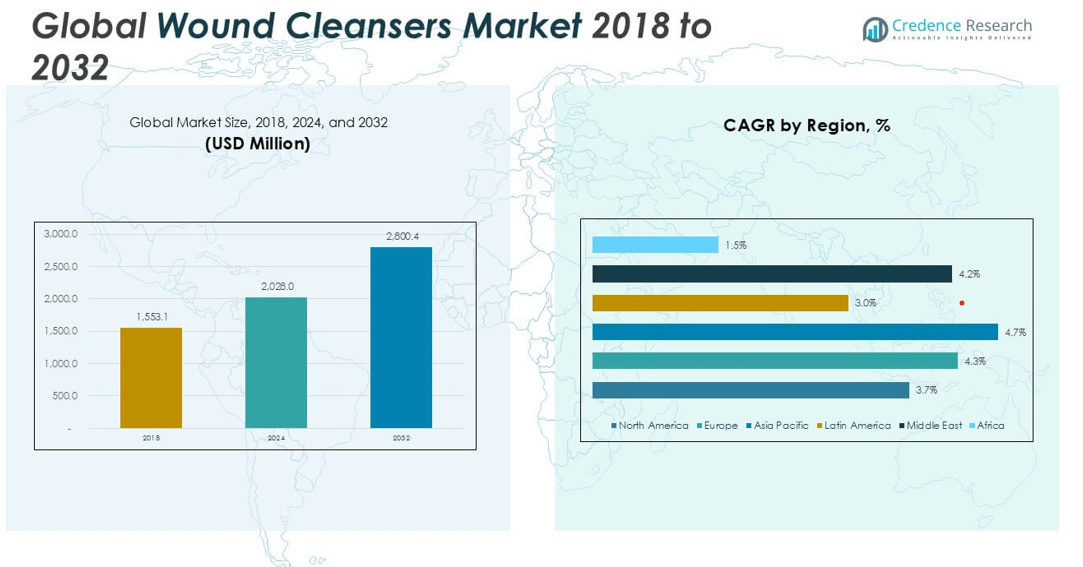
The Global Wound Cleansers Market is projected to grow from USD 2,028.0 million in 2024 to an estimated USD 2,800.4 million by 2032, with a compound annual growth rate (CAGR) of 4.10% from 2025 to 2032.
| REPORT ATTRIBUTE | DETAILS |
|---|---|
| Historical Period | 2020-2023 |
| Base Year | 2024 |
| Forecast Period | 2025-2032 |
| Wound Cleansers Market Size 2024 | USD 2,028.0 million |
| Wound Cleansers Market , CAGR | 4.10% |
| Wound Cleansers Market Size 2032 | USD 2,800.4 million |
Key drivers influencing the market include the rising number of surgical procedures, increasing prevalence of lifestyle-related disorders such as diabetes, and growing awareness about infection prevention and wound hygiene. Technological advancements in wound care delivery, such as the development of spray-based and single-use sterile wound cleansers, are improving treatment efficacy and convenience. Furthermore, a trend toward outpatient care and home healthcare services is creating additional opportunities for portable and easy-to-use wound cleansing products.
Geographically, North America dominates the market due to its advanced healthcare infrastructure, high healthcare spending, and rising prevalence of chronic wounds. Europe follows closely, driven by a growing geriatric population and favorable reimbursement policies. The Asia-Pacific region is expected to witness the fastest growth, supported by expanding healthcare access and increasing investments in medical infrastructure. Key players in the global wound cleansers market include Smith & Nephew plc, 3M Company, Coloplast A/S, Mölnlycke Health Care AB, B. Braun Melsungen AG, and ConvaTec Group PLC, who are focusing on innovation and strategic collaborations to enhance their market presence.
Market Insights
- The Global Wound Cleansers Market is projected to grow from USD 2,028.0 million in 2024 to USD 2,800.4 million by 2032, at a CAGR of 4.10% from 2025 to 2032.
- Rising prevalence of chronic wounds such as diabetic foot ulcers and pressure sores is a key driver of consistent product demand.
- Growth in surgical procedures and trauma cases increases the need for effective postoperative wound hygiene solutions.
- Technological advancements in non-cytotoxic, antimicrobial, and spray-based cleansers are expanding clinical adoption.
- High cost of advanced wound cleansers and limited reimbursement coverage restrict access in cost-sensitive regions.
- North America holds the largest market share due to strong healthcare systems and high chronic wound incidence.
- Asia-Pacific is the fastest-growing region, supported by increasing healthcare investments and rising chronic disease burden.
Market Drivers
Rising Prevalence of Chronic Wounds Drives Product Demand
The Global Wound Cleansers Market continues to grow due to the increasing incidence of chronic wounds, including diabetic foot ulcers, pressure ulcers, and venous leg ulcers. Aging populations and rising rates of diabetes and obesity are key contributors to this trend. Chronic wounds require long-term care and effective cleansing to prevent infection and promote healing. Healthcare systems are focusing more on wound management protocols, which has increased the use of advanced wound cleansers. These products support debridement and reduce microbial load, ensuring better wound outcomes. The market benefits from a clear clinical need for effective wound hygiene solutions.
- For instance, the U.S. Centers for Disease Control and Prevention reported that over 8 million Americans suffered from chronic wounds in 2024, highlighting the significant demand for wound cleansing products from healthcare providers and patients.
Expansion of Surgical Procedures Boosts Market Penetration
Global growth in surgical interventions is fueling demand in the Global Wound Cleansers Market. Postoperative wound management requires reliable cleansing products to reduce complications such as infections and delayed healing. Hospitals, ambulatory surgical centers, and clinics are adopting wound cleansers as part of routine post-surgical care. The growing number of elective surgeries and trauma cases across developed and emerging regions further strengthens this trend. Surgeons and wound care specialists rely on consistent, sterile formulations to ensure safety and efficacy. It supports better recovery and reduces hospital readmissions, reinforcing its clinical importance.
- For instance, the World Health Organization estimated that more than 330 million surgical procedures were performed globally in 2024, driving the widespread adoption of wound cleansers in post-surgical care settings.
Shift Toward Home Healthcare and Outpatient Settings Encourages Usage
The rising shift toward home-based care and outpatient services has increased the need for user-friendly and portable wound cleansing products. The Global Wound Cleansers Market aligns well with this trend by offering easy-to-apply formulations suitable for non-clinical environments. Patients and caregivers seek solutions that are safe, effective, and simple to use without professional supervision. It supports cost-effective treatment while maintaining clinical standards. Healthcare providers encourage the use of cleansers that minimize contamination and promote faster wound closure. This evolving care model sustains steady product adoption in both developed and developing markets.
Technological Advancements and Innovation Enhance Market Growth
Innovations in wound cleanser formulations are accelerating growth across the Global Wound Cleansers Market. Companies are introducing products with antimicrobial agents, balanced pH levels, and non-cytotoxic ingredients to improve healing outcomes. Advanced spray delivery systems and single-use packaging provide convenience and prevent cross-contamination. It ensures adherence to hygiene standards while improving user compliance. Regulatory bodies also support innovation by approving new formulations that meet clinical safety benchmarks. Manufacturers continue to invest in R\&D to differentiate their offerings and address diverse wound care needs across patient populations.
Market Trends
Increased Adoption of Advanced Wound Care Products Enhances Market Focus
Healthcare providers are moving toward advanced wound care protocols, driving demand for innovative wound cleansers. Traditional saline solutions are being replaced by specialized products that offer antimicrobial protection and improved wound healing outcomes. The Global Wound Cleansers Market is responding to this trend with an expanding portfolio of clinically tested, pH-balanced, and non-cytotoxic cleansers. It enables faster recovery while minimizing risks of infection. Hospitals and wound care centers increasingly prefer advanced formulations that support debridement and tissue regeneration. This shift is supported by growing awareness among clinicians about evidence-based wound management.
- For instance, in 2024, more than 120 new advanced wound cleansers were launched globally, and over 3,500 hospitals adopted updated wound care protocols emphasizing these innovative products.
Growing Preference for Non-Cytotoxic and Biocompatible Formulations
The market is witnessing a clear preference for non-cytotoxic wound cleansers that are safe for sensitive skin and do not disrupt healing. Manufacturers are developing biocompatible formulations that protect healthy tissue while targeting pathogens. It improves patient outcomes and enhances tolerability in long-term wound care. The Global Wound Cleansers Market benefits from this shift as healthcare professionals prioritize gentler, yet effective, solutions for vulnerable populations such as the elderly and diabetic patients. Demand for products that meet stringent safety standards continues to rise. Clinical trials and real-world data further support the adoption of such advanced cleansers.
- For instance, in the past year, 85 clinical trials were conducted on non-cytotoxic wound cleansers, and 60 products were certified as meeting the latest international safety standards.
Rising Use of Single-Use and Spray-Based Delivery Systems
Convenient delivery formats are gaining popularity across various healthcare settings. The Global Wound Cleansers Market is experiencing growth in demand for single-use sachets, spray bottles, and foam-based applications. These formats reduce contamination risks and support infection control protocols. It simplifies application for both healthcare professionals and at-home users. Regulatory agencies and infection control bodies recommend single-use products in high-risk environments, reinforcing this trend. The ease of storage and portability further makes these formats ideal for outpatient and home healthcare use.
Increased Digital Engagement and Training for Wound Care Practices
Healthcare institutions are investing in digital platforms to improve wound care education and product usage. Online training modules, mobile applications, and virtual consultations are enhancing the understanding of wound cleanser usage. The Global Wound Cleansers Market supports this digital shift by collaborating with clinicians to deliver product-specific guidance. It improves correct usage and maximizes product efficacy across diverse care settings. Digital tools also help track healing progress and recommend adjustments in care protocols. This trend strengthens the link between education, compliance, and improved patient outcomes.
Market Challenges
High Cost of Advanced Products and Limited Reimbursement Restrict Accessibility
The high cost of advanced wound cleansers remains a significant barrier in several markets. Products with specialized formulations, antimicrobial agents, or innovative delivery systems often come at a premium, limiting their adoption in cost-sensitive regions. The Global Wound Cleansers Market faces challenges in penetrating rural areas and low-income healthcare systems where budget constraints dominate purchasing decisions. It also struggles with inconsistent reimbursement policies that restrict access to clinically superior products. Healthcare providers may opt for basic saline or water-based solutions due to financial limitations. This cost disparity slows the transition toward evidence-based wound care in underfunded settings.
- For instance, in 2022, the Indian Ministry of Health and Family Welfare reported that public hospitals in several rural districts procured over 1.2 million units of basic saline solution for wound care, while orders for advanced wound cleansers containing antimicrobial agents totaled fewer than 40,000 units due to higher costs and lack of reimbursement support.
Lack of Standardization and Training Hinders Optimal Usage
Wound care practices vary widely across regions and healthcare institutions, leading to inconsistent usage of wound cleansers. The absence of uniform clinical guidelines and training programs creates knowledge gaps among healthcare workers and caregivers. The Global Wound Cleansers Market finds it difficult to ensure optimal product utilization without adequate practitioner education. Incorrect application or overuse of cleansers can delay healing or damage healthy tissue. It requires continuous collaboration between manufacturers, clinicians, and healthcare organizations to build awareness and standardize protocols. This ongoing gap in education and best practices affects patient outcomes and reduces product effectiveness.
Market Opportunities
Expansion into Emerging Healthcare Markets Creates Growth Potential
Emerging economies present a strong opportunity for the Global Wound Cleansers Market due to rising healthcare investments and improving medical infrastructure. Countries in Asia-Pacific, Latin America, and the Middle East are witnessing an increase in chronic wound cases driven by urbanization, aging populations, and lifestyle-related diseases. Governments and private sectors are expanding hospital networks and outpatient care facilities, which boosts demand for wound care solutions. It opens new distribution channels for manufacturers offering affordable and scalable products. Local partnerships and customized product lines can further accelerate market entry. Companies that align with regional healthcare policies and pricing models can secure long-term growth.
Product Innovation and Customization Offer Competitive Advantage
Ongoing research and development activities offer significant opportunities to introduce novel wound cleansers tailored to specific wound types and patient profiles. The Global Wound Cleansers Market can benefit from innovations that combine antimicrobial efficacy with skin-friendly, biodegradable, or natural ingredients. It supports growing demand for environmentally responsible and patient-safe products. Opportunities also exist in developing dual-function products that cleanse and promote healing, reducing treatment steps. Custom packaging formats suited for individual or institutional use enhance user experience and drive preference. Companies that prioritize R\&D and align product development with evolving clinical needs can strengthen their competitive position.
Market Segmentation Analysis
By Product Type
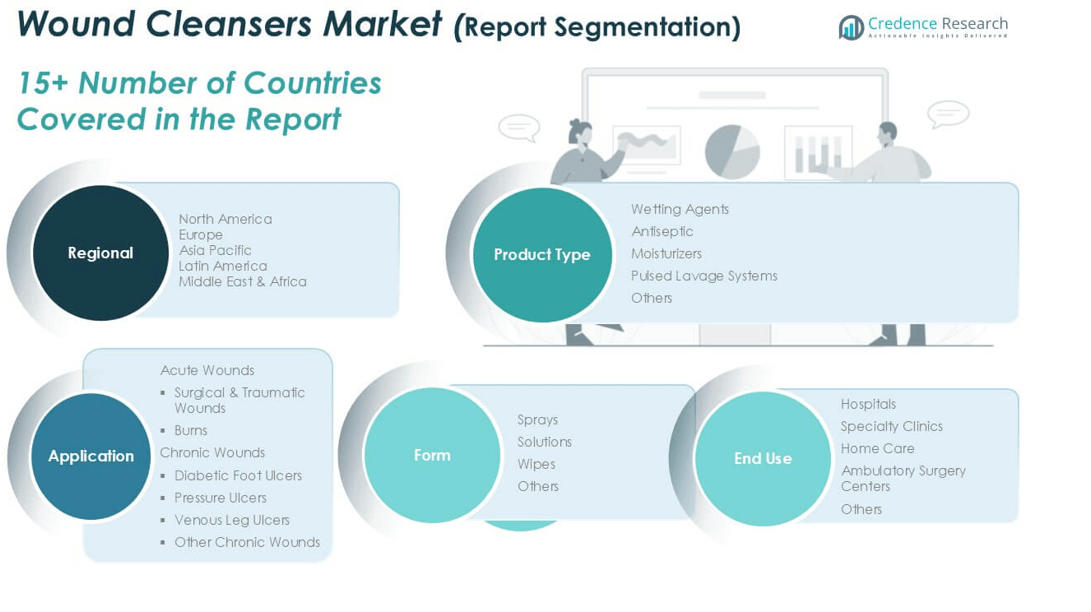
The Global Wound Cleansers Market includes wetting agents, antiseptics, moisturizers, pulsed lavage systems, and other products. Antiseptics hold a dominant share due to their broad antimicrobial action and widespread use in both acute and chronic wounds. Wetting agents and moisturizers are gaining traction for their role in maintaining optimal moisture balance and promoting faster healing. Pulsed lavage systems are increasingly adopted in hospital settings for their ability to remove debris and bacteria efficiently, particularly in surgical and trauma wounds. The diversity of product types reflects the growing demand for tailored solutions based on wound severity, infection risk, and treatment setting.
- For instance, Smith & Nephew reported distributing over 15 million units of wound cleansing products globally in 2023, with antiseptic solutions accounting for more than 8 million units.
By Application
Wound cleansers are applied across both acute and chronic wound categories. Acute wounds include surgical and traumatic injuries as well as burns, where effective cleansing is critical to prevent infection and facilitate recovery. Chronic wounds, such as diabetic foot ulcers, pressure ulcers, and venous leg ulcers, represent a major segment due to rising incidences linked to aging and lifestyle diseases. The Global Wound Cleansers Market benefits from the growing need for long-term wound care in diabetic and immobile patients. Each application type requires specific formulations and delivery methods to meet clinical goals and patient safety standards.
- For instance, the U.S. Centers for Medicare & Medicaid Services (CMS) recorded over 7 million chronic wound care cases in the United States in 2022, highlighting the substantial demand for specialized wound cleansing products in chronic care settings.
By Form
In terms of form, sprays, solutions, wipes, and others dominate the market. Spray cleansers are preferred in outpatient and home care settings due to ease of application and reduced contamination risk. Solutions continue to be widely used in clinical environments for their versatility and cost-effectiveness. Wipes provide convenience and are ideal for portable use, especially in elderly and palliative care. It supports various care protocols by offering flexibility and patient comfort. The increasing demand for hygiene, portability, and usability drives product innovation across all forms.
By End Use
The market serves hospitals, specialty clinics, home care, ambulatory surgery centers, and other healthcare facilities. Hospitals remain the leading end users due to high patient volumes and the need for standardized wound care protocols. Specialty clinics and ambulatory surgery centers use wound cleansers for both pre- and post-surgical wound management. Home care is expanding rapidly with the shift toward outpatient treatment and patient-led wound management. It creates opportunities for user-friendly and single-use products. The end-use diversity reflects how wound cleansers are essential across the continuum of care.
Segments
Based on Product Type
- Wetting Agents
- Antiseptic
- Moisturizers
- Pulsed Lavage Systems
- Others
Based on Application
- Acute Wounds
- Surgical & Traumatic Wounds
- Burns
- Chronic Wounds
- Diabetic Foot Ulcers
- Pressure Ulcers
- Venous Leg Ulcers
- Other Chronic Wounds
Based on Form
- Sprays
- Solutions
- Wipes
- Others
Based on End Use
- Hospitals
- Specialty Clinics
- Home Care
- Ambulatory Surgery Centers
- Others
Based on Region
- North America
- U.S.
- Canada
- Mexico
- Europe
- UK
- France
- Germany
- Italy
- Spain
- Russia
- Belgium
- Netherlands
- Austria
- Sweden
- Poland
- Denmark
- Switzerland
- Rest of Europe
- Asia Pacific
- China
- Japan
- South Korea
- India
- Australia
- Thailand
- Indonesia
- Vietnam
- Malaysia
- Philippines
- Taiwan
- Rest of Asia Pacific
- Latin America
- Brazil
- Argentina
- Peru
- Chile
- Colombia
- Rest of Latin America
- Middle East
- UAE
- KSA
- Israel
- Turkey
- Iran
- Rest of Middle East
- Africa
- Egypt
- Nigeria
- Algeria
- Morocco
- Rest of Afric
Regional Analysis
North America Wound Cleansers Market
The North America Wound Cleansers Market reached USD 552.92 million in 2024 and will grow to USD 740.16 million by 2032 at a CAGR of 3.7%. It holds a 27.3% share of the global market in 2024. Strong healthcare infrastructure and high chronic wound incidence drive demand. Hospitals and home-care settings lead product adoption. Favorable reimbursement frameworks support uptake of advanced cleansers. Ongoing innovation in delivery formats sustains growth.
Europe Wound Cleansers Market
Europe’s market value stood at USD 466.58 million in 2024 and will rise to USD 652.78 million by 2032 at a 4.3% CAGR. It accounts for 23.0% of global sales in 2024. Aging populations and robust clinical guidelines bolster usage. Providers favor pH-balanced and non-cytotoxic formulations. Specialty clinics and ambulatory centers drive segment growth. Continuous R\&D ensures product differentiation.
Asia-Pacific Wound Cleansers Market
The Asia-Pacific Wound Cleansers Market totaled USD 669.61 million in 2024 and will reach USD 970.91 million by 2032 at 4.7% CAGR. It represents a 33.0% share of the global market in 2024. Rapid healthcare investment and rising wound prevalence underpin growth. Emerging outpatient and home-care services expand distribution. It benefits from expanding hospital networks and local manufacturing. Government initiatives boost access in rural areas.
Latin America Wound Cleansers Market
Latin America’s market was USD 110.44 million in 2024 and will climb to USD 140.02 million by 2032 at a 3.0% CAGR. It holds a 5.5% share of global revenue. Improving medical infrastructure and rising chronic disease rates support demand. It faces cost sensitivity in certain markets, prompting need for affordable solutions. Partnerships with local distributors extend reach. Training programs enhance product utilization.
Middle East Wound Cleansers Market
The Middle East Wound Cleansers Market stood at USD 147.29 million in 2024 and will grow to USD 204.99 million by 2032 at a CAGR of 4.2%. It makes up 7.3% of the global market in 2024. Investments in healthcare modernization fuel uptake. It benefits from expanding private hospital networks. Demand for single-use and spray formats rises. Regulatory support for advanced wound-care products continues.
Africa Wound Cleansers Market
Africa’s market reached USD 81.15 million in 2024 and will increase to USD 91.57 million by 2032 at 1.5% CAGR. It contributes 4.0% of global sales in 2024. Limited healthcare spending constrains growth. It relies on basic solutions in rural areas but shows gradual uptake of advanced cleansers. Capacity building and donor-funded programs drive awareness. Future growth hinges on infrastructure improvements and training.
Key players
- Solventum
- Braun Melsungen AG
- Cardinal Health, Inc.
- Church & Dwight Inc.
- Coloplast A/S
- ConvaTec Group Plc
- Molnlycke Health Care AB
- Integra LifeSciences
- Medline Industries, Inc.
- Smith+Nephew
- Derma Sciences, Inc.
- Innovacyn, Inc.
- Mundipharma International Ltd.
- NovaBay Pharmaceuticals, Inc.
- Schulke & Mayr GmbH
Competitive Analysis
The Global Wound Cleansers Market features a mix of multinational corporations and specialized wound care firms, each leveraging core competencies in product innovation, global reach, and clinical expertise. Leading players such as Smith+Nephew, B. Braun Melsungen AG, and Coloplast A/S focus on expanding their advanced wound care portfolios with non-cytotoxic, antimicrobial, and patient-friendly formulations. It fosters intense competition through continuous R\&D, regulatory approvals, and geographic expansion. Companies such as Solventum and ConvaTec Group Plc emphasize strategic acquisitions and partnerships to strengthen their global presence. Market entrants often differentiate with targeted solutions for home healthcare and emerging markets. Pricing strategies, innovation, and distribution networks remain critical to sustaining a competitive edge.
Recent Developments
- In April 2025, Braun Melsungen AG introduced Cefazolin 3g in DUPLEX® containers to enhance perioperative infection control. This new product, designed for easy bedside activation, simplifies drug preparation and administration, potentially reducing medication errors and improving efficiency in healthcare settings. The DUPLEX container keeps the drug and diluent separate until needed, allowing for a ready-to-activate solution that can be easily mixed by squeezing and shaking.
- In February 2025, Smith & Nephew announced a 12.2% increase in revenue from their Advanced Wound Management business, with new products driving over 60% of the segment's growth in 2024. This growth was a key highlight in their full-year 2024 results, which also showed strong performance across other business units and a significant improvement in operating profit.
Market Concentration and Characteristics
The Global Wound Cleansers Market exhibits moderate market concentration, with a mix of established multinational players and regional manufacturers contributing to overall competition. It features a fragmented landscape where leading companies such as Smith+Nephew, Coloplast A/S, and B. Braun Melsungen AG hold notable shares due to their broad product portfolios and global distribution capabilities. The market is characterized by a high degree of product differentiation, with innovations in delivery formats, biocompatibility, and antimicrobial effectiveness playing a critical role. Regulatory compliance and clinical validation remain essential for market entry and sustainability. Demand varies across regions, influenced by healthcare infrastructure, reimbursement policies, and clinical practices. Price sensitivity in developing economies coexists with strong demand for premium products in developed markets, shaping a diverse and dynamic competitive environment.
Report Coverage
The research report offers an in-depth analysis based on Product Type, Application, Form, End Use and Region. It details leading market players, providing an overview of their business, product offerings, investments, revenue streams, and key applications. Additionally, the report includes insights into the competitive environment, SWOT analysis, current market trends, as well as the primary drivers and constraints. Furthermore, it discusses various factors that have driven market expansion in recent years. The report also explores market dynamics, regulatory scenarios, and technological advancements that are shaping the industry. It assesses the impact of external factors and global economic changes on market growth. Lastly, it provides strategic recommendations for new entrants and established companies to navigate the complexities of the market.
Future Outlook
- The market will witness strong demand for advanced wound cleansers with non-cytotoxic, antimicrobial, and pH-balanced properties. These innovations will support faster healing and improved patient outcomes in both acute and chronic wound cases.
- Growing preference for outpatient and home-based care will drive adoption of easy-to-use wound cleansers. Spray-based and single-use packaging formats will gain popularity for their convenience and infection control benefits.
- Asia-Pacific, Latin America, and parts of the Middle East will experience faster market expansion due to improving healthcare access and rising chronic disease burden. Local production and cost-effective solutions will support penetration.
- Regulatory agencies will continue tightening safety and efficacy standards for wound care products. Manufacturers will invest in clinical testing and documentation to meet global compliance benchmarks.
- Digital wound care platforms and mobile apps will support correct usage and monitoring of wound cleansers. Providers will use digital tools to improve adherence and patient education in both clinical and home settings.
- The market will shift toward customized wound cleanser products tailored for specific wound types, patient needs, and comorbid conditions. This will create opportunities for niche product development and segmentation.
- Companies will pursue mergers, acquisitions, and partnerships to expand portfolios and enter new markets. This strategy will support growth, innovation, and global competitiveness.
- Eco-friendly, biodegradable, and skin-safe wound cleansers will gain traction due to rising demand for sustainable healthcare products. Manufacturers will focus on green chemistry and safe ingredient sourcing.
- Rising surgical interventions and hospital admissions will create consistent demand for clinically approved wound cleansing solutions. Hospitals will remain the primary distribution channel, especially in developed regions.
- Wound care education and training programs will expand globally to address gaps in clinical practice. Manufacturers and healthcare institutions will collaborate to ensure proper use and maximize treatment outcomes.

Request a Free Sample
Fill in your details and we'll send you a free sample report.
- Sample data tables & charts
- Research methodology
Market Dynamics
Rising Prevalence of Chronic Wounds
Increasing rates of diabetes, obesity, and aging populations are leading to more cases of chronic wounds such as diabetic foot ulcers and pressure ulcers, driving sustained demand for effective wound cleansers.
Growth in Surgical Procedures and Trauma Cases
The global increase in surgical interventions and trauma incidents necessitates reliable wound cleansing solutions to prevent postoperative infections and support faster healing, boosting market penetration.
Technological Advancements in Wound Care
Innovations such as non-cytotoxic, antimicrobial, and spray-based wound cleansers are improving clinical outcomes and convenience, encouraging broader adoption in both clinical and home settings.
Shift Toward Outpatient and Home Healthcare
The trend toward outpatient care and home-based treatment is increasing demand for portable, easy-to-use wound cleansers, expanding the market beyond traditional hospital settings.
Expansion in Emerging Healthcare Markets
Rising healthcare investments and infrastructure improvements in Asia-Pacific, Latin America, and the Middle East are creating new opportunities for wound cleanser manufacturers, especially with affordable and scalable product offerings.
Need a Custom Version of This Report?
Tailor the scope, geography, or segments to your exact requirements.
- Custom geography or segment scope
- Direct access to our analyst team
Frequently Asked Questions
What is the market size of the Global Wound Cleansers Market in 2023 and 2032, and what is the CAGR?
Which product innovations are shaping the wound cleansers market?
Which regions are leading and emerging in the wound cleansers market?
Who are the key players in the Global Wound Cleansers Market?
Table of Content
Chapter 1 Market Segmentation
- 1.1 Segmentation Framework
- 1.1.1 Product and Service Classification
- 1.1.2 Application and End-Use Classification
- 1.1.3 Technology and Solution Classification
- 1.1.4 Customer and Distribution Channel Classification
- 1.1.5 Geographic Segmentation
- 1.1.6 Market Segment Definitions and Boundaries
- 1.2 By Form
- 1.2.1 Sprays
- 1.2.2 Solutions
- 1.2.3 Wipes
- 1.2.4 Others
- 1.3 By End Use
- 1.3.1 Hospitals
- 1.3.2 Specialty Clinics
- 1.3.3 Home Care
- 1.3.4 Ambulatory Surgery Centers
- 1.3.5 Others
- 1.4 By Application
- 1.4.1 Acute Wounds
- 1.4.2 Surgical & Traumatic Wounds
- 1.4.3 Burns
- 1.4.4 Chronic Wounds
- 1.4.5 Diabetic Foot Ulcers
- 1.4.6 Pressure Ulcers
- 1.4.7 Venous Leg Ulcers
- 1.4.8 Other Chronic Wounds
- 1.5 By Product Type
- 1.5.1 Wetting Agents
- 1.5.2 Antiseptic
- 1.5.3 Moisturizers
- 1.5.4 Pulsed Lavage Systems
- 1.5.5 Others
Chapter 2 Introduction
- 2.1 Report Objectives and Scope
- 2.2 Product Definition and Industry Terminology
- 2.3 Market Inclusions and Exclusions
- 2.4 Research Process
- 2.4.1 Primary Research and Expert Interviews
- 2.4.2 Secondary Research and Source Review
- 2.4.3 Top-Down and Bottom-Up Estimation
- 2.4.4 Data Triangulation and Verification
- 2.5 Market Size Measurement Basis
- 2.5.1 2023: USD 1,946 million → 2032: USD 2,800.4 million
- 2.6 Historical and Forecast Reference Periods
- 2.6.1 Base Year: 2023
- 2.6.2 Forecast Period: 2023-2032
- 2.7 Research Assumptions and Limitations
Chapter 3 Executive Summary
- 3.1 Market Snapshot and Key Findings
- 3.2 Base-Year Market Size, 2023
- 3.3 Forecast Market Size, 2032
- 3.4 Revenue and Volume Growth Outlook
- 3.5 Key Demand and Supply Indicators
- 3.6 Leading Market Segments
- 3.7 Fastest-Growing Market Opportunities
- 3.8 Regional Performance Highlights
- 3.9 Technology and Industry Transformation
- 3.10 Competitive Landscape Summary
- 3.11 Analyst View and Strategic Implications
Chapter 4 Global Wound Cleansers Market Trends and Developments
- 4.1 Historical Industry Development
- 4.2 Recent Market Trends and Developments
- 4.3 Demand and Customer Behavior Trends
- 4.4 Technology and Product Innovation
- 4.5 Artificial Intelligence, Automation and Digitalization
- 4.6 Local Manufacturing and Supply Chain Realignment
- 4.7 Industry Partnerships, Mergers and Acquisitions
- 4.8 Sustainability and Circular Economy Developments
- 4.9 Government and Private Sector Investment Trends
- 4.10 Emerging Business Models and Commercialization
- 4.11 Industry Developments and Announcements
Chapter 5 Global Wound Cleansers Market Production, Supply and Demand Analysis
- 5.1 Demand Trend and Consumption Analysis
- 5.2 Demand Forecast, 2023-2032
- 5.3 Production and Output Trend
- 5.4 Production and Output Forecast, 2023-2032
- 5.5 Installed Capacity and Capacity Utilization
- 5.6 Company-Wise Production Plants and Statistics
- 5.6.1 Installed Production Capacity
- 5.6.2 Actual Production
- 5.6.3 Planned Capacity and Expansion Targets
- 5.7 Supply Chain Structure and Procurement Trends
- 5.8 Supply-Demand Gap and Bottlenecks
- 5.9 Import Dependence and Sourcing Structure
- 5.10 Contract Manufacturing and Outsourcing
- 5.11 Regional Supply and Demand Concentration
Chapter 6 Global Wound Cleansers Market Pricing Analysis
- 6.1 Pricing Structure and Measurement
- 6.2 Historical Pricing Trends
- 6.3 Pricing Outlook, 2023-2032
- 6.4 Average Selling Price and Unit Economics
- 6.5 Pricing by Product and Market Segment
- 6.6 Geographic Pricing Differences
- 6.7 Key Input, Energy, Labor and Logistics Costs
- 6.8 Contract Pricing and Purchasing Models
- 6.9 Pricing Sensitivity and Competitive Positioning
- 6.10 Price, Margin and Profitability Implications
Chapter 7 Global Wound Cleansers Market Dynamics
- 7.1 Market Growth Drivers
- 7.1.1 Demand-Side Drivers
- 7.1.2 Technology and Innovation Drivers
- 7.1.3 Infrastructure and Investment Drivers
- 7.1.4 Regulatory and Policy Drivers
- 7.2 Market Restraints
- 7.2.1 Cost and Affordability Constraints
- 7.2.2 Technology and Adoption Barriers
- 7.2.3 Supply Chain and Operational Constraints
- 7.3 Market Challenges
- 7.3.1 Competitive Pressure and Margin Erosion
- 7.3.2 Skills, Infrastructure and Implementation Gaps
- 7.4 Emerging Market Opportunities
- 7.5 Market Dynamics Impact and Time-Horizon Assessment
Chapter 8 Global Wound Cleansers Value Chain Analysis
- 8.1 Industry Value Chain Overview
- 8.2 Upstream Suppliers and Critical Inputs
- 8.3 Technology and Component Providers
- 8.4 Manufacturing or Service Delivery
- 8.5 Distribution, Channel Partners and Integrators
- 8.6 Downstream Applications and End Users
- 8.7 Value Addition and Profit Pools
- 8.8 Vertical Integration and Outsourcing
- 8.9 Supplier Concentration and Risk
- 8.10 Supply Chain Localization and Resilience
Chapter 9 Global Wound Cleansers Market Regulations and Policies
- 9.1 Relevant Laws, Standards and Compliance Frameworks
- 9.2 Product, Service, Safety and Quality Requirements
- 9.3 Government Policies, Incentives and Subsidies
- 9.4 Imports, Exports and Trade Barriers
- 9.5 Public Procurement and Local Content Requirements
- 9.6 Environmental and Sustainability Compliance
- 9.7 Upcoming Policy Changes and Market Implications
Chapter 10 Global Wound Cleansers Market Hotspots and Opportunities
- 10.1 Market Opportunity Mapping and Growth Hotspots
- 10.2 High-Growth Applications and Customer Groups
- 10.3 Underserved Markets and White-Space Opportunities
- 10.4 Emerging Technology and Product Opportunities
- 10.5 New Capacity and Investment Hotspots
- 10.6 Market Entry and Expansion Opportunities
- 10.7 Distribution and Partnership Opportunities
- 10.8 Near-Term and Long-Term Commercial Potential
- 10.9 Opportunity Attractiveness and Execution Risks
Chapter 11 Global Wound Cleansers Market Outlook, 2023-2032
- 11.1 Market Size and Analysis
- 11.1.1 Revenue (Market Measurement: 2023: USD 1,946 million → 2032: USD 2,800.4 million)
- 11.1.2 Market Volume and Quantity Sold
- 11.1.3 Historical Market Size
- 11.1.4 Base-Year Market Size, 2023
- 11.2 Market Forecast, 2023-2032
- 11.2.1 Revenue Forecast to 2032
- 11.2.2 Volume Forecast to 2032
- 11.2.3 CAGR and Year-on-Year Growth
- 11.2.4 Incremental Revenue Opportunity
- 11.3 Forecast Assumptions and Scenario Analysis
- 11.3.1 Base-Case Forecast
- 11.3.2 Optimistic and Conservative Scenarios
- 11.3.3 Technology, Pricing and Policy Sensitivities
- 11.4 Market Attractiveness and Growth Outlook
Chapter 12 Global Wound Cleansers Market Segmentation and Outlook
- 12.1 Segmentation Summary and Market Shares, 2023
- 12.2 Largest and Fastest-Growing Segments
- 12.3 By Form - Market Size and Forecast, 2023-2032
- 12.3.1 Segment Definition and Scope
- 12.3.2 Historical Market Size
- 12.3.3 Revenue Forecast, 2023-2032
- 12.3.4 Volume Forecast, 2023-2032
- 12.3.5 Base-Year Market Share, 2023
- 12.3.6 Segment CAGR and Growth Drivers
- 12.3.7 Subsegment Market Size and Forecast
- 12.3.7.1 Sprays
- 12.3.7.2 Solutions
- 12.3.7.3 Wipes
- 12.3.7.4 Others
- 12.3.8 Subsegment Pricing and Adoption Trends
- 12.3.9 Leading Suppliers and Competition
- 12.3.10 Regional Demand and Opportunities
- 12.4 By End Use - Market Size and Forecast, 2023-2032
- 12.4.1 Segment Definition and Scope
- 12.4.2 Historical Market Size
- 12.4.3 Revenue Forecast, 2023-2032
- 12.4.4 Volume Forecast, 2023-2032
- 12.4.5 Base-Year Market Share, 2023
- 12.4.6 Segment CAGR and Growth Drivers
- 12.4.7 Subsegment Market Size and Forecast
- 12.4.7.1 Hospitals
- 12.4.7.2 Specialty Clinics
- 12.4.7.3 Home Care
- 12.4.7.4 Ambulatory Surgery Centers
- 12.4.7.5 Others
- 12.4.8 Subsegment Pricing and Adoption Trends
- 12.4.9 Leading Suppliers and Competition
- 12.4.10 Regional Demand and Opportunities
- 12.5 By Application - Market Size and Forecast, 2023-2032
- 12.5.1 Segment Definition and Scope
- 12.5.2 Historical Market Size
- 12.5.3 Revenue Forecast, 2023-2032
- 12.5.4 Volume Forecast, 2023-2032
- 12.5.5 Base-Year Market Share, 2023
- 12.5.6 Segment CAGR and Growth Drivers
- 12.5.7 Subsegment Market Size and Forecast
- 12.5.7.1 Acute Wounds
- 12.5.7.2 Surgical & Traumatic Wounds
- 12.5.7.3 Burns
- 12.5.7.4 Chronic Wounds
- 12.5.7.5 Diabetic Foot Ulcers
- 12.5.7.6 Pressure Ulcers
- 12.5.7.7 Venous Leg Ulcers
- 12.5.7.8 Other Chronic Wounds
- 12.5.8 Subsegment Pricing and Adoption Trends
- 12.5.9 Leading Suppliers and Competition
- 12.5.10 Regional Demand and Opportunities
- 12.6 By Product Type - Market Size and Forecast, 2023-2032
- 12.6.1 Segment Definition and Scope
- 12.6.2 Historical Market Size
- 12.6.3 Revenue Forecast, 2023-2032
- 12.6.4 Volume Forecast, 2023-2032
- 12.6.5 Base-Year Market Share, 2023
- 12.6.6 Segment CAGR and Growth Drivers
- 12.6.7 Subsegment Market Size and Forecast
- 12.6.7.1 Wetting Agents
- 12.6.7.2 Antiseptic
- 12.6.7.3 Moisturizers
- 12.6.7.4 Pulsed Lavage Systems
- 12.6.7.5 Others
- 12.6.8 Subsegment Pricing and Adoption Trends
- 12.6.9 Leading Suppliers and Competition
- 12.6.10 Regional Demand and Opportunities
- 12.7 Segment Growth Comparison
- 12.8 Segment Attractiveness and Priority Matrix
Chapter 13 Global Wound Cleansers End-Use and Application Market Outlook
- 13.1 End-Use Industry and Customer Demand Structure
- 13.2 Leading Applications and Customer Groups
- 13.3 End-Use Market Size, Share and Forecast
- 13.4 Major End-Use Industry Deep Dives
- 13.4.1 Customer Requirements and Use Cases
- 13.4.2 Demand and Replacement Cycles
- 13.4.3 Technical and Regulatory Considerations
- 13.4.4 Purchasing and Procurement Models
- 13.4.5 Leading Vendors and Distribution Channels
- 13.4.6 Forecast and Commercial Opportunities
- 13.5 Emerging Applications and Cross-Segment Demand
- 13.6 End-Use Industry Investment Priorities
Chapter 14 Global Wound Cleansers Geographic Market Outlook, 2023-2032
- 14.1 Regional Market Size and Share, 2023
- 14.2 Regional Market Forecast, 2023-2032
- 14.3 Regional Pricing, Production and Demand Differences
- 14.4 North America
- 14.4.1 United States
- 14.4.2 Canada
- 14.4.3 Mexico
- 14.5 Europe
- 14.5.1 Germany
- 14.5.2 France
- 14.5.3 Italy
- 14.5.4 United Kingdom
- 14.5.5 Spain
- 14.5.6 Poland
- 14.5.7 Russia
- 14.5.8 Netherlands
- 14.5.9 Belgium
- 14.5.10 Sweden
- 14.5.11 Denmark
- 14.5.12 Norway
- 14.5.13 Rest of Europe
- 14.6 Asia Pacific
- 14.6.1 China
- 14.6.2 India
- 14.6.3 Japan
- 14.6.4 South Korea
- 14.6.5 Thailand
- 14.6.6 Indonesia
- 14.6.7 Vietnam
- 14.6.8 Malaysia
- 14.6.9 Australia
- 14.6.10 Rest of Asia Pacific
- 14.7 Latin America
- 14.7.1 Brazil
- 14.7.2 Argentina
- 14.7.3 Colombia
- 14.7.4 Chile
- 14.7.5 Rest of Latin America
- 14.8 Middle East
- 14.8.1 Saudi Arabia
- 14.8.2 United Arab Emirates
- 14.8.3 Turkey
- 14.8.4 Israel
- 14.8.5 Iran
- 14.8.6 Rest of the Middle East
- 14.9 Africa
- 14.9.1 South Africa
- 14.9.2 Egypt
- 14.9.3 Nigeria
- 14.9.4 Morocco
- 14.9.5 Rest of Africa
- 14.10 Regional Investment, Policy and Supply Chain Differences
- 14.11 Regional Competitive Landscape
- 14.12 Geographic Growth Hotspots
Chapter 15 Global Wound Cleansers Technology, Innovation and Sustainability Outlook
- 15.1 Technology Landscape and Maturity
- 15.2 Product, Process and Service Innovation
- 15.3 AI, Automation and Digital Tools in the Industry
- 15.4 Technology Adoption and Performance Benchmarking
- 15.5 Innovation Pipeline and R&D Investment
- 15.6 Patent and Intellectual Property Trends
- 15.7 Energy Efficiency and Resource Management
- 15.8 Sustainability, Recycling and Circularity
- 15.9 Technology Roadmap, 2023-2032
- 15.10 Risks of Obsolescence and Technology Substitution
Chapter 16 Global Wound Cleansers Market Key Strategic Imperatives
- 16.1 Growth and Market Entry Priorities
- 16.2 High-Return Products and Segments
- 16.3 Pricing, Profitability and Cost Optimization
- 16.4 Technology Investment and Product Differentiation
- 16.5 Supply Chain Localization and Resilience
- 16.6 Distribution and Customer Acquisition
- 16.7 Partnership, Acquisition and Capacity Strategy
- 16.8 Regional Expansion Priorities
- 16.9 Short-, Medium- and Long-Term Actions
Chapter 17 Competition Outlook
- 17.1 Industry Competition Characteristics
- 17.2 Market Structure and Concentration
- 17.3 Market Share and Competitive Positioning, 2023
- 17.4 Company-Wise Revenue and Product Benchmarking
- 17.5 Production and Service Capacity Benchmarking
- 17.6 Technology, Pricing and Differentiation
- 17.7 Regional Footprint and Distribution Strength
- 17.8 Mergers, Acquisitions and Strategic Alliances
- 17.9 New Entrants and Competitive Threats
- 17.10 Porter's Five Forces and Industry Attractiveness
- 17.11 Competitive Outlook, 2023-2032
Chapter 18 Company Profiles
- 18.1 Company Coverage and Selection Criteria
- 18.2 Smith+Nephew
- 18.2.1 Business Description
- 18.2.2 Company Ownership and Geographic Presence
- 18.2.3 Product and Service Portfolio
- 18.2.4 Manufacturing and Operating Footprint
- 18.2.5 Production Capacity and Expansion Plans
- 18.2.6 Financial Performance and Investment
- 18.2.7 Market Share and Competitive Position
- 18.2.8 Technology and Innovation Capabilities
- 18.2.9 Strategic Alliances or Partnerships
- 18.2.10 Recent Developments
- 18.2.11 Growth Strategy and Outlook
- 18.3 B. Braun Melsungen AG
- 18.4 Coloplast A/S
- 18.5 3M Company
- 18.6 ConvaTec Group Plc
- 18.7 Molnlycke Health Care AB
- 18.8 Medline Industries, Inc.
- 18.9 Cardinal Health, Inc.
- 18.10 Solventum
- 18.11 Integra LifeSciences
- 18.12 Other Relevant Market Participants
Note: Every listed company is profiled on the structure shown under the first company. The company list is preliminary and may change based on research findings, market developments, data availability and client requirements.
Chapter 19 Disclaimer
- 19.1 Research and Forecast Disclaimer
- 19.2 Data Source and Estimation Limitations
Note: The depth of individual sections depends on data availability for this market. Volume, capacity, trade and other unit-based metrics are included where applicable.