
Market Overview:
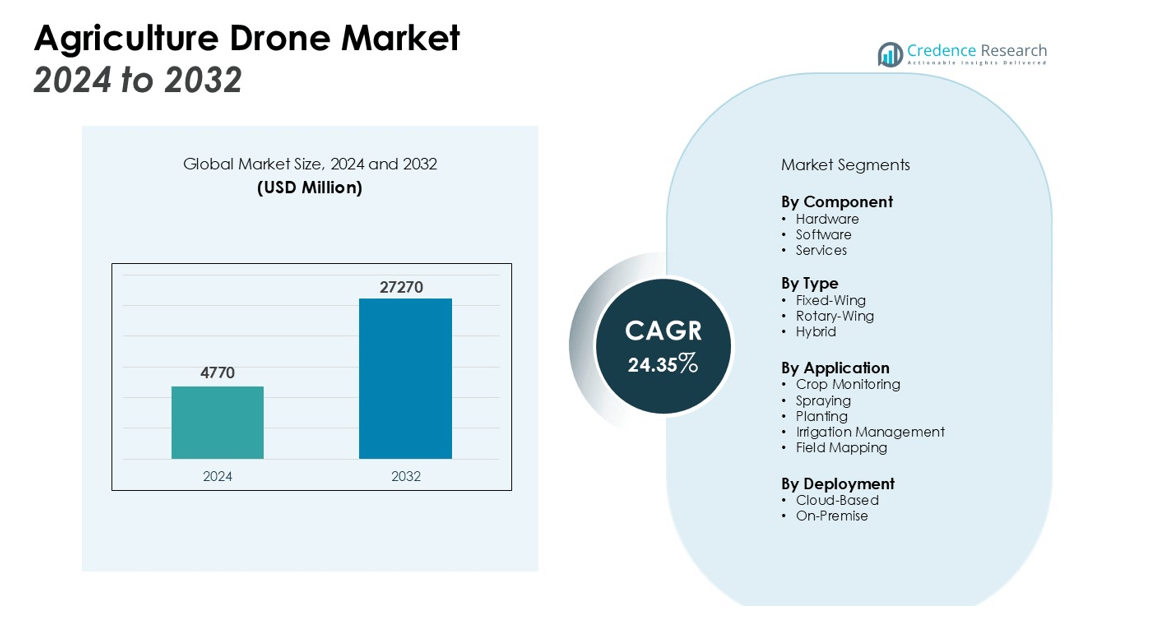
The Agriculture Drones Market size was valued at USD 4770 million in 2024 and is anticipated to reach USD 27270 million by 2032, at a CAGR of 24.35% during the forecast period (2024-2032).
| REPORT ATTRIBUTE | DETAILS |
|---|---|
| Historical Period | 2020-2023 |
| Base Year | 2024 |
| Forecast Period | 2025-2032 |
| Agriculture Drone Market Size 2024 | USD 4770 million |
| Agriculture Drone Market, CAGR | 24.35% |
| Agriculture Drone Market Size 2032 | USD 27270 million |
The agriculture drone market is driven by rising demand for precision agriculture, labor shortages, and environmental concerns. Drones enable accurate pesticide and fertilizer application, which reduces waste and minimizes chemical runoff. They also support crop health monitoring through multispectral sensors, allowing early detection of diseases. Continuous advances in artificial intelligence, longer battery life, and improved affordability further strengthen adoption. Additionally, policy support and subsidies in major farming regions accelerate the integration of drone technology into modern farming practices.
Asia-Pacific leads the global market, with China and India at the forefront due to large-scale farming operations and strong government initiatives. North America ranks next, benefiting from technological innovation and active collaboration between agriculture and technology companies. Europe shows consistent growth, supported by sustainability regulations and precision farming programs. Latin America and Africa, though still developing in this segment, present significant opportunities as farming infrastructure improves and awareness of drone benefits increases.
Market Insights:
- The Agriculture Drone Market was valued at USD 4770 million and will reach USD 27270 million by 2032, growing at a CAGR of 24.35%.
- Asia-Pacific leads with 38% share, supported by China’s manufacturing strength and India’s government-backed initiatives.
- North America follows with 30% share, driven by innovation, strong digital infrastructure, and active industry collaborations.
- Europe holds 22% share, guided by strict sustainability regulations, while Latin America and Africa together account for 10%.
- Rising demand for precision agriculture, crop monitoring, and optimized input use is driving consistent adoption.
- High costs, technical barriers, and regulatory restrictions continue to challenge smaller farms and developing regions.
- Supportive government policies, subsidies, and integration with AI-driven solutions strengthen future market expansion.
Market Drivers:
Rising Demand for Precision Agriculture Technologies
The Agriculture Drone Market benefits from the global shift toward precision agriculture. Farmers use drones for accurate field mapping, soil analysis, and crop monitoring. It enables targeted use of water, fertilizers, and pesticides, improving efficiency and lowering costs. This adoption reduces environmental impact while ensuring higher yields. The growing need to optimize inputs and maximize output fuels consistent demand.
- For instance, the company Equinox Drones, with its product EquiAgra 16.0, uses automated plant count algorithms to track agricultural yield across many acres of land, demonstrating the technology's ability to precisely monitor large-scale operations.
Addressing Labor Shortages and Enhancing Efficiency
Labor shortages in agriculture accelerate drone adoption across both developed and developing regions. It supports farmers by performing tasks like spraying, planting, and crop surveillance with greater speed. Drones reduce dependency on manual labor while ensuring consistent accuracy. This efficiency allows farmers to manage large-scale farms with fewer workers. The technology creates measurable improvements in productivity and cost savings.
- For instance, The DJI Agras T30 drone has a maximum advertised spraying capacity of up to 40 acres per hour. Its actual hourly work efficiency can vary based on factors such as field size and shape, application rates, drone refilling, and battery charging logistics.
Technological Advancements and Cost Reductions
Advances in artificial intelligence, machine learning, and sensor integration strengthen the capabilities of agricultural drones. It enables early detection of pests, diseases, and nutrient deficiencies, helping farmers make timely decisions. Improved battery performance and flight control extend operational time in the field. Costs continue to fall, making drones more accessible to medium and small-scale farmers. These developments ensure steady growth across the sector.
Supportive Policies and Sustainability Goals
Government policies and subsidies encourage the deployment of drones in agriculture. It aligns with sustainability objectives by minimizing chemical overuse and conserving natural resources. Many regions invest in agtech initiatives, providing financial and technical support to farmers adopting drones. Sustainability goals across Europe, Asia-Pacific, and North America drive structured implementation of drone solutions. This policy support reinforces long-term growth in the Agriculture Drone Market.
Market Trends:
Integration of Advanced Technologies and Data-Driven Solutions
The Agriculture Drone Market is witnessing a clear shift toward advanced technologies that enhance precision and efficiency. Drones equipped with multispectral, hyperspectral, and thermal sensors deliver real-time insights into soil health, crop stress, and water distribution. Artificial intelligence and machine learning algorithms now process drone-captured images, enabling predictive analytics and actionable recommendations for farmers. It supports decision-making by detecting early signs of disease and nutrient deficiencies. Cloud-based platforms and farm management software integrate with drone data, creating a seamless digital ecosystem for agriculture. This trend not only improves operational control but also strengthens long-term sustainability practices.
- For instance, DJI's P4 Multispectral drone achieves centimeter-level precision, with a horizontal positioning accuracy of 1 cm + 1 ppm, enhancing the reliability of farm data.
Expansion of Commercial Applications and Growing Adoption Globally
The Agriculture Drone Market shows a strong expansion of applications beyond monitoring and spraying. Drones are increasingly used for crop planting, irrigation management, and livestock monitoring, broadening their role in farm operations. It accelerates adoption among commercial farms that seek scalable solutions for large fields. Governments and private players are promoting pilot projects, grants, and partnerships to improve awareness and encourage usage. Regional adoption patterns highlight strong growth in Asia-Pacific and North America, where technological ecosystems support rapid deployment. Europe maintains steady adoption driven by environmental policies, while Latin America and Africa are emerging with growing interest. These expanding applications and global adoption trends solidify the role of drones in modern agriculture.
- For instance, AeroVironment’s Quantix drone is built for large-scale crop scouting and can survey an area of up to 400 acres in one 45-minute flight.
Market Challenges Analysis:
High Costs, Technical Barriers, and Limited Awareness
The Agriculture Drone Market faces challenges linked to high initial investment and technical complexity. Many small and medium-scale farmers find advanced drones costly, limiting widespread adoption. It also requires specialized training to operate drones and interpret collected data, creating barriers in rural areas with limited technical knowledge. Maintenance and repair costs further increase financial pressure, especially in developing regions. Limited awareness of the long-term benefits of drones reduces adoption rates in traditional farming communities. These challenges slow market penetration despite strong potential.
Regulatory Restrictions and Infrastructure Limitations
Strict aviation regulations and complex approval processes create significant hurdles for the Agriculture Drone Market. It is often restricted by rules on altitude, range, and data privacy, which differ across regions. Inconsistent policies hinder large-scale deployment and discourage smaller players from investing in drone technology. Poor connectivity and limited digital infrastructure in rural areas reduce the effectiveness of data-driven drone solutions. Concerns over data security and integration with farm management systems also create resistance. These regulatory and infrastructural limitations remain major challenges for market growth.
Market Opportunities:
Rising Role of Smart Farming and Digital Transformation
The Agriculture Drone Market presents strong opportunities through the expansion of smart farming practices. Growing reliance on digital agriculture creates demand for drones that deliver accurate and timely insights. It supports sustainable farming by enabling resource optimization, reducing chemical usage, and improving crop yields. Integration with IoT devices, satellite imaging, and artificial intelligence enhances precision agriculture systems. Increasing adoption of farm management software creates synergy with drone-based data collection. These factors open new growth avenues for companies offering integrated drone solutions.
Expansion in Emerging Markets and Government Support
Emerging economies provide significant opportunities for the Agriculture Drone Market due to large agricultural bases and rising food demand. Governments in Asia-Pacific, Latin America, and Africa are promoting technology adoption through subsidies, training programs, and pilot projects. It encourages farmers to adopt drones for irrigation management, spraying, and field mapping. Agritech startups and partnerships with established manufacturers strengthen accessibility in cost-sensitive markets. Expanding applications in forestry, livestock management, and environmental monitoring further extend market scope. These developments highlight strong growth prospects across both developed and developing regions.
Market Segmentation Analysis:
By Component
The Agriculture Drone Market by component is divided into hardware, software, and services. Hardware dominates due to strong demand for advanced sensors, cameras, and navigation systems. Software is expanding with AI-driven analytics platforms that improve image processing and predictive insights. It strengthens decision-making by integrating drone data with farm management solutions. Services such as training, maintenance, and consulting also gain momentum, supported by rising adoption among medium and large-scale farms.
- For instance, in hardware, DJI's Agras T50 drone can carry a spraying payload of 40 kg. In software, PrecisionHawk’s platform uses AI to automate plant inventory and health analysis.
By Type
The Agriculture Drone Market by type includes fixed-wing, rotary-wing, and hybrid drones. Rotary-wing drones hold the largest share because of their maneuverability and suitability for small and fragmented farms. Fixed-wing models are effective in covering large agricultural fields with efficiency and speed. It is especially valuable in regions with expansive farmland such as North America and Asia-Pacific. Hybrid drones are emerging as a promising category, offering the combined advantages of fixed and rotary-wing systems.
- For instance, the DJI Agras T40, a rotary-wing model, has an obstacle detection range of up to 50 meters.
By Applications
The Agriculture Drone Market by application spans crop monitoring, spraying, planting, irrigation management, and field mapping. Crop monitoring leads the segment, supported by the need for real-time insights and early disease detection. Spraying applications are expanding rapidly, driven by the focus on reducing chemical waste and improving efficiency. It helps farmers optimize input use while ensuring higher yields. Field mapping and irrigation management also show consistent growth, aligning with global precision agriculture initiatives and sustainability practices.
Segmentations:
By Component
- Hardware
- Software
- Services
By Type
- Fixed-Wing
- Rotary-Wing
- Hybrid
By Applications
- Crop Monitoring
- Spraying
- Planting
- Irrigation Management
- Field Mapping
By Deployment
- Cloud-Based
- On-Premise
By Region
- North America
- U.S.
- Canada
- Mexico
- Europe
- UK
- France
- Germany
- Italy
- Spain
- Russia
- Belgium
- Netherlands
- Austria
- Sweden
- Poland
- Denmark
- Switzerland
- Rest of Europe
- Asia Pacific
- China
- Japan
- South Korea
- India
- Australia
- Thailand
- Indonesia
- Vietnam
- Malaysia
- Philippines
- Taiwan
- Rest of Asia Pacific
- Latin America
- Brazil
- Argentina
- Peru
- Chile
- Colombia
- Rest of Latin America
- Middle East
- UAE
- KSA
- Israel
- Turkey
- Iran
- Rest of Middle East
- Africa
- Egypt
- Nigeria
- Algeria
- Morocco
- Rest of Africa
Regional Analysis:
Asia-Pacific Leading with Strong Adoption and Government Support
Asia-Pacific holds 38% share of the Agriculture Drone Market, making it the largest regional market. China accounts for a major portion, supported by domestic manufacturing strength and government subsidies. India contributes significantly through government-backed digital farming programs and demand for higher productivity. It benefits from advanced technology ecosystems and training initiatives that lower adoption barriers. Japan and South Korea also add momentum through AI-enabled drone research and commercial integration. The region continues to expand its lead with large-scale adoption and robust policy support.
North America Driving Growth with Innovation and Partnerships
North America captures 30% share of the Agriculture Drone Market, ranking second globally. The United States leads regional adoption with strong investments in precision agriculture and widespread digital infrastructure. Canada adds to the share through sustainability-focused programs and digital monitoring practices. It benefits from collaborations between drone makers, software firms, and farm cooperatives that create scalable solutions. Favorable regulations encourage broad usage across small and large farms. The region continues to drive global innovation and advanced deployment.
Europe and Emerging Regions Expanding Steadily
Europe accounts for 22% share of the Agriculture Drone Market, driven by regulatory alignment with sustainable farming goals. Germany, France, and the UK are leading adopters, integrating drones to achieve efficiency and environmental compliance. It reflects the region’s focus on digital farming strategies under EU policies. Latin America and Africa together hold 10% share, supported by rising agricultural demand and government-backed pilot projects. Infrastructure growth and farmer awareness are gradually removing adoption barriers. These regions remain important future growth areas as technology costs decline and accessibility improves.
Key Player Analysis:
- DJI (China)
- DroneDeploy (US)
- 3DR (US), Sentera Inc. (US)
- PrecisionHawk (US)
- ATMOS UAV (Netherlands)
- Delair (France)
- Trimble Inc. (US)
- SlantRange (US)
- Nileworks Inc. (Japan)
- Parrot Drones (France)
- AeroVironment, Inc. (US)
- Yamaha Motor Co., Ltd. (Japan)
- AgEagle Aerial Systems, Inc. (US)
Competitive Analysis:
The Agriculture Drone Market is highly competitive, with global and regional players focusing on innovation and scalability. Leading companies invest in advanced technologies such as multispectral sensors, AI-driven analytics, and automated spraying systems to differentiate their offerings. It is characterized by strategic partnerships between drone manufacturers, software developers, and agtech firms that expand application scope and improve integration with farm management platforms. Cost optimization and user-friendly designs remain priorities to attract small and medium-scale farmers, especially in emerging markets. Companies also pursue mergers, acquisitions, and collaborations to strengthen distribution networks and increase market presence. Growing emphasis on regulatory compliance and sustainability drives firms to align their products with government initiatives and precision farming programs. The competition continues to intensify, as established aerospace and technology firms enter the sector alongside specialized agricultural drone startups, broadening market opportunities while increasing rivalry across all regions.
Recent Developments:
- In May 2025, DJI launched the Mavic 4 Pro, which features a triple camera system and an extended flight time of up to 52 minutes.
- In February 2025, Platform Science completed its acquisition of Trimble's global transportation telematics business units, with Trimble becoming a strategic investor and shareholder in Platform Science.
- In August 2025, AeroVironment delivered its P550 small Unmanned Aircraft Systems (sUAS) to the U.S. Army for its Long-Range Reconnaissance (LRR) program.
Report Coverage:
The research report offers an in-depth analysis based on Component, Type, Applications, Deployment and Region. It details leading market players, providing an overview of their business, product offerings, investments, revenue streams, and key applications. Additionally, the report includes insights into the competitive environment, SWOT analysis, current market trends, as well as the primary drivers and constraints. Furthermore, it discusses various factors that have driven market expansion in recent years. The report also explores market dynamics, regulatory scenarios, and technological advancements that are shaping the industry. It assesses the impact of external factors and global economic changes on market growth. Lastly, it provides strategic recommendations for new entrants and established companies to navigate the complexities of the market.
Future Outlook:
- Precision agriculture will remain the primary growth driver, with drones becoming integral to field monitoring and crop management.
- Integration of AI and machine learning will enhance data accuracy, enabling predictive insights for disease and pest detection.
- Drone-based spraying systems will expand further, reducing chemical usage and improving resource efficiency.
- Governments will strengthen support through subsidies, training programs, and regulatory reforms to encourage broader adoption.
- Sustainability goals will drive greater use of drones to minimize environmental impact and conserve water, soil, and energy.
- Expansion in emerging economies will accelerate, supported by rising food demand and improving agricultural infrastructure.
- Collaboration between drone manufacturers, software firms, and agricultural cooperatives will create comprehensive solutions for farmers.
- Advances in battery technology and automation will extend flight duration and reduce operational costs.
- Large-scale farms will adopt drones rapidly, while affordability improvements will expand access for small and medium farms.
- Growing applications in forestry, livestock management, and environmental monitoring will further diversify the market landscape.

Request a Free Sample
Fill in your details and we'll send you a free sample report.
- Sample data tables & charts
- Research methodology
Market Dynamics
Adoption of Precision Agriculture Technologies
Farmers are increasingly using drones for field mapping, soil analysis, and crop monitoring, enabling targeted application of water, fertilizers, and pesticides. This improves efficiency, reduces costs, and minimizes environmental impact, fueling market growth.
Labor Shortages and Efficiency Needs
Drones help address agricultural labor shortages by automating tasks such as spraying, planting, and surveillance, allowing large-scale farm management with fewer workers and improving overall productivity.
Technological Advancements and Cost Reductions
Continuous improvements in AI, sensors, battery life, and flight control are making drones more capable and affordable, expanding their accessibility to medium and small-scale farmers and driving broader adoption.
Supportive Government Policies and Subsidies
Many governments, especially in Asia-Pacific and North America, are providing subsidies, training, and regulatory support for drone adoption, accelerating integration into mainstream farming practices.
Sustainability and Environmental Concerns
Drones enable precise input application, reducing chemical runoff and conserving resources, which aligns with global sustainability goals and regulatory requirements, further encouraging market expansion.
Need a Custom Version of This Report?
Tailor the scope, geography, or segments to your exact requirements.
- Custom geography or segment scope
- Direct access to our analyst team
Frequently Asked Questions
What is the current market size for Agriculture Drones, and what is its projected size in 2032?
At what Compound Annual Growth Rate is the Agriculture Drones market projected to grow between 2024 and 2032?
What are the primary factors fueling the growth of the Agriculture Drones market?
What are some challenges faced by Agricultural Drones?
Who are the major players in Agricultural Drones?
Table of Content
Chapter 1 Market Segmentation
- 1.1 Segmentation Framework
- 1.1.1 Product and Service Classification
- 1.1.2 Application and End-Use Classification
- 1.1.3 Technology and Solution Classification
- 1.1.4 Customer and Distribution Channel Classification
- 1.1.5 Geographic Segmentation
- 1.1.6 Market Segment Definitions and Boundaries
- 1.2 By Type
- 1.2.1 Fixed-Wing
- 1.2.2 Rotary-Wing
- 1.2.3 Hybrid
- 1.3 By Component
- 1.3.1 Hardware
- 1.3.2 Software
- 1.3.3 Services
- 1.4 By Deployment
- 1.4.1 Cloud-Based
- 1.4.2 On-Premise
- 1.5 By Application
- 1.5.1 Crop Monitoring
- 1.5.2 Spraying
- 1.5.3 Planting
- 1.5.4 Irrigation Management
- 1.5.5 Field Mapping
Chapter 2 Introduction
- 2.1 Report Objectives and Scope
- 2.2 Product Definition and Industry Terminology
- 2.3 Market Inclusions and Exclusions
- 2.4 Research Process
- 2.4.1 Primary Research and Expert Interviews
- 2.4.2 Secondary Research and Source Review
- 2.4.3 Top-Down and Bottom-Up Estimation
- 2.4.4 Data Triangulation and Verification
- 2.5 Market Size Measurement Basis
- 2.5.1 2024: USD 4770 million → 2032: USD 27270 million
- 2.6 Historical and Forecast Reference Periods
- 2.6.1 Base Year: 2024
- 2.6.2 Forecast Period: 2024-2032
- 2.7 Research Assumptions and Limitations
Chapter 3 Executive Summary
- 3.1 Market Snapshot and Key Findings
- 3.2 Base-Year Market Size, 2024
- 3.3 Forecast Market Size, 2032
- 3.4 Revenue and Volume Growth Outlook
- 3.5 Key Demand and Supply Indicators
- 3.6 Leading Market Segments
- 3.7 Fastest-Growing Market Opportunities
- 3.8 Regional Performance Highlights
- 3.9 Technology and Industry Transformation
- 3.10 Competitive Landscape Summary
- 3.11 Analyst View and Strategic Implications
Chapter 4 Global Agricultural Drones Market Trends and Developments
- 4.1 Historical Industry Development
- 4.2 Recent Market Trends and Developments
- 4.3 Demand and Customer Behavior Trends
- 4.4 Technology and Product Innovation
- 4.5 Artificial Intelligence, Automation and Digitalization
- 4.6 Local Manufacturing and Supply Chain Realignment
- 4.7 Industry Partnerships, Mergers and Acquisitions
- 4.8 Sustainability and Circular Economy Developments
- 4.9 Government and Private Sector Investment Trends
- 4.10 Emerging Business Models and Commercialization
- 4.11 Industry Developments and Announcements
Chapter 5 Global Agricultural Drones Market Production, Supply and Demand Analysis
- 5.1 Demand Trend and Consumption Analysis
- 5.2 Demand Forecast, 2024-2032
- 5.3 Production and Output Trend
- 5.4 Production and Output Forecast, 2024-2032
- 5.5 Installed Capacity and Capacity Utilization
- 5.6 Company-Wise Production Plants and Statistics
- 5.6.1 Installed Production Capacity
- 5.6.2 Actual Production
- 5.6.3 Planned Capacity and Expansion Targets
- 5.7 Supply Chain Structure and Procurement Trends
- 5.8 Supply-Demand Gap and Bottlenecks
- 5.9 Import Dependence and Sourcing Structure
- 5.10 Contract Manufacturing and Outsourcing
- 5.11 Regional Supply and Demand Concentration
Chapter 6 Global Agricultural Drones Market Pricing Analysis
- 6.1 Pricing Structure and Measurement
- 6.2 Historical Pricing Trends
- 6.3 Pricing Outlook, 2024-2032
- 6.4 Average Selling Price and Unit Economics
- 6.5 Pricing by Product and Market Segment
- 6.6 Geographic Pricing Differences
- 6.7 Key Input, Energy, Labor and Logistics Costs
- 6.8 Contract Pricing and Purchasing Models
- 6.9 Pricing Sensitivity and Competitive Positioning
- 6.10 Price, Margin and Profitability Implications
Chapter 7 Global Agricultural Drones Market Dynamics
- 7.1 Market Growth Drivers
- 7.1.1 Demand-Side Drivers
- 7.1.2 Technology and Innovation Drivers
- 7.1.3 Infrastructure and Investment Drivers
- 7.1.4 Regulatory and Policy Drivers
- 7.2 Market Restraints
- 7.2.1 Cost and Affordability Constraints
- 7.2.2 Technology and Adoption Barriers
- 7.2.3 Supply Chain and Operational Constraints
- 7.3 Market Challenges
- 7.3.1 Competitive Pressure and Margin Erosion
- 7.3.2 Skills, Infrastructure and Implementation Gaps
- 7.4 Emerging Market Opportunities
- 7.5 Market Dynamics Impact and Time-Horizon Assessment
Chapter 8 Global Agricultural Drones Value Chain Analysis
- 8.1 Industry Value Chain Overview
- 8.2 Upstream Suppliers and Critical Inputs
- 8.3 Technology and Component Providers
- 8.4 Manufacturing or Service Delivery
- 8.5 Distribution, Channel Partners and Integrators
- 8.6 Downstream Applications and End Users
- 8.7 Value Addition and Profit Pools
- 8.8 Vertical Integration and Outsourcing
- 8.9 Supplier Concentration and Risk
- 8.10 Supply Chain Localization and Resilience
Chapter 9 Global Agricultural Drones Market Regulations and Policies
- 9.1 Relevant Laws, Standards and Compliance Frameworks
- 9.2 Product, Service, Safety and Quality Requirements
- 9.3 Government Policies, Incentives and Subsidies
- 9.4 Imports, Exports and Trade Barriers
- 9.5 Public Procurement and Local Content Requirements
- 9.6 Environmental and Sustainability Compliance
- 9.7 Data Protection, AI and Cybersecurity Compliance
- 9.8 Upcoming Policy Changes and Market Implications
Chapter 10 Global Agricultural Drones Market Hotspots and Opportunities
- 10.1 Market Opportunity Mapping and Growth Hotspots
- 10.2 High-Growth Applications and Customer Groups
- 10.3 Underserved Markets and White-Space Opportunities
- 10.4 Emerging Technology and Product Opportunities
- 10.5 New Capacity and Investment Hotspots
- 10.6 Market Entry and Expansion Opportunities
- 10.7 Distribution and Partnership Opportunities
- 10.8 Near-Term and Long-Term Commercial Potential
- 10.9 Opportunity Attractiveness and Execution Risks
Chapter 11 Global Agricultural Drones Market Outlook, 2024-2032
- 11.1 Market Size and Analysis
- 11.1.1 Revenue (Market Measurement: 2024: USD 4770 million → 2032: USD 27270 million)
- 11.1.2 Market Volume and Quantity Sold
- 11.1.3 Historical Market Size
- 11.1.4 Base-Year Market Size, 2024
- 11.2 Market Forecast, 2024-2032
- 11.2.1 Revenue Forecast to 2032
- 11.2.2 Volume Forecast to 2032
- 11.2.3 CAGR and Year-on-Year Growth
- 11.2.4 Incremental Revenue Opportunity
- 11.3 Forecast Assumptions and Scenario Analysis
- 11.3.1 Base-Case Forecast
- 11.3.2 Optimistic and Conservative Scenarios
- 11.3.3 Technology, Pricing and Policy Sensitivities
- 11.4 Market Attractiveness and Growth Outlook
Chapter 12 Global Agricultural Drones Market Segmentation and Outlook
- 12.1 Segmentation Summary and Market Shares, 2024
- 12.2 Largest and Fastest-Growing Segments
- 12.3 By Type - Market Size and Forecast, 2024-2032
- 12.3.1 Segment Definition and Scope
- 12.3.2 Historical Market Size
- 12.3.3 Revenue Forecast, 2024-2032
- 12.3.4 Volume Forecast, 2024-2032
- 12.3.5 Base-Year Market Share, 2024
- 12.3.6 Segment CAGR and Growth Drivers
- 12.3.7 Subsegment Market Size and Forecast
- 12.3.7.1 Fixed-Wing
- 12.3.7.2 Rotary-Wing
- 12.3.7.3 Hybrid
- 12.3.8 Subsegment Pricing and Adoption Trends
- 12.3.9 Leading Suppliers and Competition
- 12.3.10 Regional Demand and Opportunities
- 12.4 By Component - Market Size and Forecast, 2024-2032
- 12.4.1 Segment Definition and Scope
- 12.4.2 Historical Market Size
- 12.4.3 Revenue Forecast, 2024-2032
- 12.4.4 Volume Forecast, 2024-2032
- 12.4.5 Base-Year Market Share, 2024
- 12.4.6 Segment CAGR and Growth Drivers
- 12.4.7 Subsegment Market Size and Forecast
- 12.4.7.1 Hardware
- 12.4.7.2 Software
- 12.4.7.3 Services
- 12.4.8 Subsegment Pricing and Adoption Trends
- 12.4.9 Leading Suppliers and Competition
- 12.4.10 Regional Demand and Opportunities
- 12.5 By Deployment - Market Size and Forecast, 2024-2032
- 12.5.1 Segment Definition and Scope
- 12.5.2 Historical Market Size
- 12.5.3 Revenue Forecast, 2024-2032
- 12.5.4 Volume Forecast, 2024-2032
- 12.5.5 Base-Year Market Share, 2024
- 12.5.6 Segment CAGR and Growth Drivers
- 12.5.7 Subsegment Market Size and Forecast
- 12.5.7.1 Cloud-Based
- 12.5.7.2 On-Premise
- 12.5.8 Subsegment Pricing and Adoption Trends
- 12.5.9 Leading Suppliers and Competition
- 12.5.10 Regional Demand and Opportunities
- 12.6 By Application - Market Size and Forecast, 2024-2032
- 12.6.1 Segment Definition and Scope
- 12.6.2 Historical Market Size
- 12.6.3 Revenue Forecast, 2024-2032
- 12.6.4 Volume Forecast, 2024-2032
- 12.6.5 Base-Year Market Share, 2024
- 12.6.6 Segment CAGR and Growth Drivers
- 12.6.7 Subsegment Market Size and Forecast
- 12.6.7.1 Crop Monitoring
- 12.6.7.2 Spraying
- 12.6.7.3 Planting
- 12.6.7.4 Irrigation Management
- 12.6.7.5 Field Mapping
- 12.6.8 Subsegment Pricing and Adoption Trends
- 12.6.9 Leading Suppliers and Competition
- 12.6.10 Regional Demand and Opportunities
- 12.7 Segment Growth Comparison
- 12.8 Segment Attractiveness and Priority Matrix
Chapter 13 Global Agricultural Drones End-Use and Application Market Outlook
- 13.1 End-Use Industry and Customer Demand Structure
- 13.2 Leading Applications and Customer Groups
- 13.3 End-Use Market Size, Share and Forecast
- 13.4 Major End-Use Industry Deep Dives
- 13.4.1 Customer Requirements and Use Cases
- 13.4.2 Demand and Replacement Cycles
- 13.4.3 Technical and Regulatory Considerations
- 13.4.4 Purchasing and Procurement Models
- 13.4.5 Leading Vendors and Distribution Channels
- 13.4.6 Forecast and Commercial Opportunities
- 13.5 Emerging Applications and Cross-Segment Demand
- 13.6 End-Use Industry Investment Priorities
Chapter 14 Global Agricultural Drones Geographic Market Outlook, 2024-2032
- 14.1 Regional Market Size and Share, 2024
- 14.2 Regional Market Forecast, 2024-2032
- 14.3 Regional Pricing, Production and Demand Differences
- 14.4 North America
- 14.4.1 United States
- 14.4.2 Canada
- 14.4.3 Mexico
- 14.5 Europe
- 14.5.1 Germany
- 14.5.2 France
- 14.5.3 Italy
- 14.5.4 United Kingdom
- 14.5.5 Spain
- 14.5.6 Poland
- 14.5.7 Russia
- 14.5.8 Netherlands
- 14.5.9 Belgium
- 14.5.10 Sweden
- 14.5.11 Denmark
- 14.5.12 Norway
- 14.5.13 Rest of Europe
- 14.6 Asia Pacific
- 14.6.1 China
- 14.6.2 India
- 14.6.3 Japan
- 14.6.4 South Korea
- 14.6.5 Thailand
- 14.6.6 Indonesia
- 14.6.7 Vietnam
- 14.6.8 Malaysia
- 14.6.9 Australia
- 14.6.10 Rest of Asia Pacific
- 14.7 Latin America
- 14.7.1 Brazil
- 14.7.2 Argentina
- 14.7.3 Colombia
- 14.7.4 Chile
- 14.7.5 Rest of Latin America
- 14.8 Middle East
- 14.8.1 Saudi Arabia
- 14.8.2 United Arab Emirates
- 14.8.3 Turkey
- 14.8.4 Israel
- 14.8.5 Iran
- 14.8.6 Rest of the Middle East
- 14.9 Africa
- 14.9.1 South Africa
- 14.9.2 Egypt
- 14.9.3 Nigeria
- 14.9.4 Morocco
- 14.9.5 Rest of Africa
- 14.10 Regional Investment, Policy and Supply Chain Differences
- 14.11 Regional Competitive Landscape
- 14.12 Geographic Growth Hotspots
Chapter 15 Global Agricultural Drones Technology, Innovation and Sustainability Outlook
- 15.1 Technology Landscape and Maturity
- 15.2 Product, Process and Service Innovation
- 15.3 AI, Automation and Digital Tools in the Industry
- 15.4 Technology Adoption and Performance Benchmarking
- 15.5 Innovation Pipeline and R&D Investment
- 15.6 Patent and Intellectual Property Trends
- 15.7 Energy Efficiency and Resource Management
- 15.8 Sustainability, Recycling and Circularity
- 15.9 Technology Roadmap, 2024-2032
- 15.10 Risks of Obsolescence and Technology Substitution
Chapter 16 Global Agricultural Drones Market Key Strategic Imperatives
- 16.1 Growth and Market Entry Priorities
- 16.2 High-Return Products and Segments
- 16.3 Pricing, Profitability and Cost Optimization
- 16.4 Technology Investment and Product Differentiation
- 16.5 Supply Chain Localization and Resilience
- 16.6 Distribution and Customer Acquisition
- 16.7 Partnership, Acquisition and Capacity Strategy
- 16.8 Regional Expansion Priorities
- 16.9 Short-, Medium- and Long-Term Actions
Chapter 17 Competition Outlook
- 17.1 Industry Competition Characteristics
- 17.2 Market Structure and Concentration
- 17.3 Market Share and Competitive Positioning, 2024
- 17.4 Company-Wise Revenue and Product Benchmarking
- 17.5 Production and Service Capacity Benchmarking
- 17.6 Technology, Pricing and Differentiation
- 17.7 Regional Footprint and Distribution Strength
- 17.8 Mergers, Acquisitions and Strategic Alliances
- 17.9 New Entrants and Competitive Threats
- 17.10 Porter's Five Forces and Industry Attractiveness
- 17.11 Competitive Outlook, 2024-2032
Chapter 18 Company Profiles
- 18.1 Company Coverage and Selection Criteria
- 18.2 DJI
- 18.2.1 Business Description
- 18.2.2 Company Ownership and Geographic Presence
- 18.2.3 Product and Service Portfolio
- 18.2.4 Manufacturing and Operating Footprint
- 18.2.5 Production Capacity and Expansion Plans
- 18.2.6 Financial Performance and Investment
- 18.2.7 Market Share and Competitive Position
- 18.2.8 Technology and Innovation Capabilities
- 18.2.9 Strategic Alliances or Partnerships
- 18.2.10 Recent Developments
- 18.2.11 Growth Strategy and Outlook
- 18.3 DroneDeploy
- 18.4 PrecisionHawk
- 18.5 AeroVironment
- 18.6 Trimble Inc.
- 18.7 Parrot Drones
- 18.8 Sentera Inc.
- 18.9 Delair
- 18.10 AgEagle Aerial Systems
- 18.11 Yamaha Motor Co., Ltd.
- 18.12 Other Relevant Market Participants
Note: Every listed company is profiled on the structure shown under the first company. The company list is preliminary and may change based on research findings, market developments, data availability and client requirements.
Chapter 19 Disclaimer
- 19.1 Research and Forecast Disclaimer
- 19.2 Data Source and Estimation Limitations
Note: The depth of individual sections depends on data availability for this market. Volume, capacity, trade and other unit-based metrics are included where applicable.

