
| REPORT ATTRIBUTE | DETAILS |
|---|---|
| Historical Period | 2019-2022 |
| Base Year | 2023 |
| Forecast Period | 2024-2032 |
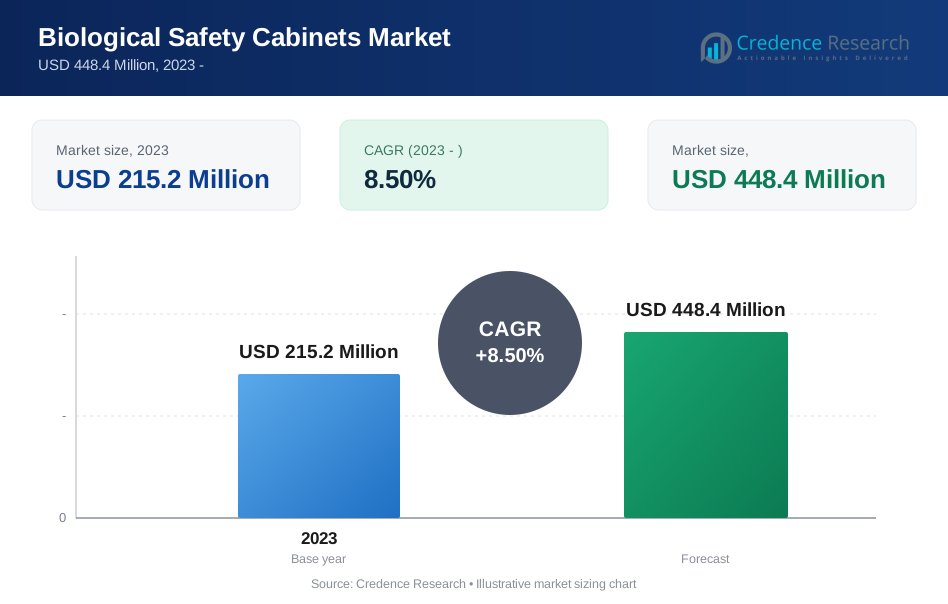
| Biological Safety Cabinets Market Size 2023 | USD 215.2 Million |
| Biological Safety Cabinets Market, CAGR | 8.50% |
| Biological Safety Cabinets Market Size 2032 | USD 448.4 Million |
Market Insights
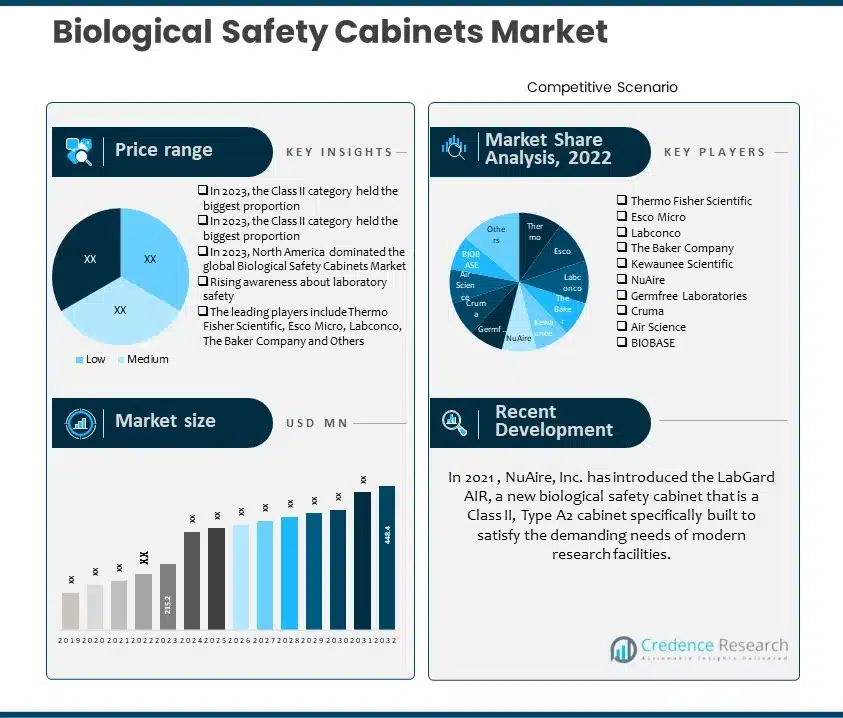
- The global demand for Biological Safety Cabinets was valued at USD 215.2 Million in 2023 and is expected to reach USD 448.4 Million in 2032, growing at a CAGR of 8.50% between 2024 and 2032.
- In 2023, the Class II category held the largest proportion, accounting for more than 41.7%, while the Class I segment is predicted to increase significantly.
- In 2023, the pharmaceutical and biopharmaceutical enterprises segment led the market. The Hospitals and Diagnostic Centers category is also predicted to grow significantly.
- Drug Discovery and development is the fastest-growing category in the Biological Safety Cabinets Market, while the Biological and Microbiological Research category also maintains a significant market share.
- Type A2 cabinets are generally regarded as the most popular section.
- Compact cabinets are usually in more demand.
- HEPA filters frequently have the largest market share.
- In the Biological Safety Cabinets Market, the Ductless (Recirculating) Cabinets category has the greatest CAGR
- Increased R&D is expected to drive the growth of the biological safety cabinet market.
- Cost limitations impede market growth.
Executive Summary
Market Definition
Biological safety cabinets, also known as biosafety cabinets or microbiological safety cabinets, are designed to protect the environment against diseases. As a result, it is an embedded, ventilated laboratory workspace for securely working with materials that may be contaminated with pathogens, which are essentially virus-infected microorganisms that require a specific biosafety level. As a result, a biological safety cabinet (BSC) is a major engineering control used to protect the personnel from biohazardous or contagious agents, as well as to help maintain quality-standard control of the material being worked with by draining both the input and exhaust air.
Market Overview
The global Biological Safety Cabinets Market has witnessed steady growth in recent years and is expected to grow at a CAGR of 8.50% between 2024 and 2032. The market was valued at USD 215.2 million in 2023 and is expected to reach USD 448.4 million in 2032.
The Biological Safety Cabinets Market is experiencing significant growth due to the increasing emphasis on biosafety and the need for proper containment measures in research, pharmaceutical, and healthcare settings. These cabinets play a crucial role in providing a safe working environment when handling potentially hazardous biological materials. The market is driven by the rising demand for advanced laboratory equipment and the growing awareness about the importance of protecting researchers, samples, and the environment from potential contaminants. Factors such as stringent regulations, technological advancements, and the need for effective infection control measures also contribute to the market's growth. With the continuous advancements in biotechnology and the increasing focus on biosafety, the Biological Safety Cabinets Market is expected to expand further in the coming years.
Segmentation by Class of Biological Safety Cabinets
- In 2023, the Class II category held the biggest proportion, accounting for more than 41.7%. The Class II portion is further divided into Types A and B. These systems provide total safety and are frequently used in basic research activities, which has contributed to their rise.
- The Class I segment is expected to experience significant growth over the projection period. The rise is due to the fact that class I BSCs were the first cabinets to be recognized as BSCs, providing personnel and environmental protection.
Segmentation by End-User
- The pharmaceutical and biopharmaceutical businesses segment dominated the market in 2023. The growing number of approved pharmaceutical goods is expected to drive market demand.
- The Hospitals and Diagnostic Centers category is also expected to have significant growth in the BSC market.
Segmentation by Application
- Drug Discovery & Development is the fastest growing category in the Biological Safety Cabinets Market. This is due to the growing demand for safe and controlled conditions for medication research and development activities.
- The Biological and Microbiological Research category also holds a large market share. Researchers in this sector must use specific containment systems to ensure the safety of their work and the protection of samples. These sectors aid in the growth and development of the Biological Safety Cabinets Market.
Segmentation by Class II Biological Safety Cabinet Types
- Type A2 cabinets are frequently considered the most popular part. These cabinets offer a better level of protection than Type A1 cabinets. Type A2 cabinets provide both personnel and environmental protection, making them ideal for a variety of applications in the research, pharmaceutical, and healthcare sectors.
Segmentation by Cabinet Size
- Compact Cabinets are typically in higher demand. Compact cabinets are preferred when space is limited, such as in tiny laboratories or research centers. These cabinets provide the necessary safety features while taking up less space.
Segmentation by Filtration Technology
- HEPA filters often have the biggest market share. HEPA filters are commonly used in biological safety cabinets to remove airborne particles and bacteria, resulting in high levels of filtration and protection. Carbon filters are another key market area. Carbon filters are used to remove chemical vapors and odors from the air, making the laboratory environment safer and more comfortable.
Segmentation by Ventilation System
- In the Biological Safety Cabinets Market, the Ductless (Recirculating) Cabinets category has the highest CAGR. These cabinets provide flexibility and convenience by recirculating filtered air back into the laboratory, which eliminates the need for external ductwork.
Segmentation by Region
- In 2023, North America dominated the global Biological Safety Cabinets Market, accounting for 32.21% of total sales.
- Asia Pacific is expected to grow the fastest throughout the projected period.
- The rest of the world, including Latin America, the Middle East, and Africa, supplies the remaining demand for Biological Safety Cabinets.
North America owned the highest market share in 2023. The local presence of large businesses active in the extensive investigation of novel medication candidates against various ailments has contributed to the BSC market's rise. Furthermore, various biotechnology projects in the United States helped the region maintain its strong market position. For example, in March 2023, the US government declared priorities and goals for American biomanufacturing and biotechnology. It contained a strategy for improving biosafety and biosecurity in the bioeconomy, boosting education and training opportunities for the biomanufacturing and biotechnology workforce, and developing national biomanufacturing facilities, among other things.
Furthermore, Asia Pacific is expected to experience considerable expansion in the biological safety cabinet market. Ongoing drug discovery studies, private-public cooperation, and government initiatives are also expected to fuel the Asian biological safety cabinets market. For example, in December 2023, WHO stated that it would partner with the Ministry of Health and Population (MoHP) and the Country Office for Nepal to provide training on fundamental BSC certification methods in order to encourage trained professionals among in-country certifiers.
Key Highlights of the Report
Class of Biological Safety Cabinets, End-User, Application, Class II Biological Safety Cabinet Types, Cabinet Size, Filtration Technology, Ventilation System, and Region Segment of the Global Biological Safety Cabinets Market. In 2023, the Class II category will have the highest proportion, with Drug Discovery & Development being the fastest expanding category. In addition, Type A2 cabinets are generally regarded the most popular element, with Compact Cabinets being in higher demand. Also, the Ductless (Recirculating) Cabinets category has the highest CAGR, with North America leading the market growth.
.The market is being driven by an increased emphasis on biosafety and severe regulations, an increase in demand for modern laboratory equipment, and a growing awareness of the significance of protecting researchers and samples. Furthermore, the high cost of biological safety cabinets, the limited availability of experienced specialists, and the challenges of integrating advanced technologies into existing infrastructure are the primary limitations of the market.
North America dominated the market, with a 32.21% share in 2023. The local presence of large businesses active in the extensive investigation of novel medication candidates against various ailments has contributed to the BSC market's rise. Furthermore, Asia Pacific is predicted to have significant increase in the biological safety cabinet market.
What Are The Main Drivers Of The Global Biological Safety Cabinets Market?
One of the key drivers for the Biological Safety Cabinets Market is the increasing emphasis on biosafety and the implementation of stringent regulations. There is a growing recognition of the need to protect researchers, samples, and the environment from potential hazards. This has led to a rising demand for specialized containment devices like biological safety cabinets. Additionally, the growing demand for advanced laboratory equipment in research, pharmaceutical, and healthcare sectors is driving the market forward. With advancements in technology and increasing awareness about the importance of biosafety, the demand for biological safety cabinets is expected to continue to rise.
What Are The Major Challenges Faced By The Global Biological Safety Cabinets Market?
Despite the positive growth prospects, there are a few restraints that could impact the Biological Safety Cabinets Market. One of the main challenges is the high cost associated with these specialized cabinets. The advanced features and technologies incorporated into these cabinets make them relatively expensive, which can be a barrier to adoption for some organizations. Another restraint is the limited availability of skilled professionals who are trained in handling and maintaining these cabinets. This shortage of expertise can hinder the effective utilization of biological safety cabinets.
What Are The Growth Opportunities In The Global Biological Safety Cabinets Market?
The Biological Safety Cabinets Market presents several opportunities for growth and development. The expansion of the biotechnology and pharmaceutical industries creates a favorable environment for the market, as these sectors heavily rely on biosafety measures. Additionally, emerging markets offer significant growth opportunities as they increase their focus on biosafety and adopt advanced laboratory equipment. Collaborations and partnerships among manufacturers, researchers, and regulatory bodies can drive product development and innovation in the market. This collaboration can lead to the introduction of more efficient and user-friendly biological safety cabinets, further expanding the market's potential.
Market Drivers
Several factors drive the global Biological Safety Cabinets Market. The following are the key drivers of the global Biological Safety Cabinets Market:
Increased R&D Activities
Significant advancements in R&D have occurred over time as a result of modernization in laboratory equipment processes and reagents, and this is expected to continue in the near future, influencing the biological safety cabinets market. Healthcare facilities are expanding, resulting in the creation of new and enhanced setups to achieve precise outcomes through the significant use of technology. Automation is widely used in laboratories for a variety of purposes, including storage, sample preparation, sample and equipment mobility, and it saves time and money. Automation in laboratories also helps to maintain an effective workflow while reducing errors and contamination levels. Biological safety cabinets have advanced with features such as unique ventilation, energy efficiency, an adjustable height stand, a factory-installed UV lamp, and armrests, which lower the danger of infection while also making working more comfortable. Biological safety cabinets are simple to use since they feature a digital interface that enables for easy control of the cabinet's functions. It helps to reduce operational complexity, which might be a significant element in the future growth of the biological safety cabinet market.
Market Restraints
The global Biological Safety Cabinets Market faces some challenges that may hinder its growth. These include the following:
Cost Limitations
One significant restraint is cost limitations. The initial investment and ongoing maintenance costs associated with biological safety cabinets can be quite high. These cabinets require specialized engineering, construction, and materials to ensure proper containment and protection. The cost of manufacturing cabinets that meet stringent safety standards and regulatory requirements can be substantial.
Moreover, the need for regular maintenance, including filter replacements and certification, adds to the overall cost of owning and operating biological safety cabinets. These ongoing expenses can be a challenge for laboratories and research facilities with limited budgets.
Additionally, the cost of training personnel on proper usage and maintenance of the cabinets can also be a constraint. It is crucial to have well-trained individuals who understand the proper protocols and procedures for working with biological safety cabinets to ensure effective containment and minimize risks.
Opportunities
The global Biological Safety Cabinets Market offers significant growth opportunities. These include the following:
Increasing Focus on Biosafety and Research Compliance
With the growing emphasis on biosafety and research compliance, there is a significant opportunity for the Biological Safety Cabinets Market. As regulations and guidelines become more stringent, laboratories and research facilities are increasingly investing in advanced safety measures to ensure the protection of personnel and samples.
Biological safety cabinets play a crucial role in providing a controlled environment for working with hazardous materials and preventing the spread of contaminants. As organizations prioritize biosafety and compliance, there is a rising demand for high-quality biological safety cabinets that meet the latest safety standards and regulations.
This presents an opportunity for manufacturers to develop innovative cabinets with enhanced features such as improved airflow, advanced filtration systems, and smart monitoring capabilities. Additionally, companies can offer comprehensive services, including installation, maintenance, and certification of biological safety cabinets, to support customers in meeting regulatory requirements.
Competitive Landscape
Key Players
The global Biological Safety Cabinets Market is highly competitive, with several key players. Some of the major players in the market and their market share are as follows:
- Thermo Fisher Scientific
- Esco Micro
- Labconco
- The Baker Company
- Kewaunee Scientific
- NuAire
- Germfree Laboratories
- Cruma
- Air Science
- BIOBASE
These organizations prioritize product innovation, Form expansion, and mergers and acquisitions to stay competitive.
The global Biological Safety Cabinets Market's key players continually seek to stay ahead by offering new products and developments.
In 2020, Thermo Fisher Scientific launched two class II biosafety cabinets, Herasafe and Maxisafe 2030i systems, which are more advanced than the already available biosafety cabinets.
In 2019, Thermo Fisher Scientific has launched a cloud-enabled BSC, the HeraSafe 2030i cabinet, to preserve cell viability and user safety, which is the most critical concern while managing moderate to high risk research activities.
In 2019, Panasonic Healthcare Corporation introduced a new biosafety cabinet, the Class II Type A2 Biosafety Cabinet, which is suitable for low- to medium-risk research activity, medicine production, and product operations.
Summary of Key Findings
- Increasing emphasis on biosafety and research compliance.
- Class of Biological Safety Cabinets, End-User, Application, Class II Biological Safety Cabinet Types, Cabinet Size, Filtration Technology, Ventilation System, and the region segment of the market.
- In 2023, the pharmaceutical and biopharmaceutical enterprises segment dominated the market
- Drug Discovery & Development is the fastest growing category in the Biological Safety Cabinets Market.
- North America is leading market growth; the market is highly competitive with key players Thermo Fisher Scientific, Esco Micro, Labconco, The Baker Company and Others.
Future Outlook
- Increasing adoption of biosafety measures
- Advancements in technology and product innovation
- Growing demand from research and healthcare sectors
- Stringent regulations driving market growth
- Rising awareness about laboratory safety
- Expansion of biotechnology and pharmaceutical industries
- Focus on infection control and prevention
How CXOs Can Benefit from the Credence Research Biological Safety Cabinets Market Report
The Credence Research Biological Safety Cabinets Market Report provides CXOs with a comprehensive overview of the market, including:
- Market size and growth forecast: The report provides detailed estimates of the global Industrial salt market size, segmented by Class of Biological Safety Cabinets, End-User, Application, Class II Biological Safety Cabinet Types, Cabinet Size, Filtration Technology, Ventilation System, and Region. It also includes forecasts for the market through 2032 based on key trends and drivers.
- Market segmentation: The report segments the Industrial salt market by Class of Biological Safety Cabinets, End-User, Application, Class II Biological Safety Cabinet Types, Cabinet Size, Filtration Technology, Ventilation System, and Region. This segmentation provides CXOs with a granular understanding of the market and the opportunities in each segment.
- Competitive Landscape: The report profiles the key players in the Biological Safety Cabinets Market and provides insights into their strategies, product offerings, and financial performance. This information can help CXOs to identify and assess their competition.
- Key trends and drivers: The report identifies and analyzes the key trends and drivers shaping the Biological Safety Cabinets Market. This information can help CXOs make informed decisions about their investments and strategies.
CXOs can use the insights from the Credence Research Biological Safety Cabinets Market Report to:
- Identify growth opportunities: The report can help CXOs identify new growth opportunities in the Biological Safety Cabinets Market. For example, it can provide insights into emerging trends, consumer preferences, and technological advancements in the home audio industry.
- Make informed investment decisions: The report can help CXOs to make informed investment decisions about Biological Safety Cabinets. For example, it can provide valuable insights into market trends, growth potential, and key players in the industry.
- Develop competitive strategies: The report can help CXOs to develop competitive strategies for their Biological Safety Cabinets businesses. For example, the report may highlight the growing demand for electric vehicle testing equipment, allowing CXOs to focus their efforts on developing and marketing innovative solutions in this specific segment.
- Track market developments: The report can help CXOs monitor market developments and stay ahead of the curve. For example, it provides insights into the latest trends and innovations in the Biological Safety Cabinets Market.
Overall, the Credence Research Biological Safety Cabinets Market Report is a valuable resource for CXOs who are looking to gain a deeper understanding of the market and identify opportunities for growth.
Segmentation
By Class of Biological Safety Cabinets:
- Class I Biological Safety Cabinets
- Class II Biological Safety Cabinets (Types A1, A2, B1, B2)
- Class III Biological Safety Cabinets
By End-User:
- Research Laboratories
- Pharmaceutical and Biotechnology Companies
- Hospitals and Diagnostic Centers
- Academic Institutes
By Application:
- Drug Discovery and Development
- Clinical Diagnostics
- Biological and Microbiological Research
- Stem Cell Research
- Genetic Engineering
By Class II Biological Safety Cabinet Types:
- Type A1 and A2
- Type B1 and B2
By Cabinet Size:
- Compact Cabinets
- Standard Cabinets
- Large Cabinets
By Filtration Technology:
- HEPA Filters
- ULPA Filters
- Carbon Filters
By Ventilation System:
- Ducted Cabinets
- Ductless (Recirculating) Cabinets
By Region
- North America
- The U.S.
- Canada
- Mexico
- Europe
- Germany
- France
- The U.K.
- Italy
- Spain
- Rest of Europe
- Asia Pacific
- China
- Japan
- India
- South Korea
- South-east Asia
- Rest of Asia Pacific
- Latin America
- Brazil
- Argentina
- Rest of Latin America
- Middle East & Africa
- GCC Countries
- South Africa
- Rest of the Middle East and Africa
Request a Free Sample
Fill in your details and we'll send you a free sample report.
- Sample data tables & charts
- Research methodology
Need a Custom Version of This Report?
Tailor the scope, geography, or segments to your exact requirements.
- Custom geography or segment scope
- Direct access to our analyst team
Frequently Asked Questions
What is the current size of the global Biological Safety Cabinets Market?
What is the expected growth rate of the Biological Safety Cabinets Market between 2024 and 2032?
Which segment is leading the market share in terms of Class of Biological Safety Cabinets?
Which Ventilation System segment is expected to post the Highest CAGR during the forecast period?
Who are the major players in the global Biological Safety Cabinets Market?
Table of Content
Chapter 1. Report Introduction
- 1.1 Report Description & Purpose
- 1.1.1 Report Title & Market Definition
- 1.1.2 Unique Selling Propositions (USP) & Key Differentiators
- 1.1.3 Value Proposition for Stakeholders
- 1.2 Research Objectives
- 1.2.1 Market Sizing Objectives (Volume & Revenue)
- 1.2.2 Segmentation Objectives
- 1.2.3 Competitive Intelligence Objectives
- 1.2.4 Forecast & Scenario Objectives
- 1.3 Report Scope
- 1.3.1 Biological Safety Cabinets Scope – Types & Subtypes Covered
- 1.3.2 Geographic Scope – Regions & Countries Covered
- 1.3.3 Historical Period, Base Year & Forecast Period (2023; forecast to the forecast period)
- 1.3.4 Inclusions & Exclusions
- 1.4 HS Code & Classification Framework
- 1.5 Currency, Units & Pricing Basis
- 1.6 Target Stakeholders
- 1.7 Limitations & Assumptions
Chapter 2. Executive Summary
- 2.1 Global Biological Safety Cabinets Market Snapshot
- 2.1.1 Market Size – Historical (2023) & Forecast (the forecast period) (2023: USD 215.2 Million → forecast year: USD 448.4 Million)
- 2.1.2 Volume & Revenue – Global Totals
- 2.1.3 Key Market Highlights – Top Five Facts
- 2.2 Biological Safety Cabinets Market Segmentation Snapshot
- 2.2.1 Market Split by Region – 2023 vs.
- 2.3 Competitive Snapshot
- 2.3.1 Top 10 Players by Revenue Share – 2023
- 2.3.2 Top 10 Players by Volume Share – 2023
- 2.3.3 Recent Strategic Developments (18-Month Summary)
- 2.4 Key Investment Highlights & Strategic Conclusions
Chapter 3. Biological Safety Cabinets Market Dynamics & Industry Analysis
- 3.1 Market Overview & Context
- 3.1.1 Biological Safety Cabinets Market Position in the Broader Automotive Value Chain
- 3.1.2 OEM vs. Replacement Market Dynamics
- 3.1.3 Market Maturity & Development Stage by Region
- 3.2 Biological Safety Cabinets Market Drivers
- 3.3 Biological Safety Cabinets Market Restraints & Challenges
- 3.4 Biological Safety Cabinets Market Opportunities
- 3.5 Porter's Five Forces Analysis
- 3.5.1 Threat of New Entrants
- 3.5.2 Bargaining Power of Suppliers
- 3.5.3 Bargaining Power of Buyers
- 3.5.4 Threat of Substitutes
- 3.5.5 Competitive Rivalry – Intensity Assessment
- 3.6 Biological Safety Cabinets Value Chain Analysis
- 3.6.1 Upstream – Raw Material/Input Suppliers
- 3.6.1.1 Raw Material/Input 1
- 3.6.1.2 Raw Material/Input 2
- 3.6.1.3 Raw Material/Input 3
- 3.6.2 Midstream – Production/Manufacturing/Service Delivery
- 3.6.2.1 Production/Process Overview
- 3.6.2.2 Key Facility Locations & Capacity by Manufacturer
- 3.6.3 Downstream – Distribution & End Consumer
- 3.6.3.1 Primary Channel – B2B/OEM
- 3.6.3.2 Secondary Channels – Dealer, Retail, Online, Direct
- 3.6.4 Value Chain Profitability Analysis
- 3.6.1 Upstream – Raw Material/Input Suppliers
- 3.7 PESTEL Analysis
- 3.7.1 Political Factors
- 3.7.2 Economic Factors
- 3.7.3 Social Factors
- 3.7.4 Technological Factors
- 3.7.5 Environmental Factors
- 3.7.6 Legal Factors
- 3.8 Biological Safety Cabinets Supply Chain Analysis
- 3.8.1 Raw Material/Input Supply Risk Assessment
- 3.8.2 Manufacturing Concentration Risk (Geographic Exposure)
- 3.8.3 Trade Disruption Impact Analysis
- 3.9 Regulatory & Policy Landscape
Note: The regulatory and policy landscape section covers regulations based on their applicability to the market, Biological Safety Cabinets category, geography, and scope of the study. Only regulatory frameworks with a material impact on operations, compliance, trade, sustainability, or market access are analyzed in detail.
Chapter 4. Key Investment Pockets & Opportunity Analysis
- 4.1 Biological Safety Cabinets Market Attractiveness Analysis
- 4.1.1 By Region – Investment Attractiveness Matrix (Volume × CAGR)
- 4.2 Absolute Revenue Growth Opportunity
- 4.2.1 By Region – Absolute USD Growth Through the forecast period
- 4.3 Incremental Volume Opportunity
- 4.3.1 By Region – Incremental Volume Through the forecast period
- 4.3.2 Segment – Incremental Volume
- 4.4 Emerging Submarket Opportunity Deep Dive (Subject to Applicability)
- 4.5 Emerging Market Opportunity Scorecards
- 4.5.1 United States
- 4.5.2 Europe
- 4.5.3 Asia
- 4.5.4 Middle East & Africa
Note: Emerging Market Opportunity Scorecards will be included based on relevance and strategic importance. Regions listed are indicative and may vary depending on data availability and market dynamics.
Chapter 5. Biological Safety Cabinets Import-Export Analysis & Trade Flows
- 5.1 Global Trade Overview
- 5.1.1 Global Export Value by Country (2023)
- 5.1.2 Global Export Volume by Country (2023)
- 5.1.3 Global Import Value by Country (2023)
- 5.1.4 Global Import Volume by Country (2023)
- 5.1.5 Net Trade Balance by Country (2023)
- 5.2 Export Analysis – Segment
- 5.2.1 Type 1 (HS Code)
- 5.2.2 Type 2 (HS Code)
- 5.2.3 Type 3 (HS Code)
- 5.2.4 Type 4 (HS Code)
- 5.2.5 Type 5 (HS Code)
- 5.3 Import Analysis – Segment
- 5.3.1 Type 1 (HS Code)
- 5.3.2 Type 2 (HS Code)
- 5.3.3 Type 3 (HS Code)
- 5.3.4 Type 4 (HS Code)
- 5.3.5 Type 5 (HS Code)
- 5.4 Average Unit Trade Prices
- 5.4.1 Average Export Price – Segment & Country
- 5.4.2 Average Import Price – Segment & Source Country
- 5.4.3 Price Trends (2023)
- 5.5 Key Trade Route Analysis
- 5.5.1 Trade Route 1
- 5.5.2 Trade Route 2
- 5.5.3 Trade Route 3
- 5.5.4 Trade Route 4
- 5.5.5 Trade Route 5
- 5.6 Trade Policy Impact Assessment
- 5.6.1 US Anti-Dumping & Section 301 Tariffs
- 5.6.2 EU Customs Union Impact
- 5.6.3 Major Free Trade Agreements
- 5.6.4 USMCA Rules of Origin
Note: Trade policy analysis will be included only where relevant to the Biological Safety Cabinets market.
Chapter 6. Competitive Landscape & Company Benchmarking
- 6.1 Biological Safety Cabinets Market Concentration & Structure
- 6.1.1 Herfindahl-Hirschman Index (HHI) – vs. 2023
- 6.1.2 Tier 1, Tier 2 & Tier 3 Market Structure
- 6.1.3 Global, Regional & Local Player Dynamics
- 6.2 Biological Safety Cabinets Market Share Analysis – 2023
- 6.2.1 Global Revenue Share by Company
- 6.2.2 Global Volume Share by Company
- 6.2.3 Regional Revenue Share
- 6.2.4 Market Share Evolution ( vs. 2023)
- 6.2.5 OEM Segment Share by Company
- 6.2.6 Replacement Segment Share by Company
- 6.3 Production/Delivery Capacity & Facility Analysis
- 6.3.1 Global Installed Capacity
- 6.3.2 Capacity Utilization Rates
- 6.3.3 Production/Output Volume
- 6.3.4 Facility Locations & Capacity Map
- 6.3.5 Planned Capacity Additions
- 6.4 Biological Safety Cabinets Competitive Benchmarking Matrix
- 6.4.1 Revenue, Volume, CAGR & Profitability Comparison
- 6.4.2 Channel Revenue Mix
- 6.4.3 Geographic Revenue Exposure
- 6.4.4 R&D Intensity
- 6.4.5 Sustainability Maturity
- 6.5 Strategic Developments in Biological Safety Cabinets (Last 24 Months)
- 6.5.1 Mergers, Acquisitions & Divestments
- 6.5.2 New Biological Safety Cabinets Launches
- 6.5.3 Facility Expansions
- 6.5.4 Strategic Alliances, Joint Ventures & Partnerships
- 6.5.5 Distribution Expansion & Market Entry
- 6.5.6 Sustainability & ESG Initiatives
- 6.6 Competitive Strategy Mapping
- 6.6.1 Leader, Challenger, Follower & Niche Classification
- 6.6.2 Pricing Strategy Comparison
- 6.6.3 Channel Strategy Matrix
Note: Strategic developments are included based on their materiality and the availability of reliable information.
Chapter 7. Global Biological Safety Cabinets Market – By Distribution Channel
- 7.1 Segment Overview
- 7.1.1 Volume & Revenue Split by Channel (2023 & )
- 7.1.2 Channel Mix Evolution (the forecast period)
Chapter 8. Regional Market Analysis – Global Overview
- 8.1 Global Regional Overview
- 8.1.1 Regional Volume Share
- 8.1.2 Regional Revenue Share
- 8.1.3 Regional Volume by Region
- 8.1.4 Regional Revenue by Region
- 8.1.5 Regional Forecast Through the forecast period
- 8.2 Cross-Regional Segment Analysis
- 8.2.1 By Distribution Channel
- 8.2.2 By Brand/Price Tier
Chapter 9. North America Biological Safety Cabinets Market
- 9.1 United States
- 9.2 Canada
- 9.3 Mexico
Chapter 10. Europe Biological Safety Cabinets Market
- 10.1 Germany
- 10.2 France
- 10.3 Italy
- 10.4 United Kingdom
- 10.5 Spain
- 10.6 Poland
- 10.7 Russia
- 10.8 Netherlands
- 10.9 Belgium
- 10.10 Sweden
- 10.11 Denmark
- 10.12 Norway
- 10.13 Rest of Europe
Chapter 11. Asia Pacific Biological Safety Cabinets Market
- 11.1 China
- 11.2 India
- 11.3 Japan
- 11.4 South Korea
- 11.5 Thailand
- 11.6 Indonesia
- 11.7 Vietnam
- 11.8 Malaysia
- 11.9 Australia
- 11.10 Rest of Asia Pacific
Chapter 12. Latin America Biological Safety Cabinets Market
- 12.1 Brazil
- 12.2 Argentina
- 12.3 Colombia
- 12.4 Chile
- 12.5 Rest of Latin America
Chapter 13. Middle East Biological Safety Cabinets Market
- 13.1 Saudi Arabia
- 13.2 United Arab Emirates
- 13.3 Turkey
- 13.4 Israel
- 13.5 Iran
- 13.6 Rest of the Middle East
Chapter 14. Africa Biological Safety Cabinets Market
- 14.1 South Africa
- 14.2 Egypt
- 14.3 Nigeria
- 14.4 Morocco
- 14.5 Rest of Africa
Chapter 15. Biological Safety Cabinets Company Profiles
- 15.1 [Company 01]
- 15.1.1 Company Overview
- 15.1.2 Key Management Personnel
- 15.1.3 Products & Services Portfolio
- 15.1.4 Financial Performance
- 15.1.5 Key Market Focus & Geographic Presence
- 15.1.6 Recent Developments & Strategic Initiatives
Note: The company profile list is preliminary and may change based on research findings, market developments, data availability, and client requirements.
Chapter 16. Appendices
- Appendix A – List of Abbreviations & Acronyms
- Appendix B – Industry Classification Code Reference – Full Series
- Appendix C – Production & Capacity Data Tables
- Appendix D – End-Use & Demand Base Tables
- Appendix E – Consumption & Replacement Rate Assumptions
- Appendix F – ASP Reference Tables
- Appendix G – Manufacturing & Facility Database
- Appendix H – Import-Export Data Tables
- Appendix I – Regulatory Summary Tables
- Appendix J – Primary Research Participant List (Anonymized)
- Appendix K – Primary Research Questionnaire Framework
- Appendix L – Data Sources & Bibliography
- Appendix M – Market Size Divergence & Source Comparison
Chapter 17. Research Methodology
- 17.1 Research Framework & Philosophy
- 17.2 Secondary Research – Sources, Hierarchy & Data Extraction
- 17.3 Data Modeling – Bottom-Up & Top-Down Market Sizing
- 17.4 Primary Research – Stakeholder Framework, LOI & Sample Sizes
- 17.5 Forecast Methodology – Regression, Scenario & Sensitivity Analysis
- 17.6 Quality Control – Four-Layer Validation Framework
- 17.7 Limitations & Standard Assumptions
- 17.8 Disclaimer
