
| REPORT ATTRIBUTE | DETAILS |
|---|---|
| Historical Period | 2019-2022 |
| Base Year | 2023 |
| Forecast Period | 2024-2032 |
| Cryopumps Market Size 2023 | USD 614.2 million |
| Cryopumps Market, CAGR | 6.80% |
| Cryopumps Market Size 2032 | USD 1110.32 million |
Market Insights
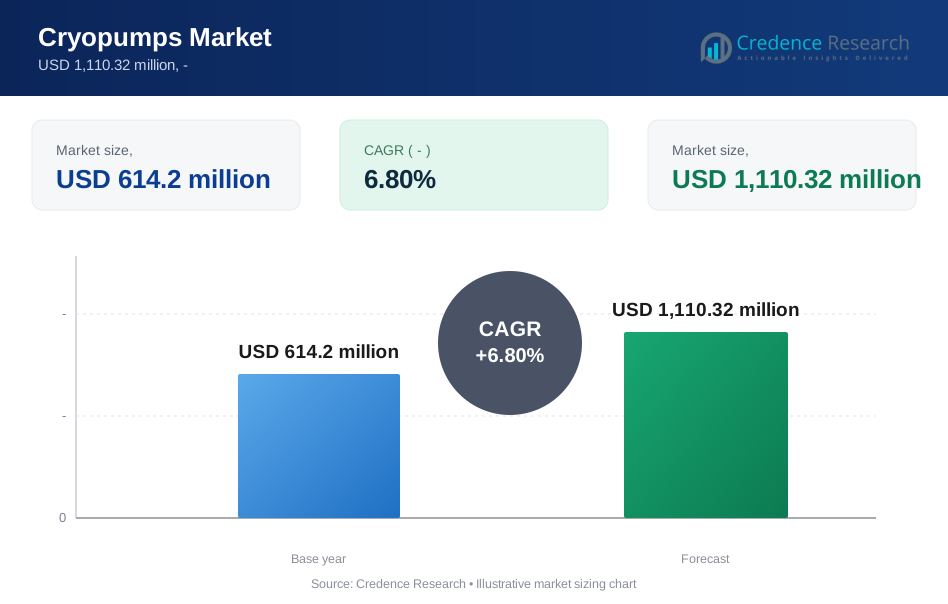
- Between 2024 and 2032, the global market for cryopumps is projected to expand at a compound annual growth rate (CAGR) of 6.80%, from an estimated USD 614.2 million in 2023 to USD 1110.32 million in 2032.
- The largest category is continuous-flow cryopumps. Displacement cryopumps, on the other hand, are expected to grow at a strong CAGR.
- The semiconductor manufacturing category will expand at a rapid rate of growth.
- Throughout the projected period, the CAGR for the semiconductor industry is anticipated to be the highest.
- Asia Pacific controlled the cryopumps market.
- Regarding the market share of cryopumps, Europe is expected to come second.
- North America is expected to experience the fastest growth in the cryopumps industry.
- A number of factors, including the expanding use of cryopumps in MRI and medical imaging systems, are propelling the growth of the global market.
- Advanced cryopumps are in high demand due to the growth in nuclear fusion projects and technological advancements.
Executive Summary
Market Definition
The cryopumps market includes the manufacture, marketing, and sales of cryopumps, a kind of vacuum pump. Cryopumps trap gases and vapors at extremely low temperatures to achieve high vacuum conditions. Using cryogenic fluids such as liquid helium or liquid nitrogen, cryopumps work by cooling surfaces to extremely low temperatures, which causes gases from the vacuum environment to condense and adsorb.
Market Overview
It is predicted that the cryopumps industry will continue its upward trajectory between 2024 and 2032, growing at a compound annual growth rate (CAGR) of 6.80%. From its projected USD 614.2 million in 2023 to USD 1110.32 million in 2032, the market will continue to grow.
The market for cryopumps is largely driven by the energy and power sector's growing need for cryogenic gases, especially in the oil and gas industry. In order to facilitate handling and shipping more easily and effectively, natural gas is frequently transported in liquid form, LNG, or liquefied natural gas. The gas must be cooled to cryogenic temperatures, usually less than -162°C (-260°F), in order to achieve liquefaction. In order to cool and maintain such low temperatures, cryopumps are essential to this process. Enhanced oil recovery techniques utilize cryogenic gases such as carbon dioxide and liquid nitrogen to optimize oil extraction from reservoirs. In order to improve extraction efficiency and lower oil viscosity, these gases are pumped into oil fields.
Furthermore, the energy sector is adopting cryopump technology more widely because of its ongoing advancements, which have increased their effectiveness and cost-efficiency. Better performance, less maintenance needs, and longer operational lifetimes are the results of innovations. The LNG market has grown significantly as a result of the world's transition to greener energy sources. For LNG plants to liquefy natural gas and keep it liquid throughout storage and transportation, cryopumps are a necessity.
Segmentation by Type of Cryopump
- Continuous-flow cryopumps are the market leader in terms of type. This particular kind of cryogenic pump is employed in high-energy physics, space simulations, and the semiconductor industry. For cryopumping to be possible, the system must constantly flow a cryogen, such as liquid nitrogen or helium, to reach and maintain the extremely low temperatures required.
- The displacement cryopumps category will exhibit a sizable CAGR during the projected period. This particular kind of cryopump is used in many different industries to produce and preserve high vacuum conditions. They trap gases and vapors by using cryogenic cooling, which uses extremely low temperatures to condense and solidify gases onto a cold surface.
- Other types of cryopumps, including hybrid cryopumps, non-evaporable getter (NEG) cryopumps, and closed-cycle cryopumps, also support the need for a cryopumps market.
Segmentation by Application
- The semiconductor manufacturing category is projected to develop at a greater CAGR over the forecast period. The manufacturing of semiconductors necessitates extremely controlled environments and highly specialized processes. In this context, cryopumps are crucial because of their capacity to establish and sustain the high vacuum conditions required for the fabrication of semiconductors.
- The research and development category will likely register a significant CAGR during forecasting. The main goal of the research is to find and apply novel materials that can increase cryopumps' longevity and efficiency. Materials that are resistant to extreme cold and have low thermal conductivity fall into this category. A major focus of R&D is creating cryopumps with reduced power consumption without sacrificing functionality. This entails refining insulation methods and maximizing cooling cycles.
- Other applications, such as thin-film coating, space simulation, vacuum furnaces, analytical instruments, and cryogenic cooling systems, further enhance the need for cryopumps.
Segmentation by End User
- The semiconductor industry is projected to grow faster over the projection period. Cryopumps are vacuum pumps that condense gases and vapors onto a cold surface at extremely low temperatures, producing a vacuum in the process. Because they can uphold the ultra-clean, high-vacuum conditions necessary for a variety of manufacturing processes, cryopumps are vital to the semiconductor industry.
- Other end users, including research laboratories, the thin-film coating industry, aerospace and defense, and the energy sector, also influence the need for cryopumps.
Segmentation by Region
- Asia Pacific leads the cryopumps industry. The expansion of the metallurgy and energy and power sectors in China and India is the main factor propelling the cryopumps market in the region.
- Europe is estimated to rank second in cryopumps market size.
- It is anticipated that the cryopumps market in North America will grow quickly.
- The remaining need for cryopumps is met by regions including Latin America, the Middle East, and Africa.
Numerous advancements in medicine and healthcare are driving the market for cryopumps. To preserve the functionality of superconducting magnets and other components, medical imaging technologies like CT (Computerized Tomography) and MRI (Magnetic Resonance Imaging) scans need extremely effective cooling systems. The low temperatures required for these devices to operate at their best are provided by cryopumps, which produce diagnostic images that are more precise and clear. It is essential for scientific research and medicinal applications to preserve biological samples, such as blood, tissues, and cells, at very low temperatures. For biobanking and cryopreservation facilities to ensure that samples are viable for extended periods, cryopumps are essential. Cryopumps are becoming more and more popular as the need for long-term biological material storage grows.
The cryopumps market in the Asia Pacific is predicted to grow to be the largest in the globe. The manufacturing sector has grown as a result of rapid industrialization, ultimately increasing the nation's GDP. The countries' lax industrial regulations, which are intended to draw in foreign investment, have also contributed to the growth of the manufacturing sector. Along with Japan, South Korea, and Australia, the manufacturing sector is the main driver of GDP, so demand for cryopumps is expected in these nations. In addition, China is a major supplier of activated pharmaceutical ingredients, and the pharmaceutical sector in India is expanding rapidly. The demand for cryopumps in Asia-Pacific has increased as a result of these factors.
It is projected that the cryopumps market will develop at the fastest rate in the North American region. Companies and academic institutions in North America make large investments in cryogenics and vacuum technology R&D. By enhancing cryopumps' effectiveness, dependability, and performance; ongoing innovation helps the area keep its competitive advantage. North America has a significant market for high-performance vacuum pumps, including cryopumps, because of its extensive consumer electronics sector, semiconductor industry, and scientific research facilities. Cryopumps efficiently supply the precise vacuum technology needed for these industries to function.
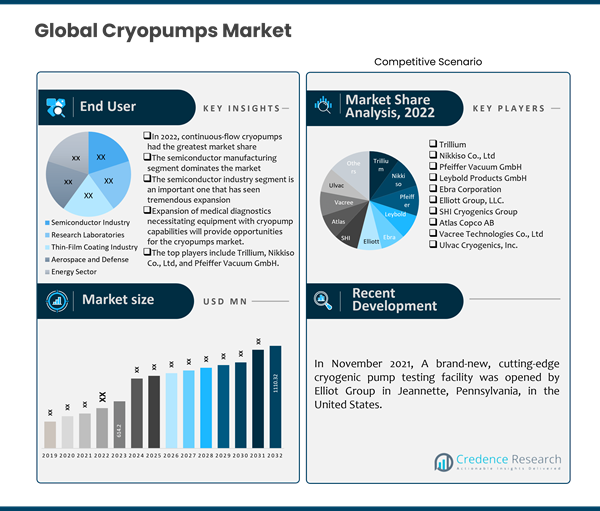
Key Highlights of the Report
The global cryopumps market is segmented by type of cryopump, application, end user, and region. Continuous-flow cryopumps are the market spearhead in terms of the type of cryopump. Semiconductor manufacturing is the top application category. Throughout the forecast period, the semiconductor industry category is expected to grow at the greatest CAGR. Asia Pacific is seeing the most growth in the cryopumps market.
The market for cryopumps is largely driven by nuclear fusion projects because of their strict vacuum requirements, difficult operating environments, and the technological advancements required to support the overconfident goals of achieving sustainable fusion energy. In order to initiate and maintain fusion reactions, nuclear fusion reactors work in extremely low-pressure environments. These ultra-high vacuum conditions must be achieved and maintained in order to avoid contamination and increase the effectiveness of fusion reactions. Cryopumps play a critical role in this process. Initiatives pertaining to nuclear fusion, like the International Thermonuclear Experimental Reactor (ITER) and other national programs, require significant financial outlays and teamwork. The need for cutting-edge cryopump technologies that can fully satisfy the special needs of large-scale fusion reactors is being driven by these projects.
It is anticipated that Asia Pacific will hold the most significant global market share for cryopumps. The governments of nations such as South Korea, China, Japan, and others have been actively promoting the expansion of their high-tech and semiconductor industries by means of funding, policies, and infrastructure development. This support includes cryopumps and other technologies required in these industries. In addition, it is projected that the market in North America will grow at the quickest rate. North America is home to several of the top cryopump manufacturers or hosts major operations there. The lead times and expenses related to the purchase and upkeep of cryopumps are shortened by this closeness to manufacturing facilities. Numerous academic institutions and research centers with expertise in vacuum and cryogenic technologies are located in North America. Through research collaborations and academic programs, these institutions support the advancement of cryopump technology and the development of a skilled workforce.
Which Key Factors Are Driving The Global Cryopumps Market?
The market for cryopumps is expanding due to their increased usage in cooling systems for supercomputers and data centers and the integration of cutting-edge technologies like IoT and AI to improve cryopump performance.
What Are The Main Challenges Confronting The Global Cryopumps Market?
The major challenges facing the cryopumps industry are the high operating and energy costs of operating cryopumps, the significant upfront investment needed for cryopump technology, and the complexity of maintenance operations.
What Market Opportunities Exist For Cryopumps Globally?
Opportunities in the cryopumps market are being created, among other things, by the growing need for cryopumps in semiconductor production processes and their growing application in medical imaging devices like MRI scanners.
Market Drivers
Technological Advancements in Cryopumps
The market for cryopumps is being driven by technological improvements that are opening up new applications and markets and enhancing efficiency, performance, and dependability. These developments not only accommodate the increased needs of the current industries but also create new avenues for growth in untapped markets, which in turn expands the cryopumps market. Improvements in technology have resulted in cryopumps with more effective cooling mechanisms. Cryopumps can now reach lower temperatures faster and more steadily due to these developments, which is essential for applications demanding ultra-high vacuum settings. The development of materials science and engineering has made it possible to produce cryopumps that are more compact and smaller without sacrificing performance. Cryopumps must get smaller in order to be integrated into ever-tinier, more complex systems, including those found in the production of semiconductors and medical equipment.
Market Restraints
Volatile Raw Material Costs
Carbon steel, bronze, stainless steel, and certain alloys are among the materials used to make cryopumps. The cost of iron and other ores has been steadily rising over time, which has led to a rise in the price of stainless steel and other metals throughout the world. Prices for processed metals have fluctuated, impacting numerous businesses, including China, the world's largest exporter and manufacturer of steel. Premium raw materials, such as stainless steel, are used in the production of cryopumps. Key producers of cryopumps are facing fierce pricing competition as a result of rising raw material costs.
The unorganized market in nations like China and India is increasingly favoring small-scale manufacturers due to the increase in cryogenic pump prices. Thus, the market is constrained by the volatility of metal prices. Manufacturers have an array of procurement options due to the availability of multiple local suppliers offering international-quality raw materials at competitive prices, in addition to major raw material providers. As a result, the disruption caused by the disorganized participants in the market impedes the market's expansion.
Opportunities
Advancements in Cryogenic Electronics Applications
Cryogenic gases are frequently utilized for semiconductor testing and manufacturing. To eliminate heat from the manufacturing process, liquid nitrogen is often utilized as a coolant. Gaps in the metallic components of electronics can be minimized by offering them cryogenic treatment. Through increased electrical and thermal conductivity and decreased operational power, cryogenics also increases the dependability of electronics. One can base cryogenic electronics (also known as cold electronics or low-temperature electronics) on superconductive, semiconductive, or a mix of these devices. There are more and more uses for cryogenic electronics. In superconducting power generation, distribution, and management, for example, power-conversion circuits can be used. The requirement for cryogenic signal-processing systems or sensors for instrumentation will also rise in tandem with rising investments in the renewable energy sector. Furthermore, the market for cryopumps is anticipated to benefit from growing applications of cryogenic electronics in research projects, superconducting magnet systems, low-temperature detection systems, and infrared array systems.
Competitive Landscape
Key Players
A number of significant players dominate the highly competitive global market for cryopumps. A handful of the top market players are shown below, together with their respective market shares:
- Trillium
- Nikkiso Co., Ltd
- Pfeiffer Vacuum GmbH
- Leybold Products GmbH
- Ebra Corporation
- Elliott Group, LLC.
- SHI Cryogenics Group
- Atlas Copco AB
- Vacree Technologies Co., Ltd
- Ulvac Cryogenics, Inc.
- Others
In order to stay competitive, these organizations give priority to product innovation, expansion of their distribution channels, and mergers and acquisitions.
By creating cutting-edge ideas and goods, the foremost manufacturers in the global market for cryopumps consistently strive to stay one step ahead of the competition.
In April 2022, the Italian company Termomeccanica Pompe, which produces split-case and vertical turbine pumps with intricate engineering, was bought by TRILLIUM FLOW TECHNOLOGIES.
In April 2022, ASU in China hired Cyostar to supply fifteen NeoVP vertical pumps for installation.
How are Companies Performing in the Cryopumps Market?
Leading companies in the cryopumps industry, including Kiutra, Applied Cryo Technologies, P3 Technologies, and Intelline, are collaborating to offer the best cryopumps possible to improve the global landscape.
In the Cryopumps market, a large number of international startups are making progress in meeting the industry's requirements. For example, Cryogen-free superconducting magnets for cryostats in general research, quantum, and detector applications are produced by the German startup Kiutra, which was founded in 2018. Their methods include direct magnetic control, closed-cycle pre-cooling, and multi-stage magnetic refrigeration, which allow them to maintain very low temperatures continuously.
Also, companies are focusing on reducing the expenses associated with storing and maintaining liquid fuels and gases in the manufacturing, metalworking, and chemical industries. A startup established in the United States called Applied Cryo Technologies makes cryogenic and liquefied natural gas (LNG) containers and transportable storage facilities. Prolonged product longevity is extended by safe and effective operations made possible by high vacuum conditions and a highly insulated structure.
Another major achievement is that of P3 Technologies, an American firm founded in 2018 that creates high-speed rotating cryopumps and cryogenic turbopumps for use in rocketry and military applications. P3 cryopumps provide the quick transfer of liquid oxygen, liquid methane, and rocket propellants by combining fluid dynamics, conjugate heat transfer, and sophisticated physics in aerospace design.
To enhance the Cryopump market's product portfolio, numerous companies have made acquisitions and product launches their primary developmental tactics. For instance, Atlas Copco purchased South Korean distributor Zeus Co Ltd. in February 2023 for sales and servicing. This action will enable Atlas to more effectively increase its market share in the nation.
Summary of Key Findings
- Cryopumps are becoming increasingly necessary due to developments in technology, safety and efficiency, and the space and aerospace sector.
- The market is segmented by type of cryopump, application, end user, and region.
- In the market, the most prevalent type of cryopump is the continuous-flow cryopump.
- Semiconductor manufacturing is the foremost application category.
- The semiconductor industry category is expected to grow the fastest in terms of CAGR during the forecast period.
- In terms of market development, Asia Pacific is a leader; the market is highly competitive with key players including Trillium, Nikkiso Co., Ltd, Pfeiffer Vacuum GmbH, Leybold Products GmbH, Ebra Corporation, Elliott Group, LLC., SHI Cryogenics Group, Atlas Copco AB, Vacree Technologies Co., Ltd, Ulvac Cryogenics, Inc., and Others.
Future Outlook
- The cryopumps industry is expected to increase significantly in Asia Pacific, and its outlook is positive worldwide.
- An increasing number of scientific and industrial uses for cryogenic cooling will continue to drive the sector.
- The main factor preventing the industry's growth in the cryopumps sector is the high energy and operational costs involved in operating cryopumps.
- Developing new products, reaching a wider market, and maintaining competitive prices are all necessary for major businesses to stay ahead of the competition.
How the Credence Research Cryopumps Market Report Can Help CXOs
The Credence Research Cryopumps Market Report provides CXOs with an extensive market overview and comprises the following:
- Market size and growth forecast: The study offers comprehensive market estimations for cryopumps globally, broken down by type of cryopump, application, end user, and region. Furthermore, the report includes market forecasts through 2032, derived from key drivers and trends.
- Market segmentation: The cryopumps market is divided into segments by type of cryopump, application, end user, and region in the research report. This segmentation helps CXOs understand the market and the opportunities inside each area in great depth.
- Competitive landscape: The study report provides a thorough analysis of the leading businesses in the cryopumps sector, together with details on their revenue streams, product lines, and business strategies. With this information, CXOs can assess and identify their competitors.
- Key trends and drivers: The study report analyzes and highlights the key developments and elements driving the market for cryopumps. CXOs can utilize this information to make well-informed choices regarding their plans and investments.
The Credence Research Cryopumps Market Report provides CXOs with insights that they may utilize to:
- Identify growth opportunities: This analysis is likely to help CXOs find fresh growth prospects in the cryopumps sector. For example, the research recognizes the semiconductor industry's increasing requirement for cryopumps as a crucial opportunity.
- Make informed investment decisions: The study aids CXOs in making informed decisions about cryopumps. For example, it delivers information on the key variables to consider while picking solutions and evaluating suppliers.
- Develop competitive strategies: CXOs can utilize the research report to establish competitive strategies for their cryopumps firms. The study paper explores the primary tactics employed by cryopumps providers to set themselves apart from their rivals.
- Track market developments: By tracking market advancements, this research report could assist CXOs in remaining ahead of the curve. For example, it provides information about the latest advancements and patterns in the cryopumps industry.
The Credence Research Cryopumps Market Report is helpful for CXOs who want to learn more about the market and identify potential opportunities.
Segmentation
-
By Type of Cryopump
- Continuous-Flow Cryopumps
- Displacement Cryopumps
- Hybrid Cryopumps
- Non-Evaporable Getter (NEG) Cryopumps
- Closed-Cycle Cryopumps
- By Application
- Semiconductor Manufacturing
- Research and Development
- Thin-Film Coating
- Space Simulation
- Vacuum Furnaces
- Analytical Instruments
- Cryogenic Cooling Systems
-
By End User
- Semiconductor Industry
- Research Laboratories
- Thin-Film Coating Industry
- Aerospace and Defense
- Energy Sector
-
By Region
- North America
- U.S
- Canada
- Mexico
- Europe
- Germany
- France
- UK
- Italy
- Spain
- Rest of Europe
- Asia Pacific
- China
- Japan
- India
- South Korea
- South-east Asia
- Rest of Asia Pacific
- Latin America
- Brazil
- Argentina
- Rest of Latin America
- Middle East & Africa
- GCC Countries
- South Africa
- The Rest of the Middle East and Africa
- North America
Adjacent Markets
Several adjacent markets in the cryopumps market have high revenue growth opportunities. The key adjacent markets for the cryopumps market -
Adjacent Markets |
||
| Semiconductor Manufacturing | Medical Imaging | Space and Satellite Technology |
| Energy and Power Generation | High-Performance Computing (HPC) | Industrial Coating and Metallurgy |
| Food and Beverage Processing | Automotive Manufacturing | Telecommunications |
Request a Free Sample
Fill in your details and we'll send you a free sample report.
- Sample data tables & charts
- Research methodology
Need a Custom Version of This Report?
Tailor the scope, geography, or segments to your exact requirements.
- Custom geography or segment scope
- Direct access to our analyst team
Frequently Asked Questions
How much does the global market currently hold for cryopumps?
What is the cryopumps market's projected growth rate between 2024 and 2032?
In terms of the type of cryopump, which market category is leading?
Regarding the application, which market category is in the lead?
Which end-user segment is estimated to have the highest CAGR throughout the forecast period?
In which region is the market for cryopumps expanding?
Who are the main players in the global cryopumps industry?
Which market factors are the primary drivers of the cryopumps industry?
What main market challenges prevent the growth of the cryopumps sector?
What are the main market opportunities for the cryopumps sector?
Table of Content
Chapter 1. Report Introduction
- 1.1 Report Description & Purpose
- 1.1.1 Report Title & Market Definition
- 1.1.2 Unique Selling Propositions (USP) & Key Differentiators
- 1.1.3 Value Proposition for Stakeholders
- 1.2 Research Objectives
- 1.2.1 Market Sizing Objectives (Volume & Revenue)
- 1.2.2 Segmentation Objectives
- 1.2.3 Competitive Intelligence Objectives
- 1.2.4 Forecast & Scenario Objectives
- 1.3 Report Scope
- 1.3.1 Cryopumps Scope – Types & Subtypes Covered
- 1.3.2 Geographic Scope – Regions & Countries Covered
- 1.3.3 Historical Period, Base Year & Forecast Period (the historical period; forecast to the forecast period)
- 1.3.4 Inclusions & Exclusions
- 1.4 HS Code & Classification Framework
- 1.5 Currency, Units & Pricing Basis
- 1.6 Target Stakeholders
- 1.7 Limitations & Assumptions
Chapter 2. Executive Summary
- 2.1 Global Cryopumps Market Snapshot
- 2.1.1 Market Size – Historical (the historical period) & Forecast (the forecast period) (base year: USD 614.2 million → forecast year: USD 1,110.32 million)
- 2.1.2 Volume & Revenue – Global Totals
- 2.1.3 Key Market Highlights – Top Five Facts
- 2.2 Cryopumps Market Segmentation Snapshot
- 2.2.1 Market Split by Region – vs.
- 2.3 Competitive Snapshot
- 2.3.1 Top 10 Players by Revenue Share –
- 2.3.2 Top 10 Players by Volume Share –
- 2.3.3 Recent Strategic Developments (18-Month Summary)
- 2.4 Key Investment Highlights & Strategic Conclusions
Chapter 3. Cryopumps Market Dynamics & Industry Analysis
- 3.1 Market Overview & Context
- 3.1.1 Cryopumps Market Position in the Broader Automotive Value Chain
- 3.1.2 OEM vs. Replacement Market Dynamics
- 3.1.3 Market Maturity & Development Stage by Region
- 3.2 Cryopumps Market Drivers
- 3.3 Cryopumps Market Restraints & Challenges
- 3.4 Cryopumps Market Opportunities
- 3.5 Porter's Five Forces Analysis
- 3.5.1 Threat of New Entrants
- 3.5.2 Bargaining Power of Suppliers
- 3.5.3 Bargaining Power of Buyers
- 3.5.4 Threat of Substitutes
- 3.5.5 Competitive Rivalry – Intensity Assessment
- 3.6 Cryopumps Value Chain Analysis
- 3.6.1 Upstream – Raw Material/Input Suppliers
- 3.6.1.1 Raw Material/Input 1
- 3.6.1.2 Raw Material/Input 2
- 3.6.1.3 Raw Material/Input 3
- 3.6.2 Midstream – Production/Manufacturing/Service Delivery
- 3.6.2.1 Production/Process Overview
- 3.6.2.2 Key Facility Locations & Capacity by Manufacturer
- 3.6.3 Downstream – Distribution & End Consumer
- 3.6.3.1 Primary Channel – B2B/OEM
- 3.6.3.2 Secondary Channels – Dealer, Retail, Online, Direct
- 3.6.4 Value Chain Profitability Analysis
- 3.6.1 Upstream – Raw Material/Input Suppliers
- 3.7 PESTEL Analysis
- 3.7.1 Political Factors
- 3.7.2 Economic Factors
- 3.7.3 Social Factors
- 3.7.4 Technological Factors
- 3.7.5 Environmental Factors
- 3.7.6 Legal Factors
- 3.8 Cryopumps Supply Chain Analysis
- 3.8.1 Raw Material/Input Supply Risk Assessment
- 3.8.2 Manufacturing Concentration Risk (Geographic Exposure)
- 3.8.3 Trade Disruption Impact Analysis
- 3.9 Regulatory & Policy Landscape
Note: The regulatory and policy landscape section covers regulations based on their applicability to the market, Cryopumps category, geography, and scope of the study. Only regulatory frameworks with a material impact on operations, compliance, trade, sustainability, or market access are analyzed in detail.
Chapter 4. Key Investment Pockets & Opportunity Analysis
- 4.1 Cryopumps Market Attractiveness Analysis
- 4.1.1 By Region – Investment Attractiveness Matrix (Volume × CAGR)
- 4.2 Absolute Revenue Growth Opportunity
- 4.2.1 By Region – Absolute USD Growth Through the forecast period
- 4.3 Incremental Volume Opportunity
- 4.3.1 By Region – Incremental Volume Through the forecast period
- 4.3.2 Segment – Incremental Volume
- 4.4 Emerging Submarket Opportunity Deep Dive (Subject to Applicability)
- 4.5 Emerging Market Opportunity Scorecards
- 4.5.1 United States
- 4.5.2 Europe
- 4.5.3 Asia
- 4.5.4 Middle East & Africa
Note: Emerging Market Opportunity Scorecards will be included based on relevance and strategic importance. Regions listed are indicative and may vary depending on data availability and market dynamics.
Chapter 5. Cryopumps Import-Export Analysis & Trade Flows
- 5.1 Global Trade Overview
- 5.1.1 Global Export Value by Country (the historical period)
- 5.1.2 Global Export Volume by Country (the historical period)
- 5.1.3 Global Import Value by Country (the historical period)
- 5.1.4 Global Import Volume by Country (the historical period)
- 5.1.5 Net Trade Balance by Country (the historical period)
- 5.2 Export Analysis – Segment
- 5.2.1 Type 1 (HS Code)
- 5.2.2 Type 2 (HS Code)
- 5.2.3 Type 3 (HS Code)
- 5.2.4 Type 4 (HS Code)
- 5.2.5 Type 5 (HS Code)
- 5.3 Import Analysis – Segment
- 5.3.1 Type 1 (HS Code)
- 5.3.2 Type 2 (HS Code)
- 5.3.3 Type 3 (HS Code)
- 5.3.4 Type 4 (HS Code)
- 5.3.5 Type 5 (HS Code)
- 5.4 Average Unit Trade Prices
- 5.4.1 Average Export Price – Segment & Country
- 5.4.2 Average Import Price – Segment & Source Country
- 5.4.3 Price Trends (the historical period)
- 5.5 Key Trade Route Analysis
- 5.5.1 Trade Route 1
- 5.5.2 Trade Route 2
- 5.5.3 Trade Route 3
- 5.5.4 Trade Route 4
- 5.5.5 Trade Route 5
- 5.6 Trade Policy Impact Assessment
- 5.6.1 US Anti-Dumping & Section 301 Tariffs
- 5.6.2 EU Customs Union Impact
- 5.6.3 Major Free Trade Agreements
- 5.6.4 USMCA Rules of Origin
Note: Trade policy analysis will be included only where relevant to the Cryopumps market.
Chapter 6. Competitive Landscape & Company Benchmarking
- 6.1 Cryopumps Market Concentration & Structure
- 6.1.1 Herfindahl-Hirschman Index (HHI) – vs.
- 6.1.2 Tier 1, Tier 2 & Tier 3 Market Structure
- 6.1.3 Global, Regional & Local Player Dynamics
- 6.2 Cryopumps Market Share Analysis –
- 6.2.1 Global Revenue Share by Company
- 6.2.2 Global Volume Share by Company
- 6.2.3 Regional Revenue Share
- 6.2.4 Market Share Evolution ( vs. )
- 6.2.5 OEM Segment Share by Company
- 6.2.6 Replacement Segment Share by Company
- 6.3 Production/Delivery Capacity & Facility Analysis
- 6.3.1 Global Installed Capacity
- 6.3.2 Capacity Utilization Rates
- 6.3.3 Production/Output Volume
- 6.3.4 Facility Locations & Capacity Map
- 6.3.5 Planned Capacity Additions
- 6.4 Cryopumps Competitive Benchmarking Matrix
- 6.4.1 Revenue, Volume, CAGR & Profitability Comparison
- 6.4.2 Channel Revenue Mix
- 6.4.3 Geographic Revenue Exposure
- 6.4.4 R&D Intensity
- 6.4.5 Sustainability Maturity
- 6.5 Strategic Developments in Cryopumps (Last 24 Months)
- 6.5.1 Mergers, Acquisitions & Divestments
- 6.5.2 New Cryopumps Launches
- 6.5.3 Facility Expansions
- 6.5.4 Strategic Alliances, Joint Ventures & Partnerships
- 6.5.5 Distribution Expansion & Market Entry
- 6.5.6 Sustainability & ESG Initiatives
- 6.6 Competitive Strategy Mapping
- 6.6.1 Leader, Challenger, Follower & Niche Classification
- 6.6.2 Pricing Strategy Comparison
- 6.6.3 Channel Strategy Matrix
Note: Strategic developments are included based on their materiality and the availability of reliable information.
Chapter 7. Global Cryopumps Market – By Distribution Channel
- 7.1 Segment Overview
- 7.1.1 Volume & Revenue Split by Channel ( & )
- 7.1.2 Channel Mix Evolution (the forecast period)
Chapter 8. Regional Market Analysis – Global Overview
- 8.1 Global Regional Overview
- 8.1.1 Regional Volume Share
- 8.1.2 Regional Revenue Share
- 8.1.3 Regional Volume by Region
- 8.1.4 Regional Revenue by Region
- 8.1.5 Regional Forecast Through the forecast period
- 8.2 Cross-Regional Segment Analysis
- 8.2.1 By Distribution Channel
- 8.2.2 By Brand/Price Tier
Chapter 9. North America Cryopumps Market
- 9.1 United States
- 9.2 Canada
- 9.3 Mexico
Chapter 10. Europe Cryopumps Market
- 10.1 Germany
- 10.2 France
- 10.3 Italy
- 10.4 United Kingdom
- 10.5 Spain
- 10.6 Poland
- 10.7 Russia
- 10.8 Netherlands
- 10.9 Belgium
- 10.10 Sweden
- 10.11 Denmark
- 10.12 Norway
- 10.13 Rest of Europe
Chapter 11. Asia Pacific Cryopumps Market
- 11.1 China
- 11.2 India
- 11.3 Japan
- 11.4 South Korea
- 11.5 Thailand
- 11.6 Indonesia
- 11.7 Vietnam
- 11.8 Malaysia
- 11.9 Australia
- 11.10 Rest of Asia Pacific
Chapter 12. Latin America Cryopumps Market
- 12.1 Brazil
- 12.2 Argentina
- 12.3 Colombia
- 12.4 Chile
- 12.5 Rest of Latin America
Chapter 13. Middle East Cryopumps Market
- 13.1 Saudi Arabia
- 13.2 United Arab Emirates
- 13.3 Turkey
- 13.4 Israel
- 13.5 Iran
- 13.6 Rest of the Middle East
Chapter 14. Africa Cryopumps Market
- 14.1 South Africa
- 14.2 Egypt
- 14.3 Nigeria
- 14.4 Morocco
- 14.5 Rest of Africa
Chapter 15. Cryopumps Company Profiles
- 15.1 [Company 01]
- 15.1.1 Company Overview
- 15.1.2 Key Management Personnel
- 15.1.3 Products & Services Portfolio
- 15.1.4 Financial Performance
- 15.1.5 Key Market Focus & Geographic Presence
- 15.1.6 Recent Developments & Strategic Initiatives
Note: The company profile list is preliminary and may change based on research findings, market developments, data availability, and client requirements.
Chapter 16. Appendices
- Appendix A – List of Abbreviations & Acronyms
- Appendix B – Industry Classification Code Reference – Full Series
- Appendix C – Production & Capacity Data Tables
- Appendix D – End-Use & Demand Base Tables
- Appendix E – Consumption & Replacement Rate Assumptions
- Appendix F – ASP Reference Tables
- Appendix G – Manufacturing & Facility Database
- Appendix H – Import-Export Data Tables
- Appendix I – Regulatory Summary Tables
- Appendix J – Primary Research Participant List (Anonymized)
- Appendix K – Primary Research Questionnaire Framework
- Appendix L – Data Sources & Bibliography
- Appendix M – Market Size Divergence & Source Comparison
Chapter 17. Research Methodology
- 17.1 Research Framework & Philosophy
- 17.2 Secondary Research – Sources, Hierarchy & Data Extraction
- 17.3 Data Modeling – Bottom-Up & Top-Down Market Sizing
- 17.4 Primary Research – Stakeholder Framework, LOI & Sample Sizes
- 17.5 Forecast Methodology – Regression, Scenario & Sensitivity Analysis
- 17.6 Quality Control – Four-Layer Validation Framework
- 17.7 Limitations & Standard Assumptions
- 17.8 Disclaimer
