| REPORT ATTRIBUTE | DETAILS |
|---|---|
| Historical Period | 2019-2022 |
| Base Year | 2023 |
| Forecast Period | 2024-2032 |
| Eosinophilic Pneumonia Treatment Market Size 2023 | USD 1354.9 Million |
| Eosinophilic Pneumonia Treatment Market, CAGR | 5.9% |
| Eosinophilic Pneumonia Treatment Market Size 2032 | USD 2277.4 Million |
Market Insights
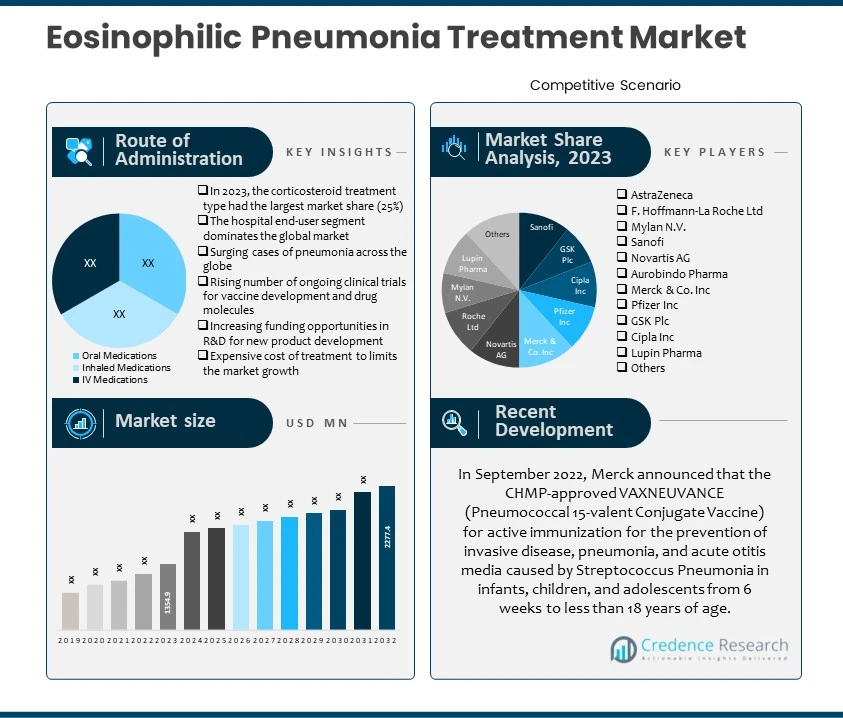
- The global demand for was valued at USD 1354.9 Million in 2023 and is expected to reach USD 2277.4 Million in 2032, growing at a CAGR of 5.9% between 2024 and 2032.
- The corticosteroids are the market leader by treatment type, accounting for more than 25% of total value in 2023, while the anti-fungal medications category is predicted to increase substantially over the forecast time frame.
- The hospital end-user category dominates the global need for eosinophilic pneumonia treatments, accounting for more than 30% in 2023, and is anticipated to grow at an elevated CAGR.
- Over the projection period, the lung biopsy segment is expected to expand at the highest rate, while the diagnostic imaging (chest X-ray, CT scan) tools category leads the market in 2023 with a 32% share.
- The oral medications category dominated the market with 40% of the total revenue share by route of administration segment. In contrast, the intravenous (IV) medications segment will expand fastest in the projected period.
- With an impressive market share of more than 58% by 2023 and estimates for considerable CAGR growth, the underlying cause category of idiopathic eosinophilic pneumonia (IEP) will likely continue dominating the global market.
- North America is fueling the growth of the eosinophilic pneumonia treatment industry with over one-third of the market share in 2023, while Europe and Asia Pacific collectively account for just under 55% of the share in 2023. Europe held over 20% share in 2023.
- According to the American Thoracic Society 2020, viral pneumonia is one of the major causes of hospitalization for newborns in the United States and around the world. Thus, the global prevalence of viral pneumonia increases the market demand for eosinophilic pneumonia therapeutic drugs.
Executive Summary
Market Definition
The eosinophilic pneumonia treatment market encompasses the pharmaceutical and healthcare sectors dedicated to addressing the medical needs of individuals diagnosed with eosinophilic pneumonia. Eosinophilic pneumonia is a rare respiratory condition characterized by increased lung eosinophils, causing inflammation. This market focuses on developing, manufacturing, and providing medical interventions to manage symptoms and improve the quality of life for patients. Treatment modalities typically involve pharmaceuticals like corticosteroids and immunomodulators.
Market Overview
The global eosinophilic pneumonia treatment market has witnessed consistent growth over recent years and is set to grow at a CAGR of 5.9% between 2024 and 2032. The market was valued at USD 1354.9 million in 2023 and is expected to reach USD 2277.4 million in 2032.
Pneumonia is an inflammatory medical illness that affects the air sacs and alveoli of the lungs. Pneumococcal infection is caused by inhaling airborne droplets from a sneeze or cough, which include bacteria, viruses, and fungus. It can also be triggered by coming into contact with objects or surfaces contaminated with pneumonia-causing germs or viruses. According to the WHO, the yearly prevalence is approximately 150.7 million cases, with 7% to 13% requiring extensive treatment. Bacteria, fungi, or viruses can cause pneumonia, accounting for 5% of pediatric mortality. The increasing number of cases of community-acquired pneumonia, particularly among young people, is an additional factor boosting market expansion.
Segmentation by Treatment Type
- Corticosteroids, comprising prednisone and prednisolone, are the primary treatment choice, holding over 25% share in value in 2023. The broad use of corticosteroids underscores their efficacy in managing eosinophilic pneumonia symptoms, contributing significantly to the market's overall value.
- The anti-fungal medications segment is poised for substantial growth, with a noteworthy market CAGR. In 2023, this segment contributes to the evolving treatment landscape, reflecting the industry's response to diverse eosinophilic pneumonia subtypes, including those associated with fungal infections.
Segmentation by Route of Administration
- Oral medications, predominantly corticosteroids, govern the global demand, holding a substantial market share of over 40% in 2023. The ease of oral administration and patient compliance contribute to this dominance, aligning with the preference for convenient long-term treatment.
- The intravenous (IV) medications category is anticipated to post the highest CAGR, indicating a growing trend towards intravenous routes for drug administration. This method offers advantages such as rapid onset of action and precise dosage control, contributing to its projected market growth.
Segmentation by End-User
- Specialty clinics and ambulatory surgical centers contribute significantly to the global market demand, emphasizing their role in providing specialized care and outpatient services. These centers play a crucial part in enhancing accessibility and cater to a diverse patient population.
- Hospitals lead the market with over 30% share in 2023, emphasizing their pivotal role as primary healthcare centers for eosinophilic pneumonia treatment. The significant market presence of hospitals highlights their capacity to handle complex cases and provide comprehensive care.
Segmentation by Underlying Cause
- The secondary eosinophilic pneumonia segment, encompassing drug-induced and parasitic infections, is anticipated to register the highest CAGR. This growth underscores the industry's recognition of various underlying causes and the need for tailored treatment approaches.
- Idiopathic eosinophilic pneumonia (IEP) holds a commanding market share of nearly 58% in 2023. This category's dominance is attributed to the prevailing cases with an unknown cause, necessitating further research efforts to unravel the complexities associated with eosinophilic pneumonia.
Segmentation by Diagnostic Tools
- Imaging tools, including chest X-rays and CT scans, dominate the global need for eosinophilic pneumonia treatment, accounting for more than 32% in 2023. These diagnostic modalities are important in accurate and non-invasive disease assessment, helping formulate effective treatment plans.
- The remaining market demand for eosinophilic pneumonia treatments is derived from blood tests and lung biopsy, offering additional insights into disease etiology and severity. While imaging tools lead, these diagnostic methods contribute to comprehensive patient evaluations and guide clinicians in treatment decisions.
Segmentation by Region
- North America is a leading global market, fueling over one-third of the growth of the eosinophilic pneumonia treatment industry as of 2023. This significant regional contribution is attributed to advanced healthcare infrastructure, high prevalence rates, and a well-established research ecosystem.
- Europe and Asia Pacific collectively account for just under 55% of the share in 2023, with Europe holding over 20% in the same year. This distribution underscores the global nature of the eosinophilic pneumonia treatment market, with substantial market presence in these regions driven by increasing awareness and improving healthcare facilities.
- The rest of the world, including Latin America, the Middle East, and Africa, supplies the remaining demand for eosinophilic pneumonia treatment. Pneumonia is extremely common among African children. However, a lack of access to pneumonia medications and treatment resources has maintained the mortality rate high in African countries.
The global eosinophilic pneumonia treatment market is propelled by factors such as the escalating prevalence and improved diagnosis of eosinophilic pneumonia and ongoing R&D initiatives focusing on innovative therapeutic interventions.
North America holds a major revenue share in the global eosinophilic pneumonia treatment market due to the increased burden of pneumonia infection and growing regional product approvals. For example, according to a report released by NCBI in August 2021, the estimated global incidence of community-acquired pneumonia ranges from 1.5 to 14 cases per 1000 person-years. It is influenced by region, season, and population factors. In the United States, the yearly incidence is 24.8 instances per 10,000 adults, with rates increasing with age. Thus, the rising burden of community-acquired pneumonia in the country will likely boost demand for its treatment, which will favorably impact the treatment market.
The Asia Pacific eosinophilic pneumonia treatment market is predicted to expand steadily over the coming years. This is mostly owing to the prevalence of pneumonia in countries within the region. For example, the World Health Organisation (WHO) estimates that 0.37 incidences of clinical pneumonia occur per child per year. Further, WHO estimates that India accounts for 36% of all cases in Southeast Asia. As a result, market demand for treatments has increased drastically. Also, additional factors in developing nations such as India, China, and Japan, such as increased diagnosis rates, rapidly aging populations, higher pollution levels, and ongoing government push to address illness management, contribute considerably to the market expansion in the region.
Key Highlights of the Report
The global eosinophilic pneumonia treatment market is segmented by treatment type, route of administration, end-user, underlying cause, diagnostic tools, and region. Corticosteroids are the predominant treatment type owing to their established efficacy in managing eosinophilic pneumonia symptoms. Oral medications, particularly corticosteroids, maintain a stronghold due to their convenience, while a rising trend in intravenous (IV) medications is noted for their precise dosage control. Moreover, specialty clinics and ambulatory surgical centers play a leading role in end-users, contributing to the overall accessibility of eosinophilic pneumonia treatment.
The increasing prevalence of eosinophilic pneumonia and the increasing number of product approvals for pneumonia therapy support the market's expansion. For example, according to UNICEF data updated in August 2021, there are over 1,400 cases of pneumonia per 100,000 children worldwide, or one case per 71 children each year, with South Asia having the highest incidence (2,500 cases per 100,000 children) and West and Central Africa having the second highest (1,620). Thus, the need for pneumonia treatment is anticipated to rise along with the rise in cases of the illness, which would further propel market expansion over the forecast duration.
North America, which includes the United States and Canada, has a long history of robust healthcare facilities and easy access to innovative medical treatments. The presence of large pharma companies and research institutions helps to drive the expansion of the pneumonia therapeutics market across this region. With their well-established medical facilities and rising awareness of respiratory disorders, European countries make important contributions to the pneumonia treatment market. Countries such as the U.K., Germany, France, and Italy are among the leaders in this sector. The healthcare sector in Asia-Pacific is rapidly expanding, owing to rising healthcare expenditure, more awareness, and a huge patient population.
What Are The Main Drivers Of The Global Eosinophilic Pneumonia Treatment Market?
The main drivers of the global eosinophilic pneumonia treatment market expansion are the growing prevalence and diagnosis of eosinophilic pneumonia cases worldwide, fueling the demand for effective treatments. Ongoing research and development efforts and advancements in diagnostic technologies contribute to expanding therapeutic options and market growth. Moreover, heightened awareness, collaborations between pharmaceutical companies, and a focus on personalized medicine further propel the market forward.
What Are The Major Challenges Faced By The Global Eosinophilic Pneumonia Treatment Market?
The eosinophilic pneumonia treatment market faces challenges such as high treatment costs, potential side effects associated with medications, and limited global awareness among healthcare professionals and patients. Besides, the stringent regulatory landscape and the relatively low prevalence of eosinophilic pneumonia hinder the development and commercialization of new treatment options, further influencing market dynamics.
What Are The Growth Opportunities In The Global Eosinophilic Pneumonia Treatment Market?
The global eosinophilic pneumonia treatment market presents growth opportunities by exploring innovative therapeutic approaches and targeted drug development. Advances in precision medicine, increased focus on patient-centric drug development, and collaborations between drug manufacturers and research institutes offer market avenues for expanding treatment options. The rise in healthcare infrastructure in emerging markets and the potential for regenerative medicine applications also present promising opportunities for market development.
Market Drivers
Several factors drive the global eosinophilic pneumonia treatment market. The following are the key drivers of the global eosinophilic pneumonia treatment market:
Growing Prevalence and Diagnosis
One major driver of the eosinophilic pneumonia treatment market share is the rising prevalence and improved diagnosis of eosinophilic pneumonia cases worldwide. As awareness of the condition grows among healthcare professionals and the general population, there has been an uptick in identifying and reporting eosinophilic pneumonia cases. The increased prevalence underscores the need for effective treatment options, promoting pharmaceutical companies and researchers to invest in developing innovative therapies.
Pneumonia is the leading infectious disease-related cause of death in children worldwide. According to WHO data, pneumonia was responsible for 898694 deaths under the age of five in 2018-19, accounting for 15% of all children's mortality in this age group. Besides, as per the Centers for CDC (Disease Control & Prevention), pneumonia mortality is astoundingly high, with 14.7 fatalities reported per 100,000 people. As a result of the high mortality rate, the industry sees an increase in demand for therapeutic products. These factors have a direct impact on market expansion.
Market Restraints
The global eosinophilic pneumonia treatment market faces challenges that may limit its growth. These include the following:
High Treatment Costs and Limited Accessibility
The higher costs associated with eosinophilic pneumonia treatments majorly limit market growth. Pharmaceutical interventions, especially newer and innovative therapies, can be expensive to develop and manufacture. In addition, the need for long-term or recurrent treatments, such as corticosteroid regimens, may contribute to the financial burden on patients and healthcare systems.
Limited accessibility to these treatments, especially in regions with constrained healthcare resources or inadequate insurance coverage, further exacerbates the challenge. High treatment costs may result in affordability issues for some patients, hindering their ability to access and adhere to prescribed medications.
Opportunities
The global eosinophilic pneumonia treatment market offers significant growth opportunities. These include the following:
Increasing Funding for New Treatment Developments to Address Disease Management
The high severity of eosinophilic pneumonia and substantial market demand have accelerated the development of new medicines and vaccines to treat this pneumonia. For example, various companies active in the pneumonia therapeutics sector, including market giants such as Pfizer, Merck, and GSK, are currently channeling massive resources and putting significant efforts into such R&D initiatives. This is further reinforced by successful clinical trials and regulatory authorization from the appropriate authorities. For instance, in February 2020, the US FDA approved a supplementary new drug application for Recarbrio to treat people with ventilator-associated and hospital-acquired bacterial pneumonia. Thus, introducing such innovative medication compounds and regulatory backing and approval will contribute to market expansion throughout the projected time frame.
Competitive Landscape
Key Players
The global eosinophilic pneumonia treatment market is characterized by the presence of several pharmaceutical companies striving to develop and commercialize effective therapeutic interventions. The following are a few of the most prominent market players and their market shares:
- AstraZeneca
- F. Hoffmann-La Roche Ltd
- Mylan N.V.
- Sanofi
- Novartis AG
- Aurobindo Pharma
- Merck & Co. Inc
- Pfizer Inc
- GSK Plc
- Cipla Inc
- Lupin Pharma
- Others
These key players in the industry actively engage in collaborations and partnerships to enhance their research capabilities and expand their product portfolios. As the market evolves, competition is likely to intensify, with a focus on addressing unmet medical needs and providing improved treatment options for patients diagnosed with eosinophilic pneumonia.
In July 2023, Paratek Pharmaceuticals Inc. announced phase 3 clinical trials for moxifloxacin and omadacycline. This study aims to compare the efficacy and safety of omadacycline to moxifloxacin in addressing community-acquired bacterial pneumonia in adults.
In February 2023, AstraZeneca Plc acquired TeneoTwo Inc., a clinical-stage biopharmaceutical business researching new antibiotics for treating eosinophilic pneumonia and other dangerous infections.
In September 2022, Pfizer reported positive top-line results from its important European Union Phase III study in infants (NCT04546425), which evaluated its 20-valent pneumococcal conjugate vaccine candidate (20vPnC) for preventing the development of invasive pneumococcal disease (IPD), pneumonia, and acute otitis media triggered by the 20 Streptococcus Pneumonia (pneumococcus) serotypes included in the vaccine for the pediatric population.
Summary of Key Findings
- Increased awareness and diagnosis of eosinophilic pneumonia have contributed to market expansion.
- The market is segmented by treatment type, route of administration, end-user, underlying cause, diagnostic tools, and region.
- Corticosteroids have been the primary treatment for eosinophilic pneumonia, and their demand will likely remain high.
- Anti-fungal medications are gaining significance, addressing specific eosinophilic pneumonia subtypes associated with fungal infections.
- Imaging tools like chest X-rays and CT scans are primary diagnostic modalities, while blood tests and lung biopsies contribute to comprehensive evaluations.
- Challenges such as high treatment costs, potential side effects of medications, and limited awareness among healthcare professionals and patients may pose obstacles to market growth.
Future Outlook
- Ongoing research and clinical trials are exploring new treatment modalities and drugs for eosinophilic pneumonia.
- Advancements in genomics, biomarker identification, and understanding of inflammatory pathways contribute to the development of personalized and patient-centric approaches.
- Market dynamics may evolve further with the introduction of advanced diagnostic tools and a deeper understanding of the molecular and genetic factors of eosinophilic pneumonia.
How CXOs Can Benefit from the Credence Research Eosinophilic Pneumonia Treatment Market Report:
The Credence Research Eosinophilic Pneumonia Treatment Market Report offers CXOs a comprehensive overview of the market, covering:
- Market Size and Growth Forecast: The report provides detailed estimates of the global eosinophilic pneumonia treatment market size, segmented by treatment type, route of administration, end-user, underlying cause, diagnostic tools, and region. It also includes forecasts for the market through 2032 based on key trends and drivers.
- Market Segmentation: The report segments the eosinophilic pneumonia treatment market by treatment type, route of administration, end-user, underlying cause, diagnostic tools, and region. This segmentation provides CXOs with a granular understanding of the market and the opportunities in each segment.
- Competitive Landscape: The report profiles the key players in the eosinophilic pneumonia treatment market and provides insights into their strategies, product offerings, and financial performance. This information can help CXOs to identify and assess their competition.
- Key Trends and Drivers: The report identifies and analyses the major trends and drivers shaping the eosinophilic pneumonia treatment market. This information can help CXOs to make informed decisions about their investments and strategies.
CXOs can leverage insights from the Credence Research Eosinophilic Pneumonia Treatment Market Report to:
- Identify Growth Opportunities: The report assists CXOs in identifying new growth opportunities in the eosinophilic pneumonia treatment market. For instance, it points out emerging trends and areas of innovation within the treatment landscape.
- Make Informed Investment Decisions: The report can help CXOs make informed investment decisions about eosinophilic pneumonia treatment. For example, the report provides insights into the key factors to consider when evaluating eosinophilic pneumonia treatment providers and selecting eosinophilic pneumonia treatment types.
- Develop competitive strategies: The report can help CXOs develop competitive strategies for their eosinophilic pneumonia treatment businesses. For example, the report identifies the key strategies that eosinophilic pneumonia treatment providers use to differentiate themselves from their competitors.
- Track market developments: The report helps CXOs track market developments and stay ahead of the curve, offering insights into the latest trends and innovations in the eosinophilic pneumonia treatment market.
Overall, the Credence Research Eosinophilic Pneumonia Treatment Market Report proves to be a valuable resource for CXOs seeking a deeper understanding of the market and identifying growth opportunities.
Segmentation
- By Treatment Type
- Corticosteroids
- Bronchodilators
- Immunosuppressants
- Anti-fungal Medications
- Biologics
- By Route of Administration
- Oral Medications
- Inhaled Medications
- Intravenous (IV) Medications
- By End-User
- Hospitals
- Specialty Clinics
- Ambulatory Surgical Centers
- Others
- By Underlying Cause
- Idiopathic Eosinophilic Pneumonia (IEP)
- Secondary Eosinophilic Pneumonia (e.g., drug-induced, parasitic infections)
- By Diagnostic Tools
- Blood Tests
- Imaging (Chest X-ray, CT Scan)
- Bronchoscopy with Bronchoalveolar Lavage (BAL)
- Lung Biopsy
- By Region
- North America
- S.
- Canada
- Mexico
- Europe
- Germany
- France
- K.
- Italy
- Spain
- Rest of Europe
- Asia Pacific
- China
- Japan
- India
- South Korea
- South-east Asia
- Rest of Asia Pacific
- Latin America
- Brazil
- Argentina
- Rest of Latin America
- Middle East & Africa
- GCC Countries
- South Africa
- Rest of the Middle East and Africa
- North America

Request a Free Sample
Fill in your details and we'll send you a free sample report.
- Sample data tables & charts
- Research methodology
Market Dynamics
Growing Prevalence and Improved Diagnosis
Increased awareness and advancements in diagnostic technologies have led to higher identification rates of eosinophilic pneumonia, expanding the patient pool and driving demand for effective treatments.
Advancements in Therapeutic Options
Ongoing R&D and the introduction of new drug classes, such as biologics and targeted therapies, are broadening the range of available treatments and improving patient outcomes, fueling market growth.
Rising Incidence of Community-Acquired Pneumonia
The global rise in community-acquired pneumonia, particularly among children and the elderly, is increasing the number of cases requiring eosinophilic pneumonia management, thus boosting the treatment market.
Expansion of Healthcare Infrastructure in Emerging Markets
Improved healthcare access, increased government initiatives, and rising healthcare expenditure in Asia Pacific and other developing regions are enabling more patients to receive timely diagnosis and treatment, supporting market expansion.
Need a Custom Version of This Report?
Tailor the scope, geography, or segments to your exact requirements.
- Custom geography or segment scope
- Direct access to our analyst team
Frequently Asked Questions
What is the current size of the global eosinophilic pneumonia treatment market?
What is the expected growth rate of the eosinophilic pneumonia treatment market between 2024 and 2032?
Which category is leading the market share in terms of treatment type?
Which end-user segment governs the demand for eosinophilic pneumonia treatment globally?
Who are the major players in the global eosinophilic pneumonia treatment market?
Table of Content
Chapter 1 Market Segmentation
- 1.1 Segmentation Framework
- 1.1.1 Product and Service Classification
- 1.1.2 Application and End-Use Classification
- 1.1.3 Technology and Solution Classification
- 1.1.4 Customer and Distribution Channel Classification
- 1.1.5 Geographic Segmentation
- 1.1.6 Market Segment Definitions and Boundaries
- 1.2 By End-User
- 1.2.1 Hospitals
- 1.2.2 Specialty Clinics
- 1.2.3 Ambulatory Surgical Centers
- 1.2.4 Others
- 1.3 By Treatment Type
- 1.3.1 Corticosteroids
- 1.3.2 Bronchodilators
- 1.3.3 Immunosuppressants
- 1.3.4 Anti-fungal Medications
- 1.3.5 Biologics
- 1.4 By Diagnostic Tools
- 1.4.1 Blood Tests
- 1.4.2 Imaging (Chest X-ray, CT Scan)
- 1.4.3 Bronchoscopy with Bronchoalveolar Lavage (BAL)
- 1.4.4 Lung Biopsy
- 1.5 By Route of Administration
- 1.5.1 Oral Medications
- 1.5.2 Inhaled Medications
- 1.5.3 Intravenous (IV) Medications
Chapter 2 Introduction
- 2.1 Report Objectives and Scope
- 2.2 Product Definition and Industry Terminology
- 2.3 Market Inclusions and Exclusions
- 2.4 Research Process
- 2.4.1 Primary Research and Expert Interviews
- 2.4.2 Secondary Research and Source Review
- 2.4.3 Top-Down and Bottom-Up Estimation
- 2.4.4 Data Triangulation and Verification
- 2.5 Market Size Measurement Basis
- 2.5.1 2023: USD 1354.9 Million → 2032: USD 2,277.4 Million
- 2.6 Historical and Forecast Reference Periods
- 2.6.1 Base Year: 2023
- 2.6.2 Forecast Period: 2023-2032
- 2.7 Research Assumptions and Limitations
Chapter 3 Executive Summary
- 3.1 Market Snapshot and Key Findings
- 3.2 Base-Year Market Size, 2023
- 3.3 Forecast Market Size, 2032
- 3.4 Revenue and Volume Growth Outlook
- 3.5 Key Demand and Supply Indicators
- 3.6 Leading Market Segments
- 3.7 Fastest-Growing Market Opportunities
- 3.8 Regional Performance Highlights
- 3.9 Technology and Industry Transformation
- 3.10 Competitive Landscape Summary
- 3.11 Analyst View and Strategic Implications
Chapter 4 Global Eosinophilic Pneumonia Treatment Market Trends and Developments
- 4.1 Historical Industry Development
- 4.2 Recent Market Trends and Developments
- 4.3 Demand and Customer Behavior Trends
- 4.4 Technology and Product Innovation
- 4.5 Artificial Intelligence, Automation and Digitalization
- 4.6 Local Manufacturing and Supply Chain Realignment
- 4.7 Industry Partnerships, Mergers and Acquisitions
- 4.8 Sustainability and Circular Economy Developments
- 4.9 Government and Private Sector Investment Trends
- 4.10 Emerging Business Models and Commercialization
- 4.11 Industry Developments and Announcements
Chapter 5 Global Eosinophilic Pneumonia Treatment Market Production, Supply and Demand Analysis
- 5.1 Demand Trend and Consumption Analysis
- 5.2 Demand Forecast, 2023-2032
- 5.3 Production and Output Trend
- 5.4 Production and Output Forecast, 2023-2032
- 5.5 Installed Capacity and Capacity Utilization
- 5.6 Company-Wise Production Plants and Statistics
- 5.6.1 Installed Production Capacity
- 5.6.2 Actual Production
- 5.6.3 Planned Capacity and Expansion Targets
- 5.7 Supply Chain Structure and Procurement Trends
- 5.8 Supply-Demand Gap and Bottlenecks
- 5.9 Import Dependence and Sourcing Structure
- 5.10 Contract Manufacturing and Outsourcing
- 5.11 Regional Supply and Demand Concentration
Chapter 6 Global Eosinophilic Pneumonia Treatment Market Pricing Analysis
- 6.1 Pricing Structure and Measurement
- 6.2 Historical Pricing Trends
- 6.3 Pricing Outlook, 2023-2032
- 6.4 Average Selling Price and Unit Economics
- 6.5 Pricing by Product and Market Segment
- 6.6 Geographic Pricing Differences
- 6.7 Key Input, Energy, Labor and Logistics Costs
- 6.8 Contract Pricing and Purchasing Models
- 6.9 Pricing Sensitivity and Competitive Positioning
- 6.10 Price, Margin and Profitability Implications
Chapter 7 Global Eosinophilic Pneumonia Treatment Market Dynamics
- 7.1 Market Growth Drivers
- 7.1.1 Demand-Side Drivers
- 7.1.2 Technology and Innovation Drivers
- 7.1.3 Infrastructure and Investment Drivers
- 7.1.4 Regulatory and Policy Drivers
- 7.2 Market Restraints
- 7.2.1 Cost and Affordability Constraints
- 7.2.2 Technology and Adoption Barriers
- 7.2.3 Supply Chain and Operational Constraints
- 7.3 Market Challenges
- 7.3.1 Competitive Pressure and Margin Erosion
- 7.3.2 Skills, Infrastructure and Implementation Gaps
- 7.4 Emerging Market Opportunities
- 7.5 Market Dynamics Impact and Time-Horizon Assessment
Chapter 8 Global Eosinophilic Pneumonia Treatment Value Chain Analysis
- 8.1 Industry Value Chain Overview
- 8.2 Upstream Suppliers and Critical Inputs
- 8.3 Technology and Component Providers
- 8.4 Manufacturing or Service Delivery
- 8.5 Distribution, Channel Partners and Integrators
- 8.6 Downstream Applications and End Users
- 8.7 Value Addition and Profit Pools
- 8.8 Vertical Integration and Outsourcing
- 8.9 Supplier Concentration and Risk
- 8.10 Supply Chain Localization and Resilience
Chapter 9 Global Eosinophilic Pneumonia Treatment Market Regulations and Policies
- 9.1 Relevant Laws, Standards and Compliance Frameworks
- 9.2 Product, Service, Safety and Quality Requirements
- 9.3 Government Policies, Incentives and Subsidies
- 9.4 Imports, Exports and Trade Barriers
- 9.5 Public Procurement and Local Content Requirements
- 9.6 Environmental and Sustainability Compliance
- 9.7 Upcoming Policy Changes and Market Implications
Chapter 10 Global Eosinophilic Pneumonia Treatment Market Hotspots and Opportunities
- 10.1 Market Opportunity Mapping and Growth Hotspots
- 10.2 High-Growth Applications and Customer Groups
- 10.3 Underserved Markets and White-Space Opportunities
- 10.4 Emerging Technology and Product Opportunities
- 10.5 New Capacity and Investment Hotspots
- 10.6 Market Entry and Expansion Opportunities
- 10.7 Distribution and Partnership Opportunities
- 10.8 Near-Term and Long-Term Commercial Potential
- 10.9 Opportunity Attractiveness and Execution Risks
Chapter 11 Global Eosinophilic Pneumonia Treatment Market Outlook, 2023-2032
- 11.1 Market Size and Analysis
- 11.1.1 Revenue (Market Measurement: 2023: USD 1354.9 Million → 2032: USD 2,277.4 Million)
- 11.1.2 Market Volume and Quantity Sold
- 11.1.3 Historical Market Size
- 11.1.4 Base-Year Market Size, 2023
- 11.2 Market Forecast, 2023-2032
- 11.2.1 Revenue Forecast to 2032
- 11.2.2 Volume Forecast to 2032
- 11.2.3 CAGR and Year-on-Year Growth
- 11.2.4 Incremental Revenue Opportunity
- 11.3 Forecast Assumptions and Scenario Analysis
- 11.3.1 Base-Case Forecast
- 11.3.2 Optimistic and Conservative Scenarios
- 11.3.3 Technology, Pricing and Policy Sensitivities
- 11.4 Market Attractiveness and Growth Outlook
Chapter 12 Global Eosinophilic Pneumonia Treatment Market Segmentation and Outlook
- 12.1 Segmentation Summary and Market Shares, 2023
- 12.2 Largest and Fastest-Growing Segments
- 12.3 By End-User - Market Size and Forecast, 2023-2032
- 12.3.1 Segment Definition and Scope
- 12.3.2 Historical Market Size
- 12.3.3 Revenue Forecast, 2023-2032
- 12.3.4 Volume Forecast, 2023-2032
- 12.3.5 Base-Year Market Share, 2023
- 12.3.6 Segment CAGR and Growth Drivers
- 12.3.7 Subsegment Market Size and Forecast
- 12.3.7.1 Hospitals
- 12.3.7.2 Specialty Clinics
- 12.3.7.3 Ambulatory Surgical Centers
- 12.3.7.4 Others
- 12.3.8 Subsegment Pricing and Adoption Trends
- 12.3.9 Leading Suppliers and Competition
- 12.3.10 Regional Demand and Opportunities
- 12.4 By Treatment Type - Market Size and Forecast, 2023-2032
- 12.4.1 Segment Definition and Scope
- 12.4.2 Historical Market Size
- 12.4.3 Revenue Forecast, 2023-2032
- 12.4.4 Volume Forecast, 2023-2032
- 12.4.5 Base-Year Market Share, 2023
- 12.4.6 Segment CAGR and Growth Drivers
- 12.4.7 Subsegment Market Size and Forecast
- 12.4.7.1 Corticosteroids
- 12.4.7.2 Bronchodilators
- 12.4.7.3 Immunosuppressants
- 12.4.7.4 Anti-fungal Medications
- 12.4.7.5 Biologics
- 12.4.8 Subsegment Pricing and Adoption Trends
- 12.4.9 Leading Suppliers and Competition
- 12.4.10 Regional Demand and Opportunities
- 12.5 By Diagnostic Tools - Market Size and Forecast, 2023-2032
- 12.5.1 Segment Definition and Scope
- 12.5.2 Historical Market Size
- 12.5.3 Revenue Forecast, 2023-2032
- 12.5.4 Volume Forecast, 2023-2032
- 12.5.5 Base-Year Market Share, 2023
- 12.5.6 Segment CAGR and Growth Drivers
- 12.5.7 Subsegment Market Size and Forecast
- 12.5.7.1 Blood Tests
- 12.5.7.2 Imaging (Chest X-ray, CT Scan)
- 12.5.7.3 Bronchoscopy with Bronchoalveolar Lavage (BAL)
- 12.5.7.4 Lung Biopsy
- 12.5.8 Subsegment Pricing and Adoption Trends
- 12.5.9 Leading Suppliers and Competition
- 12.5.10 Regional Demand and Opportunities
- 12.6 By Route of Administration - Market Size and Forecast, 2023-2032
- 12.6.1 Segment Definition and Scope
- 12.6.2 Historical Market Size
- 12.6.3 Revenue Forecast, 2023-2032
- 12.6.4 Volume Forecast, 2023-2032
- 12.6.5 Base-Year Market Share, 2023
- 12.6.6 Segment CAGR and Growth Drivers
- 12.6.7 Subsegment Market Size and Forecast
- 12.6.7.1 Oral Medications
- 12.6.7.2 Inhaled Medications
- 12.6.7.3 Intravenous (IV) Medications
- 12.6.8 Subsegment Pricing and Adoption Trends
- 12.6.9 Leading Suppliers and Competition
- 12.6.10 Regional Demand and Opportunities
- 12.7 Segment Growth Comparison
- 12.8 Segment Attractiveness and Priority Matrix
Chapter 13 Global Eosinophilic Pneumonia Treatment End-Use and Application Market Outlook
- 13.1 End-Use Industry and Customer Demand Structure
- 13.2 Leading Applications and Customer Groups
- 13.3 End-Use Market Size, Share and Forecast
- 13.4 Major End-Use Industry Deep Dives
- 13.4.1 Customer Requirements and Use Cases
- 13.4.2 Demand and Replacement Cycles
- 13.4.3 Technical and Regulatory Considerations
- 13.4.4 Purchasing and Procurement Models
- 13.4.5 Leading Vendors and Distribution Channels
- 13.4.6 Forecast and Commercial Opportunities
- 13.5 Emerging Applications and Cross-Segment Demand
- 13.6 End-Use Industry Investment Priorities
Chapter 14 Global Eosinophilic Pneumonia Treatment Geographic Market Outlook, 2023-2032
- 14.1 Regional Market Size and Share, 2023
- 14.2 Regional Market Forecast, 2023-2032
- 14.3 Regional Pricing, Production and Demand Differences
- 14.4 North America
- 14.4.1 United States
- 14.4.2 Canada
- 14.4.3 Mexico
- 14.5 Europe
- 14.5.1 Germany
- 14.5.2 France
- 14.5.3 Italy
- 14.5.4 United Kingdom
- 14.5.5 Spain
- 14.5.6 Poland
- 14.5.7 Russia
- 14.5.8 Netherlands
- 14.5.9 Belgium
- 14.5.10 Sweden
- 14.5.11 Denmark
- 14.5.12 Norway
- 14.5.13 Rest of Europe
- 14.6 Asia Pacific
- 14.6.1 China
- 14.6.2 India
- 14.6.3 Japan
- 14.6.4 South Korea
- 14.6.5 Thailand
- 14.6.6 Indonesia
- 14.6.7 Vietnam
- 14.6.8 Malaysia
- 14.6.9 Australia
- 14.6.10 Rest of Asia Pacific
- 14.7 Latin America
- 14.7.1 Brazil
- 14.7.2 Argentina
- 14.7.3 Colombia
- 14.7.4 Chile
- 14.7.5 Rest of Latin America
- 14.8 Middle East
- 14.8.1 Saudi Arabia
- 14.8.2 United Arab Emirates
- 14.8.3 Turkey
- 14.8.4 Israel
- 14.8.5 Iran
- 14.8.6 Rest of the Middle East
- 14.9 Africa
- 14.9.1 South Africa
- 14.9.2 Egypt
- 14.9.3 Nigeria
- 14.9.4 Morocco
- 14.9.5 Rest of Africa
- 14.10 Regional Investment, Policy and Supply Chain Differences
- 14.11 Regional Competitive Landscape
- 14.12 Geographic Growth Hotspots
Chapter 15 Global Eosinophilic Pneumonia Treatment Technology, Innovation and Sustainability Outlook
- 15.1 Technology Landscape and Maturity
- 15.2 Product, Process and Service Innovation
- 15.3 AI, Automation and Digital Tools in the Industry
- 15.4 Technology Adoption and Performance Benchmarking
- 15.5 Innovation Pipeline and R&D Investment
- 15.6 Patent and Intellectual Property Trends
- 15.7 Energy Efficiency and Resource Management
- 15.8 Sustainability, Recycling and Circularity
- 15.9 Technology Roadmap, 2023-2032
- 15.10 Risks of Obsolescence and Technology Substitution
Chapter 16 Global Eosinophilic Pneumonia Treatment Market Key Strategic Imperatives
- 16.1 Growth and Market Entry Priorities
- 16.2 High-Return Products and Segments
- 16.3 Pricing, Profitability and Cost Optimization
- 16.4 Technology Investment and Product Differentiation
- 16.5 Supply Chain Localization and Resilience
- 16.6 Distribution and Customer Acquisition
- 16.7 Partnership, Acquisition and Capacity Strategy
- 16.8 Regional Expansion Priorities
- 16.9 Short-, Medium- and Long-Term Actions
Chapter 17 Competition Outlook
- 17.1 Industry Competition Characteristics
- 17.2 Market Structure and Concentration
- 17.3 Market Share and Competitive Positioning, 2023
- 17.4 Company-Wise Revenue and Product Benchmarking
- 17.5 Production and Service Capacity Benchmarking
- 17.6 Technology, Pricing and Differentiation
- 17.7 Regional Footprint and Distribution Strength
- 17.8 Mergers, Acquisitions and Strategic Alliances
- 17.9 New Entrants and Competitive Threats
- 17.10 Porter's Five Forces and Industry Attractiveness
- 17.11 Competitive Outlook, 2023-2032
Chapter 18 Company Profiles
- 18.1 Company Coverage and Selection Criteria
- 18.2 AstraZeneca
- 18.2.1 Business Description
- 18.2.2 Company Ownership and Geographic Presence
- 18.2.3 Product and Service Portfolio
- 18.2.4 Manufacturing and Operating Footprint
- 18.2.5 Production Capacity and Expansion Plans
- 18.2.6 Financial Performance and Investment
- 18.2.7 Market Share and Competitive Position
- 18.2.8 Technology and Innovation Capabilities
- 18.2.9 Strategic Alliances or Partnerships
- 18.2.10 Recent Developments
- 18.2.11 Growth Strategy and Outlook
- 18.3 F. Hoffmann-La Roche Ltd
- 18.4 Mylan N.V.
- 18.5 Sanofi
- 18.6 Novartis AG
- 18.7 Aurobindo Pharma
- 18.8 Merck & Co. Inc
- 18.9 Pfizer Inc
- 18.10 GSK Plc
- 18.11 Cipla Inc
- 18.12 Other Relevant Market Participants
Note: Every listed company is profiled on the structure shown under the first company. The company list is preliminary and may change based on research findings, market developments, data availability and client requirements.
Chapter 19 Disclaimer
- 19.1 Research and Forecast Disclaimer
- 19.2 Data Source and Estimation Limitations
Note: The depth of individual sections depends on data availability for this market. Volume, capacity, trade and other unit-based metrics are included where applicable.