
| REPORT ATTRIBUTE | DETAILS |
|---|---|
| Historical Period | 2019-2022 |
| Base Year | 2023 |
| Forecast Period | 2024-2032 |
| Flexible Electronics Market Size 2023 | USD 6152.2 Million |
| Flexible Electronics Market, CAGR | 9.00% |
| Flexible Electronics Market Size 2032 | USD 13361.9 Million |
Market Insights
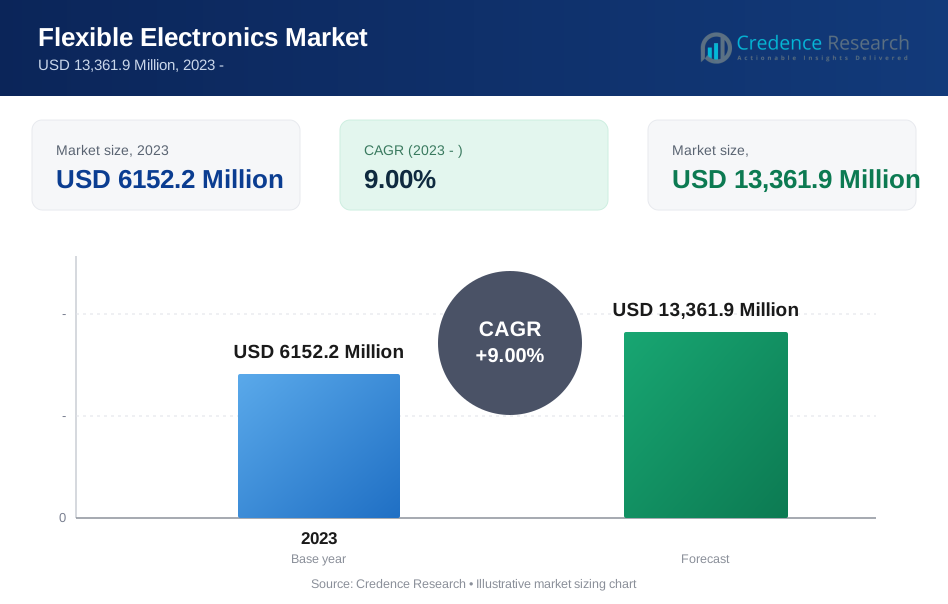
- The Flexible Electronics Market attained a valuation of USD 6152.2 Million in 2023 and is anticipated to escalate to USD 13361.9 Million by 2032, exhibiting a robust CAGR of 9.00% during the forecast period from 2024 to 2032.
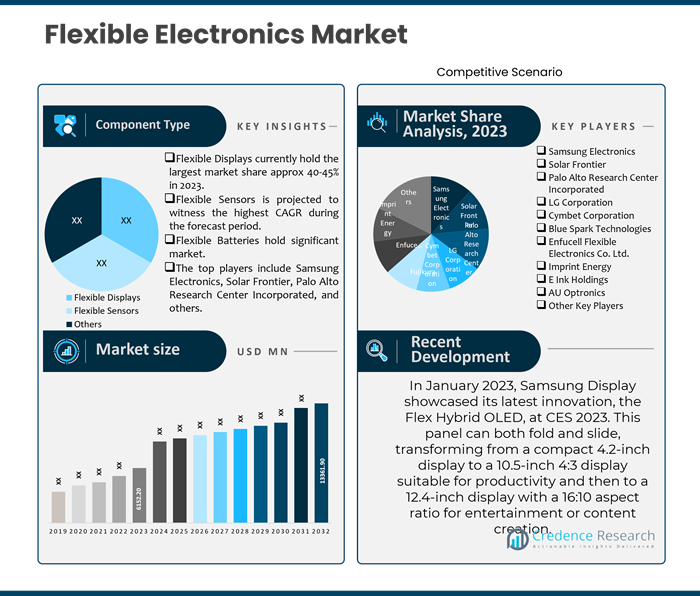
- Among the principal segments, Flexible Displays emerged as the dominant component type, capturing approximately 40-45% of the overall market share in 2023. Nevertheless, Flexible Sensors are anticipated to observe the highest growth rate throughout the forecast period.
- Consumer Electronics currently dominates the market by application, holding the largest market share of around 40-42% in 2023, driven by the escalating demand for smartphones, wearables, and similar devices.
- Plastic stands as the predominant substrate material, holding roughly 60-65% of the market share in 2023. Conversely, Metal Foils are projected to witness the highest CAGR during the forecast period, driven by their suitability in various applications.
- Organic Thin-Film Transistors (OTFT) currently hold the largest market share approx 30% in 2023 due to their compatibility with roll-to-roll mass production processes, resulting in lower operating costs and simplified assembly processes.
- Asia Pacific leads the market share in 2023, accounting for approximately 38-42% of the total market, fueled by advancements in technology and supportive government policies, particularly in countries such as China, Japan, South Korea, and Taiwan.
- The surge in demand for lightweight and compact electronic devices, promoting the adoption of flexible displays, sensors, and circuitry, propels the growth of the Flexible Electronics Market.
- Significant growth opportunities in the market include the potential expansion in various applications and end-user industries, advancements in soft materials and manufacturing technologies, and increasing investments in research and development, facilitating market growth.
Executive Summary
Market Definition
Flexible electronics market refers to the industry that designs, manufactures and sells electronic devices and products that can bend or extend. These products differ from traditional rigid electronics because they can be easily attached to circular objects or worn if it will not cause pain to the body. The global flexible electronics market is expected to grow significantly over the next few years due to increasing demand for thin and durable compact electronic devices. The major applications of this technology are materials wearables, smartphones, tablets, televisions, medical devices and automotive displays. Flexible electronics offer many advantages compared to traditional electronics, such as durability, energy efficiency, increased functionality and also offer a variety of other features, such as roll-up displays and conformal sensors, which were not possible with traditional silicon-based technologies.
Market Overview
The Flexible Electronics Market has exhibited steady growth and is anticipated to maintain a robust Compound Annual Growth Rate (CAGR) of 9.00% from 2024 to 2032. Valued at USD 6152.2 million in 2023, this market is forecasted to reach USD 13361.9 million by 2032.
Among the primary segments, Flexible Displays emerged as the dominant component type, comprising approximately 40-45% of the total market share in 2023. However, Flexible Sensors are expected to experience the highest CAGR over the forecast period.
Consumer Electronics accounted for the largest share of the market by application in 2023, capturing about 40-42% of the market, driven by the increasing demand for smartphones, wearables, and related devices.
Plastic remains the predominant substrate material, holding roughly 60-65% of the market share in 2023. Conversely, Metal Foils are anticipated to witness the highest CAGR during the forecast period, owing to their suitability in various applications.
Asia Pacific emerged as a significant market contributor in 2023, accounting for approximately 38-42% of the total market, propelled by technological advancements and favorable government policies, particularly in countries such as China, Japan, South Korea, and Taiwan.
The surge in demand for lightweight and compact electronic devices, fostering the adoption of flexible displays, sensors, and circuitry, is a key driver of the Flexible Electronics Market.
Continuous innovations in soft materials and manufacturing technologies present significant growth opportunities in the market, alongside increasing investments in research and development, facilitating market expansion.
Segmentation by Component Type
- Flexible Displays currently hold the largest market share approx 40-45% in 2023. The popularity of flexible displays can be attributed is due to their wide range of applications, including smart watches, folding phones and TV screens . Also, leading display manufacturers are actively developing flexible OLED devices, further drive the market.
- Flexible Sensors is projected to witness the highest CAGR during the forecast period. Increasing demand for IoT devices, healthcare monitoring systems and consumer electronics being adopted achieving improved sensitivity will increase demand for sensitive sensors.
Segmentation by Application
- Consumer Electronics currently hold the largest market share approx 40-42% in 2023. Growing demand for smartphones, wearables and other devices is driving the segment’s growth.
- Healthcare is projected to witness the highest CAGR during the forecast period. Rapidly evolving technologies also enable the integration of wearable exercise trackers, biocompatible sensors and implantable devices into health care systems drive the market growth.
Segmentation by Substrate Material
- Plastic currently hold the largest market share approx 60-65% in 2023. Low cost, ease of manufacture, and excellent flexibility make plastic film ideal for many applications, from consumer electronics to some of the most common industrial applications and polyethylene terephthalate (PET), polyimide (PI), and polycarbonate (PC).
- Metal Foils is projected to witness the highest CAGR during the forecast period. Copper (Cu) and aluminum (Al) sheets are materials of choice for design engineers with popular flex circuits and thermal expansion layers.
Segmentation by Technology
- Organic Thin-Film Transistors (OTFT) currently hold the largest market share approx 30% in 2023 due to their compatibility with roll-to-roll mass production processes, resulting in lower operating costs and simplified assembly processes.
- Organic Light Emitting Diodes (OLED) is projected to witness the highest CAGR during the forecast period due to faster penetration in mobile phone and television displays.
Segmentation by End-User Industry
- Consumer Electronics currently hold the largest market share approx 35-37% in 2023. Smartphones, tablets, laptops and wearable devices rely on electronics manufacturing more easily, benefiting from form factor adaptability, weight reduction and flexibility improvements.
- Automotive currently hold the significant market share approx 18-20% in 2023. Automakers are looking for flexible electronics to help identify premium interiors, dynamic headlights and aerodynamic exteriors equipped with built-in sensors, radars and cameras.
Segmentation by Region
- Asia Pacific held largest share around 38-42% of the market in 2023. The presence of advanced technologies, favorable government policies. Countries such as China, Japan, South Korea and Taiwan leading the charge in terms of R&D investment, product development contributed to the market growth.
- North America and Europe collectively account for just under 55% share in 2023, with North America holding over 20% share in the same year.
- The rest of the world, including Latin America, the Middle East, and Africa, supplies the remaining demand for Flexible Electronics.
The growing demand for lightweight and compact electronic devices promoting flexible displays, sensors, and circuitry adoption are also contributing to the market growth.
The Asia Pacific region holds the largest market share in the Flexible Electronics market. This growth can be attributed to a number of factors including increasing demand from end-user sectors such as consumer power, healthcare, automotive, military and defense etc. Besides, a large number of electronics manufacturers in countries like China, Japan, South Korea, Thailand and Taiwan have also contributed to this regional growth. For instance, in October 2023, Murata Electronics Thailand Co Ltd, a key supplier of components to Apple, has invested 2.4 billion baht to establish a new production base in Thailand for multilayer ceramic capacitors (MLCC). Rapid technological progress and increasing investments in R&D activities have led to the introduction of new convenient electrical products in the region. For instance, in December 2021, Samsung Electronics, a leading South Korean tech company, invested approximately 40 billion yen ($280 million) over five years in a new advanced chip packaging research facility in Japan. The Governments of these countries are actively promoting the adoption of smart technologies and incentives are being given to manufacturers to increase their production capacity. Moreover, rising disposable incomes and changing consumer lifestyles in emerging economies such as India and China have increased the demand for lightweight portable electronics, leading to electronic a the convenience market in the region has developed significantly.
Europe hold significant market share of the global Flexible Electronics market, driven by growing demand for lightweight and thin electronics across various industry verticals Germany, France, Italy, UK are contributors especially in the European flexible electronics market due to their well-established performance sector and supportive regulatory framework. For instance, in August 2023, Taiwanese chipmaker TSMC announced plans to build a factory in Germany, marking its first manufacturing facility in Europe. The $11 billion plant received commitments of €3.5 billion ($3.8 billion) from TSMC and up to €5 billion from Germany, aiming to open in 2027. However, many companies in this segment are investing heavily in developing flexible electronic solutions that consume less energy and provide longer battery life. For instance, in November 2023, the HyPerStripes research project launched by Würth Elektronik focuses on developing technologies and production processes for long, smart, and flexible electronic systems that can replace conventional cables. Furthermore, the expanding Internet of Things (IoT) further boost the market. In addition, the EU Horizon 2020 strategy has allocated significant funds for research and innovation in the field of flexible electronics, contributing to the growth of the overall market.
Key Highlights of the Report
The Flexible Electronics Market is segmented by Component Type, Application, Substrate Material, Technology, End-User Industry, and Region. The escalating demand for flexible electronics is propelled by factors such as the increasing adoption of lightweight and compact electronic devices, advancements in materials science, and expanding applications across various industries including consumer electronics, healthcare, automotive, and aerospace.
Flexible Displays emerge as the dominant segment, offering versatile applications in smart watches, folding phones, and TV screens, driven by the active development of flexible OLED devices by leading display manufacturers.
Plastic stands out as the predominant substrate material, favored for its low cost, ease of manufacture, and excellent flexibility, making it ideal for applications ranging from consumer electronics to industrial uses.
Organic Thin-Film Transistors (OTFT) as the dominant segment by technology due to their compatibility with roll-to-roll mass production processes, resulting in lower operating costs and simplified assembly processes.
Consumer Electronics leads the end-user segment, driven by the growing demand for smartphones, wearables, and other electronic devices benefiting from form factor adaptability and weight reduction.
Asia Pacific secures the largest market share in the Flexible Electronics market, supported by advanced technologies and favorable government policies promoting innovation and product development.
Key players such as LG Corporation, Cymbet Corporation, Blue Spark Technologies, Samsung Electronics, LG Corporation, and E Ink Holdings focus on product innovation and strategic partnerships to maintain their market competitiveness and position.
What Are The Main Drivers Of The Global Flexible Electronics Market?
The global Flexible Electronics market is driven by increasing demand for lightweight, portable, and bendable electronics, advancement in materials science for flexible design and material for manufacturing, and increasing applications in wearable electronics, healthcare, and consumer electronics. Furthermore, the need for energy-efficient and cost-effective electronic products further propel market growth.
What Are The Major Challenges Faced By The Global Flexible Electronics Market?
The global Flexible Electronics market is mainly challenged by technological limitations in acquiring high-performance flexible devices, concerns about durability and reliability of flexible components, high manufacturing costs of flexible electronics compared to the traditional electronics.
What Are The Growth Opportunities In The Global Flexible Electronics Market?
The global Flexible Electronics market presents numerous growth opportunities due to increasing adoption of emerging applications in flexible displays, wearable devices and Internet of Things (IoT) applications. Advances in soft materials and manufacturing technologies offer opportunities for innovation and the development of high-performance soft electrical components. Moreover, increasing investments in R&D, with collaborations and partnerships by industry players, facilitate technological advancement and market expansion.
Market Drivers
Increasing Demand In Consumer Electronics
The global flexible electronics market driven by the increasing demand in consumer electronics. The shift in consumer preferences towards more versatile, compact, and efficient electronics has led to the rapid growth of the global flexible electronics market. Rising demand for lightweight, portable and durable materials over traditional heavy-duty electric motors has fueled the market growth of these cutting-edge devices. In response to this growing trend, in November 2023, Materic launched Direct Silver nanowires. These highly pure nanowires were developed for a variety of applications, including smart clothing and e-readers , etc. They contribute significantly to advances in flexible electronics, touchscreen displays and solar cells by adding transparent conductive electrodes and sensors.
Market Restraints
High Manufacturing Costs Of Flexible Electronics Compared To The Traditional Electronics
High manufacturing costs of flexible electronics compared to the traditional electronics restrained the demand Flexible Electronics Market. Despite the growing popularity of flexible electronics, there are a number of challenges that can hinder widespread adoption, especially when it comes to manufacturing costs. Conventional electronics have benefited from long-established infrastructure, sophisticated processes and economies of scale, resulting in cheaper prices compared to their newer counterparts. However, producing flexible electronics tends to involve complex processes that require specialized equipment and and expertise, often increasing overall costs. Making bendable circuits for one requires unique substrate materials that can withstand repeated bending without loss of performance or reliability. Common materials such as polyimide, PET film, or stainless steel boast desirable properties but cost more than silicon wafers traditionally used in semiconductor manufacturing.
Opportunities
Adoption Of Various Strategies Among Market Players
Adoption of various strategies among market players makes significant opportunity for the market. The major companies serving the global Flexible Electronics Market are Exeger, Samsung Electronics, Solar Frontier, Palo Alto Research Center Incorporated, among others. The market players are considerably contributing to the market growth by the adoption of various strategies including mergers & acquisitions, collaborations, funding, patent application and new product launches, to stay competitive in the market. For instance, in November 2023, Kapsch TrafficCom (KTC) has entered a strategic partnership with Exeger, a Swedish company with unique solar cell technology. Through this partnership, KTC will leverage Exeger's Powerfoyle solar cell technology, which can convert all forms of light (natural and artificial) into clean, renewable energy. Its thin and flexible design allows it to be seamlessly integrated into products without compromising on visual aesthetics.
Competitive Landscape
Key Players
The global Flexible Electronics market is highly competitive, with several key players. Some of the major players in the market and their market share are as follows:
- Samsung Electronics
- Solar Frontier
- Palo Alto Research Center Incorporated
- LG Corporation
- Cymbet Corporation
- Blue Spark Technologies
- Enfucell Flexible Electronics Co. Ltd.
- Imprint Energy
- E Ink Holdings
- AU Optronics
- Others
These organizations prioritize product innovation, distribution channel expansion, and mergers and acquisitions to stay competitive.
The global Flexible Electronics market's key players continually seek to stay ahead by offering new products and developments.
In January 2023, Samsung Display showcased its latest innovation, the Flex Hybrid OLED, at CES 2023. This panel can both fold and slide, transforming from a compact 4.2-inch display to a 10.5-inch 4:3 display suitable for productivity and then to a 12.4-inch display with a 16:10 aspect ratio for entertainment or content creation.
In January 2022, Imprint Energy introduced ZinCore, their latest ultrathin, bendable battery series based on zinc technology. Offering elevated power density, ZinCore enables 5G services and novel IoT applications in fields like healthcare, agriculture, logistics, and IoT wearables.
Summary of Key Findings
- The Flexible Electronics Market is witnessing significant growth, driven by the increasing demand for lightweight, compact electronic devices across diverse industries including consumer electronics, healthcare, automotive, and aerospace. Key drivers fostering this growth include advancements in materials science, expanding applications, and the need for innovative electronic solutions.
- Market segmentation within the Flexible Electronics Market encompasses factors such as component type, application, substrate material, technology, end-user industry, and region, reflecting the diverse uses and applications of flexible electronics.
- Flexible Displays emerge as the dominant segment, capturing a significant market share due to their wide range of applications in smart watches, folding phones, and television screens. Flexible Sensors also contribute significantly, driven by increasing demand for IoT devices and healthcare monitoring systems.
- Plastic stands out as the predominant substrate material, favored for its low cost, ease of manufacture, and excellent flexibility. Metal Foils witness notable growth, particularly in applications requiring thermal expansion layers and flexible circuits.
- Consumer Electronics lead the end-user segment, fueled by the growing demand for smartphones, wearables, and other electronic devices benefiting from form factor adaptability and weight reduction. Automotive also experiences substantial growth, driven by the integration of flexible electronics in premium interiors and aerodynamic exteriors.
- Geographically, Asia Pacific holds the largest market share in the Flexible Electronics market, supported by advanced technologies and government incentives promoting innovation and production capacity. North America and Europe collectively account for a significant share of the market, with North America witnessing growth due to increasing demand for lightweight and durable electronic solutions.
Future Outlook
- The future outlook for the Flexible Electronics Market indicates promising growth opportunities, particularly within sectors such as consumer electronics, healthcare, and automotive, driven by the increasing demand for innovative electronic solutions and advancements in manufacturing technologies. However, anticipated challenges include technological limitations, concerns about durability and reliability, and high manufacturing costs compared to traditional electronics.
- To maintain competitiveness in the Flexible Electronics Market, industry players should focus on adopting various strategies such as continuous innovation, strategic collaborations, and investments in research and development. It is crucial for companies to prioritize addressing technological challenges, improving manufacturing processes, and exploring new applications to ensure sustained growth in the rapidly evolving market landscape.
How CXOs Can Benefit from the Credence Research Flexible Electronics Networks Market Report
The Credence Research Flexible Electronics Networks Market Report provides CXOs with a comprehensive overview of the market, including:
- Market size and growth forecast:The report provides detailed estimates of the global Flexible Electronics networks market size, segmented by component type, application, substrate material, technology, end-user industry, and region. It also includes forecasts for the market through 2032, based on key trends and drivers.
- Market segmentation:The report segments the Flexible Electronics networks market by component type, application, substrate material, technology, end-user industry, and region. The increasing demand for advanced solutions is driven. This segmentation provides CXOs with a granular understanding of the market and the opportunities in each segment.
- Competitive landscape:The report profiles the key players in the Flexible Electronics networks market and provides insights into their strategies, product offerings, and financial performance. This information can help CXOs to identify and assess their competition.
- Key trends and drivers:The report identifies and analyzes the key trends and drivers that are shaping the Flexible Electronics networks market. This information can help CXOs to make informed decisions about their investments and strategies.
CXOs can use the insights from the Credence Research Flexible Electronics Networks Market Report to:
- Identify growth opportunities:The report can help CXOs to identify new growth opportunities in the Flexible Electronics networks market. For example, the report identifies the growing demand for Flexible Electronics networks from cloud computing providers and telecom companies as a key opportunity.
- Make informed investment decisions:The report can help CXOs to make informed investment decisions about Flexible Electronics networks. For example, the report provides insights into the key factors to consider when evaluating Flexible Electronics providers and selecting Flexible Electronics solutions.
- Develop competitive strategies:The report can help CXOs to develop competitive strategies for their Flexible Electronics networks businesses. For example, the report identifies the key strategies that Flexible Electronics providers are using to differentiate themselves from their competitors.
- Track market developments:The report can help CXOs to track market developments and stay ahead of the curve. For example, the report provides insights into the latest trends and innovations in the Flexible Electronics networks market.
Overall, the Credence Research Flexible Electronics Networks Market Report is a valuable resource for CXOs who are looking to gain a deeper understanding of the market and identify opportunities for growth.
Segmentation
-
Component Type:
- Flexible Displays
- Flexible Batteries
- Flexible Sensors
- Flexible Circuits (Flexible Printed Circuit Boards - FPCBs)
- Flexible Memory Devices
- Photovoltaics (Flexible Solar Cells)
- Other Components
-
Application:
- Consumer Electronics
- Smartphones
- Wearable Devices (e.g., smartwatches, fitness trackers)
- Tablets
- E-readers
- Flexible TVs
- Others
- Healthcare
- Medical Wearables
- Health Monitoring Devices
- Medical Implants
- Drug Delivery Systems
- Others
- Automotive
- In-car Displays
- Smart Surfaces
- Lighting
- Sensors
- Others
- Aerospace and Defense
- Wearable Electronics for Military Applications
- Flexible Sensors for Aircraft
- Flexible Antennas
- Others
- Industrial
- Flexible Printed Electronics for Packaging
- Wearable Devices for Industrial Workers
- Flexible Sensors for Industrial Automation
- Others
- Energy
- Flexible Solar Panels
- Flexible Batteries and Energy Storage Devices
- Others
- Others
- Consumer Electronics
-
Substrate Material:
- Plastic
- Paper
- Metal Foil
- Glass
- Others
-
Technology:
- Organic Thin-film Transistors (OTFT)
- Inorganic Thin-film Transistors (ITFT)
- Organic Light Emitting Diodes (OLED)
- Organic Photovoltaics (OPV)
- Hybrid Materials
- Others
-
End-User Industry:
- Consumer Electronics
- Healthcare
- Automotive
- Aerospace and Defense
- Industrial
- Energy
- Others
-
By Region
- North America
- US
- Canada
- Mexico
- Europe
- Germany
- France
- UK.
- Italy
- Spain
- Rest of Europe
- Asia Pacific
- China
- Japan
- India
- South Korea
- South-east Asia
- Rest of Asia Pacific
- Latin America
- Brazil
- Argentina
- Rest of Latin America
- Middle East & Africa
- GCC Countries
- South Africa
- Rest of Middle East and Africa
- North America
Adjacent Markets
In the Flexible Electronics market, there are several adjacent markets which has high revenue growth opportunities. The key adjacent markets for Flexible Electronics market -
Adjacent Markets |
||
| Wearable Electronics Market | Internet of Things (IoT) Devices Market | Medical Electronics Market |
| Flexible Display Market | Smart Packaging Market | Consumer Electronics Market |
| Printed Electronics Market | Automotive Electronics Market | Energy Harvesting Devices Market |
Request a Free Sample
Fill in your details and we'll send you a free sample report.
- Sample data tables & charts
- Research methodology
Need a Custom Version of This Report?
Tailor the scope, geography, or segments to your exact requirements.
- Custom geography or segment scope
- Direct access to our analyst team
Frequently Asked Questions
What is the current size of the global Flexible Electronics market?
What is the expected growth rate of the Flexible Electronics market between 2024 and 2032?
Which segment is leading the market share in terms of Component Type?
Which Application segments governs the demand for Flexible Electronicss in the world?
Which Technology segment is expected to post the highest CAGR during the forecast period?
Which region is fueling the growth of the Flexible Electronics industry?
Who are the major players in the global Flexible Electronics market?
What are the major market drivers of the Flexible Electronics industry?
What are the major market restraints of the Flexible Electronics industry?
What are the major market opportunities of the Flexible Electronics industry?
Table of Content
Chapter 1. Report Introduction
- 1.1 Report Description & Purpose
- 1.1.1 Report Title & Market Definition
- 1.1.2 Unique Selling Propositions (USP) & Key Differentiators
- 1.1.3 Value Proposition for Stakeholders
- 1.2 Research Objectives
- 1.2.1 Market Sizing Objectives (Volume & Revenue)
- 1.2.2 Segmentation Objectives
- 1.2.3 Competitive Intelligence Objectives
- 1.2.4 Forecast & Scenario Objectives
- 1.3 Report Scope
- 1.3.1 Flexible Electronics Scope – Types & Subtypes Covered
- 1.3.2 Geographic Scope – Regions & Countries Covered
- 1.3.3 Historical Period, Base Year & Forecast Period (2023; forecast to the forecast period)
- 1.3.4 Inclusions & Exclusions
- 1.4 HS Code & Classification Framework
- 1.5 Currency, Units & Pricing Basis
- 1.6 Target Stakeholders
- 1.7 Limitations & Assumptions
Chapter 2. Executive Summary
- 2.1 Global Flexible Electronics Market Snapshot
- 2.1.1 Market Size – Historical (2023) & Forecast (the forecast period) (2023: USD 6152.2 Million → forecast year: USD 13,361.9 Million)
- 2.1.2 Volume & Revenue – Global Totals
- 2.1.3 Key Market Highlights – Top Five Facts
- 2.2 Flexible Electronics Market Segmentation Snapshot
- 2.2.1 Market Split by Region – 2023 vs.
- 2.3 Competitive Snapshot
- 2.3.1 Top 10 Players by Revenue Share – 2023
- 2.3.2 Top 10 Players by Volume Share – 2023
- 2.3.3 Recent Strategic Developments (18-Month Summary)
- 2.4 Key Investment Highlights & Strategic Conclusions
Chapter 3. Flexible Electronics Market Dynamics & Industry Analysis
- 3.1 Market Overview & Context
- 3.1.1 Flexible Electronics Market Position in the Broader Automotive Value Chain
- 3.1.2 OEM vs. Replacement Market Dynamics
- 3.1.3 Market Maturity & Development Stage by Region
- 3.2 Flexible Electronics Market Drivers
- 3.3 Flexible Electronics Market Restraints & Challenges
- 3.4 Flexible Electronics Market Opportunities
- 3.5 Porter's Five Forces Analysis
- 3.5.1 Threat of New Entrants
- 3.5.2 Bargaining Power of Suppliers
- 3.5.3 Bargaining Power of Buyers
- 3.5.4 Threat of Substitutes
- 3.5.5 Competitive Rivalry – Intensity Assessment
- 3.6 Flexible Electronics Value Chain Analysis
- 3.6.1 Upstream – Raw Material/Input Suppliers
- 3.6.1.1 Raw Material/Input 1
- 3.6.1.2 Raw Material/Input 2
- 3.6.1.3 Raw Material/Input 3
- 3.6.2 Midstream – Production/Manufacturing/Service Delivery
- 3.6.2.1 Production/Process Overview
- 3.6.2.2 Key Facility Locations & Capacity by Manufacturer
- 3.6.3 Downstream – Distribution & End Consumer
- 3.6.3.1 Primary Channel – B2B/OEM
- 3.6.3.2 Secondary Channels – Dealer, Retail, Online, Direct
- 3.6.4 Value Chain Profitability Analysis
- 3.6.1 Upstream – Raw Material/Input Suppliers
- 3.7 PESTEL Analysis
- 3.7.1 Political Factors
- 3.7.2 Economic Factors
- 3.7.3 Social Factors
- 3.7.4 Technological Factors
- 3.7.5 Environmental Factors
- 3.7.6 Legal Factors
- 3.8 Flexible Electronics Supply Chain Analysis
- 3.8.1 Raw Material/Input Supply Risk Assessment
- 3.8.2 Manufacturing Concentration Risk (Geographic Exposure)
- 3.8.3 Trade Disruption Impact Analysis
- 3.9 Regulatory & Policy Landscape
Note: The regulatory and policy landscape section covers regulations based on their applicability to the market, Flexible Electronics category, geography, and scope of the study. Only regulatory frameworks with a material impact on operations, compliance, trade, sustainability, or market access are analyzed in detail.
Chapter 4. Key Investment Pockets & Opportunity Analysis
- 4.1 Flexible Electronics Market Attractiveness Analysis
- 4.1.1 By Region – Investment Attractiveness Matrix (Volume × CAGR)
- 4.2 Absolute Revenue Growth Opportunity
- 4.2.1 By Region – Absolute USD Growth Through the forecast period
- 4.3 Incremental Volume Opportunity
- 4.3.1 By Region – Incremental Volume Through the forecast period
- 4.3.2 Segment – Incremental Volume
- 4.4 Emerging Submarket Opportunity Deep Dive (Subject to Applicability)
- 4.5 Emerging Market Opportunity Scorecards
- 4.5.1 United States
- 4.5.2 Europe
- 4.5.3 Asia
- 4.5.4 Middle East & Africa
Note: Emerging Market Opportunity Scorecards will be included based on relevance and strategic importance. Regions listed are indicative and may vary depending on data availability and market dynamics.
Chapter 5. Flexible Electronics Import-Export Analysis & Trade Flows
- 5.1 Global Trade Overview
- 5.1.1 Global Export Value by Country (2023)
- 5.1.2 Global Export Volume by Country (2023)
- 5.1.3 Global Import Value by Country (2023)
- 5.1.4 Global Import Volume by Country (2023)
- 5.1.5 Net Trade Balance by Country (2023)
- 5.2 Export Analysis – Segment
- 5.2.1 Type 1 (HS Code)
- 5.2.2 Type 2 (HS Code)
- 5.2.3 Type 3 (HS Code)
- 5.2.4 Type 4 (HS Code)
- 5.2.5 Type 5 (HS Code)
- 5.3 Import Analysis – Segment
- 5.3.1 Type 1 (HS Code)
- 5.3.2 Type 2 (HS Code)
- 5.3.3 Type 3 (HS Code)
- 5.3.4 Type 4 (HS Code)
- 5.3.5 Type 5 (HS Code)
- 5.4 Average Unit Trade Prices
- 5.4.1 Average Export Price – Segment & Country
- 5.4.2 Average Import Price – Segment & Source Country
- 5.4.3 Price Trends (2023)
- 5.5 Key Trade Route Analysis
- 5.5.1 Trade Route 1
- 5.5.2 Trade Route 2
- 5.5.3 Trade Route 3
- 5.5.4 Trade Route 4
- 5.5.5 Trade Route 5
- 5.6 Trade Policy Impact Assessment
- 5.6.1 US Anti-Dumping & Section 301 Tariffs
- 5.6.2 EU Customs Union Impact
- 5.6.3 Major Free Trade Agreements
- 5.6.4 USMCA Rules of Origin
Note: Trade policy analysis will be included only where relevant to the Flexible Electronics market.
Chapter 6. Competitive Landscape & Company Benchmarking
- 6.1 Flexible Electronics Market Concentration & Structure
- 6.1.1 Herfindahl-Hirschman Index (HHI) – vs. 2023
- 6.1.2 Tier 1, Tier 2 & Tier 3 Market Structure
- 6.1.3 Global, Regional & Local Player Dynamics
- 6.2 Flexible Electronics Market Share Analysis – 2023
- 6.2.1 Global Revenue Share by Company
- 6.2.2 Global Volume Share by Company
- 6.2.3 Regional Revenue Share
- 6.2.4 Market Share Evolution ( vs. 2023)
- 6.2.5 OEM Segment Share by Company
- 6.2.6 Replacement Segment Share by Company
- 6.3 Production/Delivery Capacity & Facility Analysis
- 6.3.1 Global Installed Capacity
- 6.3.2 Capacity Utilization Rates
- 6.3.3 Production/Output Volume
- 6.3.4 Facility Locations & Capacity Map
- 6.3.5 Planned Capacity Additions
- 6.4 Flexible Electronics Competitive Benchmarking Matrix
- 6.4.1 Revenue, Volume, CAGR & Profitability Comparison
- 6.4.2 Channel Revenue Mix
- 6.4.3 Geographic Revenue Exposure
- 6.4.4 R&D Intensity
- 6.4.5 Sustainability Maturity
- 6.5 Strategic Developments in Flexible Electronics (Last 24 Months)
- 6.5.1 Mergers, Acquisitions & Divestments
- 6.5.2 New Flexible Electronics Launches
- 6.5.3 Facility Expansions
- 6.5.4 Strategic Alliances, Joint Ventures & Partnerships
- 6.5.5 Distribution Expansion & Market Entry
- 6.5.6 Sustainability & ESG Initiatives
- 6.6 Competitive Strategy Mapping
- 6.6.1 Leader, Challenger, Follower & Niche Classification
- 6.6.2 Pricing Strategy Comparison
- 6.6.3 Channel Strategy Matrix
Note: Strategic developments are included based on their materiality and the availability of reliable information.
Chapter 7. Global Flexible Electronics Market – By Distribution Channel
- 7.1 Segment Overview
- 7.1.1 Volume & Revenue Split by Channel (2023 & )
- 7.1.2 Channel Mix Evolution (the forecast period)
Chapter 8. Regional Market Analysis – Global Overview
- 8.1 Global Regional Overview
- 8.1.1 Regional Volume Share
- 8.1.2 Regional Revenue Share
- 8.1.3 Regional Volume by Region
- 8.1.4 Regional Revenue by Region
- 8.1.5 Regional Forecast Through the forecast period
- 8.2 Cross-Regional Segment Analysis
- 8.2.1 By Distribution Channel
- 8.2.2 By Brand/Price Tier
Chapter 9. North America Flexible Electronics Market
- 9.1 United States
- 9.2 Canada
- 9.3 Mexico
Chapter 10. Europe Flexible Electronics Market
- 10.1 Germany
- 10.2 France
- 10.3 Italy
- 10.4 United Kingdom
- 10.5 Spain
- 10.6 Poland
- 10.7 Russia
- 10.8 Netherlands
- 10.9 Belgium
- 10.10 Sweden
- 10.11 Denmark
- 10.12 Norway
- 10.13 Rest of Europe
Chapter 11. Asia Pacific Flexible Electronics Market
- 11.1 China
- 11.2 India
- 11.3 Japan
- 11.4 South Korea
- 11.5 Thailand
- 11.6 Indonesia
- 11.7 Vietnam
- 11.8 Malaysia
- 11.9 Australia
- 11.10 Rest of Asia Pacific
Chapter 12. Latin America Flexible Electronics Market
- 12.1 Brazil
- 12.2 Argentina
- 12.3 Colombia
- 12.4 Chile
- 12.5 Rest of Latin America
Chapter 13. Middle East Flexible Electronics Market
- 13.1 Saudi Arabia
- 13.2 United Arab Emirates
- 13.3 Turkey
- 13.4 Israel
- 13.5 Iran
- 13.6 Rest of the Middle East
Chapter 14. Africa Flexible Electronics Market
- 14.1 South Africa
- 14.2 Egypt
- 14.3 Nigeria
- 14.4 Morocco
- 14.5 Rest of Africa
Chapter 15. Flexible Electronics Company Profiles
- 15.1 [Company 01]
- 15.1.1 Company Overview
- 15.1.2 Key Management Personnel
- 15.1.3 Products & Services Portfolio
- 15.1.4 Financial Performance
- 15.1.5 Key Market Focus & Geographic Presence
- 15.1.6 Recent Developments & Strategic Initiatives
Note: The company profile list is preliminary and may change based on research findings, market developments, data availability, and client requirements.
Chapter 16. Appendices
- Appendix A – List of Abbreviations & Acronyms
- Appendix B – Industry Classification Code Reference – Full Series
- Appendix C – Production & Capacity Data Tables
- Appendix D – End-Use & Demand Base Tables
- Appendix E – Consumption & Replacement Rate Assumptions
- Appendix F – ASP Reference Tables
- Appendix G – Manufacturing & Facility Database
- Appendix H – Import-Export Data Tables
- Appendix I – Regulatory Summary Tables
- Appendix J – Primary Research Participant List (Anonymized)
- Appendix K – Primary Research Questionnaire Framework
- Appendix L – Data Sources & Bibliography
- Appendix M – Market Size Divergence & Source Comparison
Chapter 17. Research Methodology
- 17.1 Research Framework & Philosophy
- 17.2 Secondary Research – Sources, Hierarchy & Data Extraction
- 17.3 Data Modeling – Bottom-Up & Top-Down Market Sizing
- 17.4 Primary Research – Stakeholder Framework, LOI & Sample Sizes
- 17.5 Forecast Methodology – Regression, Scenario & Sensitivity Analysis
- 17.6 Quality Control – Four-Layer Validation Framework
- 17.7 Limitations & Standard Assumptions
- 17.8 Disclaimer
