
India and China Baby Diapers Market Overview:
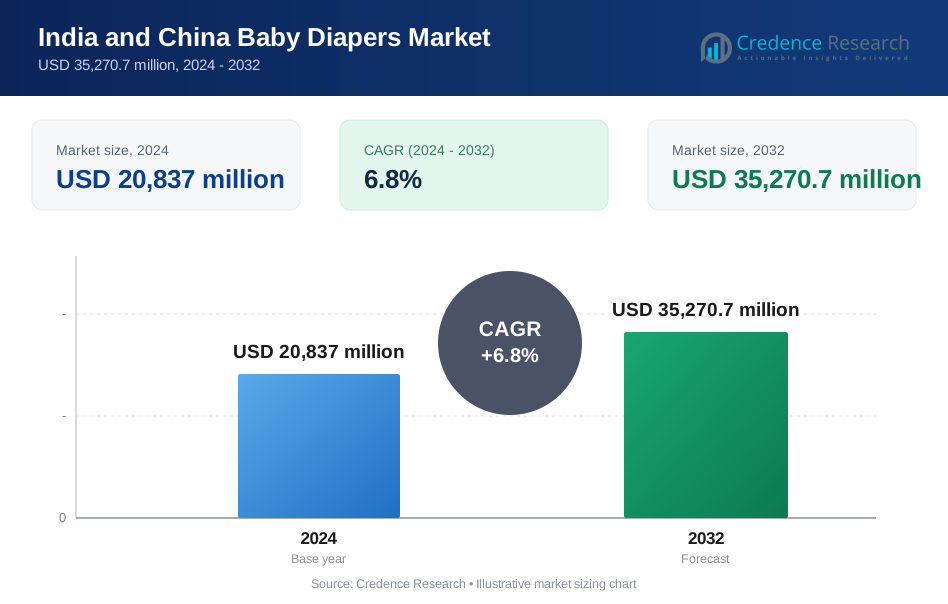
The India and China Baby Diapers Market size was valued at USD 20,837 million in 2024 and is anticipated to reach USD 35,270.7 million by 2032, growing at a CAGR of 6.8% during the forecast period.
| REPORT ATTRIBUTE | DETAILS |
|---|---|
| Historical Period | 2020-2023 |
| Base Year | 2024 |
| Forecast Period | 2025-2032 |
| India and China Baby Diapers Market Size 2024 | USD 20,837 million |
| India and China Baby Diapers Market, CAGR | 6.8% |
| India and China Baby Diapers Market Size 2032 | USD 35,270.7 million |
India and China Baby Diapers Market Insights
- Market growth is driven by rising infant population, increasing disposable income, urbanization, and growing awareness of infant hygiene, with disposable diapers dominating the market with a 6% segment share in 2024 due to convenience and superior absorbency.
- Premiumization and e-commerce expansion are key trends, as parents increasingly prefer skin-friendly, ultra-thin, and high-absorbency diapers, while online platforms lead distribution with a 7% share, supported by subscriptions and bulk purchasing.
- Strong brand presence by multinational and regional manufacturers intensifies market activity, while price sensitivity, promotional dependency, and rising raw material costs act as key restraints, especially in rural and lower-income segments.
- Regionally, China leads with a 61.6% market share in 2024 due to higher per-capita consumption and premium demand, while India holds 38.4% share, supported by a large infant base and improving retail and digital penetration.
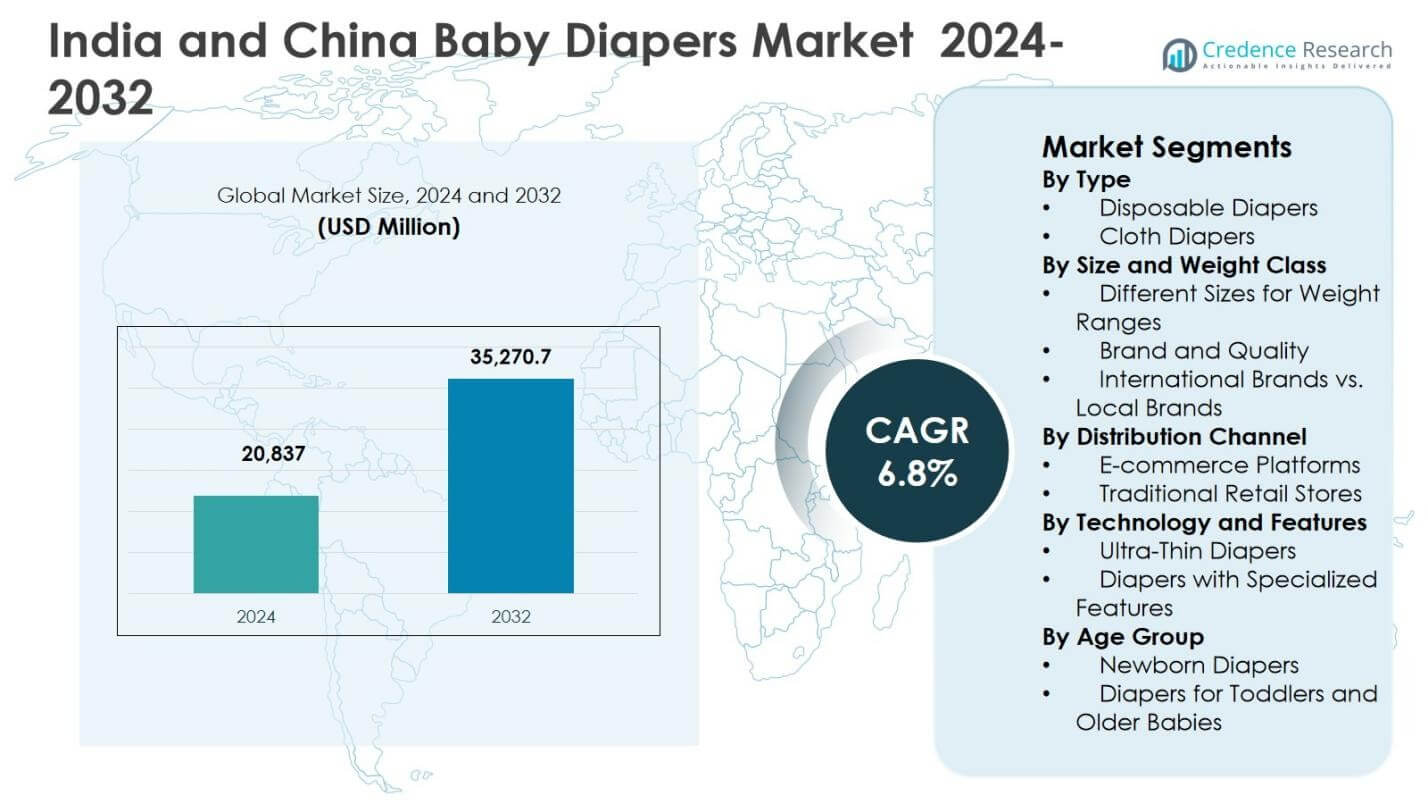
India and China Baby Diapers Market Segmentation Analysis:
By Type:
In the India and China Baby Diapers Market, disposable diapers dominate the by-type segment, accounting for 92.6% market share in 2024, while cloth diapers hold 7.4%. Disposable diapers lead due to their convenience, superior absorbency, improved skin-friendly materials, and suitability for urban lifestyles. Rising working parent populations, higher birth rates in select regions, and growing awareness of infant hygiene continue to accelerate adoption. Continuous product innovation, including breathable layers and wetness indicators, further strengthens disposable diapers’ dominance, particularly in urban and semi-urban areas across India and China.
- For instance, Huggies Natural Soft Premium Pants in India incorporate 100% imported natural cotton in the bubble bed liner and breathable material clinically proven to prevent rashes, alongside a Dry Xpert Channel for 12-hour absorption.
By Size and Weight Class / Brand and Quality:
Within size and weight class segmentation, standard weight-based diaper sizes aligned with international quality benchmarks represent the dominant sub-segment, capturing 68.9% market share in 2024. International brands account for 61.3% share, outperforming local brands due to consistent quality, advanced absorbent technology, and strong brand trust among parents. Growth is driven by increasing parental focus on comfort, leakage protection, and skin safety across different infant growth stages. Expanding product portfolios with tailored sizes for newborns to toddlers further supports segment leadership in both countries.
- For instance, Pampers Baby-Dry diapers (Size 3, 16-28 lbs) feature Lock-Away Channels for up to 100% leakproof nights, stretchy sides to prevent blowouts, and a Dri-Weave Liner that keeps skin dry and healthy while being hypoallergenic and free of parabens.
By Distribution Channel:
E-commerce platforms lead the distribution channel segment in the India and China Baby Diapers Market, holding 54.7% market share in 2024, while traditional retail stores account for 45.3%. Online dominance is driven by competitive pricing, subscription models, bulk purchase options, and convenient home delivery. High smartphone penetration, digital payment adoption, and frequent promotional campaigns accelerate online sales growth. Meanwhile, traditional retail remains relevant in rural and semi-urban areas, supported by immediate product availability and consumer preference for in-store brand comparison.
Key Growth Drivers
Rising Birth Rates and Expanding Infant Population
The India and China Baby Diapers Market benefits from a large and continuously replenishing infant population across both countries. Although urban fertility rates have stabilized, overall birth volumes remain significant due to population scale and improving maternal healthcare infrastructure. Government programs supporting maternal and child health, increasing institutional deliveries, and better access to pediatric services are encouraging early adoption of baby hygiene products. Growing awareness among first-time parents in tier-2, tier-3, and rural areas is expanding diaper penetration and supporting sustained volume growth.
- For instance, Kimberly-Clark's Huggies launched the "Geelu Monster" campaign in India in 2025, targeting first-time parents by visualizing wetness discomfort and promoting its fast-absorption technology to build trust in tier-2 and tier-3 areas.
Increasing Disposable Income and Rapid Urbanization
Rising disposable incomes and accelerating urbanization are key contributors to diaper market expansion in India and China. Dual-income households increasingly prioritize convenience, hygiene, and time efficiency, driving a shift from traditional cloth usage to disposable diapers. Improved affordability enables parents to upgrade to branded and premium variants offering better absorbency and comfort. Expanding middle-class populations, wider retail availability, and competitive pricing strategies are reinforcing regular diaper usage across urban and semi-urban regions.
- For instance, Procter & Gamble's Pampers launched its improved Premium Care Diaper Pants in India in January 2024, featuring 360-degree cottony softness, an anti-rash blanket with aloe vera, and 10 million micropores for breathability.
Growing Awareness of Infant Hygiene and Skin Health
Increasing awareness of infant hygiene and skin protection is significantly influencing diaper consumption patterns. Pediatric recommendations, online parenting communities, and digital health content have educated parents on preventing rashes and infections through proper hygiene. Manufacturers emphasize dermatologically tested, hypoallergenic, and chemical-free features to align with health-conscious parenting trends. This growing awareness is increasing diaper usage frequency per child and accelerating adoption among previously price-sensitive consumers, particularly during early infancy stages.
Key Trends & Opportunities
Premiumization and Skin-Friendly Product Innovations
Premiumization is a major trend shaping the India and China Baby Diapers Market. Parents are increasingly choosing diapers with advanced features such as breathable materials, ultra-thin absorbent cores, plant-based liners, and lotion-infused layers. Rising concerns over allergies and long-term skin health are boosting demand for dermatologist-approved products. This trend presents strong opportunities for manufacturers to introduce higher-margin premium ranges, strengthen brand loyalty, and differentiate offerings, especially among urban and health-conscious consumers.
- For instance, R for Rabbit Feather Diapers boast 10 million breathable pores for rash prevention and an ultra-thin design with 12-hour absorbency. Dermatologically and pediatrician-tested as chemical-free, they suit sensitive skin with yoga pant-style elasticity.
Growth of E-commerce and Subscription-Based Sales Models
The expansion of e-commerce platforms is transforming diaper distribution across India and China. Online channels offer bulk purchasing, subscription-based auto-replenishment, personalized recommendations, and doorstep delivery, enhancing consumer convenience and retention. Digital marketing and data-driven promotions help brands effectively target new parents. This trend creates scalable growth opportunities for both international and local players, while subscription models stabilize demand, improve forecasting, and support long-term customer relationships.
- For instance, Pampers launched its Club app in India, enabling parents to scan codes inside every diaper pack to earn redeemable points for discounts on future purchases of Pampers Premium Care pants and wipes.
Key Challenges
High Price Sensitivity and Intense Market Competition
High price sensitivity remains a major challenge, particularly in rural and lower-income segments. Consumers frequently switch brands based on discounts, limiting manufacturers’ pricing power and compressing margins. The presence of numerous domestic players intensifies competition, requiring continuous promotional spending. Rising raw material and logistics costs further strain profitability, making it difficult for companies to balance affordability, quality, and innovation in a highly competitive market environment.
Environmental Sustainability and Waste Management Issues
Environmental concerns present a growing challenge for the baby diapers industry. Disposable diapers contribute significantly to non-biodegradable waste, drawing regulatory scrutiny and increasing public awareness. This may encourage selective shifts toward cloth or eco-friendly alternatives. Manufacturers face pressure to invest in biodegradable materials, recycling solutions, and sustainable packaging, increasing production costs. Managing environmental compliance while maintaining product performance and competitive pricing remains a critical long-term challenge.
Regional Analysis
India
India accounted for 38.4% market share in 2024 in the India and China Baby Diapers Market, driven by a large infant population, rising urbanization, and improving awareness of infant hygiene. Growth is supported by expanding middle-class households, increasing female workforce participation, and higher penetration of disposable diapers in urban and semi-urban areas. Government initiatives promoting maternal and child healthcare and the rapid expansion of e-commerce platforms are accelerating adoption. Although rural penetration remains comparatively lower, affordability-focused product launches and wider retail reach continue to strengthen demand across the country.
China
China held a dominant 61.6% market share in 2024, supported by higher per-capita diaper consumption and strong demand for premium baby care products. Urban households demonstrate high adoption rates due to greater disposable income and strong awareness of infant skin health. The market benefits from a well-developed retail and e-commerce ecosystem, enabling efficient distribution and frequent product upgrades. Demand for premium, skin-friendly, and environmentally improved diapers is particularly strong among urban parents. Policy shifts supporting family growth and rising focus on product quality continue to sustain market expansion in China.
India and China Baby Diapers Market Segmentations:
By Type
- Disposable Diapers
- Cloth Diapers
By Size and Weight Class
- Different Sizes for Weight Ranges
- Brand and Quality
- International Brands vs. Local Brands
By Distribution Channel
- E-commerce Platforms
- Traditional Retail Stores
By Technology and Features
- Ultra-Thin Diapers
- Diapers with Specialized Features
By Age Group
- Newborn Diapers
- Diapers for Toddlers and Older Babies
By Region
- India
- China
Competitive Landscape
Competitive landscape analysis of the India and China Baby Diapers Market is led by Procter & Gamble, Kimberly-Clark Corporation, Unicharm Corporation, Kao Corporation, Hengan International Group Company Ltd., SCA AB, Drylock Technologies, Nobel Hygiene, and Fine Solutions. The market is highly competitive, characterized by strong brand equity, extensive retail and e-commerce distribution networks, and continuous product innovation. International players dominate the premium and mid-priced segments through advanced absorbent technology, skin-friendly materials, and aggressive promotional strategies, particularly in urban areas. Regional and local manufacturers focus on cost-competitive offerings and customized product sizes to address price-sensitive consumers in semi-urban and rural markets. Strategic priorities across the competitive landscape include premiumization, expansion of online sales channels, localized manufacturing to manage costs, and increasing emphasis on eco-friendly and dermatologically tested diaper solutions.
Key Player Analysis
- Drylock Technologies N.
- Unicharm Corporation
- Fine Solutions
- Procter & Gamble (P&G) Company
- Nobel Hygiene
- Kao Corporation
- SCA AB
- Hengan International Group Company Ltd.
- Kimberly-Clark Corporation
- Phillips Healthcare
Recent Developments
- In January 2025, Panacea Biotec's subsidiary Panacea Biotec Pharma launched baby diapers and wipes under the 'NikoMom' brand, marking its entry into the baby care segment.
- In October 2025, Kimberly-Clark Corporation launched enhanced global partnerships to expand essential care initiatives, including programs in India and China focused on maternal and newborn support.
- In August 2025, Procter & Gamble began selling China-made luxury “bumbum” brand diapers to capture demand for premium, feature-rich baby diaper products.
Report Coverage
The research report offers an in-depth analysis based on Type, Size and Weight Class, Distribution Channel, Technology and Features, Age Group and Geography. It details leading market players, providing an overview of their business, product offerings, investments, revenue streams, and key applications. Additionally, the report includes insights into the competitive environment, SWOT analysis, current market trends, as well as the primary drivers and constraints. Furthermore, it discusses various factors that have driven market expansion in recent years. The report also explores market dynamics, regulatory scenarios, and technological advancements that are shaping the industry. It assesses the impact of external factors and global economic changes on market growth. Lastly, it provides strategic recommendations for new entrants and established companies to navigate the complexities of the market.
Future Outlook
- The India and China baby diapers market will continue expanding due to sustained infant population levels and rising hygiene awareness.
- Disposable diapers will maintain dominance as convenience and lifestyle changes favor single-use products.
- Premium and ultra-premium diaper segments will gain traction, driven by demand for skin-friendly and high-absorbency features.
- Urban markets will remain key revenue contributors, while rural penetration will steadily improve through affordable product lines.
- E-commerce platforms will play a central role in driving volume growth and customer retention.
- Subscription-based purchasing models will support repeat sales and predictable demand patterns.
- Local manufacturers will strengthen their presence by offering cost-effective and region-specific products.
- Innovation in breathable, lightweight, and eco-conscious materials will shape product differentiation strategies.
- Competitive intensity will remain high, encouraging frequent product upgrades and promotional activities.
- Long-term growth will depend on balancing affordability, sustainability, and product performance across diverse consumer segments.
Request a Free Sample
Fill in your details and we'll send you a free sample report.
- Sample data tables & charts
- Research methodology
Need a Custom Version of This Report?
Tailor the scope, geography, or segments to your exact requirements.
- Custom geography or segment scope
- Direct access to our analyst team
Frequently Asked Questions
What is the current market size for the India and China Baby Diapers Market, and what is its projected size in 2032?
At what Compound Annual Growth Rate is the India and China Baby Diapers Market projected to grow between 2024 and 2032?
Which India and China Baby Diapers Market segment held the largest share in 2024?
What are the primary factors fueling the growth of the India and China Baby Diapers Market?
Who are the leading companies in the India and China Baby Diapers Market?
Which region commanded the largest share of the India and China Baby Diapers Market in 2024?
Table of Content
Chapter 1. Report Introduction
- 1.1 Report Description & Purpose
- 1.1.1 Report Title & Market Definition
- 1.1.2 Unique Selling Propositions (USP) & Key Differentiators
- 1.1.3 Value Proposition for Stakeholders
- 1.2 Research Objectives
- 1.2.1 Market Sizing Objectives (Volume & Revenue)
- 1.2.2 Segmentation Objectives
- 1.2.3 Competitive Intelligence Objectives
- 1.2.4 Forecast & Scenario Objectives
- 1.3 Report Scope
- 1.3.1 India and China Baby Diapers Scope – Types & Subtypes Covered
- 1.3.2 Geographic Scope – Regions & Countries Covered
- 1.3.3 Historical Period, Base Year & Forecast Period (2024; forecast to 2032)
- 1.3.4 Inclusions & Exclusions
- 1.4 HS Code & Classification Framework
- 1.5 Currency, Units & Pricing Basis
- 1.6 Target Stakeholders
- 1.7 Limitations & Assumptions
Chapter 2. Executive Summary
- 2.1 Global India and China Baby Diapers Market Snapshot
- 2.1.1 Market Size – Historical (2024) & Forecast (2024-2032) (2024: USD 20,837 million → 2032: USD 35,270.7 million)
- 2.1.2 Volume & Revenue – Global Totals
- 2.1.3 Key Market Highlights – Top Five Facts
- 2.2 India and China Baby Diapers Market Segmentation Snapshot
- 2.2.1 Market Split by Region – 2024 vs. 2032
- 2.3 Competitive Snapshot
- 2.3.1 Top 10 Players by Revenue Share – 2024
- 2.3.2 Top 10 Players by Volume Share – 2024
- 2.3.3 Recent Strategic Developments (18-Month Summary)
- 2.4 Key Investment Highlights & Strategic Conclusions
Chapter 3. India and China Baby Diapers Market Dynamics & Industry Analysis
- 3.1 Market Overview & Context
- 3.1.1 India and China Baby Diapers Market Position in the Broader Automotive Value Chain
- 3.1.2 OEM vs. Replacement Market Dynamics
- 3.1.3 Market Maturity & Development Stage by Region
- 3.2 India and China Baby Diapers Market Drivers
- 3.3 India and China Baby Diapers Market Restraints & Challenges
- 3.4 India and China Baby Diapers Market Opportunities
- 3.5 Porter's Five Forces Analysis
- 3.5.1 Threat of New Entrants
- 3.5.2 Bargaining Power of Suppliers
- 3.5.3 Bargaining Power of Buyers
- 3.5.4 Threat of Substitutes
- 3.5.5 Competitive Rivalry – Intensity Assessment
- 3.6 India and China Baby Diapers Value Chain Analysis
- 3.6.1 Upstream – Raw Material/Input Suppliers
- 3.6.1.1 Raw Material/Input 1
- 3.6.1.2 Raw Material/Input 2
- 3.6.1.3 Raw Material/Input 3
- 3.6.2 Midstream – Production/Manufacturing/Service Delivery
- 3.6.2.1 Production/Process Overview
- 3.6.2.2 Key Facility Locations & Capacity by Manufacturer
- 3.6.3 Downstream – Distribution & End Consumer
- 3.6.3.1 Primary Channel – B2B/OEM
- 3.6.3.2 Secondary Channels – Dealer, Retail, Online, Direct
- 3.6.4 Value Chain Profitability Analysis
- 3.6.1 Upstream – Raw Material/Input Suppliers
- 3.7 PESTEL Analysis
- 3.7.1 Political Factors
- 3.7.2 Economic Factors
- 3.7.3 Social Factors
- 3.7.4 Technological Factors
- 3.7.5 Environmental Factors
- 3.7.6 Legal Factors
- 3.8 India and China Baby Diapers Supply Chain Analysis
- 3.8.1 Raw Material/Input Supply Risk Assessment
- 3.8.2 Manufacturing Concentration Risk (Geographic Exposure)
- 3.8.3 Trade Disruption Impact Analysis
- 3.9 Regulatory & Policy Landscape
Note: The regulatory and policy landscape section covers regulations based on their applicability to the market, India and China Baby Diapers category, geography, and scope of the study. Only regulatory frameworks with a material impact on operations, compliance, trade, sustainability, or market access are analyzed in detail.
Chapter 4. Key Investment Pockets & Opportunity Analysis
- 4.1 India and China Baby Diapers Market Attractiveness Analysis
- 4.1.1 By Region – Investment Attractiveness Matrix (Volume × CAGR)
- 4.2 Absolute Revenue Growth Opportunity
- 4.2.1 By Region – Absolute USD Growth Through 2032
- 4.3 Incremental Volume Opportunity
- 4.3.1 By Region – Incremental Volume Through 2032
- 4.3.2 Segment – Incremental Volume
- 4.4 Emerging Submarket Opportunity Deep Dive (Subject to Applicability)
- 4.5 Emerging Market Opportunity Scorecards
- 4.5.1 United States
- 4.5.2 Europe
- 4.5.3 Asia
- 4.5.4 Middle East & Africa
Note: Emerging Market Opportunity Scorecards will be included based on relevance and strategic importance. Regions listed are indicative and may vary depending on data availability and market dynamics.
Chapter 5. India and China Baby Diapers Import-Export Analysis & Trade Flows
- 5.1 Global Trade Overview
- 5.1.1 Global Export Value by Country (2024)
- 5.1.2 Global Export Volume by Country (2024)
- 5.1.3 Global Import Value by Country (2024)
- 5.1.4 Global Import Volume by Country (2024)
- 5.1.5 Net Trade Balance by Country (2024)
- 5.2 Export Analysis – Segment
- 5.2.1 Type 1 (HS Code)
- 5.2.2 Type 2 (HS Code)
- 5.2.3 Type 3 (HS Code)
- 5.2.4 Type 4 (HS Code)
- 5.2.5 Type 5 (HS Code)
- 5.3 Import Analysis – Segment
- 5.3.1 Type 1 (HS Code)
- 5.3.2 Type 2 (HS Code)
- 5.3.3 Type 3 (HS Code)
- 5.3.4 Type 4 (HS Code)
- 5.3.5 Type 5 (HS Code)
- 5.4 Average Unit Trade Prices
- 5.4.1 Average Export Price – Segment & Country
- 5.4.2 Average Import Price – Segment & Source Country
- 5.4.3 Price Trends (2024)
- 5.5 Key Trade Route Analysis
- 5.5.1 Trade Route 1
- 5.5.2 Trade Route 2
- 5.5.3 Trade Route 3
- 5.5.4 Trade Route 4
- 5.5.5 Trade Route 5
- 5.6 Trade Policy Impact Assessment
- 5.6.1 US Anti-Dumping & Section 301 Tariffs
- 5.6.2 EU Customs Union Impact
- 5.6.3 Major Free Trade Agreements
- 5.6.4 USMCA Rules of Origin
Note: Trade policy analysis will be included only where relevant to the India and China Baby Diapers market.
Chapter 6. Competitive Landscape & Company Benchmarking
- 6.1 India and China Baby Diapers Market Concentration & Structure
- 6.1.1 Herfindahl-Hirschman Index (HHI) – vs. 2024
- 6.1.2 Tier 1, Tier 2 & Tier 3 Market Structure
- 6.1.3 Global, Regional & Local Player Dynamics
- 6.2 India and China Baby Diapers Market Share Analysis – 2024
- 6.2.1 Global Revenue Share by Company
- 6.2.2 Global Volume Share by Company
- 6.2.3 Regional Revenue Share
- 6.2.4 Market Share Evolution ( vs. 2024)
- 6.2.5 OEM Segment Share by Company
- 6.2.6 Replacement Segment Share by Company
- 6.3 Production/Delivery Capacity & Facility Analysis
- 6.3.1 Global Installed Capacity
- 6.3.2 Capacity Utilization Rates
- 6.3.3 Production/Output Volume
- 6.3.4 Facility Locations & Capacity Map
- 6.3.5 Planned Capacity Additions
- 6.4 India and China Baby Diapers Competitive Benchmarking Matrix
- 6.4.1 Revenue, Volume, CAGR & Profitability Comparison
- 6.4.2 Channel Revenue Mix
- 6.4.3 Geographic Revenue Exposure
- 6.4.4 R&D Intensity
- 6.4.5 Sustainability Maturity
- 6.5 Strategic Developments in India and China Baby Diapers (Last 24 Months)
- 6.5.1 Mergers, Acquisitions & Divestments
- 6.5.2 New India and China Baby Diapers Launches
- 6.5.3 Facility Expansions
- 6.5.4 Strategic Alliances, Joint Ventures & Partnerships
- 6.5.5 Distribution Expansion & Market Entry
- 6.5.6 Sustainability & ESG Initiatives
- 6.6 Competitive Strategy Mapping
- 6.6.1 Leader, Challenger, Follower & Niche Classification
- 6.6.2 Pricing Strategy Comparison
- 6.6.3 Channel Strategy Matrix
Note: Strategic developments are included based on their materiality and the availability of reliable information.
Chapter 7. Global India and China Baby Diapers Market – By Distribution Channel
- 7.1 Segment Overview
- 7.1.1 Volume & Revenue Split by Channel (2024 & 2032)
- 7.1.2 Channel Mix Evolution (2024-2032)
Chapter 8. Regional Market Analysis – Global Overview
- 8.1 Global Regional Overview
- 8.1.1 Regional Volume Share
- 8.1.2 Regional Revenue Share
- 8.1.3 Regional Volume by Region
- 8.1.4 Regional Revenue by Region
- 8.1.5 Regional Forecast Through 2032
- 8.2 Cross-Regional Segment Analysis
- 8.2.1 By Distribution Channel
- 8.2.2 By Brand/Price Tier
Chapter 9. North America India and China Baby Diapers Market
- 9.1 United States
- 9.2 Canada
- 9.3 Mexico
Chapter 10. Europe India and China Baby Diapers Market
- 10.1 Germany
- 10.2 France
- 10.3 Italy
- 10.4 United Kingdom
- 10.5 Spain
- 10.6 Poland
- 10.7 Russia
- 10.8 Netherlands
- 10.9 Belgium
- 10.10 Sweden
- 10.11 Denmark
- 10.12 Norway
- 10.13 Rest of Europe
Chapter 11. Asia Pacific India and China Baby Diapers Market
- 11.1 China
- 11.2 India
- 11.3 Japan
- 11.4 South Korea
- 11.5 Thailand
- 11.6 Indonesia
- 11.7 Vietnam
- 11.8 Malaysia
- 11.9 Australia
- 11.10 Rest of Asia Pacific
Chapter 12. Latin America India and China Baby Diapers Market
- 12.1 Brazil
- 12.2 Argentina
- 12.3 Colombia
- 12.4 Chile
- 12.5 Rest of Latin America
Chapter 13. Middle East India and China Baby Diapers Market
- 13.1 Saudi Arabia
- 13.2 United Arab Emirates
- 13.3 Turkey
- 13.4 Israel
- 13.5 Iran
- 13.6 Rest of the Middle East
Chapter 14. Africa India and China Baby Diapers Market
- 14.1 South Africa
- 14.2 Egypt
- 14.3 Nigeria
- 14.4 Morocco
- 14.5 Rest of Africa
Chapter 15. India and China Baby Diapers Company Profiles
- 15.1 [Company 01]
- 15.1.1 Company Overview
- 15.1.2 Key Management Personnel
- 15.1.3 Products & Services Portfolio
- 15.1.4 Financial Performance
- 15.1.5 Key Market Focus & Geographic Presence
- 15.1.6 Recent Developments & Strategic Initiatives
Note: The company profile list is preliminary and may change based on research findings, market developments, data availability, and client requirements.
Chapter 16. Appendices
- Appendix A – List of Abbreviations & Acronyms
- Appendix B – Industry Classification Code Reference – Full Series
- Appendix C – Production & Capacity Data Tables
- Appendix D – End-Use & Demand Base Tables
- Appendix E – Consumption & Replacement Rate Assumptions
- Appendix F – ASP Reference Tables
- Appendix G – Manufacturing & Facility Database
- Appendix H – Import-Export Data Tables
- Appendix I – Regulatory Summary Tables
- Appendix J – Primary Research Participant List (Anonymized)
- Appendix K – Primary Research Questionnaire Framework
- Appendix L – Data Sources & Bibliography
- Appendix M – Market Size Divergence & Source Comparison
Chapter 17. Research Methodology
- 17.1 Research Framework & Philosophy
- 17.2 Secondary Research – Sources, Hierarchy & Data Extraction
- 17.3 Data Modeling – Bottom-Up & Top-Down Market Sizing
- 17.4 Primary Research – Stakeholder Framework, LOI & Sample Sizes
- 17.5 Forecast Methodology – Regression, Scenario & Sensitivity Analysis
- 17.6 Quality Control – Four-Layer Validation Framework
- 17.7 Limitations & Standard Assumptions
- 17.8 Disclaimer
