
| REPORT ATTRIBUTE | DETAILS |
|---|---|
| Historical Period | 2019-2022 |
| Base Year | 2023 |
| Forecast Period | 2024-2032 |
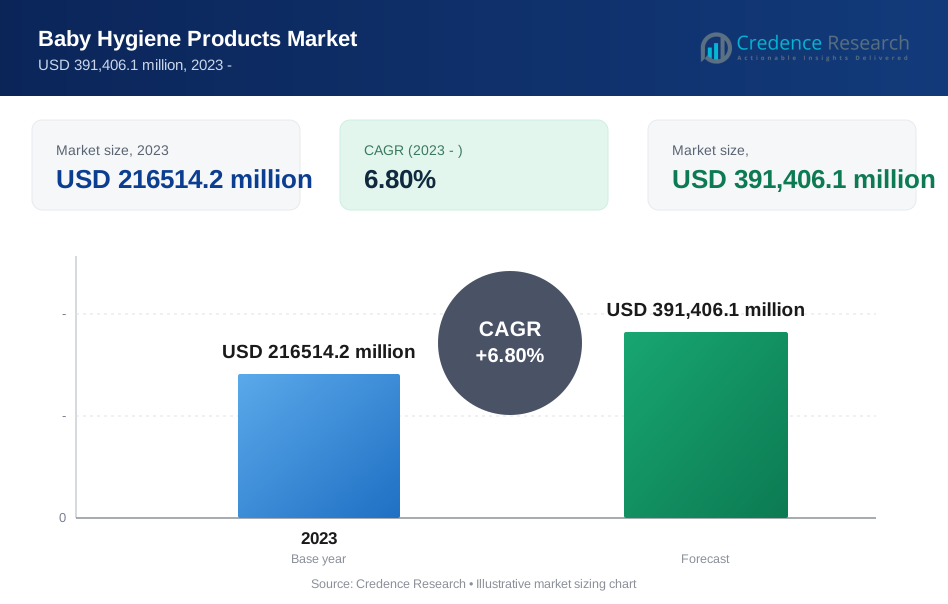
| Baby Hygiene Products Market Size 2023 | USD 216514.2Million |
| Baby Hygiene Products Market, CAGR | 6.80% |
| Baby Hygiene Products Market Size 2032 | USD 391406.1 Million |
Market Insights
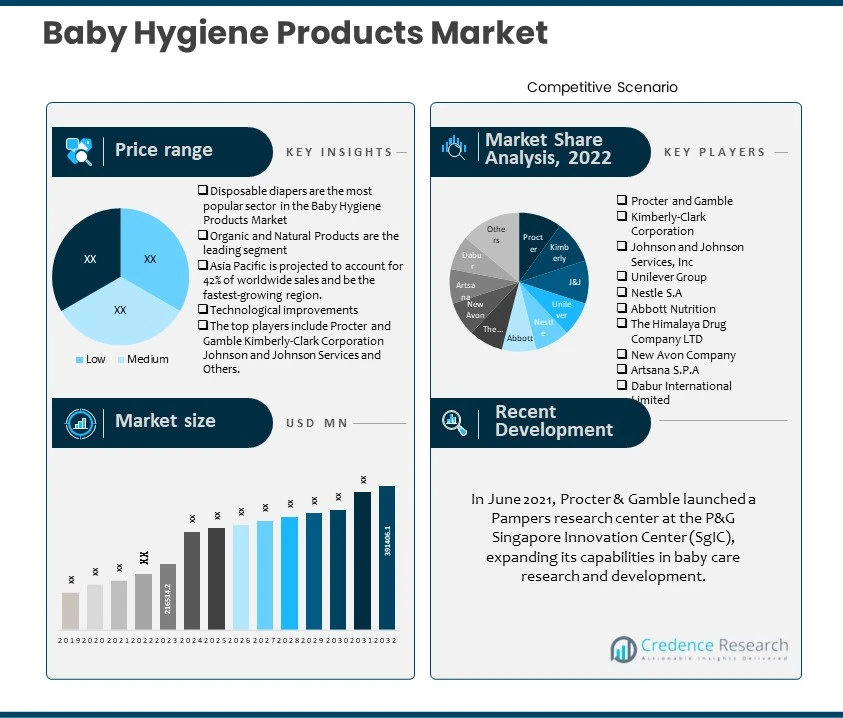
- The global demand for Baby Hygiene Products was valued at USD 216514.2 million in 2023 and is expected to reach USD 391406.1 million in 2032, growing at a CAGR of 6.80% between 2024 and 2032.
- Disposable diapers are the most popular sector in the Baby Hygiene Products Market, while baby wipes are another important market category.
- The Baby Shampoos & Washes division comprises the majority share, and Baby Soaps and Cleansers are another prominent segment in the market to address parents' worries.
- Baby Toothpaste is the fastest growing segment of the Baby Hygiene Products Market.
- Diaper Rash Creams lead the Baby Hygiene Products industry, while Baby Lotions and Creams make up another substantial part of it.
- Nasal aspirators are popular components.
- Organic and Natural Products are the leading areas in the Baby Hygiene Products Market.
- By 2023, Asia Pacific is projected to account for 42% of worldwide sales and be the fastest-growing area, while North America is forecast to experience robust growth.
- Product Life Cycle drives market growth.
- Counterfeit product concerns are among the most important hurdles to market expansion.
Executive Summary
Market Definition
Baby Hygiene Products are either made to be mild and non-irritating, or they contain compounds with these attributes. Baby care goods include oils, creams & lotions, powders, shampoos, soap, and more. These goods are primarily concerned with the baby's cleanliness and comfort. Parents' changing lifestyles mostly drive the baby care products market. Over the last few decades, parents, particularly moms, have become more career-oriented and busy in their daily lives, creating a lucrative development opportunity and opening an encouraging path for producers in the baby care product market.
Market Overview
The global Baby Hygiene Products Market has witnessed steady growth in recent years and is expected to grow at a CAGR of 6.80% between 2024 and 2032. The market was valued at USD 216514.2 million in 2023 and is expected to reach USD 391406.1 million in 2032.
Baby Hygiene Products Market is developing as parents become more concerned about their children's skin. Furthermore, infant skin must be protected from dirt exposure because it is often sensitive. People are more inclined to choose skin care products as they become more mindful of infant cleanliness and overall health. Furthermore, children are more likely to develop chronic ailments and attract bacteria that cause diseases. Many companies have devised novel solutions to demonstrate the necessity of baby hygiene and how it may effect their health.
For their infants, the majority of parents prefer homemade baby food to manufactured baby food. However, this pattern has shifted as a result of increased time demands on food preparation as a result of women's greater participation in the workforce and growing dietary concerns. Furthermore, the high cost of baby food products has slowed their uptake among middle-income families. Furthermore, due to a lack of awareness about these things, consumers choose home-cooked cuisine in rural and isolated places. Promotional activities and sensibly priced infant food items are likely to boost total market revenue creation.
Segmentation by Diapers and Wipes
- Disposable Diapers are the most in-demand sector in the Baby Hygiene Products Market. This segment is popular among parents because of its simplicity and ease of usage.
- Another significant market category is baby wipes, which are noted for their versatility and mild cleansing capabilities, making them a must-have in baby care routines.
Segmentation by Bathing and Cleansing Products
- The Baby Shampoos & Washes section comprises the majority of baby bath products and is predicted to expand significantly between 2023 and 2032. Body washes are getting more popular across the country as the population in these areas grows, encouraging an increasing number of consumers to purchase baby care products for their infants.
- Baby Soaps and Cleansers are another popular segment in the market to parents' concerns.
Segmentation By Oral Care Products
- Baby Toothpaste is the fastest-growing section of the Baby Hygiene Products Market. Baby toothpaste is rapidly expanding as parents become more aware of the importance of oral hygiene for their children.
Segmentation by Skin Care Products
- Diaper Rash Creams dominate the Baby Hygiene Products Market. This sector has a significant market share due to the critical need for treatments that prevent and treat diaper rash in newborns.
- Baby Lotions and Creams, which are popular for keeping baby's skin soft and hydrated, make up another large share of the market.
Segmentation by Hygiene Accessories
- Nasal Aspirators are a popular component of the Baby Hygiene Products market. They are necessary for emptying a baby's nasal passages, particularly if the baby has congestion or a stuffy nose.
Segmentation by Sensitive and Specialty Products
- Organic and Natural Products are the dominant sector in the Baby Hygiene Products Market. Organic and natural infant hygiene products are becoming increasingly popular among parents due to their gentle and chemical-free ingredients. They are an excellent alternative for those looking for safe and natural options for their babies' skincare and cleanliness.
Segmentation by Region
- By 2023, Asia Pacific is predicted to account for 42% of global sales and be the fastest-growing region.
- North America is expected to experience strong growth during 2023-2032
- The rest of the world, including Latin America, the Middle East, and Africa, supplies the remaining demand for Baby Hygiene Products.
Asia-Pacific is expected to be the fastest-growing market for Baby Hygiene Products during the projected period, owing to rising birth rates, urbanization, and rapid economic expansion, which has resulted in rising parental income levels, which has significantly enhanced purchasing power. Furthermore, the rise in literacy rates and transparency in research data has moved parents' preferences toward organic baby care goods on the market. This has created a pressing need for manufacturers in the baby care products market to focus on a variety of characteristics such as ingredient quality, product function/effect, value for money, and the absence of additives.
Moreover, North America is predicted to have significant growth from 2023 to 2032. The presence of well-known product manufacturers in North America, such as Unilever, Kimberly-Clark (KCWW), and Johnson & Johnson Consumer Inc., as well as expanding retail infrastructure, are projected to drive demand for baby care goods.
Key Highlights of the Report
The global Baby Hygiene Products Market is segmented based on Diapers and Wipes, Bathing and Cleansing Products, Oral Care Products, Skin Care Products, Hygiene Accessories, Sensitive and Specialty Products, and region. In 2023, The market for baby hygiene products was dominated by diaper rash creams, with disposable diapers being the most in-demand product category. Nonetheless, the category with the greatest rate of growth is baby toothpaste, and nasal aspirators are a widely used item. Asia Pacific is driving market expansion.
The Baby Hygiene Products Market is being driven by parents' growing awareness of baby hygiene and health, as well as an increase in disposable income, which leads to more expenditure on premium products. However, the market confronts hurdles such as tight laws and compliance requirements, fierce rivalry from both established and new companies, and customer worries about product safety and ingredients. Despite these constraints, there are opportunities for the market, such as increased demand for organic and natural infant hygiene products, expansion into emerging economies with rising birth rates, and the development of novel and convenient baby hygiene solutions.
Asia-Pacific is predicted to be the fastest-growing market for Baby Hygiene Products over the forecast period, owing to rising birth rates, urbanization, and rapid economic expansion, all of which have resulted in rising parental income levels and therefore greatly increased purchasing power. Furthermore, North America is expected to experience strong growth from 2023 to 2032.
What Are The Main Drivers Of The Global Baby Hygiene Products Market?
The market's primary drivers are increasing disposable income, which leads to higher expenditures on premium baby hygiene products, and the expansion of distribution channels and online retail platforms.
What Are The Major Challenges Faced By The Global Baby Hygiene Products Market?
A major issue confronting the market is an increase in consumer concerns about safety and security. Side effects of counterfeit commodities include allergies, infections, and chemical contact, all of which would restrict the market's growth pace even further. On the other hand, challenges to market expansion are projected to include costly research and development costs, a lack of suitable infrastructure, and a lack of awareness in emerging countries. During the forecast period of 2023-2032, the market is likely to experience obstacles such as an increase in the number of counterfeit items on the market, limited insurance coverage and regulatory compliance, and a lack of adequate infrastructure in low- and middle-income countries.
What Are The Growth Opportunities In The Global Baby Hygiene Products Market?
The market's significant opportunities include increasing demand for organic and natural infant hygiene products, expanding into emerging countries and areas with rising birth rates, and developing novel and easy baby hygiene solutions.
Market Drivers
Several factors drive the global Baby Hygiene Products Market. The following are the key drivers of the global Baby Hygiene Products Market:
Product Life Cycle
The baby products sector is currently increasing rapidly due to its growth phase. This is primarily owing to an increase in birth rates around the world, and increased consumer awareness of sanitation and cleanliness has resulted in a surge in demand for baby care goods. Furthermore, the parents are attempting to equip their children with the best things on the market to keep them secure and sound. This increases the market's demand for these items, putting pressure on global leaders in the baby care product market to develop new products. Growing consumer demand for infant items, as well as marketing methods employed by industry players, are expected to fuel market expansion over the forecast period.
Market Restraints
The global Baby Hygiene Products Market faces some challenges that may hinder its growth. These include the following:
Counterfeit Product Threats
Counterfeit products are becoming more widely available throughout the country. They are traded in the gray market alongside discarded items, stolen goods, and overruns, making it impossible to separate unlawful products and control the market. The availability of these fake baby care items on the market is a huge cause of loss for brands worldwide.
In addition, counterfeiters cost various brands billions of dollars in brand value every year. These imitation products are made from low-quality materials and marketed at the same prices as the legitimate brands. Thus, such things have a negative impact on the market, which is likely to impede market growth throughout the forecast period.
Opportunities
The global Gasket and seal market offers significant growth opportunities. These include the following:
Lifestyle Changes and Growing Awareness About Children's Health and Hygiene
In recent years, the baby products industry has grown significantly. This acceleration in the growth pattern is driven by an increase in the female workforce, an increase in individuals' disposable income, and growing concern about their health and cleanliness. Parents are unable to spend time with their children owing to their hectic work schedules, and their desire to provide the greatest resources for their children has led them to choose infant care items to ensure greater health and safety.
Baby skin is thinner, has less hair, is delicate, and is less cornified than adult skin, so it requires more care. The most common problem in children, particularly babies, is due to tight-fitting clothing, which, if not changed often, creates a warm and stagnant environment conducive to bacterial growth. This resulted in a variety of derma and health problems in infants, including skin rashes, infant discomfort, and cradle cap. Thus, to hinder the growth of these bacteria, these baby care products contain formulations of various germicides, such as cetyl pyridinium chloride and benzethonium chloride, which contribute to the infant's overall health. Parents must ensure that their children receive adequate nutrition. However, their inability to provide these nutrients to their children through traditional meals has shifted their focus to supplements.
Competitive Landscape
Key Players
The global Baby Hygiene Products Market is highly competitive, with several key players. Some of the major players in the market and their market share are as follows:
- Procter and Gamble
- Kimberly-Clark Corporation
- Johnson and Johnson Services, Inc
- Unilever Group
- Nestle S.A
- Abbott Nutrition
- The Himalaya Drug Company LTD
- New Avon Company
- Artsana S.P.A
- Dabur International Limited
- Danone S A
- Weleda AG
- Beiersdorf Group
- Burts Bees, Inc
- LOreal S.A.
These organizations prioritize product innovation, Service Provider expansion, and mergers and acquisitions to stay competitive.
The global Baby Hygiene Products Market's key players continually seek to stay ahead by offering new products and developments.
In October 2018, Johnson & Johnson Consumer Inc. released a new line of cotton-infused infant wash, shampoo, and lotion under the Cotton Touch brand.
In September 2021, Personal care company Johnson & Johnson announced its new Cottontouch baby care products, which include lotion, oil, wash, and cream, in response to rising demand in the Indian market. The company intends to sell these products through a variety of channels, including physical stores and multi-brand e-commerce platforms, including Flipkart, Nykaa, Amazon India, BigBasket, and FirstCry.
In October 2022, ITC, an Indian brand, bought 16% of Mother Sparsh, a direct-to-consumer company that specializes in mother and newborn care.
Summary of Key Findings
- Lifestyle Changes and Growing Awareness of Children's Health and Hygiene
- The market is segmented by Diapers and Wipes, Bathing and Cleansing Products, Oral Care Products, Skin Care Products, Hygiene Accessories, Sensitive and Specialty Products, and Region.
- Baby Toothpaste is the fastest-growing segment of the Baby Hygiene Products Market
- Nasal Aspirators is a common component.
- Asia Pacific is leading market growth. The market is highly competitive, with key players including Procter and Gamble Kimberly-Clark Corporation Johnson and Johnson Services and Others.
Future Outlook
- Increasing demand for environmentally friendly and sustainable baby hygiene products.
- Increased online sales and e-commerce platforms for baby hygiene items.
- Technological improvements result in novel product development.
How CXOs Can Benefit from the Credence Research Baby Hygiene Products Market Report
The Credence Research Baby Hygiene Products Market Report provides CXOs with a comprehensive overview of the market, including:
- Market Size and Growth Forecast:The report provides detailed estimates of the global Baby Hygiene Products Market segmented by Diapers and Wipes, Bathing and Cleansing Products, Oral Care Products, Skin Care Products, Hygiene Accessories, Sensitive and Specialty Products, and Region. It also includes forecasts for the market through 2032 based on key trends and drivers.
- Market segmentation:The report segments the Baby Hygiene Products Market by Diapers and Wipes, Bathing and Cleansing Products, Oral Care Products, Skin Care Products, Hygiene Accessories, Sensitive and Specialty Products, and Region. This segmentation provides CXOs with a granular understanding of the market and the opportunities in each segment.
- Competitive Landscape:The report profiles the key players in the Baby Hygiene Products Market and provides insights into their strategies, product offerings, and financial performance. This information can help CXOs to identify and assess their competition.
- Key trends and drivers:The report identifies and analyzes the key trends and drivers shaping the Baby Hygiene Products Market. This information can help CXOs make informed decisions about their investments and strategies.
CXOs can use the insights from the Credence Research Baby Hygiene Products Market Report to:
- Identify growth opportunities:The report can help CXOs identify new growth opportunities in the Baby Hygiene Products Market. It provides valuable insights and analysis that can assist them in making informed decisions and strategic plans for their businesses.
- Make in Informed investment decisions:The report can help CXOs to make informed investment decisions about Baby Hygiene Products. For example, it provides valuable market insights such as growth trends, market size, and competitive analysis. CXOs can use this information to assess the potential profitability and growth opportunities in the Baby Hygiene Products Market.
- Develop competitive strategies:The report can help CXOs develop competitive strategies for their Baby Hygiene Products businesses. It provides insights into market trends, customer preferences, and competitive landscape analysis.
- Track market developments:The report can help CXOs track market developments and stay ahead of the curve. For example, It provides valuable insights and analysis that can inform strategic decision-making and help them stay ahead of the competition.
Overall, the Credence Research Baby Hygiene Products Market Report is a valuable resource for CXOs who are looking to gain a deeper understanding of the market and identify opportunities for growth.
Segmentation
By Diapers and Wipes:- Disposable Diapers
- Cloth Diapers
- Baby Wipes
- Baby Shampoos and Washes
- Baby Bath Tubs and Accessories
- Baby Soaps and Cleansers
- Baby Toothbrushes
- Baby Toothpaste
- Baby Lotions and Creams
- Diaper Rash Creams
- Baby Powders
- Nail Care Products
- Nasal Aspirators
- Ear Care Products
- Hypoallergenic Formulations
- Organic and Natural Products
- North America
- The U.S.
- Canada
- Mexico
- Europe
- Germany
- France
- The U.K.
- Italy
- Spain
- Rest of Europe
- Asia Pacific
- China
- Japan
- India
- South Korea
- South-east Asia
- Rest of Asia Pacific
- Latin America
- Brazil
- Argentina
- Rest of Latin America
- Middle East & Africa
- GCC Countries
- South Africa
- Rest of the Middle East and Africa
Request a Free Sample
Fill in your details and we'll send you a free sample report.
- Sample data tables & charts
- Research methodology
Need a Custom Version of This Report?
Tailor the scope, geography, or segments to your exact requirements.
- Custom geography or segment scope
- Direct access to our analyst team
Frequently Asked Questions
What is the current Diapers and Wipes of the global Baby Hygiene Products Market?
What is the expected growth rate of the Baby Hygiene Products Market between 2024 and 2032?
Which segment is leading the market share in terms of Skin Care Products?
Which Hygiene Accessories segment governs the demand for rapid pharmaceutical microbiology testing in the world?
Who are the major players in the global Baby Hygiene Products Market?
Table of Content
Chapter 1. Report Introduction
- 1.1 Report Description & Purpose
- 1.1.1 Report Title & Market Definition
- 1.1.2 Unique Selling Propositions (USP) & Key Differentiators
- 1.1.3 Value Proposition for Stakeholders
- 1.2 Research Objectives
- 1.2.1 Market Sizing Objectives (Volume & Revenue) (Volume Where Applicable)
- 1.2.2 Segmentation Objectives
- 1.2.3 Competitive Intelligence Objectives
- 1.2.4 Forecast & Scenario Objectives
- 1.3 Report Scope
- 1.3.1 Baby Hygiene Products Scope – Segments & Subsegments Covered
- 1.3.2 Geographic Scope – Regions & Countries Covered
- 1.3.3 Historical Period, Base Year & Forecast Period (2023; forecast to the forecast period)
- 1.3.4 Inclusions & Exclusions
- 1.4 Industry Classification & Applicable Codes
- 1.5 Currency, Measurement Units & Valuation Basis
- 1.6 Target Stakeholders
- 1.7 Limitations & Assumptions
Chapter 2. Executive Summary
- 2.1 Global Baby Hygiene Products Market Snapshot
- 2.1.1 Market Size – Historical (2023) & Forecast (the forecast period) (2023: USD 216514.2 million → forecast year: USD 391,406.1 million)
- 2.1.2 Volume & Revenue – Global Totals (Volume Where Applicable)
- 2.1.3 Key Market Highlights – Top Five Facts
- 2.2 Baby Hygiene Products Market Segmentation Snapshot
- 2.2.1 Market Split by Region – 2023 vs.
- 2.3 Competitive Snapshot
- 2.3.1 Top 10 Players by Revenue Share – 2023
- 2.3.2 Top 10 Players by Volume Share – 2023 (Volume Where Applicable)
- 2.3.3 Recent Strategic Developments (18-Month Summary)
- 2.4 Key Investment Highlights & Strategic Conclusions
Chapter 3. Baby Hygiene Products Market Dynamics & Industry Analysis
- 3.1 Market Overview & Context
- 3.1.1 Baby Hygiene Products Market Position in the Broader Industry Value Chain
- 3.1.2 Demand Structure & Purchasing Dynamics
- 3.1.3 Market Maturity & Development Stage by Region
- 3.2 Baby Hygiene Products Market Drivers
- 3.3 Baby Hygiene Products Market Restraints & Challenges
- 3.4 Baby Hygiene Products Market Opportunities
- 3.5 Porter's Five Forces Analysis
- 3.5.1 Threat of New Entrants
- 3.5.2 Bargaining Power of Suppliers
- 3.5.3 Bargaining Power of Buyers
- 3.5.4 Threat of Substitutes
- 3.5.5 Competitive Rivalry – Intensity Assessment
- 3.6 Baby Hygiene Products Value Chain Analysis
- 3.6.1 Upstream – Key Inputs, Resources & Suppliers
- 3.6.1.1 Key Input/Resource 1
- 3.6.1.2 Key Input/Resource 2
- 3.6.1.3 Key Input/Resource 3
- 3.6.2 Midstream – Core Operations & Value Creation
- 3.6.2.1 Operating Model & Process Overview
- 3.6.2.2 Key Operating Locations & Capabilities by Company
- 3.6.3 Downstream – Market Channels & End Users
- 3.6.3.1 Direct Sales & Customer Engagement Channels
- 3.6.3.2 Indirect Sales, Intermediaries & Partner Channels
- 3.6.4 Value Chain Profitability Analysis
- 3.6.1 Upstream – Key Inputs, Resources & Suppliers
- 3.7 PESTEL Analysis
- 3.7.1 Political Factors
- 3.7.2 Economic Factors
- 3.7.3 Social Factors
- 3.7.4 Technological Factors
- 3.7.5 Environmental Factors
- 3.7.6 Legal Factors
- 3.8 Baby Hygiene Products Supply Chain Analysis
- 3.8.1 Critical Input & Resource Availability Risk Assessment
- 3.8.2 Supplier & Operational Concentration Risk (Geographic Exposure)
- 3.8.3 Supply & Service Disruption Impact Analysis
- 3.9 Regulatory & Policy Landscape
Note: The regulatory and policy landscape section covers regulations based on their applicability to the market, Baby Hygiene Products category, geography, and scope of the study. Only regulatory frameworks with a material impact on operations, compliance, trade, sustainability, or market access are analyzed in detail.
Chapter 4. Key Investment Pockets & Opportunity Analysis
- 4.1 Baby Hygiene Products Market Attractiveness Analysis
- 4.1.1 By Region – Investment Attractiveness Matrix (Market Size × CAGR)
- 4.2 Absolute Revenue Growth Opportunity
- 4.2.1 By Region – Absolute Revenue Growth Through the forecast period
- 4.3 Incremental Demand Opportunity
- 4.3.1 By Region – Incremental Demand Through the forecast period
- 4.3.2 Segment – Incremental Demand
- 4.4 Emerging Submarket Opportunity Deep Dive (Subject to Applicability)
- 4.5 Priority Market Opportunity Scorecards
- 4.5.1 United States
- 4.5.2 Europe
- 4.5.3 Asia
- 4.5.4 Middle East & Africa
Note: Priority market opportunity scorecards reflect the geographic scope and strategic relevance of the study. Listed markets are indicative and may be adapted to the industry.
Chapter 5. Baby Hygiene Products Cross-Border Trade & Market Access Analysis
- 5.1 International Trade & Cross-Border Activity Overview
- 5.1.1 Global Export Value by Country (2023)
- 5.1.2 Global Export Volume by Country (2023) (Volume Where Applicable)
- 5.1.3 Global Import Value by Country (2023)
- 5.1.4 Global Import Volume by Country (2023) (Volume Where Applicable)
- 5.1.5 Net Trade Balance by Country (2023)
- 5.2 Export Analysis – Segment
- 5.2.1 Category 1 (Applicable Classification Code)
- 5.2.2 Category 2 (Applicable Classification Code)
- 5.2.3 Category 3 (Applicable Classification Code)
- 5.2.4 Category 4 (Applicable Classification Code)
- 5.2.5 Category 5 (Applicable Classification Code)
- 5.3 Import Analysis – Segment
- 5.3.1 Category 1 (Applicable Classification Code)
- 5.3.2 Category 2 (Applicable Classification Code)
- 5.3.3 Category 3 (Applicable Classification Code)
- 5.3.4 Category 4 (Applicable Classification Code)
- 5.3.5 Category 5 (Applicable Classification Code)
- 5.4 Cross-Border Pricing & Transaction Benchmarks
- 5.4.1 Export Pricing – Segment & Country
- 5.4.2 Import Pricing – Segment & Source Country
- 5.4.3 Price Trends (2023)
- 5.5 Key Cross-Border Trade & Delivery Routes
- 5.5.1 Cross-Border Trade/Delivery Route 1
- 5.5.2 Cross-Border Trade/Delivery Route 2
- 5.5.3 Cross-Border Trade/Delivery Route 3
- 5.5.4 Cross-Border Trade/Delivery Route 4
- 5.5.5 Cross-Border Trade/Delivery Route 5
- 5.6 Trade Policy & Market Access Impact Assessment
- 5.6.1 Tariff & Non-Tariff Barriers
- 5.6.2 Regional Trade & Economic Integration Frameworks
- 5.6.3 Bilateral & Multilateral Trade Agreements
- 5.6.4 Cross-Border Operating, Licensing & Localization Requirements
Note: This chapter applies where cross-border trade or delivery is relevant to Baby Hygiene Products. Goods, services, and digital offerings are assessed using applicable classifications and transaction measures. Import-export volumes, trade balances, and route analyses are included only where meaningful to the market.
Chapter 6. Competitive Landscape & Company Benchmarking
- 6.1 Baby Hygiene Products Market Concentration & Structure
- 6.1.1 Herfindahl-Hirschman Index (HHI) – vs. 2023
- 6.1.2 Leading, Mid-Sized & Emerging Player Structure
- 6.1.3 Global, Regional & Local Player Dynamics
- 6.2 Baby Hygiene Products Market Share Analysis – 2023
- 6.2.1 Global Revenue Share by Company
- 6.2.2 Global Volume Share by Company (Volume Where Applicable)
- 6.2.3 Regional Revenue Share
- 6.2.4 Market Share Evolution ( vs. 2023)
- 6.2.5 Company Market Share by Key Segment
- 6.2.6 Company Market Share by Customer Group
- 6.3 Operating Scale, Capacity & Infrastructure Analysis
- 6.3.1 Global Operating Scale & Supply Capacity
- 6.3.2 Resource Utilization & Operating Efficiency
- 6.3.3 Output, Service Delivery & Activity Metrics
- 6.3.4 Operating Footprint & Infrastructure Map
- 6.3.5 Planned Operational & Capacity Expansion
- 6.4 Baby Hygiene Products Competitive Benchmarking Matrix
- 6.4.1 Revenue, Growth, Profitability & Operating Metric Comparison
- 6.4.2 Channel Revenue Mix
- 6.4.3 Geographic Revenue Exposure
- 6.4.4 R&D Intensity
- 6.4.5 Sustainability Maturity
- 6.5 Strategic Developments in Baby Hygiene Products (Last 24 Months)
- 6.5.1 Mergers, Acquisitions & Divestments
- 6.5.2 New Products, Services & Solutions in Baby Hygiene Products
- 6.5.3 Operational & Infrastructure Expansions
- 6.5.4 Strategic Alliances, Joint Ventures & Partnerships
- 6.5.5 Distribution Expansion & Market Entry
- 6.5.6 Sustainability & ESG Initiatives
- 6.6 Competitive Strategy Mapping
- 6.6.1 Leader, Challenger, Follower & Niche Classification
- 6.6.2 Pricing Strategy Comparison
- 6.6.3 Channel Strategy Matrix
Note: Strategic developments are included based on their materiality and the availability of reliable information.
Chapter 7. Global Baby Hygiene Products Market – By Sales & Delivery Channel
- 7.1 Segment Overview
- 7.1.1 Volume & Revenue Split by Channel (2023 & ) (Volume Where Applicable)
- 7.1.2 Channel Mix Evolution (the forecast period)
Chapter 8. Regional Market Analysis – Global Overview
- 8.1 Global Regional Overview
- 8.1.1 Regional Volume Share (Volume Where Applicable)
- 8.1.2 Regional Revenue Share
- 8.1.3 Regional Volume by Region (Volume Where Applicable)
- 8.1.4 Regional Revenue by Region
- 8.1.5 Regional Forecast Through the forecast period
- 8.2 Cross-Regional Segment Analysis
- 8.2.1 By Sales & Delivery Channel
- 8.2.2 By Competitive Positioning & Price Tier
Chapter 9. North America Baby Hygiene Products Market
- 9.1 United States
- 9.2 Canada
- 9.3 Mexico
Chapter 10. Europe Baby Hygiene Products Market
- 10.1 Germany
- 10.2 France
- 10.3 Italy
- 10.4 United Kingdom
- 10.5 Spain
- 10.6 Poland
- 10.7 Russia
- 10.8 Netherlands
- 10.9 Belgium
- 10.10 Sweden
- 10.11 Denmark
- 10.12 Norway
- 10.13 Rest of Europe
Chapter 11. Asia Pacific Baby Hygiene Products Market
- 11.1 China
- 11.2 India
- 11.3 Japan
- 11.4 South Korea
- 11.5 Thailand
- 11.6 Indonesia
- 11.7 Vietnam
- 11.8 Malaysia
- 11.9 Australia
- 11.10 Rest of Asia Pacific
Chapter 12. Latin America Baby Hygiene Products Market
- 12.1 Brazil
- 12.2 Argentina
- 12.3 Colombia
- 12.4 Chile
- 12.5 Rest of Latin America
Chapter 13. Middle East Baby Hygiene Products Market
- 13.1 Saudi Arabia
- 13.2 United Arab Emirates
- 13.3 Turkey
- 13.4 Israel
- 13.5 Iran
- 13.6 Rest of the Middle East
Chapter 14. Africa Baby Hygiene Products Market
- 14.1 South Africa
- 14.2 Egypt
- 14.3 Nigeria
- 14.4 Morocco
- 14.5 Rest of Africa
Chapter 15. Baby Hygiene Products Company Profiles
- 15.1 [Company 01]
- 15.1.1 Company Overview
- 15.1.2 Key Management Personnel
- 15.1.3 Products & Services Portfolio
- 15.1.4 Financial Performance
- 15.1.5 Key Market Focus & Geographic Presence
- 15.1.6 Recent Developments & Strategic Initiatives
Note: The company profile list is preliminary and may change based on research findings, market developments, data availability, and client requirements.
Chapter 16. Appendices
- Appendix A – List of Abbreviations & Acronyms
- Appendix B – Industry Classification Code Reference – Full Series
- Appendix C – Supply, Output & Operating Capacity Data Tables
- Appendix D – End-Use & Demand Base Tables
- Appendix E – Demand, Adoption & Usage Assumptions
- Appendix F – Pricing & Revenue Metric Reference Tables
- Appendix G – Company Operations & Infrastructure Database
- Appendix H – Cross-Border Trade & Activity Data Tables (Where Applicable)
- Appendix I – Regulatory Summary Tables
- Appendix J – Primary Research Participant List (Anonymized)
- Appendix K – Primary Research Questionnaire Framework
- Appendix L – Data Sources & Bibliography
- Appendix M – Market Size Divergence & Source Comparison
Chapter 17. Research Methodology
- 17.1 Research Framework & Philosophy
- 17.2 Secondary Research – Sources, Hierarchy & Data Extraction
- 17.3 Data Modeling – Bottom-Up & Top-Down Market Sizing
- 17.4 Primary Research – Stakeholder Framework, LOI & Sample Sizes
- 17.5 Forecast Methodology – Regression, Scenario & Sensitivity Analysis
- 17.6 Quality Control – Four-Layer Validation Framework
- 17.7 Limitations & Standard Assumptions
- 17.8 Disclaimer
