
Unmanned Aerial Vehicles (UAV) Market Overview:
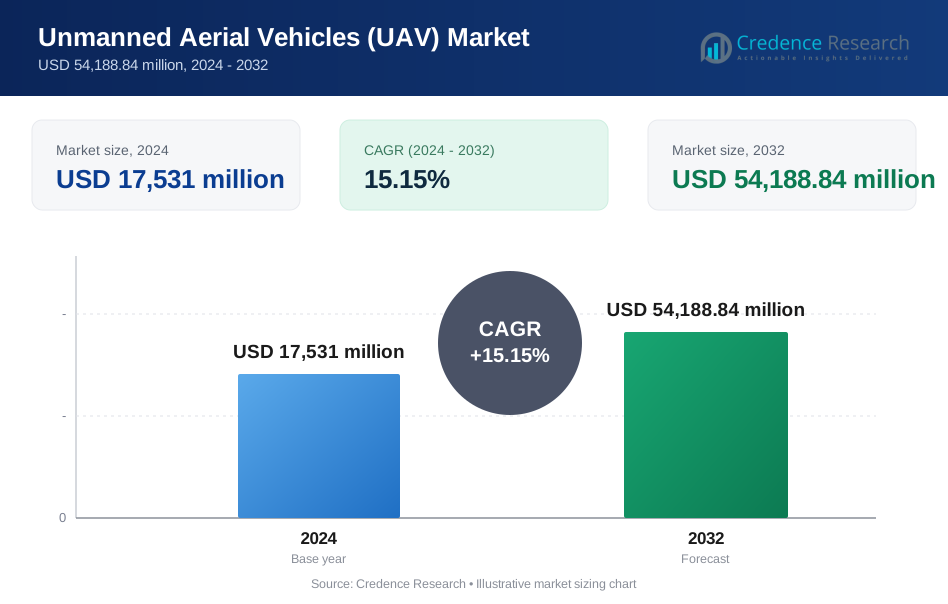
The Unmanned Aerial Vehicles (UAV) Market size was valued at USD 17,531 million in 2024 and is anticipated to reach USD 54,188.84 million by 2032, expanding at a CAGR of 15.15% during the forecast period.
| REPORT ATTRIBUTE | DETAILS |
|---|---|
| Historical Period | 2020-2023 |
| Base Year | 2024 |
| Forecast Period | 2025-2032 |
| Unmanned Aerial Vehicles (UAV) Market Size 2024 | USD 17,531 million |
| Unmanned Aerial Vehicles (UAV) Market , CAGR | 15.15% |
| Unmanned Aerial Vehicles (UAV) Market Size 2032 | USD 54,188.84 million |
Unmanned Aerial Vehicles (UAV) Market Insights
- Growth in the Unmanned Aerial Vehicles (UAV) Market is driven by rising defense modernization, increasing military UAV procurement, and expanding commercial use across agriculture, energy inspection, construction, and logistics applications.
- Key trends in the Unmanned Aerial Vehicles (UAV) Market include rapid adoption of autonomous and AI-enabled UAVs, integration of advanced payloads, and growing focus on endurance, secure communication, and multi-mission platforms by leading players.
- Market restraints impacting the Unmanned Aerial Vehicles (UAV) Market include stringent regulatory frameworks, airspace management complexities, cybersecurity risks, and limited battery endurance affecting long-range operations.
- Regionally, North America led the Unmanned Aerial Vehicles (UAV) Market with 38.6% share in 2024, followed by Asia Pacific at 29.4% and Europe at 21.3%, while Small UAVs dominated by class with a 46.8% segment share due to wide commercial and defense adoption.
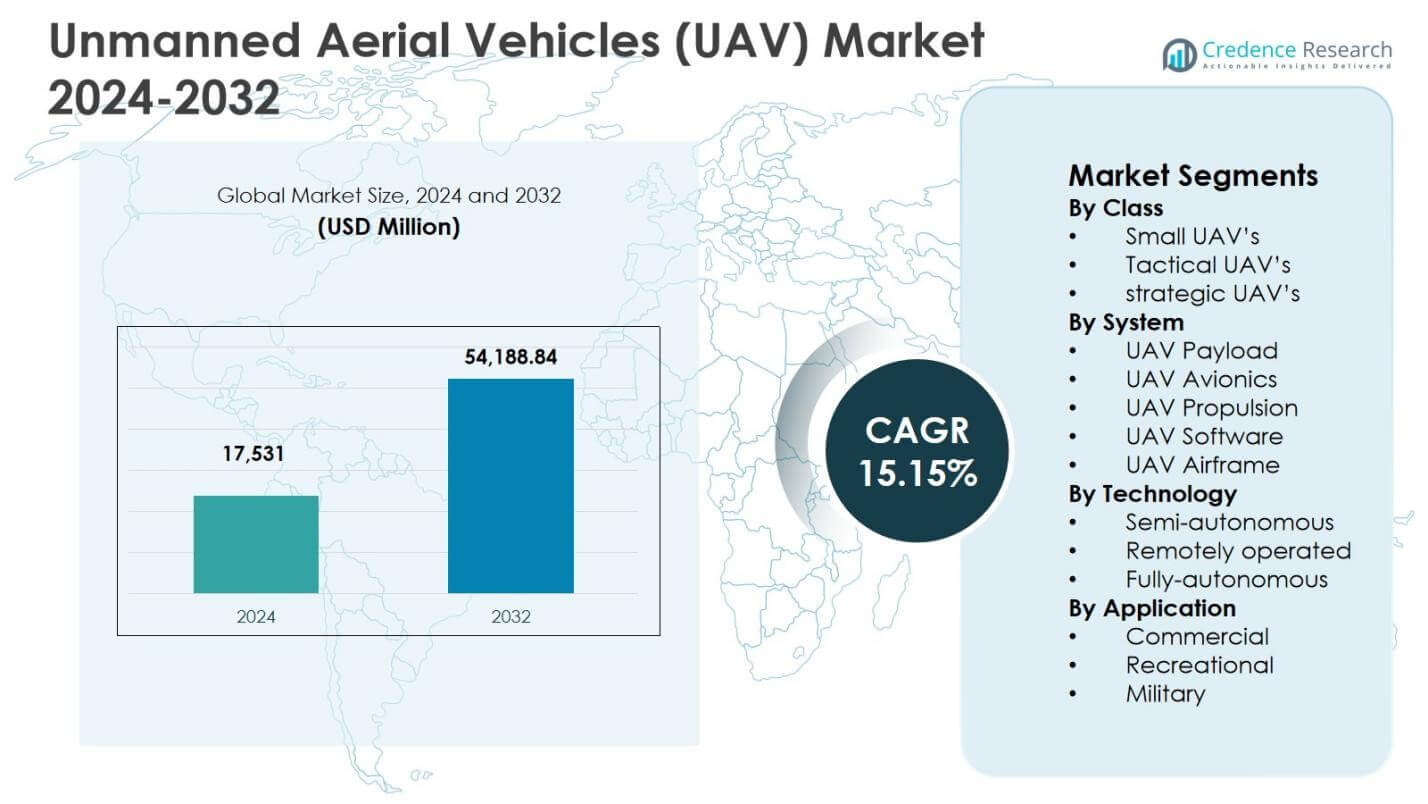
Unmanned Aerial Vehicles (UAV) Market Segmentation Analysis:
By Class
The By Class segment in the Unmanned Aerial Vehicles (UAV) Market is led by Small UAVs, which accounted for 46.8% market share in 2024. Small UAVs dominate due to their widespread adoption across commercial, defense, and civil applications, including surveillance, mapping, agriculture, and infrastructure inspection. Their lower procurement costs, ease of deployment, and regulatory flexibility strongly support adoption. Tactical UAVs follow, driven by military intelligence, surveillance, and reconnaissance missions, while Strategic UAVs serve long-endurance and high-altitude defense operations, supported by increasing defense modernization programs and cross-border security requirements.
- For instance, DJI's Agras T10 supports agriculture with an 8-liter spraying tank and 5-meter spray width, covering up to 15 acres per hour for precise pesticide or nutrient application on small to medium farms.
By System
The By System segment is dominated by UAV Payload, holding a 34.6% share in 2024, as payloads directly determine mission capability and operational value. Growth is driven by increasing demand for high-resolution cameras, LiDAR sensors, infrared imaging, and electronic warfare payloads across defense and commercial sectors. UAV Avionics and Software segments benefit from advances in navigation, data processing, and AI-enabled analytics. UAV Airframe and Propulsion systems gain traction through lightweight composite materials and fuel-efficient propulsion technologies that enhance endurance, range, and overall platform efficiency.
- For instance, Phase One's P5 camera delivers 0.5 cm accuracy with a 128 MP sensor and electronic global shutter for distortion-free aerial surveying on small UAVs.
By Technology
The By Technology segment is led by Remotely Operated UAVs, which captured a 51.2% market share in 2024, supported by established operational reliability and regulatory acceptance. These systems remain essential for defense missions, border surveillance, and commercial inspection tasks requiring real-time human control. Semi-autonomous UAVs gain momentum due to improved obstacle avoidance and assisted navigation features, while Fully-Autonomous UAVs experience rising adoption in logistics, swarm operations, and industrial automation, driven by advancements in artificial intelligence, machine learning, and edge computing capabilities.
Key Growth Drivers
Rising Defense Modernization and Military UAV Procurement
The Unmanned Aerial Vehicles (UAV) Market benefits significantly from rising defense modernization programs and increased military spending worldwide. Governments prioritize UAV deployment for intelligence, surveillance, reconnaissance, and combat missions due to their ability to reduce human risk and deliver persistent situational awareness. Armed and long-endurance UAVs enable border monitoring, maritime patrol, and counterterrorism operations with superior cost efficiency compared to manned aircraft. The integration of advanced sensors, electronic warfare payloads, and secure communication systems further strengthens UAV adoption across air forces and defense agencies globally.
- For instance, Northrop Grumman's RQ-4 Global Hawk set a 31.5-hour endurance record at 65,100 feet for high-altitude reconnaissance, aiding precise targeting in missions like Operations Enduring and Iraqi Freedom.
Expanding Commercial and Industrial Applications
Rapid expansion of commercial and industrial applications strongly drives growth in the Unmanned Aerial Vehicles (UAV) Market. Industries such as agriculture, energy, construction, mining, and logistics increasingly rely on UAVs for precision monitoring, asset inspection, and real-time data collection. UAVs improve operational efficiency by reducing inspection time, labor costs, and safety risks in hazardous environments. Their use in crop health analysis, pipeline inspection, wind turbine monitoring, and infrastructure surveying continues to rise, supported by improved payload capabilities and high-resolution imaging technologies.
- For instance, Phoenix Air Unmanned partnered with Shell Pipeline Company to patrol 320 miles of pipeline in one day using a single UAS in 7.6 flight hours, delivering real-time data under FAA BVLOS waiver while avoiding manned risks.
Technological Advancements in Autonomy and Payload Systems
Continuous technological advancements in autonomy, artificial intelligence, and payload systems serve as a major growth catalyst in the Unmanned Aerial Vehicles (UAV) Market. Enhanced flight control algorithms, obstacle avoidance systems, and AI-enabled analytics improve mission accuracy and operational reliability. Developments in lightweight sensors, thermal imaging, LiDAR, and communication payloads expand UAV mission scope across defense and civilian sectors. Improvements in battery technology and propulsion systems further enhance endurance and range, supporting broader adoption in long-duration and complex operational environments.
Key Trends & Opportunities
Growing Adoption of Autonomous and AI-Enabled UAVs
The increasing adoption of autonomous and AI-enabled UAVs represents a key trend and growth opportunity in the Unmanned Aerial Vehicles (UAV) Market. Organizations deploy autonomous UAVs for applications requiring minimal human intervention, such as automated inspections, warehouse inventory tracking, and last-mile delivery trials. AI-driven data processing enables real-time decision-making, object recognition, and predictive analytics. These capabilities create new opportunities in smart cities, defense swarm operations, and disaster response, where rapid situational awareness and coordinated multi-UAV operations are critical.
- For instance, Chevron partnered with Percepto to deploy autonomous drones for safety inspections across its Permian Basin and Rocky Mountain assets. The AI-powered Percepto AIM software analyzes visual and gas-monitoring data collected during BVLOS flights, enabling remote anomaly detection from control centers without on-site personnel.
Rising Demand for UAVs in Logistics and Urban Mobility
The growing demand for UAVs in logistics and urban mobility creates strong long-term opportunities in the Unmanned Aerial Vehicles (UAV) Market. E-commerce growth and demand for faster delivery encourage companies to explore UAV-based parcel transport and medical supply delivery. Urban air mobility concepts and drone corridors gain attention from regulators and city planners. Advancements in navigation, collision avoidance, and communication infrastructure support safe integration into urban airspace, positioning UAVs as an efficient solution for time-sensitive logistics and emergency services.
- For instance, Airbus conducted Skyways drone trials in Singapore, autonomously delivering 1.5 kg of 3D-printed consumables from Marina South Pier to the offshore vessel M/V Pacific Centurion in just 10 minutes.
Key Challenges
Stringent Regulatory and Airspace Management Constraints
Stringent regulatory frameworks and airspace management challenges restrain growth in the Unmanned Aerial Vehicles (UAV) Market. Regulations governing beyond-visual-line-of-sight operations, payload limits, and urban flights vary widely across regions, creating compliance complexity for operators and manufacturers. Lengthy approval processes slow commercial deployment and innovation. Concerns around air traffic integration, collision risk, and operational safety further restrict widespread adoption, particularly in densely populated areas where airspace congestion and regulatory scrutiny remain high.
Cybersecurity Risks and Limited Endurance Capabilities
Cybersecurity risks and limited endurance present critical challenges in the Unmanned Aerial Vehicles (UAV) Market. UAV systems face vulnerabilities related to data interception, signal jamming, and unauthorized control, especially in defense and critical infrastructure applications. Additionally, battery limitations restrict flight duration and payload capacity for electric UAVs, affecting long-range and continuous operations. Addressing these challenges requires significant investment in secure communication protocols, anti-jamming technologies, and next-generation energy storage solutions to ensure reliable and safe UAV deployment.
Regional Analysis
North America
North America accounted for 38.6% of the Unmanned Aerial Vehicles (UAV) Market share in 2024, driven by strong defense spending, advanced aerospace infrastructure, and early adoption of UAV technologies. The United States leads regional growth due to extensive deployment of UAVs for military surveillance, combat operations, and homeland security. Commercial adoption remains robust across agriculture, energy inspection, construction monitoring, and logistics trials. Continuous investments in autonomous systems, AI-enabled payloads, and secure communication technologies further support market expansion, positioning North America as the most mature and innovation-driven UAV market globally.
Europe
Europe held 21.3% market share in 2024, supported by rising defense modernization programs and growing use of UAVs in border surveillance, environmental monitoring, and infrastructure inspection. Countries such as France, Germany, and the United Kingdom invest heavily in tactical and strategic UAV programs while encouraging commercial drone integration through standardized regulatory frameworks. Increasing demand for UAVs in smart city initiatives, disaster management, and renewable energy inspection strengthens market growth. Collaboration between defense agencies and UAV manufacturers further accelerates technological advancements and regional adoption across military and civil applications.
Asia Pacific
Asia Pacific captured 29.4% of the Unmanned Aerial Vehicles (UAV) Market share in 2024, driven by rising defense budgets, territorial security concerns, and rapid commercialization of drone technologies. China, India, Japan, and South Korea lead adoption across military surveillance, industrial inspection, agriculture, and logistics. Expanding manufacturing capabilities and government support for domestic UAV production enhance regional competitiveness. The growing use of UAVs in precision farming, smart infrastructure, and emergency response, combined with advancements in autonomous flight systems, continues to propel strong growth across the Asia Pacific region.
Latin America
Latin America accounted for 4.6% market share in 2024, supported by increasing adoption of UAVs in agriculture, mining, oil and gas inspection, and public safety applications. Countries such as Brazil and Mexico actively deploy UAVs for crop monitoring, land surveying, and environmental assessment. Governments increasingly use UAVs for border monitoring and disaster management to improve response efficiency. Improving regulatory clarity and declining UAV system costs encourage broader commercial adoption, while gradual defense investments support steady growth across both civil and security-related UAV applications in the region.
Middle East & Africa
The Middle East & Africa region held 6.1% of the Unmanned Aerial Vehicles (UAV) Market share in 2024, driven primarily by defense and security requirements. Countries across the Middle East invest in UAVs for surveillance, border protection, and combat operations due to ongoing geopolitical tensions. In Africa, UAV adoption rises in agriculture, wildlife monitoring, mining, and humanitarian aid delivery. Government initiatives to enhance security infrastructure and increasing use of UAVs in oil and gas inspection support regional growth, despite challenges related to regulatory harmonization and technological infrastructure.
Unmanned Aerial Vehicles (UAV) Market Segmentations:
By Class
- Small UAV’s
- Tactical UAV’s
- strategic UAV’s
By System
- UAV Payload
- UAV Avionics
- UAV Propulsion
- UAV Software
- UAV Airframe
By Technology
- Semi-autonomous
- Remotely operated
- Fully-autonomous
By Application
- Commercial
- Recreational
- Military
By Geography
- North America
- U.S.
- Canada
- Mexico
- Europe
- Germany
- France
- U.K.
- Italy
- Spain
- Rest of Europe
- Asia Pacific
- China
- Japan
- India
- South Korea
- South-east Asia
- Rest of Asia Pacific
- Latin America
- Brazil
- Argentina
- Rest of Latin America
- Middle East & Africa
- GCC Countries
- South Africa
- Rest of the Middle East and Africa
Competitive Landscape
Competitive landscape in the Unmanned Aerial Vehicles (UAV) Market is shaped by major players including General Atomics Aeronautical Systems Inc., Northrop Grumman Corporation, Boeing, Lockheed Martin Corporation, Textron Inc., AeroVironment, Inc., Israel Aerospace Industries, SZ DJI Technology Co., Ltd., and Thales Group. The market reflects strong competition between defense-focused manufacturers and commercial drone specialists, with companies emphasizing technological differentiation and operational reliability. Key players invest heavily in research and development to enhance autonomous flight, payload integration, endurance, and secure communication systems. Defense contractors focus on long-endurance, combat, and surveillance UAVs through government contracts, while commercial players prioritize scalability, AI-driven software, and cost efficiency. Strategic collaborations, regional expansion, and portfolio diversification remain central strategies, supporting sustained innovation and long-term market positioning.
Key Player Analysis
- Thales Group (France)
- AeroVironment, Inc. (United States)
- SZ DJI Technology Co., Ltd. (China)
- Lockheed Martin Corporation (United States)
- Parrot SA (France)
- Israel Aerospace Industries (Israel)
- Textron Inc. (United States)
- Boeing (United States)
- General Atomics Aeronautical Systems Inc. (United States)
- Northrop Grumman Corporation (United States)
Recent Developments
- In December 2025, Quantum Systems acquired FERNRIDE to expand into multi-domain solutions, integrating ground autonomy with its UAV technologies.
- In November 2025, Anduril and EDGE Group entered a partnership to support drone sales in the UAE, marking strategic collaboration in unmanned systems deployment.
- In February 2025, Tata Elxsi and Garuda Aerospace signed an MoU at Aero India 2025 to establish a Centre of Excellence for indigenised UAV design and development in India.
Report Coverage
The research report offers an in-depth analysis based on Class, System, Technology, Application and Geography. It details leading market players, providing an overview of their business, product offerings, investments, revenue streams, and key applications. Additionally, the report includes insights into the competitive environment, SWOT analysis, current market trends, as well as the primary drivers and constraints. Furthermore, it discusses various factors that have driven market expansion in recent years. The report also explores market dynamics, regulatory scenarios, and technological advancements that are shaping the industry. It assesses the impact of external factors and global economic changes on market growth. Lastly, it provides strategic recommendations for new entrants and established companies to navigate the complexities of the market.
Future Outlook
- The Unmanned Aerial Vehicles (UAV) Market will witness increased adoption of autonomous and AI-enabled systems across defense and commercial applications.
- Defense forces will continue expanding UAV fleets to enhance intelligence, surveillance, reconnaissance, and combat capabilities.
- Commercial UAV usage will rise in agriculture, infrastructure inspection, energy monitoring, and construction surveying.
- Advancements in battery technology and hybrid propulsion systems will improve UAV endurance and operational range.
- Integration of advanced payloads such as LiDAR, thermal imaging, and multispectral sensors will expand mission versatility.
- Regulatory frameworks will evolve to support beyond-visual-line-of-sight operations and safer airspace integration.
- UAV-based logistics and last-mile delivery applications will gain traction in urban and remote environments.
- Swarm technology and coordinated multi-UAV operations will become more prevalent in defense and industrial use cases.
- Cybersecurity and secure communication solutions will receive increased focus to protect UAV operations and data integrity.
- Emerging markets will contribute to growth through rising investments in surveillance, agriculture, and public safety UAV deployments.
Request a Free Sample
Fill in your details and we'll send you a free sample report.
- Sample data tables & charts
- Research methodology
Need a Custom Version of This Report?
Tailor the scope, geography, or segments to your exact requirements.
- Custom geography or segment scope
- Direct access to our analyst team
Frequently Asked Questions
What is the current market size for the Unmanned Aerial Vehicles (UAV) Market, and what is its projected size in 2032?
At what Compound Annual Growth Rate is the Unmanned Aerial Vehicles (UAV) Market projected to grow between 2024 and 2032?
Which Unmanned Aerial Vehicles (UAV) Market segment held the largest share in 2024?
What are the primary factors fueling the growth of the Unmanned Aerial Vehicles (UAV) Market?
Who are the leading companies in the Unmanned Aerial Vehicles (UAV) Market?
Which region commanded the largest share of the Unmanned Aerial Vehicles (UAV) Market in 2024?
Table of Content
Chapter 1. Report Introduction
- 1.1 Report Description & Purpose
- 1.1.1 Report Title & Market Definition
- 1.1.2 Unique Selling Propositions (USP) & Key Differentiators
- 1.1.3 Value Proposition for Stakeholders
- 1.2 Research Objectives
- 1.2.1 Market Sizing Objectives (Volume & Revenue)
- 1.2.2 Segmentation Objectives
- 1.2.3 Competitive Intelligence Objectives
- 1.2.4 Forecast & Scenario Objectives
- 1.3 Report Scope
- 1.3.1 Unmanned Aerial Vehicles (UAV) Scope – Types & Subtypes Covered
- 1.3.2 Geographic Scope – Regions & Countries Covered
- 1.3.3 Historical Period, Base Year & Forecast Period (2024; forecast to 2032)
- 1.3.4 Inclusions & Exclusions
- 1.4 HS Code & Classification Framework
- 1.5 Currency, Units & Pricing Basis
- 1.6 Target Stakeholders
- 1.7 Limitations & Assumptions
Chapter 2. Executive Summary
- 2.1 Global Unmanned Aerial Vehicles (UAV) Market Snapshot
- 2.1.1 Market Size – Historical (2024) & Forecast (2024-2032) (2024: USD 17,531 million → 2032: USD 54,188.84 million)
- 2.1.2 Volume & Revenue – Global Totals
- 2.1.3 Key Market Highlights – Top Five Facts
- 2.2 Unmanned Aerial Vehicles (UAV) Market Segmentation Snapshot
- 2.2.1 Market Split by Region – 2024 vs. 2032
- 2.3 Competitive Snapshot
- 2.3.1 Top 10 Players by Revenue Share – 2024
- 2.3.2 Top 10 Players by Volume Share – 2024
- 2.3.3 Recent Strategic Developments (18-Month Summary)
- 2.4 Key Investment Highlights & Strategic Conclusions
Chapter 3. Unmanned Aerial Vehicles (UAV) Market Dynamics & Industry Analysis
- 3.1 Market Overview & Context
- 3.1.1 Unmanned Aerial Vehicles (UAV) Market Position in the Broader Automotive Value Chain
- 3.1.2 OEM vs. Replacement Market Dynamics
- 3.1.3 Market Maturity & Development Stage by Region
- 3.2 Unmanned Aerial Vehicles (UAV) Market Drivers
- 3.3 Unmanned Aerial Vehicles (UAV) Market Restraints & Challenges
- 3.4 Unmanned Aerial Vehicles (UAV) Market Opportunities
- 3.5 Porter's Five Forces Analysis
- 3.5.1 Threat of New Entrants
- 3.5.2 Bargaining Power of Suppliers
- 3.5.3 Bargaining Power of Buyers
- 3.5.4 Threat of Substitutes
- 3.5.5 Competitive Rivalry – Intensity Assessment
- 3.6 Unmanned Aerial Vehicles (UAV) Value Chain Analysis
- 3.6.1 Upstream – Raw Material/Input Suppliers
- 3.6.1.1 Raw Material/Input 1
- 3.6.1.2 Raw Material/Input 2
- 3.6.1.3 Raw Material/Input 3
- 3.6.2 Midstream – Production/Manufacturing/Service Delivery
- 3.6.2.1 Production/Process Overview
- 3.6.2.2 Key Facility Locations & Capacity by Manufacturer
- 3.6.3 Downstream – Distribution & End Consumer
- 3.6.3.1 Primary Channel – B2B/OEM
- 3.6.3.2 Secondary Channels – Dealer, Retail, Online, Direct
- 3.6.4 Value Chain Profitability Analysis
- 3.6.1 Upstream – Raw Material/Input Suppliers
- 3.7 PESTEL Analysis
- 3.7.1 Political Factors
- 3.7.2 Economic Factors
- 3.7.3 Social Factors
- 3.7.4 Technological Factors
- 3.7.5 Environmental Factors
- 3.7.6 Legal Factors
- 3.8 Unmanned Aerial Vehicles (UAV) Supply Chain Analysis
- 3.8.1 Raw Material/Input Supply Risk Assessment
- 3.8.2 Manufacturing Concentration Risk (Geographic Exposure)
- 3.8.3 Trade Disruption Impact Analysis
- 3.9 Regulatory & Policy Landscape
Note: The regulatory and policy landscape section covers regulations based on their applicability to the market, Unmanned Aerial Vehicles (UAV) category, geography, and scope of the study. Only regulatory frameworks with a material impact on operations, compliance, trade, sustainability, or market access are analyzed in detail.
Chapter 4. Key Investment Pockets & Opportunity Analysis
- 4.1 Unmanned Aerial Vehicles (UAV) Market Attractiveness Analysis
- 4.1.1 By Region – Investment Attractiveness Matrix (Volume × CAGR)
- 4.2 Absolute Revenue Growth Opportunity
- 4.2.1 By Region – Absolute USD Growth Through 2032
- 4.3 Incremental Volume Opportunity
- 4.3.1 By Region – Incremental Volume Through 2032
- 4.3.2 Segment – Incremental Volume
- 4.4 Emerging Submarket Opportunity Deep Dive (Subject to Applicability)
- 4.5 Emerging Market Opportunity Scorecards
- 4.5.1 United States
- 4.5.2 Europe
- 4.5.3 Asia
- 4.5.4 Middle East & Africa
Note: Emerging Market Opportunity Scorecards will be included based on relevance and strategic importance. Regions listed are indicative and may vary depending on data availability and market dynamics.
Chapter 5. Unmanned Aerial Vehicles (UAV) Import-Export Analysis & Trade Flows
- 5.1 Global Trade Overview
- 5.1.1 Global Export Value by Country (2024)
- 5.1.2 Global Export Volume by Country (2024)
- 5.1.3 Global Import Value by Country (2024)
- 5.1.4 Global Import Volume by Country (2024)
- 5.1.5 Net Trade Balance by Country (2024)
- 5.2 Export Analysis – Segment
- 5.2.1 Type 1 (HS Code)
- 5.2.2 Type 2 (HS Code)
- 5.2.3 Type 3 (HS Code)
- 5.2.4 Type 4 (HS Code)
- 5.2.5 Type 5 (HS Code)
- 5.3 Import Analysis – Segment
- 5.3.1 Type 1 (HS Code)
- 5.3.2 Type 2 (HS Code)
- 5.3.3 Type 3 (HS Code)
- 5.3.4 Type 4 (HS Code)
- 5.3.5 Type 5 (HS Code)
- 5.4 Average Unit Trade Prices
- 5.4.1 Average Export Price – Segment & Country
- 5.4.2 Average Import Price – Segment & Source Country
- 5.4.3 Price Trends (2024)
- 5.5 Key Trade Route Analysis
- 5.5.1 Trade Route 1
- 5.5.2 Trade Route 2
- 5.5.3 Trade Route 3
- 5.5.4 Trade Route 4
- 5.5.5 Trade Route 5
- 5.6 Trade Policy Impact Assessment
- 5.6.1 US Anti-Dumping & Section 301 Tariffs
- 5.6.2 EU Customs Union Impact
- 5.6.3 Major Free Trade Agreements
- 5.6.4 USMCA Rules of Origin
Note: Trade policy analysis will be included only where relevant to the Unmanned Aerial Vehicles (UAV) market.
Chapter 6. Competitive Landscape & Company Benchmarking
- 6.1 Unmanned Aerial Vehicles (UAV) Market Concentration & Structure
- 6.1.1 Herfindahl-Hirschman Index (HHI) – vs. 2024
- 6.1.2 Tier 1, Tier 2 & Tier 3 Market Structure
- 6.1.3 Global, Regional & Local Player Dynamics
- 6.2 Unmanned Aerial Vehicles (UAV) Market Share Analysis – 2024
- 6.2.1 Global Revenue Share by Company
- 6.2.2 Global Volume Share by Company
- 6.2.3 Regional Revenue Share
- 6.2.4 Market Share Evolution ( vs. 2024)
- 6.2.5 OEM Segment Share by Company
- 6.2.6 Replacement Segment Share by Company
- 6.3 Production/Delivery Capacity & Facility Analysis
- 6.3.1 Global Installed Capacity
- 6.3.2 Capacity Utilization Rates
- 6.3.3 Production/Output Volume
- 6.3.4 Facility Locations & Capacity Map
- 6.3.5 Planned Capacity Additions
- 6.4 Unmanned Aerial Vehicles (UAV) Competitive Benchmarking Matrix
- 6.4.1 Revenue, Volume, CAGR & Profitability Comparison
- 6.4.2 Channel Revenue Mix
- 6.4.3 Geographic Revenue Exposure
- 6.4.4 R&D Intensity
- 6.4.5 Sustainability Maturity
- 6.5 Strategic Developments in Unmanned Aerial Vehicles (UAV) (Last 24 Months)
- 6.5.1 Mergers, Acquisitions & Divestments
- 6.5.2 New Unmanned Aerial Vehicles (UAV) Launches
- 6.5.3 Facility Expansions
- 6.5.4 Strategic Alliances, Joint Ventures & Partnerships
- 6.5.5 Distribution Expansion & Market Entry
- 6.5.6 Sustainability & ESG Initiatives
- 6.6 Competitive Strategy Mapping
- 6.6.1 Leader, Challenger, Follower & Niche Classification
- 6.6.2 Pricing Strategy Comparison
- 6.6.3 Channel Strategy Matrix
Note: Strategic developments are included based on their materiality and the availability of reliable information.
Chapter 7. Global Unmanned Aerial Vehicles (UAV) Market – By Distribution Channel
- 7.1 Segment Overview
- 7.1.1 Volume & Revenue Split by Channel (2024 & 2032)
- 7.1.2 Channel Mix Evolution (2024-2032)
Chapter 8. Regional Market Analysis – Global Overview
- 8.1 Global Regional Overview
- 8.1.1 Regional Volume Share
- 8.1.2 Regional Revenue Share
- 8.1.3 Regional Volume by Region
- 8.1.4 Regional Revenue by Region
- 8.1.5 Regional Forecast Through 2032
- 8.2 Cross-Regional Segment Analysis
- 8.2.1 By Distribution Channel
- 8.2.2 By Brand/Price Tier
Chapter 9. North America Unmanned Aerial Vehicles (UAV) Market
- 9.1 United States
- 9.2 Canada
- 9.3 Mexico
Chapter 10. Europe Unmanned Aerial Vehicles (UAV) Market
- 10.1 Germany
- 10.2 France
- 10.3 Italy
- 10.4 United Kingdom
- 10.5 Spain
- 10.6 Poland
- 10.7 Russia
- 10.8 Netherlands
- 10.9 Belgium
- 10.10 Sweden
- 10.11 Denmark
- 10.12 Norway
- 10.13 Rest of Europe
Chapter 11. Asia Pacific Unmanned Aerial Vehicles (UAV) Market
- 11.1 China
- 11.2 India
- 11.3 Japan
- 11.4 South Korea
- 11.5 Thailand
- 11.6 Indonesia
- 11.7 Vietnam
- 11.8 Malaysia
- 11.9 Australia
- 11.10 Rest of Asia Pacific
Chapter 12. Latin America Unmanned Aerial Vehicles (UAV) Market
- 12.1 Brazil
- 12.2 Argentina
- 12.3 Colombia
- 12.4 Chile
- 12.5 Rest of Latin America
Chapter 13. Middle East Unmanned Aerial Vehicles (UAV) Market
- 13.1 Saudi Arabia
- 13.2 United Arab Emirates
- 13.3 Turkey
- 13.4 Israel
- 13.5 Iran
- 13.6 Rest of the Middle East
Chapter 14. Africa Unmanned Aerial Vehicles (UAV) Market
- 14.1 South Africa
- 14.2 Egypt
- 14.3 Nigeria
- 14.4 Morocco
- 14.5 Rest of Africa
Chapter 15. Unmanned Aerial Vehicles (UAV) Company Profiles
- 15.1 [Company 01]
- 15.1.1 Company Overview
- 15.1.2 Key Management Personnel
- 15.1.3 Products & Services Portfolio
- 15.1.4 Financial Performance
- 15.1.5 Key Market Focus & Geographic Presence
- 15.1.6 Recent Developments & Strategic Initiatives
Note: The company profile list is preliminary and may change based on research findings, market developments, data availability, and client requirements.
Chapter 16. Appendices
- Appendix A – List of Abbreviations & Acronyms
- Appendix B – Industry Classification Code Reference – Full Series
- Appendix C – Production & Capacity Data Tables
- Appendix D – End-Use & Demand Base Tables
- Appendix E – Consumption & Replacement Rate Assumptions
- Appendix F – ASP Reference Tables
- Appendix G – Manufacturing & Facility Database
- Appendix H – Import-Export Data Tables
- Appendix I – Regulatory Summary Tables
- Appendix J – Primary Research Participant List (Anonymized)
- Appendix K – Primary Research Questionnaire Framework
- Appendix L – Data Sources & Bibliography
- Appendix M – Market Size Divergence & Source Comparison
Chapter 17. Research Methodology
- 17.1 Research Framework & Philosophy
- 17.2 Secondary Research – Sources, Hierarchy & Data Extraction
- 17.3 Data Modeling – Bottom-Up & Top-Down Market Sizing
- 17.4 Primary Research – Stakeholder Framework, LOI & Sample Sizes
- 17.5 Forecast Methodology – Regression, Scenario & Sensitivity Analysis
- 17.6 Quality Control – Four-Layer Validation Framework
- 17.7 Limitations & Standard Assumptions
- 17.8 Disclaimer
