
Market Overview:
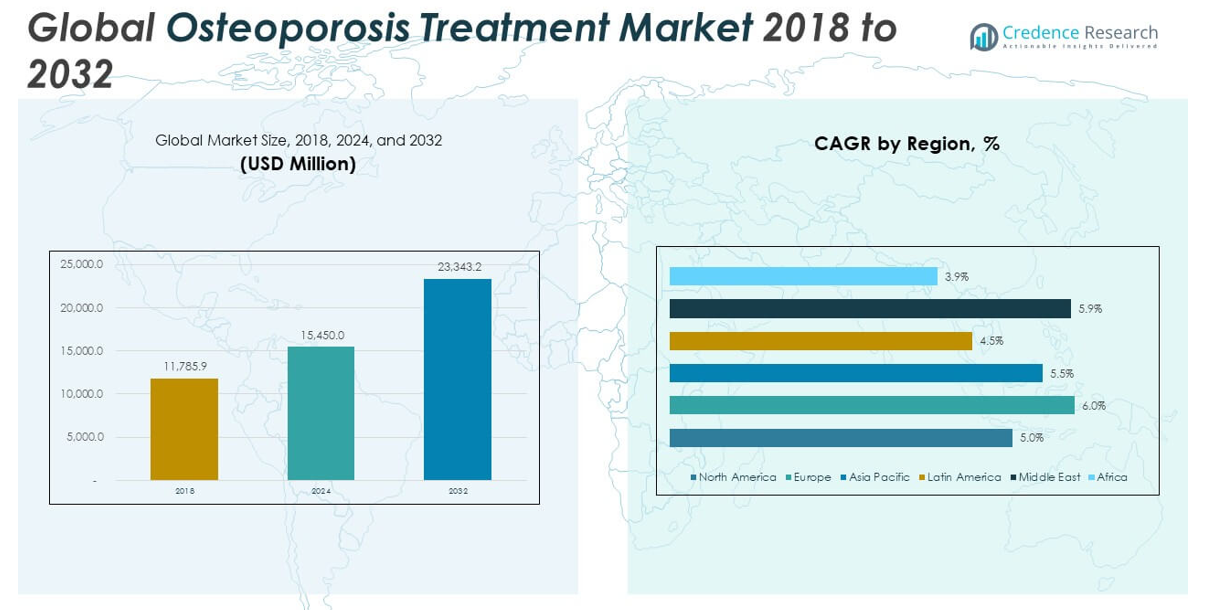
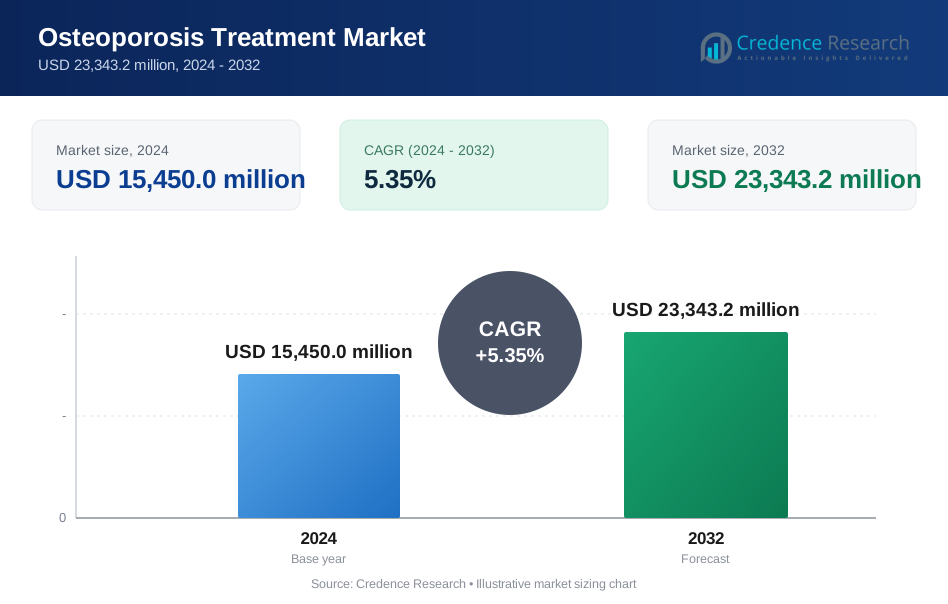
The Global Osteoporosis Treatment Market size was valued at USD 11,785.9 million in 2018 to USD 15,450.0 million in 2024 and is anticipated to reach USD 23,343.2 million by 2032, at a CAGR of 5.35% during the forecast period.
| REPORT ATTRIBUTE | DETAILS |
|---|---|
| Historical Period | 2020-2023 |
| Base Year | 2024 |
| Forecast Period | 2025-2032 |
| Osteoporosis Treatment Market Size 2024 | USD 15,450.0 million |
| Osteoporosis Treatment Market, CAGR | 5.35% |
| Osteoporosis Treatment Market Size 2032 | USD 23,343.2 million |
Several key drivers are fueling the growth of the osteoporosis treatment market. Chief among these is the increasing prevalence of osteoporosis due to aging populations, lifestyle-related risk factors, and a growing incidence of secondary osteoporosis associated with comorbidities such as spinal cord injuries. It is estimated that over 21% of women and 6.3% of men above the age of 50 suffer from osteoporosis globally. Rising awareness among patients and healthcare providers has led to more frequent screenings and earlier diagnosis, particularly with the support of advanced diagnostic technologies such as dual-energy X-ray absorptiometry (DXA). Additionally, pharmaceutical innovation continues to reshape the treatment landscape. While bisphosphonates remain a frontline therapy, the market is witnessing increased adoption of biologics, including denosumab and parathyroid hormone analogs, which offer enhanced efficacy and patient compliance. The launch of denosumab biosimilars in early 2025—such as Jubbonti and Wyost—has expanded treatment access and introduced competitive dynamics, benefiting both payers and patients. Moreover, government initiatives in emerging economies to improve healthcare access, alongside growing investments in patient education and infrastructure, are further propelling market expansion.
Regionally, North America holds the largest share of the global osteoporosis treatment market. The U.S. dominates the regional market, supported by a high prevalence of osteoporosis, well-established healthcare systems, widespread access to diagnostics, and favorable reimbursement policies. The presence of key pharmaceutical players and continued innovation in therapeutic offerings also bolster regional growth. Europe follows closely, driven by a growing elderly population, extensive use of advanced therapies, and public health initiatives that promote early detection and treatment adherence. The region has also embraced biosimilars to improve affordability and treatment uptake. Meanwhile, the Asia-Pacific region is emerging as the fastest-growing market, with countries such as China, Japan, and India witnessing rapid increases in osteoporosis cases due to demographic changes and lifestyle transitions. Improved healthcare infrastructure, rising awareness, and expanding insurance coverage are facilitating greater diagnosis and treatment adoption in these markets. Conversely, regions such as Latin America and the Middle East & Africa exhibit slower growth due to limited healthcare access and lower awareness, though future expansion is anticipated as governments and private stakeholders invest in healthcare reforms and public education. Overall, the global osteoporosis treatment market presents a promising outlook, with significant opportunities for innovation, expansion, and improved patient outcomes.
Market Insights:
- The market was valued at USD 11.79 billion in 2018, reaching USD 15.45 billion in 2024, and is projected to hit USD 23.34 billion by 2032, growing at a CAGR of 5.35%.
- Age-related bone loss, especially in people over 50, is significantly driving demand for osteoporosis therapies, particularly in developed nations with aging demographics.
- Increased osteoporosis cases linked to diabetes, arthritis, thyroid issues, and corticosteroid use, alongside sedentary lifestyles, are broadening the market scope.
- The shift from bisphosphonates to biologics like denosumab and romosozumab improves treatment adherence. The 2025 launch of biosimilars (e.g., Jubbonti, Wyost) boosts affordability and access.
- Advances in DXA scanning, public health programs, and national awareness campaigns are enabling earlier detection and driving proactive treatment.
- High costs of advanced biologics and limited reimbursement policies restrict access in developing regions, hindering full market penetration.
- North America leads with strong infrastructure and high disease prevalence, followed by Europe with wide biosimilar uptake. Asia-Pacific is the fastest-growing region, while Latin America & MEA show slower adoption due to lower awareness and infrastructure gaps.
Market Drivers:
Rising Geriatric Population and Age-Related Bone Loss Drive Demand for Osteoporosis Therapies:
The Global Osteoporosis Treatment Market is experiencing sustained growth due to the rapid increase in the elderly population worldwide. Aging significantly weakens bone density, particularly in postmenopausal women and older men, making them highly susceptible to fractures. A large percentage of the global population over 50 suffers from osteoporosis or low bone mass, creating a significant treatment burden. This demographic trend is more pronounced in developed nations, but emerging economies are also witnessing similar patterns. The growing elderly segment directly increases the need for preventive and therapeutic solutions. Governments and healthcare systems continue to prioritize osteoporosis screening and management programs to reduce the clinical and economic impact of fractures.
- For instance, . Amgen’s Prolia (denosumab) demonstrated a 39% reduced risk of major osteoporotic fracture compared to alendronate over five years in a real-world study of nearly half a million postmenopausal women with osteoporosis.
Increased Prevalence of Lifestyle Diseases and Secondary Osteoporosis Expands the Treatment Base:
Osteoporosis is no longer confined to aging alone, with a rising number of cases linked to secondary conditions and lifestyle-related diseases. Conditions such as diabetes, rheumatoid arthritis, thyroid disorders, and long-term corticosteroid use are contributing to early-onset bone loss. Sedentary behavior, poor dietary habits, smoking, and alcohol consumption further accelerate bone degradation. The Global Osteoporosis Treatment Market benefits from a broader patient base resulting from these comorbidities. Healthcare providers are emphasizing early diagnosis and intervention in high-risk individuals regardless of age. The expansion of at-risk populations is expected to sustain long-term growth in pharmaceutical and clinical solutions.
- For instance, Amgen’s Prolia (denosumab) received FDA approval for glucocorticoid-induced osteoporosis after a Phase 3 study showed greater gains in bone mineral density for patients on long-term glucocorticoid therapy compared to active controls.
Innovation in Drug Development and Emergence of Biologics Enhance Treatment Outcomes:
Pharmaceutical innovation plays a vital role in shaping the competitive landscape of osteoporosis care. The market has shifted from traditional bisphosphonates toward targeted therapies like denosumab, romosozumab, and parathyroid hormone analogs, which offer improved safety profiles and greater efficacy. Biologics have enabled longer dosing intervals and better patient adherence, helping to reduce fracture risk and improve quality of life. The Global Osteoporosis Treatment Market has also seen a rise in research and development efforts focused on dual-action therapies that can both increase bone formation and reduce bone resorption. Regulatory approvals of biosimilars have further expanded access to advanced treatments in cost-sensitive markets. These innovations are accelerating therapeutic adoption across all regions.
Improved Awareness, Screening Infrastructure, and Access to Care Promote Early Intervention:
Public and clinical awareness of osteoporosis and its complications has grown significantly over the past decade. National health programs, non-profit campaigns, and educational initiatives are encouraging earlier diagnosis through bone mineral density testing and risk assessment tools. Hospitals and clinics have adopted more efficient diagnostic equipment, making screening more accessible to rural and underserved populations. The Global Osteoporosis Treatment Market benefits from these system-wide improvements in early detection and follow-up care. Patients are increasingly seeking treatment before the occurrence of debilitating fractures. Health systems are prioritizing osteoporosis care as part of chronic disease management strategies, supporting long-term market expansion.
Market Trends:
Shift Toward Combination Therapies and Sequential Treatment Protocols Is Gaining Clinical Acceptance:
Healthcare providers are increasingly adopting combination and sequential therapies to improve treatment outcomes for patients with severe or treatment-resistant osteoporosis. Clinicians are prescribing anabolic agents followed by antiresorptive therapies to first build bone and then maintain density. This trend addresses the limitations of monotherapy by leveraging the strengths of multiple drug classes. It is supported by clinical guidelines and real-world evidence that demonstrate enhanced fracture prevention. The Global Osteoporosis Treatment Market is responding to this trend with a broader pipeline of combination-ready therapeutics. Pharmaceutical companies are focusing on optimizing treatment duration and sequencing strategies to deliver better long-term results.
- For instance, the ARCH study showed that sequential treatment with UCB and Amgen’s Evenity (romosozumab) for 12 months followed by alendronate reduced new vertebral fractures by 50% compared to alendronate alone, and clinical fractures by 27% over 24 months in postmenopausal women at high risk.
Rising Popularity of Extended-Release and Less Frequent Dosing Formulations Improves Compliance:
Patients often struggle with the burden of frequent dosing in chronic conditions such as osteoporosis. This has led to increased preference for extended-release injectables and treatments with dosing schedules ranging from once a month to once a year. Long-acting formulations improve adherence, reduce clinical visits, and enhance patient satisfaction. The Global Osteoporosis Treatment Market reflects this demand with the growing use of denosumab, zoledronic acid, and other infrequently administered drugs. It is also fostering innovation in drug delivery platforms that support sustained release without compromising efficacy. Manufacturers are focusing on reducing injection-site discomfort and simplifying administration methods.
- For instance, Novartis’s Reclast (zoledronic acid), administered as a once-yearly infusion, reduced spine fractures by 70% and hip fractures by 41% over three years in women with postmenopausal osteoporosis.
Expansion of Digital Health and Remote Monitoring Tools Enhances Patient Engagement:
Digital health platforms are playing a larger role in osteoporosis care by enabling remote patient monitoring, treatment tracking, and adherence support. Wearable devices, mobile apps, and telehealth consultations are helping clinicians monitor patient compliance and track bone health indicators more efficiently. These tools support early intervention in case of therapy discontinuation or side effects. The Global Osteoporosis Treatment Market is integrating such technologies to bridge gaps between physician visits and improve outcomes through personalized care. Pharmaceutical companies and health tech firms are collaborating to offer digital companion solutions alongside drug therapies. It reflects a shift toward data-driven, connected care environments.
Growing Investment in Biomarker Research and Personalized Therapy Supports Targeted Interventions:
Advancements in genomics and molecular diagnostics are guiding the development of targeted therapies based on patient-specific risk profiles. Biomarkers such as serum CTX, PINP, and genetic markers are helping identify patients who may benefit most from specific drug classes or combinations. The Global Osteoporosis Treatment Market is seeing a gradual move toward personalized treatment planning supported by laboratory data. Research institutions and biopharma companies are prioritizing biomarker validation to predict treatment response and fracture risk. This trend enables more efficient resource allocation and reduces the likelihood of overtreatment. It reflects a precision medicine approach that aligns with broader healthcare modernization efforts.
Market Challenges Analysis:
High Cost of Advanced Therapies and Limited Affordability in Low-Income Regions Restrict Market Penetration:
The Global Osteoporosis Treatment Market faces a significant challenge due to the high cost of advanced biologics and patented therapies. Treatments such as denosumab and romosozumab offer strong clinical outcomes but remain unaffordable for large portions of the population in low- and middle-income countries. Many health systems lack broad reimbursement coverage, forcing patients to bear out-of-pocket expenses. This financial barrier limits therapy access, particularly in regions with underdeveloped insurance frameworks. The market also contends with slow adoption of biosimilars, which could otherwise improve affordability. It must address cost disparities to achieve equitable access and drive global volume growth.
Underdiagnosis, Patient Non-Adherence, and Lack of Awareness Continue to Undermine Treatment Outcomes:
Despite medical advances, underdiagnosis of osteoporosis remains widespread due to limited screening infrastructure and poor public awareness. Many patients do not receive timely bone density tests, and those diagnosed often fail to initiate or complete treatment regimens. Long treatment durations, fear of side effects, and unclear symptom progression contribute to poor adherence. The Global Osteoporosis Treatment Market is hindered by this gap between diagnosis and consistent therapy application. It must invest in education, patient support programs, and simplified treatment protocols to improve continuity of care. Closing the awareness and compliance gap is essential for reducing fracture rates and improving long-term outcomes.
Market Opportunities:
Expansion of Biosimilars and Generic Drugs Unlocks Access in Price-Sensitive Markets:
The Global Osteoporosis Treatment Market holds strong potential in expanding biosimilars and generics that lower treatment costs and improve accessibility. Patent expirations of key biologics create room for cost-effective alternatives with comparable efficacy. Regulatory bodies in emerging economies are accelerating approvals, encouraging more manufacturers to enter these markets. This shift enhances affordability in regions where branded therapies remain out of reach for most patients. It creates a viable pathway for expanding treatment coverage and increasing patient volumes. The market can leverage this trend to build sustainable growth in underserved areas.
Integration of Digital Tools and Preventive Screening Initiatives Drives Early Intervention:
Wider adoption of digital health platforms presents a scalable opportunity to improve early diagnosis and treatment adherence. Mobile health applications, AI-enabled risk assessment, and telemedicine are transforming patient engagement and streamlining care pathways. The Global Osteoporosis Treatment Market can benefit from integrating these technologies into standard care models. Expanding preventive screening programs through public-private partnerships also strengthens early detection. It positions the market to reduce fracture incidence and healthcare costs through timely intervention. These tools support long-term patient monitoring and create new value-added services for providers.
Market Segmentation Analysis:
By Drug Class
Bisphosphonates continue to dominate the market due to their established safety profile and cost-efficiency. RANK ligand inhibitors, including denosumab, are expanding their market share with enhanced outcomes in fracture prevention. Parathyroid hormone therapies such as teriparatide are preferred in severe cases for their bone-building capabilities. SERMs and calcitonin remain relevant in specific patient demographics. The "Others" category includes newer biologics and dual-action agents under clinical advancement.
- For instance, Novartis’s Reclast (zoledronic acid), a bisphosphonate, achieved a 70% reduction in spine fractures and a 41% reduction in hip fractures over three years.Radius Health’s Tymlos (abaloparatide), a parathyroid hormone analog, reduced new vertebral fractures by 86% and nonvertebral fractures by 43% in the ACTIVE trial.
By Route of Administration
Oral formulations account for the largest market share, driven by convenience and widespread availability. Parenteral options are growing rapidly due to improved efficacy, reduced dosing frequency, and physician-led administration, especially in patients with poor adherence to oral medications.
- For instance, Novartis’s Reclast (zoledronic acid) is administered intravenously once yearly, providing significant reductions in all major fracture types, while oral bisphosphonates require more frequent dosing.
By Distribution Channel
Hospital pharmacies lead in revenue due to specialist prescriptions and high patient throughput. Retail pharmacies support accessibility for long-term therapy users. Online pharmacies are gaining relevance, backed by telemedicine growth and consumer preference for home delivery models.
Segmentation:
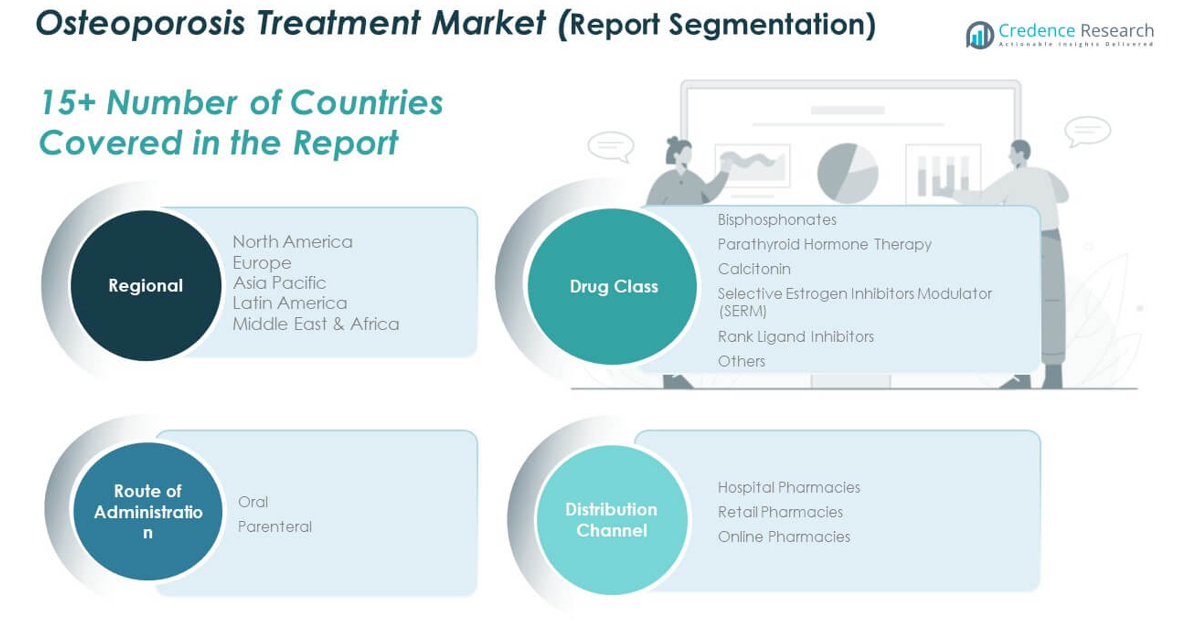
By Drug Class
- Bisphosphonates
- Parathyroid Hormone Therapy
- Calcitonin
- Selective Estrogen Receptor Modulators (SERMs)
- RANK Ligand Inhibitors
- Others
By Route of Administration
- Oral
- Parenteral
By Distribution Channel
- Hospital Pharmacies
- Retail Pharmacies
- Online Pharmacies
By Region
- North America
- U.S.
- Canada
- Mexico
- Europe
- Germany
- France
- U.K.
- Italy
- Spain
- Rest of Europe
- Asia Pacific
- China
- Japan
- India
- South Korea
- South-east Asia
- Rest of Asia Pacific
- Latin America
- Brazil
- Argentina
- Rest of Latin America
- Middle East & Africa
- GCC Countries
- South Africa
- Rest of the Middle East and Africa
Regional Analysis:
North America
The North America Osteoporosis Treatment Market size was valued at USD 4,020.17 million in 2018 to USD 5,179.94 million in 2024 and is anticipated to reach USD 7,644.90 million by 2032, at a CAGR of 5.0% during the forecast period. North America holds the largest share of the Global Osteoporosis Treatment Market, accounting for more than 33% of global revenue. The region benefits from a high prevalence of osteoporosis, robust healthcare infrastructure, and broad access to advanced therapeutics. The United States leads regional performance, supported by early diagnosis practices and a strong reimbursement ecosystem. A high concentration of pharmaceutical companies contributes to rapid drug adoption and innovation. Market dynamics are further supported by aging demographics and growing awareness around fracture prevention. It continues to set the pace for clinical adoption of biologics and biosimilars.
Europe
The Europe Osteoporosis Treatment Market size was valued at USD 2,566.97 million in 2018 to USD 3,490.15 million in 2024 and is anticipated to reach USD 5,525.34 million by 2032, at a CAGR of 6.0% during the forecast period. Europe represents approximately 22.6% of the global market and shows strong momentum driven by a growing elderly population and proactive public health policies. Countries such as Germany, France, and the UK are adopting advanced osteoporosis therapies and embracing biosimilars to expand treatment access. Government-sponsored screening programs promote early detection and therapy initiation. The presence of universal healthcare systems enhances affordability and long-term adherence. High penetration of parenteral treatments is evident in both inpatient and outpatient settings. It remains a key region for market expansion through innovation and regulatory support.
Asia Pacific
The Asia Pacific Osteoporosis Treatment Market size was valued at USD 3,127.98 million in 2018 to USD 4,133.53 million in 2024 and is anticipated to reach USD 6,312.00 million by 2032, at a CAGR of 5.5% during the forecast period. Asia Pacific accounts for nearly 26.5% of the global market and is the fastest-developing region in terms of patient base and healthcare investment. Countries like China, Japan, and India are driving demand due to rising osteoporosis incidence and demographic shifts. Expanding insurance coverage and healthcare reforms have improved patient access to diagnostic tools and branded therapies. Pharmaceutical companies are targeting this region with cost-effective biosimilars and awareness initiatives. Urbanization and changes in diet and lifestyle are contributing to increased bone health concerns. It continues to show strong potential for long-term market growth.
Latin America
The Latin America Osteoporosis Treatment Market size was valued at USD 1,191.55 million in 2018 to USD 1,488.50 million in 2024 and is anticipated to reach USD 2,100.89 million by 2032, at a CAGR of 4.5% during the forecast period. Latin America contributes about 9.6% to the global market, with Brazil and Mexico being the primary revenue contributors. Market growth is supported by rising awareness and increasing adoption of pharmaceutical therapies in urban centers. Limited access to advanced diagnostic facilities and affordability issues constrain rural market development. Public health campaigns and private sector investments are gradually improving screening rates. Demand for generic bisphosphonates remains high, while uptake of parenteral therapies is slower. It offers moderate growth potential in high-density population areas.
Middle East
The Middle East Osteoporosis Treatment Market size was valued at USD 636.44 million in 2018 to USD 862.11 million in 2024 and is anticipated to reach USD 1,358.57 million by 2032, at a CAGR of 5.9% during the forecast period. The region contributes around 5.8% to the global market, led by Gulf Cooperation Council (GCC) countries. Market drivers include rising health awareness, high vitamin D deficiency rates, and increasing investment in hospital infrastructure. Governments are integrating bone health management into national health strategies. Access to advanced drugs is growing, although disparities exist between urban and rural healthcare systems. Parenteral treatments are more common in private healthcare settings. It is emerging as a niche but steadily expanding market for osteoporosis therapy.
Africa
The Africa Osteoporosis Treatment Market size was valued at USD 242.79 million in 2018 to USD 295.76 million in 2024 and is anticipated to reach USD 401.50 million by 2032, at a CAGR of 3.9% during the forecast period. Africa holds the smallest share in the global market, contributing about 1.7% of total revenue. Limited awareness, lack of screening infrastructure, and affordability issues hinder market penetration. Urban centers in countries like South Africa and Egypt are showing gradual improvements in osteoporosis diagnosis and treatment access. Generic oral drugs dominate prescriptions due to cost sensitivity. Investment from international healthcare organizations supports awareness and early intervention. It remains a long-term growth region with significant unmet clinical needs.
Key Player Analysis:
- Allergan Plc
- Amgen, Inc.
- Actavis Plc
- Eli Lilly and Company
- Hoffmann-La Roche Ltd.
- GSK plc
- Novartis AG
- Novo Nordisk A/S
- Teva Pharmaceuticals Industries Ltd.
- Pfizer, Inc.
- Other Key Players
Competitive Analysis:
The Global Osteoporosis Treatment Market is highly competitive, with leading pharmaceutical companies focusing on product innovation, lifecycle management, and strategic collaborations. Key players include Amgen, Eli Lilly and Company, UCB, Novartis, Pfizer, and Teva Pharmaceuticals. It is characterized by the presence of both branded biologics and emerging biosimilars, which intensify pricing and market share competition. Companies invest heavily in clinical trials to expand indications and improve therapeutic outcomes. Strategic partnerships with diagnostics firms and digital health providers help enhance treatment adherence and patient monitoring. The market also sees growing competition from regional generic manufacturers entering cost-sensitive economies. Innovation in delivery methods and long-acting formulations remains a central focus to maintain product differentiation.
Recent Developments:
- In May 2025, Actavis Plc (now part of Teva Pharmaceuticals) was highlighted for its ongoing expansion in the osteoporosis generics sector, driven by patent expirations and the need for affordable alternatives. Actavis’ acquisition of Warner Chilcott PLC has strengthened its position in women’s health and osteoporosis treatment, broadening its global reach and product offerings.
- In May 2025, Amgen, Inc. collaborated with Sandoz to resolve patent litigation and enable the launch of denosumab biosimilars Jubbonti® and Wyost® on or before May 31, 2025. This development increases competition and expands access to proven RANK‑ligand inhibitor therapies.
- In May 2025, GSK plc announced an agreement to acquire efimosfermin alfa, a phase III-ready investigational specialty medicine from Boston Pharmaceuticals. While efimosfermin targets steatotic liver disease, GSK emphasized the acquisition as part of its broader strategy to expand its specialty medicine pipeline, which includes therapies relevant to metabolic and bone health.
- In March 2025, F. Hoffmann-La Roche Ltd. announced an exclusive global collaboration and licensing agreement with Zealand Pharma to co-develop and co-commercialize petrelintide, a potential therapy targeting obesity and related metabolic comorbidities. While petrelintide is primarily aimed at obesity, Roche highlighted its potential to address unmet medical needs in metabolic and bone health, which are closely linked to osteoporosis risk and management.
Market Concentration & Characteristics:
The Global Osteoporosis Treatment Market shows moderate to high concentration, with a few multinational pharmaceutical companies holding significant market share through patented biologics and established brand portfolios. It is defined by high barriers to entry due to regulatory requirements, capital-intensive R&D, and the need for strong clinical evidence. The market features a mix of long-established therapies and newer biologics that offer improved outcomes and dosing convenience. It is evolving with the introduction of biosimilars, increasing competitive pressure and expanding access in emerging regions. Treatment adherence, efficacy, and safety remain core differentiators. The market also exhibits characteristics of therapeutic specialization, where continuous innovation and physician education shape prescribing trends.
Report Coverage:
The research report offers an in-depth analysis based on segmentation across drug class, route of administration, and distribution channel. It details leading market players, providing an overview of their business, product offerings, investments, revenue streams, and key applications. Additionally, the report includes insights into the competitive environment, SWOT analysis, current market trends, as well as the primary drivers and constraints. Furthermore, it discusses various factors that have driven market expansion in recent years. The report also explores market dynamics, regulatory scenarios, and technological advancements that are shaping the industry. It assesses the impact of external factors and global economic changes on market growth. Lastly, it provides strategic recommendations for new entrants and established companies to navigate the complexities of the market.
Future Outlook:
- Rising global elderly population will steadily increase the demand for osteoporosis therapies.
- Biosimilars are expected to improve affordability and expand access in cost-sensitive regions.
- New drug approvals targeting both bone formation and resorption will diversify treatment options.
- Personalized medicine, guided by biomarkers, will enhance therapeutic precision and outcomes.
- Remote monitoring and digital adherence tools will strengthen long-term patient management.
- Emerging economies will drive market expansion through healthcare infrastructure development.
- Extended-release formulations will improve patient compliance and reduce dosing frequency.
- Strategic collaborations between pharma and tech firms will introduce value-added care models.
- Increased screening initiatives will enable earlier diagnosis and reduce fracture incidence.
- Regulatory support for innovative therapies and generic competition will shape pricing dynamics.
Request a Free Sample
Fill in your details and we'll send you a free sample report.
- Sample data tables & charts
- Research methodology
Need a Custom Version of This Report?
Tailor the scope, geography, or segments to your exact requirements.
- Custom geography or segment scope
- Direct access to our analyst team
Frequently Asked Questions
What is the current size of the Global Osteoporosis Treatment Market?
What are the key segments within the Global Osteoporosis Treatment Market?
What are some challenges faced by the Global Osteoporosis Treatment Market?
Who are the major players in the Global Osteoporosis Treatment Market?
Table of Content
Chapter 1. Report Introduction
- 1.1 Report Description & Purpose
- 1.1.1 Report Title & Market Definition
- 1.1.2 Unique Selling Propositions (USP) & Key Differentiators
- 1.1.3 Value Proposition for Stakeholders
- 1.2 Research Objectives
- 1.2.1 Market Sizing Objectives (Volume & Revenue)
- 1.2.2 Segmentation Objectives
- 1.2.3 Competitive Intelligence Objectives
- 1.2.4 Forecast & Scenario Objectives
- 1.3 Report Scope
- 1.3.1 Osteoporosis Treatment Scope – Types & Subtypes Covered
- 1.3.2 Geographic Scope – Regions & Countries Covered
- 1.3.3 Historical Period, Base Year & Forecast Period (2024; forecast to 2032)
- 1.3.4 Inclusions & Exclusions
- 1.4 HS Code & Classification Framework
- 1.5 Currency, Units & Pricing Basis
- 1.6 Target Stakeholders
- 1.7 Limitations & Assumptions
Chapter 2. Executive Summary
- 2.1 Global Osteoporosis Treatment Market Snapshot
- 2.1.1 Market Size – Historical (2024) & Forecast (2024-2032) (2024: USD 15,450.0 million → 2032: USD 23,343.2 million)
- 2.1.2 Volume & Revenue – Global Totals
- 2.1.3 Key Market Highlights – Top Five Facts
- 2.2 Osteoporosis Treatment Market Segmentation Snapshot
- 2.2.1 Market Split by Region – 2024 vs. 2032
- 2.3 Competitive Snapshot
- 2.3.1 Top 10 Players by Revenue Share – 2024
- 2.3.2 Top 10 Players by Volume Share – 2024
- 2.3.3 Recent Strategic Developments (18-Month Summary)
- 2.4 Key Investment Highlights & Strategic Conclusions
Chapter 3. Osteoporosis Treatment Market Dynamics & Industry Analysis
- 3.1 Market Overview & Context
- 3.1.1 Osteoporosis Treatment Market Position in the Broader Automotive Value Chain
- 3.1.2 OEM vs. Replacement Market Dynamics
- 3.1.3 Market Maturity & Development Stage by Region
- 3.2 Osteoporosis Treatment Market Drivers
- 3.3 Osteoporosis Treatment Market Restraints & Challenges
- 3.4 Osteoporosis Treatment Market Opportunities
- 3.5 Porter's Five Forces Analysis
- 3.5.1 Threat of New Entrants
- 3.5.2 Bargaining Power of Suppliers
- 3.5.3 Bargaining Power of Buyers
- 3.5.4 Threat of Substitutes
- 3.5.5 Competitive Rivalry – Intensity Assessment
- 3.6 Osteoporosis Treatment Value Chain Analysis
- 3.6.1 Upstream – Raw Material/Input Suppliers
- 3.6.1.1 Raw Material/Input 1
- 3.6.1.2 Raw Material/Input 2
- 3.6.1.3 Raw Material/Input 3
- 3.6.2 Midstream – Production/Manufacturing/Service Delivery
- 3.6.2.1 Production/Process Overview
- 3.6.2.2 Key Facility Locations & Capacity by Manufacturer
- 3.6.3 Downstream – Distribution & End Consumer
- 3.6.3.1 Primary Channel – B2B/OEM
- 3.6.3.2 Secondary Channels – Dealer, Retail, Online, Direct
- 3.6.4 Value Chain Profitability Analysis
- 3.6.1 Upstream – Raw Material/Input Suppliers
- 3.7 PESTEL Analysis
- 3.7.1 Political Factors
- 3.7.2 Economic Factors
- 3.7.3 Social Factors
- 3.7.4 Technological Factors
- 3.7.5 Environmental Factors
- 3.7.6 Legal Factors
- 3.8 Osteoporosis Treatment Supply Chain Analysis
- 3.8.1 Raw Material/Input Supply Risk Assessment
- 3.8.2 Manufacturing Concentration Risk (Geographic Exposure)
- 3.8.3 Trade Disruption Impact Analysis
- 3.9 Regulatory & Policy Landscape
Note: The regulatory and policy landscape section covers regulations based on their applicability to the market, Osteoporosis Treatment category, geography, and scope of the study. Only regulatory frameworks with a material impact on operations, compliance, trade, sustainability, or market access are analyzed in detail.
Chapter 4. Key Investment Pockets & Opportunity Analysis
- 4.1 Osteoporosis Treatment Market Attractiveness Analysis
- 4.1.1 By Region – Investment Attractiveness Matrix (Volume × CAGR)
- 4.2 Absolute Revenue Growth Opportunity
- 4.2.1 By Region – Absolute USD Growth Through 2032
- 4.3 Incremental Volume Opportunity
- 4.3.1 By Region – Incremental Volume Through 2032
- 4.3.2 Segment – Incremental Volume
- 4.4 Emerging Submarket Opportunity Deep Dive (Subject to Applicability)
- 4.5 Emerging Market Opportunity Scorecards
- 4.5.1 United States
- 4.5.2 Europe
- 4.5.3 Asia
- 4.5.4 Middle East & Africa
Note: Emerging Market Opportunity Scorecards will be included based on relevance and strategic importance. Regions listed are indicative and may vary depending on data availability and market dynamics.
Chapter 5. Osteoporosis Treatment Import-Export Analysis & Trade Flows
- 5.1 Global Trade Overview
- 5.1.1 Global Export Value by Country (2024)
- 5.1.2 Global Export Volume by Country (2024)
- 5.1.3 Global Import Value by Country (2024)
- 5.1.4 Global Import Volume by Country (2024)
- 5.1.5 Net Trade Balance by Country (2024)
- 5.2 Export Analysis – Segment
- 5.2.1 Type 1 (HS Code)
- 5.2.2 Type 2 (HS Code)
- 5.2.3 Type 3 (HS Code)
- 5.2.4 Type 4 (HS Code)
- 5.2.5 Type 5 (HS Code)
- 5.3 Import Analysis – Segment
- 5.3.1 Type 1 (HS Code)
- 5.3.2 Type 2 (HS Code)
- 5.3.3 Type 3 (HS Code)
- 5.3.4 Type 4 (HS Code)
- 5.3.5 Type 5 (HS Code)
- 5.4 Average Unit Trade Prices
- 5.4.1 Average Export Price – Segment & Country
- 5.4.2 Average Import Price – Segment & Source Country
- 5.4.3 Price Trends (2024)
- 5.5 Key Trade Route Analysis
- 5.5.1 Trade Route 1
- 5.5.2 Trade Route 2
- 5.5.3 Trade Route 3
- 5.5.4 Trade Route 4
- 5.5.5 Trade Route 5
- 5.6 Trade Policy Impact Assessment
- 5.6.1 US Anti-Dumping & Section 301 Tariffs
- 5.6.2 EU Customs Union Impact
- 5.6.3 Major Free Trade Agreements
- 5.6.4 USMCA Rules of Origin
Note: Trade policy analysis will be included only where relevant to the Osteoporosis Treatment market.
Chapter 6. Competitive Landscape & Company Benchmarking
- 6.1 Osteoporosis Treatment Market Concentration & Structure
- 6.1.1 Herfindahl-Hirschman Index (HHI) – vs. 2024
- 6.1.2 Tier 1, Tier 2 & Tier 3 Market Structure
- 6.1.3 Global, Regional & Local Player Dynamics
- 6.2 Osteoporosis Treatment Market Share Analysis – 2024
- 6.2.1 Global Revenue Share by Company
- 6.2.2 Global Volume Share by Company
- 6.2.3 Regional Revenue Share
- 6.2.4 Market Share Evolution ( vs. 2024)
- 6.2.5 OEM Segment Share by Company
- 6.2.6 Replacement Segment Share by Company
- 6.3 Production/Delivery Capacity & Facility Analysis
- 6.3.1 Global Installed Capacity
- 6.3.2 Capacity Utilization Rates
- 6.3.3 Production/Output Volume
- 6.3.4 Facility Locations & Capacity Map
- 6.3.5 Planned Capacity Additions
- 6.4 Osteoporosis Treatment Competitive Benchmarking Matrix
- 6.4.1 Revenue, Volume, CAGR & Profitability Comparison
- 6.4.2 Channel Revenue Mix
- 6.4.3 Geographic Revenue Exposure
- 6.4.4 R&D Intensity
- 6.4.5 Sustainability Maturity
- 6.5 Strategic Developments in Osteoporosis Treatment (Last 24 Months)
- 6.5.1 Mergers, Acquisitions & Divestments
- 6.5.2 New Osteoporosis Treatment Launches
- 6.5.3 Facility Expansions
- 6.5.4 Strategic Alliances, Joint Ventures & Partnerships
- 6.5.5 Distribution Expansion & Market Entry
- 6.5.6 Sustainability & ESG Initiatives
- 6.6 Competitive Strategy Mapping
- 6.6.1 Leader, Challenger, Follower & Niche Classification
- 6.6.2 Pricing Strategy Comparison
- 6.6.3 Channel Strategy Matrix
Note: Strategic developments are included based on their materiality and the availability of reliable information.
Chapter 7. Global Osteoporosis Treatment Market – By Distribution Channel
- 7.1 Segment Overview
- 7.1.1 Volume & Revenue Split by Channel (2024 & 2032)
- 7.1.2 Channel Mix Evolution (2024-2032)
Chapter 8. Regional Market Analysis – Global Overview
- 8.1 Global Regional Overview
- 8.1.1 Regional Volume Share
- 8.1.2 Regional Revenue Share
- 8.1.3 Regional Volume by Region
- 8.1.4 Regional Revenue by Region
- 8.1.5 Regional Forecast Through 2032
- 8.2 Cross-Regional Segment Analysis
- 8.2.1 By Distribution Channel
- 8.2.2 By Brand/Price Tier
Chapter 9. North America Osteoporosis Treatment Market
- 9.1 United States
- 9.2 Canada
- 9.3 Mexico
Chapter 10. Europe Osteoporosis Treatment Market
- 10.1 Germany
- 10.2 France
- 10.3 Italy
- 10.4 United Kingdom
- 10.5 Spain
- 10.6 Poland
- 10.7 Russia
- 10.8 Netherlands
- 10.9 Belgium
- 10.10 Sweden
- 10.11 Denmark
- 10.12 Norway
- 10.13 Rest of Europe
Chapter 11. Asia Pacific Osteoporosis Treatment Market
- 11.1 China
- 11.2 India
- 11.3 Japan
- 11.4 South Korea
- 11.5 Thailand
- 11.6 Indonesia
- 11.7 Vietnam
- 11.8 Malaysia
- 11.9 Australia
- 11.10 Rest of Asia Pacific
Chapter 12. Latin America Osteoporosis Treatment Market
- 12.1 Brazil
- 12.2 Argentina
- 12.3 Colombia
- 12.4 Chile
- 12.5 Rest of Latin America
Chapter 13. Middle East Osteoporosis Treatment Market
- 13.1 Saudi Arabia
- 13.2 United Arab Emirates
- 13.3 Turkey
- 13.4 Israel
- 13.5 Iran
- 13.6 Rest of the Middle East
Chapter 14. Africa Osteoporosis Treatment Market
- 14.1 South Africa
- 14.2 Egypt
- 14.3 Nigeria
- 14.4 Morocco
- 14.5 Rest of Africa
Chapter 15. Osteoporosis Treatment Company Profiles
- 15.1 [Company 01]
- 15.1.1 Company Overview
- 15.1.2 Key Management Personnel
- 15.1.3 Products & Services Portfolio
- 15.1.4 Financial Performance
- 15.1.5 Key Market Focus & Geographic Presence
- 15.1.6 Recent Developments & Strategic Initiatives
Note: The company profile list is preliminary and may change based on research findings, market developments, data availability, and client requirements.
Chapter 16. Appendices
- Appendix A – List of Abbreviations & Acronyms
- Appendix B – Industry Classification Code Reference – Full Series
- Appendix C – Production & Capacity Data Tables
- Appendix D – End-Use & Demand Base Tables
- Appendix E – Consumption & Replacement Rate Assumptions
- Appendix F – ASP Reference Tables
- Appendix G – Manufacturing & Facility Database
- Appendix H – Import-Export Data Tables
- Appendix I – Regulatory Summary Tables
- Appendix J – Primary Research Participant List (Anonymized)
- Appendix K – Primary Research Questionnaire Framework
- Appendix L – Data Sources & Bibliography
- Appendix M – Market Size Divergence & Source Comparison
Chapter 17. Research Methodology
- 17.1 Research Framework & Philosophy
- 17.2 Secondary Research – Sources, Hierarchy & Data Extraction
- 17.3 Data Modeling – Bottom-Up & Top-Down Market Sizing
- 17.4 Primary Research – Stakeholder Framework, LOI & Sample Sizes
- 17.5 Forecast Methodology – Regression, Scenario & Sensitivity Analysis
- 17.6 Quality Control – Four-Layer Validation Framework
- 17.7 Limitations & Standard Assumptions
- 17.8 Disclaimer
