
| REPORT ATTRIBUTE | DETAILS |
|---|---|
| Historical Period | 2019-2022 |
| Base Year | 2023 |
| Forecast Period | 2024-2032 |
| Pedestrian Entrance Control Systems Market Size 2023 | USD 1624.2 million |
| Pedestrian Entrance Control Systems Market, CAGR | 4.30% |
| Pedestrian Entrance Control Systems Market Size 2032 | USD 2372.45 million |
Market Insights
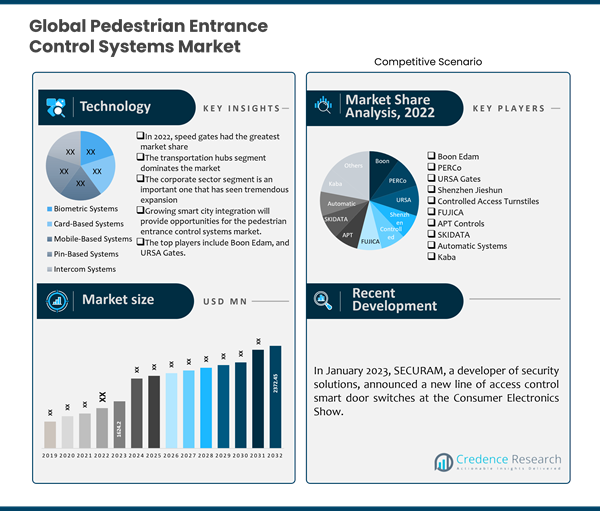
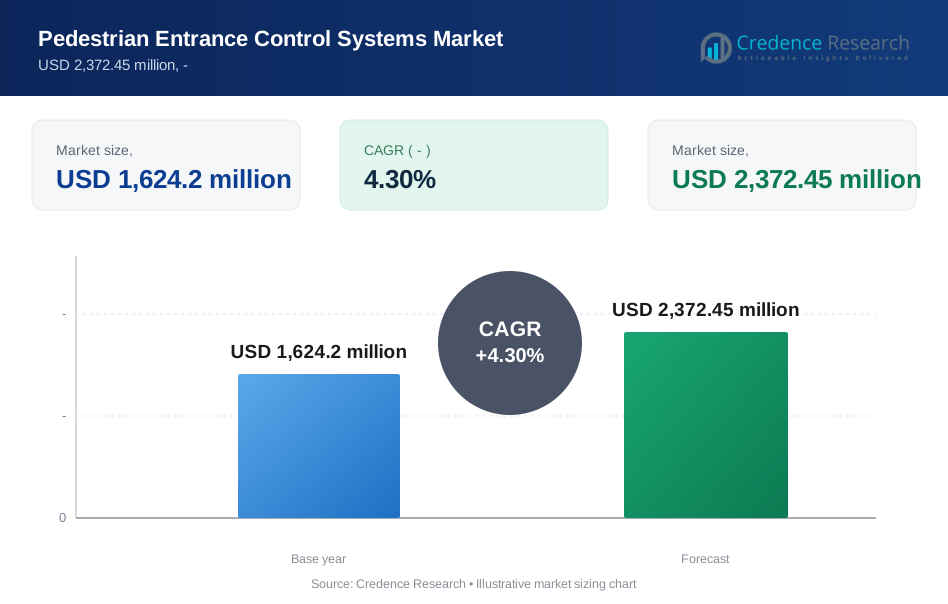
- The global market for pedestrian entrance control systems is projected to expand at a compound annual growth rate (CAGR) of 4.30% between 2024 and 2032, from an estimated USD 1624.2 million in 2023 to USD 2372.45 million in 2032.
- The largest category is speed gates. Turnstiles, on the other hand, is expected to grow at a strong CAGR.
- The transportation hubs category will expand rapidly.
- Throughout the projected period, the CAGR for the corporate sector is anticipated to be the highest.
- Throughout the projection period, the biometric systems should have the largest compound annual growth rate.
- North America controlled the pedestrian entrance control systems market.
- Regarding the market share of pedestrian entrance control systems, Europe is expected to come second.
- Asia Pacific is expected to experience the fastest growth in the pedestrian entrance control systems industry.
- The expansion of the global market is being driven by the growing need for cost-effective security and access management solutions and enhanced building management through integrated access control solutions.
- The market for pedestrian entrance control systems may benefit from developments that drive the adoption of cloud-based access control systems for flexibility and scalability and opportunities in hotels, resorts, and amusement parks for secure and seamless guest access.
Executive Summary
Market Definition
The market for pedestrian entrance control systems includes the manufacture and distribution of technologies for managing and controlling pedestrian entry in various facilities. This covers revolving doors, speed gates, security doors, and automated turnstiles. The market serves applications in commercial buildings, airports, transportation hubs, and other locations needing controlled pedestrian traffic. Urbanization, technical developments, and security concerns are the main drivers of growth.
Market Overview
The pedestrian entrance control systems industry is predicted to continue its upward trajectory between 2024 and 2032, growing at a compound annual growth rate (CAGR) of 4.30%. The market will continue to grow from its projected USD 1624.2 million in 2023 to USD 2372.45 million in 2032.
The security of different buildings and sensitive locations through the management and observation of personnel's physical access is known as pedestrian entrance control. Additionally, building managers and administrators can improve traffic flow and streamline it for enhanced security by implementing pedestrian access control systems. Moreover, pedestrian entry control systems validate and conduct security checks on new entrants and authorize staff to have rapid access to different building locations. So, in order to implement improved security features at many access points with the least amount of disruption to their employees and clients, pedestrian entrance control systems have provided businesses with a workable option.
Moreover, the growing threat of terrorism worldwide is one of the main factors propelling the growth of the pedestrian entrance control systems market. In order to guarantee the public and private safety of physical locations as well as the individuals who visit or work there, it has become necessary for several enterprises and governments worldwide to invest in the newest and most cutting-edge security solutions. The market for pedestrian access control systems has expanded due to a number of other issues, including an increase in theft and espionage. Various problems, such as high beginning expenses and little technological awareness, are hindering the market's expansion. However, because of the growing need for security and the growing number of threats against government and commercial buildings worldwide, it is anticipated that the market for pedestrian entrance control systems as a whole will expand significantly throughout the projected period.
Segmentation by Type of System
- Speed gates are the market leader in terms of type of system. They are made to handle large volumes of pedestrian traffic quickly and effectively. Typically, they have barrier wings or retractable glass that swiftly open to let authorized people in. Speed gates are used in places where quick access is required, like stadiums, corporate buildings, and public transportation hubs.
- The turnstiles category will exhibit a sizable CAGR during the projected period. A traditional type of entrance control device, turnstiles are made out of vertical posts or spinning horizontal arms. They are useful for managing the flow of foot traffic because they only permit one person to pass through at a time.
- Other types of systems, including swing gates, revolving doors, sliding gates, flap barriers, and bollards, also support the need for pedestrian entrance control systems.
Segmentation by Application
- Transportation hubs are considered the best type of application. Entrance control systems are essential in places like bus terminals, train stations, and airports. These technologies aid in controlling passenger flow, boosting security, and guaranteeing that only people with permission can enter restricted areas.
- The government buildings category will likely register a significant CAGR during forecasting. Government buildings, military installations, and other offices frequently need to adhere to strict security protocols. Entry control systems in this industry offer controlled access for authorized individuals, guests, and automobiles.
- Other applications, such as commercial buildings, industrial facilities, stadiums and event venues, educational institutions, and healthcare facilities, further enhance the need for pedestrian entrance control systems.
Segmentation by End User
- The corporate sector category is projected to grow faster over the projection period. The pedestrian entrance control systems market is driven by the corporate sector, which implements cutting-edge solutions for effective employee access, visitor control, and increased security. An important element driving demand in this market is the emergence of smart workplaces and the necessity of safeguarding assets and maintaining safety.
- Other end users, including the public sector, transport and logistics, retail and hospitality, healthcare sector, and education sector, also influence the need for pedestrian entrance control systems.
Segmentation by Technology
- The biometric systems category is likely to have the greatest CAGR throughout the forecast period. Biometric systems technology plays a major role in boosting the market for pedestrian entrance control systems. These systems provide smooth and improved access control by using fingerprint, iris, and facial recognition scanning. Due to their accuracy, efficiency, and capacity to prevent unlawful entry, biometric solutions are becoming increasingly common in a variety of applications, from public spaces to corporate offices.
- Other technologies, such as card-based systems, mobile-based systems, pin-based systems, and intercom systems, also contribute to the demand for pedestrian entrance control systems.
Segmentation by Region
- North America leads the pedestrian entrance control systems industry. This is due to the rising demand for pedestrian entrance control systems from North American countries such as the United States, Canada, and Mexico.
- Europe is estimated to rank second in the pedestrian entrance control systems market.
- It is anticipated that the pedestrian entrance control systems market in Asia Pacific will grow quickly.
- Regions, including Latin America, the Middle East, and Africa, meet the remaining need for pedestrian entrance control systems.
The market for pedestrian entrance control systems is expanding because remote monitoring can improve security, save costs, and increase operational efficiency. It allows for scalability, real-time monitoring, and rapid alarms. It also offers data analytics and system integration. This system successfully satisfies contemporary security requirements while guaranteeing proactive maintenance and user ease.
It is anticipated that the pedestrian entrance control systems market in North America will surpass those in the entire world. The need is driven by a significant amount of technical innovation, the existence of essential infrastructure, and security concerns. Advanced security systems have garnered significant interest from the region. The use of entrance control systems in this area is facilitated by stringent regulatory requirements and an emphasis on improving security measures. Infrastructure development and urbanization have accelerated in the area. The requirement for sophisticated access control systems and growing security concerns have raised the demand for these systems in the North American area.
It is projected that the pedestrian entrance control systems market will develop at the fastest rate in the Asia Pacific region. Because of the region's growing infrastructure, security concerns, and fast urbanization, the market is expanding in the Asia Pacific area. The demand for sophisticated pedestrian entrance control solutions is increasing as a result of government initiatives for smart cities and growing investments in commercial buildings, transportation hubs, and public spaces, making the area a major growth driver.
Key Highlights of the Report
The global pedestrian entrance control systems market is segmented by type of system, application, end user, technology, and region. As far as the type of system is concerned, speed gates are the market spearhead. Transportation hubs are the top application category. Throughout the forecast period, the corporate sector category is expected to grow at the greatest CAGR. During the predicted period, the category with the highest CAGR will be the biometric systems. North America is seeing the most growth in the pedestrian entrance control systems market.
The necessity for increased security in a variety of locations, such as airports, government buildings, corporate headquarters, and key infrastructure, is one of the main motivators. Pedestrian entrance control systems serve to safeguard people and property by preventing unwanted entry. The expansion of the pedestrian entrance control systems market is significantly fueled by compliance with security rules and standards. Entrance control systems assist firms in complying with requirements on security standards, which are mandatory for many sectors and buildings. Cities now have denser populations as a result of the global trend toward urbanization. Entrance control systems are becoming more and more necessary in urban environments as a means of controlling pedestrian traffic and protecting public areas.
It is anticipated that North America will hold the biggest global market share for pedestrian entrance control systems. The market for pedestrian entrance control systems in North America is anticipated to expand significantly throughout the forecast period due to rising investments in public safety and physical security. In addition, it is projected that the Asia Pacific market will grow at the quickest rate. Pedestrian entrance control systems are becoming more capable with the integration of cutting-edge technology like facial recognition, biometric systems, and AI-driven solutions. With a populace well-versed in technology and a thriving tech sector, Asia Pacific is leading the way in incorporating these advancements.
Which Key Factors Are Driving The Global Pedestrian Entrance Control Systems Market?
The demand for pedestrian entrance control systems is being driven by the expanding urban population, which necessitates effective crowd control and a growing need for increased protection in public and private areas.
What Are The Main Challenges Confronting The Global Pedestrian Entrance Control Systems Market?
The biggest challenges affecting the pedestrian entrance control systems industry are the significant investment required for installation and setup and the ongoing costs associated with system upkeep and repairs.
What Market Opportunities Exist For Pedestrian Entrance Control Systems Globally?
The increasing need for secure access in expanding logistics and distribution centers and the growing number of healthcare facilities requiring stringent access control are some of the reasons for the growth of the pedestrian entrance control systems market.
Market Drivers
Emergency Preparedness and Public Safety to Expand the Market
Entrance control systems have become increasingly complex and effective due to ongoing advances in technology like biometrics, RFID, IoT, and AI. Enhancing operational efficiency and security are two benefits of these technical improvements. One important motivator is the integration of entrance control systems with more comprehensive access control systems. Throughout a building or organization, this integration enables centralized management, oversight, and control of access permits. Entrance control systems aid in emergency reaction and preparation. Managing entry points during an emergency can assist in securing particular sections, coordinating evacuations, and guaranteeing the safety of those inside a building.
Market Restraints
Complex Integration May Potentially Impede Market Expansion
Pedestrian entrance control system implementation might have a substantial upfront cost, which includes hardware and software purchases, installation, and system integration. This expense could be prohibitive, particularly for startups and smaller companies with tighter resources. Over time, additional expenditures may result from ongoing entrance control system maintenance and service. Companies and institutions must set aside funds for routine maintenance in order to guarantee the lifetime and correct operation of their systems. It cannot be easy to integrate entrance control systems with access control and security infrastructure that already exist. Compatibility problems and the requirement for specialist knowledge during integration could be problematic, especially for companies that use older systems.
Opportunities
Rising Smart City Integration
The market is expected to increase significantly as a result of the incorporation of pedestrian access control systems into smart city initiatives. Pedestal entrance control systems are a perfect fit for smart cities, which use cutting-edge technology like big data, AI, and the Internet of Things to improve urban living. By integrating these technologies with other smart city infrastructures like surveillance, traffic control, and public transit networks, one can increase security, facilitate pedestrian flow, and gather useful data that municipal planners can use. Worldwide, cities are trying to become more user-friendly, safe, and efficient, which is driving up demand for such integrated solutions. The global movement towards smart urbanization is expected to propel the pedestrian entrance control systems market, resulting in significant growth.
Competitive Landscape
Key Players
A number of significant players dominate the highly competitive global market for pedestrian entrance control systems. A handful of the top market players are shown below, together with their respective market shares:
- Boon Edam
- PERCo
- URSA Gates
- Shenzhen Jieshun
- Controlled Access Turnstiles
- FUJICA
- APT Controls
- SKIDATA
- Automatic Systems
- Kaba
- Mecanizados Argusa
- Turnstile Security Inc.
- Omnitec
- Shenzhen CMOLO Intelligent Technology
- Shenzhen RONA Intelligent Technology
- Others
To stay competitive, these organizations prioritize product innovation, expansion of their distribution channels, and mergers and acquisitions.
By creating cutting-edge ideas and goods, the foremost manufacturers in the global market for pedestrian entrance control systems consistently strive to stay one step ahead of the competition.
In May 2022, smart home company Vivint released a new line of home security equipment, and an upgraded computer vision processor has increased the security system's capability. Vivint's technology uses a centralized controller, an Android app, a number of professionally installed sensors, and artificial intelligence (AI) to analyze user behavior and identify dangers.
In September 2020, ADT Blue introduced a new range of adaptable security devices. The new line's many flexible and expandable options, which include doorbell cameras, cameras for both indoor and outdoor use, and sensors for a range of applications, allow customers to design unique security systems for their houses.
How are Companies Performing in the Pedestrian Entrance Control Systems Market?
Due to several significant factors, companies in the pedestrian entrance control systems sector are performing well. With respect to pedestrian entrance control systems, HID Global Corporation holds a significant market share worldwide. Sensing and scanning are two of the main biometric system components used by this company. A number of companies in the pedestrian entrance control systems industry have established manufacturing facilities in developing nations where labor and production expenses are lower than in other places, which will contribute to market expansion.
Pedestrian entrance control systems market companies focus on expanding their clientele in order to have a competitive edge. Thus, top companies engage in various strategic endeavors, including alliances, acquisitions, joint ventures, teamwork, and the development of novel products and technology. An extensive examination of the key strategic decisions taken by the leading companies in the pedestrian entrance control systems industry in recent years has created a competitive climate. To be competitive in the industry, companies are partnering, merging, and buying other companies. One example is the agreement between IDEMIA and Microsoft that was announced in January 2022 to provide eSIM and next-generation connectivity solutions for consumer and IoT devices. Furthermore, as part of the Trusted Digital Identity Service Platform, Thales Group unveiled a new voice biometric solution for onboarding and authentication in July 2021. It enables the capture of fraudulent individuals who pose as clients.
Summary of Key Findings
- Rising demand for seamless and user-friendly access control solutions, as well as increasing incidents of unauthorized access and theft, influence the demand for pedestrian entrance control systems.
- The market is segmented by type of system, application, end user, technology, and region.
- In the market, the most prevalent type of system is speed gates.
- Transportation hubs are the foremost application category.
- The corporate sector is expected to grow the fastest in terms of CAGR during the forecast period.
- During the predicted period, biometric systems are likely to have the greatest CAGR.
- In terms of market development, North America is a leader; the market is highly competitive with key players including Boon Edam, PERCo, URSA Gates, Shenzhen Jieshun, Controlled Access Turnstiles, FUJICA, APT Controls, SKIDATA, Automatic Systems, Kaba, Mecanizados Argusa, Turnstile Security Inc., Omnitec, Shenzhen CMOLO Intelligent Technology, Shenzhen RONA Intelligent Technology, and Others.
Future Outlook
- The pedestrian entrance control systems industry is expected to increase significantly in North America, and its outlook is positive worldwide.
- The market will continue to expand due to several factors, including the expansion of retail spaces requiring efficient customer management.
- Limited space in some facilities hinders the installation of control systems.
- Developing new products, reaching a wider market, and maintaining competitive prices are all necessary for major businesses to stay ahead of the competition.
How the Credence Research Pedestrian Entrance Control Systems Market Report Can Help CXOs
The Credence Research Pedestrian Entrance Control Systems Market Report provides CXOs with an extensive market overview and comprises the following:
- Market size and growth forecast: The study offers comprehensive market estimations for pedestrian entrance control systems globally, broken down by type of system, application, end user, technology, and region. Furthermore, the report includes market forecasts through 2032, derived from key drivers and trends.
- Market segmentation: The research report divides the pedestrian entrance control systems market into segments by type of system, application, end user, technology, and region. This segmentation helps CXOs understand the market and the opportunities inside each area in great depth.
- Competitive landscape: The study report provides a thorough analysis of the leading businesses in the pedestrian entrance control systems sector, together with details on their revenue streams, product lines, and business strategies. With this information, CXOs can assess and identify their competitors.
- Key trends and drivers: The study report analyzes and highlights the key developments and elements driving the market for pedestrian entrance control systems. CXOs can utilize this information to make well-informed choices regarding their plans and investments.
The Credence Research Pedestrian Entrance Control Systems Market Report provides CXOs with insights that they may utilize to:
- Identify growth opportunities: This analysis is likely to help CXOs find fresh growth prospects in the pedestrian entrance control systems sector. For example, the research recognizes the increasing requirement for pedestrian entrance control systems from the corporate sector as a crucial opportunity.
- Make informed investment decisions: The study aids CXOs in making informed decisions about pedestrian entrance control systems. For example, it delivers information on the key variables to consider while picking solutions and evaluating suppliers.
- Develop competitive strategies: CXOs can utilize the research report to establish competitive strategies for their pedestrian entrance control systems firms. The study paper explores the primary tactics employed by pedestrian entrance control systems providers to set themselves apart from their rivals.
- Track market developments: By tracking market advancements, this research report could assist CXOs in remaining ahead of the curve. For example, it provides information about the latest advancements and patterns in the pedestrian entrance control systems industry.
The Credence Research Pedestrian Entrance Control Systems Market Report is helpful for CXOs who want to learn more about the market and identify potential opportunities.
Segmentation
-
By Type of System
- Turnstiles
- Tripod Turnstiles
- Full-Height Turnstiles
- Optical Turnstiles
- Swing Gates
- Speed Gates
- Revolving Doors
- Sliding Gates
- Flap Barriers
- Bollards
- Turnstiles
-
By Application
- Commercial Buildings
- Transportation Hubs
- Government Buildings
- Industrial Facilities
- Stadiums and Event Venues
- Educational Institutions
- Healthcare Facilities
-
By End User
- Corporate Sector
- Public Sector
- Transport and Logistics
- Retail and Hospitality
- Healthcare Sector
- Education Sector
-
By Technology
- Biometric Systems
- Card-Based Systems
- Mobile-Based Systems
- Pin-Based Systems
- Intercom Systems
-
By Region
- North America
- U.S
- Canada
- Mexico
- Europe
- Germany
- France
- UK
- Italy
- Spain
- Rest of Europe
- Asia Pacific
- China
- Japan
- India
- South Korea
- South-east Asia
- Rest of Asia Pacific
- Latin America
- Brazil
- Argentina
- Rest of Latin America
- Middle East & Africa
- GCC Countries
- South Africa
- The Rest of the Middle East and Africa
- North America
Adjacent Markets
Several adjacent markets in the pedestrian entrance control systems market have high revenue growth opportunities. The key adjacent markets for the pedestrian entrance control systems market-
Adjacent Markets |
||
| Surveillance Camera Systems Market | Intrusion Detection Systems Market | Public Transportation Systems Market |
| Access Control Systems Market | Security Alarm Systems Market | Event Management Systems Market |
| Building Management Systems Market | Smart City Solutions Market | Healthcare Security Systems Market |
Request a Free Sample
Fill in your details and we'll send you a free sample report.
- Sample data tables & charts
- Research methodology
Need a Custom Version of This Report?
Tailor the scope, geography, or segments to your exact requirements.
- Custom geography or segment scope
- Direct access to our analyst team
Frequently Asked Questions
How much does the global market currently hold for pedestrian entrance control systems?
What is the pedestrian entrance control systems market's projected growth rate between 2024 and 2032?
In terms of the type of system, which market category is leading?
Regarding the application, which market category is in the lead?
Which technology category is anticipated to grow at the fastest rate throughout the projected period?
In which region is the market for pedestrian entrance control systems expanding?
Who are the main players in the global pedestrian entrance control systems industry?
Which market factors are the primary drivers of the pedestrian entrance control systems industry?
What main market challenges prevent the growth of the pedestrian entrance control systems sector?
What are the main market opportunities for the pedestrian entrance control systems sector?
Table of Content
Chapter 1. Report Introduction
- 1.1 Report Description & Purpose
- 1.1.1 Report Title & Market Definition
- 1.1.2 Unique Selling Propositions (USP) & Key Differentiators
- 1.1.3 Value Proposition for Stakeholders
- 1.2 Research Objectives
- 1.2.1 Market Sizing Objectives (Volume & Revenue)
- 1.2.2 Segmentation Objectives
- 1.2.3 Competitive Intelligence Objectives
- 1.2.4 Forecast & Scenario Objectives
- 1.3 Report Scope
- 1.3.1 Pedestrian Entrance Control Systems Scope – Types & Subtypes Covered
- 1.3.2 Geographic Scope – Regions & Countries Covered
- 1.3.3 Historical Period, Base Year & Forecast Period (the historical period; forecast to the forecast period)
- 1.3.4 Inclusions & Exclusions
- 1.4 HS Code & Classification Framework
- 1.5 Currency, Units & Pricing Basis
- 1.6 Target Stakeholders
- 1.7 Limitations & Assumptions
Chapter 2. Executive Summary
- 2.1 Global Pedestrian Entrance Control Systems Market Snapshot
- 2.1.1 Market Size – Historical (the historical period) & Forecast (the forecast period) (base year: USD 1,624.2 million → forecast year: USD 2,372.45 million)
- 2.1.2 Volume & Revenue – Global Totals
- 2.1.3 Key Market Highlights – Top Five Facts
- 2.2 Pedestrian Entrance Control Systems Market Segmentation Snapshot
- 2.2.1 Market Split by Region – vs.
- 2.3 Competitive Snapshot
- 2.3.1 Top 10 Players by Revenue Share –
- 2.3.2 Top 10 Players by Volume Share –
- 2.3.3 Recent Strategic Developments (18-Month Summary)
- 2.4 Key Investment Highlights & Strategic Conclusions
Chapter 3. Pedestrian Entrance Control Systems Market Dynamics & Industry Analysis
- 3.1 Market Overview & Context
- 3.1.1 Pedestrian Entrance Control Systems Market Position in the Broader Automotive Value Chain
- 3.1.2 OEM vs. Replacement Market Dynamics
- 3.1.3 Market Maturity & Development Stage by Region
- 3.2 Pedestrian Entrance Control Systems Market Drivers
- 3.3 Pedestrian Entrance Control Systems Market Restraints & Challenges
- 3.4 Pedestrian Entrance Control Systems Market Opportunities
- 3.5 Porter's Five Forces Analysis
- 3.5.1 Threat of New Entrants
- 3.5.2 Bargaining Power of Suppliers
- 3.5.3 Bargaining Power of Buyers
- 3.5.4 Threat of Substitutes
- 3.5.5 Competitive Rivalry – Intensity Assessment
- 3.6 Pedestrian Entrance Control Systems Value Chain Analysis
- 3.6.1 Upstream – Raw Material/Input Suppliers
- 3.6.1.1 Raw Material/Input 1
- 3.6.1.2 Raw Material/Input 2
- 3.6.1.3 Raw Material/Input 3
- 3.6.2 Midstream – Production/Manufacturing/Service Delivery
- 3.6.2.1 Production/Process Overview
- 3.6.2.2 Key Facility Locations & Capacity by Manufacturer
- 3.6.3 Downstream – Distribution & End Consumer
- 3.6.3.1 Primary Channel – B2B/OEM
- 3.6.3.2 Secondary Channels – Dealer, Retail, Online, Direct
- 3.6.4 Value Chain Profitability Analysis
- 3.6.1 Upstream – Raw Material/Input Suppliers
- 3.7 PESTEL Analysis
- 3.7.1 Political Factors
- 3.7.2 Economic Factors
- 3.7.3 Social Factors
- 3.7.4 Technological Factors
- 3.7.5 Environmental Factors
- 3.7.6 Legal Factors
- 3.8 Pedestrian Entrance Control Systems Supply Chain Analysis
- 3.8.1 Raw Material/Input Supply Risk Assessment
- 3.8.2 Manufacturing Concentration Risk (Geographic Exposure)
- 3.8.3 Trade Disruption Impact Analysis
- 3.9 Regulatory & Policy Landscape
Note: The regulatory and policy landscape section covers regulations based on their applicability to the market, Pedestrian Entrance Control Systems category, geography, and scope of the study. Only regulatory frameworks with a material impact on operations, compliance, trade, sustainability, or market access are analyzed in detail.
Chapter 4. Key Investment Pockets & Opportunity Analysis
- 4.1 Pedestrian Entrance Control Systems Market Attractiveness Analysis
- 4.1.1 By Region – Investment Attractiveness Matrix (Volume × CAGR)
- 4.2 Absolute Revenue Growth Opportunity
- 4.2.1 By Region – Absolute USD Growth Through the forecast period
- 4.3 Incremental Volume Opportunity
- 4.3.1 By Region – Incremental Volume Through the forecast period
- 4.3.2 Segment – Incremental Volume
- 4.4 Emerging Submarket Opportunity Deep Dive (Subject to Applicability)
- 4.5 Emerging Market Opportunity Scorecards
- 4.5.1 United States
- 4.5.2 Europe
- 4.5.3 Asia
- 4.5.4 Middle East & Africa
Note: Emerging Market Opportunity Scorecards will be included based on relevance and strategic importance. Regions listed are indicative and may vary depending on data availability and market dynamics.
Chapter 5. Pedestrian Entrance Control Systems Import-Export Analysis & Trade Flows
- 5.1 Global Trade Overview
- 5.1.1 Global Export Value by Country (the historical period)
- 5.1.2 Global Export Volume by Country (the historical period)
- 5.1.3 Global Import Value by Country (the historical period)
- 5.1.4 Global Import Volume by Country (the historical period)
- 5.1.5 Net Trade Balance by Country (the historical period)
- 5.2 Export Analysis – Segment
- 5.2.1 Type 1 (HS Code)
- 5.2.2 Type 2 (HS Code)
- 5.2.3 Type 3 (HS Code)
- 5.2.4 Type 4 (HS Code)
- 5.2.5 Type 5 (HS Code)
- 5.3 Import Analysis – Segment
- 5.3.1 Type 1 (HS Code)
- 5.3.2 Type 2 (HS Code)
- 5.3.3 Type 3 (HS Code)
- 5.3.4 Type 4 (HS Code)
- 5.3.5 Type 5 (HS Code)
- 5.4 Average Unit Trade Prices
- 5.4.1 Average Export Price – Segment & Country
- 5.4.2 Average Import Price – Segment & Source Country
- 5.4.3 Price Trends (the historical period)
- 5.5 Key Trade Route Analysis
- 5.5.1 Trade Route 1
- 5.5.2 Trade Route 2
- 5.5.3 Trade Route 3
- 5.5.4 Trade Route 4
- 5.5.5 Trade Route 5
- 5.6 Trade Policy Impact Assessment
- 5.6.1 US Anti-Dumping & Section 301 Tariffs
- 5.6.2 EU Customs Union Impact
- 5.6.3 Major Free Trade Agreements
- 5.6.4 USMCA Rules of Origin
Note: Trade policy analysis will be included only where relevant to the Pedestrian Entrance Control Systems market.
Chapter 6. Competitive Landscape & Company Benchmarking
- 6.1 Pedestrian Entrance Control Systems Market Concentration & Structure
- 6.1.1 Herfindahl-Hirschman Index (HHI) – vs.
- 6.1.2 Tier 1, Tier 2 & Tier 3 Market Structure
- 6.1.3 Global, Regional & Local Player Dynamics
- 6.2 Pedestrian Entrance Control Systems Market Share Analysis –
- 6.2.1 Global Revenue Share by Company
- 6.2.2 Global Volume Share by Company
- 6.2.3 Regional Revenue Share
- 6.2.4 Market Share Evolution ( vs. )
- 6.2.5 OEM Segment Share by Company
- 6.2.6 Replacement Segment Share by Company
- 6.3 Production/Delivery Capacity & Facility Analysis
- 6.3.1 Global Installed Capacity
- 6.3.2 Capacity Utilization Rates
- 6.3.3 Production/Output Volume
- 6.3.4 Facility Locations & Capacity Map
- 6.3.5 Planned Capacity Additions
- 6.4 Pedestrian Entrance Control Systems Competitive Benchmarking Matrix
- 6.4.1 Revenue, Volume, CAGR & Profitability Comparison
- 6.4.2 Channel Revenue Mix
- 6.4.3 Geographic Revenue Exposure
- 6.4.4 R&D Intensity
- 6.4.5 Sustainability Maturity
- 6.5 Strategic Developments in Pedestrian Entrance Control Systems (Last 24 Months)
- 6.5.1 Mergers, Acquisitions & Divestments
- 6.5.2 New Pedestrian Entrance Control Systems Launches
- 6.5.3 Facility Expansions
- 6.5.4 Strategic Alliances, Joint Ventures & Partnerships
- 6.5.5 Distribution Expansion & Market Entry
- 6.5.6 Sustainability & ESG Initiatives
- 6.6 Competitive Strategy Mapping
- 6.6.1 Leader, Challenger, Follower & Niche Classification
- 6.6.2 Pricing Strategy Comparison
- 6.6.3 Channel Strategy Matrix
Note: Strategic developments are included based on their materiality and the availability of reliable information.
Chapter 7. Global Pedestrian Entrance Control Systems Market – By Distribution Channel
- 7.1 Segment Overview
- 7.1.1 Volume & Revenue Split by Channel ( & )
- 7.1.2 Channel Mix Evolution (the forecast period)
Chapter 8. Regional Market Analysis – Global Overview
- 8.1 Global Regional Overview
- 8.1.1 Regional Volume Share
- 8.1.2 Regional Revenue Share
- 8.1.3 Regional Volume by Region
- 8.1.4 Regional Revenue by Region
- 8.1.5 Regional Forecast Through the forecast period
- 8.2 Cross-Regional Segment Analysis
- 8.2.1 By Distribution Channel
- 8.2.2 By Brand/Price Tier
Chapter 9. North America Pedestrian Entrance Control Systems Market
- 9.1 United States
- 9.2 Canada
- 9.3 Mexico
Chapter 10. Europe Pedestrian Entrance Control Systems Market
- 10.1 Germany
- 10.2 France
- 10.3 Italy
- 10.4 United Kingdom
- 10.5 Spain
- 10.6 Poland
- 10.7 Russia
- 10.8 Netherlands
- 10.9 Belgium
- 10.10 Sweden
- 10.11 Denmark
- 10.12 Norway
- 10.13 Rest of Europe
Chapter 11. Asia Pacific Pedestrian Entrance Control Systems Market
- 11.1 China
- 11.2 India
- 11.3 Japan
- 11.4 South Korea
- 11.5 Thailand
- 11.6 Indonesia
- 11.7 Vietnam
- 11.8 Malaysia
- 11.9 Australia
- 11.10 Rest of Asia Pacific
Chapter 12. Latin America Pedestrian Entrance Control Systems Market
- 12.1 Brazil
- 12.2 Argentina
- 12.3 Colombia
- 12.4 Chile
- 12.5 Rest of Latin America
Chapter 13. Middle East Pedestrian Entrance Control Systems Market
- 13.1 Saudi Arabia
- 13.2 United Arab Emirates
- 13.3 Turkey
- 13.4 Israel
- 13.5 Iran
- 13.6 Rest of the Middle East
Chapter 14. Africa Pedestrian Entrance Control Systems Market
- 14.1 South Africa
- 14.2 Egypt
- 14.3 Nigeria
- 14.4 Morocco
- 14.5 Rest of Africa
Chapter 15. Pedestrian Entrance Control Systems Company Profiles
- 15.1 [Company 01]
- 15.1.1 Company Overview
- 15.1.2 Key Management Personnel
- 15.1.3 Products & Services Portfolio
- 15.1.4 Financial Performance
- 15.1.5 Key Market Focus & Geographic Presence
- 15.1.6 Recent Developments & Strategic Initiatives
Note: The company profile list is preliminary and may change based on research findings, market developments, data availability, and client requirements.
Chapter 16. Appendices
- Appendix A – List of Abbreviations & Acronyms
- Appendix B – Industry Classification Code Reference – Full Series
- Appendix C – Production & Capacity Data Tables
- Appendix D – End-Use & Demand Base Tables
- Appendix E – Consumption & Replacement Rate Assumptions
- Appendix F – ASP Reference Tables
- Appendix G – Manufacturing & Facility Database
- Appendix H – Import-Export Data Tables
- Appendix I – Regulatory Summary Tables
- Appendix J – Primary Research Participant List (Anonymized)
- Appendix K – Primary Research Questionnaire Framework
- Appendix L – Data Sources & Bibliography
- Appendix M – Market Size Divergence & Source Comparison
Chapter 17. Research Methodology
- 17.1 Research Framework & Philosophy
- 17.2 Secondary Research – Sources, Hierarchy & Data Extraction
- 17.3 Data Modeling – Bottom-Up & Top-Down Market Sizing
- 17.4 Primary Research – Stakeholder Framework, LOI & Sample Sizes
- 17.5 Forecast Methodology – Regression, Scenario & Sensitivity Analysis
- 17.6 Quality Control – Four-Layer Validation Framework
- 17.7 Limitations & Standard Assumptions
- 17.8 Disclaimer
