
| REPORT ATTRIBUTE | DETAILS |
|---|---|
| Historical Period | 2019-2022 |
| Base Year | 2023 |
| Forecast Period | 2024-2032 |
| Quillaia Extract Market Size 2023 | USD 958.20 Million |
| Quillaia Extract Market, CAGR | 6.00% |
| Quillaia Extract Market Size 2032 | USD 1618.86 Million |
Market Insights
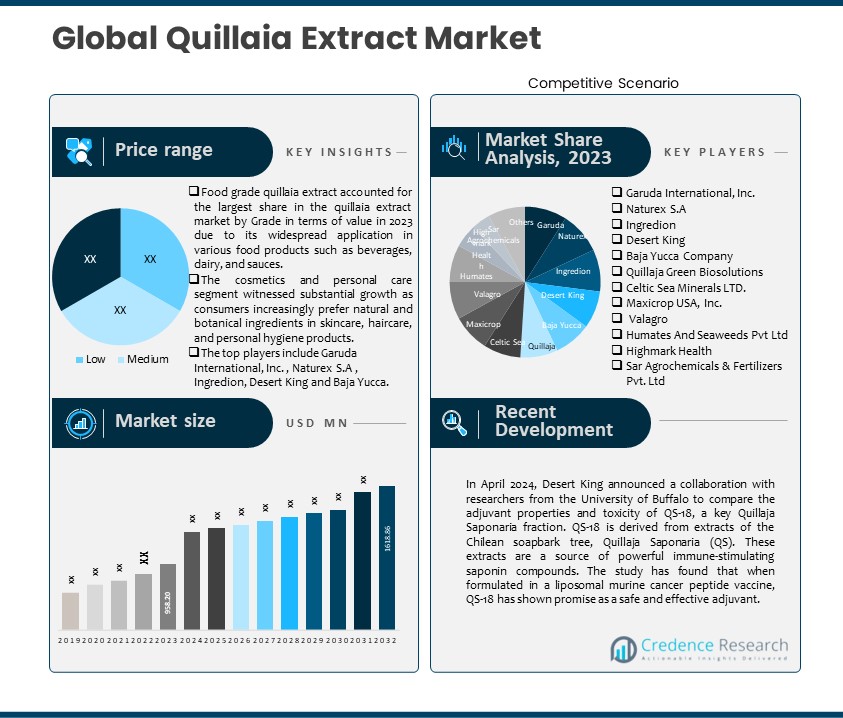
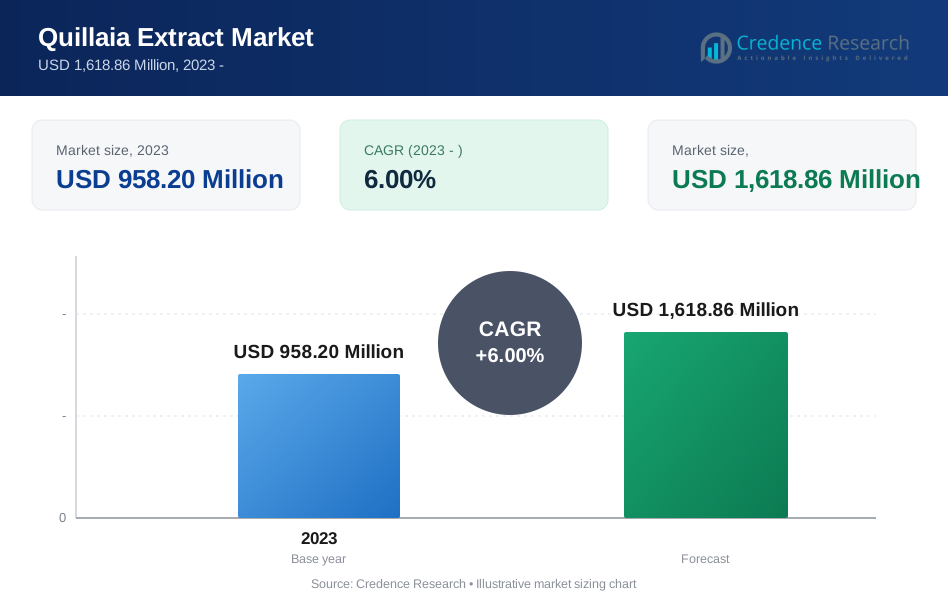
- The global demand for Quillaia Extract was valued at USD 958.20 Million in 2023 and is expected to reach USD 1618.86 Million in 2032, growing at a CAGR of 6.00% between 2024 and 2032.
- The food grade is the market leader by grade type, accounting for a significant portion of total value in 2023, while the pharmaceutical grade segment is expected to grow rapidly throughout the forecast period.
- The food and beverages segment dominates the global need by application type, accounting for a significant portion in 2023. The cosmetics and personal care segment is predicted to expand at a high CAGR.
- Over the projection period, the powder quillaia extract is expected to expand at the highest rate, while the liquid quillaia extract dominates the market in 2023 with a substantial share.
- The food and Beverage Industry segment boasts the dominant portion, with a substantial market share in 2023, while the Cosmetics and Personal Care Industry segment is expected to grow at the highest rate.
- North America will dominate the quillaia extract industry, with a substantial share in 2023, while Asia Pacific is expected to grow at the highest rate during the forecast period.
- The market's primary possibilities include advancements in extraction technologies that enhance the efficiency and sustainability of quillaia extract production by improving yield and quality.
Executive Summary
Market Definition
Quillaia extract is a natural botanical extract derived from the inner bark of the Quillaja saponaria tree, native to South America. It is characterized by its high content of saponins, which are surface-active compounds with emulsifying, foaming, and stabilizing properties. Quillaia extract is widely utilized in various industries, including food and beverages, cosmetics, pharmaceuticals, and agriculture, due to its ability to enhance texture, improve product stability, and create foaming properties. As a versatile natural ingredient, Quillaia extract serves as an alternative to synthetic additives, catering to consumer preferences for clean-label and natural products.
Market Overview
The global Quillaia Extract Market has witnessed steady growth in recent years and is expected to grow at a CAGR of 6.00% between 2024 and 2032. The market was valued at USD 958.20 million in 2023 and is expected to reach USD 1618.86 million in 2032.
The surge in demand for natural ingredients, spurred by consumers' preference for clean-label products within the food and beverage industry is driving the demand for quillaia extracts. Quillaia extracts, known for their role as emulsifiers, foaming agents, and stabilizers, are benefiting from this trend as manufacturers seek natural alternatives to synthetic additives.
Moreover, the overarching shift towards natural and organic products is profoundly shaping market dynamics. Consumers are becoming more discerning, seeking products free from synthetic additives and chemicals. This heightened consumer awareness about health and environmental sustainability is driving the demand for natural ingredients, including Quillaia extracts. Consequently, companies across industries are reformulating their products to align with these consumer preferences, thereby driving market growth.
Additionally, as urbanization continues and disposable incomes rise, there's a parallel increase in the consumption of beauty and personal care products. Quillaia extracts, known for their emulsifying and foaming properties, find applications in various cosmetic formulations. Consequently, the growth trajectory of the cosmetics industry contributes to the expanding market for Quillaia extracts. Furthermore, quillaia extracts find applications in pharmaceutical formulations such as cough syrups and oral medications. As the pharmaceutical industry continues to innovate and expand, the demand for Quillaia extracts is expected to grow further, especially with increasing emphasis on natural and plant-based remedies.
Segmentation by Grade
- Food grade is the leading segment by grade type and will hold a substantial share in 2023 owing to its range of functional benefits, such as emulsification, foaming, and stabilization, which make it versatile in food and beverage formulations.
- The pharmaceutical grade segment is expected to exhibit a significant CAGR during the forecast period owing to the therapeutic benefits of Quillaia extracts, including their immunomodulatory and adjuvant properties, which could lead to the development of new pharmaceutical products and treatments.
- The industrial grade significantly contributes to the market growth.
Segmentation by Application
- The food and beverages segment boasts the dominating position in the Quillaia Extract industry, holding a massive share in 2023. This is attributed to their applications in various products, including beverages, dairy products, confectionery, sauces, dressings, and processed meats. The versatility of Quillaia extracts in enhancing texture, stability, and sensory attributes makes them indispensable ingredients in food and beverage formulations.
- The cosmetics and personal care segment is expected to grow with the highest CAGR during the projected period due to rising consumer preference for natural and clean beauty products globally.
- The Other applications, including pharmaceuticals, agricultural and industrial, further contribute significantly to the growth of the market.
Segmentation by Form
- The liquid quillaia extract boasts the dominating position in the quillaia extract industry, holding a massive share in 2023. Liquid quillaia extract provides uniform dispersion and homogeneity throughout formulations, ensuring consistent product quality and performance. This uniformity is crucial in applications where precise dosing and distribution of Quillaia extract are required to achieve desired product attributes.
- Powder quillaia extract is expected to grow at the highest rate due to its longer shelf life compared to liquid forms, making it a preferred choice for manufacturers concerned with product stability and storage requirements. The powder form helps preserve the extract's quality and efficacy over an extended period, reducing the risk of degradation and ensuring consistent product performance.
Segmentation by End-Use Industry
- The cosmetics and personal care industry is expected to post the highest CAGR during the forecast period. This is primarily due to their versatility, which allows manufacturers to improve product texture, performance, and sensory attributes, enhancing the overall quality of cosmetic and personal care offerings.
- The food and beverage industry is leading the market share with a significant share in 2023. This is attributed to the growing consumer preference for natural and clean-label ingredients in food and beverages.
- The pharmaceutical industry and the agriculture and agrochemical industry also contributes to the growth of the market
Segmentation by Region
- North America is fueling the growth of the quillaia extract industry with a massive share in 2023 due to the region's growing consumer preferences for natural and clean-label ingredients in food products.
- Asia Pacific market is expected to grow at the highest rate during the forecasted period.
- The rest of the world, including Latin America, the Middle East, and Africa, supplies the remaining demand for the quillaia extract industry.
North America stands as the predominant market for quillaia extracts, driven by growing consumer preferences for specific food products. This leadership is further bolstered by a strong correlation between the specialty food ingredient sector and the processed food market, emphasizing functional benefits and tailored value addition for end-user applications. Notably, American consumers exhibit a discerning awareness of label claims, ingredient lists, and nutritional profiles, with health considerations as an important factor in purchasing decisions. This is evidenced by a 2022 report from The Food Industry Association (FMI) indicating that six in 10 U.S. food shoppers prioritize health benefits. Moreover, the source of ingredients significantly influences consumer choices, with dietary claims shaping about 56% of consumers' preferences.
Moreover, a proactive pursuit of health and fitness in daily life propels demand for specialty food ingredients and functional food and beverages, including Quillaia extracts. The U.S. functional food/drink sales reached USD 83 billion in 2021, marking a 6.8% increase from 2020, as reported by The Food Industry Association (FMI). The market also witnesses the proliferation of products offering distinct organoleptic traits and cleaner ingredient profiles, with categories such as plant-based, vegetarian, gluten-free, non-GMO, and convenient foods experiencing substantial penetration. This surge in product innovation within the food and beverage sector drives heightened utilization of specialty ingredients, including Quillaia extracts, which contribute to health and nutrition.
Furthermore, the growing pharmaceutical industry in the U.S. highlights the demand for Quillaia extract, with North America commanding a significant share of global pharmaceutical sales. As indicated by the European Federation of Pharmaceutical Industries and Association, North America represented 49.1% of worldwide pharmaceutical sales in 2021, with the U.S. accounting for 64.4% of new medicine sales launched between 2016 and 2021, highlighting the region's pivotal role in driving demand for Quillaia extracts.
On the other hand, the robust expansion of the cosmetics market in the Asia-Pacific region, propelled by the burgeoning middle class and increasing disposable incomes among consumers, serves as a pivotal driver of the Quillaia extracts market growth in the region. As the Asia-Pacific region ascends to market leader in the global cosmetics industry, fueled by escalating consumption of beauty products, particularly in nations such as South Korea, China, Japan, Indonesia, Malaysia, and Thailand, the demand for ingredients such as Quillaia extracts experiences a pronounced surge. As per McKinsey's analysis, North Asia commands the largest share of the beauty and personal care products market, comprising over one-third of the market in 2021, with China emerging as a dominant player in the region. This burgeoning cosmetics sector offers lucrative prospects for Quillaia extract suppliers, given their diverse applications in cosmetic formulations, owing to their emulsifying and foaming properties.
Furthermore, beyond the cosmetics sphere, the escalating demand for Quillaia extracts in the agricultural and agrochemicals industry augments market growth in the Asia-Pacific region, underscoring the broad applications and burgeoning opportunities for Quillaia extracts across varied industries in the region.
Key Highlights of the Report
The global quillaia extract market is segmented by grade, application, form, end-use industry, and region. Food grade is the most popular segment, while Liquid Quillaia Extract is the primary segment in form. In addition, the Food and Beverage Industry is the most demanding end-user industry, with the North America region leading the market growth.
The main factors propelling the global market for quillaia extract is the increasing demand across various industries such as food, cosmetics, and pharmaceuticals, owing to its natural properties and versatility in enhancing product quality. Additionally, consumer preferences for clean-label and natural products are driving the adoption of Quillaia extracts. The expansion of industries, including cosmetics and personal care, coupled with the rising demand for organic alternatives, further contributes to market growth.
Nonetheless, North America is anticipated to have the greatest share of the worldwide Quillaia Extract Market due to the region's growing consumer preferences for natural and clean label ingredients in food products. Furthermore, the market is anticipated to expand at the highest rate in the Asia-Pacific region due to the expansion of the cosmetics market in the Asia-Pacific region, propelled by the burgeoning middle class and increasing disposable incomes among consumers.
What Are the Main Drivers of the Global Quillaia Extract Market?
The quillaia extract market is propelled by its increasing demand across various industries such as food, cosmetics, and pharmaceuticals, owing to its natural properties and versatility in enhancing product quality. Additionally, consumer preferences for clean-label and natural products are driving the adoption of quillaia extracts. The expansion of industries, including cosmetics and personal care, coupled with the rising demand for organic alternatives, further contributes to market growth. Technological advancements in production processes have led to higher efficiency and cost-effectiveness, making Quillaia extracts more accessible to a wider range of industries.
What Are the Major Challenges Faced by the Global Quillaia Extract Market?
The limited availability and harvesting constraints of Quillaja Saponaria trees, the primary source of Quillaia extracts, contribute to price volatility, thus posing challenges to market growth. As these trees are primarily concentrated in specific regions of South America, any disruptions or fluctuations in harvesting practices directly impact Quillaia extract availability. Consequently, the market encounters uncertainties in its supply chain, leading to price fluctuations.
What Are the Growth Opportunities in the Global Quillaia Extract Market?
Ongoing advancements in extraction technologies are enhancing the efficiency and sustainability of Quillaia extract production. Innovative extraction methods not only improve yield and quality but also reduce production costs and environmental impact. As extraction processes become more efficient and scalable, it opens up opportunities for market expansion and diversification of product offerings.
Market Drivers
The global Quillaia Extract Market is driven by several factors. The following are the key drivers of the global Quillaia Extract market:
Increasing Demand for Clean-Label and Natural Ingredients in Various Industries
The growing demand for Quillaia extracts across various industries, particularly in the food and beverage sector, is a significant driver of the market's growth. With its widespread use as emulsifiers, foaming agents, and stabilizers, Quillaia extracts cater to the increasing demand for natural ingredients in food products, aligning with the rising popularity of functional foods and clean-label products. According to the Institute of Food Technologists, global sales of functional foods reached USD 292 billion in 2021, indicating a growing market for products enriched with natural additives including Quillaia extracts. Moreover, Quillaia extracts' traditional use in the pharmaceutical industry for their medicinal properties, particularly in formulations such as cough syrups and oral medications, further fuels their demand in this sector, contributing to the overall growth of the global Quillaia Extracts Market.
Furthermore, the ongoing trend of urbanization, coupled with rising disposable incomes, is driving an increased consumption of beauty and personal care products. Quillaia extracts, valued for their emulsifying and foaming properties, are being incorporated into various cosmetic formulations. Their role in enhancing product texture, stability, and performance aligns with the evolving preferences of consumers seeking high-quality and natural ingredients in their beauty products. As a result, the growth trend of the cosmetics industry significantly contributes to the expanding market for Quillaia extracts.
Market Restraints
The global Quillaia Extract Market faces some challenges that may hinder its growth. These include the following:
Limited Availability and Harvesting Challenges
Limited availability and harvesting challenges of quillaja saponaria trees, the primary source of quillaia extracts, contribute to price volatility, restraining the growth of the market. With these trees predominantly found in specific regions of South America, any disruptions or fluctuations in harvesting practices can directly impact the availability of Quillaia extracts. As a result, the market faces uncertainties in the supply chain, leading to price volatility. Instances of limited availability due to harvesting challenges can drive prices upwards, affecting the profitability of market players and potentially deterring potential buyers. This instability in pricing poses a significant challenge for both producers and consumers, hindering the market's growth prospects.
Opportunities
The global Quillaia Extract Market presents lucrative opportunities for growth. These include the following:
Technological Advancements in Extraction Processes
The advancement of extraction technologies, such as the novel ultrasound-assisted enzymatic extraction (UAEE) method, presents a significant opportunity for the Quillaia extracts market's future growth. This innovative approach enhances the efficiency and sustainability of Quillaia extract production by improving yield and quality while reducing production costs and environmental impact. For example, recent studies utilizing UAEE have demonstrated remarkable improvements in QS-21 yield, surpassing conventional extraction methods such as UAE and EAE. With the establishment of optimal extraction conditions through sophisticated experimental designs such as the Plackett-Burman and Central Composite designs, UAEE showcases its potential to revolutionize Quillaia extract production. As extraction processes continue to evolve, becoming more efficient and scalable, they create avenues for market expansion and the diversification of product offerings, driving the Quillaia extracts market towards a promising future.
Competitive Landscape
Key Players
The global Quillaia Extract Market is highly competitive, with several key players. Some of the major players in the market and their market share are as follows:
- Garuda International, Inc.
- Naturex S.A
- Ingredion
- Desert King
- Baja Yucca Company
- Quillaja Green Biosolutions
- Celtic Sea Minerals LTD.
- Maxicrop USA, Inc.
- Valagro
- Humates And Seaweeds Pvt Ltd
- Highmark Health
- Sar Agrochemicals & Fertilizers Pvt. Ltd
- Others
These organizations prioritize product innovation to stay competitive.
The global Quillaia Extract market's key players continually seek to stay ahead by offering new products and developments.
In April 2024, Desert King announced a collaboration with researchers from the University of Buffalo to compare the adjuvant properties and toxicity of QS-18, a key Quillaja Saponaria fraction. QS-18 is derived from extracts of the Chilean soapbark tree, Quillaja Saponaria (QS). These extracts are a source of powerful immune-stimulating saponin compounds. The study has found that when formulated in a liposomal murine cancer peptide vaccine, QS-18 was verified as a safe and effective adjuvant.
In October 2023, Valagro merged with Syngenta Group, leveraging the resources of Syngenta Crop Protection to accelerate innovation and growth. This strategic alliance has the potential to impact the Quillaia extracts market positively, especially in the agricultural sector. By harnessing the collective expertise and capabilities of both companies, the merged entity aims to pioneer advancements in the utilization of natural plant extracts including Quillaia in agricultural applications.
How Companies are Performing in Quillaia Extract Market?
The global Quillaia Extract Market is highly competitive, with several key players.
Startups are becoming increasingly instrumental in shaping the Quillaia extracts market, offering innovative solutions and addressing evolving industry demands. Leveraging advancements in technology and research, these startups are driving efficiency and sustainability in Quillaia extract production processes. Through the development of novel extraction methods and technologies, startups are enhancing both the yield and quality of Quillaia extracts, while concurrently reducing environmental impact. Moreover, startups are diversifying the Quillaia extracts market by introducing a range of innovative products tailored to various industries. These products include concentrated extracts, powdered formulations, and specialized blends optimized for specific applications.
Furthermore, startups are forging strategic partnerships and collaborations to accelerate innovation and market penetration. By collaborating with research institutions, universities, and industry stakeholders, startups gain access to valuable expertise, resources, and market insights. These collaborative efforts facilitate knowledge exchange, technology transfer, and joint research initiatives, driving continuous improvement and growth in the Quillaia extracts market.
Summary of Key Findings
- The demand for quillaia extract is increasing due to the increasing demand across various industries such as food, cosmetics, and pharmaceuticals, owing to its natural properties and versatility in enhancing product quality. Additionally, consumer preferences for clean-label and natural products are driving the adoption of Quillaia extracts.
- Market segmented by grade, application, form, end-use industry, and region.
- Food grade is the leading segment by grade type owing to its range of functional benefits, such as emulsification, foaming, and stabilization, which make it versatile in food and beverage formulations.
- The liquid quillaia extract boasts the dominating position in the quillaia extract industry. It provides uniform dispersion and homogeneity throughout formulations, ensuring consistent product quality and performance. This uniformity is crucial in applications where precise dosing and distribution of quillaia extract are required to achieve desired product attributes.
- North America is leading market growth; the market is highly competitive with key players including Garuda International, Inc., Naturex S.A, Ingredion., Desert King, Baja Yucca Company, Quillaja Green Biosolutions, Celtic Sea Minerals LTD., Maxicrop USA, Inc., Valagro, Humates and Seaweeds Pvt Ltd, Highmark Health, Sar Agrochemicals & Fertilizers Pvt. Ltd, Others.
Future Outlook
- Positive outlook for the global quillaia extract market with significant growth potential in the Asia Pacific region.
- One of the main factors promoting the market's expansion is growing demand for natural ingredients, spurred by consumers' preference for clean-label products.
- During the forecast period, limited availability and harvesting constraints of Quillaja saponaria trees, the primary source of quillaia extracts, contribute to price volatility, which is expected to act as significant factors restraining the growth of the quillaia extract market
- To stay competitive, key firms in the Quillaia Extract Market should prioritize advancements in extraction technologies.
How CXOs Can Benefit from the Credence Research Quillaia Extract Market Report
The Credence Research Quillaia Extract Market Report provides CXOs with a comprehensive overview of the market, including:
- Market size and growth forecast:The report provides detailed estimates of the global quillaia extract market size, segmented by grade, application, form, end-use industry, and region. It also includes forecasts for the market through 2032 based on key trends and drivers.
- Market segmentation:The report segments the quillaia extract market by grade, application, form, end-use industry, and region. This segmentation provides CXOs with a granular understanding of the market and the opportunities in each segment.
- Competitive Landscape:The report profiles the key players in the Quillaia Extract Market and provides insights into their strategies, product offerings, and financial performance. This information can help CXOs to identify and assess their competition.
- Key trends and drivers:The report identifies and analyses the key trends and drivers shaping the Quillaia Extract Market. This information can help CXOs make informed decisions about their investments and strategies.
CXOs can use the insights from the Credence Research Quillaia Extract Market Report to:
- Identify growth opportunities:The report can help CXOs to identify new growth opportunities in the quillaia extract market. For example, the report identifies the growing demand for quillaia extracts from emerging markets such as China and India, where there's an increasing interest in natural ingredients for various industries.
- Make informed investment decisions:The report can help CXOs make informed investment decisions about quillaia extract. For example, it provides insights into the key factors to consider when evaluating and selecting quillaia extract providers.
- Develop competitive strategies:The report can help CXOs develop competitive strategies for their quillaia extract businesses. For example, the report identifies the key strategies that quillaia extract providers are using to differentiate themselves from their competitors.
- Track market developments:The report can help CXOs monitor market developments and stay ahead of the curve. For example, it provides insights into the latest trends and innovations in the Quillaia Extract Market.
Overall, the Credence Research Quillaia Extract Market Report is a valuable resource for CXOs who are looking to gain a deeper understanding of the market and identify opportunities for growth.
Segmentation
- By Grade
- Food Grade
- Pharmaceutical Grade
- Industrial Grade
- By Application
- Food and Beverages
- Pharmaceuticals
- Cosmetics and Personal Care
- Agriculture
- Industrial Applications
- By Form
- Liquid Quillaia Extract
- Powder Quillaia Extract
- By End-Use Industry
- Food and Beverage Industry
- Pharmaceutical Industry
- Cosmetics and Personal Care Industry
- Agriculture and Agrochemical Industry
- By Region
- North America
- The U.S.
- Canada
- Mexico
- Europe
- Germany
- France
- The U.K.
- Italy
- Spain
- Rest of Europe
- Asia Pacific
- China
- Japan
- India
- South Korea
- South-east Asia
- Rest of Asia Pacific
- Latin America
- Brazil
- Argentina
- Rest of Latin America
- Middle East & Africa
- GCC Countries
- South Africa
- Rest of the Middle East and Africa
- North America
Adjacent Markets
In the Quillaia Extract Market, several adjacent markets have high revenue growth opportunities. The key adjacent markets for Quillaia Extract Market -
Adjacent Markets |
||
| Botanicals Market | Yucca Extract Market | Natural Ingredients Market |
| Flavoring Agents Market | Foaming Agents Market | Pharmaceutical Market |
| Emulsifying Agents Market | Agriculture Market | Personal Care & Cosmetics Market |
Request a Free Sample
Fill in your details and we'll send you a free sample report.
- Sample data tables & charts
- Research methodology
Need a Custom Version of This Report?
Tailor the scope, geography, or segments to your exact requirements.
- Custom geography or segment scope
- Direct access to our analyst team
Frequently Asked Questions
What is the current size of the global quillaia extract market?
What is the expected growth rate of the quillaia extract market between 2024 and 2032?
Which segment is leading the market share in terms of grade?
Which segment is leading the market share in terms of form?
Who are the major players in the global Quillaia Extract Market?
Table of Content
Chapter 1. Report Introduction
- 1.1 Report Description & Purpose
- 1.1.1 Report Title & Market Definition
- 1.1.2 Unique Selling Propositions (USP) & Key Differentiators
- 1.1.3 Value Proposition for Stakeholders
- 1.2 Research Objectives
- 1.2.1 Market Sizing Objectives (Volume & Revenue)
- 1.2.2 Segmentation Objectives
- 1.2.3 Competitive Intelligence Objectives
- 1.2.4 Forecast & Scenario Objectives
- 1.3 Report Scope
- 1.3.1 Quillaia Extract Scope – Types & Subtypes Covered
- 1.3.2 Geographic Scope – Regions & Countries Covered
- 1.3.3 Historical Period, Base Year & Forecast Period (2023; forecast to the forecast period)
- 1.3.4 Inclusions & Exclusions
- 1.4 HS Code & Classification Framework
- 1.5 Currency, Units & Pricing Basis
- 1.6 Target Stakeholders
- 1.7 Limitations & Assumptions
Chapter 2. Executive Summary
- 2.1 Global Quillaia Extract Market Snapshot
- 2.1.1 Market Size – Historical (2023) & Forecast (the forecast period) (2023: USD 958.20 Million → forecast year: USD 1,618.86 Million)
- 2.1.2 Volume & Revenue – Global Totals
- 2.1.3 Key Market Highlights – Top Five Facts
- 2.2 Quillaia Extract Market Segmentation Snapshot
- 2.2.1 Market Split by Region – 2023 vs.
- 2.3 Competitive Snapshot
- 2.3.1 Top 10 Players by Revenue Share – 2023
- 2.3.2 Top 10 Players by Volume Share – 2023
- 2.3.3 Recent Strategic Developments (18-Month Summary)
- 2.4 Key Investment Highlights & Strategic Conclusions
Chapter 3. Quillaia Extract Market Dynamics & Industry Analysis
- 3.1 Market Overview & Context
- 3.1.1 Quillaia Extract Market Position in the Broader Automotive Value Chain
- 3.1.2 OEM vs. Replacement Market Dynamics
- 3.1.3 Market Maturity & Development Stage by Region
- 3.2 Quillaia Extract Market Drivers
- 3.3 Quillaia Extract Market Restraints & Challenges
- 3.4 Quillaia Extract Market Opportunities
- 3.5 Porter's Five Forces Analysis
- 3.5.1 Threat of New Entrants
- 3.5.2 Bargaining Power of Suppliers
- 3.5.3 Bargaining Power of Buyers
- 3.5.4 Threat of Substitutes
- 3.5.5 Competitive Rivalry – Intensity Assessment
- 3.6 Quillaia Extract Value Chain Analysis
- 3.6.1 Upstream – Raw Material/Input Suppliers
- 3.6.1.1 Raw Material/Input 1
- 3.6.1.2 Raw Material/Input 2
- 3.6.1.3 Raw Material/Input 3
- 3.6.2 Midstream – Production/Manufacturing/Service Delivery
- 3.6.2.1 Production/Process Overview
- 3.6.2.2 Key Facility Locations & Capacity by Manufacturer
- 3.6.3 Downstream – Distribution & End Consumer
- 3.6.3.1 Primary Channel – B2B/OEM
- 3.6.3.2 Secondary Channels – Dealer, Retail, Online, Direct
- 3.6.4 Value Chain Profitability Analysis
- 3.6.1 Upstream – Raw Material/Input Suppliers
- 3.7 PESTEL Analysis
- 3.7.1 Political Factors
- 3.7.2 Economic Factors
- 3.7.3 Social Factors
- 3.7.4 Technological Factors
- 3.7.5 Environmental Factors
- 3.7.6 Legal Factors
- 3.8 Quillaia Extract Supply Chain Analysis
- 3.8.1 Raw Material/Input Supply Risk Assessment
- 3.8.2 Manufacturing Concentration Risk (Geographic Exposure)
- 3.8.3 Trade Disruption Impact Analysis
- 3.9 Regulatory & Policy Landscape
Note: The regulatory and policy landscape section covers regulations based on their applicability to the market, Quillaia Extract category, geography, and scope of the study. Only regulatory frameworks with a material impact on operations, compliance, trade, sustainability, or market access are analyzed in detail.
Chapter 4. Key Investment Pockets & Opportunity Analysis
- 4.1 Quillaia Extract Market Attractiveness Analysis
- 4.1.1 By Region – Investment Attractiveness Matrix (Volume × CAGR)
- 4.2 Absolute Revenue Growth Opportunity
- 4.2.1 By Region – Absolute USD Growth Through the forecast period
- 4.3 Incremental Volume Opportunity
- 4.3.1 By Region – Incremental Volume Through the forecast period
- 4.3.2 Segment – Incremental Volume
- 4.4 Emerging Submarket Opportunity Deep Dive (Subject to Applicability)
- 4.5 Emerging Market Opportunity Scorecards
- 4.5.1 United States
- 4.5.2 Europe
- 4.5.3 Asia
- 4.5.4 Middle East & Africa
Note: Emerging Market Opportunity Scorecards will be included based on relevance and strategic importance. Regions listed are indicative and may vary depending on data availability and market dynamics.
Chapter 5. Quillaia Extract Import-Export Analysis & Trade Flows
- 5.1 Global Trade Overview
- 5.1.1 Global Export Value by Country (2023)
- 5.1.2 Global Export Volume by Country (2023)
- 5.1.3 Global Import Value by Country (2023)
- 5.1.4 Global Import Volume by Country (2023)
- 5.1.5 Net Trade Balance by Country (2023)
- 5.2 Export Analysis – Segment
- 5.2.1 Type 1 (HS Code)
- 5.2.2 Type 2 (HS Code)
- 5.2.3 Type 3 (HS Code)
- 5.2.4 Type 4 (HS Code)
- 5.2.5 Type 5 (HS Code)
- 5.3 Import Analysis – Segment
- 5.3.1 Type 1 (HS Code)
- 5.3.2 Type 2 (HS Code)
- 5.3.3 Type 3 (HS Code)
- 5.3.4 Type 4 (HS Code)
- 5.3.5 Type 5 (HS Code)
- 5.4 Average Unit Trade Prices
- 5.4.1 Average Export Price – Segment & Country
- 5.4.2 Average Import Price – Segment & Source Country
- 5.4.3 Price Trends (2023)
- 5.5 Key Trade Route Analysis
- 5.5.1 Trade Route 1
- 5.5.2 Trade Route 2
- 5.5.3 Trade Route 3
- 5.5.4 Trade Route 4
- 5.5.5 Trade Route 5
- 5.6 Trade Policy Impact Assessment
- 5.6.1 US Anti-Dumping & Section 301 Tariffs
- 5.6.2 EU Customs Union Impact
- 5.6.3 Major Free Trade Agreements
- 5.6.4 USMCA Rules of Origin
Note: Trade policy analysis will be included only where relevant to the Quillaia Extract market.
Chapter 6. Competitive Landscape & Company Benchmarking
- 6.1 Quillaia Extract Market Concentration & Structure
- 6.1.1 Herfindahl-Hirschman Index (HHI) – vs. 2023
- 6.1.2 Tier 1, Tier 2 & Tier 3 Market Structure
- 6.1.3 Global, Regional & Local Player Dynamics
- 6.2 Quillaia Extract Market Share Analysis – 2023
- 6.2.1 Global Revenue Share by Company
- 6.2.2 Global Volume Share by Company
- 6.2.3 Regional Revenue Share
- 6.2.4 Market Share Evolution ( vs. 2023)
- 6.2.5 OEM Segment Share by Company
- 6.2.6 Replacement Segment Share by Company
- 6.3 Production/Delivery Capacity & Facility Analysis
- 6.3.1 Global Installed Capacity
- 6.3.2 Capacity Utilization Rates
- 6.3.3 Production/Output Volume
- 6.3.4 Facility Locations & Capacity Map
- 6.3.5 Planned Capacity Additions
- 6.4 Quillaia Extract Competitive Benchmarking Matrix
- 6.4.1 Revenue, Volume, CAGR & Profitability Comparison
- 6.4.2 Channel Revenue Mix
- 6.4.3 Geographic Revenue Exposure
- 6.4.4 R&D Intensity
- 6.4.5 Sustainability Maturity
- 6.5 Strategic Developments in Quillaia Extract (Last 24 Months)
- 6.5.1 Mergers, Acquisitions & Divestments
- 6.5.2 New Quillaia Extract Launches
- 6.5.3 Facility Expansions
- 6.5.4 Strategic Alliances, Joint Ventures & Partnerships
- 6.5.5 Distribution Expansion & Market Entry
- 6.5.6 Sustainability & ESG Initiatives
- 6.6 Competitive Strategy Mapping
- 6.6.1 Leader, Challenger, Follower & Niche Classification
- 6.6.2 Pricing Strategy Comparison
- 6.6.3 Channel Strategy Matrix
Note: Strategic developments are included based on their materiality and the availability of reliable information.
Chapter 7. Global Quillaia Extract Market – By Distribution Channel
- 7.1 Segment Overview
- 7.1.1 Volume & Revenue Split by Channel (2023 & )
- 7.1.2 Channel Mix Evolution (the forecast period)
Chapter 8. Regional Market Analysis – Global Overview
- 8.1 Global Regional Overview
- 8.1.1 Regional Volume Share
- 8.1.2 Regional Revenue Share
- 8.1.3 Regional Volume by Region
- 8.1.4 Regional Revenue by Region
- 8.1.5 Regional Forecast Through the forecast period
- 8.2 Cross-Regional Segment Analysis
- 8.2.1 By Distribution Channel
- 8.2.2 By Brand/Price Tier
Chapter 9. North America Quillaia Extract Market
- 9.1 United States
- 9.2 Canada
- 9.3 Mexico
Chapter 10. Europe Quillaia Extract Market
- 10.1 Germany
- 10.2 France
- 10.3 Italy
- 10.4 United Kingdom
- 10.5 Spain
- 10.6 Poland
- 10.7 Russia
- 10.8 Netherlands
- 10.9 Belgium
- 10.10 Sweden
- 10.11 Denmark
- 10.12 Norway
- 10.13 Rest of Europe
Chapter 11. Asia Pacific Quillaia Extract Market
- 11.1 China
- 11.2 India
- 11.3 Japan
- 11.4 South Korea
- 11.5 Thailand
- 11.6 Indonesia
- 11.7 Vietnam
- 11.8 Malaysia
- 11.9 Australia
- 11.10 Rest of Asia Pacific
Chapter 12. Latin America Quillaia Extract Market
- 12.1 Brazil
- 12.2 Argentina
- 12.3 Colombia
- 12.4 Chile
- 12.5 Rest of Latin America
Chapter 13. Middle East Quillaia Extract Market
- 13.1 Saudi Arabia
- 13.2 United Arab Emirates
- 13.3 Turkey
- 13.4 Israel
- 13.5 Iran
- 13.6 Rest of the Middle East
Chapter 14. Africa Quillaia Extract Market
- 14.1 South Africa
- 14.2 Egypt
- 14.3 Nigeria
- 14.4 Morocco
- 14.5 Rest of Africa
Chapter 15. Quillaia Extract Company Profiles
- 15.1 [Company 01]
- 15.1.1 Company Overview
- 15.1.2 Key Management Personnel
- 15.1.3 Products & Services Portfolio
- 15.1.4 Financial Performance
- 15.1.5 Key Market Focus & Geographic Presence
- 15.1.6 Recent Developments & Strategic Initiatives
Note: The company profile list is preliminary and may change based on research findings, market developments, data availability, and client requirements.
Chapter 16. Appendices
- Appendix A – List of Abbreviations & Acronyms
- Appendix B – Industry Classification Code Reference – Full Series
- Appendix C – Production & Capacity Data Tables
- Appendix D – End-Use & Demand Base Tables
- Appendix E – Consumption & Replacement Rate Assumptions
- Appendix F – ASP Reference Tables
- Appendix G – Manufacturing & Facility Database
- Appendix H – Import-Export Data Tables
- Appendix I – Regulatory Summary Tables
- Appendix J – Primary Research Participant List (Anonymized)
- Appendix K – Primary Research Questionnaire Framework
- Appendix L – Data Sources & Bibliography
- Appendix M – Market Size Divergence & Source Comparison
Chapter 17. Research Methodology
- 17.1 Research Framework & Philosophy
- 17.2 Secondary Research – Sources, Hierarchy & Data Extraction
- 17.3 Data Modeling – Bottom-Up & Top-Down Market Sizing
- 17.4 Primary Research – Stakeholder Framework, LOI & Sample Sizes
- 17.5 Forecast Methodology – Regression, Scenario & Sensitivity Analysis
- 17.6 Quality Control – Four-Layer Validation Framework
- 17.7 Limitations & Standard Assumptions
- 17.8 Disclaimer
