| REPORT ATTRIBUTE | DETAILS |
|---|---|
| Historical Period | 2019-2022 |
| Base Year | 2023 |
| Forecast Period | 2024-2032 |
| Processed Meat Market Size 2023 | USD 615842.2 Million |
| Processed Meat Market, CAGR | 5.00% |
| Processed Meat Market Size 2032 | USD 955373.3 Million |
Market Insights
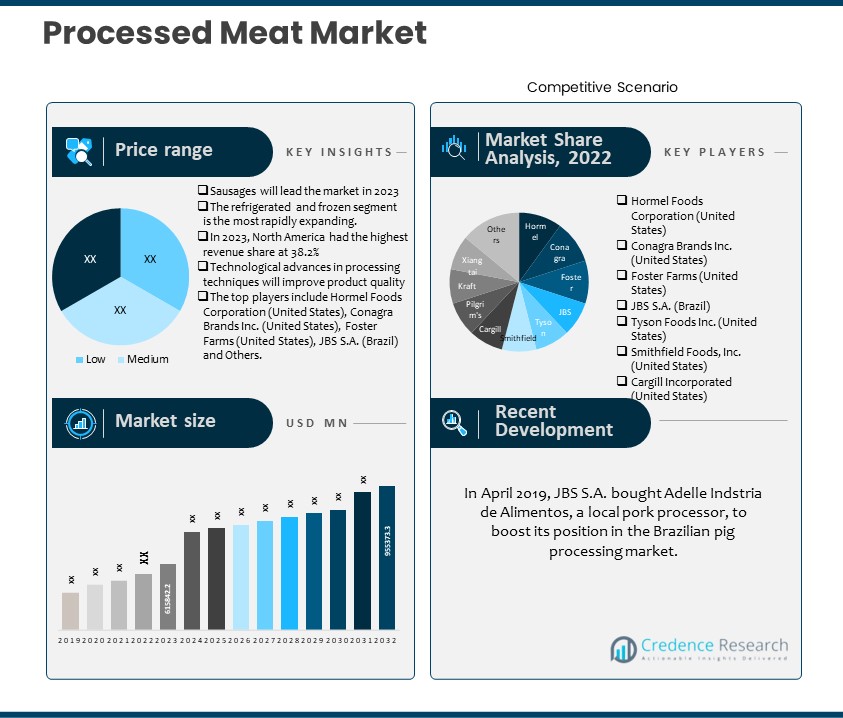
- The global demand for Processed Meat was valued at USD 615842.2 Million in 2023 and is expected to reach USD 955373.3 Million in 2032, growing at a CAGR of 5.00% between 2024 and 2032.
- Sausages will lead the market in 2023, with canned meat having the greatest CAGR and ham and bacon being the second most significant component.
- In 2023, poultry dominated the processed meat business, while the beef segment is expected to grow at a 4.1% CAGR during the projected period.
- Cooking and heat treatment are key categories, while fermentation is a major shareholder in the processed meat business.
- The refrigerated and frozen segments are the fastest growing.
- North America had the largest revenue share in 2023 at 38.2%, and the Asia Pacific Processed Meat Market is expected to grow at the fastest CAGR throughout the forecast period.
- Rising demand for processed food products propels the growth of the processed meat industry.
- The carcinogenic dangers associated with processed meat are limiting market expansion.
Executive Summary
Market Definition
Processed meat is described as meat that has been treated with additives and preservatives such as acidifiers, minerals, salts, and a range of other seasoning and flavoring agents. The meat is prepared primarily to increase its quality, prevent degeneration, and enhance its natural flavor profile. Red or white flesh from brutes, pullets, heifers, or sea creatures may be employed.
Market Overview
The global Processed Meat Market has witnessed steady growth in recent years and is expected to grow at a CAGR of 5.00% between 2024 and 2032. The market was valued at USD 615842.2 million in 2023 and is expected to reach USD 955373.3 million in 2032.
Meat is called processed when it is preserved by smoking, salting, fermenting, or adding any chemical to increase its shelf life and flavor. Meats such as beef, hog, turkey, chicken, and lamb are frequently utilized to make processed meat. Pepperoni, jerky, hot dogs, and sausages are all processed meat items. Preservatives are given to meat to keep it from rotting due to bacteria and other microorganisms.
The rapid proliferation of fast-food restaurants like KFC, McDonald's, Subway, Burger King, and Taco Bell has substantially impacted processed meat consumption. Furthermore, the discounts and economical meal packages offered by these fast-food chains helped drive global expansion in the processed meat business. According to the United States Centers for Disease Control and Prevention, around 37% of the American population eats fast food on a daily basis. As a result, higher consumption of processed beef in developed regions has historically boosted market growth.
Consumers' busy lifestyles, as the number of jobs has increased, have increased consumption of ready-to-cook and ready-to-eat food. Ready-to-eat foods are in high demand due to their convenience and time savings. This is an important factor driving the expansion of the global processed meat market.
Segmentation By Product Type
- Sausages dominate the market in 2023. Due to their versatility, convenience, and diverse flavors and types, sausages are a popular choice among consumers around the world. They are widely consumed as independent items, utilized in cooking, or incorporated into a variety of cuisines, making them a processed meat industry staple.
- Canned meat utilization is increasing at a moderate CAGR due to its perceived lower nutritional value when compared to frozen and fresh meat. Canning meat is produced at a low cost, making it both economical and convenient.
- However, ham and bacon are the second most important section of the processed meat business.
Segmentation By Meat Type
- In 2023, poultry dominated the processed meat industry, accounting for 42.4%. Processed poultry meat is composed of poultry meat that has been processed and treated to lengthen its shelf life and improve its flavor. Any essence that is not ancient is classified as processed. Processed Meat is commonly associated with pig and cow, although it also contains poultry (chicken, turkey, and duck) and fish. Sausages, hot dogs, corned beef, beef jerky, canned meat, meat sauces, and bacon are examples of these.
- However, the beef segment is predicted to rise at a 4.1% CAGR throughout the forecast period. Beef jerky, like bacon, sausage, and hot dogs, is a form of processed red meat.
Segmentation by Processing Method
- Cooking and heat treatment is a prominent category since it is commonly used in the preparation of various meat products such as sausages, hot dogs, and deli meats. Cooking and heat treatment are important in guaranteeing food safety since they eliminate hazardous bacteria and pathogens while also improving the flavor and texture of meat.
- On the other hand, Fermentation is a major shareholder in the processed meat market. Fermentation is a classic method for imparting distinct tastes and extending the shelf life of processed meat products such as salami and pepperoni.
Segmentation By Packaging and Distribution
- The refrigerated and frozen segment is the fastest expanding. This is due to the growing demand for meat products that can be kept in the refrigerator or freezer for extended periods. Consumers are lured to the freshness and convenience of refrigerated and frozen processed meat products, resulting in strong market expansion for this segmnet.
Segmentation by Region
- In 2023, North America had the greatest revenue share at 38.2%.
- The Asia Pacific Processed Meat Market is predicted to develop at the quickest CAGR during the forecast period.
- The rest of the world, including Latin America, the Middle East, and Africa, supplies the remaining demand for Processed Meat.
In 2023, North America dominated the processed meat industry, accounting for 38.2%. Restaurants and cafes are increasing their demand for ground beef. The market is growing as the region's demand for ready-to-cook and ready-to-eat foods rises. Consumers in North America, notably in the United States and Canada, have begun to choose meat-based breakfast alternatives, such as bacon, over other morning options, such as pancakes, due to changing palates and a desire to try new products. Because of their hectic lifestyles, customers in the region are increasingly anticipating better taste and higher-quality ready-to-eat and ready-to-cook beef products.
Moreover, The Asia Pacific Processed Meat Market is predicted to develop at the quickest CAGR during the forecast period. Because of the growing popularity of processed meat, Asia-Pacific's processed meat market is predicted to expand significantly. Urbanization and rising disposable incomes have boosted market expansion. The increasing acceptance of Westernized culture also has a substantial impact on regional market growth.
Key Highlights of the Report
Product Type, Meat Type, Processing Method, Packaging and Distribution, and region segment of the global Processed Meat Market. In 2023, poultry dominated the processed meat sector, with canned meat showing the highest CAGR, and fermentation was a key shareholder. Furthermore, the refrigerated and frozen segments are the fastest growing and North America, leading the market growth.
The market's primary drivers are changing customer preferences for convenience and ready-to-eat foods, technological developments in meat processing processes, and increasing urbanization, which leads to an increase in demand for processed meats. However, health concerns about processed meat consumption, stringent food safety and labeling rules, and fluctuating raw material prices affecting production costs are the market's main constraints.
In 2023, North America dominated the processed meat sector. Restaurants and cafes are boosting their demand for ground beef. The market is expanding as the region's demand for ready-to-cook and ready-to-eat foods increases. Furthermore, the Asia Pacific Processed Meat Market is expected to grow at the fastest CAGR over the forecast period.
What Are The Main Drivers Of The Global Processed Meat Market?
Increased disposable income is predicted to be one of the primary drivers of growth in the processed meat industry over the forecast period. Furthermore, an increase in the number of working-class specialists is predicted to help the processed meat market flourish. Furthermore, the reduced time required to cook meat at home as a result of today's hectic lifestyle is predicted to propel the processed meat market forward.
What Are The Major Challenges Faced By The Global Processed Meat Market?
Obesity rates are rising as a result of increased consumption of processed meat-based products, which is projected to limit the growth of the processed meat market throughout the forecast period. High dietary cholesterol levels in red and processed meat have been linked to improper glucose metabolism in the body. Furthermore, synthetic preservatives have been demonstrated to have an adverse effect on the human body. Because customers are increasingly turning to plant-based meat products, the perceived negative health effects will limit market expansion.
What Are The Growth Opportunities In The Global Processed Meat Market?
Consumer knowledge and adoption of meat product appropriateness are likely to rise further, creating profitable commercial prospects for both large companies and new entrants to the sector. The government's efforts to assist producers and processors of red meat, notably bacon, in becoming more inventive and competitive in domestic and international markets. These are the variables that are predicted to drive market growth in the future.
Market Drivers
Several factors drive the global Processed Meat Market. The following are the key drivers of the global Processed Meat Market:
Rising Demand For Processed Food Products
The increased consumption of various processed food products is projected to drive the growth of the processed meat industry in the future. Processed food is defined as food that has been frozen, canned, cooked, packed, or had its nutritional makeup altered through fortification, preservation, or other methods of preparation. Processed meat has various benefits, including a better taste, a lower risk of meat-borne diseases, a longer shelf life, and increased portability. In fiscal year 2020-21, India shipped 774.11 Megaton (MT) of processed meat to the world, worth $1.62 million, according to the Agriculture and Processed Food Products Export Development Authority. As a result, the increased consumption of various processed food products propels the processed meat industry forward.
Market Restraints
The global Processed Meat Market faces some challenges that may hinder its growth. These include the following:
Processed Meat's Carcinogenic Risks
The World Health Organization classifies processed meats, such as ham, bacon, salami, and Frankfurt's, as Group 1 carcinogens (known to cause cancer), indicating that there is a strong likelihood that they cause cancer. Processed meat consumption raises the risk of bowel and stomach cancer. Excessive meat consumption produces cancer-causing chemicals that can be derived from nitrites. These substances could be the primary reason slowing the growth of the Processed Meat market.
Opportunities
The global Processed Meat Market offers significant growth opportunities. These include the following:
Effect Of Urbanization On The Processed Meat Market
Growing urbanization is predicted to drive future growth in the processed beef sector. Urbanization is the process by which rural settlements develop into cities. Urbanization has led to a shift in dietary habits, with customers preferring processed beef products for their convenience and extended shelf life. For example, according to data from the United Nations Department of Economic and Social Affairs, 55% of the world's population resided in cities in 2018, with that figure predicted to rise to 68% by 2050. As a result, increasing urbanization will drive future growth in the processed meat business.
Competitive Landscape
Key Players
The global Processed Meat Market is highly competitive, with several key players. Some of the major players in the market and their market share are as follows:
- Hormel Foods Corporation (United States)
- Conagra Brands Inc. (United States)
- Foster Farms (United States)
- JBS S.A. (Brazil)
- Tyson Foods Inc. (United States)
- Smithfield Foods, Inc. (United States)
- Cargill Incorporated (United States)
- Pilgrim's Pride Corporation (United States)
- The Kraft Heinz Company (United States)
- China Xiangtai Food Co., Ltd. (China)
These organizations prioritize product innovation, Processing Method expansion, and mergers and acquisitions to stay competitive.
The global Processed Meat Market's key players continually seek to stay ahead by offering new products and developments.
In May 2021, Tyson Foods, a meat-processing powerhouse, has introduced new plant-based goods, despite worries over greenwashing.
In February 2020, Cranswick PLC has acquired Buckle Farms Limited's pig farming and rearing activities. This purchase will allow the company to expand its pig processing operation and enhance its self-sufficiency by 30%.
Summary of Key Findings
- The Impact Of Urbanization On The Processed Meat Market
- The market is segmented by Product Type, Continuous Monitoring is the largest market sector
- The refrigerated and frozen segments are the most rapidly growing.
- Fermentation is a significant contributor to the processed meat market
- North America is leading in market growth; the market is highly competitive, with key players including Hormel Foods Corporation (United States), Conagra Brands Inc. (United States), Foster Farms (United States), JBS S.A. (Brazil) and Others.
Future Outlook
- The processed meat market is predicted to develop steadily in the next years.
- Shifting consumer choices and lifestyles will drive market growth.
- Technological advances in processing techniques will improve product quality.
- As urbanization and hectic lifestyles increase, so will demand for convenience foods.
How CXOs Can Benefit from the Credence Research Processed Meat Market Report
The Credence Research Processed Meat Market Report provides CXOs with a comprehensive overview of the market, including:
- Market size and growth forecast: The report provides detailed estimates of the global Processed Meat Market size, segmented By Product Type, Meat Type, Processing Method, Packaging and Distribution and region. It also includes forecasts for the market through 2032 based on key trends and drivers.
- Market segmentation: The report segments the Processed Meat Market By Product Type, Meat Type, Processing Method, Packaging and Distribution and region. This segmentation provides CXOs with a granular understanding of the market and the opportunities in each segment.
- Competitive Landscape: The report profiles the key players in the Processed Meat Market and provides insights into their strategies, product offerings, and financial performance. This information can help CXOs to identify and assess their competition.
- Key trends and drivers: The report identifies and analyzes the key trends and drivers that are shaping the Processed Meat Market. This information can help CXOs to make informed decisions about their investments and strategies.
CXOs can use the insights from the Credence Research Processed Meat Market Report to:
- Identify growth opportunities: The report can help CXOs to identify new growth opportunities in the Processed Meat Market. For example, by analyzing the data and trends in the report, they can make informed decisions on where to invest and expand their business.
- Make informed investment decisions: The report can help CXOs make informed investment decisions about Processed Meat. For example, it may provide useful insights into market trends, customer preferences, the competitive landscape, and growth prospects in the mobile accessories business..
- Develop competitive strategies: The report can help CXOs develop competitive strategies for their Processed Meat businesses. For example, by analyzing market trends, client preferences, and the competitive environment mentioned in the report, CXOs can fine-tune their strategies, differentiate their offers, and effectively position their firms in the marketplace.
- Track market developments: The report can help CXOs monitor market developments and stay ahead of the curve. For example, it provides insights into the latest trends and innovations in the Processed Meat Market.
Overall, the Credence Research Processed Meat Market Report is a valuable resource for CXOs who are looking to gain a deeper understanding of the market and identify .opportunities for growth.
Segmentation
- By Product Type:
- Sausages
- Ham and Bacon
- Delicatessen Meats
- Poultry Products
- Canned Meat
- Dried and Cured Meat
- Meat Snacks
- By Meat Type:
- Beef
- Pork
- Poultry
- Mixed Meats
- By Processing Method:
- Curing and Smoking
- Fermentation
- Cooking and Heat Treatment
- Canning and Sterilization
- Drying and Dehydration
- By Packaging and Distribution:
- Refrigerated and Frozen
- Shelf-Stable and Ambient
- Retail and Foodservice
- By Region
- North America
- The U.S.
- Canada
- Mexico
- Europe
- Germany
- France
- The U.K.
- Italy
- Spain
- Rest of Europe
- Asia Pacific
- China
- Japan
- India
- South Korea
- South-east Asia
- Rest of Asia Pacific
- Latin America
- Brazil
- Argentina
- Rest of Latin America
- Middle East & Africa
- GCC Countries
- South Africa
- Rest of the Middle East and Africa
- North America

Request a Free Sample
Fill in your details and we'll send you a free sample report.
- Sample data tables & charts
- Research methodology
Market Dynamics
Rising Demand for Processed Food Products
The increasing consumption of processed and convenience foods, driven by busy lifestyles and urbanization, is fueling demand for processed meat products globally. Consumers seek ready-to-eat and ready-to-cook options, making processed meats a staple in many households.
Expansion of Fast-Food Chains
The proliferation of global fast-food chains such as McDonald's, KFC, and Subway has significantly increased the consumption of processed meat products like sausages, burgers, and deli meats, especially in urban and developing regions.
Technological Advancements in Meat Processing
Innovations in processing methods, packaging, and preservation have improved the safety, shelf life, and flavor of processed meats, making them more appealing and accessible to a wider consumer base.
Urbanization and Changing Dietary Habits
Rapid urbanization and rising disposable incomes, particularly in Asia Pacific, are shifting dietary preferences toward Western-style diets that include more processed meat products, supporting market growth.
Product Innovation and Diversification
Manufacturers are introducing new flavors, healthier formulations, and convenient packaging, catering to evolving consumer preferences and expanding the processed meat market's reach.
Need a Custom Version of This Report?
Tailor the scope, geography, or segments to your exact requirements.
- Custom geography or segment scope
- Direct access to our analyst team
Frequently Asked Questions
What is the current size of the global Processed Meat Market?
What is the expected growth rate of the Processed Meat Market between 2024 and 2032?
Which segment is leading the market share in terms of Meat Type?
Which Processing Method segment governs the demand for Processed Meat in the world?
Who are the major players in the global Processed Meat Market?
Table of Content
Chapter 1 Market Segmentation
- 1.1 Segmentation Framework
- 1.1.1 Product and Service Classification
- 1.1.2 Application and End-Use Classification
- 1.1.3 Technology and Solution Classification
- 1.1.4 Customer and Distribution Channel Classification
- 1.1.5 Geographic Segmentation
- 1.1.6 Market Segment Definitions and Boundaries
- 1.2 By Meat Type
- 1.2.1 Beef
- 1.2.2 Pork
- 1.2.3 Poultry
- 1.2.4 Mixed Meats
- 1.3 By Product Type
- 1.3.1 Sausages
- 1.3.2 Ham and Bacon
- 1.3.3 Delicatessen Meats
- 1.3.4 Poultry Products
- 1.3.5 Canned Meat
- 1.3.6 Dried and Cured Meat
- 1.3.7 Meat Snacks
- 1.4 By Processing Method
- 1.4.1 Curing and Smoking
- 1.4.2 Fermentation
- 1.4.3 Cooking and Heat Treatment
- 1.4.4 Canning and Sterilization
- 1.4.5 Drying and Dehydration
- 1.5 By Packaging and Distribution
- 1.5.1 Refrigerated and Frozen
- 1.5.2 Shelf-Stable and Ambient
- 1.5.3 Retail
- 1.5.4 Foodservice
Chapter 2 Introduction
- 2.1 Report Objectives and Scope
- 2.2 Product Definition and Industry Terminology
- 2.3 Market Inclusions and Exclusions
- 2.4 Research Process
- 2.4.1 Primary Research and Expert Interviews
- 2.4.2 Secondary Research and Source Review
- 2.4.3 Top-Down and Bottom-Up Estimation
- 2.4.4 Data Triangulation and Verification
- 2.5 Market Size Measurement Basis
- 2.5.1 2023: USD 615842.2 Million → 2032: USD 955,373.3 Million
- 2.6 Historical and Forecast Reference Periods
- 2.6.1 Base Year: 2023
- 2.6.2 Forecast Period: 2023-2032
- 2.7 Research Assumptions and Limitations
Chapter 3 Executive Summary
- 3.1 Market Snapshot and Key Findings
- 3.2 Base-Year Market Size, 2023
- 3.3 Forecast Market Size, 2032
- 3.4 Revenue and Volume Growth Outlook
- 3.5 Key Demand and Supply Indicators
- 3.6 Leading Market Segments
- 3.7 Fastest-Growing Market Opportunities
- 3.8 Regional Performance Highlights
- 3.9 Technology and Industry Transformation
- 3.10 Competitive Landscape Summary
- 3.11 Analyst View and Strategic Implications
Chapter 4 Global Processed Meat Market Trends and Developments
- 4.1 Historical Industry Development
- 4.2 Recent Market Trends and Developments
- 4.3 Demand and Customer Behavior Trends
- 4.4 Technology and Product Innovation
- 4.5 Artificial Intelligence, Automation and Digitalization
- 4.6 Local Manufacturing and Supply Chain Realignment
- 4.7 Industry Partnerships, Mergers and Acquisitions
- 4.8 Sustainability and Circular Economy Developments
- 4.9 Government and Private Sector Investment Trends
- 4.10 Emerging Business Models and Commercialization
- 4.11 Industry Developments and Announcements
Chapter 5 Global Processed Meat Market Production, Supply and Demand Analysis
- 5.1 Demand Trend and Consumption Analysis
- 5.2 Demand Forecast, 2023-2032
- 5.3 Production and Output Trend
- 5.4 Production and Output Forecast, 2023-2032
- 5.5 Installed Capacity and Capacity Utilization
- 5.6 Company-Wise Production Plants and Statistics
- 5.6.1 Installed Production Capacity
- 5.6.2 Actual Production
- 5.6.3 Planned Capacity and Expansion Targets
- 5.7 Supply Chain Structure and Procurement Trends
- 5.8 Supply-Demand Gap and Bottlenecks
- 5.9 Import Dependence and Sourcing Structure
- 5.10 Contract Manufacturing and Outsourcing
- 5.11 Regional Supply and Demand Concentration
Chapter 6 Global Processed Meat Market Pricing Analysis
- 6.1 Pricing Structure and Measurement
- 6.2 Historical Pricing Trends
- 6.3 Pricing Outlook, 2023-2032
- 6.4 Average Selling Price and Unit Economics
- 6.5 Pricing by Product and Market Segment
- 6.6 Geographic Pricing Differences
- 6.7 Key Input, Energy, Labor and Logistics Costs
- 6.8 Contract Pricing and Purchasing Models
- 6.9 Pricing Sensitivity and Competitive Positioning
- 6.10 Price, Margin and Profitability Implications
Chapter 7 Global Processed Meat Market Dynamics
- 7.1 Market Growth Drivers
- 7.1.1 Demand-Side Drivers
- 7.1.2 Technology and Innovation Drivers
- 7.1.3 Infrastructure and Investment Drivers
- 7.1.4 Regulatory and Policy Drivers
- 7.2 Market Restraints
- 7.2.1 Cost and Affordability Constraints
- 7.2.2 Technology and Adoption Barriers
- 7.2.3 Supply Chain and Operational Constraints
- 7.3 Market Challenges
- 7.3.1 Competitive Pressure and Margin Erosion
- 7.3.2 Skills, Infrastructure and Implementation Gaps
- 7.4 Emerging Market Opportunities
- 7.5 Market Dynamics Impact and Time-Horizon Assessment
Chapter 8 Global Processed Meat Value Chain Analysis
- 8.1 Industry Value Chain Overview
- 8.2 Upstream Suppliers and Critical Inputs
- 8.3 Technology and Component Providers
- 8.4 Manufacturing or Service Delivery
- 8.5 Distribution, Channel Partners and Integrators
- 8.6 Downstream Applications and End Users
- 8.7 Value Addition and Profit Pools
- 8.8 Vertical Integration and Outsourcing
- 8.9 Supplier Concentration and Risk
- 8.10 Supply Chain Localization and Resilience
Chapter 9 Global Processed Meat Market Regulations and Policies
- 9.1 Relevant Laws, Standards and Compliance Frameworks
- 9.2 Product, Service, Safety and Quality Requirements
- 9.3 Government Policies, Incentives and Subsidies
- 9.4 Imports, Exports and Trade Barriers
- 9.5 Public Procurement and Local Content Requirements
- 9.6 Environmental and Sustainability Compliance
- 9.7 Upcoming Policy Changes and Market Implications
Chapter 10 Global Processed Meat Market Hotspots and Opportunities
- 10.1 Market Opportunity Mapping and Growth Hotspots
- 10.2 High-Growth Applications and Customer Groups
- 10.3 Underserved Markets and White-Space Opportunities
- 10.4 Emerging Technology and Product Opportunities
- 10.5 New Capacity and Investment Hotspots
- 10.6 Market Entry and Expansion Opportunities
- 10.7 Distribution and Partnership Opportunities
- 10.8 Near-Term and Long-Term Commercial Potential
- 10.9 Opportunity Attractiveness and Execution Risks
Chapter 11 Global Processed Meat Market Outlook, 2023-2032
- 11.1 Market Size and Analysis
- 11.1.1 Revenue (Market Measurement: 2023: USD 615842.2 Million → 2032: USD 955,373.3 Million)
- 11.1.2 Market Volume and Quantity Sold
- 11.1.3 Historical Market Size
- 11.1.4 Base-Year Market Size, 2023
- 11.2 Market Forecast, 2023-2032
- 11.2.1 Revenue Forecast to 2032
- 11.2.2 Volume Forecast to 2032
- 11.2.3 CAGR and Year-on-Year Growth
- 11.2.4 Incremental Revenue Opportunity
- 11.3 Forecast Assumptions and Scenario Analysis
- 11.3.1 Base-Case Forecast
- 11.3.2 Optimistic and Conservative Scenarios
- 11.3.3 Technology, Pricing and Policy Sensitivities
- 11.4 Market Attractiveness and Growth Outlook
Chapter 12 Global Processed Meat Market Segmentation and Outlook
- 12.1 Segmentation Summary and Market Shares, 2023
- 12.2 Largest and Fastest-Growing Segments
- 12.3 By Meat Type - Market Size and Forecast, 2023-2032
- 12.3.1 Segment Definition and Scope
- 12.3.2 Historical Market Size
- 12.3.3 Revenue Forecast, 2023-2032
- 12.3.4 Volume Forecast, 2023-2032
- 12.3.5 Base-Year Market Share, 2023
- 12.3.6 Segment CAGR and Growth Drivers
- 12.3.7 Subsegment Market Size and Forecast
- 12.3.7.1 Beef
- 12.3.7.2 Pork
- 12.3.7.3 Poultry
- 12.3.7.4 Mixed Meats
- 12.3.8 Subsegment Pricing and Adoption Trends
- 12.3.9 Leading Suppliers and Competition
- 12.3.10 Regional Demand and Opportunities
- 12.4 By Product Type - Market Size and Forecast, 2023-2032
- 12.4.1 Segment Definition and Scope
- 12.4.2 Historical Market Size
- 12.4.3 Revenue Forecast, 2023-2032
- 12.4.4 Volume Forecast, 2023-2032
- 12.4.5 Base-Year Market Share, 2023
- 12.4.6 Segment CAGR and Growth Drivers
- 12.4.7 Subsegment Market Size and Forecast
- 12.4.7.1 Sausages
- 12.4.7.2 Ham and Bacon
- 12.4.7.3 Delicatessen Meats
- 12.4.7.4 Poultry Products
- 12.4.7.5 Canned Meat
- 12.4.7.6 Dried and Cured Meat
- 12.4.7.7 Meat Snacks
- 12.4.8 Subsegment Pricing and Adoption Trends
- 12.4.9 Leading Suppliers and Competition
- 12.4.10 Regional Demand and Opportunities
- 12.5 By Processing Method - Market Size and Forecast, 2023-2032
- 12.5.1 Segment Definition and Scope
- 12.5.2 Historical Market Size
- 12.5.3 Revenue Forecast, 2023-2032
- 12.5.4 Volume Forecast, 2023-2032
- 12.5.5 Base-Year Market Share, 2023
- 12.5.6 Segment CAGR and Growth Drivers
- 12.5.7 Subsegment Market Size and Forecast
- 12.5.7.1 Curing and Smoking
- 12.5.7.2 Fermentation
- 12.5.7.3 Cooking and Heat Treatment
- 12.5.7.4 Canning and Sterilization
- 12.5.7.5 Drying and Dehydration
- 12.5.8 Subsegment Pricing and Adoption Trends
- 12.5.9 Leading Suppliers and Competition
- 12.5.10 Regional Demand and Opportunities
- 12.6 By Packaging and Distribution - Market Size and Forecast, 2023-2032
- 12.6.1 Segment Definition and Scope
- 12.6.2 Historical Market Size
- 12.6.3 Revenue Forecast, 2023-2032
- 12.6.4 Volume Forecast, 2023-2032
- 12.6.5 Base-Year Market Share, 2023
- 12.6.6 Segment CAGR and Growth Drivers
- 12.6.7 Subsegment Market Size and Forecast
- 12.6.7.1 Refrigerated and Frozen
- 12.6.7.2 Shelf-Stable and Ambient
- 12.6.7.3 Retail
- 12.6.7.4 Foodservice
- 12.6.8 Subsegment Pricing and Adoption Trends
- 12.6.9 Leading Suppliers and Competition
- 12.6.10 Regional Demand and Opportunities
- 12.7 Segment Growth Comparison
- 12.8 Segment Attractiveness and Priority Matrix
Chapter 13 Global Processed Meat Geographic Market Outlook, 2023-2032
- 13.1 Regional Market Size and Share, 2023
- 13.2 Regional Market Forecast, 2023-2032
- 13.3 Regional Pricing, Production and Demand Differences
- 13.4 North America
- 13.4.1 United States
- 13.4.2 Canada
- 13.4.3 Mexico
- 13.5 Europe
- 13.5.1 Germany
- 13.5.2 France
- 13.5.3 Italy
- 13.5.4 United Kingdom
- 13.5.5 Spain
- 13.5.6 Poland
- 13.5.7 Russia
- 13.5.8 Netherlands
- 13.5.9 Belgium
- 13.5.10 Sweden
- 13.5.11 Denmark
- 13.5.12 Norway
- 13.5.13 Rest of Europe
- 13.6 Asia Pacific
- 13.6.1 China
- 13.6.2 India
- 13.6.3 Japan
- 13.6.4 South Korea
- 13.6.5 Thailand
- 13.6.6 Indonesia
- 13.6.7 Vietnam
- 13.6.8 Malaysia
- 13.6.9 Australia
- 13.6.10 Rest of Asia Pacific
- 13.7 Latin America
- 13.7.1 Brazil
- 13.7.2 Argentina
- 13.7.3 Colombia
- 13.7.4 Chile
- 13.7.5 Rest of Latin America
- 13.8 Middle East
- 13.8.1 Saudi Arabia
- 13.8.2 United Arab Emirates
- 13.8.3 Turkey
- 13.8.4 Israel
- 13.8.5 Iran
- 13.8.6 Rest of the Middle East
- 13.9 Africa
- 13.9.1 South Africa
- 13.9.2 Egypt
- 13.9.3 Nigeria
- 13.9.4 Morocco
- 13.9.5 Rest of Africa
- 13.10 Regional Investment, Policy and Supply Chain Differences
- 13.11 Regional Competitive Landscape
- 13.12 Geographic Growth Hotspots
Chapter 14 Global Processed Meat Technology, Innovation and Sustainability Outlook
- 14.1 Technology Landscape and Maturity
- 14.2 Product, Process and Service Innovation
- 14.3 AI, Automation and Digital Tools in the Industry
- 14.4 Technology Adoption and Performance Benchmarking
- 14.5 Innovation Pipeline and R&D Investment
- 14.6 Patent and Intellectual Property Trends
- 14.7 Energy Efficiency and Resource Management
- 14.8 Sustainability, Recycling and Circularity
- 14.9 Technology Roadmap, 2023-2032
- 14.10 Risks of Obsolescence and Technology Substitution
Chapter 15 Global Processed Meat Market Key Strategic Imperatives
- 15.1 Growth and Market Entry Priorities
- 15.2 High-Return Products and Segments
- 15.3 Pricing, Profitability and Cost Optimization
- 15.4 Technology Investment and Product Differentiation
- 15.5 Supply Chain Localization and Resilience
- 15.6 Distribution and Customer Acquisition
- 15.7 Partnership, Acquisition and Capacity Strategy
- 15.8 Regional Expansion Priorities
- 15.9 Short-, Medium- and Long-Term Actions
Chapter 16 Competition Outlook
- 16.1 Industry Competition Characteristics
- 16.2 Market Structure and Concentration
- 16.3 Market Share and Competitive Positioning, 2023
- 16.4 Company-Wise Revenue and Product Benchmarking
- 16.5 Production and Service Capacity Benchmarking
- 16.6 Technology, Pricing and Differentiation
- 16.7 Regional Footprint and Distribution Strength
- 16.8 Mergers, Acquisitions and Strategic Alliances
- 16.9 New Entrants and Competitive Threats
- 16.10 Porter's Five Forces and Industry Attractiveness
- 16.11 Competitive Outlook, 2023-2032
Chapter 17 Company Profiles
- 17.1 Company Coverage and Selection Criteria
- 17.2 Hormel Foods Corporation
- 17.2.1 Business Description
- 17.2.2 Company Ownership and Geographic Presence
- 17.2.3 Product and Service Portfolio
- 17.2.4 Manufacturing and Operating Footprint
- 17.2.5 Production Capacity and Expansion Plans
- 17.2.6 Financial Performance and Investment
- 17.2.7 Market Share and Competitive Position
- 17.2.8 Technology and Innovation Capabilities
- 17.2.9 Strategic Alliances or Partnerships
- 17.2.10 Recent Developments
- 17.2.11 Growth Strategy and Outlook
- 17.3 Conagra Brands Inc.
- 17.4 Foster Farms
- 17.5 JBS S.A.
- 17.6 Tyson Foods Inc.
- 17.7 Smithfield Foods, Inc.
- 17.8 Cargill Incorporated
- 17.9 Pilgrim's Pride Corporation
- 17.10 The Kraft Heinz Company
- 17.11 China Xiangtai Food Co., Ltd.
- 17.12 Other Relevant Market Participants
Note: Every listed company is profiled on the structure shown under the first company. The company list is preliminary and may change based on research findings, market developments, data availability and client requirements.
Chapter 18 Disclaimer
- 18.1 Research and Forecast Disclaimer
- 18.2 Data Source and Estimation Limitations
Note: The depth of individual sections depends on data availability for this market. Volume, capacity, trade and other unit-based metrics are included where applicable.