
| REPORT ATTRIBUTE | DETAILS |
|---|---|
| Historical Period | 2019-2022 |
| Base Year | 2023 |
| Forecast Period | 2024-2032 |
| Specialty Food Ingredients Market Size 2023 | USD 1725.8 million |
| Specialty Food Ingredients Market, CAGR | 32.30% |
| Specialty Food Ingredients Market Size 2032 | USD 21430.34 million |
Market Insights
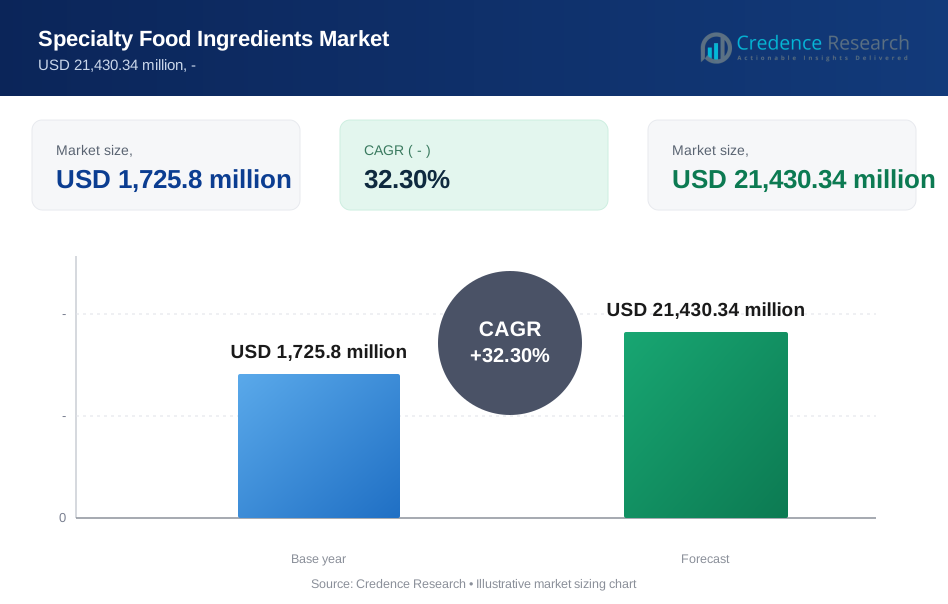
- Between 2024 and 2032, the global market for specialty food ingredients is projected to rise at a compound annual growth rate (CAGR) of 32.30%, from an estimated USD 1725.8 million in 2023 to USD 21430.34 million in 2032.
- The largest category is flavor enhancers. Emulsifiers, on the other hand, are expected to grow at a strong CAGR.
- The bakery and confectionery category will expand at a rapid rate of growth.
- The CAGR for food and beverage manufacturers is expected to be the highest during the projection period.
- Asia Pacific governed the market for specialty food ingredients.
- Regarding the market share of specialty food ingredients, Europe is expected to come second.
- In the specialty food ingredients market, North America is anticipated to grow fastest.
- The key drivers propelling the global market's development are customer demand for clean-label products and growing consumer attention to functional food components and health-conscious eating practices.
- The growth of natural and organic products, together with the trend toward plant-based diets, are factors that have encouraged the need for plant-derived specialty ingredients and contributed to the development of the specialty food ingredients sector.
Executive Summary
Market Definition
The sector of the food business committed to the manufacturing, marketing, and distribution of distinctive and specialized ingredients utilized in food and beverage products is known as the specialty food ingredients market. Usually, these additives have sensory or functional qualities that improve food products' flavor, texture, appearance, nutritional content, or shelf life.
Market Overview
The specialty food ingredients sector is predicted to continue its upward trend between 2024 and 2032, growing at a compound annual growth rate (CAGR) of 32.30%. From its projected USD 1725.8 million in 2023 to USD 21430.34 million in 2032, the market will continue to grow.
The market for specialty food ingredients offers a chance to create new products. Businesses must set themselves apart from rivals as the market grows and spreads into new areas. Manufacturers have several options to create novel food items with improved qualities in order to meet changing customer and industry expectations. Businesses have the chance to modify their products to suit the demands and preferences of customers in various areas as a result of the specialty food ingredients industry's growth into new areas. Specialty food ingredients present a viable chance for businesses to create fresh, cutting-edge goods that can adapt to changing consumer demands and preferences.
The growing middle class in countries that are emerging is placing greater value on health and fitness. Growing numbers of health-conscious consumers are searching for foods that fulfill their dietary requirements and provide nutritional value. Specialty food components, such as plant-based proteins, natural sweeteners, and functional additives, can meet these needs by providing healthier alternatives to conventional ingredients. Producers can now design ingredients for food products that meet certain dietary needs, such as organic, vegan, or gluten-free selections.
Segmentation by Type of Ingredient
- The flavor enhancers category is the market leader in terms of type of ingredient. The primary advantage of flavor enhancers is that they augment food flavor, which can elevate the dining experience as a whole. Furthermore, flavor enhancers can aid in lowering the quantity of salt and other seasonings used to cuisine.
- The emulsifiers category will exhibit a sizable CAGR during the projected period. To keep the components of processed foods like mayonnaise, ice cream, chocolates, peanut butter, cookies, creamy sauces, margarine, and baked goods from separating, emulsifiers are included. Emulsifiers extend the shelf life of certain meals and give them a smooth texture.
- Other types of ingredients, including enzymes, proteases, amylases, lipases, monosodium glutamate (MSG), yeast extracts, natural and artificial flavorings, sweeteners, preservatives, texturizers, and nutritional additives, also support the need for specialty food ingredients.
Segmentation by Application Segments
- Bakery and confectionery are considered the best application category. Sweetened baked goods and confections with unique flavor profiles and maybe health benefits can be achieved by using specialty sweeteners like honey, maple syrup, agave nectar, and specialized sugars like muscovado sugar and coconut sugar.
- The beverages category will likely register a significant CAGR during forecasting. In order to provide effervescence and improve sensory qualities including mouthfeel and freshness, carbonation agents are used to add carbon dioxide gas to beverages. To create sparkling beverages with regulated carbonation levels, specialized carbonation methods and apparatus are used.
- Other application segments, such as dairy and frozen desserts, meat and seafood, sauces, dressings, condiments, snacks, and convenience foods, also contribute to the demand for specialty food ingredients.
Segmentation by End-User Industries
- The food and beverage manufacturers category is projected to grow faster over the projection period. Food safety and quality are given top priority by food and beverage manufacturers throughout the entire manufacturing process. Specialty food ingredients that adhere to strict safety and quality requirements give producers peace of mind and confidence in the quality of their goods, which promotes consumer trust.
- Other end-user industries, including food service and hospitality and retail and grocery chains, influence the need for specialty food ingredients.
Segmentation by Region
- The Asia Pacific leads the specialty food ingredients industry. In 2023, the region held a dominant revenue share of 33.9% in the market. China is now the most significant market for emulsifiers in the region due to the rise in demand for them in the food industry brought about by the popularity of convenience meals.
- Europe is estimated to rank second in specialty food ingredients market size.
- The specialty food ingredients industry is predicted to flourish rapidly in North America.
- The remaining need for specialty food ingredients is covered by regions including Latin America, Africa, and the Middle East.
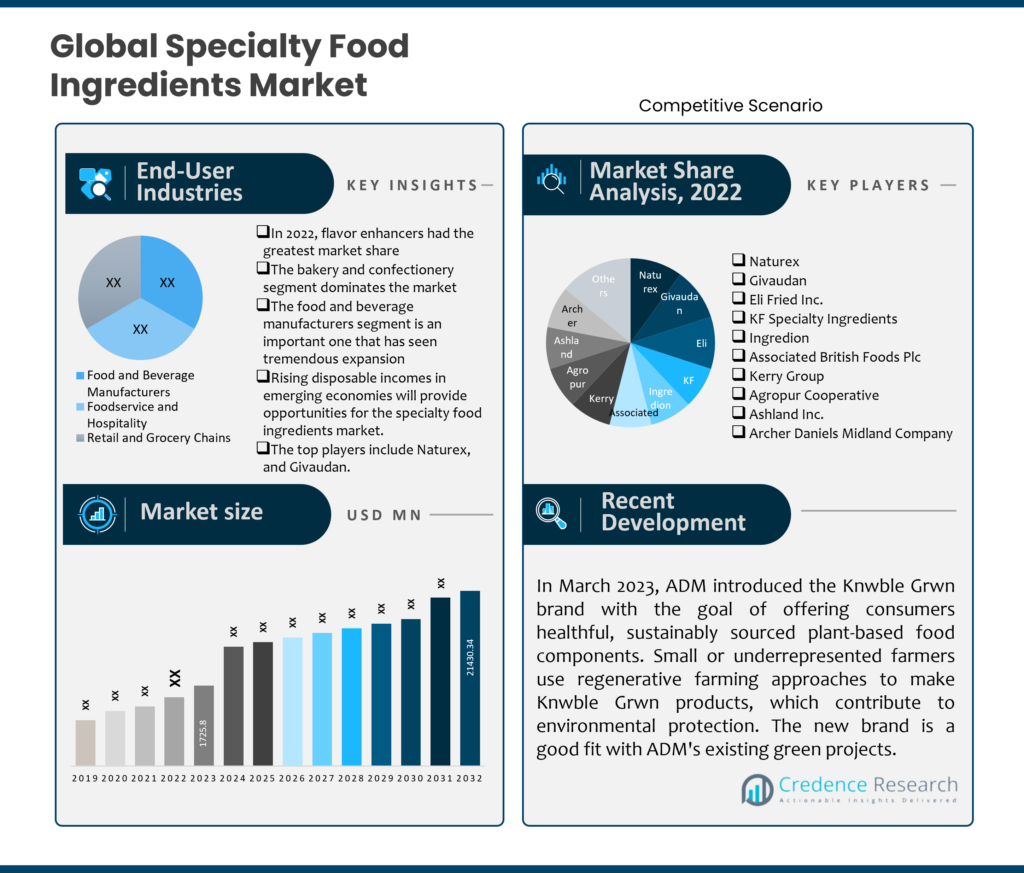
Foods that have been supplemented with vital nutrients increase their nutritional content and help compensate for nutrient deficiencies. Businesses are benefiting from the growing need for fortified meals, which is driving up demand for functional ingredients such as protein, omega-3, vitamins, and minerals. Customers are choosing more and more goods and drinks with particular healthful ingredients. Adding fiber, protein, vitamins, minerals, calcium, probiotics, and prebiotics to one's diet is something that most consumers strive to do. Customers are becoming more aware of dietary fiber components because they think they are healthful, which is driving up demand for foods high in fiber. For example, in 2021, 56% of consumers actively tried to consume fiber, according to the International Food Information Council (IFIC) food and health study.
Based on projections, Asia Pacific is anticipated to control the specialty food ingredients market. India's vast population makes it one of the world's most populous countries. A wide range of specialty food components is desperately needed in the market to cater to different tastes and preferences because of the enormous consumer base. The country's economic growth has resulted in an increase in the size and disposable income of the middle class. As a result, the growing popularity of premium and specialized foods drives the need for specialty food ingredients. Due to consumers' growing health consciousness, there is a growing need for practical and healthier eating options. In the Asia Pacific area, specialty food components with unique health benefits are gaining prominence.
North America's specialty food ingredients market is expected to grow at a rapid pace during the forecast period. The United States led the market in North America in 2023 as a result of rising consumer demand for safe, plant-based goods. The nation's younger generation is demanding healthier and more natural food products and is concentrating on ingredient transparency.
Key Highlights of the Report
The global specialty food ingredients market is segmented by type of ingredient, application segments, end-user industries, and region. The flavor enhancers category is the market spearhead in terms of type of ingredient, and bakery and confectionery are the top application segments. The food and beverage manufacturers category is anticipated to increase at the highest CAGR throughout the projection period. The specialty food ingredients market is expanding mostly in Asia Pacific.
The industry is expected to rise as a result of the numerous awareness initiatives conducted by businesses, non-governmental organizations, and government agencies. These campaigns have increased consumer knowledge of the nutritional advantages of food ingredients. Some businesses that provide protein supplements also carry organic and natural products in their product lineup, which is driving up market expansion even more. Spending on protein supplements has surged as a result of enhanced consumer awareness brought about by appealing packaging techniques.
Asia Pacific is expected to account for the largest specialty food ingredients market globally. Through the Ministry of Food Processing Industries (MoFPI), the Indian government is working tirelessly to boost investments in the food processing industry. Up till March 2026, the Indian government has allotted Rs 4,600 crore to the overarching PMKSY scheme. Food processing is one of the biggest industries in India, accounting for 32% of the country's total food industry and ranking fifth in terms of output, consumption, exports, and expected growth. It is also anticipated that the market will develop at the fastest rate in the North American region. This is due to the rising demand for specialty food ingredients from North American countries such as the United States, Canada, and Mexico.
Which Key Factors Are Driving The Global Specialty Food Ingredients Market?
Rising levels of disposable income, the quickly growing food business, and improvements in food processing technology have made it possible for consumers to spend more on specialty and premium food items. The market for specialty food ingredients is growing as a result of these factors.
What Are The Main Challenges Confronting The Global Specialty Food Ingredients Market?
The sector's main issues are the short lifespans of specialty food ingredients, competition from conventional products, and the complexity of ingredient labeling.
What Market Opportunities Exist For Specialty Food Ingredients Globally?
The market for specialty food ingredients is expanding due to a number of causes, including the growing demand for authentic and ethnic flavors, a shift towards sustainable sourcing, and improvements in ingredient extraction techniques.
Market Drivers
Increasing Global Population
The market for specialty food ingredients is expanding at an exponential rate due to the expanding global population. As the world's population rises, so does the need for food goods. The FAO estimates that the current global population of 5,300 million is growing by about 250,000 people every day. It is projected that this decade will see the birth of 1,000 million humans. The need for food products that meet a wide range of dietary requirements, preferences, and health concerns is growing along with the world's population. Because they provide creative and value-added solutions, specialty food ingredients are essential to satisfying these changing expectations. Specialty food ingredients, which offer unique flavors, textures, and dietary characteristics to accommodate a range of consumer preferences, are becoming more and more in demand.
Due to the influence of multilingualism on eating patterns and growing globalization, the demand for specialist food ingredients has grown. As consumers are exposed to a wider range of international cuisines and flavors, the practice of incorporating unusual and ethnic ingredients into meals is growing in popularity. A wide range of culinary flavors are available to consumers because specialist food ingredients, including herbs, spices, and unique flavor enhancers, can be used. Thus, the market for specialty food ingredients is growing as a result of the growing worldwide population.
Market Restraints
Certain Specialty Ingredients have Limited Shelf Life and Stability
The limited shelf life and volatility of certain specialized ingredients present significant challenges for the specialty food ingredient sector. Specialty components are often important for applications due to their unique features, yet these same qualities can also contribute to their unstable nature and limited shelf life.
Many specialty ingredients are derived from natural sources, such as fruits, vegetables, and herbs, which can deteriorate and expire over time. These substances may be volatile, have sensitive tastes, or be active ingredients that break down or lose their potency in the presence of air, light, or moisture. Thus, the shelf life of some constituents may be reduced when compared to highly processed or synthetic compounds.
Opportunities
Unique Food Ingredients' Advantages
In today's world, specialty food components are an essential component of many food products. Over the past few decades, there have been major changes to the societal norms and practices that guide our everyday lives. People's time spent in the kitchen has decreased as a result of involvement in unrelated pursuits. The application of specialty food ingredients, along with food technology improvements, has made it possible to produce nutritious food on a large scale with cost-effectiveness.
To guarantee the safety of a food product, a variety of specialist food ingredients are added. Specialty food ingredients can lessen the formation of undesirable substances during cooking processes, such as acrylamide. In a similar vein, specialist food components let producers of food and drink make goods that satisfy particular dietary requirements. For example, a greater range of products is available to customers with food allergies and intolerances because of alternative specialist food ingredients. It is anticipated that these benefits will propel market expansion.
Competitive Landscape
Key Players
In the highly competitive global specialty food ingredients market, there are a number of significant rivals. A few of the top market players are shown below, together with their respective market shares:
- Naturex
- Givaudan
- Eli Fried Inc.
- KF Specialty Ingredients
- Ingredion
- Associated British Foods Plc
- Kerry Group
- Agropur Cooperative
- Ashland Inc
- Archer Daniels Midland Company
- Cargill Inc.
- Wild Flavors GmbH
- DSM
- Diana Group SA
- Tate & Lyle
- CHR. Hansen
- Others
To stay competitive, these businesses give priority to product innovation, expanding their distribution networks, and completing mergers and acquisitions.
The biggest vendors in the global specialty food ingredients market consistently strive to keep one step ahead of the competition by creating cutting-edge ideas and goods.
In November 2022, Tate & Lyle developed Erytesse erythritol, a new sweetener. It declared that this addition would increase its capacity to assist clients in meeting consumer demand for healthier, lower-sugar, lower-calorie goods. This would be accomplished through a strategic partnership distribution deal with a major supplier of erythritol.
In October 2022, International Flavors and Fragrance Inc. made a USD 30 million investment to increase its regional presence in Singapore. Within the new Singapore innovation center are the business segments of Nourish, Health & Biosciences, Scent, and Pharma Solutions. Almost 11,000 square meters make it the biggest IFF property in the vicinity.
In September 2022, First Choice Ingredients, a top supplier of savory flavorings derived from dairy, and Royal DSM announced a deal to buy the latter for an estimated USD 453 million in enterprise value. First Choice Ingredients creates savory flavorings for dairy products and fermented dairy products under a clean label that are both tasty and practical for a range of uses.
How are Companies Performing in the Specialty Food Ingredients Market?
The significant performance of companies in the specialty food ingredients market can be attributed to some noteworthy reasons. In order to develop and create better products, multinational companies are implementing new technology. For example, Kraft Heinz established a new digital hub to develop digitally enabled strategies and support the introduction of novel food concepts that may effectively grab a significant portion of the market. Moreover, as more food businesses join this trend, technology like blockchain will continue to rise in popularity.
The largest companies in the industry are primarily implementing very significant expansion plans to increase their manufacturing capacity, regional reach, and R&D spending. For example, the Archer Daniels Midland Company opened the Knwble Grwn brand in March 2023 with the purpose of delivering clients with healthy, environmentally friendly plant-based food items.
The most popular approach used by players in the market to boost their reputations and assortments of products is product invention and development, which is followed by mergers and acquisitions and market expansions. To meet consumer demand for "clean labels," companies concentrate on offering all-natural specialty ingredients that extend the shelf life of their products and allow them to label them as "100% all-natural."
Companies of foods and beverages have been reformulating their products more frequently in order to satisfy the shifting needs of consumers who want natural ingredients. Roquette introduced a new range of organic pea components in October 2022, which included organic pea protein and organic pea starch modified for use in non-dairy or alternative meat products and certain nutrition categories. In order to meet the growing demand from customers for wholesome, sustainably produced food, the company set out to meet the needs of food manufacturers who are concentrated on creating goods with organic ingredients.
Summary of Key Findings
- The global market is expanding due to factors such as the increasing demand for artisanal and craft products and the clean-eating movement.
- The market is segmented by type of ingredient, application segments, end-user industries, and region.
- In the market, flavor enhancers are the most widely used type of ingredient.
- Bakery and confectionery are the foremost application category.
- The food and beverage manufacturers category is expected to grow fastest in terms of CAGR during the forecast period.
- Asia Pacific is leading market development; the market is highly competitive with key players including Naturex, Givaudan, Eli Fried Inc., KF Specialty Ingredients, Ingredion, Associated British Foods Plc, Kerry Group, Agropur Cooperative, Ashland Inc., Archer Daniels Midland Company, Cargill Inc., Wild Flavors GmbH, DSM, Diana Group SA, Tate & Lyle, CHR. Hansen, and Others.
Future Outlook
- The specialty food ingredients industry is expected to increase significantly in Asia Pacific, and its outlook is positive worldwide.
- Convenient, ready-to-eat foods created using specialist ingredients are becoming more and more popular due to busy lifestyles.
- Seasonal crops provide specialty ingredients, but things like weather and crop diseases can cause shortages in availability or quality fluctuations.
- Major organizations need to create novel offerings, reach a wider audience, and maintain competitive pricing in order to stay ahead of other businesses.
How the Credence Research Specialty Food Ingredients Market Report Can Help CXOs
The Credence Research specialty food ingredients Market Report provides CXOs with an extensive market overview and comprises the following:
- Market size and growth forecast: The study offers comprehensive market estimations for specialty food ingredients globally, broken down by type of ingredient, application segments, end-user industries, and region. In addition, projections for the market through 2032 based on significant drivers and trends are included.
- Market segmentation: The specialty food ingredients market is divided into segments by type of ingredient, application segments, end-user industries, and region in the research report. CXOs are given a detailed grasp of the market and the potential inside each sector due to this segmentation.
- Competitive landscape: The study report provides a thorough analysis of the leading businesses in the specialty food ingredients sector, together with details on their revenue streams, product lines, and business strategies. This information can help CXOs assess and identify their competitors.
- Key trends and drivers: The study report analyzes and highlights the key developments and elements driving the market for specialty food ingredients. CXOs can utilize this information to make well-informed choices regarding their plans and investments.
The Credence Research Specialty Food Ingredients Market Report provides CXOs with insights that they may utilize to:
- Identify growth opportunities: This analysis is likely to help CXOs find fresh growth prospects in the specialty food ingredients sector. For example, the research recognizes the increasing requirement for specialty food ingredients from food and beverage manufacturers as a crucial opportunity.
- Make informed investment decisions: The study aids CXOs in making informed decisions about specialty food ingredients. For example, it delivers information on the key variables to consider while picking specialty food ingredient solutions and evaluating suppliers.
- Develop competitive strategies: CXOs can utilize the research report to establish competitive strategies for their specialty food ingredients firms. The study paper explores the primary tactics employed by specialty food ingredients providers to set themselves apart from their rivals.
- Track market developments: By tracking market advancements, this research report could assist CXOs in remaining ahead of the curve. For example, it provides information about the latest advancements and patterns in the specialty food ingredients industry.
The Credence Research Specialty Food Ingredients Market Report is helpful for CXOs who want to learn more about the market and identify potential opportunities.
Segmentation
-
By Type of Ingredient
- Emulsifiers
- Enzymes
- Proteases
- Amylases
- Lipases
- Flavor Enhancers
- Monosodium Glutamate (MSG)
- Yeast Extracts
- Natural and Artificial Flavorings
- Sweeteners
- Sugar Alcohols (Polyols)
- High-Intensity Sweeteners
- Natural Sweeteners
- Preservatives
- Antioxidants
- Antimicrobials
- Natural Preservatives
- Texturizers
- Hydrocolloids
- Starches and Modified Starches
- Protein-based Texturizers
- Nutritional Additives
- Vitamins and Minerals
- Fiber and Prebiotics
- Probiotics
-
By Application Segments
- Bakery and Confectionery
- Beverages
- Dairy and Frozen Desserts
- Meat and Seafood
- Sauces, Dressings, and Condiments
- Snacks and Convenience Foods
-
By End-User Industries
- Food and Beverage Manufacturers
- Foodservice and Hospitality
- Retail and Grocery Chains
-
By Region
- North America
- The U.S.
- Canada
- Mexico
- Europe
- Germany
- France
- UK.
- Italy
- Spain
- Rest of Europe
- Asia Pacific
- China
- Japan
- India
- South Korea
- South-east Asia
- Rest of Asia Pacific
- Latin America
- Brazil
- Argentina
- Rest of Latin America
- Middle East & Africa
- GCC Countries
- South Africa
- The Rest of the Middle East and Africa
- North America
Adjacent Markets
Several adjacent markets in the zinc citrate market have high revenue growth opportunities. The key adjacent markets for the specialty food ingredients market -
Adjacent Markets |
||
| Natural Flavors and Fragrances | Functional Food Ingredients | Clean Label Ingredients |
| Plant-Based Ingredients | Organic Ingredients | Gluten-Free Ingredients |
| Dairy Alternatives | Sugar Alternatives | Functional Beverages |
Request a Free Sample
Fill in your details and we'll send you a free sample report.
- Sample data tables & charts
- Research methodology
Need a Custom Version of This Report?
Tailor the scope, geography, or segments to your exact requirements.
- Custom geography or segment scope
- Direct access to our analyst team
Frequently Asked Questions
How much does the global market currently hold for specialty food ingredients?
What is the specialty food ingredients market's projected growth rate between 2024 and 2032?
What is the most significant market segment in terms of type of ingredient?
Regarding the application, which market category is in the lead?
Which end-user industries are anticipated to grow at the fastest rate throughout the projected period?
In which region is the market for specialty food ingredients expanding?
Who are the main players in the specialty food ingredients industry globally?
Which market factors are the primary drivers of the specialty food ingredients industry?
What main market challenges prevent the growth of the specialty food ingredients sector?
What are the main market opportunities for the specialty food ingredients sector?
Table of Content
Chapter 1. Report Introduction
- 1.1 Report Description & Purpose
- 1.1.1 Report Title & Market Definition
- 1.1.2 Unique Selling Propositions (USP) & Key Differentiators
- 1.1.3 Value Proposition for Stakeholders
- 1.2 Research Objectives
- 1.2.1 Market Sizing Objectives (Volume & Revenue)
- 1.2.2 Segmentation Objectives
- 1.2.3 Competitive Intelligence Objectives
- 1.2.4 Forecast & Scenario Objectives
- 1.3 Report Scope
- 1.3.1 Specialty Food Ingredients Scope – Types & Subtypes Covered
- 1.3.2 Geographic Scope – Regions & Countries Covered
- 1.3.3 Historical Period, Base Year & Forecast Period (the historical period; forecast to the forecast period)
- 1.3.4 Inclusions & Exclusions
- 1.4 HS Code & Classification Framework
- 1.5 Currency, Units & Pricing Basis
- 1.6 Target Stakeholders
- 1.7 Limitations & Assumptions
Chapter 2. Executive Summary
- 2.1 Global Specialty Food Ingredients Market Snapshot
- 2.1.1 Market Size – Historical (the historical period) & Forecast (the forecast period) (base year: USD 1,725.8 million → forecast year: USD 21,430.34 million)
- 2.1.2 Volume & Revenue – Global Totals
- 2.1.3 Key Market Highlights – Top Five Facts
- 2.2 Specialty Food Ingredients Market Segmentation Snapshot
- 2.2.1 Market Split by Region – vs.
- 2.3 Competitive Snapshot
- 2.3.1 Top 10 Players by Revenue Share –
- 2.3.2 Top 10 Players by Volume Share –
- 2.3.3 Recent Strategic Developments (18-Month Summary)
- 2.4 Key Investment Highlights & Strategic Conclusions
Chapter 3. Specialty Food Ingredients Market Dynamics & Industry Analysis
- 3.1 Market Overview & Context
- 3.1.1 Specialty Food Ingredients Market Position in the Broader Automotive Value Chain
- 3.1.2 OEM vs. Replacement Market Dynamics
- 3.1.3 Market Maturity & Development Stage by Region
- 3.2 Specialty Food Ingredients Market Drivers
- 3.3 Specialty Food Ingredients Market Restraints & Challenges
- 3.4 Specialty Food Ingredients Market Opportunities
- 3.5 Porter's Five Forces Analysis
- 3.5.1 Threat of New Entrants
- 3.5.2 Bargaining Power of Suppliers
- 3.5.3 Bargaining Power of Buyers
- 3.5.4 Threat of Substitutes
- 3.5.5 Competitive Rivalry – Intensity Assessment
- 3.6 Specialty Food Ingredients Value Chain Analysis
- 3.6.1 Upstream – Raw Material/Input Suppliers
- 3.6.1.1 Raw Material/Input 1
- 3.6.1.2 Raw Material/Input 2
- 3.6.1.3 Raw Material/Input 3
- 3.6.2 Midstream – Production/Manufacturing/Service Delivery
- 3.6.2.1 Production/Process Overview
- 3.6.2.2 Key Facility Locations & Capacity by Manufacturer
- 3.6.3 Downstream – Distribution & End Consumer
- 3.6.3.1 Primary Channel – B2B/OEM
- 3.6.3.2 Secondary Channels – Dealer, Retail, Online, Direct
- 3.6.4 Value Chain Profitability Analysis
- 3.6.1 Upstream – Raw Material/Input Suppliers
- 3.7 PESTEL Analysis
- 3.7.1 Political Factors
- 3.7.2 Economic Factors
- 3.7.3 Social Factors
- 3.7.4 Technological Factors
- 3.7.5 Environmental Factors
- 3.7.6 Legal Factors
- 3.8 Specialty Food Ingredients Supply Chain Analysis
- 3.8.1 Raw Material/Input Supply Risk Assessment
- 3.8.2 Manufacturing Concentration Risk (Geographic Exposure)
- 3.8.3 Trade Disruption Impact Analysis
- 3.9 Regulatory & Policy Landscape
Note: The regulatory and policy landscape section covers regulations based on their applicability to the market, Specialty Food Ingredients category, geography, and scope of the study. Only regulatory frameworks with a material impact on operations, compliance, trade, sustainability, or market access are analyzed in detail.
Chapter 4. Key Investment Pockets & Opportunity Analysis
- 4.1 Specialty Food Ingredients Market Attractiveness Analysis
- 4.1.1 By Region – Investment Attractiveness Matrix (Volume × CAGR)
- 4.2 Absolute Revenue Growth Opportunity
- 4.2.1 By Region – Absolute USD Growth Through the forecast period
- 4.3 Incremental Volume Opportunity
- 4.3.1 By Region – Incremental Volume Through the forecast period
- 4.3.2 Segment – Incremental Volume
- 4.4 Emerging Submarket Opportunity Deep Dive (Subject to Applicability)
- 4.5 Emerging Market Opportunity Scorecards
- 4.5.1 United States
- 4.5.2 Europe
- 4.5.3 Asia
- 4.5.4 Middle East & Africa
Note: Emerging Market Opportunity Scorecards will be included based on relevance and strategic importance. Regions listed are indicative and may vary depending on data availability and market dynamics.
Chapter 5. Specialty Food Ingredients Import-Export Analysis & Trade Flows
- 5.1 Global Trade Overview
- 5.1.1 Global Export Value by Country (the historical period)
- 5.1.2 Global Export Volume by Country (the historical period)
- 5.1.3 Global Import Value by Country (the historical period)
- 5.1.4 Global Import Volume by Country (the historical period)
- 5.1.5 Net Trade Balance by Country (the historical period)
- 5.2 Export Analysis – Segment
- 5.2.1 Type 1 (HS Code)
- 5.2.2 Type 2 (HS Code)
- 5.2.3 Type 3 (HS Code)
- 5.2.4 Type 4 (HS Code)
- 5.2.5 Type 5 (HS Code)
- 5.3 Import Analysis – Segment
- 5.3.1 Type 1 (HS Code)
- 5.3.2 Type 2 (HS Code)
- 5.3.3 Type 3 (HS Code)
- 5.3.4 Type 4 (HS Code)
- 5.3.5 Type 5 (HS Code)
- 5.4 Average Unit Trade Prices
- 5.4.1 Average Export Price – Segment & Country
- 5.4.2 Average Import Price – Segment & Source Country
- 5.4.3 Price Trends (the historical period)
- 5.5 Key Trade Route Analysis
- 5.5.1 Trade Route 1
- 5.5.2 Trade Route 2
- 5.5.3 Trade Route 3
- 5.5.4 Trade Route 4
- 5.5.5 Trade Route 5
- 5.6 Trade Policy Impact Assessment
- 5.6.1 US Anti-Dumping & Section 301 Tariffs
- 5.6.2 EU Customs Union Impact
- 5.6.3 Major Free Trade Agreements
- 5.6.4 USMCA Rules of Origin
Note: Trade policy analysis will be included only where relevant to the Specialty Food Ingredients market.
Chapter 6. Competitive Landscape & Company Benchmarking
- 6.1 Specialty Food Ingredients Market Concentration & Structure
- 6.1.1 Herfindahl-Hirschman Index (HHI) – vs.
- 6.1.2 Tier 1, Tier 2 & Tier 3 Market Structure
- 6.1.3 Global, Regional & Local Player Dynamics
- 6.2 Specialty Food Ingredients Market Share Analysis –
- 6.2.1 Global Revenue Share by Company
- 6.2.2 Global Volume Share by Company
- 6.2.3 Regional Revenue Share
- 6.2.4 Market Share Evolution ( vs. )
- 6.2.5 OEM Segment Share by Company
- 6.2.6 Replacement Segment Share by Company
- 6.3 Production/Delivery Capacity & Facility Analysis
- 6.3.1 Global Installed Capacity
- 6.3.2 Capacity Utilization Rates
- 6.3.3 Production/Output Volume
- 6.3.4 Facility Locations & Capacity Map
- 6.3.5 Planned Capacity Additions
- 6.4 Specialty Food Ingredients Competitive Benchmarking Matrix
- 6.4.1 Revenue, Volume, CAGR & Profitability Comparison
- 6.4.2 Channel Revenue Mix
- 6.4.3 Geographic Revenue Exposure
- 6.4.4 R&D Intensity
- 6.4.5 Sustainability Maturity
- 6.5 Strategic Developments in Specialty Food Ingredients (Last 24 Months)
- 6.5.1 Mergers, Acquisitions & Divestments
- 6.5.2 New Specialty Food Ingredients Launches
- 6.5.3 Facility Expansions
- 6.5.4 Strategic Alliances, Joint Ventures & Partnerships
- 6.5.5 Distribution Expansion & Market Entry
- 6.5.6 Sustainability & ESG Initiatives
- 6.6 Competitive Strategy Mapping
- 6.6.1 Leader, Challenger, Follower & Niche Classification
- 6.6.2 Pricing Strategy Comparison
- 6.6.3 Channel Strategy Matrix
Note: Strategic developments are included based on their materiality and the availability of reliable information.
Chapter 7. Global Specialty Food Ingredients Market – By Distribution Channel
- 7.1 Segment Overview
- 7.1.1 Volume & Revenue Split by Channel ( & )
- 7.1.2 Channel Mix Evolution (the forecast period)
Chapter 8. Regional Market Analysis – Global Overview
- 8.1 Global Regional Overview
- 8.1.1 Regional Volume Share
- 8.1.2 Regional Revenue Share
- 8.1.3 Regional Volume by Region
- 8.1.4 Regional Revenue by Region
- 8.1.5 Regional Forecast Through the forecast period
- 8.2 Cross-Regional Segment Analysis
- 8.2.1 By Distribution Channel
- 8.2.2 By Brand/Price Tier
Chapter 9. North America Specialty Food Ingredients Market
- 9.1 United States
- 9.2 Canada
- 9.3 Mexico
Chapter 10. Europe Specialty Food Ingredients Market
- 10.1 Germany
- 10.2 France
- 10.3 Italy
- 10.4 United Kingdom
- 10.5 Spain
- 10.6 Poland
- 10.7 Russia
- 10.8 Netherlands
- 10.9 Belgium
- 10.10 Sweden
- 10.11 Denmark
- 10.12 Norway
- 10.13 Rest of Europe
Chapter 11. Asia Pacific Specialty Food Ingredients Market
- 11.1 China
- 11.2 India
- 11.3 Japan
- 11.4 South Korea
- 11.5 Thailand
- 11.6 Indonesia
- 11.7 Vietnam
- 11.8 Malaysia
- 11.9 Australia
- 11.10 Rest of Asia Pacific
Chapter 12. Latin America Specialty Food Ingredients Market
- 12.1 Brazil
- 12.2 Argentina
- 12.3 Colombia
- 12.4 Chile
- 12.5 Rest of Latin America
Chapter 13. Middle East Specialty Food Ingredients Market
- 13.1 Saudi Arabia
- 13.2 United Arab Emirates
- 13.3 Turkey
- 13.4 Israel
- 13.5 Iran
- 13.6 Rest of the Middle East
Chapter 14. Africa Specialty Food Ingredients Market
- 14.1 South Africa
- 14.2 Egypt
- 14.3 Nigeria
- 14.4 Morocco
- 14.5 Rest of Africa
Chapter 15. Specialty Food Ingredients Company Profiles
- 15.1 [Company 01]
- 15.1.1 Company Overview
- 15.1.2 Key Management Personnel
- 15.1.3 Products & Services Portfolio
- 15.1.4 Financial Performance
- 15.1.5 Key Market Focus & Geographic Presence
- 15.1.6 Recent Developments & Strategic Initiatives
Note: The company profile list is preliminary and may change based on research findings, market developments, data availability, and client requirements.
Chapter 16. Appendices
- Appendix A – List of Abbreviations & Acronyms
- Appendix B – Industry Classification Code Reference – Full Series
- Appendix C – Production & Capacity Data Tables
- Appendix D – End-Use & Demand Base Tables
- Appendix E – Consumption & Replacement Rate Assumptions
- Appendix F – ASP Reference Tables
- Appendix G – Manufacturing & Facility Database
- Appendix H – Import-Export Data Tables
- Appendix I – Regulatory Summary Tables
- Appendix J – Primary Research Participant List (Anonymized)
- Appendix K – Primary Research Questionnaire Framework
- Appendix L – Data Sources & Bibliography
- Appendix M – Market Size Divergence & Source Comparison
Chapter 17. Research Methodology
- 17.1 Research Framework & Philosophy
- 17.2 Secondary Research – Sources, Hierarchy & Data Extraction
- 17.3 Data Modeling – Bottom-Up & Top-Down Market Sizing
- 17.4 Primary Research – Stakeholder Framework, LOI & Sample Sizes
- 17.5 Forecast Methodology – Regression, Scenario & Sensitivity Analysis
- 17.6 Quality Control – Four-Layer Validation Framework
- 17.7 Limitations & Standard Assumptions
- 17.8 Disclaimer
