
| REPORT ATTRIBUTE | DETAILS |
|---|---|
| Historical Period | 2019-2022 |
| Base Year | 2023 |
| Forecast Period | 2024-2032 |
| Roll To Roll (R2R) Technology For Flexible Device Market Size 2023 | USD 28151.2 Million |
| Roll To Roll (R2R) Technology For Flexible Device Market, CAGR | 13.50% |
| Roll To Roll (R2R) Technology For Flexible Device Market Size 2032 | USD 87995.3 Million |
Market Insights
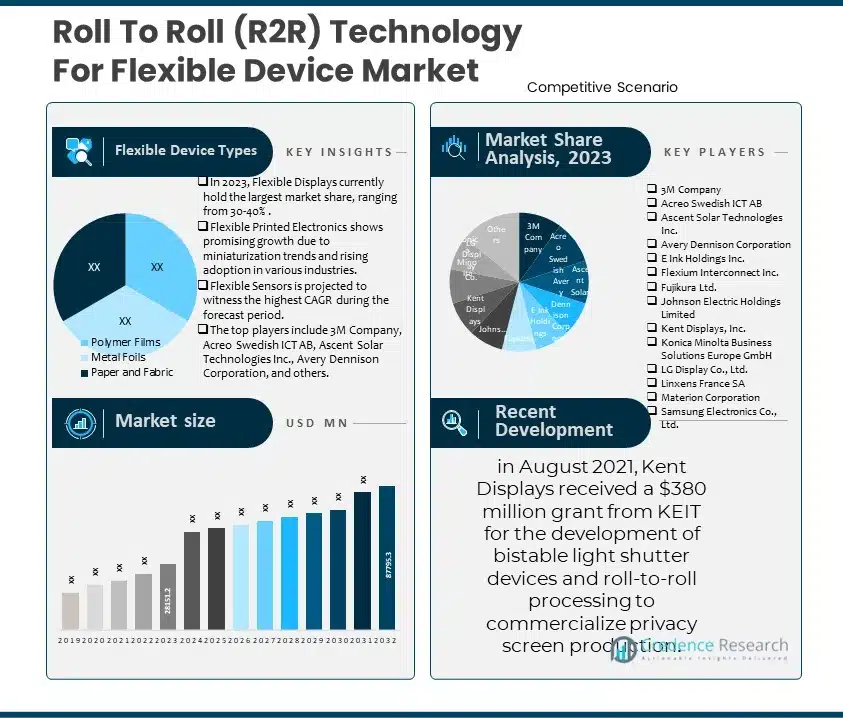
- The global Roll To Roll (R2R) Technology For Flexible Device Market reached a valuation of USD 28151.2 Million in 2023 and is anticipated to surge to USD 87995.3 Million by 2032, exhibiting a robust CAGR of 13.50% from 2024 to 2032.
- Among the key segments, Flexible Displays emerged as the market leader by flexible device type, constituting around 30-40% of the total market share in 2023. However, Flexible Sensors are expected to experience rapid growth throughout the forecast period.
- Consumer Electronics segment holds around 30-35% of the market share owing to the increasing demand for foldable smartphones and smart glasses.
- Printing technologies is expected to witness the highest growth rate among manufacturing processes, while Coating and Laminating maintains dominance, constituting a significant share of the market in 2023.
- Asia Pacific accounts for more than 35% of the market share in 2023, followed by North America and Europe with a collective share of just under 55%, with Europe holding over 20% share in 2023.
- The rise in demand for flexible electronics and the limitations of traditional manufacturing methods fuel the demand for Roll To Roll (R2R) Technology For Flexible Device, augmenting growth prospects.
- Key opportunities in the market include significant growth potential in Asia Pacific, increased adoption across various industries, and continuous advancements in technology, fostering market expansion.
Executive Summary
Market Definition
Roll-to-roll (R2R) technology revolutionizes flexible device manufacturing by enabling continuous, high-throughput production on flexible substrates, such as plastics and metals. This innovative process employs various thin-film deposition techniques like PVD, CVD, and printing methods such as inkjet and gravure printing. R2R's cost-efficient and high-volume production capabilities are crucial for applications like consumer electronics and renewable energy.
However, R2R faces challenges in maintaining quality and uniformity over long runs, as well as handling delicate substrates. Despite these challenges, R2R finds applications in diverse industries, including consumer electronics, automotive, healthcare, and energy, producing items like flexible displays, solar panels, and sensors. As technology advances, R2R is expected to expand its capabilities, driving further growth in the flexible device market.
Market Overview
The Roll To Roll (R2R) Technology For Flexible Device Market has demonstrated consistent expansion and is projected to maintain a robust CAGR of 13.50% from 2024 to 2032. Valued at USD 28151.2 million in 2023, this market is expected to reach USD 87995.3 million by 2032. The market's growth is primarily fueled by the increasing demand for R2R technology in various industries such as consumer electronics, automotive, healthcare, and energy. These products cater to a wide range of applications including flexible displays, printed electronics, sensors, and wearable electronics.
Key players such as 3M Company, Avery Dennison Corporation, Ascent Solar Technologies Inc., Johnson Electric Holdings Limited, LG Display Co., Ltd., Samsung Electronics Co., Ltd., and others significantly contribute to the market's expansion. The market's global presence spans across regions including North America, Asia-Pacific, and Europe, with Asia-Pacific leading in market growth. Continuous innovation in R2R technology for flexible devices, such as advancements in printing technologies and substrate materials, drives market growth, meeting the evolving needs of industries and consumers across different regions.
The Roll To Roll (R2R) Technology For Flexible Device Market offers diverse solutions for flexible displays, printed electronics, wearable electronics, and other applications, with ongoing advancements enhancing their performance and usability in various industries.
Segmentation by Flexible Device Types
- Flexible Displays currently hold the largest market share, ranging from 30-40% in 2023. Foldable smartphones, e-readers, and other innovative display applications drive the market of this segment.
- Flexible Printed Electronics encompassing other flexible components like circuits and antennas, also shows promising growth due to miniaturization trends and rising adoption in various industries.
- Flexible Sensorsis is projected to witness the highest CAGR during the forecast period, driven by applications in healthcare, automotive, and consumer electronics.
Segmentation by Technology Substrate Material
- Polymer Films hold the largest market share, estimated to be around 55-60% in 2023. Advancements in materials like Polyimide provide high heat resistance and durability, further drive the market of this segment.
- Metal Foils is projected to witness the highest CAGR during the forecast period. Growing demand for flexible electronics in rugged environments and high-performance applications like batteries and antennas favors metal foils due to their superior conductivity and mechanical strength further drive the market.
Segmentation by Manufacturing Processes
- Printing technologies currently hold a significant market share, estimated to be around 40-50% in 2023. These technologies offer low-cost, high-throughput production, making them suitable for mass production of simple devices like flexible displays and circuits. Advancements in ink formulations and printing techniques cater to diverse substrates and device structures, driving the growth of the market.
- Coating and Laminating is projected to witness the highest CAGR during the forecast period.
Segmentation by Application-Specific Segments
- Flexible OLED Displays currently hold the largest market share, estimated to be around 40-50% in 2023. Widespread adoption in smartphones, tablets, and even TVs drives the market of the segment.
- Wearable Electronics is projected to witness the highest CAGR during the forecast period. The market is driven by several factors such as rapid growth in smartwatches, fitness trackers, and other wearable devices fuels demand for flexible batteries, sensors, and displays.
Segmentation by End-User Industries
- Consumer Electronics currently holds the largest market share, estimated to be around 30-35% in 2023. Emerging applications like foldable smartphones and smart glasses drive the market of this segment.
- Healthcare is projected to witness the highest CAGR during the forecast period. Growing demand for wearable medical devices like health monitors, patches, and biosensors for diagnostics and remote patient care drive the market of this segment during the forecast period.
Segmentation by Region
- Asia Pacific held significant share around 35-40% of the market in 2023. This dominance is attributed to the regions large manufacturing hub for electronic devices and components, which drives the demand for R2R technology.
- North America and Europe collectively account for just under 55% share in 2023, with Europe holding over 20% share in the same year.
- The rest of the world, including Latin America, the Middle East, and Africa, supplies the remaining demand for Roll To Roll (R2R) Technology For Flexible Device.
Technological advancements within the Roll To Roll (R2R) Technology For Flexible Device, such as the emergence of more efficient and sustainable products, are also contributing to market growth.
The Asia-Pacific (APAC) region is projected to lead the roll-to-roll (R2R) flexible electronics market, with China expected to be the top contributor to the market in the APAC region. This dominance is attributed to several factors, including the increasing investment in expanding consumer electronics, the surge in the adoption of Internet of Things (IoT) devices, and the presence of major companies such as Samsung, LG, and E Ink Holdings in the region. Additionally, the region is witnessing a growing demand for R2R technology, which enables the mass production of flexible electronic components used in products such as smartphones, tablets, and wearables. For instance, in November 2023, China Unicom and Huawei assisted Exquisite Automotive in implementing a commercial 5G-Advanced flexible production line, enhancing efficiency and reducing downtime at Great Wall Motor's factory in Baoding. The new system replaces traditional wired connections with 5G-Advanced technology, minimizing production interruptions and improving overall performance.
Furthermore, governments in APAC countries are providing incentives and support for the development of the semiconductor industry, which benefits the R2R flexible electronics market. For instance, in September 2023, China launched a new state-backed investment fund aiming to raise $40 billion for its semiconductor sector, exceeding previous funds raised in 2014 and 2019. The China Integrated Circuit Industry Investment Fund, also known as the Big Fund, targets 300 billion yuan ($41 billion), demonstrating China's increased efforts to catch up with the US and other rivals in the industry.
The growth of the automotive industry, which is adopting R2R flexible electronics for applications such as lighting, sensors, and in-mold electronics drive the market of North America region. Furthermore, The companies which are contributing to the growth of the Roll To Roll (R2R) Technology For Flexible Device Market include 3M Company, Avery Dennison Corporation, Kent Displays, Inc., Ascent Solar Technologies Inc., and Johnson Electric Holdings Limited The market players are considerably contributing to the market growth by the adoption of various strategies including new product launch, merger, and acquisition, collaborations with government, funding to the start-ups and technological advancements to stay competitive in the market. For instance, in August 2021, Kent Displays received a $380 million grant from KEIT for the development of bistable light shutter devices and roll-to-roll processing to commercialize privacy screen production. The two-year project aims to create a prototype using Kent Displays' patented technologies and expertise, leading to improved optical properties for energy-saving bistable light shutters. Dr. Mauricio Echeverri is the principal investigator, and Q-Sys, Inc. is managing the program.
Key Highlights of the Report
The Roll To Roll (R2R) Technology For Flexible Device Market is segmented by Flexible Device Type, Substrate Material, Manufacturing Process, Application-Specific Segment, End-User Industry, and Region. The increasing demand for flexible electronics solutions is driven by the rising need for innovative electronic devices across various industries, including consumer electronics, automotive, healthcare, and energy. This surge in demand is largely due to the versatility and adaptability of flexible devices, offering solutions for diverse applications.
Flexible Displays hold a dominant position in the market, providing high-resolution and customizable display options for smartphones, tablets, and other electronic devices. Additionally, Flexible Sensors are experiencing rapid growth, especially with advancements in sensor technology and increasing demand for IoT applications.
Key user segments include consumer electronics manufacturers, healthcare institutions, automotive companies, and packaging industries, reflecting a diverse adoption of R2R technology across various sectors. The rapid growth in wearable electronics applications indicates an increasing trend toward personalized and flexible electronic devices.
Asia Pacific drives the market growth, major players like Samsung Electronics Co., Ltd., LG Display Co., Ltd., and 3M Company. This dominance is attributed to the region's large manufacturing hub for electronic devices and components, as well as increasing investments in R2R technology. Additionally, government support and technological advancements contribute to the region's leadership in the Roll To Roll (R2R) Technology For Flexible Device Market.
What Are The Main Drivers Of The Global Roll To Roll (R2R) Technology For Flexible Device Market?
According to various market research reports, the main drivers of the global roll-to-roll (R2R) technology for flexible device market include the development of compact and lightweight electronic devices and circuits using R2R printing, the rise in global demand for energy-efficient, thin, and flexible R2R printed consumer electronics, significant cost advantages offered by R2R printing used for manufacturing electronic components and devices, deployment of flexible electronic components in IoT applications, and the increasing focus of public and private organizations on R2R processing.
What Are The Major Challenges Faced By The Global Roll To Roll (R2R) Technology For Flexible Device Market?
The ongoing competition between organic and silicon electronics can impact the adoption of R2R-based flexible electronics, and the absence of standardized infrastructure and lack of proper supply chain limits the growth of Roll To Roll (R2R) Technology market.
What Are The Growth Opportunities In The Global Roll To Roll (R2R) Technology For Flexible Device Market?
The global roll-to-roll (R2R) technology for flexible devices market is experiencing significant growth opportunities in various applications, including displays, batteries, solar cells, and sensors. The increasing demand for flexible and wearable electronics, along with the rising need for high-volume production processes, drives the adoption of R2R technology.
Market Drivers
The global Roll To Roll (R2R) Technology For Flexible Device market is driven by several factors. The following are the key drivers of the global Roll To Roll (R2R) Technology For Flexible Device market:
Adoption of Various Strategies Among Market Players
The major companies serving the global Roll To Roll (R2R) Technology For Flexible Device Market are LG Display Co., Ltd., Linxens France SA, Materion Corporation, and Samsung Electronics Co., Ltd. The market players are considerably contributing to the market growth by the adoption of various strategies including mergers & acquisitions, collaborations, funding, and new product launches, to stay competitive in the market. For instance, in January 2023, At CES 2023, Samsung showcased its latest innovation, the Flex Hybrid OLED mobile display, which combines the advantages of foldable and rigid displays. The display can switch between a flat, tablet-like form and a folded, smartphone-like shape, offering users more versatility and convenience. This cutting-edge technology is expected to revolutionize the mobile device market.
Market Restraints
The global Roll To Roll (R2R) Technology For Flexible Device market faces some challenges that may hinder its growth. These include the following:
High Cost of Roll To Roll (R2R) Technology For Flexible Device
The high cost of Roll-to-Roll (R2R) technology for flexible devices is a significant impediment to widespread adoption, as it necessitates specialized equipment and materials, leading to higher production costs compared to traditional manufacturing methods. The expense of raw materials and manufacturing processes for R2R technology can be prohibitive, making it challenging for companies to produce affordable flexible devices. This limitation restricts market penetration, particularly in price-sensitive industries such as consumer electronics.
Opportunities
The global Roll To Roll (R2R) Technology For Flexible Device market offers significant growth opportunities. These include the following:
Rising Demand for OLED TV
The demand for flexible gaming experiences is expected to drive the growth of the Roll-to-Roll (R2R) technology for flexible device market. R2R displays are ideal for portable gaming devices due to their ability to roll up and down and their compact size. The low power consumption and high pixel density of R2R technology provide an immersive gaming experience, further driving the market's growth. For instance, in May 2023, LG announces 2023 OLED TV lineup, featuring world's largest 97-inch OLED TV and flexible gaming OLED TV. 21 TVs across various sizes and resolutions, including 8K OLED Z3 Series, OLED Evo Gallery Edition G3 Series, OLED Evo 3 Series, OLED B3 Series, and OLED A3 Series. Customizable viewing experience with sizes ranging from 42-inch to 97-inch.
Competitive Landscape
Key Players
The global Roll To Roll (R2R) Technology For Flexible Device market is highly competitive, with several key players. Some of the major players in the market and their market share are as follows:
- 3M Company
- Acreo Swedish ICT AB
- Ascent Solar Technologies Inc.
- Avery Dennison Corporation
- E Ink Holdings Inc.
- Flexium Interconnect Inc.
- Fujikura Ltd.
- Johnson Electric Holdings Limited
- Kent Displays, Inc.
- Konica Minolta Business Solutions Europe GmbH
- LG Display Co., Ltd.
- Linxens France SA
- Materion Corporation
- Samsung Electronics Co., Ltd.
- Others
These organizations prioritize product innovation, distribution channel expansion, and mergers and acquisitions to stay competitive.
The global Roll To Roll (R2R) Technology For Flexible Device market's key players continually seek to stay ahead by offering new products and developments.
In October 2023, Japanese researchers developed flexible crystalline silicon solar modules with a PET front cover, suitable for roofs with load restrictions. The modules demonstrated high reliability under extreme temperatures and humidity, promising for efficient energy harvesting..
in May 2023, LG announces 2023 OLED TV lineup, featuring world's largest 97-inch OLED TV and flexible gaming OLED TV. 21 TVs across various sizes and resolutions, including 8K OLED Z3 Series, OLED Evo Gallery Edition G3 Series, OLED Evo 3 Series, OLED B3 Series, and OLED A3 Series. Customizable viewing experience with sizes ranging from 42-inch to 97-inch.
In June 2020, Materion Corporation acquired Optics Balzers, AG, a leading provider of thin film optical coatings, to expand its product offerings and geographic reach. The acquisition is expected to be accretive to Materion's growth, EBITDA margin, and 2021 earnings.
Summary of Key Findings
- The rising demand for flexible electronics solutions across various industries such as consumer electronics, automotive, and healthcare drives the growth of the Roll To Roll (R2R) Technology For Flexible Device Market. This demand surge is fueled by the need for innovative electronic devices and the versatility offered by flexible devices, propelling market expansion.
- Market segmentation is based on flexible device type, substrate material, manufacturing process, application-specific segment, end-user industry, and region, highlighting the diverse applications and specialized approaches within the R2R technology sector.
- Flexible Displays hold a dominant position in the market, offering high-resolution and customizable display options for electronic devices. Additionally, Flexible Sensors are experiencing rapid growth, driven by advancements in sensor technology and increasing demand for IoT applications.
- Key user segments include consumer electronics manufacturers, healthcare institutions, automotive companies, and packaging industries, showcasing widespread adoption across various sectors. The growing utilization of R2R technology in wearable electronics applications indicates a trend towards personalized and flexible electronic devices.
Future Outlook
- The Roll To Roll (R2R) Technology For Flexible Device Market demonstrates a promising outlook with significant growth potential in Asia Pacific, driven by the region's large manufacturing hub for electronic devices and components.
- A significant challenge anticipated in the forecast period is the need to address the competition between organic and silicon electronics, influencing market dynamics and adoption rates.
- Key industry players should prioritize product innovation, technological advancements, and strategic collaborations to address evolving market demands and maintain competitiveness in the dynamic landscape of the R2R technology market.
How CXOs Can Benefit from the Credence Research Roll To Roll (R2R) Technology For Flexible Device Networks Market Report
The Credence Research Roll To Roll (R2R) Technology For Flexible Device Networks Market Report provides CXOs with a comprehensive overview of the market, including:
- Market size and growth forecast: The report provides detailed estimates of the global Roll To Roll (R2R) Technology For Flexible Device networks market size, segmented by Flexible Device Type, Substrate Material, Manufacturing Process, Application-Specific Segment, End-User Industry, and Region. It also includes forecasts for the market through 2032, based on key trends and drivers.
- Market segmentation: The report segments the Roll To Roll (R2R) Technology For Flexible Device networks market Flexible Device Type, Substrate Material, Manufacturing Process, Application-Specific Segment, End-User Industry, and Region. The increasing demand for advanced solutions is driven. This segmentation provides CXOs with a granular understanding of the market and the opportunities in each segment.
- Competitive landscape: The report profiles the key players in the Roll To Roll (R2R) Technology For Flexible Device networks market and provides insights into their strategies, product offerings, and financial performance. This information can help CXOs to identify and assess their competition.
- Key trends and drivers: The report identifies and analyzes the key trends and drivers that are shaping the Roll To Roll (R2R) Technology For Flexible Device networks market. This information can help CXOs to make informed decisions about their investments and strategies.
CXOs can use the insights from the Credence Research Roll To Roll (R2R) Technology For Flexible Device Networks Market Report to:
- Identify growth opportunities: The report can help CXOs to identify new growth opportunities in the Roll To Roll (R2R) Technology For Flexible Device networks market. For example, the report identifies the growing demand for Roll To Roll (R2R) Technology For Flexible Device networks from cloud computing providers and telecom companies as a key opportunity.
- Make informed investment decisions: The report can help CXOs to make informed investment decisions about Roll To Roll (R2R) Technology For Flexible Device networks. For example, the report provides insights into the key factors to consider when evaluating Roll To Roll (R2R) Technology For Flexible Device providers and selecting Roll To Roll (R2R) Technology For Flexible Device solutions.
- Develop competitive strategies: The report can help CXOs to develop competitive strategies for their Roll To Roll (R2R) Technology For Flexible Device networks businesses. For example, the report identifies the key strategies that Roll To Roll (R2R) Technology For Flexible Device providers are using to differentiate themselves from their competitors.
- Track market developments: The report can help CXOs to track market developments and stay ahead of the curve. For example, the report provides insights into the latest trends and innovations in the Roll To Roll (R2R) Technology For Flexible Device networks market.
Overall, the Credence Research Roll To Roll (R2R) Technology For Flexible Device Networks Market Report is a valuable resource for CXOs who are looking to gain a deeper understanding of the market and identify opportunities for growth.
Segmentation
- By Flexible Device Types:
- Flexible Displays
- Flexible Solar Cells
- Flexible Batteries
- Flexible Sensors
- Flexible Printed Electronics
- By Substrate Material:
- Polymer Films
- Metal Foils
- Paper and Fabric
- By Manufacturing Processes:
- Printing Technologies
- Coating and Laminating
- Photolithography
- By Application-Specific Segments:
- Flexible OLED Displays
- Flexible Solar Panels
- Wearable Electronics
- Smart Packaging
- RFID Tags
- By End-User Industries:
- Consumer Electronics
- Healthcare
- Energy
- Automotive
- Packaging
- By Region
- North America
- The U.S.
- Canada
- Mexico
- Europe
- Germany
- France
- The U.K.
- Italy
- Spain
- Rest of Europe
- Asia Pacific
- China
- Japan
- India
- South Korea
- South-east Asia
- Rest of Asia Pacific
- Latin America
- Brazil
- Argentina
- Rest of Latin America
- Middle East & Africa
- GCC Countries
- South Africa
- Rest of Middle East and Africa
- North America

Request a Free Sample
Fill in your details and we'll send you a free sample report.
- Sample data tables & charts
- Research methodology
Market Dynamics
Surging Demand for Flexible Consumer Electronics
The rapid adoption of foldable smartphones, smart glasses, and wearable devices is driving the need for high-throughput, cost-effective manufacturing processes like R2R technology, especially in Asia Pacific where consumer electronics manufacturing is concentrated.
Advancements in Printing and Substrate Technologies
Continuous innovation in printing techniques and the development of advanced substrate materials such as high-heat-resistant polymer films and conductive metal foils are expanding the range and performance of flexible devices, making R2R processes more attractive for diverse applications.
Expansion of IoT and Wearable Healthcare Devices
The proliferation of IoT devices and the growing demand for wearable medical sensors and health monitoring patches are fueling the adoption of R2R technology, which enables mass production of lightweight, flexible, and miniaturized electronic components.
Cost and Efficiency Advantages Over Traditional Manufacturing
R2R technology offers significant cost savings and higher production throughput compared to batch processing, making it ideal for large-scale manufacturing of flexible electronics, displays, and sensors, thus accelerating market growth.
Government and Industry Investments in Flexible Electronics
Strategic investments and incentives from governments, particularly in Asia Pacific, and collaborations among leading industry players are fostering R&D and commercialization of R2R-based flexible devices, further propelling market expansion.
Need a Custom Version of This Report?
Tailor the scope, geography, or segments to your exact requirements.
- Custom geography or segment scope
- Direct access to our analyst team
Frequently Asked Questions
What is the current size of the global Roll To Roll (R2R) Technology For Flexible Device market?
What is the expected growth rate of the Roll To Roll (R2R) Technology For Flexible Device market between 2024 and 2032?
Which segment is leading the market share in terms of Roll To Roll (R2R) Technology For Flexible Device Types?
Which Substrate Material Segments governs the demand for Roll To Roll (R2R) Technology For Flexible Devices in the world?
Who are the major players in the global Roll To Roll (R2R) Technology For Flexible Device market?
Table of Content
Chapter 1 Market Segmentation
- 1.1 Segmentation Framework
- 1.1.1 Product and Service Classification
- 1.1.2 Application and End-Use Classification
- 1.1.3 Technology and Solution Classification
- 1.1.4 Customer and Distribution Channel Classification
- 1.1.5 Geographic Segmentation
- 1.1.6 Market Segment Definitions and Boundaries
- 1.2 By Substrate Material
- 1.2.1 Polymer Films
- 1.2.2 Metal Foils
- 1.2.3 Paper and Fabric
- 1.3 By End-User Industries
- 1.3.1 Consumer Electronics
- 1.3.2 Healthcare
- 1.3.3 Energy
- 1.3.4 Automotive
- 1.3.5 Packaging
- 1.4 By Flexible Device Types
- 1.4.1 Flexible Displays
- 1.4.2 Flexible Solar Cells
- 1.4.3 Flexible Batteries
- 1.4.4 Flexible Sensors
- 1.4.5 Flexible Printed Electronics
- 1.5 By Manufacturing Processes
- 1.5.1 Printing Technologies
- 1.5.2 Coating and Laminating
- 1.5.3 Photolithography
Chapter 2 Introduction
- 2.1 Report Objectives and Scope
- 2.2 Product Definition and Industry Terminology
- 2.3 Market Inclusions and Exclusions
- 2.4 Research Process
- 2.4.1 Primary Research and Expert Interviews
- 2.4.2 Secondary Research and Source Review
- 2.4.3 Top-Down and Bottom-Up Estimation
- 2.4.4 Data Triangulation and Verification
- 2.5 Market Size Measurement Basis
- 2.5.1 2023: USD 28151.2 Million → 2032: USD 87,995.3 Million
- 2.6 Historical and Forecast Reference Periods
- 2.6.1 Base Year: 2023
- 2.6.2 Forecast Period: 2023-2032
- 2.7 Research Assumptions and Limitations
Chapter 3 Executive Summary
- 3.1 Market Snapshot and Key Findings
- 3.2 Base-Year Market Size, 2023
- 3.3 Forecast Market Size, 2032
- 3.4 Revenue and Volume Growth Outlook
- 3.5 Key Demand and Supply Indicators
- 3.6 Leading Market Segments
- 3.7 Fastest-Growing Market Opportunities
- 3.8 Regional Performance Highlights
- 3.9 Technology and Industry Transformation
- 3.10 Competitive Landscape Summary
- 3.11 Analyst View and Strategic Implications
Chapter 4 Global Roll To Roll (R2R) Technology For Flexible Device Market Trends and Developments
- 4.1 Historical Industry Development
- 4.2 Recent Market Trends and Developments
- 4.3 Demand and Customer Behavior Trends
- 4.4 Technology and Product Innovation
- 4.5 Artificial Intelligence, Automation and Digitalization
- 4.6 Local Manufacturing and Supply Chain Realignment
- 4.7 Industry Partnerships, Mergers and Acquisitions
- 4.8 Sustainability and Circular Economy Developments
- 4.9 Government and Private Sector Investment Trends
- 4.10 Emerging Business Models and Commercialization
- 4.11 Industry Developments and Announcements
Chapter 5 Global Roll To Roll (R2R) Technology For Flexible Device Market Production, Supply and Demand Analysis
- 5.1 Demand Trend and Consumption Analysis
- 5.2 Demand Forecast, 2023-2032
- 5.3 Production and Output Trend
- 5.4 Production and Output Forecast, 2023-2032
- 5.5 Installed Capacity and Capacity Utilization
- 5.6 Company-Wise Production Plants and Statistics
- 5.6.1 Installed Production Capacity
- 5.6.2 Actual Production
- 5.6.3 Planned Capacity and Expansion Targets
- 5.7 Supply Chain Structure and Procurement Trends
- 5.8 Supply-Demand Gap and Bottlenecks
- 5.9 Import Dependence and Sourcing Structure
- 5.10 Contract Manufacturing and Outsourcing
- 5.11 Regional Supply and Demand Concentration
Chapter 6 Global Roll To Roll (R2R) Technology For Flexible Device Market Pricing Analysis
- 6.1 Pricing Structure and Measurement
- 6.2 Historical Pricing Trends
- 6.3 Pricing Outlook, 2023-2032
- 6.4 Average Selling Price and Unit Economics
- 6.5 Pricing by Product and Market Segment
- 6.6 Geographic Pricing Differences
- 6.7 Key Input, Energy, Labor and Logistics Costs
- 6.8 Contract Pricing and Purchasing Models
- 6.9 Pricing Sensitivity and Competitive Positioning
- 6.10 Price, Margin and Profitability Implications
Chapter 7 Global Roll To Roll (R2R) Technology For Flexible Device Market Dynamics
- 7.1 Market Growth Drivers
- 7.1.1 Demand-Side Drivers
- 7.1.2 Technology and Innovation Drivers
- 7.1.3 Infrastructure and Investment Drivers
- 7.1.4 Regulatory and Policy Drivers
- 7.2 Market Restraints
- 7.2.1 Cost and Affordability Constraints
- 7.2.2 Technology and Adoption Barriers
- 7.2.3 Supply Chain and Operational Constraints
- 7.3 Market Challenges
- 7.3.1 Competitive Pressure and Margin Erosion
- 7.3.2 Skills, Infrastructure and Implementation Gaps
- 7.4 Emerging Market Opportunities
- 7.5 Market Dynamics Impact and Time-Horizon Assessment
Chapter 8 Global Roll To Roll (R2R) Technology For Flexible Device Value Chain Analysis
- 8.1 Industry Value Chain Overview
- 8.2 Upstream Suppliers and Critical Inputs
- 8.3 Technology and Component Providers
- 8.4 Manufacturing or Service Delivery
- 8.5 Distribution, Channel Partners and Integrators
- 8.6 Downstream Applications and End Users
- 8.7 Value Addition and Profit Pools
- 8.8 Vertical Integration and Outsourcing
- 8.9 Supplier Concentration and Risk
- 8.10 Supply Chain Localization and Resilience
Chapter 9 Global Roll To Roll (R2R) Technology For Flexible Device Market Regulations and Policies
- 9.1 Relevant Laws, Standards and Compliance Frameworks
- 9.2 Product, Service, Safety and Quality Requirements
- 9.3 Government Policies, Incentives and Subsidies
- 9.4 Imports, Exports and Trade Barriers
- 9.5 Public Procurement and Local Content Requirements
- 9.6 Environmental and Sustainability Compliance
- 9.7 Upcoming Policy Changes and Market Implications
Chapter 10 Global Roll To Roll (R2R) Technology For Flexible Device Market Hotspots and Opportunities
- 10.1 Market Opportunity Mapping and Growth Hotspots
- 10.2 High-Growth Applications and Customer Groups
- 10.3 Underserved Markets and White-Space Opportunities
- 10.4 Emerging Technology and Product Opportunities
- 10.5 New Capacity and Investment Hotspots
- 10.6 Market Entry and Expansion Opportunities
- 10.7 Distribution and Partnership Opportunities
- 10.8 Near-Term and Long-Term Commercial Potential
- 10.9 Opportunity Attractiveness and Execution Risks
Chapter 11 Global Roll To Roll (R2R) Technology For Flexible Device Market Outlook, 2023-2032
- 11.1 Market Size and Analysis
- 11.1.1 Revenue (Market Measurement: 2023: USD 28151.2 Million → 2032: USD 87,995.3 Million)
- 11.1.2 Market Volume and Quantity Sold
- 11.1.3 Historical Market Size
- 11.1.4 Base-Year Market Size, 2023
- 11.2 Market Forecast, 2023-2032
- 11.2.1 Revenue Forecast to 2032
- 11.2.2 Volume Forecast to 2032
- 11.2.3 CAGR and Year-on-Year Growth
- 11.2.4 Incremental Revenue Opportunity
- 11.3 Forecast Assumptions and Scenario Analysis
- 11.3.1 Base-Case Forecast
- 11.3.2 Optimistic and Conservative Scenarios
- 11.3.3 Technology, Pricing and Policy Sensitivities
- 11.4 Market Attractiveness and Growth Outlook
Chapter 12 Global Roll To Roll (R2R) Technology For Flexible Device Market Segmentation and Outlook
- 12.1 Segmentation Summary and Market Shares, 2023
- 12.2 Largest and Fastest-Growing Segments
- 12.3 By Substrate Material - Market Size and Forecast, 2023-2032
- 12.3.1 Segment Definition and Scope
- 12.3.2 Historical Market Size
- 12.3.3 Revenue Forecast, 2023-2032
- 12.3.4 Volume Forecast, 2023-2032
- 12.3.5 Base-Year Market Share, 2023
- 12.3.6 Segment CAGR and Growth Drivers
- 12.3.7 Subsegment Market Size and Forecast
- 12.3.7.1 Polymer Films
- 12.3.7.2 Metal Foils
- 12.3.7.3 Paper and Fabric
- 12.3.8 Subsegment Pricing and Adoption Trends
- 12.3.9 Leading Suppliers and Competition
- 12.3.10 Regional Demand and Opportunities
- 12.4 By End-User Industries - Market Size and Forecast, 2023-2032
- 12.4.1 Segment Definition and Scope
- 12.4.2 Historical Market Size
- 12.4.3 Revenue Forecast, 2023-2032
- 12.4.4 Volume Forecast, 2023-2032
- 12.4.5 Base-Year Market Share, 2023
- 12.4.6 Segment CAGR and Growth Drivers
- 12.4.7 Subsegment Market Size and Forecast
- 12.4.7.1 Consumer Electronics
- 12.4.7.2 Healthcare
- 12.4.7.3 Energy
- 12.4.7.4 Automotive
- 12.4.7.5 Packaging
- 12.4.8 Subsegment Pricing and Adoption Trends
- 12.4.9 Leading Suppliers and Competition
- 12.4.10 Regional Demand and Opportunities
- 12.5 By Flexible Device Types - Market Size and Forecast, 2023-2032
- 12.5.1 Segment Definition and Scope
- 12.5.2 Historical Market Size
- 12.5.3 Revenue Forecast, 2023-2032
- 12.5.4 Volume Forecast, 2023-2032
- 12.5.5 Base-Year Market Share, 2023
- 12.5.6 Segment CAGR and Growth Drivers
- 12.5.7 Subsegment Market Size and Forecast
- 12.5.7.1 Flexible Displays
- 12.5.7.2 Flexible Solar Cells
- 12.5.7.3 Flexible Batteries
- 12.5.7.4 Flexible Sensors
- 12.5.7.5 Flexible Printed Electronics
- 12.5.8 Subsegment Pricing and Adoption Trends
- 12.5.9 Leading Suppliers and Competition
- 12.5.10 Regional Demand and Opportunities
- 12.6 By Manufacturing Processes - Market Size and Forecast, 2023-2032
- 12.6.1 Segment Definition and Scope
- 12.6.2 Historical Market Size
- 12.6.3 Revenue Forecast, 2023-2032
- 12.6.4 Volume Forecast, 2023-2032
- 12.6.5 Base-Year Market Share, 2023
- 12.6.6 Segment CAGR and Growth Drivers
- 12.6.7 Subsegment Market Size and Forecast
- 12.6.7.1 Printing Technologies
- 12.6.7.2 Coating and Laminating
- 12.6.7.3 Photolithography
- 12.6.8 Subsegment Pricing and Adoption Trends
- 12.6.9 Leading Suppliers and Competition
- 12.6.10 Regional Demand and Opportunities
- 12.7 Segment Growth Comparison
- 12.8 Segment Attractiveness and Priority Matrix
Chapter 13 Global Roll To Roll (R2R) Technology For Flexible Device End-Use and Application Market Outlook
- 13.1 End-Use Industry and Customer Demand Structure
- 13.2 Leading Applications and Customer Groups
- 13.3 End-Use Market Size, Share and Forecast
- 13.4 Major End-Use Industry Deep Dives
- 13.4.1 Customer Requirements and Use Cases
- 13.4.2 Demand and Replacement Cycles
- 13.4.3 Technical and Regulatory Considerations
- 13.4.4 Purchasing and Procurement Models
- 13.4.5 Leading Vendors and Distribution Channels
- 13.4.6 Forecast and Commercial Opportunities
- 13.5 Emerging Applications and Cross-Segment Demand
- 13.6 End-Use Industry Investment Priorities
Chapter 14 Global Roll To Roll (R2R) Technology For Flexible Device Geographic Market Outlook, 2023-2032
- 14.1 Regional Market Size and Share, 2023
- 14.2 Regional Market Forecast, 2023-2032
- 14.3 Regional Pricing, Production and Demand Differences
- 14.4 North America
- 14.4.1 United States
- 14.4.2 Canada
- 14.4.3 Mexico
- 14.5 Europe
- 14.5.1 Germany
- 14.5.2 France
- 14.5.3 Italy
- 14.5.4 United Kingdom
- 14.5.5 Spain
- 14.5.6 Poland
- 14.5.7 Russia
- 14.5.8 Netherlands
- 14.5.9 Belgium
- 14.5.10 Sweden
- 14.5.11 Denmark
- 14.5.12 Norway
- 14.5.13 Rest of Europe
- 14.6 Asia Pacific
- 14.6.1 China
- 14.6.2 India
- 14.6.3 Japan
- 14.6.4 South Korea
- 14.6.5 Thailand
- 14.6.6 Indonesia
- 14.6.7 Vietnam
- 14.6.8 Malaysia
- 14.6.9 Australia
- 14.6.10 Rest of Asia Pacific
- 14.7 Latin America
- 14.7.1 Brazil
- 14.7.2 Argentina
- 14.7.3 Colombia
- 14.7.4 Chile
- 14.7.5 Rest of Latin America
- 14.8 Middle East
- 14.8.1 Saudi Arabia
- 14.8.2 United Arab Emirates
- 14.8.3 Turkey
- 14.8.4 Israel
- 14.8.5 Iran
- 14.8.6 Rest of the Middle East
- 14.9 Africa
- 14.9.1 South Africa
- 14.9.2 Egypt
- 14.9.3 Nigeria
- 14.9.4 Morocco
- 14.9.5 Rest of Africa
- 14.10 Regional Investment, Policy and Supply Chain Differences
- 14.11 Regional Competitive Landscape
- 14.12 Geographic Growth Hotspots
Chapter 15 Global Roll To Roll (R2R) Technology For Flexible Device Technology, Innovation and Sustainability Outlook
- 15.1 Technology Landscape and Maturity
- 15.2 Product, Process and Service Innovation
- 15.3 AI, Automation and Digital Tools in the Industry
- 15.4 Technology Adoption and Performance Benchmarking
- 15.5 Innovation Pipeline and R&D Investment
- 15.6 Patent and Intellectual Property Trends
- 15.7 Energy Efficiency and Resource Management
- 15.8 Sustainability, Recycling and Circularity
- 15.9 Technology Roadmap, 2023-2032
- 15.10 Risks of Obsolescence and Technology Substitution
Chapter 16 Global Roll To Roll (R2R) Technology For Flexible Device Market Key Strategic Imperatives
- 16.1 Growth and Market Entry Priorities
- 16.2 High-Return Products and Segments
- 16.3 Pricing, Profitability and Cost Optimization
- 16.4 Technology Investment and Product Differentiation
- 16.5 Supply Chain Localization and Resilience
- 16.6 Distribution and Customer Acquisition
- 16.7 Partnership, Acquisition and Capacity Strategy
- 16.8 Regional Expansion Priorities
- 16.9 Short-, Medium- and Long-Term Actions
Chapter 17 Competition Outlook
- 17.1 Industry Competition Characteristics
- 17.2 Market Structure and Concentration
- 17.3 Market Share and Competitive Positioning, 2023
- 17.4 Company-Wise Revenue and Product Benchmarking
- 17.5 Production and Service Capacity Benchmarking
- 17.6 Technology, Pricing and Differentiation
- 17.7 Regional Footprint and Distribution Strength
- 17.8 Mergers, Acquisitions and Strategic Alliances
- 17.9 New Entrants and Competitive Threats
- 17.10 Porter's Five Forces and Industry Attractiveness
- 17.11 Competitive Outlook, 2023-2032
Chapter 18 Company Profiles
- 18.1 Company Coverage and Selection Criteria
- 18.2 3M Company
- 18.2.1 Business Description
- 18.2.2 Company Ownership and Geographic Presence
- 18.2.3 Product and Service Portfolio
- 18.2.4 Manufacturing and Operating Footprint
- 18.2.5 Production Capacity and Expansion Plans
- 18.2.6 Financial Performance and Investment
- 18.2.7 Market Share and Competitive Position
- 18.2.8 Technology and Innovation Capabilities
- 18.2.9 Strategic Alliances or Partnerships
- 18.2.10 Recent Developments
- 18.2.11 Growth Strategy and Outlook
- 18.3 Avery Dennison Corporation
- 18.4 Samsung Electronics Co., Ltd.
- 18.5 LG Display Co., Ltd.
- 18.6 Ascent Solar Technologies Inc.
- 18.7 Johnson Electric Holdings Limited
- 18.8 E Ink Holdings Inc.
- 18.9 Materion Corporation
- 18.10 Kent Displays, Inc.
- 18.11 Flexium Interconnect Inc.
- 18.12 Other Relevant Market Participants
Note: Every listed company is profiled on the structure shown under the first company. The company list is preliminary and may change based on research findings, market developments, data availability and client requirements.
Chapter 19 Disclaimer
- 19.1 Research and Forecast Disclaimer
- 19.2 Data Source and Estimation Limitations
Note: The depth of individual sections depends on data availability for this market. Volume, capacity, trade and other unit-based metrics are included where applicable.

