
| REPORT ATTRIBUTE | DETAILS |
|---|---|
| Historical Period | 2020-2023 |
| Base Year | 2024 |
| Forecast Period | 2025-2032 |
| Single-Use Bio-Processing Systems Market Size 2024 | USD 17,326.05 million |
| Single-Use Bio-Processing Systems Market, CAGR | 16.22% |
| Single-Use Bio-Processing Systems Market Size 2032 | USD 57,663.39 million |
Market Overview
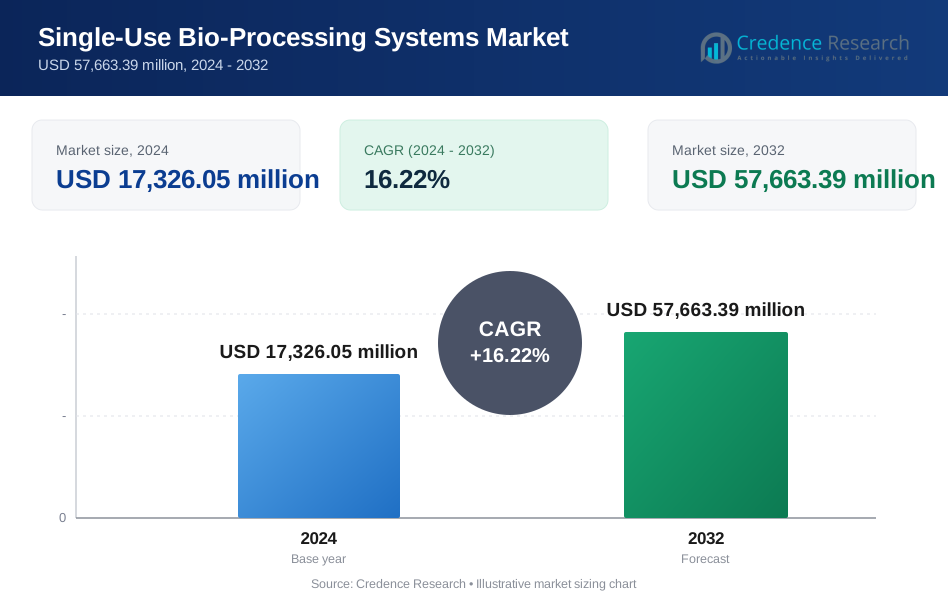
Global Single-Use Bio-Processing Systems market size was valued at USD 17,326.05 million in 2024 and is anticipated to reach USD 57,663.39 million by 2032, at a CAGR of 16.22% during the forecast period (2024-2032).
The global Single-Use Bio-Processing Systems market is driven by several key factors, including the growing demand for cost-effective, scalable, and flexible solutions in the biopharmaceutical industry. Single-use systems offer significant advantages, such as reduced risk of cross-contamination, lower capital investment, and shorter setup times, making them an attractive option for manufacturers. Additionally, the rise in biologics production, the increasing focus on personalized medicine, and advancements in cell-based therapies are further fueling market growth. Trends such as automation and the integration of smart technologies into single-use systems are also enhancing efficiency and productivity in bio-manufacturing. Furthermore, the shift towards continuous bioprocessing and increasing regulatory support for innovative bio-processing technologies are propelling the adoption of these systems. As the industry moves towards more sustainable and flexible production methods, single-use bio-processing systems are expected to play a critical role in meeting the evolving needs of the global biopharmaceutical sector.
Geographically, the global single-use bio-processing systems market is primarily driven by North America, Europe, and Asia Pacific, with each region exhibiting distinct growth factors. North America leads the market due to the strong presence of biopharmaceutical companies, substantial investments in R&D, and favorable regulatory frameworks. Europe follows closely with significant contributions from countries like Germany and the UK, where advancements in biologics and biosimilars are accelerating the adoption of single-use systems. Asia Pacific is witnessing rapid growth, fueled by expanding biopharmaceutical manufacturing capabilities and increasing healthcare demands in countries like China, India, and Japan. The Rest of the World (RoW) segment, including Latin America and the Middle East, is also poised for growth due to improvements in biomanufacturing infrastructures. Key players in the market, such as Thermo Fisher Scientific, Sartorius AG, Merck KGaA, and Danaher Corporation, are contributing significantly through innovative product offerings and strategic expansions.
Market Insights
- The global single-use bio-processing systems market was valued at USD 17,326.05 million in 2024 and is projected to reach USD 57,663.39 million by 2032, growing at a CAGR of 16.22% from 2024 to 2032.
- Increasing demand for biologics and personalized medicine is driving market growth, as single-use systems provide flexibility and cost-efficiency in production.
- Technological advancements, including automation and IoT integration, are enhancing the efficiency and performance of single-use systems.
- The market is seeing a shift towards continuous bioprocessing, with single-use systems being well-suited for these applications.
- Sustainability concerns around waste management and the environmental impact of single-use plastics are key challenges.
- North America and Europe are dominant markets, with rapid adoption in Asia Pacific due to expanding biopharmaceutical production.
- Key players like Thermo Fisher Scientific, Sartorius AG, and Merck KGaA are focusing on innovations and strategic expansions to maintain competitive advantage.
Report Scope
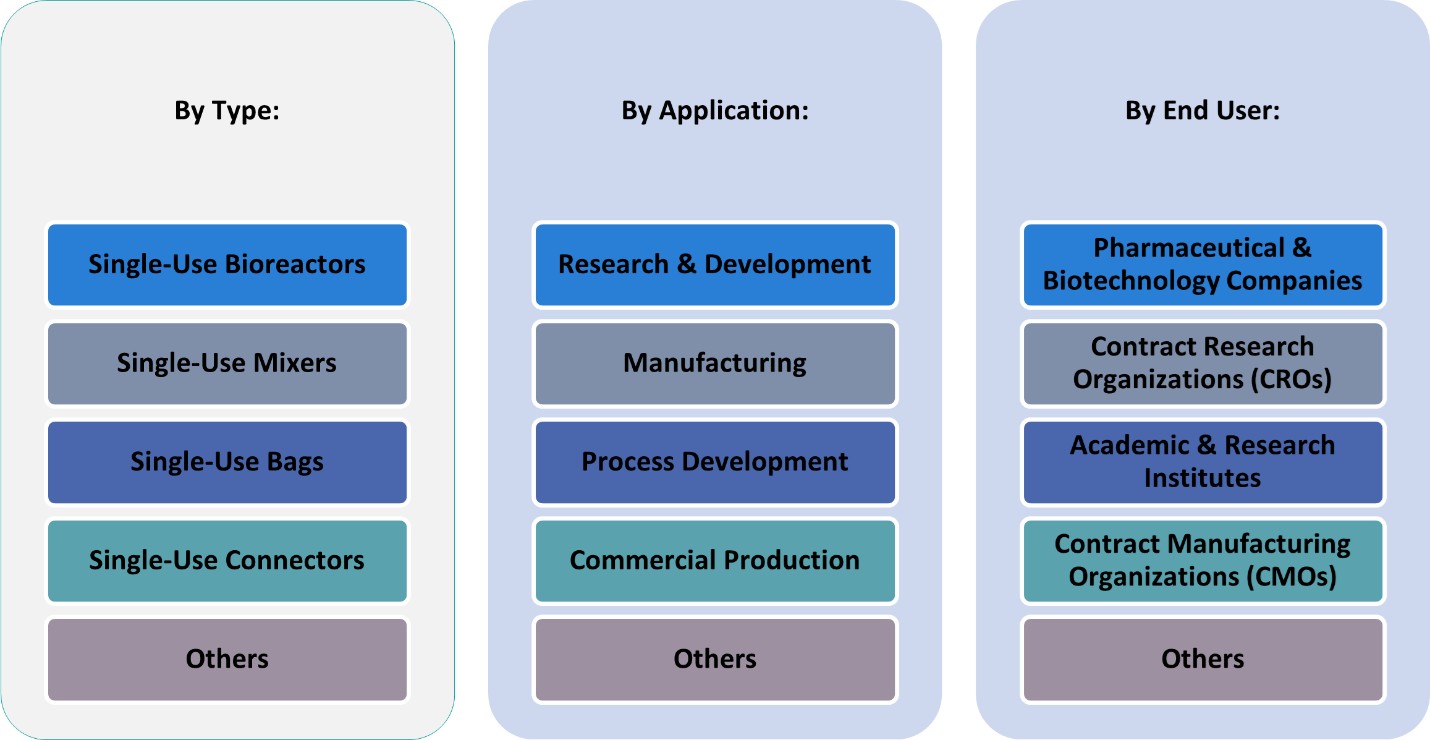
This report segments the Global Single-Use Bio-Processing Systems Market as follows:
Market Drivers
Cost-Effectiveness and Operational Efficiency
The increasing demand for cost-effective manufacturing solutions is a major driver in the growth of the global Single-Use Bio-Processing Systems market. These systems significantly reduce capital expenditure by eliminating the need for cleaning and sterilization, which are costly and time-consuming in traditional multi-use systems. Single-use components, such as bioreactors, filters, and bags, require minimal maintenance, making them a more economical option for manufacturers. For instance, the adoption of single-use bioprocessing technology has been driven by the growing demand for biopharmaceuticals and increased investments in biologics development. Additionally, the modular nature of these systems enables quicker setups and changeovers between production batches, enhancing overall operational efficiency. With biopharmaceutical companies striving to optimize production costs, single-use systems are becoming an increasingly attractive choice, especially for small and medium-sized enterprises that may not have the resources for large-scale, reusable equipment.
Rise in Biologics Production and Personalized Medicine
The growing production of biologics, including monoclonal antibodies, vaccines, and cell and gene therapies, is a key factor propelling the market for single-use bio-processing systems. Biologics require highly specialized production techniques, and the scalability of single-use systems makes them an ideal solution for the diverse needs of biologic manufacturing. These systems offer flexibility for varying production scales, from small batch clinical trials to large-scale commercial production. For instance, the commercial success of biopharmaceuticals has led single-use manufacturers to expand their production facilities globally. Moreover, the shift towards personalized medicine, which often involves tailored therapeutic products for individual patients, further supports the demand for flexible and adaptable bioprocessing equipment. As the biologics market continues to expand, the reliance on single-use bio-processing systems to meet production demands is expected to grow substantially.
Advancements in Technology and Automation
Technological advancements in single-use bio-processing systems are significantly driving their adoption. Innovations in automation, sensor integration, and data analytics are enhancing the functionality and efficiency of these systems. Automated processes, such as automated bioreactor control and real-time monitoring, enable greater precision, higher yield, and more consistent product quality. These advancements are crucial in meeting the increasing demand for large-scale, high-quality biopharmaceutical production while minimizing human error and labor costs. Additionally, the integration of smart technologies, such as Internet of Things (IoT)-enabled devices, allows for seamless tracking and optimization of production processes. As these technologies evolve, single-use systems are becoming more sophisticated, offering even greater benefits in terms of performance and productivity.
Regulatory Support and Industry Standardization
The global regulatory environment plays a significant role in accelerating the adoption of single-use bio-processing systems. Health authorities, including the U.S. Food and Drug Administration (FDA) and the European Medicines Agency (EMA), have increasingly recognized the benefits of single-use technologies, leading to a more supportive regulatory framework for their use. These systems have been proven to meet stringent safety and quality standards, providing regulatory agencies with confidence in their reliability. Additionally, the growing industry standardization of single-use systems further drives their adoption, as companies seek to align with recognized best practices and ensure compliance with regulatory guidelines. As the regulatory landscape continues to evolve, the increased support for innovative bio-processing technologies, such as single-use systems, will play a crucial role in shaping the future of biomanufacturing.
Market Trends
Increasing Adoption of Continuous Bioprocessing
One of the key trends shaping the global single-use bio-processing systems market is the growing shift towards continuous bioprocessing. Traditional batch production methods are being replaced by continuous processes that offer significant benefits, including improved yield, reduced production time, and enhanced efficiency. Single-use systems, with their modular and flexible nature, are ideally suited for continuous manufacturing environments. These systems enable streamlined workflows, where production steps such as fermentation, filtration, and packaging can be seamlessly integrated and scaled. As biopharmaceutical companies continue to embrace continuous processing to meet increasing demand and improve product quality, the role of single-use systems in this transition is becoming more critical.
Integration of Smart Technologies and IoT
The integration of smart technologies and Internet of Things (IoT) capabilities is another prominent trend in the single-use bio-processing systems market. Advances in automation and real-time data analytics are enhancing the performance and efficiency of bio-processing systems. Single-use systems are increasingly equipped with sensors, connected devices, and automated controls that allow for continuous monitoring of parameters like temperature, pressure, and pH. For instance, automation of bioprocessing systems is streamlining production processes, reducing costs, and improving efficiency. This real-time data enables manufacturers to optimize production processes, improve product consistency, and reduce downtime. As IoT-enabled solutions become more sophisticated, the ability to track and optimize every stage of production will become a critical factor in increasing operational efficiency and ensuring the highest levels of product quality.
Sustainability and Eco-friendly Innovations
Sustainability is becoming an important trend within the single-use bio-processing systems market, driven by the growing pressure on biopharmaceutical companies to adopt eco-friendly practices. Single-use systems, which require less cleaning and sterilization, inherently offer a more environmentally friendly alternative to traditional stainless-steel systems. Furthermore, manufacturers are developing biodegradable or recyclable single-use components, reducing waste associated with disposable items. For instance, regulatory agencies are increasingly supporting single-use technologies due to their ability to meet stringent safety and quality standards. In addition, innovations such as closed-loop water and waste management systems are gaining traction, helping companies minimize their environmental footprint. As sustainability becomes a key factor in regulatory compliance and public perception, the demand for eco-friendly single-use bio-processing systems is expected to rise.
Expansion in Emerging Markets
Emerging markets are playing an increasingly vital role in the growth of the single-use bio-processing systems market. Countries in Asia Pacific, Latin America, and the Middle East are experiencing rapid growth in the biopharmaceutical sector due to rising healthcare needs, improving infrastructure, and increased investments in biotechnology. In these regions, the adoption of single-use systems is accelerating as manufacturers seek cost-effective, scalable solutions for biopharmaceutical production. Additionally, the growing focus on biologics and personalized medicine in emerging markets is fueling demand for flexible and efficient bio-processing technologies. As these regions continue to develop their biomanufacturing capabilities, the adoption of single-use systems will continue to expand, further contributing to global market growth.
Market Challenges Analysis
Concerns Over Single-Use System Waste and Sustainability
One of the significant challenges facing the global single-use bio-processing systems market is the growing concern over waste management and the environmental impact of disposable components. While single-use systems are advantageous in terms of reducing cleaning and sterilization requirements, the sheer volume of single-use plastics generated by these systems poses environmental concerns. The disposal of large quantities of plastic bags, filters, and other disposable materials adds to the growing global plastic waste problem. For instance, regulatory agencies are increasingly supporting single-use technologies due to their ability to meet stringent safety and quality standards while addressing sustainability concerns. As sustainability becomes a key focus for both consumers and regulators, the biopharmaceutical industry faces increasing pressure to develop more eco-friendly solutions. Efforts to create biodegradable or recyclable materials are still in the early stages, and addressing these concerns will require continued innovation and investment in sustainable alternatives.
Limited Standardization and Compatibility Issues
Another challenge for the single-use bio-processing systems market is the lack of standardization across different manufacturers, which can lead to compatibility issues. Although many suppliers are developing single-use systems with modular designs, these components may not always be compatible with each other, creating integration challenges. This lack of uniformity can complicate the adoption of single-use systems, especially in large-scale manufacturing environments where a seamless workflow is critical. Additionally, the absence of universally accepted industry standards can lead to inefficiencies and additional costs for companies that need to invest in customized solutions. To overcome this challenge, the industry must prioritize standardization and collaborate to ensure that single-use systems can be integrated smoothly across diverse biomanufacturing processes, enabling cost savings and operational efficiency.
Market Opportunities
The global single-use bio-processing systems market presents several compelling opportunities driven by the increasing demand for biologics, personalized medicine, and cost-effective production methods. As the biopharmaceutical industry continues to grow, particularly in the production of monoclonal antibodies, vaccines, and cell-based therapies, the need for scalable, flexible, and efficient manufacturing solutions has become more pronounced. Single-use systems provide an ideal solution for these demands, offering reduced capital expenditures, faster setup times, and lower operational costs. The ongoing shift towards biologics, coupled with the rise of personalized medicine, creates a significant opportunity for single-use systems to become the standard for biomanufacturers looking to scale production rapidly while maintaining high levels of quality and flexibility. Additionally, the expansion of biologics production in emerging markets, such as Asia Pacific and Latin America, presents new growth avenues for these systems as companies in these regions seek cost-efficient and adaptable solutions to meet rising healthcare demands.
Another key opportunity lies in the increasing focus on automation and smart technologies within the bio-manufacturing sector. The integration of IoT-enabled devices, sensors, and real-time data analytics into single-use bio-processing systems offers the potential to optimize production processes, reduce human error, and improve overall product consistency. As biopharmaceutical companies continue to prioritize operational efficiency and product quality, the demand for advanced, automated single-use systems will likely surge. Furthermore, sustainability concerns present opportunities for innovation in developing eco-friendly single-use components, such as biodegradable or recyclable materials, to address the growing environmental impact of disposable bio-processing systems. By capitalizing on these trends, manufacturers in the single-use bio-processing systems market can position themselves for long-term growth and success.
Market Segmentation Analysis:
By Type:
The global single-use bio-processing systems market is segmented by type into Single-Use Bioreactors, Single-Use Mixers, Single-Use Bags, Single-Use Connectors, and Others. Among these, Single-Use Bioreactors dominate the market due to their significant role in cell culture processes, a critical step in biologics manufacturing. These bioreactors are favored for their flexibility, scalability, and cost-effectiveness, allowing manufacturers to scale production while minimizing cleaning and sterilization time. Single-Use Mixers are also essential in bio-manufacturing for homogenizing and blending components, providing a critical solution for efficient production. Single-Use Bags serve as vital components for liquid storage and transport, offering benefits such as reduced contamination risk and enhanced convenience. Single-Use Connectors are integral for ensuring safe fluid transfer between systems, reducing the chance of leaks and cross-contamination. The "Others" category includes accessories and components that support the overall bio-processing process but contribute less to the overall market share. As the demand for biopharmaceutical production rises, the growth of these segments continues to be driven by increasing adoption in flexible manufacturing environments.
By Application:
In terms of application, the single-use bio-processing systems market is segmented into Research & Development, Manufacturing, Process Development, Commercial Production, and Others. Research & Development is a key application segment, as single-use systems provide flexibility and cost-efficiency, essential for small-scale production and experimentation during the early phases of drug development. Manufacturing accounts for a significant share due to the demand for scalable, cost-effective, and rapid production solutions. Process Development focuses on optimizing production processes, where single-use systems enable quick adjustments and flexible workflows, particularly during the clinical and pre-commercial stages. Commercial Production represents the largest application, as companies increasingly adopt single-use systems for large-scale biopharmaceutical production. These systems reduce operational costs and time-to-market for new therapies. The Others category includes applications such as training and small-scale production runs. Across these segments, the trend toward personalization and biologics production continues to drive the growth of single-use systems in the bio-manufacturing process.
Segments:
Based on Type:
- Single-Use Bioreactors
- Single-Use Mixers
- Single-Use Bags
- Single-Use Connectors
- Others
Based on Application:
- Research & Development
- Manufacturing
- Process Development
- Commercial Production
- Others
Based on End- User:
- Pharmaceutical & Biotechnology Companies
- Contract Research Organizations (CROs)
- Academic & Research Institutes
- Contract Manufacturing Organizations (CMOs)
- Others
Based on the Geography:
- North America
- U.S.
- Canada
- Mexico
- Europe
- UK
- France
- Germany
- Italy
- Spain
- Russia
- Belgium
- Netherlands
- Austria
- Sweden
- Poland
- Denmark
- Switzerland
- Rest of Europe
- Asia Pacific
- China
- Japan
- South Korea
- India
- Australia
- Thailand
- Indonesia
- Vietnam
- Malaysia
- Philippines
- Taiwan
- Rest of Asia Pacific
- Latin America
- Brazil
- Argentina
- Peru
- Chile
- Colombia
- Rest of Latin America
- Middle East
- UAE
- KSA
- Israel
- Turkey
- Iran
- Rest of Middle East
- Africa
- Egypt
- Nigeria
- Algeria
- Morocco
- Rest of Africa
Regional Analysis
North America
North America holds the largest market share of approximately 40% of the global single-use bio-processing systems market. The United States, in particular, is a key player, driven by the substantial presence of pharmaceutical and biotechnology companies, a robust regulatory framework, and significant investments in biopharmaceutical R&D. The market in this region benefits from early adoption of advanced bio-processing technologies, including single-use systems, driven by the need for cost-effective, flexible, and scalable production methods. The increasing focus on biologics, cell and gene therapies, and personalized medicine also contributes to the market's expansion in North America. Additionally, the high concentration of contract manufacturing organizations (CMOs) in the U.S. further accelerates the adoption of single-use bio-processing systems.
Europe
Europe holds the second-largest market share, contributing approximately 30% to the global single-use bio-processing systems market. The region benefits from a strong pharmaceutical industry and a growing demand for biologics and biosimilars. Countries such as Germany, France, and the United Kingdom are leading the charge in adopting single-use technologies for biopharmaceutical production. The European market is also supported by increasing investments in research and development, as well as the presence of well-established academic and research institutions focused on advancing bio-manufacturing processes. Regulatory support and the ongoing shift towards more flexible and efficient production methods in Europe are key drivers of the market in this region.
Asia Pacific
Asia Pacific is witnessing the fastest growth, with a market share of around 20%. This region is characterized by rapid industrialization, expanding healthcare needs, and increasing investments in biotechnology. Countries like China, India, Japan, and South Korea are emerging as significant markets for single-use bio-processing systems, driven by their growing pharmaceutical manufacturing capabilities and a surge in biologics production. The demand for flexible, cost-effective, and scalable bioprocessing solutions in Asia Pacific is expected to continue rising, especially as many countries in the region focus on strengthening their biotechnology and life sciences sectors. The low manufacturing costs, combined with the increasing adoption of innovative bio-manufacturing technologies, position Asia Pacific for continued growth.
Rest of the World (RoW)
The Rest of the World (RoW) segment, which includes regions like Latin America, the Middle East, and Africa, holds a smaller market share, approximately 10%. However, these regions present significant growth opportunities due to increasing healthcare investments, improving biopharmaceutical infrastructures, and rising demand for cost-effective production technologies. Countries in Latin America, such as Brazil and Mexico, are investing heavily in biotechnology, driving demand for single-use bio-processing systems. Similarly, the Middle East and Africa are gradually increasing their adoption of modern bio-manufacturing technologies, with key developments seen in the healthcare and life sciences sectors. Although the market share remains relatively smaller, the RoW segment is expected to grow at a strong pace, driven by emerging markets' expansion in biologics production.
Key Player Analysis
- Thermo Fisher Scientific Inc.
- Sartorius AG
- Merck KGaA
- Danaher Corporation
- Eppendorf AG
- Corning Incorporated
- PBS Biotech, Inc.
- Entegris, Inc.
- Celltainer Biotech BV
- Meissner Filtration Products, Inc.
Competitive Analysis
The global single-use bio-processing systems market is highly competitive, with leading players such as Thermo Fisher Scientific Inc., Sartorius AG, Merck KGaA, Danaher Corporation, Eppendorf AG, Corning Incorporated, PBS Biotech, Inc., Entegris, Inc., Celltainer Biotech BV, and Meissner Filtration Products, Inc. dominating the landscape. These companies are leveraging a combination of innovative product offerings, strategic acquisitions, and expanding global footprints to maintain competitive advantage. Many market players are enhancing their competitive positions by investing in technological advancements such as automation, smart sensors, and IoT-enabled devices. These technologies enable real-time monitoring, process optimization, and greater control over production, providing a clear edge in the market. Companies also focus on addressing sustainability challenges by developing environmentally friendly and recyclable single-use components, responding to the growing concern over plastic waste. In addition to technological innovation, strategic partnerships, mergers, and acquisitions are common in this highly dynamic sector, allowing companies to expand their portfolios and access new markets. The market’s competitive environment is expected to intensify further as more players enter the space, focusing on offering cost-effective, efficient, and customizable solutions to meet the evolving needs of the biopharmaceutical industry.
Recent Developments
- In April 2025, Thermo Fisher Scientific launched the 5L DynaDrive Single-Use Bioreactor, a bench-scale system designed for seamless scalability from 1 to 5,000 liters. This new bioreactor offers a 27% productivity increase over glass bioreactors, enhanced sustainability with biobased films, and consistent performance across different scales, supporting both large and small biopharma manufacturers. The DynaDrive S.U.B. supports robust production across scales and has the flexibility to accommodate a variety of cell lines and processing modalities.
- In April 2025, Sartorius Stedim Biotech entered a strategic partnership with Tulip Interfaces to drive digital transformation in single-use bioprocessing. The collaboration introduced Biobrain® Operate powered by Tulip, a suite of digital manufacturing applications that integrate with Sartorius equipment to reduce process variability, digitize operations, and ensure regulatory compliance. This partnership aims to advance paperless manufacturing and optimize resource efficiency in bioprocessing.
- In March 2025, Corning introduced new technologies to support advanced therapy applications, including the Ascent™ Fixed Bed Reactor (FBR) and expanded cell expansion platforms like HYPERStack®, HYPERFlask®, and CellSTACK®. These platforms feature closed systems and automation to reduce contamination risk and enhance scalability for bioprocess applications.
- In April 2023, Merck KGaA launched the Ultimus® Single-Use Process Container Film, featuring ten times greater abrasion resistance than other films, improved durability, and leak resistance for single-use assemblies. The technology is now available in Mobius® 3D process containers, enhancing operational efficiency and cell growth performance.
Market Concentration & Characteristics
The global single-use bio-processing systems market exhibits moderate concentration, with a few key players dominating the market while a significant number of smaller companies cater to niche segments. The market is characterized by high competition, driven by continuous technological advancements, product innovations, and the growing demand for biologics and personalized medicine. Companies in this sector focus on offering a diverse range of products, including single-use bioreactors, mixers, bags, connectors, and other essential components for bio-manufacturing. As the industry continues to grow, larger players are increasing their market share through strategic acquisitions and partnerships to expand their product portfolios and enhance their geographic reach. Smaller players, on the other hand, often differentiate themselves through specialized solutions, customized products, and regional expertise. The market's characteristics are shaped by the ongoing need for flexibility, scalability, and cost efficiency in biopharmaceutical production, with an emphasis on sustainable and eco-friendly solutions.
Report Coverage
The research report offers an in-depth analysis based on Type, Application, End-User and Geography. It details leading market players, providing an overview of their business, product offerings, investments, revenue streams, and key applications. Additionally, the report includes insights into the competitive environment, SWOT analysis, current market trends, as well as the primary drivers and constraints. Furthermore, it discusses various factors that have driven market expansion in recent years. The report also explores market dynamics, regulatory scenarios, and technological advancements that are shaping the industry. It assesses the impact of external factors and global economic changes on market growth. Lastly, it provides strategic recommendations for new entrants and established companies to navigate the complexities of the market.
Future Outlook
- The global single-use bio-processing systems market is expected to continue growing rapidly due to the increasing demand for biologics and personalized medicine.
- Technological advancements such as automation, IoT integration, and real-time monitoring will drive further efficiency and innovation in bio-manufacturing.
- Sustainability will become a key focus, with manufacturers developing eco-friendly and recyclable single-use components to address environmental concerns.
- The market will see an increased adoption of single-use systems in emerging markets, particularly in Asia Pacific, driven by expanding biopharmaceutical manufacturing capabilities.
- The demand for flexible, scalable, and cost-effective manufacturing solutions will continue to propel the growth of single-use bio-processing systems.
- Customization and the ability to integrate with existing systems will become crucial factors for companies in the selection of single-use solutions.
- The shift towards continuous bioprocessing will further accelerate the adoption of single-use systems in large-scale commercial production.
- Partnerships and collaborations between biopharmaceutical companies and bio-processing system providers will increase to meet the growing need for advanced manufacturing solutions.
- Research and development will focus on improving the performance and efficiency of single-use systems, reducing production costs, and enhancing scalability.
- The growing importance of regulatory compliance and quality control in bio-manufacturing will drive further innovation in single-use bio-processing systems.
Request a Free Sample
Fill in your details and we'll send you a free sample report.
- Sample data tables & charts
- Research methodology
Need a Custom Version of This Report?
Tailor the scope, geography, or segments to your exact requirements.
- Custom geography or segment scope
- Direct access to our analyst team
Frequently Asked Questions
What is the current size of the Global Single-Use Bio-Processing Systems?
What factors are driving the growth of the Global Single-Use Bio-Processing Systems?
What are some challenges faced by the Global Single-Use Bio-Processing Systems?
Who are the major players in this market?
Table of Content
Chapter 1. Report Introduction
- 1.1 Report Description & Purpose
- 1.1.1 Report Title & Market Definition
- 1.1.2 Unique Selling Propositions (USP) & Key Differentiators
- 1.1.3 Value Proposition for Stakeholders
- 1.2 Research Objectives
- 1.2.1 Market Sizing Objectives (Volume & Revenue)
- 1.2.2 Segmentation Objectives
- 1.2.3 Competitive Intelligence Objectives
- 1.2.4 Forecast & Scenario Objectives
- 1.3 Report Scope
- 1.3.1 Single-Use Bio-Processing Systems Scope – Types & Subtypes Covered
- 1.3.2 Geographic Scope – Regions & Countries Covered
- 1.3.3 Historical Period, Base Year & Forecast Period (2024; forecast to 2032)
- 1.3.4 Inclusions & Exclusions
- 1.4 HS Code & Classification Framework
- 1.5 Currency, Units & Pricing Basis
- 1.6 Target Stakeholders
- 1.7 Limitations & Assumptions
Chapter 2. Executive Summary
- 2.1 Global Single-Use Bio-Processing Systems Market Snapshot
- 2.1.1 Market Size – Historical (2024) & Forecast (2024-2032) (2024: USD 17,326.05 million → 2032: USD 57,663.39 million)
- 2.1.2 Volume & Revenue – Global Totals
- 2.1.3 Key Market Highlights – Top Five Facts
- 2.2 Single-Use Bio-Processing Systems Market Segmentation Snapshot
- 2.2.1 Market Split by Region – 2024 vs. 2032
- 2.3 Competitive Snapshot
- 2.3.1 Top 10 Players by Revenue Share – 2024
- 2.3.2 Top 10 Players by Volume Share – 2024
- 2.3.3 Recent Strategic Developments (18-Month Summary)
- 2.4 Key Investment Highlights & Strategic Conclusions
Chapter 3. Single-Use Bio-Processing Systems Market Dynamics & Industry Analysis
- 3.1 Market Overview & Context
- 3.1.1 Single-Use Bio-Processing Systems Market Position in the Broader Automotive Value Chain
- 3.1.2 OEM vs. Replacement Market Dynamics
- 3.1.3 Market Maturity & Development Stage by Region
- 3.2 Single-Use Bio-Processing Systems Market Drivers
- 3.3 Single-Use Bio-Processing Systems Market Restraints & Challenges
- 3.4 Single-Use Bio-Processing Systems Market Opportunities
- 3.5 Porter's Five Forces Analysis
- 3.5.1 Threat of New Entrants
- 3.5.2 Bargaining Power of Suppliers
- 3.5.3 Bargaining Power of Buyers
- 3.5.4 Threat of Substitutes
- 3.5.5 Competitive Rivalry – Intensity Assessment
- 3.6 Single-Use Bio-Processing Systems Value Chain Analysis
- 3.6.1 Upstream – Raw Material/Input Suppliers
- 3.6.1.1 Raw Material/Input 1
- 3.6.1.2 Raw Material/Input 2
- 3.6.1.3 Raw Material/Input 3
- 3.6.2 Midstream – Production/Manufacturing/Service Delivery
- 3.6.2.1 Production/Process Overview
- 3.6.2.2 Key Facility Locations & Capacity by Manufacturer
- 3.6.3 Downstream – Distribution & End Consumer
- 3.6.3.1 Primary Channel – B2B/OEM
- 3.6.3.2 Secondary Channels – Dealer, Retail, Online, Direct
- 3.6.4 Value Chain Profitability Analysis
- 3.6.1 Upstream – Raw Material/Input Suppliers
- 3.7 PESTEL Analysis
- 3.7.1 Political Factors
- 3.7.2 Economic Factors
- 3.7.3 Social Factors
- 3.7.4 Technological Factors
- 3.7.5 Environmental Factors
- 3.7.6 Legal Factors
- 3.8 Single-Use Bio-Processing Systems Supply Chain Analysis
- 3.8.1 Raw Material/Input Supply Risk Assessment
- 3.8.2 Manufacturing Concentration Risk (Geographic Exposure)
- 3.8.3 Trade Disruption Impact Analysis
- 3.9 Regulatory & Policy Landscape
Note: The regulatory and policy landscape section covers regulations based on their applicability to the market, Single-Use Bio-Processing Systems category, geography, and scope of the study. Only regulatory frameworks with a material impact on operations, compliance, trade, sustainability, or market access are analyzed in detail.
Chapter 4. Key Investment Pockets & Opportunity Analysis
- 4.1 Single-Use Bio-Processing Systems Market Attractiveness Analysis
- 4.1.1 By Region – Investment Attractiveness Matrix (Volume × CAGR)
- 4.2 Absolute Revenue Growth Opportunity
- 4.2.1 By Region – Absolute USD Growth Through 2032
- 4.3 Incremental Volume Opportunity
- 4.3.1 By Region – Incremental Volume Through 2032
- 4.3.2 Segment – Incremental Volume
- 4.4 Emerging Submarket Opportunity Deep Dive (Subject to Applicability)
- 4.5 Emerging Market Opportunity Scorecards
- 4.5.1 United States
- 4.5.2 Europe
- 4.5.3 Asia
- 4.5.4 Middle East & Africa
Note: Emerging Market Opportunity Scorecards will be included based on relevance and strategic importance. Regions listed are indicative and may vary depending on data availability and market dynamics.
Chapter 5. Single-Use Bio-Processing Systems Import-Export Analysis & Trade Flows
- 5.1 Global Trade Overview
- 5.1.1 Global Export Value by Country (2024)
- 5.1.2 Global Export Volume by Country (2024)
- 5.1.3 Global Import Value by Country (2024)
- 5.1.4 Global Import Volume by Country (2024)
- 5.1.5 Net Trade Balance by Country (2024)
- 5.2 Export Analysis – Segment
- 5.2.1 Type 1 (HS Code)
- 5.2.2 Type 2 (HS Code)
- 5.2.3 Type 3 (HS Code)
- 5.2.4 Type 4 (HS Code)
- 5.2.5 Type 5 (HS Code)
- 5.3 Import Analysis – Segment
- 5.3.1 Type 1 (HS Code)
- 5.3.2 Type 2 (HS Code)
- 5.3.3 Type 3 (HS Code)
- 5.3.4 Type 4 (HS Code)
- 5.3.5 Type 5 (HS Code)
- 5.4 Average Unit Trade Prices
- 5.4.1 Average Export Price – Segment & Country
- 5.4.2 Average Import Price – Segment & Source Country
- 5.4.3 Price Trends (2024)
- 5.5 Key Trade Route Analysis
- 5.5.1 Trade Route 1
- 5.5.2 Trade Route 2
- 5.5.3 Trade Route 3
- 5.5.4 Trade Route 4
- 5.5.5 Trade Route 5
- 5.6 Trade Policy Impact Assessment
- 5.6.1 US Anti-Dumping & Section 301 Tariffs
- 5.6.2 EU Customs Union Impact
- 5.6.3 Major Free Trade Agreements
- 5.6.4 USMCA Rules of Origin
Note: Trade policy analysis will be included only where relevant to the Single-Use Bio-Processing Systems market.
Chapter 6. Competitive Landscape & Company Benchmarking
- 6.1 Single-Use Bio-Processing Systems Market Concentration & Structure
- 6.1.1 Herfindahl-Hirschman Index (HHI) – vs. 2024
- 6.1.2 Tier 1, Tier 2 & Tier 3 Market Structure
- 6.1.3 Global, Regional & Local Player Dynamics
- 6.2 Single-Use Bio-Processing Systems Market Share Analysis – 2024
- 6.2.1 Global Revenue Share by Company
- 6.2.2 Global Volume Share by Company
- 6.2.3 Regional Revenue Share
- 6.2.4 Market Share Evolution ( vs. 2024)
- 6.2.5 OEM Segment Share by Company
- 6.2.6 Replacement Segment Share by Company
- 6.3 Production/Delivery Capacity & Facility Analysis
- 6.3.1 Global Installed Capacity
- 6.3.2 Capacity Utilization Rates
- 6.3.3 Production/Output Volume
- 6.3.4 Facility Locations & Capacity Map
- 6.3.5 Planned Capacity Additions
- 6.4 Single-Use Bio-Processing Systems Competitive Benchmarking Matrix
- 6.4.1 Revenue, Volume, CAGR & Profitability Comparison
- 6.4.2 Channel Revenue Mix
- 6.4.3 Geographic Revenue Exposure
- 6.4.4 R&D Intensity
- 6.4.5 Sustainability Maturity
- 6.5 Strategic Developments in Single-Use Bio-Processing Systems (Last 24 Months)
- 6.5.1 Mergers, Acquisitions & Divestments
- 6.5.2 New Single-Use Bio-Processing Systems Launches
- 6.5.3 Facility Expansions
- 6.5.4 Strategic Alliances, Joint Ventures & Partnerships
- 6.5.5 Distribution Expansion & Market Entry
- 6.5.6 Sustainability & ESG Initiatives
- 6.6 Competitive Strategy Mapping
- 6.6.1 Leader, Challenger, Follower & Niche Classification
- 6.6.2 Pricing Strategy Comparison
- 6.6.3 Channel Strategy Matrix
Note: Strategic developments are included based on their materiality and the availability of reliable information.
Chapter 7. Global Single-Use Bio-Processing Systems Market – By Distribution Channel
- 7.1 Segment Overview
- 7.1.1 Volume & Revenue Split by Channel (2024 & 2032)
- 7.1.2 Channel Mix Evolution (2024-2032)
Chapter 8. Regional Market Analysis – Global Overview
- 8.1 Global Regional Overview
- 8.1.1 Regional Volume Share
- 8.1.2 Regional Revenue Share
- 8.1.3 Regional Volume by Region
- 8.1.4 Regional Revenue by Region
- 8.1.5 Regional Forecast Through 2032
- 8.2 Cross-Regional Segment Analysis
- 8.2.1 By Distribution Channel
- 8.2.2 By Brand/Price Tier
Chapter 9. North America Single-Use Bio-Processing Systems Market
- 9.1 United States
- 9.2 Canada
- 9.3 Mexico
Chapter 10. Europe Single-Use Bio-Processing Systems Market
- 10.1 Germany
- 10.2 France
- 10.3 Italy
- 10.4 United Kingdom
- 10.5 Spain
- 10.6 Poland
- 10.7 Russia
- 10.8 Netherlands
- 10.9 Belgium
- 10.10 Sweden
- 10.11 Denmark
- 10.12 Norway
- 10.13 Rest of Europe
Chapter 11. Asia Pacific Single-Use Bio-Processing Systems Market
- 11.1 China
- 11.2 India
- 11.3 Japan
- 11.4 South Korea
- 11.5 Thailand
- 11.6 Indonesia
- 11.7 Vietnam
- 11.8 Malaysia
- 11.9 Australia
- 11.10 Rest of Asia Pacific
Chapter 12. Latin America Single-Use Bio-Processing Systems Market
- 12.1 Brazil
- 12.2 Argentina
- 12.3 Colombia
- 12.4 Chile
- 12.5 Rest of Latin America
Chapter 13. Middle East Single-Use Bio-Processing Systems Market
- 13.1 Saudi Arabia
- 13.2 United Arab Emirates
- 13.3 Turkey
- 13.4 Israel
- 13.5 Iran
- 13.6 Rest of the Middle East
Chapter 14. Africa Single-Use Bio-Processing Systems Market
- 14.1 South Africa
- 14.2 Egypt
- 14.3 Nigeria
- 14.4 Morocco
- 14.5 Rest of Africa
Chapter 15. Single-Use Bio-Processing Systems Company Profiles
- 15.1 [Company 01]
- 15.1.1 Company Overview
- 15.1.2 Key Management Personnel
- 15.1.3 Products & Services Portfolio
- 15.1.4 Financial Performance
- 15.1.5 Key Market Focus & Geographic Presence
- 15.1.6 Recent Developments & Strategic Initiatives
Note: The company profile list is preliminary and may change based on research findings, market developments, data availability, and client requirements.
Chapter 16. Appendices
- Appendix A – List of Abbreviations & Acronyms
- Appendix B – Industry Classification Code Reference – Full Series
- Appendix C – Production & Capacity Data Tables
- Appendix D – End-Use & Demand Base Tables
- Appendix E – Consumption & Replacement Rate Assumptions
- Appendix F – ASP Reference Tables
- Appendix G – Manufacturing & Facility Database
- Appendix H – Import-Export Data Tables
- Appendix I – Regulatory Summary Tables
- Appendix J – Primary Research Participant List (Anonymized)
- Appendix K – Primary Research Questionnaire Framework
- Appendix L – Data Sources & Bibliography
- Appendix M – Market Size Divergence & Source Comparison
Chapter 17. Research Methodology
- 17.1 Research Framework & Philosophy
- 17.2 Secondary Research – Sources, Hierarchy & Data Extraction
- 17.3 Data Modeling – Bottom-Up & Top-Down Market Sizing
- 17.4 Primary Research – Stakeholder Framework, LOI & Sample Sizes
- 17.5 Forecast Methodology – Regression, Scenario & Sensitivity Analysis
- 17.6 Quality Control – Four-Layer Validation Framework
- 17.7 Limitations & Standard Assumptions
- 17.8 Disclaimer
