
| REPORT ATTRIBUTE | DETAILS |
|---|---|
| Historical Period | 2019-2022 |
| Base Year | 2023 |
| Forecast Period | 2024-2032 |
| Web Real-Time Communication Market Size 2023 | USD 1725.8 million |
| Web Real-Time Communication Market, CAGR | 32.30% |
| Web Real-Time Communication Market Size 2032 | USD 21430.34 million |
Market Insights
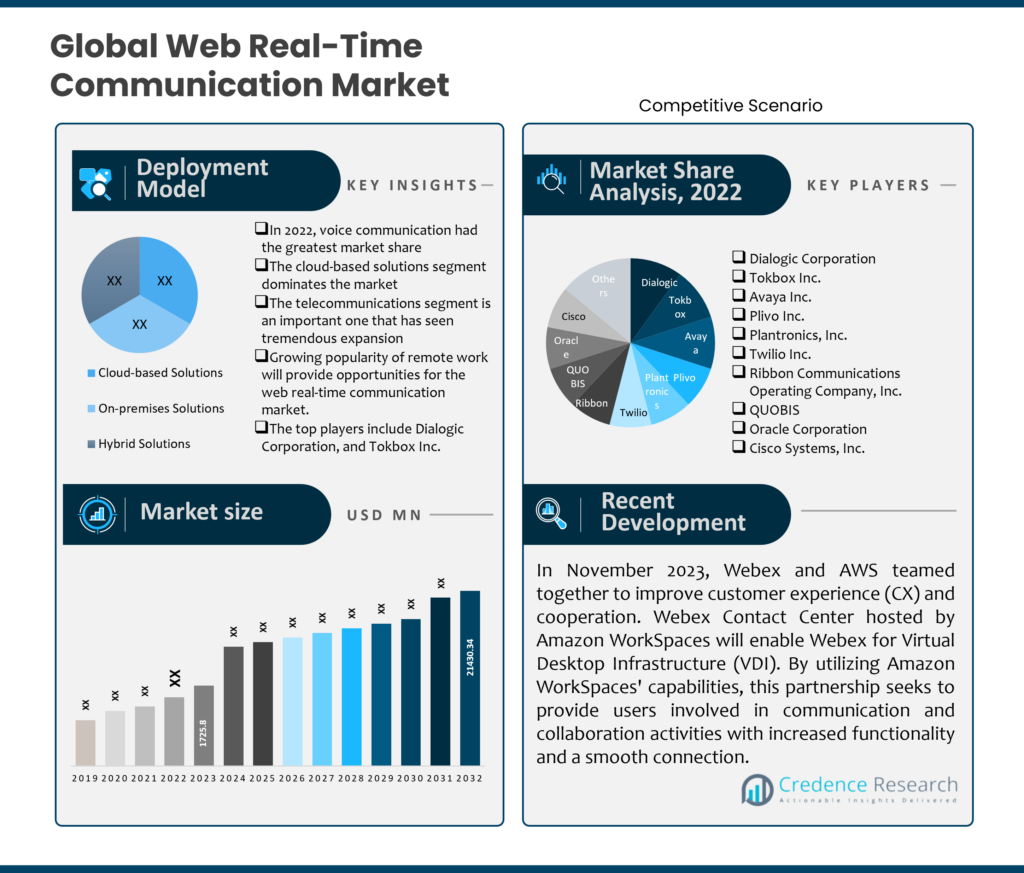
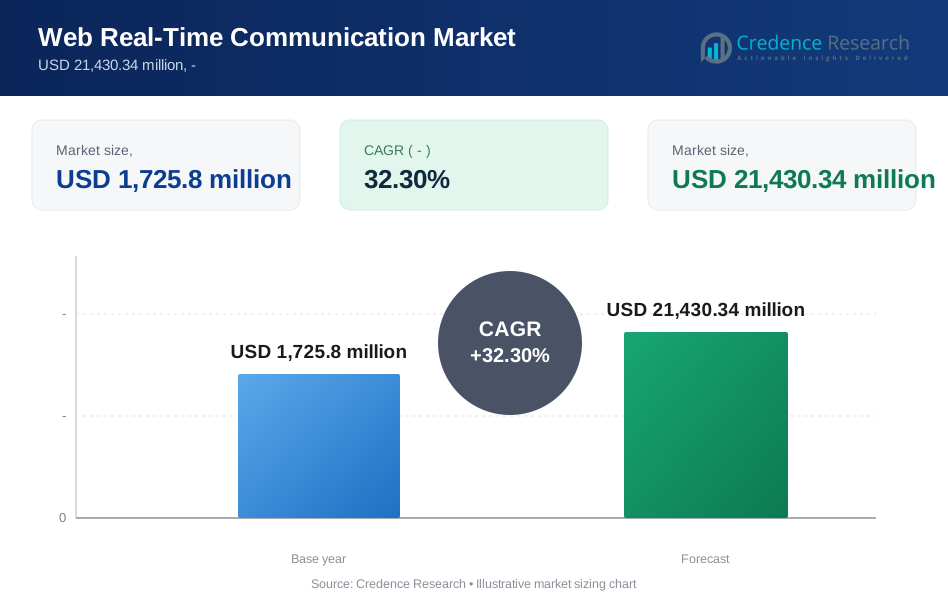
- Between 2024 and 2032, the global market for web real-time communication is projected to rise at a compound annual growth rate (CAGR) of 32.30%, from an estimated USD 1725.8 million in 2023 to USD 21430.34 million in 2032.
- The largest category is voice communication. Video communication, on the other hand, is expected to grow at a strong CAGR.
- The cloud-based solutions category will expand at a rapid rate of growth.
- The CAGR for telecommunications is expected to be the highest during the projection period.
- North America governed the market for web real-time communication.
- Regarding the market share of web real-time communication, Europe is expected to come second.
- In the web real-time communication market, Asia Pacific is anticipated to grow fastest.
- The spread of internet connectivity and the rising need for real-time communication are the main factors driving the global market's expansion.
- The variables supporting the development of the web real-time communication industry include the increasing acceptance of remote work, expanding rates of smartphone and tablet use, and more convenient access to webRTC-enabled applications on mobile platforms.
Executive Summary
Market Definition
WebRTC, or Web Real-Time Communication, is a technology that allows websites and applications to record and stream audio and video content. It also allows arbitrary data to be exchanged between browsers without the need for a middleman. The user experience offered by WebRTC is seamless and native. Being peer-to-peer, it minimizes server dependency and guarantees low-latency communication.
Market Overview
The web real-time communication sector is predicted to continue its upward trend between 2024 and 2032, growing at a compound annual growth rate (CAGR) of 32.30%. From its projected USD 1725.8 million in 2023 to USD 21430.34 million in 2032, the market will continue to grow.
WebRTC-based solutions are less costly because they don't require any extra plugins or software to work properly. With WebRTC, any web server can offer a distinctive real-time communication experience that is remarkably dependable, easy to use, and reasonably priced. Due to WebRTC, browser-based applications may now simulate real-time user experiences. It also offers inexpensive, secure web communication with a host of advantages, such as easy deployment across multiple operating systems and device types. Due to these significant benefits, WebRTC technology is currently highly sought after by numerous small and medium-sized enterprises.
Business-specific solutions that are specifically tailored to their needs should offer significant opportunities for growth. Some businesses ask for specialized WebRTC solutions in order to meet their unique business needs. While WebRTC solutions are standard across all industry verticals, offering tailored solutions can assist market participants in improving their market visibility. As a result, there is a significant market growth potential for customized solutions.
Segmentation by Product Type
- The voice communication category is the market leader in terms of product type. Voice communication is when two people speak to each other at the same time, like during a typical phone call. Through the utilization of WebRTC, developers may incorporate rich and engaging voice experiences into web apps, facilitating smooth user interaction and collaboration across many platforms and devices.
- The video communication category will exhibit a sizable CAGR during the projected period. Video communication is essentially a form of communication that enables people to connect electronically and have face-to-face conversations about internal communications or corporate meetings.
- Other product types, including data sharing and file transfer, screen sharing, instant messaging and chat, and collaboration tools, also support the need for web real-time communication.
Segmentation by Deployment Model
- Cloud-based solutions are considered the best deployment model. Cloud-based media servers handle real-time media processing operations like transcoding, mixing, and stream routing. By automatically adjusting to network conditions and client capabilities, these servers guarantee peak performance and quality of service (QoS).
- The on-premises solutions category will likely register a significant CAGR during forecasting. Instead of depending on outside cloud providers, on-premises Web Real-Time Communication (WebRTC) solutions give businesses the freedom and power to implement and administer real-time communication services inside their infrastructure.
- Other deployment models, such as hybrid solutions, also contribute to the demand for web real-time communication.
Segmentation by End-User Industry
- The telecommunications category is projected to grow faster over the projection period. The telecommunications industry has already experienced disruption as a result of the Internet and application ecosystem. Real-time internet communication has become crucial as social networks and voice-over-internet protocol (VoIP) gain popularity among consumers globally. To keep up with the latest communication trends, telecom companies are evaluating their conventional communication services and creating new ones.
- Other end-user industries influence the need for web real-time communication, including enterprise and corporate, finance and banking, healthcare, education, retail and e-commerce, government and public sector, and media and entertainment.
Segmentation by Region
- North America leads the web real-time communication industry. The existence of significant market participants like Avaya Inc., Oracle Corporation, Cisco Systems, Inc., and Ribbon Communications Operating Company, Inc. is attributed for this. The growing need for virtual meetings combined with high-speed internet access is a key factor propelling this region's industry expansion.
- Europe is estimated to rank second in web real-time communication market size.
- The web real-time communication industry is predicted to flourish rapidly in Asia Pacific.
- The remaining need for web real-time communication is covered by regions including Latin America, Africa, and the Middle East.
During the projected period, the increasing percentage of internet users is anticipated to have a beneficial effect on the market. The International Telecommunication Union (ITU) reports that, compared to 51.4% in 2018, over 53.6% of people on the planet have internet connectivity in 2019. The market is expected to rise as internet penetration increases. Furthermore, the introduction of 5G technology will support BSPs in expanding their business to include WebRTC-based high-quality image provision for e-sports streaming, personal broadcasting, interactive advertising, and educational broadcasting. Businesses benefit from increased customer involvement as a result of viewers being able to speak in both directions.
Based on projections, North America is anticipated to control the web real-time communication market. Significant infrastructure development is available in North America for the use of WebRTC technology. North America was the original home of popular WebRTC services, including Facebook, Twitter, Snapchat, and Google Hangouts. Leading suppliers are also concentrating on creating cutting-edge solutions, forming strategic partnerships, and expanding geographically to fortify their position in the market and raise awareness of this new technology throughout the world.
Asia Pacific's web real-time communication market is expected to grow at a rapid pace during the forecast period. Due to factors such as a large population base, rapidly increasing smartphone penetration, increased competition among telecom service providers, GDP growth, and a spike in millennials' use of social media, Asia-Pacific is predicted to experience the highest growth in the WebRTC sector. Additionally, in order to draw in more users for improved communication, businesses are encouraged to incorporate excellent communication and collaboration features into their applications due to the speedier data access on mobile and Internet networks.
Key Highlights of the Report
The global web real-time communication market is segmented by product type, deployment model, end-user industry, and region. The voice communication category is the market spearhead in terms of product type, and cloud-based solutions are the top deployment model. The telecommunications category is anticipated to increase at the highest CAGR throughout the projection period. The web real-time communication market is expanding mostly in North America.
The rising acceptance of cloud-based solutions has led to the adoption of web real-time communication solutions and services by several SMEs in European countries, such as the UK, France, and Germany, in recent years. Europe is seeing an increase in demand for software development services. Offering affordable, user-friendly, industry-specific WebRTC-based communication solutions is the primary goal of Web real-time communication solution providers in the European market. Web real-time communication solutions are becoming more and more in demand across several industry sectors, including BFSI, healthcare, and IT & telecom.
North America is expected to account for the largest web real-time communication market globally. In an effort to regain audience share, telecom firms are partnering with WebRTC providers. A secure, instantaneous communication channel within any website session is made possible by the North America Partner Program, which was introduced in April 2017 by WebRTC developer and software-as-a-service provider i-COMM Connect. It is also anticipated that the market will develop at the fastest rate in the Asia Pacific region. Furthermore, substantial prospects for market growth are projected due to increases in IT investment and population expansion in nations like China and India.
Which Key Factors Are Driving The Global Web Real-time Communication Market?
The need for customer interaction solutions, the rise of WebRTC platforms, the use of cloud computing, and the developments in web technology. These considerations are leading to an expansion of the web real-time communications sector.
What Are The Main Challenges Confronting The Global Web Real-Time Communication Market?
The major challenges confronting the web real-time communication industry are the costs associated with establishing and maintaining WebRTC infrastructure and end users' lack of awareness of the benefits and possibilities of WebRTC technology.
What Market Opportunities Exist For Web Real-Time Communication Globally?
The rising popularity of virtual classrooms and e-learning platforms, shifts in the media and entertainment industries, and the integration of WebRTC with Internet of Things (IoT) devices for real-time monitoring are some of the factors supporting the growth of the web real-time communication market.
Market Drivers
Growth in WebRTC Adoption Among Businesses
With WebRTC, business clients can communicate with individuals directly at a reduced cost without the need to download any plugins or pick up the phone. With WebRTC, businesses may have internal and external meetings through a web browser instead of requiring separate software to be installed. Global communications are no longer subject to the exorbitant per-minute fees that businesses currently pay. When a user initiates a conversation straight from an application or particular website, they greatly enhance their experience. Furthermore, as WebRTC standards gain familiarity among developers, more widespread enterprises are anticipated to create WebRTC apps in order to capitalize on the advantages in terms of functionality and cost savings. To improve efficiency and enable salespeople to talk, videoconference, and communicate in real-time with their customers and coworkers, SAP, for example, is integrating rich communications and collaboration into its software.
Market Restraints
Insufficient Network Infrastructure
During the forecast period, the primary factor anticipated to impede the expansion of the global web real-time communication market is inadequate network infrastructure. The widespread use of WebRTC solutions is predicted to be severely hampered by the lack of effective network infrastructure, particularly in emerging markets. For example, according to forecasts from the Federal Communication Commission (FCC), in 2020, 68.6% of Americans living in rural areas would have access to fixed terrestrial services and mobile LTE. This number is lower than the 92% of those living in metropolitan areas in the same year. Moreover, emerging regions are transitioning from IPv4 to IPv6 at a slower pace than developed regions. However, in order to spur market expansion, it is anticipated that the government will soon issue a mandate requiring these areas to upgrade their network infrastructure.
Opportunities
BYOD Trend's Rapid Growth
Businesses are expected to leverage cutting-edge communication technologies like WebRTC and HTML5 in light of the growing dominance of BYOD (Bring Your Own Device) policies in the workplace. Companies are expected to allow workers to use their own devices for work, which means they should provide HTML5 services that operate with web browsers like Google Chrome and Mozilla Firefox or that let work-related apps connect to company data. With its secure communication capabilities and ease of integration into workplace applications, WebRTC presents a workable solution for online communication. Some WebRTC-based suppliers that emphasize teamwork are Unify with Circuit, Cisco with Spark, and Switch Communications. These vendors provide message, video, and phone services that link employees.
Competitive Landscape
Key Players
In the highly competitive global web real-time communication market, there are a number of significant rivals. A few of the top market players are shown below, together with their respective market shares:
- Dialogic Corporation
- Tokbox Inc.
- Avaya Inc.
- Plivo Inc.
- Plantronics, Inc.
- Twilio Inc.
- Ribbon Communications Operating Company, Inc.
- QUOBIS
- Oracle Corporation
- Cisco Systems, Inc.
- Others
To stay competitive, these businesses give priority to product innovation, expanding their distribution networks, and completing mergers and acquisitions.
The biggest vendors in the global real-time communication market consistently strive to keep one step ahead of the competition by creating cutting-edge ideas and goods.
In April 2023, Zoom bought the employee communications platform Workvivo, located in Ireland. The acquisition of Zoom improved its capacity for internal communication and employee engagement in businesses. In line with Zoom's mission to offer all-inclusive solutions for remote communication, teamwork, and employee engagement, Workvivo's platform focuses on building a connected and engaged workforce.
In August 2022, IWK Health made an announcement about the success of its web-delivered application, Chez NICU Home, which uses securely powered Cisco Webex technologies to connect NICU families with the information, tools, and support they require to take a more active role in their infants' care, making family outcomes healthier. Due to technology, over 450 families have prospered while obtaining essential support and online connections.
In July 2022, The unified Software Defined Network (SDN) transport architecture that Cisco and Celcom Axiata Berhad (Celcom) built in 2019 improved service provisioning time by a significant amount by utilizing machine learning and artificial intelligence. Celcom's rollout has improved its go-to-market agility and resulted in a network that is ready for the future for consumers and businesses of all sizes.
How are Companies Performing in the Web Real-Time Communication Market?
The significant performance of companies in the web real-time communication market can be attributed to some noteworthy reasons. Major companies within the industry are introducing improved WebRTC platforms and services in an effort to broaden their range of offerings and acquire a competitive edge. For example, the first WebRTC-based HTML5 Virtual Classroom was released in 50 languages by BrainCert, an all-in-one training platform with a virtual classroom integrated into it. Also, in an effort to increase their market share, major industry companies are concentrating on launching WebRTC solutions tailored to particular industry verticals.
The key goal of companies in the market is to expand the range of their products and boost their market position by introducing new items. For example, Ribbon Communications Operating Company, Inc. launched in March 2020 the introduction of its cloud-based "Work@Home" products to provide businesses with cutting-edge capabilities for remote working. Among the services offered is a full Unified Communications and Collaboration solution with Ribbon's smart office, which offers group chat, screen sharing, conferencing, and HD video whiteboarding on desktop and mobile devices.
Some companies in the sector are placing a strong emphasis on inorganic tactics to obtain a competitive edge, such as mergers and acquisitions. In September of 2019, for example, real-time solution provider Voicea was acquired by Cisco Systems, Inc. By combining automatic speech recognition and artificial intelligence (AI), the acquisition was intended to expand Cisco System Inc.'s Webex offering with transcription capabilities. The main tactics used by the leading companies in the industry are, therefore, product differentiation and strategic collaborations.
Summary of Key Findings
- Partnerships among technological companies, service providers, and industry associations may encourage the standardization and widespread adoption of WebRTC.
- The market is segmented by product type, deployment model, end-user industry, and region.
- In the market, voice communication is the most widely used product type.
- Cloud-based solutions are the foremost deployment model category.
- The Telecommunications industry is expected to grow fastest in terms of CAGR during the forecast period.
- North America is leading market development; the market is highly competitive with key players including Dialogic Corporation, Tokbox Inc., Avaya Inc., Plivo Inc., Plantronics, Inc., Twilio Inc., Ribbon Communications Operating Company, Inc., QUOBIS, Oracle Corporation, Cisco Systems, Inc., and Others.
Future Outlook
- The web real-time communication industry is expected to increase significantly in North America, and its outlook is positive worldwide.
- Continuous WebRTC technology innovation, development, and research that propels the release of new features, improvements, and applications.
- Customers may be reluctant to adopt or use real-time communication applications due to worries about the security and privacy of their data during WebRTC sessions.
- Major organizations need to create novel offerings, reach a wider audience, and maintain competitive pricing in order to stay ahead of other businesses.
How the Credence Research Web Real-Time Communication Market Report Can Help CXOs
The Credence Research Web Real-Time Communication Market Report provides CXOs with an extensive market overview and comprises the following:
- Market size and growth forecast: The study offers comprehensive market estimations for web real-time communication globally, broken down by product type, deployment model, end-user industry, and region. In addition, projections for the market through 2032 based on significant drivers and trends are included.
- Market segmentation: The web real-time communication market is divided into segments by product type, deployment model, end-user industry, and region in the research report. CXOs are given a detailed grasp of the market and the potential inside each sector due to this segmentation.
- Competitive landscape: The study report provides a thorough analysis of the leading businesses in the web real-time communication sector, together with details on their revenue streams, product lines, and business strategies. CXOs can assess and identify their competitors with the use of this information.
- Key trends and drivers: The study report analyzes and highlights the key developments and elements driving the market for web real-time communication. CXOs can utilize this information to make well-informed choices regarding their plans and investments.
The Credence Research Web Real-Time Communication Market Report provides CXOs with insights that they may utilize to:
- Identify growth opportunities: This analysis is likely to help CXOs find fresh growth prospects in the web real-time communication sector. For example, the research recognizes the increasing requirement for web real-time communication from telecommunications as a crucial opportunity.
- Make informed investment decisions: The study aids CXOs in making informed decisions about web real-time communication. For example, it delivers information on the key variables to consider while picking web real-time communication solutions and evaluating suppliers.
- Develop competitive strategies: CXOs can utilize the research report to establish competitive strategies for their web real-time communication firms. The study paper explores the primary tactics employed by web real-time communication providers to set themselves apart from their rivals.
- Track market developments: By tracking market advancements, this research report could assist CXOs in remaining ahead of the curve. For example, it provides information about the latest advancements and patterns in the web real-time communication industry.
The Credence Research Web Real-Time Communication Market Report is helpful for CXOs who want to learn more about the market and identify potential opportunities.
Segmentation
-
By Product Type
- Voice Communication
- Video Communication
- Data Sharing and File Transfer
- Screen Sharing
- Instant Messaging and Chat
- Collaboration Tools
-
By Deployment Mdel
- Cloud-based Solutions
- On-premises Solutions
- Hybrid Solutions
-
By End-User Industry
- Enterprise and Corporate
- Telecommunications
- Finance and Banking
- Healthcare
- Education
- Retail and E-commerce
- Government and Public Sector
- Media and Entertainment
-
By Region
- North America
- U.S.
- Canada
- Mexico
- Europe
- Germany
- France
- UK.
- Italy
- Spain
- Rest of Europe
- Asia Pacific
- China
- Japan
- India
- South Korea
- South-east Asia
- Rest of Asia Pacific
- Latin America
- Brazil
- Argentina
- Rest of Latin America
- Middle East & Africa
- GCC Countries
- South Africa
- The Rest of the Middle East and Africa
- North America
Adjacent Markets
Several adjacent markets in the web real-time communication market have high revenue growth opportunities. The key adjacent markets for the web real-time communication market -
Adjacent Markets |
||
| Unified Communications | Contact Center Solutions | Voice over Internet Protocol |
| Video Conferencing | Collaboration Tools | Customer Relationship Management |
| Telemedicine | Education Technology (EdTech) | Financial Technology (FinTech) |
Request a Free Sample
Fill in your details and we'll send you a free sample report.
- Sample data tables & charts
- Research methodology
Need a Custom Version of This Report?
Tailor the scope, geography, or segments to your exact requirements.
- Custom geography or segment scope
- Direct access to our analyst team
Frequently Asked Questions
How much does the global market currently hold for web real-time communication?
What is the web real-time communication market's projected growth rate between 2024 and 2032?
What is the most significant market segment in terms of product type?
Regarding the deployment model, which market category is in the lead?
Which end-user industry sector is anticipated to grow at the fastest rate throughout the projected period?
In which region is the market for web real-time communication expanding?
Who are the main players in the web real-time communication industry globally?
Which market factors are the primary drivers of the web real-time communication industry?
What main market challenges prevent the growth of the web real-time communication sector?
What are the main market opportunities for the web real-time communication sector?
Table of Content
Chapter 1. Report Introduction
- 1.1 Report Description & Purpose
- 1.1.1 Report Title & Market Definition
- 1.1.2 Unique Selling Propositions (USP) & Key Differentiators
- 1.1.3 Value Proposition for Stakeholders
- 1.2 Research Objectives
- 1.2.1 Market Sizing Objectives (Volume & Revenue)
- 1.2.2 Segmentation Objectives
- 1.2.3 Competitive Intelligence Objectives
- 1.2.4 Forecast & Scenario Objectives
- 1.3 Report Scope
- 1.3.1 Web Real-Time Communication Scope – Types & Subtypes Covered
- 1.3.2 Geographic Scope – Regions & Countries Covered
- 1.3.3 Historical Period, Base Year & Forecast Period (the historical period; forecast to the forecast period)
- 1.3.4 Inclusions & Exclusions
- 1.4 HS Code & Classification Framework
- 1.5 Currency, Units & Pricing Basis
- 1.6 Target Stakeholders
- 1.7 Limitations & Assumptions
Chapter 2. Executive Summary
- 2.1 Global Web Real-Time Communication Market Snapshot
- 2.1.1 Market Size – Historical (the historical period) & Forecast (the forecast period) (base year: USD 1,725.8 million → forecast year: USD 21,430.34 million)
- 2.1.2 Volume & Revenue – Global Totals
- 2.1.3 Key Market Highlights – Top Five Facts
- 2.2 Web Real-Time Communication Market Segmentation Snapshot
- 2.2.1 Market Split by Region – vs.
- 2.3 Competitive Snapshot
- 2.3.1 Top 10 Players by Revenue Share –
- 2.3.2 Top 10 Players by Volume Share –
- 2.3.3 Recent Strategic Developments (18-Month Summary)
- 2.4 Key Investment Highlights & Strategic Conclusions
Chapter 3. Web Real-Time Communication Market Dynamics & Industry Analysis
- 3.1 Market Overview & Context
- 3.1.1 Web Real-Time Communication Market Position in the Broader Automotive Value Chain
- 3.1.2 OEM vs. Replacement Market Dynamics
- 3.1.3 Market Maturity & Development Stage by Region
- 3.2 Web Real-Time Communication Market Drivers
- 3.3 Web Real-Time Communication Market Restraints & Challenges
- 3.4 Web Real-Time Communication Market Opportunities
- 3.5 Porter's Five Forces Analysis
- 3.5.1 Threat of New Entrants
- 3.5.2 Bargaining Power of Suppliers
- 3.5.3 Bargaining Power of Buyers
- 3.5.4 Threat of Substitutes
- 3.5.5 Competitive Rivalry – Intensity Assessment
- 3.6 Web Real-Time Communication Value Chain Analysis
- 3.6.1 Upstream – Raw Material/Input Suppliers
- 3.6.1.1 Raw Material/Input 1
- 3.6.1.2 Raw Material/Input 2
- 3.6.1.3 Raw Material/Input 3
- 3.6.2 Midstream – Production/Manufacturing/Service Delivery
- 3.6.2.1 Production/Process Overview
- 3.6.2.2 Key Facility Locations & Capacity by Manufacturer
- 3.6.3 Downstream – Distribution & End Consumer
- 3.6.3.1 Primary Channel – B2B/OEM
- 3.6.3.2 Secondary Channels – Dealer, Retail, Online, Direct
- 3.6.4 Value Chain Profitability Analysis
- 3.6.1 Upstream – Raw Material/Input Suppliers
- 3.7 PESTEL Analysis
- 3.7.1 Political Factors
- 3.7.2 Economic Factors
- 3.7.3 Social Factors
- 3.7.4 Technological Factors
- 3.7.5 Environmental Factors
- 3.7.6 Legal Factors
- 3.8 Web Real-Time Communication Supply Chain Analysis
- 3.8.1 Raw Material/Input Supply Risk Assessment
- 3.8.2 Manufacturing Concentration Risk (Geographic Exposure)
- 3.8.3 Trade Disruption Impact Analysis
- 3.9 Regulatory & Policy Landscape
Note: The regulatory and policy landscape section covers regulations based on their applicability to the market, Web Real-Time Communication category, geography, and scope of the study. Only regulatory frameworks with a material impact on operations, compliance, trade, sustainability, or market access are analyzed in detail.
Chapter 4. Key Investment Pockets & Opportunity Analysis
- 4.1 Web Real-Time Communication Market Attractiveness Analysis
- 4.1.1 By Region – Investment Attractiveness Matrix (Volume × CAGR)
- 4.2 Absolute Revenue Growth Opportunity
- 4.2.1 By Region – Absolute USD Growth Through the forecast period
- 4.3 Incremental Volume Opportunity
- 4.3.1 By Region – Incremental Volume Through the forecast period
- 4.3.2 Segment – Incremental Volume
- 4.4 Emerging Submarket Opportunity Deep Dive (Subject to Applicability)
- 4.5 Emerging Market Opportunity Scorecards
- 4.5.1 United States
- 4.5.2 Europe
- 4.5.3 Asia
- 4.5.4 Middle East & Africa
Note: Emerging Market Opportunity Scorecards will be included based on relevance and strategic importance. Regions listed are indicative and may vary depending on data availability and market dynamics.
Chapter 5. Web Real-Time Communication Import-Export Analysis & Trade Flows
- 5.1 Global Trade Overview
- 5.1.1 Global Export Value by Country (the historical period)
- 5.1.2 Global Export Volume by Country (the historical period)
- 5.1.3 Global Import Value by Country (the historical period)
- 5.1.4 Global Import Volume by Country (the historical period)
- 5.1.5 Net Trade Balance by Country (the historical period)
- 5.2 Export Analysis – Segment
- 5.2.1 Type 1 (HS Code)
- 5.2.2 Type 2 (HS Code)
- 5.2.3 Type 3 (HS Code)
- 5.2.4 Type 4 (HS Code)
- 5.2.5 Type 5 (HS Code)
- 5.3 Import Analysis – Segment
- 5.3.1 Type 1 (HS Code)
- 5.3.2 Type 2 (HS Code)
- 5.3.3 Type 3 (HS Code)
- 5.3.4 Type 4 (HS Code)
- 5.3.5 Type 5 (HS Code)
- 5.4 Average Unit Trade Prices
- 5.4.1 Average Export Price – Segment & Country
- 5.4.2 Average Import Price – Segment & Source Country
- 5.4.3 Price Trends (the historical period)
- 5.5 Key Trade Route Analysis
- 5.5.1 Trade Route 1
- 5.5.2 Trade Route 2
- 5.5.3 Trade Route 3
- 5.5.4 Trade Route 4
- 5.5.5 Trade Route 5
- 5.6 Trade Policy Impact Assessment
- 5.6.1 US Anti-Dumping & Section 301 Tariffs
- 5.6.2 EU Customs Union Impact
- 5.6.3 Major Free Trade Agreements
- 5.6.4 USMCA Rules of Origin
Note: Trade policy analysis will be included only where relevant to the Web Real-Time Communication market.
Chapter 6. Competitive Landscape & Company Benchmarking
- 6.1 Web Real-Time Communication Market Concentration & Structure
- 6.1.1 Herfindahl-Hirschman Index (HHI) – vs.
- 6.1.2 Tier 1, Tier 2 & Tier 3 Market Structure
- 6.1.3 Global, Regional & Local Player Dynamics
- 6.2 Web Real-Time Communication Market Share Analysis –
- 6.2.1 Global Revenue Share by Company
- 6.2.2 Global Volume Share by Company
- 6.2.3 Regional Revenue Share
- 6.2.4 Market Share Evolution ( vs. )
- 6.2.5 OEM Segment Share by Company
- 6.2.6 Replacement Segment Share by Company
- 6.3 Production/Delivery Capacity & Facility Analysis
- 6.3.1 Global Installed Capacity
- 6.3.2 Capacity Utilization Rates
- 6.3.3 Production/Output Volume
- 6.3.4 Facility Locations & Capacity Map
- 6.3.5 Planned Capacity Additions
- 6.4 Web Real-Time Communication Competitive Benchmarking Matrix
- 6.4.1 Revenue, Volume, CAGR & Profitability Comparison
- 6.4.2 Channel Revenue Mix
- 6.4.3 Geographic Revenue Exposure
- 6.4.4 R&D Intensity
- 6.4.5 Sustainability Maturity
- 6.5 Strategic Developments in Web Real-Time Communication (Last 24 Months)
- 6.5.1 Mergers, Acquisitions & Divestments
- 6.5.2 New Web Real-Time Communication Launches
- 6.5.3 Facility Expansions
- 6.5.4 Strategic Alliances, Joint Ventures & Partnerships
- 6.5.5 Distribution Expansion & Market Entry
- 6.5.6 Sustainability & ESG Initiatives
- 6.6 Competitive Strategy Mapping
- 6.6.1 Leader, Challenger, Follower & Niche Classification
- 6.6.2 Pricing Strategy Comparison
- 6.6.3 Channel Strategy Matrix
Note: Strategic developments are included based on their materiality and the availability of reliable information.
Chapter 7. Global Web Real-Time Communication Market – By Distribution Channel
- 7.1 Segment Overview
- 7.1.1 Volume & Revenue Split by Channel ( & )
- 7.1.2 Channel Mix Evolution (the forecast period)
Chapter 8. Regional Market Analysis – Global Overview
- 8.1 Global Regional Overview
- 8.1.1 Regional Volume Share
- 8.1.2 Regional Revenue Share
- 8.1.3 Regional Volume by Region
- 8.1.4 Regional Revenue by Region
- 8.1.5 Regional Forecast Through the forecast period
- 8.2 Cross-Regional Segment Analysis
- 8.2.1 By Distribution Channel
- 8.2.2 By Brand/Price Tier
Chapter 9. North America Web Real-Time Communication Market
- 9.1 United States
- 9.2 Canada
- 9.3 Mexico
Chapter 10. Europe Web Real-Time Communication Market
- 10.1 Germany
- 10.2 France
- 10.3 Italy
- 10.4 United Kingdom
- 10.5 Spain
- 10.6 Poland
- 10.7 Russia
- 10.8 Netherlands
- 10.9 Belgium
- 10.10 Sweden
- 10.11 Denmark
- 10.12 Norway
- 10.13 Rest of Europe
Chapter 11. Asia Pacific Web Real-Time Communication Market
- 11.1 China
- 11.2 India
- 11.3 Japan
- 11.4 South Korea
- 11.5 Thailand
- 11.6 Indonesia
- 11.7 Vietnam
- 11.8 Malaysia
- 11.9 Australia
- 11.10 Rest of Asia Pacific
Chapter 12. Latin America Web Real-Time Communication Market
- 12.1 Brazil
- 12.2 Argentina
- 12.3 Colombia
- 12.4 Chile
- 12.5 Rest of Latin America
Chapter 13. Middle East Web Real-Time Communication Market
- 13.1 Saudi Arabia
- 13.2 United Arab Emirates
- 13.3 Turkey
- 13.4 Israel
- 13.5 Iran
- 13.6 Rest of the Middle East
Chapter 14. Africa Web Real-Time Communication Market
- 14.1 South Africa
- 14.2 Egypt
- 14.3 Nigeria
- 14.4 Morocco
- 14.5 Rest of Africa
Chapter 15. Web Real-Time Communication Company Profiles
- 15.1 [Company 01]
- 15.1.1 Company Overview
- 15.1.2 Key Management Personnel
- 15.1.3 Products & Services Portfolio
- 15.1.4 Financial Performance
- 15.1.5 Key Market Focus & Geographic Presence
- 15.1.6 Recent Developments & Strategic Initiatives
Note: The company profile list is preliminary and may change based on research findings, market developments, data availability, and client requirements.
Chapter 16. Appendices
- Appendix A – List of Abbreviations & Acronyms
- Appendix B – Industry Classification Code Reference – Full Series
- Appendix C – Production & Capacity Data Tables
- Appendix D – End-Use & Demand Base Tables
- Appendix E – Consumption & Replacement Rate Assumptions
- Appendix F – ASP Reference Tables
- Appendix G – Manufacturing & Facility Database
- Appendix H – Import-Export Data Tables
- Appendix I – Regulatory Summary Tables
- Appendix J – Primary Research Participant List (Anonymized)
- Appendix K – Primary Research Questionnaire Framework
- Appendix L – Data Sources & Bibliography
- Appendix M – Market Size Divergence & Source Comparison
Chapter 17. Research Methodology
- 17.1 Research Framework & Philosophy
- 17.2 Secondary Research – Sources, Hierarchy & Data Extraction
- 17.3 Data Modeling – Bottom-Up & Top-Down Market Sizing
- 17.4 Primary Research – Stakeholder Framework, LOI & Sample Sizes
- 17.5 Forecast Methodology – Regression, Scenario & Sensitivity Analysis
- 17.6 Quality Control – Four-Layer Validation Framework
- 17.7 Limitations & Standard Assumptions
- 17.8 Disclaimer
