
Market Overview
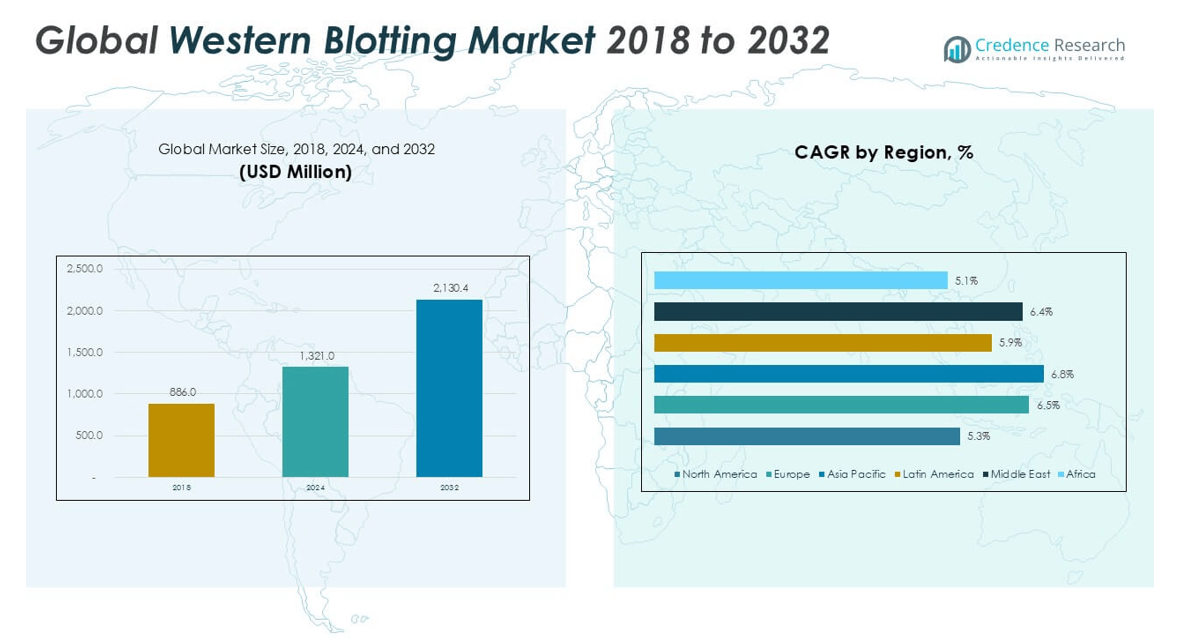
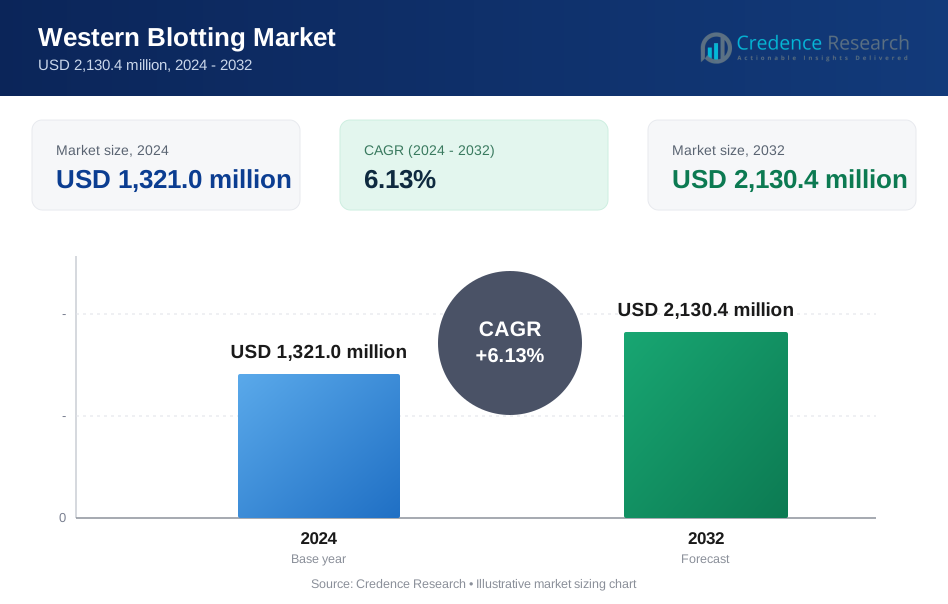
The Global Western Blotting Market is projected to grow from USD 1,321.0 million in 2024 to an estimated USD 2,130.4 million by 2032, with a compound annual growth rate (CAGR) of 6.13% from 2025 to 2032.
| REPORT ATTRIBUTE | DETAILS |
|---|---|
| Historical Period | 2020-2023 |
| Base Year | 2024 |
| Forecast Period | 2025-2032 |
| Western Blotting Market Size 2024 | USD 1,321.0 million |
| Western Blotting Market, CAGR | 6.13% |
| Western Blotting Market Size 2032 | USD 2,130.4 million |
The market is primarily driven by the rising prevalence of chronic and infectious diseases, which necessitates precise protein expression analysis for diagnostics and therapeutic monitoring. Technological advancements, such as automated blotting systems and improved detection reagents, are enhancing accuracy and efficiency. Moreover, an increase in funding for life sciences research and a surge in personalized medicine initiatives are promoting the use of western blotting techniques. Trends such as multiplexing capabilities and integration with imaging systems are further enhancing the utility of western blotting in complex biological studies.
Geographically, North America dominates the western blotting market due to a strong research infrastructure, high healthcare expenditure, and the presence of key players. Europe follows closely, driven by extensive academic and clinical research activities. Meanwhile, the Asia-Pacific region is projected to experience the fastest growth, supported by expanding research facilities and increasing healthcare investments in countries like China and India. Prominent players in the global market include Thermo Fisher Scientific Inc., Bio-Rad Laboratories Inc., GE Healthcare, Merck KGaA, and LI-COR Biosciences.
Market Insights
- The Global Western Blotting Market is projected to grow from USD 1,321.0 million in 2024 to USD 2,130.4 million by 2032, at a CAGR of 6.13% between 2025 and 2032.
- The market is expanding due to rising demand for protein detection in molecular biology, diagnostics, and biopharmaceutical research.
- Increasing prevalence of chronic and infectious diseases is driving the need for accurate protein expression analysis.
- Technological advancements such as automated blotting systems and improved detection reagents enhance efficiency and data quality.
- High cost of instruments and consumables remains a key restraint, especially for smaller laboratories and institutions.
- North America dominates the market due to strong R\&D infrastructure, healthcare funding, and presence of key industry players.
- Asia-Pacific is projected to register the fastest growth, supported by rising healthcare investments and expanding research capabilities.
Market Drivers
Rising Prevalence of Chronic and Infectious Diseases Increases Protein Analysis Demand
The Global Western Blotting Market benefits significantly from the growing incidence of chronic and infectious diseases worldwide. Accurate protein detection is critical for diagnosing conditions such as cancer, HIV, and Lyme disease. Western blotting enables targeted identification of specific proteins, making it a preferred technique in clinical laboratories. Hospitals and diagnostic centers increasingly rely on it for confirmatory testing. Governments and private healthcare providers are investing in improved diagnostic infrastructure, which supports the market’s expansion. The technique's relevance in understanding disease progression further strengthens its adoption in clinical applications.
- For instance, in 2024, the U.S. Centers for Disease Control and Prevention reported that over 1,200,000 western blot tests were performed nationwide for the confirmation of HIV and Lyme disease diagnoses, highlighting its widespread use in infectious disease management.
Strong Growth in Research Funding and Academic Collaborations Enhances Market Scope
Public and private research funding directed toward molecular biology, proteomics, and disease biology boosts the Global Western Blotting Market. Academic and research institutions increasingly collaborate with industry players to develop advanced protein detection techniques. It supports innovation in protein expression studies, drug target identification, and biomarker validation. The expansion of biotechnology and pharmaceutical R\&D pipelines also fuels the demand for precise analytical tools. Universities and research labs continue to adopt western blotting for both basic and applied science. This ongoing support from educational and scientific bodies helps maintain consistent demand.
- For instance, more than 7,800 academic and research institutions worldwide incorporated western blotting into their molecular biology and proteomics research projects, reflecting the technique’s central role in advancing scientific discovery.
Technological Advancements Improve Efficiency and Broaden Application Areas
Innovations in western blotting technology make the process faster, more reproducible, and user-friendly, driving the Global Western Blotting Market. Automated blotting systems and enhanced imaging tools reduce manual errors and time consumption. It allows laboratories to process more samples with higher accuracy. Improvements in detection reagents and multiplexing capabilities increase the technique's versatility. These developments enable broader use in complex protein interaction studies. The drive for automation and integration supports growing adoption in both clinical and research environments.
Expanding Personalized Medicine and Proteomics Sectors Stimulate Market Adoption
The rising interest in personalized medicine and proteomics directly contributes to the growth of the Global Western Blotting Market. Western blotting plays a vital role in analyzing individual protein expression patterns. It helps identify patient-specific therapeutic targets and monitor treatment outcomes. Pharmaceutical firms increasingly use this technique in preclinical research to evaluate drug responses. The expanding need for tailored diagnostics and targeted therapies elevates the relevance of western blotting. This shift toward personalized healthcare encourages continued investment in high-performance protein detection methods.
Market Trends
Integration of Automation and Digital Imaging Enhances Laboratory Efficiency
Automation and digital imaging continue to reshape laboratory workflows, significantly impacting the Global Western Blotting Market. Automated blotting systems reduce human error, improve reproducibility, and shorten turnaround times. Laboratories prefer systems that streamline sample preparation, blot development, and detection. Advanced imaging platforms now offer higher resolution, better quantification, and digital data storage. It enables easier data analysis and sharing across research teams. The push for high-throughput and cost-effective solutions is accelerating adoption across academic and clinical labs.
- For instance, in 2024, a leading laboratory equipment manufacturer reported installing over 6,500 automated western blotting systems and more than 12,000 digital imaging platforms in research and clinical laboratories worldwide, according to company shipment records and industry surveys.
Rising Demand for Multiplexing and High-Sensitivity Detection Techniques
The market is witnessing growing interest in multiplex western blotting techniques that allow simultaneous detection of multiple proteins. Researchers benefit from reduced sample volume, time, and reagent use. This capability supports complex studies involving protein interactions and signaling pathways. High-sensitivity chemiluminescent and fluorescent detection systems improve data quality and enable low-abundance protein detection. The Global Western Blotting Market gains traction from the shift toward more data-rich and resource-efficient approaches. It supports applications in drug discovery and biomarker validation.
- For instance, in 2024, more than 3,800 research institutions globally adopted multiplex western blotting kits capable of detecting up to 10 proteins per sample, as documented in company product registries and academic laboratory surveys.
Sustainability and Miniaturization Gain Importance in Research Practices
Laboratories are adopting more sustainable and compact blotting solutions to minimize environmental impact and laboratory space usage. Manufacturers focus on reducing chemical waste and using environmentally friendly reagents. It aligns with broader institutional goals for sustainable research practices. Miniaturized systems require less power, consumables, and bench space, appealing to smaller research setups. The Global Western Blotting Market reflects this trend in the form of portable and user-friendly devices. This shift improves operational efficiency and appeals to budget-conscious institutions.
Growth in Application Across Non-Traditional Sectors Broadens Market Reach
Western blotting is expanding beyond traditional life sciences into fields such as food safety, forensics, and environmental monitoring. It supports allergen detection in food samples and verification of forensic evidence in criminal investigations. Environmental researchers use it to monitor protein-level responses to pollutants and stressors. The Global Western Blotting Market benefits from these diversified applications, expanding its customer base. It demonstrates flexibility in addressing specialized analytical needs across various industries. This broader application range strengthens market resilience and growth potential.
Market Challenges
High Cost of Equipment and Reagents Limits Adoption Across Smaller Laboratories
The Global Western Blotting Market faces significant challenges due to the high cost of instruments, detection systems, and reagents. Smaller laboratories and academic institutions often struggle to invest in advanced blotting systems. High operational expenses, including recurring costs for membranes, antibodies, and chemicals, place pressure on limited research budgets. It restricts the accessibility of western blotting technology in low-resource settings. The cost barrier also slows the adoption of newer, automated systems in developing regions. This financial constraint hinders widespread implementation despite the technique’s scientific value.
- For instance, new western blotting systems typically range from 5,000 to 50,000 units depending on complexity and features, while recurring reagent costs can add thousands of units annually to laboratory budgets—making such investments a significant hurdle for smaller institutions and those in developing regions
Technical Complexity and Lack of Standardization Affect Reproducibility
Western blotting remains a complex and labor-intensive process, often requiring skilled personnel for accurate execution and interpretation. Variability in sample preparation, transfer efficiency, and detection protocols can lead to inconsistent results. The Global Western Blotting Market contends with the ongoing issue of low reproducibility, especially in multi-lab research studies. It reduces confidence in data and slows progress in collaborative research. Limited standardization across laboratories complicates the development of uniform procedures. These challenges highlight the need for more user-friendly platforms and validated protocols to improve reliability.
Market Opportunities
Expansion of Proteomics and Biomarker Research Opens New Growth Avenues
The growing focus on proteomics and biomarker discovery creates strong opportunities for the Global Western Blotting Market. Researchers require precise tools to validate protein targets and study disease mechanisms. Western blotting remains a trusted method for verifying protein expression and interaction. It supports pharmaceutical companies and academic institutions involved in early-stage drug development and personalized medicine. The rise in clinical trials and translational research increases the demand for accurate protein analysis. This trend positions western blotting as a critical tool in next-generation diagnostics and therapeutics.
Emerging Markets and Academic Investments Boost Technology Penetration
Rising investments in life sciences research across emerging economies present untapped potential for market growth. Governments in regions such as Asia-Pacific and Latin America are expanding funding for academic and clinical research infrastructure. The Global Western Blotting Market stands to benefit from growing awareness and demand for advanced molecular biology tools in these areas. It supports the deployment of affordable, compact systems tailored to regional needs. Partnerships between global vendors and local institutions can accelerate technology transfer. These developments enhance access to reliable protein detection methods in previously underserved markets.
Market Segmentation Analysis
By Product
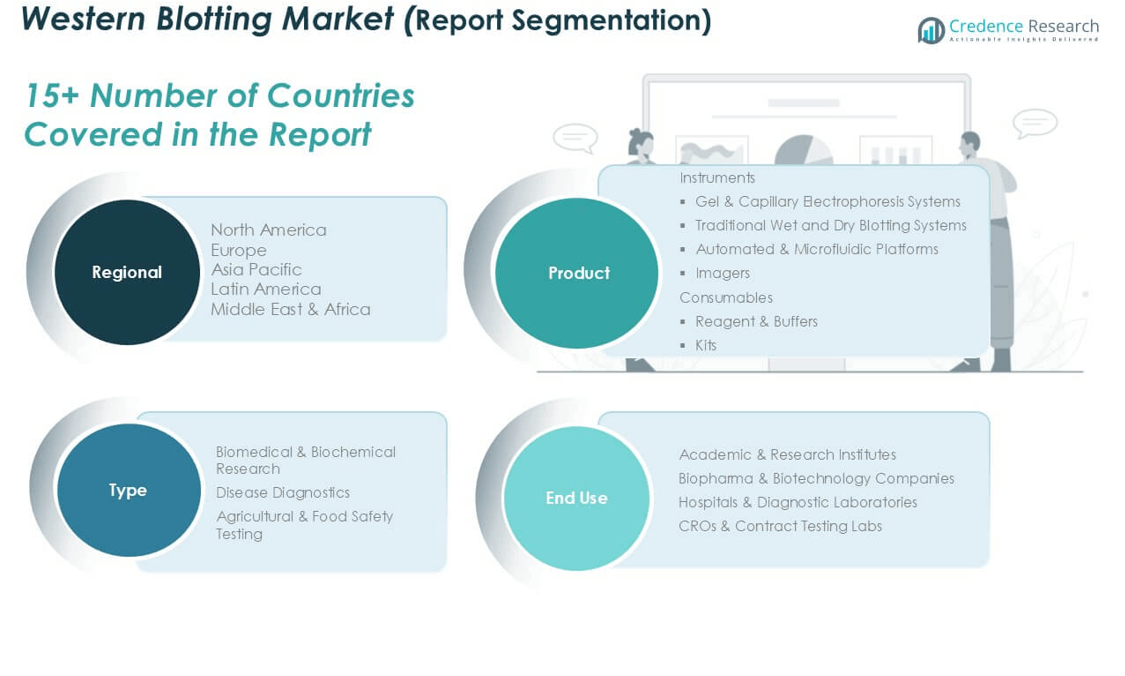
The Global Western Blotting Market is segmented by product into instruments and consumables. Instruments include gel and capillary electrophoresis systems, traditional wet and dry blotting systems, automated and microfluidic platforms, and imagers. Automated platforms and advanced imaging systems are gaining traction due to their accuracy and efficiency. It supports laboratories aiming to reduce manual workload and improve reproducibility. Consumables such as reagents, buffers, and kits dominate the recurring revenue stream, driven by high usage frequency. Kits with pre-optimized components attract users looking for convenience and consistency in results.
- For instance, over 120,000 western blotting instruments were installed in research and clinical laboratories worldwide, while more than 18 million western blotting consumable kits were sold globally during the same year.
By Type
The market, by type, covers biomedical and biochemical research, disease diagnostics, and agricultural and food safety testing. Biomedical and biochemical research holds the largest share, driven by expanding academic and pharmaceutical R\&D activities. Disease diagnostics is a fast-growing segment, supported by the increasing use of western blotting in confirming infectious and autoimmune conditions. It remains critical in HIV testing and in identifying protein-level disease markers. Agricultural and food safety testing is emerging as a niche application, where western blotting helps detect allergens and contaminants in food products.
- For instance, according to a 2023 government health report, more than 9 million western blot tests were performed globally for disease diagnostics, with over 6 million usespecifically for HIV confirmation and autoimmune disease detection in clinical laboratories.
By End Use
End users include academic and research institutes, biopharma and biotechnology companies, hospitals and diagnostic laboratories, and CROs and contract testing labs. Academic institutes and research centers contribute significantly due to widespread use in basic science and proteomics. Biopharma companies use western blotting in drug development and validation processes. Hospitals and diagnostic labs apply it for confirmatory diagnostic testing. The Global Western Blotting Market sees growing demand from CROs and contract testing labs due to increasing outsourcing of research and diagnostic services. It supports cost efficiency and scalability for end users.
Segments
Based on Product
- Instruments
- Gel & Capillary Electrophoresis Systems
- Traditional Wet and Dry Blotting Systems
- Automated & Microfluidic Platforms
- Imagers
- Consumables
- Reagent & Buffers
- Kits
Based on Type
- Biomedical & Biochemical Research
- Disease Diagnostics
- Agricultural & Food Safety Testing
Based on End Use
- Academic & Research Institutes
- Biopharma & Biotechnology Companies
- Hospitals & Diagnostic Laboratories
- CROs & Contract Testing Labs
Based on Region
- North America
- U.S.
- Canada
- Mexico
- Europe
- UK
- France
- Germany
- Italy
- Spain
- Russia
- Belgium
- Netherlands
- Austria
- Sweden
- Poland
- Denmark
- Switzerland
- Rest of Europe
- Asia Pacific
- China
- Japan
- South Korea
- India
- Australia
- Thailand
- Indonesia
- Vietnam
- Malaysia
- Philippines
- Taiwan
- Rest of Asia Pacific
- Latin America
- Brazil
- Argentina
- Peru
- Chile
- Colombia
- Rest of Latin America
- Middle East
- UAE
- KSA
- Israel
- Turkey
- Iran
- Rest of Middle East
- Africa
- Egypt
- Nigeria
- Algeria
- Morocco
- Rest of Africa
Regional Analysis
North America Western Blotting Market
North America held the largest share in the Western Blotting Market in 2024, valued at USD 431.75 million, and is projected to reach USD 655.73 million by 2032, growing at a CAGR of 5.3%. It accounted for approximately 32.7% of the global market in 2024. Strong demand from advanced diagnostic laboratories and pharmaceutical companies supports growth in the region. The United States leads with high R\&D spending, adoption of automated systems, and a robust clinical research infrastructure. Canada also contributes through growing academic collaborations and life science research. It continues to benefit from established regulatory frameworks and consistent healthcare investment.
Europe Western Blotting Market
Europe’s Western Blotting Market reached USD 294.63 million in 2024 and is expected to grow to USD 489.99 million by 2032, at a CAGR of 6.5%. The region held a 22.3% share of the global market in 2024. Countries such as Germany, the UK, and France drive market expansion through strong academic institutions and pharmaceutical research. Demand is rising for precise protein analysis tools in disease diagnostics and proteomics. It benefits from EU-funded research programs and collaborative projects across member states. The shift toward personalized medicine supports further adoption of western blotting techniques.
Asia Pacific Western Blotting Market
The Asia Pacific Western Blotting Market was valued at USD 364.53 million in 2024 and is projected to reach USD 617.81 million by 2032, growing at the highest CAGR of 6.8%. It captured approximately 27.6% of the global market in 2024. China, Japan, and India lead with rapid investments in biotechnology, academic research, and diagnostics. Growing healthcare infrastructure and government support for life sciences research fuel market expansion. It is also supported by the rising demand for protein-based diagnostic tools. Regional players are investing in cost-effective platforms tailored for local needs.
Latin America Western Blotting Market
Latin America’s Western Blotting Market is projected to grow from USD 131.80 million in 2024 to USD 208.78 million by 2032, at a CAGR of 5.9%. The region accounted for approximately 10% of the global market share in 2024. Brazil and Mexico dominate, driven by growing interest in academic and clinical research. Government initiatives in public health and biotechnology strengthen demand for protein detection tools. It sees rising adoption in diagnostic laboratories, particularly for infectious disease screening. Limited access to advanced automation slows growth in smaller markets but creates potential for affordable platforms.
Middle East Western Blotting Market
The Middle East Western Blotting Market reached USD 72.53 million in 2024 and is expected to reach USD 119.51 million by 2032, registering a CAGR of 6.4%. It contributed about 5.5% to the global market in 2024. Countries like Saudi Arabia and the UAE are investing in healthcare modernization and clinical research. The market gains support from expanding diagnostic capabilities and medical education infrastructure. It is also influenced by international collaborations in biotechnology. Western blotting is increasingly used in regional hospitals and private labs for disease diagnostics and academic research.
Africa Western Blotting Market
Africa’s Western Blotting Market was valued at USD 25.80 million in 2024 and is forecast to reach USD 38.56 million by 2032, growing at a CAGR of 5.1%. The region held a 1.95% share of the global market in 2024. South Africa leads with the strongest demand due to its established academic and medical institutions. Growing awareness of disease diagnostics and rising research funding support modest expansion. It faces infrastructure and affordability challenges, but rising collaboration with global health initiatives offers growth potential. Adoption remains gradual but steady across diagnostic and research applications.
Key players
- Thermo Fisher Scientific
- Bio-Rad Laboratories
- Danaher Corporation
- Merck KGaA
- LI-COR Biosciences
- Bio-Techne Corporation
- GE Healthcare
- Abcam plc
- Agilent Technologies
- PerkinElmer, Inc.
- Trinity Biotech plc
Competitive Analysis
The Global Western Blotting Market is highly competitive, with established players focusing on innovation, product diversification, and strategic partnerships. Thermo Fisher Scientific and Bio-Rad Laboratories lead with broad product portfolios and global reach. Danaher Corporation and Merck KGaA invest heavily in R\&D to expand their life sciences solutions. LI-COR Biosciences and Bio-Techne Corporation emphasize advanced imaging and detection technologies. GE Healthcare and Abcam plc maintain strong positions through targeted applications in diagnostics and research. Agilent Technologies and PerkinElmer offer integrated platforms for proteomic studies. It remains driven by product innovation, automated systems, and strong distribution networks. Market players compete on quality, precision, and adaptability to research and clinical needs.
Recent Developments
- In July 2024, Bio‑Rad Laboratories introduced the ChemiDoc Go Imaging System, a benchtop instrument designed for sensitive gel and western blot imaging. This system utilizes CMOS digital imaging and cloud connectivity, offering high sensitivity and versatility for various applications. It also supports Bio-Rad's BR.io cloud platform for imagstorage and accessibility.
Market Concentration and Characteristics
The Global Western Blotting Market exhibits moderate to high market concentration, with a few major players such as Thermo Fisher Scientific, Bio-Rad Laboratories, and Merck KGaA holding significant shares. It is characterized by a strong focus on research-driven product innovation, technological integration, and application-specific solutions. Companies compete on the basis of performance reliability, automation, and user-friendly platforms. The market shows high entry barriers due to the capital-intensive nature of instrumentation and the need for specialized expertise. It supports steady demand from academic, clinical, and biopharmaceutical sectors, driven by consistent research activity and diagnostic needs. Strategic partnerships and geographic expansion are common among leading players to strengthen their global presence.
Report Coverage
The research report offers an in-depth analysis based on Product, Type, End Use and Region. It details leading market players, providing an overview of their business, product offerings, investments, revenue streams, and key applications. Additionally, the report includes insights into the competitive environment, SWOT analysis, current market trends, as well as the primary drivers and constraints. Furthermore, it discusses various factors that have driven market expansion in recent years. The report also explores market dynamics, regulatory scenarios, and technological advancements that are shaping the industry. It assesses the impact of external factors and global economic changes on market growth. Lastly, it provides strategic recommendations for new entrants and established companies to navigate the complexities of the market.
Future Outlook
- Western blotting will play a growing role in precision medicine by enabling targeted protein analysis for personalized treatment strategies.
- The adoption of automated platforms and AI-based image analysis will improve reproducibility, reduce manual errors, and streamline data interpretation.
- Rising research investments in countries like China, India, and Brazil will create strong opportunities for western blotting system suppliers.
- Manufacturers will focus on compact blotting systems that reduce reagent consumption and offer cost-effective solutions for resource-limited settings.
- Applications in food allergen detection and crop quality monitoring will diversify the market beyond healthcare and life sciences.
- Next-generation reagent kits will deliver higher accuracy, supporting advanced applications such as biomarker validation and low-abundance protein detection.
- Stronger partnerships between biotech firms and research institutes will drive innovation and foster the adoption of advanced blotting platforms.
- Public sector initiatives will continue supporting disease diagnostic research, increasing demand for robust western blotting methods.
- The need for faster and more efficient protein analysis will drive the shift to multiplex western blotting technologies across laboratories.
- Vendors will prioritize eco-friendly materials and energy-efficient systems, aligning with global sustainability goals and laboratory standards.
Request a Free Sample
Fill in your details and we'll send you a free sample report.
- Sample data tables & charts
- Research methodology
Need a Custom Version of This Report?
Tailor the scope, geography, or segments to your exact requirements.
- Custom geography or segment scope
- Direct access to our analyst team
Frequently Asked Questions
What is the market size of the Global Western Blotting Market in 2023 and 2032, and what is its CAGR?
Which regions are expected to dominate or grow fastest in this market?
What role does western blotting play in modern diagnostics and research?
Who are the key players in the global western blotting market?
Table of Content
Chapter 1. Report Introduction
- 1.1 Report Description & Purpose
- 1.1.1 Report Title & Market Definition
- 1.1.2 Unique Selling Propositions (USP) & Key Differentiators
- 1.1.3 Value Proposition for Stakeholders
- 1.2 Research Objectives
- 1.2.1 Market Sizing Objectives (Volume & Revenue)
- 1.2.2 Segmentation Objectives
- 1.2.3 Competitive Intelligence Objectives
- 1.2.4 Forecast & Scenario Objectives
- 1.3 Report Scope
- 1.3.1 Western Blotting Scope – Types & Subtypes Covered
- 1.3.2 Geographic Scope – Regions & Countries Covered
- 1.3.3 Historical Period, Base Year & Forecast Period (2024; forecast to 2032)
- 1.3.4 Inclusions & Exclusions
- 1.4 HS Code & Classification Framework
- 1.5 Currency, Units & Pricing Basis
- 1.6 Target Stakeholders
- 1.7 Limitations & Assumptions
Chapter 2. Executive Summary
- 2.1 Global Western Blotting Market Snapshot
- 2.1.1 Market Size – Historical (2024) & Forecast (2024-2032) (2024: USD 1,321.0 million → 2032: USD 2,130.4 million)
- 2.1.2 Volume & Revenue – Global Totals
- 2.1.3 Key Market Highlights – Top Five Facts
- 2.2 Western Blotting Market Segmentation Snapshot
- 2.2.1 Market Split by Region – 2024 vs. 2032
- 2.3 Competitive Snapshot
- 2.3.1 Top 10 Players by Revenue Share – 2024
- 2.3.2 Top 10 Players by Volume Share – 2024
- 2.3.3 Recent Strategic Developments (18-Month Summary)
- 2.4 Key Investment Highlights & Strategic Conclusions
Chapter 3. Western Blotting Market Dynamics & Industry Analysis
- 3.1 Market Overview & Context
- 3.1.1 Western Blotting Market Position in the Broader Automotive Value Chain
- 3.1.2 OEM vs. Replacement Market Dynamics
- 3.1.3 Market Maturity & Development Stage by Region
- 3.2 Western Blotting Market Drivers
- 3.3 Western Blotting Market Restraints & Challenges
- 3.4 Western Blotting Market Opportunities
- 3.5 Porter's Five Forces Analysis
- 3.5.1 Threat of New Entrants
- 3.5.2 Bargaining Power of Suppliers
- 3.5.3 Bargaining Power of Buyers
- 3.5.4 Threat of Substitutes
- 3.5.5 Competitive Rivalry – Intensity Assessment
- 3.6 Western Blotting Value Chain Analysis
- 3.6.1 Upstream – Raw Material/Input Suppliers
- 3.6.1.1 Raw Material/Input 1
- 3.6.1.2 Raw Material/Input 2
- 3.6.1.3 Raw Material/Input 3
- 3.6.2 Midstream – Production/Manufacturing/Service Delivery
- 3.6.2.1 Production/Process Overview
- 3.6.2.2 Key Facility Locations & Capacity by Manufacturer
- 3.6.3 Downstream – Distribution & End Consumer
- 3.6.3.1 Primary Channel – B2B/OEM
- 3.6.3.2 Secondary Channels – Dealer, Retail, Online, Direct
- 3.6.4 Value Chain Profitability Analysis
- 3.6.1 Upstream – Raw Material/Input Suppliers
- 3.7 PESTEL Analysis
- 3.7.1 Political Factors
- 3.7.2 Economic Factors
- 3.7.3 Social Factors
- 3.7.4 Technological Factors
- 3.7.5 Environmental Factors
- 3.7.6 Legal Factors
- 3.8 Western Blotting Supply Chain Analysis
- 3.8.1 Raw Material/Input Supply Risk Assessment
- 3.8.2 Manufacturing Concentration Risk (Geographic Exposure)
- 3.8.3 Trade Disruption Impact Analysis
- 3.9 Regulatory & Policy Landscape
Note: The regulatory and policy landscape section covers regulations based on their applicability to the market, Western Blotting category, geography, and scope of the study. Only regulatory frameworks with a material impact on operations, compliance, trade, sustainability, or market access are analyzed in detail.
Chapter 4. Key Investment Pockets & Opportunity Analysis
- 4.1 Western Blotting Market Attractiveness Analysis
- 4.1.1 By Region – Investment Attractiveness Matrix (Volume × CAGR)
- 4.2 Absolute Revenue Growth Opportunity
- 4.2.1 By Region – Absolute USD Growth Through 2032
- 4.3 Incremental Volume Opportunity
- 4.3.1 By Region – Incremental Volume Through 2032
- 4.3.2 Segment – Incremental Volume
- 4.4 Emerging Submarket Opportunity Deep Dive (Subject to Applicability)
- 4.5 Emerging Market Opportunity Scorecards
- 4.5.1 United States
- 4.5.2 Europe
- 4.5.3 Asia
- 4.5.4 Middle East & Africa
Note: Emerging Market Opportunity Scorecards will be included based on relevance and strategic importance. Regions listed are indicative and may vary depending on data availability and market dynamics.
Chapter 5. Western Blotting Import-Export Analysis & Trade Flows
- 5.1 Global Trade Overview
- 5.1.1 Global Export Value by Country (2024)
- 5.1.2 Global Export Volume by Country (2024)
- 5.1.3 Global Import Value by Country (2024)
- 5.1.4 Global Import Volume by Country (2024)
- 5.1.5 Net Trade Balance by Country (2024)
- 5.2 Export Analysis – Segment
- 5.2.1 Type 1 (HS Code)
- 5.2.2 Type 2 (HS Code)
- 5.2.3 Type 3 (HS Code)
- 5.2.4 Type 4 (HS Code)
- 5.2.5 Type 5 (HS Code)
- 5.3 Import Analysis – Segment
- 5.3.1 Type 1 (HS Code)
- 5.3.2 Type 2 (HS Code)
- 5.3.3 Type 3 (HS Code)
- 5.3.4 Type 4 (HS Code)
- 5.3.5 Type 5 (HS Code)
- 5.4 Average Unit Trade Prices
- 5.4.1 Average Export Price – Segment & Country
- 5.4.2 Average Import Price – Segment & Source Country
- 5.4.3 Price Trends (2024)
- 5.5 Key Trade Route Analysis
- 5.5.1 Trade Route 1
- 5.5.2 Trade Route 2
- 5.5.3 Trade Route 3
- 5.5.4 Trade Route 4
- 5.5.5 Trade Route 5
- 5.6 Trade Policy Impact Assessment
- 5.6.1 US Anti-Dumping & Section 301 Tariffs
- 5.6.2 EU Customs Union Impact
- 5.6.3 Major Free Trade Agreements
- 5.6.4 USMCA Rules of Origin
Note: Trade policy analysis will be included only where relevant to the Western Blotting market.
Chapter 6. Competitive Landscape & Company Benchmarking
- 6.1 Western Blotting Market Concentration & Structure
- 6.1.1 Herfindahl-Hirschman Index (HHI) – vs. 2024
- 6.1.2 Tier 1, Tier 2 & Tier 3 Market Structure
- 6.1.3 Global, Regional & Local Player Dynamics
- 6.2 Western Blotting Market Share Analysis – 2024
- 6.2.1 Global Revenue Share by Company
- 6.2.2 Global Volume Share by Company
- 6.2.3 Regional Revenue Share
- 6.2.4 Market Share Evolution ( vs. 2024)
- 6.2.5 OEM Segment Share by Company
- 6.2.6 Replacement Segment Share by Company
- 6.3 Production/Delivery Capacity & Facility Analysis
- 6.3.1 Global Installed Capacity
- 6.3.2 Capacity Utilization Rates
- 6.3.3 Production/Output Volume
- 6.3.4 Facility Locations & Capacity Map
- 6.3.5 Planned Capacity Additions
- 6.4 Western Blotting Competitive Benchmarking Matrix
- 6.4.1 Revenue, Volume, CAGR & Profitability Comparison
- 6.4.2 Channel Revenue Mix
- 6.4.3 Geographic Revenue Exposure
- 6.4.4 R&D Intensity
- 6.4.5 Sustainability Maturity
- 6.5 Strategic Developments in Western Blotting (Last 24 Months)
- 6.5.1 Mergers, Acquisitions & Divestments
- 6.5.2 New Western Blotting Launches
- 6.5.3 Facility Expansions
- 6.5.4 Strategic Alliances, Joint Ventures & Partnerships
- 6.5.5 Distribution Expansion & Market Entry
- 6.5.6 Sustainability & ESG Initiatives
- 6.6 Competitive Strategy Mapping
- 6.6.1 Leader, Challenger, Follower & Niche Classification
- 6.6.2 Pricing Strategy Comparison
- 6.6.3 Channel Strategy Matrix
Note: Strategic developments are included based on their materiality and the availability of reliable information.
Chapter 7. Global Western Blotting Market – By Distribution Channel
- 7.1 Segment Overview
- 7.1.1 Volume & Revenue Split by Channel (2024 & 2032)
- 7.1.2 Channel Mix Evolution (2024-2032)
Chapter 8. Regional Market Analysis – Global Overview
- 8.1 Global Regional Overview
- 8.1.1 Regional Volume Share
- 8.1.2 Regional Revenue Share
- 8.1.3 Regional Volume by Region
- 8.1.4 Regional Revenue by Region
- 8.1.5 Regional Forecast Through 2032
- 8.2 Cross-Regional Segment Analysis
- 8.2.1 By Distribution Channel
- 8.2.2 By Brand/Price Tier
Chapter 9. North America Western Blotting Market
- 9.1 United States
- 9.2 Canada
- 9.3 Mexico
Chapter 10. Europe Western Blotting Market
- 10.1 Germany
- 10.2 France
- 10.3 Italy
- 10.4 United Kingdom
- 10.5 Spain
- 10.6 Poland
- 10.7 Russia
- 10.8 Netherlands
- 10.9 Belgium
- 10.10 Sweden
- 10.11 Denmark
- 10.12 Norway
- 10.13 Rest of Europe
Chapter 11. Asia Pacific Western Blotting Market
- 11.1 China
- 11.2 India
- 11.3 Japan
- 11.4 South Korea
- 11.5 Thailand
- 11.6 Indonesia
- 11.7 Vietnam
- 11.8 Malaysia
- 11.9 Australia
- 11.10 Rest of Asia Pacific
Chapter 12. Latin America Western Blotting Market
- 12.1 Brazil
- 12.2 Argentina
- 12.3 Colombia
- 12.4 Chile
- 12.5 Rest of Latin America
Chapter 13. Middle East Western Blotting Market
- 13.1 Saudi Arabia
- 13.2 United Arab Emirates
- 13.3 Turkey
- 13.4 Israel
- 13.5 Iran
- 13.6 Rest of the Middle East
Chapter 14. Africa Western Blotting Market
- 14.1 South Africa
- 14.2 Egypt
- 14.3 Nigeria
- 14.4 Morocco
- 14.5 Rest of Africa
Chapter 15. Western Blotting Company Profiles
- 15.1 [Company 01]
- 15.1.1 Company Overview
- 15.1.2 Key Management Personnel
- 15.1.3 Products & Services Portfolio
- 15.1.4 Financial Performance
- 15.1.5 Key Market Focus & Geographic Presence
- 15.1.6 Recent Developments & Strategic Initiatives
Note: The company profile list is preliminary and may change based on research findings, market developments, data availability, and client requirements.
Chapter 16. Appendices
- Appendix A – List of Abbreviations & Acronyms
- Appendix B – Industry Classification Code Reference – Full Series
- Appendix C – Production & Capacity Data Tables
- Appendix D – End-Use & Demand Base Tables
- Appendix E – Consumption & Replacement Rate Assumptions
- Appendix F – ASP Reference Tables
- Appendix G – Manufacturing & Facility Database
- Appendix H – Import-Export Data Tables
- Appendix I – Regulatory Summary Tables
- Appendix J – Primary Research Participant List (Anonymized)
- Appendix K – Primary Research Questionnaire Framework
- Appendix L – Data Sources & Bibliography
- Appendix M – Market Size Divergence & Source Comparison
Chapter 17. Research Methodology
- 17.1 Research Framework & Philosophy
- 17.2 Secondary Research – Sources, Hierarchy & Data Extraction
- 17.3 Data Modeling – Bottom-Up & Top-Down Market Sizing
- 17.4 Primary Research – Stakeholder Framework, LOI & Sample Sizes
- 17.5 Forecast Methodology – Regression, Scenario & Sensitivity Analysis
- 17.6 Quality Control – Four-Layer Validation Framework
- 17.7 Limitations & Standard Assumptions
- 17.8 Disclaimer
