
| REPORT ATTRIBUTE | DETAILS |
|---|---|
| Historical Period | 2019-2022 |
| Base Year | 2023 |
| Forecast Period | 2024-2032 |
| Enterprise Video Conferencing Market Size 2023 | USD 6815.2 Million |
| Enterprise Video Conferencing Market, CAGR | 12.80% |
| Enterprise Video Conferencing Market Size 2032 | USD 35692.5 Million |
Market Insights
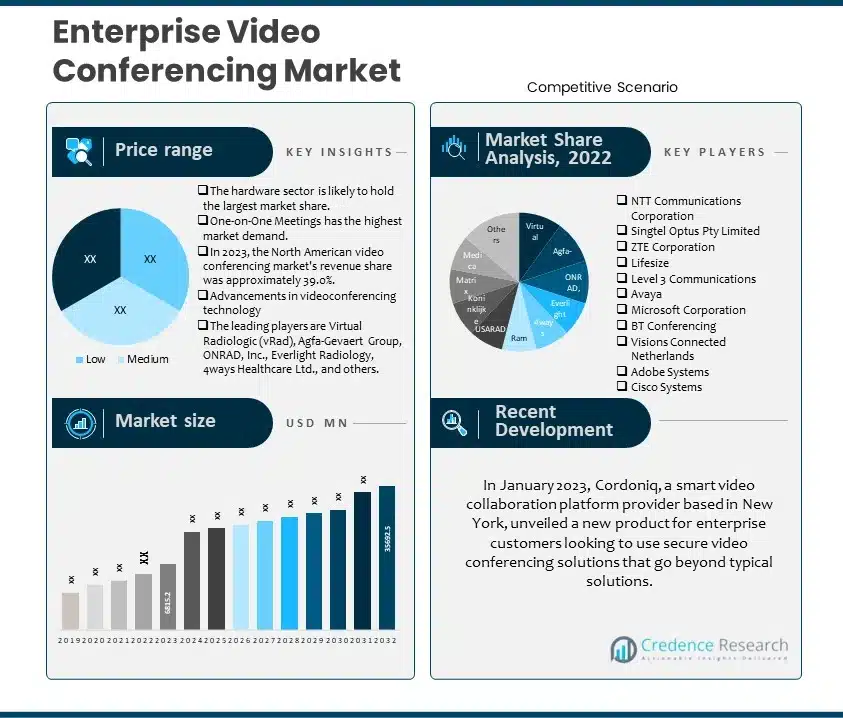
- The global demand for Enterprise Video Conferencing was valued at USD 6815.2 Million in 2023 and is expected to reach USD 35692.5 Million in 2032, growing at a CAGR of 12.80% between 2024 and 2032.
- In 2023, the on-premise segment dominated the market, accounting for almost 59.0% of total revenue. The cloud deployment segment is predicted to grow at a rate of around 14.0% during the projection period.
- The hardware sector is predicted to have the largest market share during the forecast period, with the software industry driving growth in this category.
- In 2023, the major business segment had a revenue share of over 77.0%, while the Small and Medium Enterprises (SMEs) segment is predicted to see a considerable CAGR.
- The government and defense sector, which will contribute for approximately 6.0% of total income in 2023, and IT and telecommunications are also increasingly popular components.
- Telepresence systems are likely to dominate the market, while desktop systems are expected to rise significantly during the projection period.
- Communication and collaboration are the most prominent areas, while virtual events and webinars are another rapidly increasing industry area.
- One-on-one meetings is the sector with the biggest market demand and Another significant market sector is Group Meetings
- Unified Communication (UC) Integration is the market's most popular sector.
- The Windows platform has the highest market share.
- The North American video conferencing market had a revenue share of roughly 39.0% in 2023, and Asia Pacific is expected to have the fastest CAGR during the forecast period.
- The Work-from-Home Movement Will Accelerate Global Market Growth.
- Privacy concerns could slow down the global market.
Executive Summary
Market Definition
The enterprise video conferencing market is the industry that focuses on offering video communication solutions to businesses and organizations. It entails the use of video conferencing platforms, software, and hardware to enable real-time communication and collaboration between individuals, teams, and stakeholders in various locations.
Enterprise video conferencing enables face-to-face communication, screen sharing, document collaboration, and other interactive capabilities using video and audio links. It enables businesses to hold virtual meetings, remote training sessions, webinars, and presentations, reducing the need for physical travel while promoting efficient and cost-effective communication.
Market Overview
The global Enterprise Video Conferencing Market has witnessed steady growth in recent years and is expected to grow at a CAGR of 12.80% between 2024 and 2032. The market was valued at USD 6815.2 million in 2023 and is expected to reach USD 35692.5 million in 2032.
The Enterprise Video Conferencing Market is rising rapidly and is likely to remain so in the future years. The market is being pushed by factors such as the growing popularity of remote work practices, the requirement for efficient communication and collaboration among geographically dispersed teams, and developments in video conferencing technology. With the advent of globalization and the necessity for organizations to connect with partners, clients, and workers all over the world, enterprise video conferencing offers a low-cost and convenient option. It facilitates real-time collaboration, increases productivity, and lowers travel expenses.
Segmentation by Deployment Model
- In 2023, the on-premise segment dominated the market, accounting for approximately 59.0% of the total revenue. This is mostly due to the increased popularity of this deployment approach among large enterprises in the face of escalating data security concerns.
- The cloud deployment segment is expected to increase at a rate of about 14.0% during the projection period.
Segmentation by Component
- The hardware sector is expected to have the biggest market share over the forecast period. The market expansion has driven up demand for conferencing solutions such as Skype, Microsoft Teams, Zoom, and others across a wide range of sectors.
- The software industry is improving the visual conferencing experiences of its components, leading to the growth of this segment.
Segmentation by End-User
- The large enterprise segment had a revenue share of more than 77.0% in 2023, owing to their preference for video conferencing solutions for cross-border business communications. As a result, leading market players are focusing on providing services that meet the needs of international corporations.
- The Small and Medium Enterprises (SMEs) segment is expected to see a significant CAGR of roughly 15.0% over the next several years.
Segmentation by Industry Vertical
- Businesses in the public sector are now using conferencing solutions to improve efficiency and productivity; the government and defense sector, which will account for approximately 6.0% of total revenue in 2023, is emerging as a promising market.
- IT and telecommunications are other increasingly popular components of the enterprise video conferencing market.
Segmentation by Type
- During the projection period, the telepresence system is expected to have the highest market share. This system uses cutting-edge technology to broadcast the conference in high-quality audio and video.
- The desktop system is predicted to demonstrate a significant growth rate during the projection period. The desktop system is a highly adaptable, dependable, and affordable video communication solution.
Segmentation by Application
- Communication and Collaboration are the most prominent segments in the Enterprise Video Conferencing Market. It is commonly used to facilitate internal communication and collaboration.
- Virtual events and webinars are another fast-growing market area. This segment has grown significantly due to the increased demand for remote events and online learning.
Segmentation by Meeting Type
- One-on-One Meetings is the sector with the highest market demand. It is an important part of business communication because it allows individuals to hold private conversations remotely.
- Another key market sector is Group Meetings, which allow teams to engage and discuss in real time, independent of their physical location. These sectors address various demands within businesses, promoting successful communication and collaboration.
Segmentation by Technology
- Unified Communication (UC) Integration is the market's most popular sector. This sector focuses on combining video conferencing capabilities with other communication tools such as instant messaging and email, ensuring that customers have a seamless and unified experience. It enables efficient communication and collaboration across several platforms.
Segmentation by Device Compatibility
- The Windows platform commands the most market share in the Enterprise Video Conferencing Market. Windows is widely used in both personal and business contexts, making it an attractive option for video conferencing systems.
- However, video conferencing apps are equally popular on iOS and Android devices due to their enormous user base.
Segmentation by Region
- The North American video conferencing market had a revenue share of around 39.0% in 2023
- Asia Pacific is predicted to have the quickest CAGR throughout the forecast period.
- The rest of the world, including Latin America, the Middle East, and Africa, supplies the remaining demand for Enterprise Video Conferencing.
The North American video conferencing market had the largest revenue share in 2023, owing to the region's higher adoption rate. The growing demand for high-quality internet and video conferencing services is likely to drive market expansion. Furthermore, the strong presence of different prominent companies in the region, combined with the growing trend of Bring Your Own Device (BYOD) solutions, which leads to increased demand for webcams and headphones, is propelling the market forward.
The Asia Pacific video conferencing market is predicted to grow at a CAGR of more than 14.0% through 2032, driven by the adoption of new work patterns across regional organizations. As a result of the COVID-19 pandemic, some enterprises were forced to employ remote working, which prompted the construction of high-quality internet infrastructure in the region. This resulted in a significant increase in regional demand for video conferencing equipment, collaboration tools, and accessories. Furthermore, advances in mobile broadband technologies, such as WiMAX and High-Speed Downlink Packed-Access (HSDPA) networks in Japan and India, will drive market expansion even further.
Key Highlights of the Report
The global Enterprise Video Conferencing Market is segmented by Modality, Service Type, End-User, Technology, Component, Workflow and region. The hardware sector is predicted to have the largest market share during the projection period, with the on-premise segment dominating in 2023. Furthermore, One-on-One Meetings has the biggest market demand, while Unified Communication (UC) Integration is the most popular sector. Additionally, the Small and Medium Enterprises (SMEs) group is predicted to experience a considerable CAGR, with North America leading the market growth.
The market's main drivers are rising demand for remote work and virtual collaboration solutions, technological advancements, and cost-effectiveness and time-saving benefits. Furthermore, connectivity challenges and network capacity constraints in some countries, security worries about data privacy and potential breaches, and resistance to change and lack of experience with video conferencing tools in certain businesses are the primary barriers in the market.
Nonetheless, the North American video conferencing market had the highest revenue share in 2023, owing to its higher adoption rate. Furthermore, the Asia Pacific video conferencing market is expected to rise at a CAGR of more than 14.0% until 2032, led by the adoption of new work practices across regional organizations.
What Are The Main Drivers Of The Global Enterprise Video Conferencing Market?
Several factors drive the enterprise video conferencing market. There is a growing need for remote working and virtual collaboration solutions. With the advent of flexible work arrangements and the need to link geographically scattered teams, video conferencing offers a simple and effective way to communicate and cooperate. In Alsao, technological breakthroughs are important. The availability of high-quality video and audio, combined with cloud-based platforms, has improved the whole video conferencing experience.
What Are The Major Challenges Faced By The Global Enterprise Video Conferencing Market?
While the Enterprise Video Conferencing Market is expanding, there are a few limitations to consider. Connectivity difficulties and network bandwidth limits in specific places can impede a seamless video conferencing experience. Furthermore, security worries about data privacy and potential breaches are critical issues for enterprises. Ensuring the security of sensitive information during video chats is critical.
What Are The Growth Opportunities In The Global Enterprise Video Conferencing Market?
The Enterprise Video Conferencing Market has numerous chances for growth and innovation. The increased use of hybrid work models, in which employees combine remote and in-office work, creates a need for adaptable and seamless communication solutions. This creates opportunities for video conferencing providers to offer bespoke solutions to match the changing needs of enterprises. Furthermore, development into emerging areas with increased internet penetration allows video conferencing services to reach new consumer bases.
Market Drivers
The global Enterprise Video Conferencing Market is driven by several factors. The following are the key drivers of the global Enterprise Video Conferencing Market:
The Work From Home Movement Will Accelerate Global Market Growth
Government restrictions during the epidemic forced businesses to adopt the work-from-home strategy in order to survive. The ability of video conferencing to facilitate communication allowed businesses to continue operating. The need for necessary office tools that coordinate and communicate well has resulted from this. Consequently, guaranteeing enterprises a successful result.
Furthermore, during the past few months, the need for video-calling software has been greatly increased by cancellations, quarantines, and WFH policies. By bringing people closer together, video conferencing has maintained corporate continuity and is still in use today. Employees of the company who live in different nations or regions can nonetheless effectively operate from home and provide the companies with the results they need at the same time.
Market Restraints
The global Enterprise Video Conferencing Market faces some challenges that may hinder its growth. These include the following:
Privacy Concerns Could Slow Down the World Market
The demand for video conferencing has increased globally, but there have also been startling negative impacts because of concerns over data privacy and security. Owing to the increased need for video conferencing equipment, it has also witnessed the quickest product delivery. As a result, concerns about data privacy and security have grown along with the need for these solutions. People's product selections have also changed as a result of this.
These solutions need to offer enterprise-grade security standards even though they are simple to use. Businesses may experience security problems with their goods and personal information, which could result in significant losses. With the rising remote workforce, the security of private data has become a critical concern to address. Solution providers are expected to step up to enable enterprise-grade collaboration. This might result in a seamless and safe solution that provides end-to-end communication encryption.
Opportunities
The global Enterprise Video Conferencing Market offers significant growth opportunities. These include the following:
Innovation in Technology to Open Up New Growth Prospects for the World Market
Voice over Internet Protocol (VoIP) technology, which is part of the developing 5G technology, is a new development that is changing market trends. Businesses using this technology have created enormous potential in industrialized economies like the U.S., the U.K., and Germany. When it becomes advantageous to reach remote places and expand into new geographic locations, this might become a game-changer.
Market leaders like Cisco Systems, Inc. and Microsoft Corporation are leading the charge in creating video conferencing solutions that automatically route calls over VoIP networks in an effort to make money. With the release of Cisco Webex Edge Connect in June 2018, Cisco Systems, Inc. employed its Unified Communications Manager to route calls over the VoIP network automatically. As a result, the industry has grown significantly as cloud-based communication technologies like Zoom and AvayaLive Video are increasingly being used.
Competitive Landscape
Key Players
The global Enterprise Video Conferencing Market is highly competitive, with several key players. Some of the major players in the market and their market share are as follows:
- NTT Communications Corporation
- Singtel Optus Pty Limited
- ZTE Corporation
- Lifesize
- Level 3 Communications
- Avaya
- Microsoft Corporation
- BT Conferencing
- Visions Connected Netherlands
- Adobe Systems
- Cisco Systems
These organizations prioritize product innovation, distribution channel expansion, and mergers and acquisitions to stay competitive.
The global Enterprise Video Conferencing Market's key players continually seek to stay ahead by offering new products and developments.
In February, 2023, Qualcomm Technologies, Inc. has launched a new video conferencing solution with AI capabilities for more immersive collaboration. The method removes distractions and increases user interaction.
In March, 2022, Cisco Systems, Inc. collaborated with Ford to integrate electric car screens into Webex. Furthermore, with this agreement, the company hopes to convert electric vehicles into cutting-edge office spaces. Furthermore, Webex will operate in audio mode while the car is in motion and with all functions while it is stopped, including visual conferencing.
Summary of Key Findings
- Technological innovation opens up new growth prospects for the global market.
- Market segmented by Deployment Model, Component, End-User, Industry Vertical, Type, Application, Meeting Type, Technology, Device Compatibility, and region.
- Communication and collaboration are the most prominent areas
- One-on-one meetings are the sector with the biggest market demand
- North America is leading market growth; the market is highly competitive with key players including NTT Communications Corporation, Singtel Optus Pty Limited, ZTE Corporation, Lifesize, Level 3 Communications, Avaya, and Others.
Future Outlook
- Continued growth and expansion
- Increasing demand for remote work solutions
- Advancements in video conferencing technology
- Integration with other collaboration tools
- Rising global connectivity
- Cost-effectiveness and convenience
- Adoption across various industries
How CXOs Can Benefit from the Credence Research Enterprise Video Conferencing Market Report
The Credence Research Enterprise Video Conferencing Market Report provides CXOs with a comprehensive overview of the market, including:
- Market size and growth forecast: The report provides detailed estimates of the global Enterprise Video Conferencing Market size, segmented by Deployment Model, Component, End-User, Industry Vertical, Type, Application, Meeting Type, Technology, Device Compatibility, and region. It also includes forecasts for the market through 2032, based on key trends and drivers.
- Market segmentation: The report segments the Enterprise Video Conferencing Market by Deployment Model, Component, End-User, Industry Vertical, Type, Application, Meeting Type, Technology, Device Compatibility, and region. This segmentation provides CXOs with a granular understanding of the market and the opportunities in each segment.
- Competitive landscape: The report profiles the key players in the Enterprise Video Conferencing Market and provides insights into their strategies, product offerings, and financial performance. This information can help CXOs to identify and assess their competition.
- Key trends and drivers: The report identifies and analyzes the key trends and drivers that are shaping the Enterprise Video Conferencing Market. This information can help CXOs to make informed decisions about their investments and strategies.
CXOs can use the insights from the Credence Research Enterprise Video Conferencing Market Report to:
- Identify growth opportunities: The report can help CXOs to identify new growth opportunities in the Enterprise Video Conferencing Market. For example, it can provide insights into emerging technologies, market trends, and key market players.
- Make informed investment decisions: The report can help CXOs to make informed investment decisions about Enterprise Video Conferencing. For example, t can provide insights into market trends, growth potential, competitive landscape, and key players in the industry.
- Develop competitive strategies: The report can help CXOs to develop competitive strategies for their Enterprise Video Conferencing businesses. For example, the report identifies the key strategies that dark fiber providers are using to differentiate themselves from their competitors.
- Track market developments: The report can help CXOs to track market developments and stay ahead of the curve. For example, the report provides insights into the latest trends and innovations in the Enterprise Video Conferencing Market.
Overall, the Credence Research Enterprise Video Conferencing Market Report is a valuable resource for CXOs who are looking to gain a deeper understanding of the market and identify opportunities for growth.
Segmentation
- By Deployment Model:
- On-Premises Video Conferencing
- Cloud-Based Video Conferencing
- Hybrid Video Conferencing
- By Component:
- Hardware (Cameras, Microphones, Displays, Codecs)
- Software (Video Conferencing Applications, Collaboration Tools)
- Services (Integration, Maintenance, Managed Services)
- By End-User:
- Small and Medium-sized Enterprises (SMEs)
- Large Enterprises
- By Industry Vertical:
- IT and Telecommunications
- Healthcare
- BFSI (Banking, Financial Services, and Insurance)
- Government and Defense
- Education
- Media and Entertainment
- Manufacturing
- Others
- By Type:
- Telepresence Systems
- Desktop and Mobile Video Conferencing
- Integrated Conferencing Solutions
- By Application:
- Communication and Collaboration
- Training and Learning
- Web Conferencing
- Virtual Events and Webinars
- Others
- By Meeting Type:
- One-on-One Meetings
- Group Meetings
- Large Conferences
- By Technology:
- Unified Communications (UC) Integration
- Artificial Intelligence (AI) and Machine Learning (ML) Integration
- Encryption and Security Features
- By Device Compatibility:
- Windows
- iOS
- Android
- Others
- By Region
- North America
- The U.S.
- Canada
- Mexico
- Europe
- Germany
- France
- The U.K.
- Italy
- Spain
- Rest of Europe
- Asia Pacific
- China
- Japan
- India
- South Korea
- South-east Asia
- Rest of Asia Pacific
- Latin America
- Brazil
- Argentina
- Rest of Latin America
- Middle East & Africa
- GCC Countries
- South Africa
- Rest of Middle East and Africa
- North America

Request a Free Sample
Fill in your details and we'll send you a free sample report.
- Sample data tables & charts
- Research methodology
Market Dynamics
Work-from-Home Movement
The widespread adoption of remote and hybrid work models has significantly increased the need for enterprise-grade video conferencing solutions, enabling organizations to maintain productivity and collaboration across distributed teams.
Data Security and Privacy Requirements
Large enterprises, especially in regulated industries, are driving demand for on-premises and secure video conferencing solutions to ensure compliance and protect sensitive business communications.
Technological Advancements in Video Conferencing
Improvements in video and audio quality, integration of AI features, and seamless unified communications are enhancing user experience and expanding the use cases for enterprise video conferencing.
Expansion of High-Speed Internet and Mobile Broadband
The rollout of high-speed internet infrastructure, particularly in Asia Pacific and emerging markets, is enabling more organizations to adopt advanced video conferencing tools, supporting market growth.
Cost and Travel Reduction Initiatives
Enterprises are increasingly leveraging video conferencing to reduce travel expenses and time, supporting sustainability goals and operational efficiency.
Need a Custom Version of This Report?
Tailor the scope, geography, or segments to your exact requirements.
- Custom geography or segment scope
- Direct access to our analyst team
Frequently Asked Questions
What is the current size of the global Enterprise Video Conferencing Market?
What is the expected growth rate of the Enterprise Video Conferencing Market between 2024 and 2032?
Which segment is leading the market share in terms of Deployment Model?
Which Meeting Type segment governs the demand for Enterprise Video Conferencing in the world?
Who are the major players in the global Enterprise Video Conferencing Market?
Table of Content
Chapter 1 Market Segmentation
- 1.1 Segmentation Framework
- 1.1.1 Product and Service Classification
- 1.1.2 Application and End-Use Classification
- 1.1.3 Technology and Solution Classification
- 1.1.4 Customer and Distribution Channel Classification
- 1.1.5 Geographic Segmentation
- 1.1.6 Market Segment Definitions and Boundaries
- 1.2 By End-User
- 1.2.1 Large Enterprises
- 1.2.2 Small and Medium-sized Enterprises (SMEs)
- 1.3 By Component
- 1.3.1 Hardware (Cameras, Microphones, Displays, Codecs)
- 1.3.2 Software (Video Conferencing Applications, Collaboration Tools)
- 1.3.3 Services (Integration, Maintenance, Managed Services)
- 1.4 By Deployment Model
- 1.4.1 On-Premises Video Conferencing
- 1.4.2 Cloud-Based Video Conferencing
- 1.4.3 Hybrid Video Conferencing
- 1.5 By Industry Vertical
- 1.5.1 IT and Telecommunications
- 1.5.2 Government and Defense
- 1.5.3 Healthcare
- 1.5.4 Education
- 1.5.5 BFSI (Banking, Financial Services, and Insurance)
Chapter 2 Introduction
- 2.1 Report Objectives and Scope
- 2.2 Product Definition and Industry Terminology
- 2.3 Market Inclusions and Exclusions
- 2.4 Research Process
- 2.4.1 Primary Research and Expert Interviews
- 2.4.2 Secondary Research and Source Review
- 2.4.3 Top-Down and Bottom-Up Estimation
- 2.4.4 Data Triangulation and Verification
- 2.5 Market Size Measurement Basis
- 2.5.1 2023: USD 6815.2 Million → 2032: USD 35,692.5 Million
- 2.6 Historical and Forecast Reference Periods
- 2.6.1 Base Year: 2023
- 2.6.2 Forecast Period: 2023-2032
- 2.7 Research Assumptions and Limitations
Chapter 3 Executive Summary
- 3.1 Market Snapshot and Key Findings
- 3.2 Base-Year Market Size, 2023
- 3.3 Forecast Market Size, 2032
- 3.4 Revenue and Volume Growth Outlook
- 3.5 Key Demand and Supply Indicators
- 3.6 Leading Market Segments
- 3.7 Fastest-Growing Market Opportunities
- 3.8 Regional Performance Highlights
- 3.9 Technology and Industry Transformation
- 3.10 Competitive Landscape Summary
- 3.11 Analyst View and Strategic Implications
Chapter 4 Global Enterprise Video Conferencing Market Trends and Developments
- 4.1 Historical Industry Development
- 4.2 Recent Market Trends and Developments
- 4.3 Demand and Customer Behavior Trends
- 4.4 Technology and Product Innovation
- 4.5 Artificial Intelligence, Automation and Digitalization
- 4.6 Local Manufacturing and Supply Chain Realignment
- 4.7 Industry Partnerships, Mergers and Acquisitions
- 4.8 Sustainability and Circular Economy Developments
- 4.9 Government and Private Sector Investment Trends
- 4.10 Emerging Business Models and Commercialization
- 4.11 Industry Developments and Announcements
Chapter 5 Global Enterprise Video Conferencing Market Production, Supply and Demand Analysis
- 5.1 Demand Trend and Consumption Analysis
- 5.2 Demand Forecast, 2023-2032
- 5.3 Production and Output Trend
- 5.4 Production and Output Forecast, 2023-2032
- 5.5 Installed Capacity and Capacity Utilization
- 5.6 Company-Wise Production Plants and Statistics
- 5.6.1 Installed Production Capacity
- 5.6.2 Actual Production
- 5.6.3 Planned Capacity and Expansion Targets
- 5.7 Supply Chain Structure and Procurement Trends
- 5.8 Supply-Demand Gap and Bottlenecks
- 5.9 Import Dependence and Sourcing Structure
- 5.10 Contract Manufacturing and Outsourcing
- 5.11 Regional Supply and Demand Concentration
Chapter 6 Global Enterprise Video Conferencing Market Pricing Analysis
- 6.1 Pricing Structure and Measurement
- 6.2 Historical Pricing Trends
- 6.3 Pricing Outlook, 2023-2032
- 6.4 Average Selling Price and Unit Economics
- 6.5 Pricing by Product and Market Segment
- 6.6 Geographic Pricing Differences
- 6.7 Key Input, Energy, Labor and Logistics Costs
- 6.8 Contract Pricing and Purchasing Models
- 6.9 Pricing Sensitivity and Competitive Positioning
- 6.10 Price, Margin and Profitability Implications
Chapter 7 Global Enterprise Video Conferencing Market Dynamics
- 7.1 Market Growth Drivers
- 7.1.1 Demand-Side Drivers
- 7.1.2 Technology and Innovation Drivers
- 7.1.3 Infrastructure and Investment Drivers
- 7.1.4 Regulatory and Policy Drivers
- 7.2 Market Restraints
- 7.2.1 Cost and Affordability Constraints
- 7.2.2 Technology and Adoption Barriers
- 7.2.3 Supply Chain and Operational Constraints
- 7.3 Market Challenges
- 7.3.1 Competitive Pressure and Margin Erosion
- 7.3.2 Skills, Infrastructure and Implementation Gaps
- 7.4 Emerging Market Opportunities
- 7.5 Market Dynamics Impact and Time-Horizon Assessment
Chapter 8 Global Enterprise Video Conferencing Value Chain Analysis
- 8.1 Industry Value Chain Overview
- 8.2 Upstream Suppliers and Critical Inputs
- 8.3 Technology and Component Providers
- 8.4 Manufacturing or Service Delivery
- 8.5 Distribution, Channel Partners and Integrators
- 8.6 Downstream Applications and End Users
- 8.7 Value Addition and Profit Pools
- 8.8 Vertical Integration and Outsourcing
- 8.9 Supplier Concentration and Risk
- 8.10 Supply Chain Localization and Resilience
Chapter 9 Global Enterprise Video Conferencing Market Regulations and Policies
- 9.1 Relevant Laws, Standards and Compliance Frameworks
- 9.2 Product, Service, Safety and Quality Requirements
- 9.3 Government Policies, Incentives and Subsidies
- 9.4 Imports, Exports and Trade Barriers
- 9.5 Public Procurement and Local Content Requirements
- 9.6 Environmental and Sustainability Compliance
- 9.7 Data Protection, AI and Cybersecurity Compliance
- 9.8 Upcoming Policy Changes and Market Implications
Chapter 10 Global Enterprise Video Conferencing Market Hotspots and Opportunities
- 10.1 Market Opportunity Mapping and Growth Hotspots
- 10.2 High-Growth Applications and Customer Groups
- 10.3 Underserved Markets and White-Space Opportunities
- 10.4 Emerging Technology and Product Opportunities
- 10.5 New Capacity and Investment Hotspots
- 10.6 Market Entry and Expansion Opportunities
- 10.7 Distribution and Partnership Opportunities
- 10.8 Near-Term and Long-Term Commercial Potential
- 10.9 Opportunity Attractiveness and Execution Risks
Chapter 11 Global Enterprise Video Conferencing Market Outlook, 2023-2032
- 11.1 Market Size and Analysis
- 11.1.1 Revenue (Market Measurement: 2023: USD 6815.2 Million → 2032: USD 35,692.5 Million)
- 11.1.2 Market Volume and Quantity Sold
- 11.1.3 Historical Market Size
- 11.1.4 Base-Year Market Size, 2023
- 11.2 Market Forecast, 2023-2032
- 11.2.1 Revenue Forecast to 2032
- 11.2.2 Volume Forecast to 2032
- 11.2.3 CAGR and Year-on-Year Growth
- 11.2.4 Incremental Revenue Opportunity
- 11.3 Forecast Assumptions and Scenario Analysis
- 11.3.1 Base-Case Forecast
- 11.3.2 Optimistic and Conservative Scenarios
- 11.3.3 Technology, Pricing and Policy Sensitivities
- 11.4 Market Attractiveness and Growth Outlook
Chapter 12 Global Enterprise Video Conferencing Market Segmentation and Outlook
- 12.1 Segmentation Summary and Market Shares, 2023
- 12.2 Largest and Fastest-Growing Segments
- 12.3 By End-User - Market Size and Forecast, 2023-2032
- 12.3.1 Segment Definition and Scope
- 12.3.2 Historical Market Size
- 12.3.3 Revenue Forecast, 2023-2032
- 12.3.4 Volume Forecast, 2023-2032
- 12.3.5 Base-Year Market Share, 2023
- 12.3.6 Segment CAGR and Growth Drivers
- 12.3.7 Subsegment Market Size and Forecast
- 12.3.7.1 Large Enterprises
- 12.3.7.2 Small and Medium-sized Enterprises (SMEs)
- 12.3.8 Subsegment Pricing and Adoption Trends
- 12.3.9 Leading Suppliers and Competition
- 12.3.10 Regional Demand and Opportunities
- 12.4 By Component - Market Size and Forecast, 2023-2032
- 12.4.1 Segment Definition and Scope
- 12.4.2 Historical Market Size
- 12.4.3 Revenue Forecast, 2023-2032
- 12.4.4 Volume Forecast, 2023-2032
- 12.4.5 Base-Year Market Share, 2023
- 12.4.6 Segment CAGR and Growth Drivers
- 12.4.7 Subsegment Market Size and Forecast
- 12.4.7.1 Hardware (Cameras, Microphones, Displays, Codecs)
- 12.4.7.2 Software (Video Conferencing Applications, Collaboration Tools)
- 12.4.7.3 Services (Integration, Maintenance, Managed Services)
- 12.4.8 Subsegment Pricing and Adoption Trends
- 12.4.9 Leading Suppliers and Competition
- 12.4.10 Regional Demand and Opportunities
- 12.5 By Deployment Model - Market Size and Forecast, 2023-2032
- 12.5.1 Segment Definition and Scope
- 12.5.2 Historical Market Size
- 12.5.3 Revenue Forecast, 2023-2032
- 12.5.4 Volume Forecast, 2023-2032
- 12.5.5 Base-Year Market Share, 2023
- 12.5.6 Segment CAGR and Growth Drivers
- 12.5.7 Subsegment Market Size and Forecast
- 12.5.7.1 On-Premises Video Conferencing
- 12.5.7.2 Cloud-Based Video Conferencing
- 12.5.7.3 Hybrid Video Conferencing
- 12.5.8 Subsegment Pricing and Adoption Trends
- 12.5.9 Leading Suppliers and Competition
- 12.5.10 Regional Demand and Opportunities
- 12.6 By Industry Vertical - Market Size and Forecast, 2023-2032
- 12.6.1 Segment Definition and Scope
- 12.6.2 Historical Market Size
- 12.6.3 Revenue Forecast, 2023-2032
- 12.6.4 Volume Forecast, 2023-2032
- 12.6.5 Base-Year Market Share, 2023
- 12.6.6 Segment CAGR and Growth Drivers
- 12.6.7 Subsegment Market Size and Forecast
- 12.6.7.1 IT and Telecommunications
- 12.6.7.2 Government and Defense
- 12.6.7.3 Healthcare
- 12.6.7.4 Education
- 12.6.7.5 BFSI (Banking, Financial Services, and Insurance)
- 12.6.8 Subsegment Pricing and Adoption Trends
- 12.6.9 Leading Suppliers and Competition
- 12.6.10 Regional Demand and Opportunities
- 12.7 Segment Growth Comparison
- 12.8 Segment Attractiveness and Priority Matrix
Chapter 13 Global Enterprise Video Conferencing End-Use and Application Market Outlook
- 13.1 End-Use Industry and Customer Demand Structure
- 13.2 Leading Applications and Customer Groups
- 13.3 End-Use Market Size, Share and Forecast
- 13.4 Major End-Use Industry Deep Dives
- 13.4.1 Customer Requirements and Use Cases
- 13.4.2 Demand and Replacement Cycles
- 13.4.3 Technical and Regulatory Considerations
- 13.4.4 Purchasing and Procurement Models
- 13.4.5 Leading Vendors and Distribution Channels
- 13.4.6 Forecast and Commercial Opportunities
- 13.5 Emerging Applications and Cross-Segment Demand
- 13.6 End-Use Industry Investment Priorities
Chapter 14 Global Enterprise Video Conferencing Geographic Market Outlook, 2023-2032
- 14.1 Regional Market Size and Share, 2023
- 14.2 Regional Market Forecast, 2023-2032
- 14.3 Regional Pricing, Production and Demand Differences
- 14.4 North America
- 14.4.1 United States
- 14.4.2 Canada
- 14.4.3 Mexico
- 14.5 Europe
- 14.5.1 Germany
- 14.5.2 France
- 14.5.3 Italy
- 14.5.4 United Kingdom
- 14.5.5 Spain
- 14.5.6 Poland
- 14.5.7 Russia
- 14.5.8 Netherlands
- 14.5.9 Belgium
- 14.5.10 Sweden
- 14.5.11 Denmark
- 14.5.12 Norway
- 14.5.13 Rest of Europe
- 14.6 Asia Pacific
- 14.6.1 China
- 14.6.2 India
- 14.6.3 Japan
- 14.6.4 South Korea
- 14.6.5 Thailand
- 14.6.6 Indonesia
- 14.6.7 Vietnam
- 14.6.8 Malaysia
- 14.6.9 Australia
- 14.6.10 Rest of Asia Pacific
- 14.7 Latin America
- 14.7.1 Brazil
- 14.7.2 Argentina
- 14.7.3 Colombia
- 14.7.4 Chile
- 14.7.5 Rest of Latin America
- 14.8 Middle East
- 14.8.1 Saudi Arabia
- 14.8.2 United Arab Emirates
- 14.8.3 Turkey
- 14.8.4 Israel
- 14.8.5 Iran
- 14.8.6 Rest of the Middle East
- 14.9 Africa
- 14.9.1 South Africa
- 14.9.2 Egypt
- 14.9.3 Nigeria
- 14.9.4 Morocco
- 14.9.5 Rest of Africa
- 14.10 Regional Investment, Policy and Supply Chain Differences
- 14.11 Regional Competitive Landscape
- 14.12 Geographic Growth Hotspots
Chapter 15 Global Enterprise Video Conferencing Technology, Innovation and Sustainability Outlook
- 15.1 Technology Landscape and Maturity
- 15.2 Product, Process and Service Innovation
- 15.3 AI, Automation and Digital Tools in the Industry
- 15.4 Technology Adoption and Performance Benchmarking
- 15.5 Innovation Pipeline and R&D Investment
- 15.6 Patent and Intellectual Property Trends
- 15.7 Energy Efficiency and Resource Management
- 15.8 Sustainability, Recycling and Circularity
- 15.9 Technology Roadmap, 2023-2032
- 15.10 Risks of Obsolescence and Technology Substitution
Chapter 16 Global Enterprise Video Conferencing Market Key Strategic Imperatives
- 16.1 Growth and Market Entry Priorities
- 16.2 High-Return Products and Segments
- 16.3 Pricing, Profitability and Cost Optimization
- 16.4 Technology Investment and Product Differentiation
- 16.5 Supply Chain Localization and Resilience
- 16.6 Distribution and Customer Acquisition
- 16.7 Partnership, Acquisition and Capacity Strategy
- 16.8 Regional Expansion Priorities
- 16.9 Short-, Medium- and Long-Term Actions
Chapter 17 Competition Outlook
- 17.1 Industry Competition Characteristics
- 17.2 Market Structure and Concentration
- 17.3 Market Share and Competitive Positioning, 2023
- 17.4 Company-Wise Revenue and Product Benchmarking
- 17.5 Production and Service Capacity Benchmarking
- 17.6 Technology, Pricing and Differentiation
- 17.7 Regional Footprint and Distribution Strength
- 17.8 Mergers, Acquisitions and Strategic Alliances
- 17.9 New Entrants and Competitive Threats
- 17.10 Porter's Five Forces and Industry Attractiveness
- 17.11 Competitive Outlook, 2023-2032
Chapter 18 Company Profiles
- 18.1 Company Coverage and Selection Criteria
- 18.2 Cisco Systems
- 18.2.1 Business Description
- 18.2.2 Company Ownership and Geographic Presence
- 18.2.3 Product and Service Portfolio
- 18.2.4 Manufacturing and Operating Footprint
- 18.2.5 Production Capacity and Expansion Plans
- 18.2.6 Financial Performance and Investment
- 18.2.7 Market Share and Competitive Position
- 18.2.8 Technology and Innovation Capabilities
- 18.2.9 Strategic Alliances or Partnerships
- 18.2.10 Recent Developments
- 18.2.11 Growth Strategy and Outlook
- 18.3 Microsoft Corporation
- 18.4 Zoom Video Communications
- 18.5 Avaya
- 18.6 Adobe Systems
- 18.7 Lifesize
- 18.8 NTT Communications Corporation
- 18.9 ZTE Corporation
- 18.10 Singtel Optus Pty Limited
- 18.11 BT Conferencing
- 18.12 Other Relevant Market Participants
Note: Every listed company is profiled on the structure shown under the first company. The company list is preliminary and may change based on research findings, market developments, data availability and client requirements.
Chapter 19 Disclaimer
- 19.1 Research and Forecast Disclaimer
- 19.2 Data Source and Estimation Limitations
Note: The depth of individual sections depends on data availability for this market. Volume, capacity, trade and other unit-based metrics are included where applicable.

