
Key Highlights of the Report
The global medical animation market is segmented by type, application, therapeutic area, end user, and region. 3D animation category is the most popular type of medical animation, while drug mechanism of action (MoA) category is the primary application segment. In addition, the oncology categories held the largest share in the therapeutic area segment. The medical devices manufacturers category led the market by end user segment, with North America leading the market growth.
Over the course of the forecast period, healthcare professionals' growing use of medical animation in the promotion and marketing of pharmaceutical products is anticipated to fuel the market's expansion. Additionally, it is projected that during the forecast period, there will be a rise in the preference for patient interaction in the healthcare industry.
Nonetheless, the North America market for medical animation is predicted to grow at the greatest CAGR because of the growing use of electronic devices and the large majority of pharmaceutical companies that use animation for marketing and medical education. Additionally, the increased use of clinical image analysis software in emerging nations is anticipated to fuel market expansion.
Market Overview
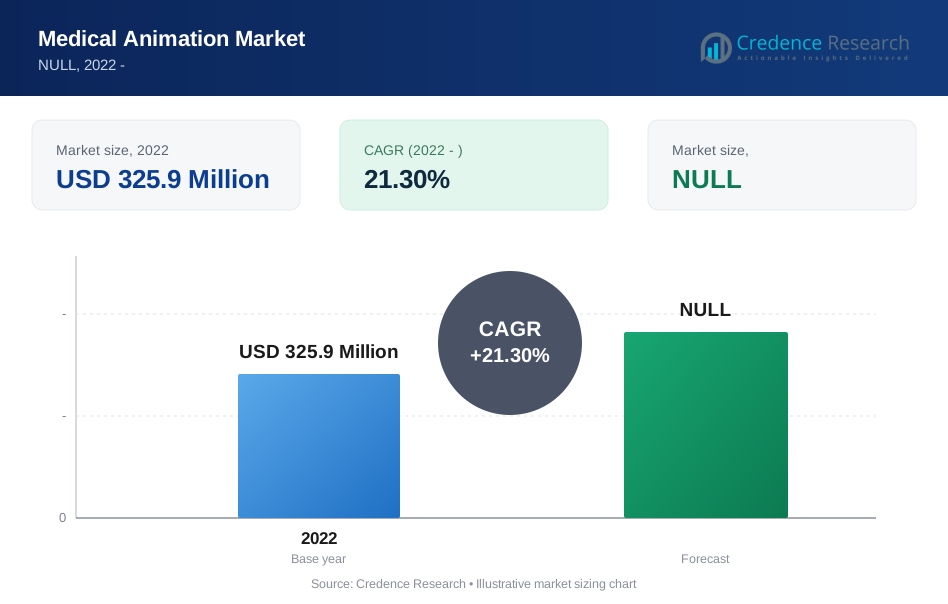
The global medical animation market has witnessed steady growth in recent years and is expected to continue growing at a CAGR of 21.30% between 2023 and 2030. The market was valued at USD 325.9 million in 2022 and is expected to reach USD 1259.2 million in 2030.
What Are The Main Drivers Of The Global Medical animation Market?
The growth of R&D activities, increased use of 3D computer graphics in medical marketing, and increased public awareness of various health conditions all contribute to the growth of the medical animation industry. Additionally, the adoption of animated studies, the expanding need for real-time & flash animation, and the expanding and developing pharmaceutical business all contribute to medical animation's market growth.
What Are The Major Challenges Faced By The Global Medical Animation Market?
The expected barriers to the medical animation market's expansion in the targeted period include the rising cost of medical animation services and a shortage of licensed medical animators.
What Are The Growth Opportunities In The Global Medical Animation Market?
In the upcoming years, it is anticipated that there will be an increase in demand for sophisticated methods like flash and real-time animation. A rise in patient enrolment in disease management or wellness programs is shown as a result of this technology's assistance in patient education. This demonstrates the technology's promise for the foreseeable future.
Executive Summary
Overview of the Global Medical Animation Market
The rising cancer incidence and expanding R&D activities using 3D animation technology for visualization during the creation of new medications are projected to fuel market expansion throughout the forecast period, increasing the demand for animated studies to explain the growth of drugs. Additionally, It is anticipated that including this medical animation in mobile apps, which combines real-time media-rich content with measurable data and adaptable tools for different medical device and pharmaceutical company sales, will create a significant opportunity for the growth of the medical animation market.
Market Definition
Any medical technology must have medical animation since it helps to thoroughly explain medical technology. A new generation of information, technology, and designers has emerged in the medical industry for both scientific and medical illustration purposes due to the advancement of computer hardware and software through the work of numerous colleges. The medical industry is expected to go to the next stage of development by fusing scientific research with advanced computer graphics and animation capabilities.
Market Insights
- The global demand for medical animation was valued at USD 325.9 Million in 2022 and is expected to reach USD 1259.2 Million in 2030, growing at a CAGR of 21.30% between 2023 and 2030.
- In terms of value, the 3D animation category leads the market and accounted for almost 29% of sales in 2022. The 2D animation category is expected to increase at the fastest rate.
- The drug mechanism of action (MoA) category is expected to continue to dominate the medical animation market through 2022, with a massive market share of over 24% predicted.
- The oncology category is expected to dominate the medical animation market through 2022.
- The medical devices manufacturers category is anticipated to dominate the medical animation market, with a market share of over 32% predicted.
- In 2022, North America will account for roughly one-third of the global market for medical animation, with the remaining 45% of the market being split between Asia Pacific and Europe.
- The increased usage of medical animation by healthcare professionals in the advertising and marketing of pharmaceutical products is predicted to propel market growth over the course of the forecast period. Furthermore, it is anticipated that the preference for patient interaction would increase in the healthcare sector during the forecast period.
- The North America medical animation industry is predicted to expand at a faster CAGR owing to the rise in the use of electronic devices and the vast majority of pharmaceutical companies use animation in their marketing and medical education. The rising use of clinical image analysis software in developing countries is also projected to fuel market growth.
Segmentation by Type
- With almost 29% of the market share for medical animation, the 3D animation category remained the top rank in terms of type in 2022.
- The global medical animation market is expected to experience the quickest growth throughout the projected period in the 2D animation category.
Segmentation by Application
- The drug mechanism of action (MoA) segment led the medical animation market with a market share of over 24% in 2022.
- The cellular and molecular applications category is anticipated to register the highest CAGR over the forecast period.
Segmentation by Therapeutic Area
- The oncology segment led the medical animation market with a share of over 27% in 2022.
- The cosmecuticals/plastic surgery category is anticipated to register the highest CAGR.
Segmentation by End User
- The medical devices manufacturers segment led the medical animation market with a market share of over 32% in 2022.
- The global market is anticipated to experience a rapid growth over the projected period by the academic institutes category.
Segmentation by Region
- North America region held the largest share in the global medical animation market in 2022.
- In 2022, Asia Pacific will occupy more than 28% of the global medical animation market, with Europe accounting for just under 23% of the total.
- The rest of the world's demand for medical animation comes from places including Latin America, the Middle East, and Africa.
The medical animation sector is expanding as a result of rising R&D expenditures, growing usage of 3D computer graphics in medical advertising, and rising public awareness of various health issues. The market for medical animation is also growing due to the acceptance of animated studies, the increased need for real-time & flash animation, and the expanding and developing pharmaceutical industry.
North America dominated the global medical animation market. One of the reasons propelling the market for medical animation in North America is pharmaceutical firms' increasing use of animation for medical education and product marketing. Businesses are utilizing strategies including new product development, mergers and acquisitions, and technology advancements to compete in the fiercely competitive medical animation sector. For instance, in July 2017, Graphite Capital, a semi-private equity company that provides the health and pharmaceutical industries with premium medical animation and digital content services, acquired Random42.
The market for medical animation in the Asia Pacific is anticipated to grow at the highest CAGR. The growing significance of investing in medical animation to advance patient education and healthcare infrastructure throughout many Asia Pacific countries. Due to the existence of sizable pharmaceutical firms and the growing focus of key market players on realizing the potential of the Asia Pacific market, the region is likely to experience growth.
Overall, healthcare professionals' use of medical animation to sell pharmaceutical products for a range of goals, including education and promotion, is expected to increase. Innovations in technology and the use of 3D animation technologies for visualization during the development of new drugs are additional elements anticipated to support the growth of the target market.
The market for medical animation is expected to slow expansion in the target period due to rising costs for animation services and a shortage of licenses animators. The lack of understanding in impoverished and backward economies, however, could pose additional obstacles to the market for medical animation in the near future.
Rising Adoption In The Life Sciences And Pharmaceutical Industries
Growing start-up companies, the pharmaceutical and biopharmaceutical industries, and medical technology improvements are all contributing to the growth of the market for medical animation. As more medical practitioners employ medical animation techniques to teach medical procedures or even other scientific topics with noticeably increased comprehension, the market for medical animation is predicted to grow. This technology's contribution to patient education is demonstrated by a rise in patient enrolment in illness management or wellbeing programs. The technology's promise for the future is thus shown.
Incorporating medical animation into mobile apps is anticipated to create a lucrative opportunity for the growth of the market for medical animation by fusing real-time media-rich content with quantifiable data and programmable methods for various medical device and pharmaceutical company sales.
Rise In The Number Of Patients Enrolling In Health Management Programmes
An increase in patient enrollment in illness management or wellness programs shows how this technology helps patients learn. WHO estimates that around 10 million people will die from cancer worldwide in 2020. Integrating this medical animation into mobile apps is anticipated to create a significant potential for expanding the medical animation market since it combines real-time media-rich content with quantifiable data and adaptable tools for diverse medical device and pharmaceutical firm sales. For instance, Terumo Trima requested that we produce a 3D animation in October to highlight some of the new features of an upgraded version of one of their current product lines.
Increased Production Cost
The production price can be a major barrier in the market for medical animation. Medical experts and proficient animators are the professionals needed to produce accurate and excellent medical animations. Medical cartoons frequently feature intricate anatomical components and physiological processes that need in-depth understanding and proficiency. These experts contribute specialized expertise and experience to the production process, but hiring them can be expensive. In addition, producing medical animations or movies requires a significant financial expenditure. Medical cartoons are frequently produced through several iterations and modifications to assure accuracy and satisfy customer needs. The production team must spend more time and energy on each iteration, which might raise the cost of production as a whole.
Usage Of Digital Platforms Growing
The development and widespread usage of tablets, smartphones, and other mobile platforms, the rise in the global senior population, and the increasing number of surgeries carried out annually are further factors pushing the medical animation industry. The demand for medical animation has increased because medical literacy is still comparably low in non-traditional and underserved locations, which is anticipated to offer the market for medical animation with favourable growth possibilities throughout the projected period. Additionally, companies are using tactics including new product development, mergers and acquisitions, and technological breakthroughs to compete in the fiercely competitive medical animation sector.
Manufacturers' Promotion Of Newly Launched Products
The medical animation market is anticipated to expand due to a rise in the use of medical animation techniques by healthcare practitioners to explain medical procedures or other scientific concepts with noticeably higher comprehension. A rise in patient enrolment in illness management or wellness programs is seen as a result of this technology's contribution to patient education. This demonstrates the technology's promise for the foreseeable future. It is also anticipated that integrating this medical animation into mobile apps by integrating real-time media-rich material with quantifiable data and customizable tools for various medical device and pharmaceutical firm sales will provide profitable chances for the market's expansion.
For instance, in October 2019, the results of a feasibility study using Oculus Quest Wireless Virtual Reality headphones by Ghost Productions, Inc.'s surgical simulation and medical animation program are encouraging. While not able to produce photo-stylized images, the wireless VR handset could engage with real-time surgical anatomy in their assessments of its medical performance capabilities. These findings enable a significant shift in the medical sector's use of virtual reality, which has lagged in utilizing the many advantages virtual reality education can provide.
Competitive Landscape
Key Players
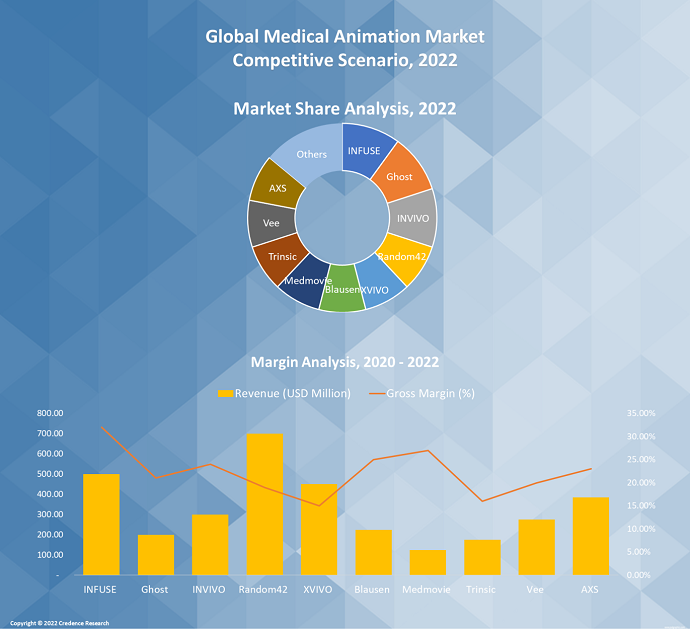
The global medical animation market is highly competitive, with the presence of several key players. Some of the major players in the market and their market share are as follows:
- INFUSE MEDIA GROUP, LLC. (US)
- Ghost Productions, Inc. (US)
- Scientific Animations Inc. (US)
- INVIVO (Canada)
- Random42 Scientific Communication (UK)
- AXS Studio. (Canada)
- Visible Body
- Animated Biomedical Productions (Australia)
- XVIVO (Sweden)
- Blausen Medical (US)
- Trinsic Animation (US)
- Understand.com, LLC. (US)
- Medmovie (US)
- Trinity Animation (US)
- Vee Technologies (US)
These businesses prioritise product innovation, enlarging their distribution networks, and mergers and acquisitions to stay competitive in the market.
The key players in the worldwide medical animation market are continually launching new products and developments in an effort to stay ahead.
November 2019: W20 has acquired Radius Digital Science, a reputable service provider to the healthcare sector that combines art and technology to create compelling and simple-to-understand creative experiences for healthcare clients.
Summary of Key Findings
- The usage of medical animation by healthcare practitioners to promote and educate patients about pharmaceutical products is anticipated to rise.
- Market segmented by type, application, therapeutic area, end user, and region.
- 3D animation category is most popular, with 2D animation category as the primary medical animation type.
- The drug mechanism of action (MoA) segment is the most commonly used medical animation market application.
- North America is leading market growth; the market is highly competitive with key players including INFUSE MEDIA GROUP, LLC. (US), Random42 Scientific Communication. (UK), Ghost Productions, Inc. (US), AXS Studio. (Canada), Visible Body, Scientific Animations Inc. (US), INVIVO (Canada), Animated Biomedical Productions (Australia), XVIVO (Sweden), Trinsic Animation (US), Understand.com, LLC. (US), Medmovie (US), Trinity Animation (US), Blausen Medical (US), and Vee Technologies (US).
Future Outlook
- The global market for medical animation is expected to increase significantly, especially in the North American region.
- Technology advancements and the usage of 3D animation technologies for visualization during the development of new pharmaceuticals are projected to boost the growth of the target market.
- In the near future, the market for medical animation may face challenges due to a lack of knowledge in underdeveloped and backward economies.
- Major companies should focus on creating novel items, expanding their market, and maintaining cheap power ratings to be competitive in the market.
Segmentation
By Type
- 3D Animation
- 2D animation
- Real-time imaging (4D Animation)
- Flash Animation
By Application
- Drug Mechanism of Action (MoA)
- Patient Education
- Surgical Training and Planning
- Cellular and Molecular Applications
- Other Applications
- Medical Simulation
- Forensic Reconstruction
- Medical Legal
- Emergency Care Instruction
By Therapeutic Area
- Oncology
- Cardiology
- Cosmecuticals/Plastic Surgery
- Dental
- Other Therapeutic Areas
- ENT
- Gastroenterology
- Orthopedics
- Ophthalmology
- Neurology
- Gynaecology
By End User
- Life Sciences Companies
- Medical Devices Manufacturers
- Hospitals, Surgical Centers, and Clinics
- Academic Institutes
- Other End Users
- Medico-legal Firms
- Forensic Departments
- Government Bodies
- Insurance Companies
By Region
- North America
- US
- Canada
- Mexico
- Europe
- Germany
- France
- U.K.
- Italy
- Spain
- Rest of Europe
- Asia Pacific
- China
- Japan
- India
- South Korea
- South-east Asia
- Rest of Asia Pacific
- Latin America
- Brazil
- Argentina
- Rest of Latin America
- Middle East & Africa
- GCC Countries
- South Africa
- Rest of Middle East and Africa
Request a Free Sample
Fill in your details and we'll send you a free sample report.
- Sample data tables & charts
- Research methodology
Need a Custom Version of This Report?
Tailor the scope, geography, or segments to your exact requirements.
- Custom geography or segment scope
- Direct access to our analyst team
Frequently Asked Questions
What is the current size of the global medical animation market?
What is the expected growth rate of the medical animation market between 2023 and 2030?
Which segment is leading the market share in terms of type?
Which application segment governs the demand for medical animation in the world?
Which therapeutic area segment is expected to post the highest CAGR during the forecast period?
Which region is fueling the growth of the medical animation industry?
Who are the major players in the global medical animation market?
What are the major market drivers of the medical animation industry?
What are the major market restraints of the medical animation industry?
What are the major market opportunities of the medical animation industry?
Table of Content
Chapter 1. Report Introduction
- 1.1 Report Description & Purpose
- 1.1.1 Report Title & Market Definition
- 1.1.2 Unique Selling Propositions (USP) & Key Differentiators
- 1.1.3 Value Proposition for Stakeholders
- 1.2 Research Objectives
- 1.2.1 Market Sizing Objectives (Volume & Revenue) (Volume Where Applicable)
- 1.2.2 Segmentation Objectives
- 1.2.3 Competitive Intelligence Objectives
- 1.2.4 Forecast & Scenario Objectives
- 1.3 Report Scope
- 1.3.1 Medical Animation Scope – Segments & Subsegments Covered
- 1.3.2 Geographic Scope – Regions & Countries Covered
- 1.3.3 Historical Period, Base Year & Forecast Period (2022; forecast to the forecast period)
- 1.3.4 Inclusions & Exclusions
- 1.4 Industry Classification & Applicable Codes
- 1.5 Currency, Measurement Units & Valuation Basis
- 1.6 Target Stakeholders
- 1.7 Limitations & Assumptions
Chapter 2. Executive Summary
- 2.1 Global Medical Animation Market Snapshot
- 2.1.1 Market Size – Historical (2022) & Forecast (the forecast period) (2022: USD 325.9 Million → forecast year: NULL)
- 2.1.2 Volume & Revenue – Global Totals (Volume Where Applicable)
- 2.1.3 Key Market Highlights – Top Five Facts
- 2.2 Medical Animation Market Segmentation Snapshot
- 2.2.1 Market Split by Region – 2022 vs.
- 2.3 Competitive Snapshot
- 2.3.1 Top 10 Players by Revenue Share – 2022
- 2.3.2 Top 10 Players by Volume Share – 2022 (Volume Where Applicable)
- 2.3.3 Recent Strategic Developments (18-Month Summary)
- 2.4 Key Investment Highlights & Strategic Conclusions
Chapter 3. Medical Animation Market Dynamics & Industry Analysis
- 3.1 Market Overview & Context
- 3.1.1 Medical Animation Market Position in the Broader Industry Value Chain
- 3.1.2 Demand Structure & Purchasing Dynamics
- 3.1.3 Market Maturity & Development Stage by Region
- 3.2 Medical Animation Market Drivers
- 3.3 Medical Animation Market Restraints & Challenges
- 3.4 Medical Animation Market Opportunities
- 3.5 Porter's Five Forces Analysis
- 3.5.1 Threat of New Entrants
- 3.5.2 Bargaining Power of Suppliers
- 3.5.3 Bargaining Power of Buyers
- 3.5.4 Threat of Substitutes
- 3.5.5 Competitive Rivalry – Intensity Assessment
- 3.6 Medical Animation Value Chain Analysis
- 3.6.1 Upstream – Key Inputs, Resources & Suppliers
- 3.6.1.1 Key Input/Resource 1
- 3.6.1.2 Key Input/Resource 2
- 3.6.1.3 Key Input/Resource 3
- 3.6.2 Midstream – Core Operations & Value Creation
- 3.6.2.1 Operating Model & Process Overview
- 3.6.2.2 Key Operating Locations & Capabilities by Company
- 3.6.3 Downstream – Market Channels & End Users
- 3.6.3.1 Direct Sales & Customer Engagement Channels
- 3.6.3.2 Indirect Sales, Intermediaries & Partner Channels
- 3.6.4 Value Chain Profitability Analysis
- 3.6.1 Upstream – Key Inputs, Resources & Suppliers
- 3.7 PESTEL Analysis
- 3.7.1 Political Factors
- 3.7.2 Economic Factors
- 3.7.3 Social Factors
- 3.7.4 Technological Factors
- 3.7.5 Environmental Factors
- 3.7.6 Legal Factors
- 3.8 Medical Animation Supply Chain Analysis
- 3.8.1 Critical Input & Resource Availability Risk Assessment
- 3.8.2 Supplier & Operational Concentration Risk (Geographic Exposure)
- 3.8.3 Supply & Service Disruption Impact Analysis
- 3.9 Regulatory & Policy Landscape
Note: The regulatory and policy landscape section covers regulations based on their applicability to the market, Medical Animation category, geography, and scope of the study. Only regulatory frameworks with a material impact on operations, compliance, trade, sustainability, or market access are analyzed in detail.
Chapter 4. Key Investment Pockets & Opportunity Analysis
- 4.1 Medical Animation Market Attractiveness Analysis
- 4.1.1 By Region – Investment Attractiveness Matrix (Market Size × CAGR)
- 4.2 Absolute Revenue Growth Opportunity
- 4.2.1 By Region – Absolute Revenue Growth Through the forecast period
- 4.3 Incremental Demand Opportunity
- 4.3.1 By Region – Incremental Demand Through the forecast period
- 4.3.2 Segment – Incremental Demand
- 4.4 Emerging Submarket Opportunity Deep Dive (Subject to Applicability)
- 4.5 Priority Market Opportunity Scorecards
- 4.5.1 United States
- 4.5.2 Europe
- 4.5.3 Asia
- 4.5.4 Middle East & Africa
Note: Priority market opportunity scorecards reflect the geographic scope and strategic relevance of the study. Listed markets are indicative and may be adapted to the industry.
Chapter 5. Medical Animation Cross-Border Trade & Market Access Analysis
- 5.1 International Trade & Cross-Border Activity Overview
- 5.1.1 Global Export Value by Country (2022)
- 5.1.2 Global Export Volume by Country (2022) (Volume Where Applicable)
- 5.1.3 Global Import Value by Country (2022)
- 5.1.4 Global Import Volume by Country (2022) (Volume Where Applicable)
- 5.1.5 Net Trade Balance by Country (2022)
- 5.2 Export Analysis – Segment
- 5.2.1 Category 1 (Applicable Classification Code)
- 5.2.2 Category 2 (Applicable Classification Code)
- 5.2.3 Category 3 (Applicable Classification Code)
- 5.2.4 Category 4 (Applicable Classification Code)
- 5.2.5 Category 5 (Applicable Classification Code)
- 5.3 Import Analysis – Segment
- 5.3.1 Category 1 (Applicable Classification Code)
- 5.3.2 Category 2 (Applicable Classification Code)
- 5.3.3 Category 3 (Applicable Classification Code)
- 5.3.4 Category 4 (Applicable Classification Code)
- 5.3.5 Category 5 (Applicable Classification Code)
- 5.4 Cross-Border Pricing & Transaction Benchmarks
- 5.4.1 Export Pricing – Segment & Country
- 5.4.2 Import Pricing – Segment & Source Country
- 5.4.3 Price Trends (2022)
- 5.5 Key Cross-Border Trade & Delivery Routes
- 5.5.1 Cross-Border Trade/Delivery Route 1
- 5.5.2 Cross-Border Trade/Delivery Route 2
- 5.5.3 Cross-Border Trade/Delivery Route 3
- 5.5.4 Cross-Border Trade/Delivery Route 4
- 5.5.5 Cross-Border Trade/Delivery Route 5
- 5.6 Trade Policy & Market Access Impact Assessment
- 5.6.1 Tariff & Non-Tariff Barriers
- 5.6.2 Regional Trade & Economic Integration Frameworks
- 5.6.3 Bilateral & Multilateral Trade Agreements
- 5.6.4 Cross-Border Operating, Licensing & Localization Requirements
Note: This chapter applies where cross-border trade or delivery is relevant to Medical Animation. Goods, services, and digital offerings are assessed using applicable classifications and transaction measures. Import-export volumes, trade balances, and route analyses are included only where meaningful to the market.
Chapter 6. Competitive Landscape & Company Benchmarking
- 6.1 Medical Animation Market Concentration & Structure
- 6.1.1 Herfindahl-Hirschman Index (HHI) – vs. 2022
- 6.1.2 Leading, Mid-Sized & Emerging Player Structure
- 6.1.3 Global, Regional & Local Player Dynamics
- 6.2 Medical Animation Market Share Analysis – 2022
- 6.2.1 Global Revenue Share by Company
- 6.2.2 Global Volume Share by Company (Volume Where Applicable)
- 6.2.3 Regional Revenue Share
- 6.2.4 Market Share Evolution ( vs. 2022)
- 6.2.5 Company Market Share by Key Segment
- 6.2.6 Company Market Share by Customer Group
- 6.3 Operating Scale, Capacity & Infrastructure Analysis
- 6.3.1 Global Operating Scale & Supply Capacity
- 6.3.2 Resource Utilization & Operating Efficiency
- 6.3.3 Output, Service Delivery & Activity Metrics
- 6.3.4 Operating Footprint & Infrastructure Map
- 6.3.5 Planned Operational & Capacity Expansion
- 6.4 Medical Animation Competitive Benchmarking Matrix
- 6.4.1 Revenue, Growth, Profitability & Operating Metric Comparison
- 6.4.2 Channel Revenue Mix
- 6.4.3 Geographic Revenue Exposure
- 6.4.4 R&D Intensity
- 6.4.5 Sustainability Maturity
- 6.5 Strategic Developments in Medical Animation (Last 24 Months)
- 6.5.1 Mergers, Acquisitions & Divestments
- 6.5.2 New Products, Services & Solutions in Medical Animation
- 6.5.3 Operational & Infrastructure Expansions
- 6.5.4 Strategic Alliances, Joint Ventures & Partnerships
- 6.5.5 Distribution Expansion & Market Entry
- 6.5.6 Sustainability & ESG Initiatives
- 6.6 Competitive Strategy Mapping
- 6.6.1 Leader, Challenger, Follower & Niche Classification
- 6.6.2 Pricing Strategy Comparison
- 6.6.3 Channel Strategy Matrix
Note: Strategic developments are included based on their materiality and the availability of reliable information.
Chapter 7. Global Medical Animation Market – By Sales & Delivery Channel
- 7.1 Segment Overview
- 7.1.1 Volume & Revenue Split by Channel (2022 & ) (Volume Where Applicable)
- 7.1.2 Channel Mix Evolution (the forecast period)
Chapter 8. Regional Market Analysis – Global Overview
- 8.1 Global Regional Overview
- 8.1.1 Regional Volume Share (Volume Where Applicable)
- 8.1.2 Regional Revenue Share
- 8.1.3 Regional Volume by Region (Volume Where Applicable)
- 8.1.4 Regional Revenue by Region
- 8.1.5 Regional Forecast Through the forecast period
- 8.2 Cross-Regional Segment Analysis
- 8.2.1 By Sales & Delivery Channel
- 8.2.2 By Competitive Positioning & Price Tier
Chapter 9. North America Medical Animation Market
- 9.1 United States
- 9.2 Canada
- 9.3 Mexico
Chapter 10. Europe Medical Animation Market
- 10.1 Germany
- 10.2 France
- 10.3 Italy
- 10.4 United Kingdom
- 10.5 Spain
- 10.6 Poland
- 10.7 Russia
- 10.8 Netherlands
- 10.9 Belgium
- 10.10 Sweden
- 10.11 Denmark
- 10.12 Norway
- 10.13 Rest of Europe
Chapter 11. Asia Pacific Medical Animation Market
- 11.1 China
- 11.2 India
- 11.3 Japan
- 11.4 South Korea
- 11.5 Thailand
- 11.6 Indonesia
- 11.7 Vietnam
- 11.8 Malaysia
- 11.9 Australia
- 11.10 Rest of Asia Pacific
Chapter 12. Latin America Medical Animation Market
- 12.1 Brazil
- 12.2 Argentina
- 12.3 Colombia
- 12.4 Chile
- 12.5 Rest of Latin America
Chapter 13. Middle East Medical Animation Market
- 13.1 Saudi Arabia
- 13.2 United Arab Emirates
- 13.3 Turkey
- 13.4 Israel
- 13.5 Iran
- 13.6 Rest of the Middle East
Chapter 14. Africa Medical Animation Market
- 14.1 South Africa
- 14.2 Egypt
- 14.3 Nigeria
- 14.4 Morocco
- 14.5 Rest of Africa
Chapter 15. Medical Animation Company Profiles
- 15.1 [Company 01]
- 15.1.1 Company Overview
- 15.1.2 Key Management Personnel
- 15.1.3 Products & Services Portfolio
- 15.1.4 Financial Performance
- 15.1.5 Key Market Focus & Geographic Presence
- 15.1.6 Recent Developments & Strategic Initiatives
Note: The company profile list is preliminary and may change based on research findings, market developments, data availability, and client requirements.
Chapter 16. Appendices
- Appendix A – List of Abbreviations & Acronyms
- Appendix B – Industry Classification Code Reference – Full Series
- Appendix C – Supply, Output & Operating Capacity Data Tables
- Appendix D – End-Use & Demand Base Tables
- Appendix E – Demand, Adoption & Usage Assumptions
- Appendix F – Pricing & Revenue Metric Reference Tables
- Appendix G – Company Operations & Infrastructure Database
- Appendix H – Cross-Border Trade & Activity Data Tables (Where Applicable)
- Appendix I – Regulatory Summary Tables
- Appendix J – Primary Research Participant List (Anonymized)
- Appendix K – Primary Research Questionnaire Framework
- Appendix L – Data Sources & Bibliography
- Appendix M – Market Size Divergence & Source Comparison
Chapter 17. Research Methodology
- 17.1 Research Framework & Philosophy
- 17.2 Secondary Research – Sources, Hierarchy & Data Extraction
- 17.3 Data Modeling – Bottom-Up & Top-Down Market Sizing
- 17.4 Primary Research – Stakeholder Framework, LOI & Sample Sizes
- 17.5 Forecast Methodology – Regression, Scenario & Sensitivity Analysis
- 17.6 Quality Control – Four-Layer Validation Framework
- 17.7 Limitations & Standard Assumptions
- 17.8 Disclaimer
