
Market Overview
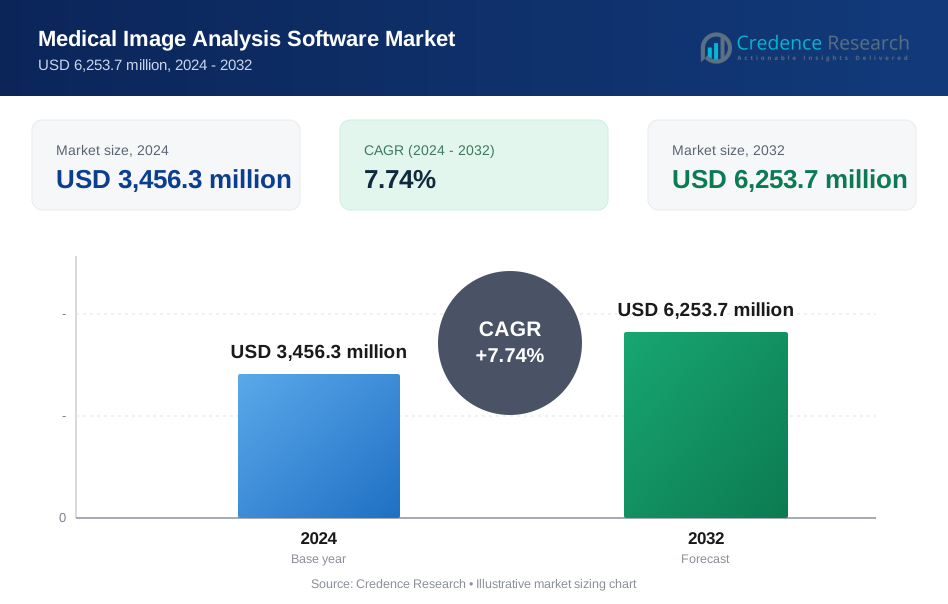
The Global Medical Image Analysis Software Market size was valued at USD 2,247.0 million in 2018, increasing to USD 3,456.3 million in 2024, and is anticipated to reach USD 6,253.7 million by 2032, growing at a CAGR of 7.74% during the forecast period.
| REPORT ATTRIBUTE | DETAILS |
|---|---|
| Historical Period | 2020-2023 |
| Base Year | 2024 |
| Forecast Period | 2025-2032 |
| Medical Image Analysis Software Market Size 2024 | USD 3,456.3 Million |
| Medical Image Analysis Software Market, CAGR | 7.74% |
| Medical Image Analysis Software Market Size 2032 | USD 6,253.7 Million |
The Global Medical Image Analysis Software Market is highly competitive, led by key players such as Koninklijke Philips N.V., Siemens Healthineers AG, Agfa-Gevaert Group, Canon Medical Systems, MIM Software, Inc., Bruker, ESAOTE S.p.A., Deep Rui Medica, Infervision Medical Technology Co., Ltd., and Neusoft Medical Systems Co., Ltd. These companies focus on innovation in AI-driven diagnostics, cloud-based imaging platforms, and advanced 3D visualization technologies to strengthen their market presence. Strategic collaborations and technological advancements remain central to maintaining competitiveness. North America emerged as the leading region, accounting for 35.8% of the global market share in 2024, driven by robust healthcare infrastructure, early adoption of digital imaging systems, and strong investments in medical technology development.
Market Insights
- The Global Medical Image Analysis Software Market was valued at USD 3,456.3 million in 2024 and is projected to reach USD 6,253.7 million by 2032, growing at a CAGR of 7.74%.
- The market growth is driven by the increasing prevalence of chronic diseases, rising demand for diagnostic imaging, and advancements in AI-based image processing that enhance diagnostic accuracy.
- A key trend includes the integration of cloud computing and machine learning in image analysis platforms, improving workflow efficiency and clinical decision-making.
- The competitive landscape features major players such as Koninklijke Philips N.V., Siemens Healthineers AG, Canon Medical Systems, Agfa-Gevaert Group, and MIM Software, focusing on innovation and strategic partnerships.
- Regionally, North America dominates with 35.8% share, followed by Europe and Asia Pacific; by software type, integrated software holds the major segment share due to its seamless interoperability across imaging systems.
Market Segmentation Analysis:
By Software Type:
The global medical image analysis software market by software type is dominated by integrated software, accounting for 62% of the total market share in 2024. Integrated software solutions are preferred for their seamless interoperability with imaging devices and hospital information systems, enhancing workflow efficiency and data management. Their adoption is driven by the growing demand for automated image processing and the increasing integration of AI-driven diagnostic tools. In contrast, stand-alone software holds a moderate share, primarily used in small diagnostic centers and research facilities for independent image analysis applications.
For instance, GE HealthCare’s Edison platform integrates AI algorithms directly into its imaging systems to optimize workflow and enhance early disease detection.
By Modality:
Based on modality, tomography leads the global medical image analysis software market with a share of 45% in 2024, attributed to its extensive use in oncology, cardiology, and neurology diagnostics. The increasing number of CT and MRI scans, combined with advancements in 3D visualization and image reconstruction technologies, supports this dominance. Ultrasound imaging follows closely due to its non-invasive nature and rising use in obstetrics and cardiovascular diagnostics. Meanwhile, radiographic imaging and combined modalities continue to gain traction with expanding use in multi-disease assessments and hybrid imaging systems.
For instance, Philips’ EPIQ Elite ultrasound system integrates AI-assisted cardiac quantification tools, improving accuracy in cardiac function analysis.
By Application:
In terms of application, oncology dominates the medical image analysis software market, capturing 38% of the market share in 2024. The high incidence of cancer globally and the need for accurate tumor detection, staging, and treatment monitoring drive this segment’s leadership. The integration of AI and machine learning for automated lesion detection further boosts adoption. Cardiology and orthopedic applications also hold significant shares, driven by growing cardiovascular disease prevalence and orthopedic imaging demand. Mammography and other applications continue to expand with the rising focus on early disease screening and digital imaging advancements.
Key Growth Drivers
Rising Adoption of AI and Machine Learning in Imaging
The growing integration of artificial intelligence (AI) and machine learning (ML) in medical image analysis is a major driver of market growth. These technologies enable faster, more accurate interpretation of medical images, improving diagnostic precision and clinical decision-making. Automated image segmentation and pattern recognition enhance workflow efficiency and reduce human error. Hospitals and imaging centers increasingly adopt AI-driven platforms to manage large imaging datasets, supporting early disease detection and personalized treatment, thereby propelling the overall demand for advanced image analysis software.
For instance, at Moorfields Eye Hospital, a deep learning system trained on over 128,000 retinal images achieved accuracy comparable to expert ophthalmologists in detecting diabetic retinopathy.
Increasing Prevalence of Chronic and Age-Related Diseases
The rising incidence of chronic diseases such as cancer, cardiovascular disorders, and neurological conditions is fueling the demand for advanced medical imaging solutions. Aging populations and lifestyle-related health issues are increasing diagnostic imaging volumes globally. As early detection becomes critical for effective treatment, healthcare institutions are investing in software that can process complex image data with greater speed and accuracy. This growing diagnostic need, combined with government and private healthcare infrastructure development, continues to strengthen market expansion.
For instance, GE HealthCare’s Revolution Apex Elite CT system, introduced in 2023, enhances low-dose imaging performance, benefiting early detection in oncology and neurology.
Expanding Healthcare Digitalization and Cloud Integration
Rapid digital transformation in healthcare is significantly boosting the medical image analysis software market. The adoption of cloud-based imaging platforms facilitates real-time collaboration between healthcare professionals and enhances data accessibility. These systems reduce storage costs and enable remote image analysis, which is particularly valuable for telemedicine and multi-center diagnostic networks. Integration with Picture Archiving and Communication Systems (PACS) and Electronic Health Records (EHRs) is further driving efficiency, accelerating diagnostic workflows, and ensuring secure data management across the global healthcare ecosystem.
Key Trends & Opportunities
Growing Integration of Multi-Modality Imaging Solutions
A major trend shaping the market is the increasing use of multi-modality imaging systems, which combine data from CT, MRI, PET, and ultrasound scans for comprehensive diagnostics. Software that can integrate and analyze these modalities enables a more holistic view of patient conditions. This approach supports improved diagnostic accuracy and treatment planning, particularly in oncology and cardiology. The demand for such advanced solutions is expected to rise as healthcare providers seek integrated tools that enhance precision medicine and optimize imaging resource utilization.
For instance, at UCSF, dual-modality systems that combine X-ray CT with radionuclide imaging like SPECT or PET allow clinicians to produce fused images with radionuclide distribution displayed in color on CT images, enhancing evaluation of diseases compared to PET or SPECT alone.
Rising Demand for Cloud-Based and Remote Imaging Platforms
The shift toward cloud-based medical image analysis solutions presents significant growth opportunities. These platforms enable remote access to imaging data, facilitating tele-diagnostics and collaborative review among radiologists. The trend is reinforced by growing telehealth adoption, particularly in developing regions with limited imaging infrastructure. Cloud deployment offers scalability, cost efficiency, and enhanced cybersecurity for data handling. As healthcare systems prioritize digital connectivity and patient-centered care, cloud-enabled image analysis software is becoming a preferred choice for modern medical institutions.
For instance, ZEISS offers AI-driven cloud and desktop tools that automate segmentation and classification for pharmaceutical and biotech imaging workflows, enhancing efficiency and reproducibility.
Key Challenges
High Implementation Costs and Limited Budget Allocation
Despite technological advancements, the high cost of medical image analysis software remains a key barrier to widespread adoption. Implementation expenses include licensing fees, hardware upgrades, training, and integration with existing hospital systems. Smaller healthcare facilities and diagnostic centers, particularly in emerging economies, often face financial constraints that limit adoption. This challenge underscores the need for cost-effective, subscription-based, or open-source solutions to enhance accessibility and enable broader use of advanced image analysis technologies across healthcare networks.
Data Security and Interoperability Concerns
Data privacy and interoperability challenges pose significant hurdles for the medical image analysis software market. The vast amount of patient imaging data transferred across cloud platforms increases the risk of cyberattacks and unauthorized access. Additionally, interoperability issues between different software vendors and healthcare systems hinder seamless data exchange. Ensuring compliance with stringent regulatory frameworks such as HIPAA and GDPR further adds complexity. Addressing these challenges requires robust encryption technologies, standardized data protocols, and enhanced cybersecurity measures to build trust and ensure safe digital imaging operations.
Regional Analysis
North America:
North America dominates the global medical image analysis software market, accounting for 35.8% of the global share in 2024. The market grew from USD 816.55 million in 2018 to USD 1,236.19 million in 2024 and is projected to reach USD 2,188.79 million by 2032, registering a CAGR of 7.4%. Growth is driven by the strong presence of leading imaging software developers, rapid adoption of AI-based diagnostic tools, and advanced healthcare infrastructure. The U.S. leads the region with extensive R&D investments, high imaging volumes, and favorable reimbursement policies supporting digital diagnostic solutions.
Europe:
Europe represents a significant share of the global medical image analysis software market, contributing 28.2% in 2024. The market expanded from USD 641.74 million in 2018 to USD 973.95 million in 2024 and is expected to reach USD 1,730.39 million by 2032, growing at a CAGR of 7.5%. Growth is supported by widespread healthcare digitalization, increasing adoption of integrated imaging platforms, and government initiatives promoting e-health. Key markets such as Germany, the UK, and France are at the forefront due to strong hospital networks and high demand for precision imaging technologies.
Asia Pacific:
The Asia Pacific region is the fastest-growing market, projected to record a CAGR of 8.4% during the forecast period. The market rose from USD 489.39 million in 2018 to USD 782.42 million in 2024 and is anticipated to reach USD 1,487.12 million by 2032, holding around 23% of the global share. Rapid healthcare infrastructure development, growing investments in AI-driven diagnostics, and the increasing prevalence of chronic diseases are driving market growth. China, Japan, and India lead adoption, supported by expanding imaging centers, government digital health programs, and a rising focus on early disease detection.
Latin America:
Latin America accounted for 7.4% of the global market share in 2024, with the market value increasing from USD 164.48 million in 2018 to USD 251.38 million in 2024, and projected to reach USD 450.89 million by 2032 at a CAGR of 7.6%. Market growth is supported by gradual healthcare modernization, growing investments in diagnostic imaging, and improved access to digital healthcare solutions. Brazil leads the region due to advancements in public healthcare systems, while Mexico and Argentina are witnessing rising adoption of cloud-based imaging software and telemedicine platforms.
Middle East:
The Middle East medical image analysis software market is witnessing rapid expansion, growing at a CAGR of 8.7%, the highest among emerging regions. Valued at USD 101.11 million in 2018, it reached USD 164.42 million in 2024 and is projected to attain USD 318.94 million by 2032, holding around 3.9% of the global market share. Growth is fueled by expanding healthcare digitization, increasing hospital investments, and the adoption of AI-based imaging in GCC countries. Saudi Arabia and the UAE lead regional demand, supported by government initiatives and large-scale healthcare infrastructure projects.
Africa:
Africa holds a smaller but steadily growing share of the global medical image analysis software market, contributing around 1.7% in 2024. The market expanded from USD 33.70 million in 2018 to USD 47.99 million in 2024, and is forecast to reach USD 77.55 million by 2032, growing at a CAGR of 6.2%. Growth is primarily driven by increasing investments in healthcare IT, expanding diagnostic imaging capacity, and international collaborations to strengthen medical infrastructure. South Africa leads regional adoption, followed by Egypt, as countries prioritize early disease detection and digital healthcare modernization.
Market Segmentations:
By Software Type
- Integrated Software
- Stand-alone Software
By Modality
- Tomography
- Ultrasound Imaging
- Radiographic Imaging
- Combined Modalities
By Application
- Orthopedic
- Cardiology
- Oncology
- Mammography
- Others
By End User:
- Hospitals
- Diagnostic Centers
- Ambulatory Surgical Centers
By Region:
- North America
- U.S.
- Canada
- Mexico
- Europe
- Germany
- France
- U.K.
- Italy
- Spain
- Rest of Europe
- Asia Pacific
- China
- Japan
- India
- South Korea
- South-east Asia
- Rest of Asia Pacific
- Latin America
- Brazil
- Argentina
- Rest of Latin America
- Middle East & Africa
- GCC Countries
- South Africa
- Rest of the Middle East and Africa
Competitive Landscape
The competitive landscape of the Global Medical Image Analysis Software Market is characterized by the presence of major players such as Koninklijke Philips N.V., Siemens Healthineers AG, Agfa-Gevaert Group, Canon Medical Systems, MIM Software, Inc., Bruker, ESAOTE S.p.A., Deep Rui Medica, Infervision Medical Technology Co., Ltd., and Neusoft Medical Systems Co., Ltd. These companies compete through technological innovation, strategic partnerships, and product portfolio expansion to strengthen their market position. Leading vendors are increasingly focusing on AI-powered diagnostic imaging, cloud-based analysis platforms, and multi-modality integration to enhance diagnostic precision and efficiency. Mergers, acquisitions, and collaborations with healthcare providers are common strategies aimed at expanding global reach and improving interoperability with hospital systems. Additionally, the growing emphasis on regulatory compliance, user-friendly interfaces, and workflow automation drives differentiation in the market. The intensifying competition encourages continuous R&D investment, fostering advancements in 3D visualization, image reconstruction, and predictive diagnostic capabilities.
Key Player Analysis
- Koninklijke Philips N.V.
- Agfa-Gevaert Group
- Canon Medical Systems
- MIM Software, Inc.
- Bruker
- Siemens Healthineers AG
- ESAOTE S.p.A.
- Deep Rui Medica
- Infervision Medical Technology Co., Ltd.
- Neusoft Medical Systems Co., Ltd.
- Other Key Players
Recent Developments
- In April 2025, Applied Spectral Imaging (ASI) introduced GenASIs v8.4.1, an upgraded version of its medical image analysis software that integrates advanced computer-aided analysis and streamlined workflows for cytogenetics and pathology laboratories.
- In March 2025, Intrasense secured CE-marking for its DUOnco™ Bones solution, an AI-powered medical imaging tool designed to enhance bone-lesion detection and oncology diagnostics.
- In February 2024, Deepc completed the acquisition of Osimis, a Belgium-based medical imaging software company, to strengthen its radiology AI ecosystem and expand its imaging integration capabilities.
- In January 2024, GE HealthCare announced its agreement to acquire MIM Software, a provider of medical image analysis and digital workflow solutions.
Report Coverage
The research report offers an in-depth analysis based on Software Type, Modality, Application, End User and Region. It details leading market players, providing an overview of their business, product offerings, investments, revenue streams, and key applications. Additionally, the report includes insights into the competitive environment, SWOT analysis, current market trends, as well as the primary drivers and constraints. Furthermore, it discusses various factors that have driven market expansion in recent years. The report also explores market dynamics, regulatory scenarios, and technological advancements that are shaping the industry. It assesses the impact of external factors and global economic changes on market growth. Lastly, it provides strategic recommendations for new entrants and established companies to navigate the complexities of the market.
Future Outlook
- The market will continue to grow steadily driven by increasing adoption of AI and deep learning technologies in medical imaging.
- Cloud-based image analysis platforms will gain strong traction due to their scalability and remote accessibility.
- Integration of multi-modality imaging will enhance diagnostic precision and clinical decision-making.
- Demand for automated image processing tools will rise with the expansion of digital healthcare infrastructure.
- Oncology and cardiology applications will remain dominant due to growing imaging volumes in disease detection.
- Strategic collaborations between software providers and healthcare institutions will accelerate innovation.
- Emerging economies in Asia Pacific and the Middle East will offer significant growth opportunities.
- Regulatory advancements will support faster adoption of AI-powered diagnostic solutions.
- The focus on interoperability and secure data exchange will shape future software developments.
- Continuous R&D investments will drive the evolution of advanced 3D visualization and predictive imaging technologies.
Request a Free Sample
Fill in your details and we'll send you a free sample report.
- Sample data tables & charts
- Research methodology
Need a Custom Version of This Report?
Tailor the scope, geography, or segments to your exact requirements.
- Custom geography or segment scope
- Direct access to our analyst team
Frequently Asked Questions
What is the current market size for the Global Medical Image Analysis Software Market, and what is its projected size in 2032?
At what Compound Annual Growth Rate is the Global Medical Image Analysis Software Market projected to grow between 2025 and 2032?
Which Global Medical Image Analysis Software Market segment held the largest share in 2024?
What are the primary factors fueling the growth of the Global Medical Image Analysis Software Market?
Who are the leading companies in the Global Medical Image Analysis Software Market?
Which region commanded the largest share of the Global Medical Image Analysis Software Market in 2024?
Table of Content
Chapter 1. Report Introduction
- 1.1 Report Description & Purpose
- 1.1.1 Report Title & Market Definition
- 1.1.2 Unique Selling Propositions (USP) & Key Differentiators
- 1.1.3 Value Proposition for Stakeholders
- 1.2 Research Objectives
- 1.2.1 Market Sizing Objectives (Volume & Revenue) (Volume Where Applicable)
- 1.2.2 Segmentation Objectives
- 1.2.3 Competitive Intelligence Objectives
- 1.2.4 Forecast & Scenario Objectives
- 1.3 Report Scope
- 1.3.1 Medical Image Analysis Software Scope – Segments & Subsegments Covered
- 1.3.2 Geographic Scope – Regions & Countries Covered
- 1.3.3 Historical Period, Base Year & Forecast Period (2024; forecast to 2032)
- 1.3.4 Inclusions & Exclusions
- 1.4 Industry Classification & Applicable Codes
- 1.5 Currency, Measurement Units & Valuation Basis
- 1.6 Target Stakeholders
- 1.7 Limitations & Assumptions
Chapter 2. Executive Summary
- 2.1 Global Medical Image Analysis Software Market Snapshot
- 2.1.1 Market Size – Historical (2024) & Forecast (2024-2032) (2024: USD 3,456.3 million → 2032: USD 6,253.7 million)
- 2.1.2 Volume & Revenue – Global Totals (Volume Where Applicable)
- 2.1.3 Key Market Highlights – Top Five Facts
- 2.2 Medical Image Analysis Software Market Segmentation Snapshot
- 2.2.1 Market Split by Region – 2024 vs. 2032
- 2.3 Competitive Snapshot
- 2.3.1 Top 10 Players by Revenue Share – 2024
- 2.3.2 Top 10 Players by Volume Share – 2024 (Volume Where Applicable)
- 2.3.3 Recent Strategic Developments (18-Month Summary)
- 2.4 Key Investment Highlights & Strategic Conclusions
Chapter 3. Medical Image Analysis Software Market Dynamics & Industry Analysis
- 3.1 Market Overview & Context
- 3.1.1 Medical Image Analysis Software Market Position in the Broader Industry Value Chain
- 3.1.2 Demand Structure & Purchasing Dynamics
- 3.1.3 Market Maturity & Development Stage by Region
- 3.2 Medical Image Analysis Software Market Drivers
- 3.3 Medical Image Analysis Software Market Restraints & Challenges
- 3.4 Medical Image Analysis Software Market Opportunities
- 3.5 Porter's Five Forces Analysis
- 3.5.1 Threat of New Entrants
- 3.5.2 Bargaining Power of Suppliers
- 3.5.3 Bargaining Power of Buyers
- 3.5.4 Threat of Substitutes
- 3.5.5 Competitive Rivalry – Intensity Assessment
- 3.6 Medical Image Analysis Software Value Chain Analysis
- 3.6.1 Upstream – Key Inputs, Resources & Suppliers
- 3.6.1.1 Key Input/Resource 1
- 3.6.1.2 Key Input/Resource 2
- 3.6.1.3 Key Input/Resource 3
- 3.6.2 Midstream – Core Operations & Value Creation
- 3.6.2.1 Operating Model & Process Overview
- 3.6.2.2 Key Operating Locations & Capabilities by Company
- 3.6.3 Downstream – Market Channels & End Users
- 3.6.3.1 Direct Sales & Customer Engagement Channels
- 3.6.3.2 Indirect Sales, Intermediaries & Partner Channels
- 3.6.4 Value Chain Profitability Analysis
- 3.6.1 Upstream – Key Inputs, Resources & Suppliers
- 3.7 PESTEL Analysis
- 3.7.1 Political Factors
- 3.7.2 Economic Factors
- 3.7.3 Social Factors
- 3.7.4 Technological Factors
- 3.7.5 Environmental Factors
- 3.7.6 Legal Factors
- 3.8 Medical Image Analysis Software Supply Chain Analysis
- 3.8.1 Critical Input & Resource Availability Risk Assessment
- 3.8.2 Supplier & Operational Concentration Risk (Geographic Exposure)
- 3.8.3 Supply & Service Disruption Impact Analysis
- 3.9 Regulatory & Policy Landscape
Note: The regulatory and policy landscape section covers regulations based on their applicability to the market, Medical Image Analysis Software category, geography, and scope of the study. Only regulatory frameworks with a material impact on operations, compliance, trade, sustainability, or market access are analyzed in detail.
Chapter 4. Key Investment Pockets & Opportunity Analysis
- 4.1 Medical Image Analysis Software Market Attractiveness Analysis
- 4.1.1 By Region – Investment Attractiveness Matrix (Market Size × CAGR)
- 4.2 Absolute Revenue Growth Opportunity
- 4.2.1 By Region – Absolute Revenue Growth Through 2032
- 4.3 Incremental Demand Opportunity
- 4.3.1 By Region – Incremental Demand Through 2032
- 4.3.2 Segment – Incremental Demand
- 4.4 Emerging Submarket Opportunity Deep Dive (Subject to Applicability)
- 4.5 Priority Market Opportunity Scorecards
- 4.5.1 United States
- 4.5.2 Europe
- 4.5.3 Asia
- 4.5.4 Middle East & Africa
Note: Priority market opportunity scorecards reflect the geographic scope and strategic relevance of the study. Listed markets are indicative and may be adapted to the industry.
Chapter 5. Medical Image Analysis Software Cross-Border Trade & Market Access Analysis
- 5.1 International Trade & Cross-Border Activity Overview
- 5.1.1 Global Export Value by Country (2024)
- 5.1.2 Global Export Volume by Country (2024) (Volume Where Applicable)
- 5.1.3 Global Import Value by Country (2024)
- 5.1.4 Global Import Volume by Country (2024) (Volume Where Applicable)
- 5.1.5 Net Trade Balance by Country (2024)
- 5.2 Export Analysis – Segment
- 5.2.1 Category 1 (Applicable Classification Code)
- 5.2.2 Category 2 (Applicable Classification Code)
- 5.2.3 Category 3 (Applicable Classification Code)
- 5.2.4 Category 4 (Applicable Classification Code)
- 5.2.5 Category 5 (Applicable Classification Code)
- 5.3 Import Analysis – Segment
- 5.3.1 Category 1 (Applicable Classification Code)
- 5.3.2 Category 2 (Applicable Classification Code)
- 5.3.3 Category 3 (Applicable Classification Code)
- 5.3.4 Category 4 (Applicable Classification Code)
- 5.3.5 Category 5 (Applicable Classification Code)
- 5.4 Cross-Border Pricing & Transaction Benchmarks
- 5.4.1 Export Pricing – Segment & Country
- 5.4.2 Import Pricing – Segment & Source Country
- 5.4.3 Price Trends (2024)
- 5.5 Key Cross-Border Trade & Delivery Routes
- 5.5.1 Cross-Border Trade/Delivery Route 1
- 5.5.2 Cross-Border Trade/Delivery Route 2
- 5.5.3 Cross-Border Trade/Delivery Route 3
- 5.5.4 Cross-Border Trade/Delivery Route 4
- 5.5.5 Cross-Border Trade/Delivery Route 5
- 5.6 Trade Policy & Market Access Impact Assessment
- 5.6.1 Tariff & Non-Tariff Barriers
- 5.6.2 Regional Trade & Economic Integration Frameworks
- 5.6.3 Bilateral & Multilateral Trade Agreements
- 5.6.4 Cross-Border Operating, Licensing & Localization Requirements
Note: This chapter applies where cross-border trade or delivery is relevant to Medical Image Analysis Software. Goods, services, and digital offerings are assessed using applicable classifications and transaction measures. Import-export volumes, trade balances, and route analyses are included only where meaningful to the market.
Chapter 6. Competitive Landscape & Company Benchmarking
- 6.1 Medical Image Analysis Software Market Concentration & Structure
- 6.1.1 Herfindahl-Hirschman Index (HHI) – vs. 2024
- 6.1.2 Leading, Mid-Sized & Emerging Player Structure
- 6.1.3 Global, Regional & Local Player Dynamics
- 6.2 Medical Image Analysis Software Market Share Analysis – 2024
- 6.2.1 Global Revenue Share by Company
- 6.2.2 Global Volume Share by Company (Volume Where Applicable)
- 6.2.3 Regional Revenue Share
- 6.2.4 Market Share Evolution ( vs. 2024)
- 6.2.5 Company Market Share by Key Segment
- 6.2.6 Company Market Share by Customer Group
- 6.3 Operating Scale, Capacity & Infrastructure Analysis
- 6.3.1 Global Operating Scale & Supply Capacity
- 6.3.2 Resource Utilization & Operating Efficiency
- 6.3.3 Output, Service Delivery & Activity Metrics
- 6.3.4 Operating Footprint & Infrastructure Map
- 6.3.5 Planned Operational & Capacity Expansion
- 6.4 Medical Image Analysis Software Competitive Benchmarking Matrix
- 6.4.1 Revenue, Growth, Profitability & Operating Metric Comparison
- 6.4.2 Channel Revenue Mix
- 6.4.3 Geographic Revenue Exposure
- 6.4.4 R&D Intensity
- 6.4.5 Sustainability Maturity
- 6.5 Strategic Developments in Medical Image Analysis Software (Last 24 Months)
- 6.5.1 Mergers, Acquisitions & Divestments
- 6.5.2 New Products, Services & Solutions in Medical Image Analysis Software
- 6.5.3 Operational & Infrastructure Expansions
- 6.5.4 Strategic Alliances, Joint Ventures & Partnerships
- 6.5.5 Distribution Expansion & Market Entry
- 6.5.6 Sustainability & ESG Initiatives
- 6.6 Competitive Strategy Mapping
- 6.6.1 Leader, Challenger, Follower & Niche Classification
- 6.6.2 Pricing Strategy Comparison
- 6.6.3 Channel Strategy Matrix
Note: Strategic developments are included based on their materiality and the availability of reliable information.
Chapter 7. Global Medical Image Analysis Software Market – By Sales & Delivery Channel
- 7.1 Segment Overview
- 7.1.1 Volume & Revenue Split by Channel (2024 & 2032) (Volume Where Applicable)
- 7.1.2 Channel Mix Evolution (2024-2032)
Chapter 8. Regional Market Analysis – Global Overview
- 8.1 Global Regional Overview
- 8.1.1 Regional Volume Share (Volume Where Applicable)
- 8.1.2 Regional Revenue Share
- 8.1.3 Regional Volume by Region (Volume Where Applicable)
- 8.1.4 Regional Revenue by Region
- 8.1.5 Regional Forecast Through 2032
- 8.2 Cross-Regional Segment Analysis
- 8.2.1 By Sales & Delivery Channel
- 8.2.2 By Competitive Positioning & Price Tier
Chapter 9. North America Medical Image Analysis Software Market
- 9.1 United States
- 9.2 Canada
- 9.3 Mexico
Chapter 10. Europe Medical Image Analysis Software Market
- 10.1 Germany
- 10.2 France
- 10.3 Italy
- 10.4 United Kingdom
- 10.5 Spain
- 10.6 Poland
- 10.7 Russia
- 10.8 Netherlands
- 10.9 Belgium
- 10.10 Sweden
- 10.11 Denmark
- 10.12 Norway
- 10.13 Rest of Europe
Chapter 11. Asia Pacific Medical Image Analysis Software Market
- 11.1 China
- 11.2 India
- 11.3 Japan
- 11.4 South Korea
- 11.5 Thailand
- 11.6 Indonesia
- 11.7 Vietnam
- 11.8 Malaysia
- 11.9 Australia
- 11.10 Rest of Asia Pacific
Chapter 12. Latin America Medical Image Analysis Software Market
- 12.1 Brazil
- 12.2 Argentina
- 12.3 Colombia
- 12.4 Chile
- 12.5 Rest of Latin America
Chapter 13. Middle East Medical Image Analysis Software Market
- 13.1 Saudi Arabia
- 13.2 United Arab Emirates
- 13.3 Turkey
- 13.4 Israel
- 13.5 Iran
- 13.6 Rest of the Middle East
Chapter 14. Africa Medical Image Analysis Software Market
- 14.1 South Africa
- 14.2 Egypt
- 14.3 Nigeria
- 14.4 Morocco
- 14.5 Rest of Africa
Chapter 15. Medical Image Analysis Software Company Profiles
- 15.1 [Company 01]
- 15.1.1 Company Overview
- 15.1.2 Key Management Personnel
- 15.1.3 Products & Services Portfolio
- 15.1.4 Financial Performance
- 15.1.5 Key Market Focus & Geographic Presence
- 15.1.6 Recent Developments & Strategic Initiatives
Note: The company profile list is preliminary and may change based on research findings, market developments, data availability, and client requirements.
Chapter 16. Appendices
- Appendix A – List of Abbreviations & Acronyms
- Appendix B – Industry Classification Code Reference – Full Series
- Appendix C – Supply, Output & Operating Capacity Data Tables
- Appendix D – End-Use & Demand Base Tables
- Appendix E – Demand, Adoption & Usage Assumptions
- Appendix F – Pricing & Revenue Metric Reference Tables
- Appendix G – Company Operations & Infrastructure Database
- Appendix H – Cross-Border Trade & Activity Data Tables (Where Applicable)
- Appendix I – Regulatory Summary Tables
- Appendix J – Primary Research Participant List (Anonymized)
- Appendix K – Primary Research Questionnaire Framework
- Appendix L – Data Sources & Bibliography
- Appendix M – Market Size Divergence & Source Comparison
Chapter 17. Research Methodology
- 17.1 Research Framework & Philosophy
- 17.2 Secondary Research – Sources, Hierarchy & Data Extraction
- 17.3 Data Modeling – Bottom-Up & Top-Down Market Sizing
- 17.4 Primary Research – Stakeholder Framework, LOI & Sample Sizes
- 17.5 Forecast Methodology – Regression, Scenario & Sensitivity Analysis
- 17.6 Quality Control – Four-Layer Validation Framework
- 17.7 Limitations & Standard Assumptions
- 17.8 Disclaimer
