Market Overview:
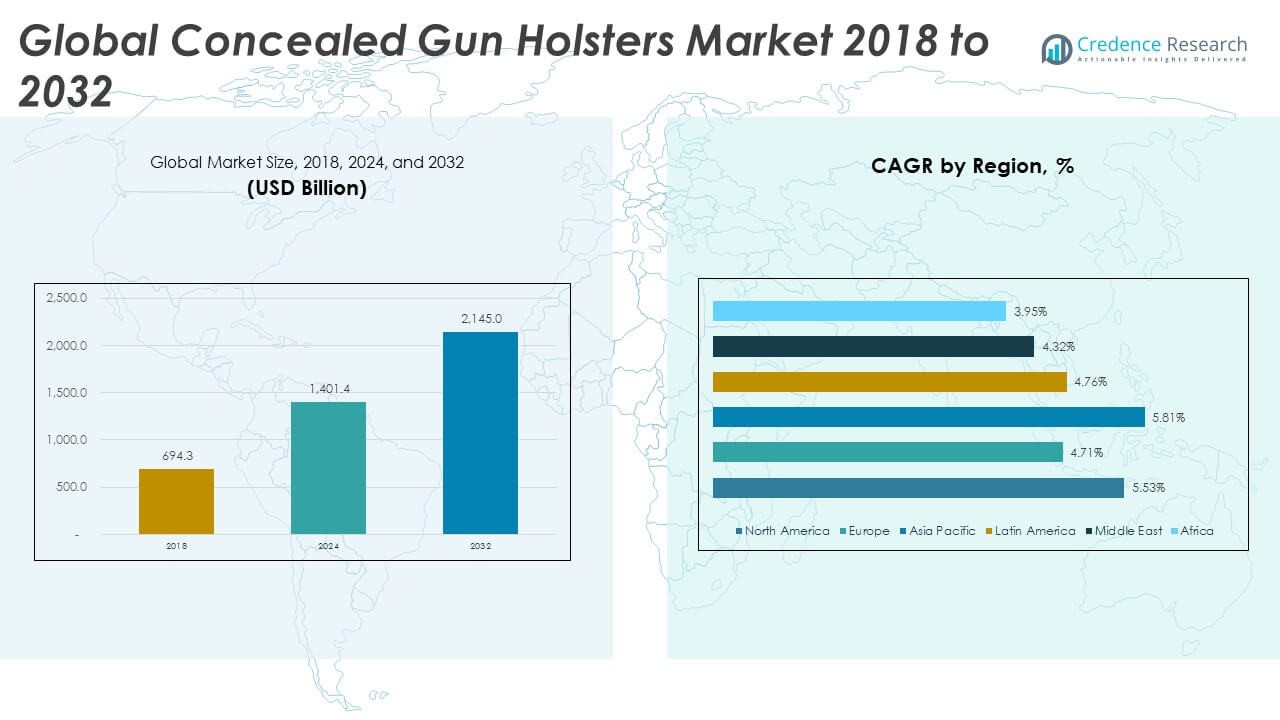
The Global Concealed Gun Holsters Market size was valued at USD 694.3 billion in 2018, rose to USD 1,401.40 billion in 2024 and is anticipated to reach USD 2,145.00 billion by 2032, at a CAGR of 5.51% during the forecast period.
| REPORT ATTRIBUTE | DETAILS |
|---|---|
| Historical Period | 2020-2023 |
| Base Year | 2024 |
| Forecast Period | 2025-2032 |
| Concealed Gun Holsters Market Size 2024 | USD 1,401.40 billion |
| Concealed Gun Holsters Market, CAGR | 5.51% |
| Concealed Gun Holsters Market Size 2032 | USD 2,145.00 billion |
Growth in this market is driven by increasing demand for personal safety solutions and rising adoption of concealed carry permits among civilians. Manufacturers are responding with ergonomic designs, advanced materials and retention systems to meet evolving user needs. The expansion of online retail and growing interest in shooting sports further amplify demand and broaden the consumer base.
Regionally, North America leads the market thanks to strong firearm ownership and established concealed carry culture. Europe holds a stable position due to supportive regulatory frameworks and awareness of personal defence. Meanwhile, Asia‑Pacific is emerging as a high‑growth region, as rising security concerns and disposable incomes foster increased interest in concealed carry holsters.
Market Insights:
- The Global Concealed Gun Holsters Market was valued at USD 694.3 billion in 2018, expected to grow to USD 1,401.40 billion by 2024, and projected to reach USD 2,145.00 billion by 2032, at a CAGR of 5.02% during the forecast period.
- North America holds the largest market share of 39.41%, driven by its strong gun ownership culture, increasing concealed carry permits, and a growing demand for personal safety solutions. Europe follows with 50.79%, supported by a rising interest in concealed carry and law enforcement demand. Asia-Pacific commands 75.48% of the market, showing rapid growth driven by increasing firearm ownership, evolving laws, and heightened security concerns.
- The fastest-growing region is the Asia-Pacific, with 75.48% market share. Growth is fueled by rising security concerns, expanding civilian gun ownership, and evolving concealed carry laws.
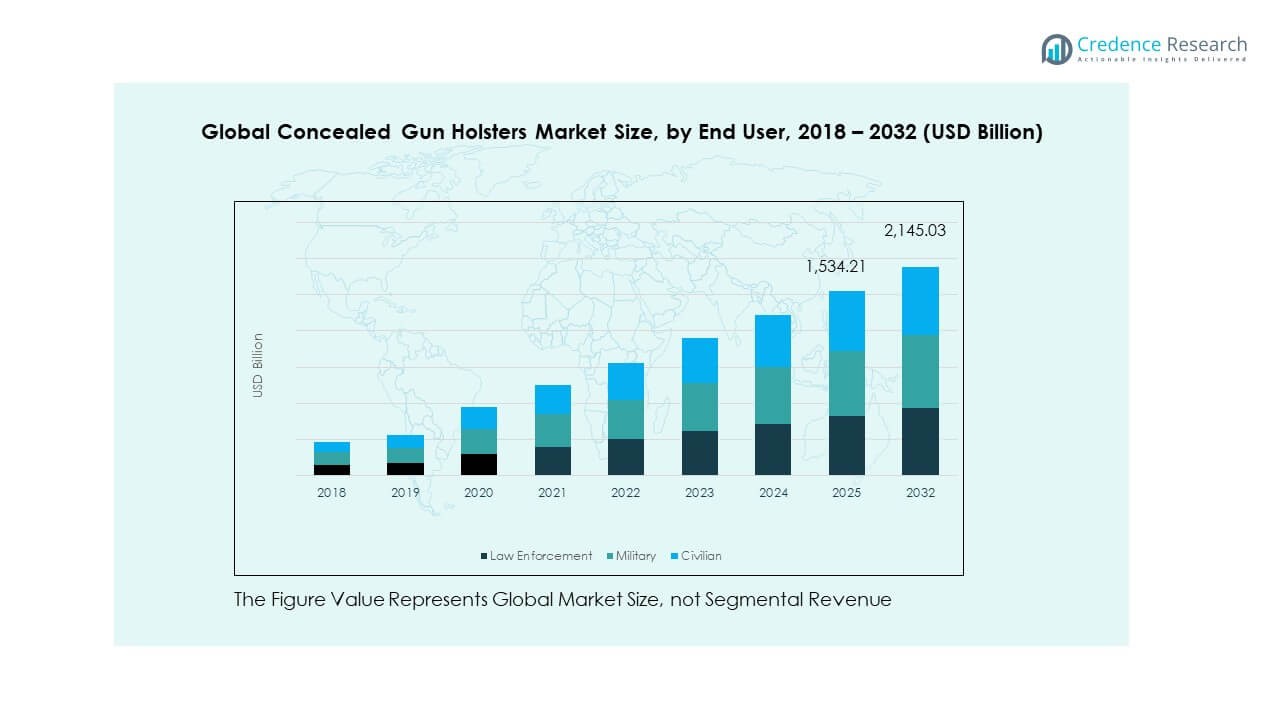
- The market share distribution by segment shows that law enforcement holds the largest share at 48%, followed by the civilian market at 41%, with the military segment representing the smallest portion at 11%.
- By end-user segment, law enforcement holds the largest share at 48%, while the civilian segment is expanding rapidly, now at 41%. Military applications remain steady but account for only 11% of the total market.
 Market Drivers:
Growing Demand for Personal Safety Solutions
The demand for concealed gun holsters is increasingly driven by rising concerns over personal safety. Consumers are becoming more aware of their security needs, particularly in regions with higher crime rates. This growing emphasis on safety has contributed to more individuals seeking out concealed carry options. Governments in certain regions have also made strides in legalizing concealed carry, thereby fueling demand for holsters. The market's response to these demands is evident in the variety of designs available, which cater to the specific needs of consumers. As people become more invested in personal protection, the need for secure and accessible concealed gun holsters continues to rise.
- For instance, Alien Gear Holsters’ ShapeShift line supports over 700 unique handgun models, which exemplifies how the industry tailors options to diverse user profiles. Governments in certain regions have also made strides in legalizing concealed carry, thereby increasing demand for holsters.
Expanding Concealed Carry Permits and Legalization
An increase in the number of concealed carry permits, particularly in North America, has further propelled the market. Several U.S. states have adopted more lenient laws regarding concealed carry, resulting in a higher demand for holsters. Many states are revisiting laws that restrict firearm possession, leading to new market opportunities. The trend towards legalizing concealed carry permits in both urban and rural areas is expected to drive further growth. This regulatory shift has broadened the consumer base, as both seasoned firearm owners and new gun owners seek suitable holsters. These changes have created a solid foundation for market expansion, fueling innovations in holster designs.
- For instance, Safariland acquired Rogers Holster in 2015 to enhance its carry product portfolio and respond quickly to evolving law‑enforcement and civilian carry regulations. The trend toward permit legalization in both urban and rural areas has broadened the consumer base, with newcomers and seasoned carriers alike seeking suitable holsters.
Technological Advancements in Holster Designs
The Global Concealed Gun Holsters Market benefits from technological advancements in materials and retention systems. Manufacturers are adopting modern materials, such as lightweight polymers and moisture-resistant fabrics, which enhance comfort and durability. These innovations contribute to more ergonomic and discreet holsters. Additionally, advanced retention systems improve the security and accessibility of concealed firearms, addressing consumer concerns over firearm safety. These developments attract both new buyers and long-term firearm enthusiasts, thus broadening the market's appeal. With the growing technological integration, the holster market continues to evolve to meet the functional and aesthetic preferences of consumers.
Rising Popularity of Concealed Carry for Self-Defense
Concealed carry for self-defense purposes has gained widespread popularity across various regions. The increasing perception that law enforcement cannot guarantee immediate protection in all situations drives individuals to take personal security measures into their own hands. This growing trend emphasizes the importance of accessible and reliable concealed carry options. As more people opt to carry firearms for self-defense, the demand for comfortable, concealable, and safe holsters rises. This shift in consumer behavior directly influences the growth of the Global Concealed Gun Holsters Market, as individuals prioritize both convenience and security.
Market Trends:
Integration of Smart Technology in Holsters
Smart technology integration is one of the emerging trends in the Global Concealed Gun Holsters Market. Some manufacturers are exploring ways to incorporate biometric access systems into holsters, ensuring quick and secure firearm access. These holsters use fingerprint recognition or RFID technology to enhance user security while maintaining rapid accessibility. The addition of smart features represents a growing demand for more advanced, user-friendly products. As consumers seek convenience and efficiency, this trend could reshape the design and functionality of concealed gun holsters. Expect further innovations in this space, as technological advancements continue to influence consumer preferences.
- For instance, Revere Defense developed a holster with omnidirectional fingerprint recognition technology tailored for civilian carry. These holsters use fingerprint sensors or RFID technology to enhance user security while maintaining rapid accessibility. The addition of smart features represents growing demand for more advanced, user‑friendly products.
Sustainability Focus in Manufacturing
Environmental concerns are also making an impact on the concealed gun holster market, with many companies turning towards eco-friendly production methods. Manufacturers are increasingly using sustainable materials, such as recycled plastics and biodegradable fabrics, to produce holsters. This shift towards sustainability reflects broader consumer trends prioritizing environmentally conscious products. Holster producers are innovating to reduce waste and minimize the environmental impact of manufacturing processes. The push for sustainability in the industry is expected to gain momentum, particularly as consumers demand products that align with their eco-conscious values.
- For instance, Vega Holster launched its “Earth Division,” offering holsters made from recycled polyamide and vegetable‑tanned leather under ISO 14001 certification. This shift reflects broader consumer trends prioritizing environment‑conscious products.
Customization and Personalization of Holsters
There is a growing trend towards offering customizable concealed gun holsters to cater to individual preferences. Consumers now have the ability to personalize holsters with features such as adjustable straps, multiple color options, and varying retention systems. This shift towards customization allows buyers to tailor their holster to their specific needs, enhancing both comfort and functionality. Additionally, the rise of online sales platforms has made it easier for consumers to explore a wide range of customizable options. As the demand for more personalized products increases, manufacturers are expected to continue expanding their customization options to remain competitive.
Holsters Designed for Women
Holsters designed specifically for women are gaining popularity, driven by an increasing number of female firearm owners. Women tend to have unique requirements when it comes to concealed carry, including holsters that offer comfort, accessibility, and style. Manufacturers are addressing this need by designing holsters that fit various body types and accommodate women’s clothing preferences. The trend towards gender-specific products is expected to grow as more women embrace concealed carry for personal protection. This market segment shows strong potential, as manufacturers continue to focus on creating holsters that meet the specific needs of female consumers.
Market Challenges Analysis:
Regulatory and Legal Barriers
One of the main challenges for the Global Concealed Gun Holsters Market lies in the varying regulations across regions. In many countries, laws surrounding the possession and carrying of firearms are stringent and vary significantly from one jurisdiction to another. These regulatory hurdles can create barriers for consumers, preventing the widespread adoption of concealed carry options. Market players must navigate these complex legal frameworks to ensure their products are compliant with local laws. Additionally, constantly changing legislation poses a challenge for manufacturers, as they must adapt to new laws quickly to maintain market relevance.
Competition from Alternative Concealed Carry Options
The Global Concealed Gun Holsters Market faces stiff competition from alternative concealed carry products, such as belt bags and other innovative carrying solutions. While holsters remain the most popular method for carrying concealed firearms, these alternatives are gaining traction due to their practicality and ease of use. These new products often provide additional features like storage for personal items, offering added convenience for users. The growing appeal of alternative carrying options challenges traditional holster designs, forcing manufacturers to innovate in order to maintain their market share.
Market Opportunities:
Increasing Adoption in Emerging Markets
Emerging markets present significant growth opportunities for the Global Concealed Gun Holsters Market. Countries in Asia-Pacific, Africa, and Latin America are witnessing rising interest in firearm ownership for self-defense. This growing demand is coupled with evolving legal frameworks that support the ownership and concealed carry of firearms. As these regions continue to develop their economies and infrastructure, the need for personal safety products like concealed gun holsters is expected to grow. Manufacturers should focus on these emerging markets, offering affordable and adaptable products that cater to the unique needs of these consumers.
Expansion of E-commerce Platforms
The rise of e-commerce platforms presents new opportunities for the Global Concealed Gun Holsters Market. Online shopping offers consumers greater convenience and access to a wide range of holster options. E-commerce has enabled manufacturers to reach customers in previously underserved regions, further expanding their market reach. This shift is expected to continue, as more consumers turn to online retailers for personalized and convenient shopping experiences. Manufacturers should focus on enhancing their online presence to capitalize on the growing trend of digital sales in the holster market.
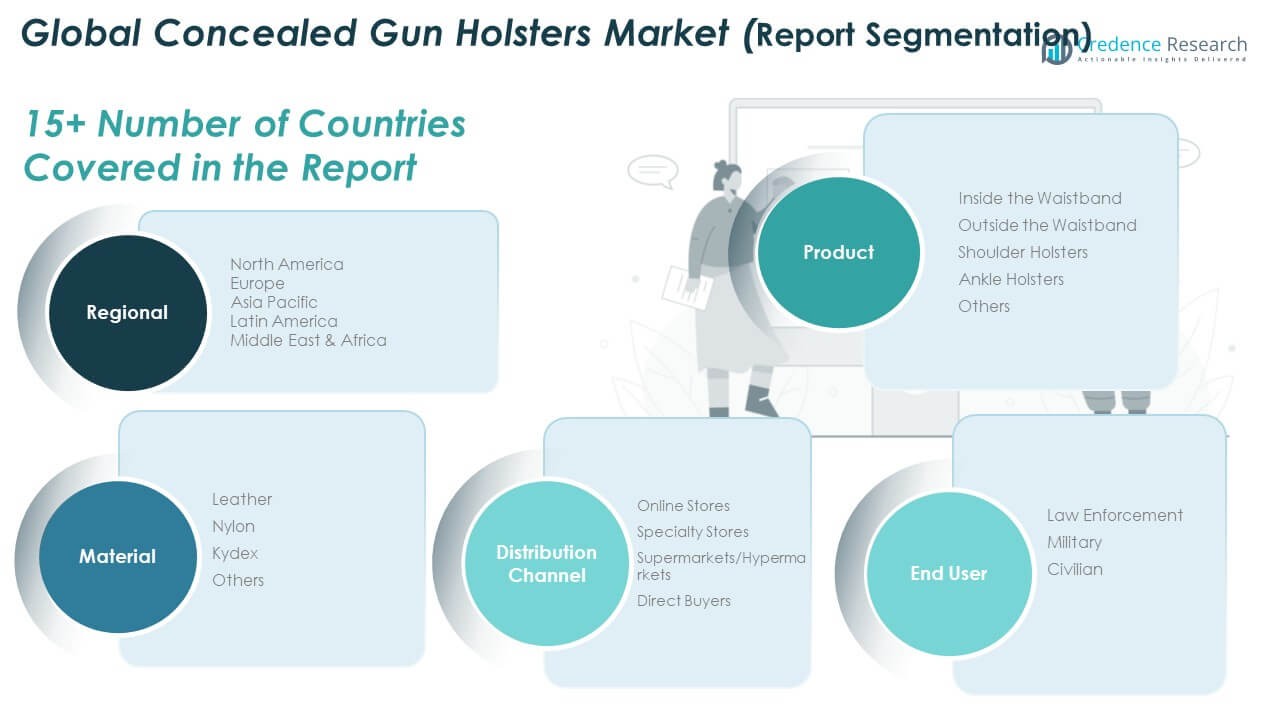
Market Segmentation Analysis:
By Product Type
The Global Concealed Gun Holsters Market is segmented by product type into Inside the Waistband (IWB), Outside the Waistband (OWB), Shoulder Holsters, Ankle Holsters, and Others. IWB and OWB holsters dominate the market, as they offer varying degrees of concealment and comfort for consumers. Shoulder and ankle holsters are preferred by those seeking alternative carry options. The "Others" category includes specialized holsters like thigh and belt holsters, which cater to niche needs.
- For instance, Blackhawk’s Omnivore model fits over 150 semi‑auto pistol models, demonstrating how major players focus on universal IWB/OWB designs. Shoulder and ankle holsters appeal to users who prefer alternative carry positions; for instance, Galco offers over 3,500 SKU leather models including ankle and shoulder options.
By Material
The material segment includes Leather, Nylon, Kydex, and Others. Leather holsters remain popular due to their classic appeal, comfort, and durability. Kydex holsters have seen increased adoption for their lightweight, rigid design and superior retention features. Nylon holsters offer an affordable alternative, combining flexibility and practicality. The "Others" category includes materials like polymer and hybrid combinations, which are gaining traction for specific needs like tactical or everyday carry.
- For instance, Galco promotes its handcrafted exotic leather holsters made from materials such as alligator or ostrich skin, highlighting its high‑end leather craftsmanship. Kydex holsters have seen increased adoption thanks to their lightweight, rigid design and strong retention
By Distribution Channel
Distribution channels in the market include Online Stores, Specialty Stores, Supermarkets/Hypermarkets, and Direct Buyers. Online sales channels are seeing significant growth due to the convenience they offer. Specialty stores provide hands-on experiences, attracting firearm enthusiasts who prefer in-person purchases. Supermarkets/Hypermarkets and direct buyers continue to capture a portion of the market, offering convenience and established relationships.
By End User
The end-user segment includes Law Enforcement, Military, and Civilian consumers. Law enforcement and military sectors remain significant drivers due to their ongoing demand for high-quality, functional holsters. The civilian market has seen a surge in growth, with individuals purchasing holsters for self-defense purposes, especially in regions where concealed carry laws have become more permissive.
Segmentation:
By Product Type:- Inside the Waistband (IWB)
- Outside the Waistband (OWB)
- Shoulder Holsters
- Ankle Holsters
- Others
- Leather
- Nylon
- Kydex
- Others
- Online Stores
- Specialty Stores
- Supermarkets/Hypermarkets
- Direct Buyers
- Law Enforcement
- Military
- Civilian
- North America
- U.S.
- Canada
- Mexico
- Europe
- Germany
- France
- U.K.
- Italy
- Spain
- Rest of Europe
- Asia Pacific
- China
- Japan
- India
- South Korea
- South-east Asia
- Rest of Asia Pacific
- Latin America
- Brazil
- Argentina
- Rest of Latin America
- Middle East & Africa
- GCC Countries
- South Africa
- Rest of the Middle East and Africa
Regional Analysis:
U.S. Concealed Gun Holsters Market
The U.S. Concealed Gun Holsters Market size was valued at USD 39.41 million in 2018, to USD 50.79 million in 2024, and is anticipated to reach USD 75.48 million by 2032, at a CAGR of 5.02% during the forecast period. The U.S. holds a significant share of the Global Concealed Gun Holsters Market, representing 39.41% of the global market. This market is primarily driven by the high levels of firearm ownership and a growing trend of concealed carry permits across various states. Both civilians and law enforcement sectors contribute to the demand for holsters, with increasing emphasis on personal security and self-defense. The rise in gun ownership and an expanding culture of concealed carry in the U.S. plays a pivotal role in market growth. Technological innovations, such as biometric-enabled holsters and advanced retention systems, further enhance the appeal of concealed carry solutions. Online platforms and specialty stores remain the primary distribution channels, ensuring broad market access. The U.S. continues to be the dominant market player, expected to lead the global market, setting trends in product innovation and consumer demand. The focus on comfort, concealability, and security will drive further growth in the coming years.
Key Player Analysis:
- Blackhawk
- Safariland
- Galco Gunleather
- Alien Gear Holsters
- CrossBreed Holsters
- DeSantis Gunhide
- Fobus Holsters
- Uncle Mike's
- Blade-Tech Industries
- Comp-Tac Victory Gear
- 1791 Gunleather
- Vedder Holsters
- StealthGearUSA
- Clinger Holsters
- We The People Holsters
Competitive Analysis:
The Global Concealed Gun Holsters Market is highly competitive, with key players continually innovating to meet growing demand for secure, comfortable, and accessible concealed carry solutions. Companies like Blackhawk, Safariland, and Alien Gear Holsters dominate the market through strong brand recognition, diverse product offerings, and cutting-edge designs. These companies focus on providing various holster options, including inside-the-waistband (IWB), outside-the-waistband (OWB), and shoulder holsters. The competitive landscape also includes companies focused on technological advancements, such as biometric security features in holsters. Manufacturers are investing heavily in research and development to improve retention, comfort, and concealability. Distribution through online platforms, specialty stores, and direct-to-consumer channels remains crucial for market reach and growth. The increasing focus on personal safety and concealed carry permits across regions continues to drive competition and market innovation.
Recent Developments:
- In July 2025, Trinity Hunt Partners, a Dallas-based private equity firm, acquired a majority stake in Blackhawk Supply, a move aimed at creating a national leader in HVAC distribution. This partnership is expected to accelerate value creation and growth in the broader supply chain, leveraging Blackhawk's existing foundation for rapid scaling and efficiency improvements across the industry. Additionally, in April 2025, Black Hawk Acquisition Corp announced a business combination agreement with Vesicor Therapeutics Inc., a California-based biotech company, focusing on developing p53-based cancer therapeutics delivered via microvesicles, with the transaction expected to close in Q4 2025.
- In July 2025, DeSantis Gunhide attended the Chattanooga Shooting Supplies Dealer Show to exhibit new product lines and engage directly with dealers. The event provided an opportunity for retailers and partners to experience DeSantis' latest holster innovations in leather, nylon, and Kydex-underscoring the company’s commitment to high-quality products for law enforcement, the armed forces, and hobbyists alike.
- In April 2025, Safariland revealed a newly developed holster product as part of an integrated collaboration with Axon, launched at Phoenix's Axon Week 2025. This partnership introduced a holster compatible with Axon's Signal device, reinforcing Safariland's ongoing commitment to product innovation in public safety technology and accessories. Earlier in January 2025, Safariland debuted its advanced Ballast duty-rated holster system at the SHOT Show, targeting law enforcement professionals and continuing its push for technologically advanced, duty-specific holster solutions.
Report Coverage:
The research report offers an in-depth analysis based on product segments, materials, distribution channels, and end-user categories. It details leading market players, providing an overview of their business, product offerings, investments, revenue streams, and key applications. Additionally, the report includes insights into the competitive environment, SWOT analysis, current market trends, as well as the primary drivers and constraints. Furthermore, it discusses various factors that have driven market expansion in recent years. The report also explores market dynamics, regulatory scenarios, and technological advancements that are shaping the industry. It assesses the impact of external factors and global economic changes on market growth. Lastly, it provides strategic recommendations for new entrants and established companies to navigate the complexities of the market.
Future Outlook:
- The demand for concealed gun holsters will continue to grow due to increased interest in personal defense.
- Technological innovation will drive market growth with the introduction of smart holsters with biometric and RFID features.
- The civilian segment will expand, as more individuals opt for concealed carry for self-defense purposes.
- Online retail channels will dominate sales, offering convenience and a wide range of holster options.
- Manufacturers will focus on improving the comfort, concealability, and retention of holsters.
- The trend toward customizable holsters will gain momentum, with consumers seeking personalized products.
- Regulatory changes in key markets, especially in North America, will drive demand for concealed carry solutions.
- The growing adoption of concealed carry laws in emerging markets will open new avenues for growth.
- The market will see increased collaboration between holster manufacturers and law enforcement agencies.
- Increased investment in research and development will lead to more efficient and secure holster solutions.

Request a Free Sample
Fill in your details and we'll send you a free sample report.
- Sample data tables & charts
- Research methodology
Need a Custom Version of This Report?
Tailor the scope, geography, or segments to your exact requirements.
- Custom geography or segment scope
- Direct access to our analyst team
Frequently Asked Questions
What is the current market size for the Global Concealed Gun Holsters Market, and what is its projected size in 2032?
At what Compound Annual Growth Rate is the Global Concealed Gun Holsters Market projected to grow between 2025 and 2032?
Which Global Concealed Gun Holsters Market segment held the largest share in 2024?
What are the primary factors fueling the growth of the Global Concealed Gun Holsters Market?
Who are the leading companies in the Global Concealed Gun Holsters Market?
Which region commanded the largest share of the Global Concealed Gun Holsters Market in 2024?
Table of Content
Chapter 1 Market Segmentation
- 1.1 Segmentation Framework
- 1.1.1 Product and Service Classification
- 1.1.2 Application and End-Use Classification
- 1.1.3 Technology and Solution Classification
- 1.1.4 Customer and Distribution Channel Classification
- 1.1.5 Geographic Segmentation
- 1.1.6 Market Segment Definitions and Boundaries
Chapter 2 Introduction
- 2.1 Report Objectives and Scope
- 2.2 Product Definition and Industry Terminology
- 2.3 Market Inclusions and Exclusions
- 2.4 Research Process
- 2.4.1 Primary Research and Expert Interviews
- 2.4.2 Secondary Research and Source Review
- 2.4.3 Top-Down and Bottom-Up Estimation
- 2.4.4 Data Triangulation and Verification
- 2.5 Market Size Measurement Basis
- 2.5.1 2018: USD 694.3 billion → 2024: USD 1,401.40 billion
- 2.6 Historical and Forecast Reference Periods
- 2.6.1 Base Year: 2018
- 2.6.2 Forecast Period: 2018-2024
- 2.7 Research Assumptions and Limitations
Chapter 3 Executive Summary
- 3.1 Market Snapshot and Key Findings
- 3.2 Base-Year Market Size, 2018
- 3.3 Forecast Market Size, 2024
- 3.4 Revenue and Volume Growth Outlook
- 3.5 Key Demand and Supply Indicators
- 3.6 Leading Market Segments
- 3.7 Fastest-Growing Market Opportunities
- 3.8 Regional Performance Highlights
- 3.9 Technology and Industry Transformation
- 3.10 Competitive Landscape Summary
- 3.11 Analyst View and Strategic Implications
Chapter 4 Global Concealed Gun Holsters Market Trends and Developments
- 4.1 Historical Industry Development
- 4.2 Recent Market Trends and Developments
- 4.3 Demand and Customer Behavior Trends
- 4.4 Technology and Product Innovation
- 4.5 Artificial Intelligence, Automation and Digitalization
- 4.6 Local Manufacturing and Supply Chain Realignment
- 4.7 Industry Partnerships, Mergers and Acquisitions
- 4.8 Sustainability and Circular Economy Developments
- 4.9 Government and Private Sector Investment Trends
- 4.10 Emerging Business Models and Commercialization
- 4.11 Industry Developments and Announcements
Chapter 5 Global Concealed Gun Holsters Market Production, Supply and Demand Analysis
- 5.1 Demand Trend and Consumption Analysis
- 5.2 Demand Forecast, 2018-2024
- 5.3 Production and Output Trend
- 5.4 Production and Output Forecast, 2018-2024
- 5.5 Installed Capacity and Capacity Utilization
- 5.6 Company-Wise Production Plants and Statistics
- 5.6.1 Installed Production Capacity
- 5.6.2 Actual Production
- 5.6.3 Planned Capacity and Expansion Targets
- 5.7 Supply Chain Structure and Procurement Trends
- 5.8 Supply-Demand Gap and Bottlenecks
- 5.9 Import Dependence and Sourcing Structure
- 5.10 Contract Manufacturing and Outsourcing
- 5.11 Regional Supply and Demand Concentration
Chapter 6 Global Concealed Gun Holsters Market Pricing Analysis
- 6.1 Pricing Structure and Measurement
- 6.2 Historical Pricing Trends
- 6.3 Pricing Outlook, 2018-2024
- 6.4 Average Selling Price and Unit Economics
- 6.5 Pricing by Product and Market Segment
- 6.6 Geographic Pricing Differences
- 6.7 Key Input, Energy, Labor and Logistics Costs
- 6.8 Contract Pricing and Purchasing Models
- 6.9 Pricing Sensitivity and Competitive Positioning
- 6.10 Price, Margin and Profitability Implications
Chapter 7 Global Concealed Gun Holsters Market Dynamics
- 7.1 Market Growth Drivers
- 7.1.1 Demand-Side Drivers
- 7.1.2 Technology and Innovation Drivers
- 7.1.3 Infrastructure and Investment Drivers
- 7.1.4 Regulatory and Policy Drivers
- 7.2 Market Restraints
- 7.2.1 Cost and Affordability Constraints
- 7.2.2 Technology and Adoption Barriers
- 7.2.3 Supply Chain and Operational Constraints
- 7.3 Market Challenges
- 7.3.1 Competitive Pressure and Margin Erosion
- 7.3.2 Skills, Infrastructure and Implementation Gaps
- 7.4 Emerging Market Opportunities
- 7.5 Market Dynamics Impact and Time-Horizon Assessment
Chapter 8 Global Concealed Gun Holsters Value Chain Analysis
- 8.1 Industry Value Chain Overview
- 8.2 Upstream Suppliers and Critical Inputs
- 8.3 Technology and Component Providers
- 8.4 Manufacturing or Service Delivery
- 8.5 Distribution, Channel Partners and Integrators
- 8.6 Downstream Applications and End Users
- 8.7 Value Addition and Profit Pools
- 8.8 Vertical Integration and Outsourcing
- 8.9 Supplier Concentration and Risk
- 8.10 Supply Chain Localization and Resilience
Chapter 9 Global Concealed Gun Holsters Market Regulations and Policies
- 9.1 Relevant Laws, Standards and Compliance Frameworks
- 9.2 Product, Service, Safety and Quality Requirements
- 9.3 Government Policies, Incentives and Subsidies
- 9.4 Imports, Exports and Trade Barriers
- 9.5 Public Procurement and Local Content Requirements
- 9.6 Environmental and Sustainability Compliance
- 9.7 Upcoming Policy Changes and Market Implications
Chapter 10 Global Concealed Gun Holsters Market Hotspots and Opportunities
- 10.1 Market Opportunity Mapping and Growth Hotspots
- 10.2 High-Growth Applications and Customer Groups
- 10.3 Underserved Markets and White-Space Opportunities
- 10.4 Emerging Technology and Product Opportunities
- 10.5 New Capacity and Investment Hotspots
- 10.6 Market Entry and Expansion Opportunities
- 10.7 Distribution and Partnership Opportunities
- 10.8 Near-Term and Long-Term Commercial Potential
- 10.9 Opportunity Attractiveness and Execution Risks
Chapter 11 Global Concealed Gun Holsters Market Outlook, 2018-2024
- 11.1 Market Size and Analysis
- 11.1.1 Revenue (Market Measurement: 2018: USD 694.3 billion → 2024: USD 1,401.40 billion)
- 11.1.2 Market Volume and Quantity Sold
- 11.1.3 Historical Market Size
- 11.1.4 Base-Year Market Size, 2018
- 11.2 Market Forecast, 2018-2024
- 11.2.1 Revenue Forecast to 2024
- 11.2.2 Volume Forecast to 2024
- 11.2.3 CAGR and Year-on-Year Growth
- 11.2.4 Incremental Revenue Opportunity
- 11.3 Forecast Assumptions and Scenario Analysis
- 11.3.1 Base-Case Forecast
- 11.3.2 Optimistic and Conservative Scenarios
- 11.3.3 Technology, Pricing and Policy Sensitivities
- 11.4 Market Attractiveness and Growth Outlook
Chapter 12 Global Concealed Gun Holsters Market Segmentation and Outlook
- 12.1 Segmentation Summary and Market Shares, 2018
- 12.2 Largest and Fastest-Growing Segments
- 12.3 Segment Growth Comparison
- 12.4 Segment Attractiveness and Priority Matrix
Chapter 13 Global Concealed Gun Holsters Geographic Market Outlook, 2018-2024
- 13.1 Regional Market Size and Share, 2018
- 13.2 Regional Market Forecast, 2018-2024
- 13.3 Regional Pricing, Production and Demand Differences
- 13.4 North America
- 13.4.1 United States
- 13.4.2 Canada
- 13.4.3 Mexico
- 13.5 Europe
- 13.5.1 Germany
- 13.5.2 France
- 13.5.3 Italy
- 13.5.4 United Kingdom
- 13.5.5 Spain
- 13.5.6 Poland
- 13.5.7 Russia
- 13.5.8 Netherlands
- 13.5.9 Belgium
- 13.5.10 Sweden
- 13.5.11 Denmark
- 13.5.12 Norway
- 13.5.13 Rest of Europe
- 13.6 Asia Pacific
- 13.6.1 China
- 13.6.2 India
- 13.6.3 Japan
- 13.6.4 South Korea
- 13.6.5 Thailand
- 13.6.6 Indonesia
- 13.6.7 Vietnam
- 13.6.8 Malaysia
- 13.6.9 Australia
- 13.6.10 Rest of Asia Pacific
- 13.7 Latin America
- 13.7.1 Brazil
- 13.7.2 Argentina
- 13.7.3 Colombia
- 13.7.4 Chile
- 13.7.5 Rest of Latin America
- 13.8 Middle East
- 13.8.1 Saudi Arabia
- 13.8.2 United Arab Emirates
- 13.8.3 Turkey
- 13.8.4 Israel
- 13.8.5 Iran
- 13.8.6 Rest of the Middle East
- 13.9 Africa
- 13.9.1 South Africa
- 13.9.2 Egypt
- 13.9.3 Nigeria
- 13.9.4 Morocco
- 13.9.5 Rest of Africa
- 13.10 Regional Investment, Policy and Supply Chain Differences
- 13.11 Regional Competitive Landscape
- 13.12 Geographic Growth Hotspots
Chapter 14 Global Concealed Gun Holsters Technology, Innovation and Sustainability Outlook
- 14.1 Technology Landscape and Maturity
- 14.2 Product, Process and Service Innovation
- 14.3 AI, Automation and Digital Tools in the Industry
- 14.4 Technology Adoption and Performance Benchmarking
- 14.5 Innovation Pipeline and R&D Investment
- 14.6 Patent and Intellectual Property Trends
- 14.7 Energy Efficiency and Resource Management
- 14.8 Sustainability, Recycling and Circularity
- 14.9 Technology Roadmap, 2018-2024
- 14.10 Risks of Obsolescence and Technology Substitution
Chapter 15 Global Concealed Gun Holsters Market Key Strategic Imperatives
- 15.1 Growth and Market Entry Priorities
- 15.2 High-Return Products and Segments
- 15.3 Pricing, Profitability and Cost Optimization
- 15.4 Technology Investment and Product Differentiation
- 15.5 Supply Chain Localization and Resilience
- 15.6 Distribution and Customer Acquisition
- 15.7 Partnership, Acquisition and Capacity Strategy
- 15.8 Regional Expansion Priorities
- 15.9 Short-, Medium- and Long-Term Actions
Chapter 16 Competition Outlook
- 16.1 Industry Competition Characteristics
- 16.2 Market Structure and Concentration
- 16.3 Market Share and Competitive Positioning, 2018
- 16.4 Company-Wise Revenue and Product Benchmarking
- 16.5 Production and Service Capacity Benchmarking
- 16.6 Technology, Pricing and Differentiation
- 16.7 Regional Footprint and Distribution Strength
- 16.8 Mergers, Acquisitions and Strategic Alliances
- 16.9 New Entrants and Competitive Threats
- 16.10 Porter's Five Forces and Industry Attractiveness
- 16.11 Competitive Outlook, 2018-2024
Chapter 17 Company Profiles
- 17.1 Company Coverage and Selection Criteria
- 17.2 Leading Market Participants – Standard Profile Structure
- 17.2.1 Business Description
- 17.2.2 Company Ownership and Geographic Presence
- 17.2.3 Product and Service Portfolio
- 17.2.4 Manufacturing and Operating Footprint
- 17.2.5 Production Capacity and Expansion Plans
- 17.2.6 Financial Performance and Investment
- 17.2.7 Market Share and Competitive Position
- 17.2.8 Technology and Innovation Capabilities
- 17.2.9 Strategic Alliances or Partnerships
- 17.2.10 Recent Developments
- 17.2.11 Growth Strategy and Outlook
- 17.3 Other Relevant Market Participants
Note: Every listed company is profiled on the structure shown under the first company. The company list is preliminary and may change based on research findings, market developments, data availability and client requirements.
Chapter 18 Disclaimer
- 18.1 Research and Forecast Disclaimer
- 18.2 Data Source and Estimation Limitations
Note: The depth of individual sections depends on data availability for this market. Volume, capacity, trade and other unit-based metrics are included where applicable.