
Market Overview:
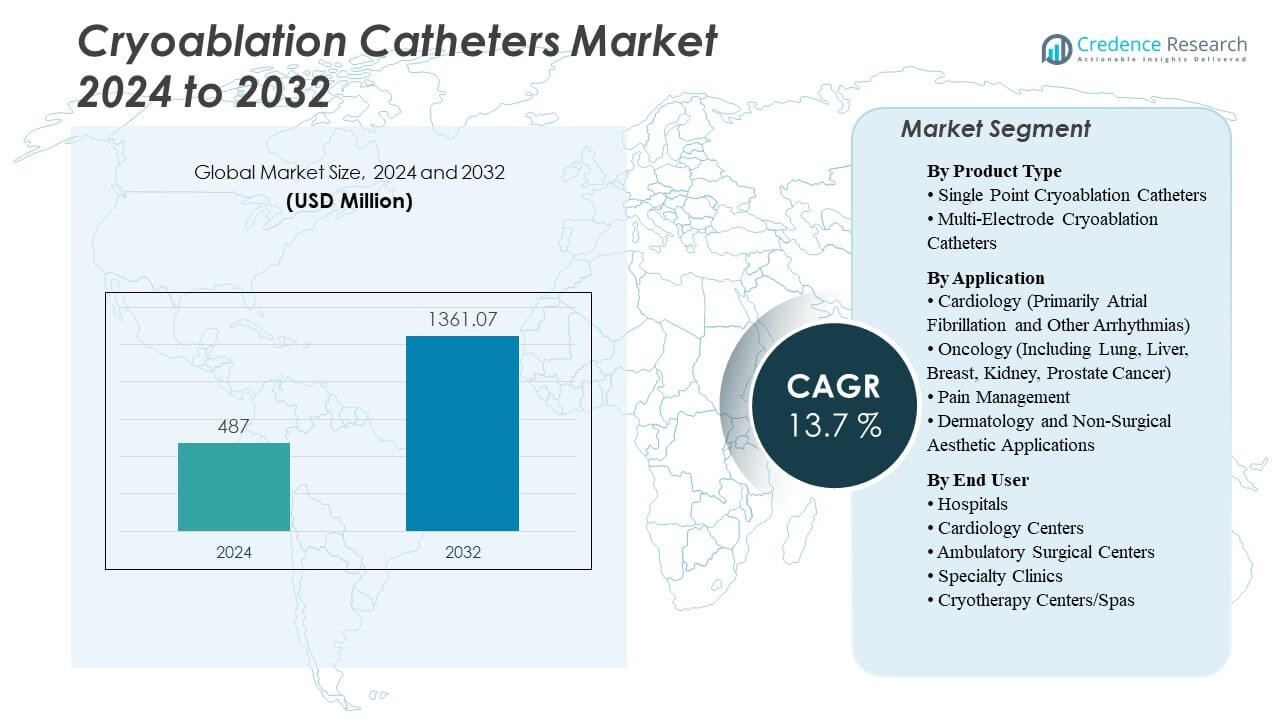
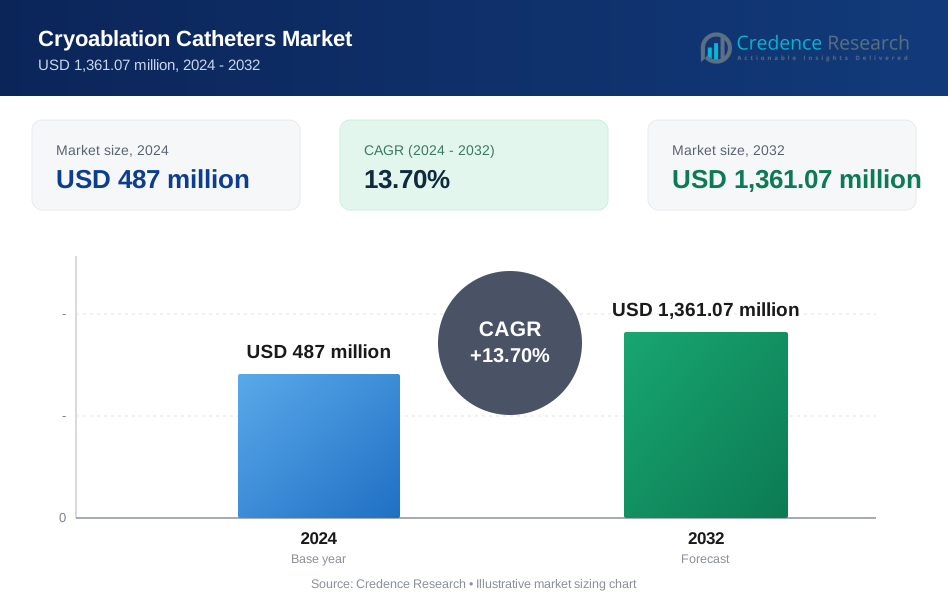
The Cryoablation Catheters Market is projected to grow from USD 487 million in 2024 to an estimated USD 1,361.07 million by 2032, with a compound annual growth rate (CAGR) of 13.7% from 2024 to 2032.
| REPORT ATTRIBUTE | DETAILS |
|---|---|
| Historical Period | 2020-2023 |
| Base Year | 2024 |
| Forecast Period | 2025-2032 |
| Cryoablation Catheters Market Size 2024 | USD 487 Million |
| Cryoablation Catheters Market, CAGR | 13.7% |
| Cryoablation Catheters Market Size 2032 | USD 1,361.07 Million |
Rising prevalence of cardiac rhythm disorders and strong preference for cryothermal procedures drive market growth. Healthcare professionals favor cryoablation over traditional methods due to its precision, reduced collateral tissue damage, and faster recovery time. Growing clinical validation and favorable regulatory approvals further strengthen adoption rates. Technological innovation by major players focusing on catheter performance, temperature control, and improved lesion durability also supports long-term market sustainability across both developed and emerging economies.
North America leads the Cryoablation Catheters Market owing to advanced healthcare infrastructure, strong reimbursement support, and higher awareness of cardiac arrhythmia treatments. Europe follows with strong adoption in cardiac centers backed by ongoing clinical research and regulatory support. The Asia-Pacific region is emerging rapidly due to growing healthcare investments, expanding patient awareness, and rising cardiovascular disease prevalence in countries like China, Japan, and India. Latin America and the Middle East & Africa show steady growth with improving access to modern cardiac treatment facilities and skilled practitioners.
Market Insights:
- The Cryoablation Catheters Market is projected to grow from USD 487 million in 2024 to USD 1,361.07 million by 2032, at a CAGR of 13.7%.
- Rising cases of atrial fibrillation and increasing adoption of minimally invasive cardiac procedures are major growth drivers.
- Advancements in cryothermal technology improve safety, lesion precision, and overall treatment outcomes.
- High equipment costs and limited access in low-income regions act as key market restraints.
- North America dominates due to advanced healthcare systems and strong reimbursement structures.
- Europe shows steady growth driven by clinical validation and adoption across cardiac care centers.
- Asia-Pacific is the fastest-growing region, supported by healthcare investments and expanding cardiac facilities.
Market Drivers
Rising Prevalence of Atrial Fibrillation and Growing Need for Minimally Invasive Treatments
The Cryoablation Catheters Market benefits from a sharp rise in atrial fibrillation cases globally. Hospitals and cardiac centers prefer cryoablation procedures for their precision and minimal tissue damage. The growing elderly population increases the number of cardiac rhythm disorders needing advanced intervention. Surgeons favor cryothermal technology due to its predictable lesion formation and safety profile. It allows shorter procedure durations and faster recovery for patients. Strong clinical success rates drive greater physician adoption. Governments and health insurers support these therapies due to lower long-term care costs. This creates consistent demand for advanced cryoablation catheters worldwide.
- For example, Medtronic’s Arctic Front Advance cryoballoon catheter system has demonstrated pulmonary vein isolation success rates above 99% in multicenter studies involving over 1,600 patients. Data from the STOP AF Post-Approval Study and European registry confirmed consistent performance across diverse clinical settings, reinforcing its global adoption in cardiac ablation practice.
Technological Innovation and Integration of Advanced Imaging and Mapping Systems
Continuous innovation strengthens product capabilities and supports the efficiency of cardiac ablations. Modern systems now integrate three-dimensional mapping, enhanced visualization, and precise temperature control. The combination of cryo-energy with navigation tools ensures accurate lesion targeting. It enables electrophysiologists to treat complex arrhythmias safely and reproducibly. Medical device companies invest heavily in R&D to improve catheter flexibility and energy delivery. Upgraded hardware enhances patient safety while improving procedural consistency. Hospitals adopt systems that merge cryoablation with digital guidance for higher precision. These innovations support a strong competitive edge among leading manufacturers.
- For example, a 2025 multicenter study (N=80) comparing Boston Scientific’s POLARx FIT Cryoablation System with Medtronic’s Arctic Front Advance Pro showed that POLARx FIT achieved a shorter skin-to-skin procedure time of 62.7 ± 8.9 minutes versus 72.7 ± 21.6 minutes (p = 0.008). The study also reported significantly reduced fluoroscopy and left atrial dwell times, while the POLARx balloon’s 31 mm adaptive diameter improved tissue contact and visualization.
Increasing Clinical Validation and Favorable Regulatory Support for New Catheter Technologies
Rising clinical evidence supports the safety and long-term outcomes of cryoablation therapy. Several large-scale trials confirm its effectiveness in managing atrial fibrillation and other rhythm disorders. It has gained rapid FDA and CE mark approvals, encouraging healthcare providers to expand usage. Regulatory bodies recognize the technology’s potential to reduce complications and recurrence rates. Hospitals rely on documented outcomes to improve patient confidence and procedural adoption. Growing acceptance in clinical guidelines strengthens the market outlook. Companies with proven clinical performance see faster product approvals. These factors collectively ensure steady market expansion across developed economies.
Expanding Healthcare Infrastructure and Access to Electrophysiology Services in Emerging Markets
Developing regions invest heavily in advanced cardiac care facilities and training programs. Hospitals in Asia-Pacific, Latin America, and the Middle East expand electrophysiology units. It allows broader access to cryoablation therapies and supports early arrhythmia intervention. Growing health awareness increases patient willingness to adopt modern treatment solutions. Governments prioritize cardiac disease management through funding and insurance coverage. Training programs by device manufacturers improve procedural expertise among physicians. Local distributors form alliances to ensure product availability in secondary cities. The growing reach of cardiac treatment centers continues to open new commercial opportunities.
Market Trends
Integration of Artificial Intelligence and Digital Mapping Tools in Cryoablation Procedures
Artificial intelligence is transforming ablation workflows through predictive analytics and smart mapping systems. AI-enabled tools analyze patient-specific data to plan optimal lesion paths. It supports faster diagnosis and better intra-procedural decision-making. Digital mapping ensures complete lesion coverage with minimal radiation exposure. Hospitals use connected software for real-time monitoring and documentation. The integration reduces human error while improving procedural reproducibility. Medical device manufacturers partner with software firms to refine these systems. The trend is accelerating clinical adoption of AI-driven cryoablation solutions worldwide.
- For example, Boston Scientific’s POLARx™ Cryoablation System achieved an acute pulmonary vein isolation rate of 99.5% compared to 100% with Medtronic’s Arctic Front Advance Pro in a multicenter study. The system also demonstrated higher pulmonary vein potential visualization at 96.3% versus 88.6% (p < 0.001), supporting its precision and procedural efficiency.
Growing Shift Toward Outpatient and Ambulatory Cryoablation Procedures
Healthcare providers favor outpatient ablations due to reduced hospitalization costs and higher patient turnover. Shorter recovery times and lower complication risks make the technology ideal for same-day discharge. It supports hospital efficiency and patient convenience simultaneously. Many centers now adopt compact cryoablation systems designed for ambulatory settings. It also reduces the overall burden on tertiary cardiac hospitals. Insurers expand reimbursement for outpatient arrhythmia care, improving accessibility. Technological refinements enhance safety for shorter stay treatments. This shift drives higher utilization rates in both developed and emerging markets.
Product Miniaturization and Focus on Single-Use Catheter Development
Manufacturers increasingly design smaller and more flexible catheters for easier navigation. The miniaturization trend enhances comfort and reduces vascular complications during procedures. It supports treatment of complex arrhythmias in smaller cardiac chambers. Single-use catheter models eliminate cross-contamination risks and meet stringent hospital hygiene norms. It also simplifies inventory management and ensures device consistency. Companies invest in new materials that withstand extreme cryothermal stress. Hospitals prefer disposable devices for operational efficiency and compliance. This trend reshapes procurement strategies across high-volume cardiac centers globally.
Increased Collaboration Between Device Makers and Healthcare Providers for Clinical Training
Collaborations between manufacturers and hospitals improve clinical expertise and procedural outcomes. Structured training programs and simulation workshops boost confidence among new electrophysiologists. It leads to better procedural success rates and patient satisfaction. Companies sponsor fellowships and educational courses in major cardiac institutes. The partnerships ensure proper equipment usage and feedback-driven product enhancement. It also supports regional adoption where specialized expertise is still developing. By building skilled user networks, firms strengthen their brand trust. These collaborations play a vital role in long-term technology acceptance.
- For example, Major academic hospitals in the U.S. and Europe have participated in multicenter clinical studies evaluating Boston Scientific’s POLARx™ and Medtronic’s Arctic Front Advance Pro systems. Their involvement supports evidence-based training programs and standardized protocols for cardiac cryoablation procedures.
Market Challenges Analysis
High Cost of Cryoablation Systems and Limited Accessibility in Low-Income Regions
The Cryoablation Catheters Market faces major cost-related barriers that restrict its widespread use. Advanced cryoablation systems demand heavy investment in equipment, installation, and maintenance. It limits adoption in low- and middle-income economies with budget constraints. Hospitals often rely on public funding or grants to procure these systems. Limited insurance coverage in developing regions further deters patient uptake. Import duties and lack of local manufacturing increase device pricing. The situation reduces affordability for both private and public health institutions. Overcoming these challenges requires cost optimization and scalable technology models.
Shortage of Trained Electrophysiologists and Lack of Procedural Awareness Among Clinicians
A growing skill gap in electrophysiology affects treatment quality and procedural consistency. Many hospitals struggle to recruit adequately trained specialists. It slows the diffusion of cryoablation technology beyond major cardiac centers. Limited awareness among general cardiologists delays timely referrals for advanced care. Training costs and certification requirements also deter smaller hospitals. The absence of standardized global protocols affects procedural uniformity. Medical device firms invest in capacity-building programs to bridge this gap. Addressing this shortage is critical for ensuring sustainable market expansion and patient access.
Market Opportunities
Growing Investments in Healthcare Modernization and Expansion of Cardiac Care Facilities
The Cryoablation Catheters Market benefits from major healthcare modernization programs across developing economies. Governments are allocating funds to upgrade cardiac hospitals and diagnostic labs. It creates a favorable environment for integrating cryoablation technology into routine practice. The expanding private hospital sector accelerates adoption through equipment upgrades. Multinational firms partner with local distributors to meet regional demands. Continuous expansion of telemedicine networks supports faster referrals and follow-ups. The focus on improving procedural safety encourages wider technology penetration. These dynamics provide long-term opportunities for global and regional manufacturers.
Emergence of Next-Generation Cryothermal Platforms and Hybrid Ablation Techniques
Ongoing R&D is introducing advanced cryothermal systems that improve precision and procedural safety. Manufacturers focus on hybrid ablation combining cryo and radiofrequency energy for enhanced outcomes. It offers greater lesion control and reduces recurrence in complex arrhythmia cases. Integration with robotic and digital systems increases procedural consistency. Device miniaturization supports use in pediatric and low-volume cardiac structures. Hospitals seek new systems that minimize procedure time and improve recovery. These innovations create strong opportunities for technology differentiation. Early adopters gain competitive advantage in both developed and emerging markets.
Market Segmentation Analysis:
By Product Type
The Cryoablation Catheters Market is divided into single point and multi-electrode cryoablation catheters. Single point catheters hold a major share due to their accuracy in targeted tissue ablation and proven safety profile. They are widely used in cardiac procedures requiring localized lesion creation. Multi-electrode catheters are gaining traction for their ability to treat multiple areas simultaneously, improving procedural efficiency. It supports shorter operation times and reduced patient recovery periods. Manufacturers focus on integrating advanced temperature sensors and control systems to improve procedural outcomes. The segment continues to evolve with higher precision and reliability in clinical applications.
- For instance, in the STOP AF clinical trial for Medtronic’s Arctic Front cryoablation catheter, nearly 70% of patients were free from atrial fibrillation at 12 months post-procedure, a result that led to FDA approval and broad clinical adoption.
By Application
Cardiology leads the market due to increasing atrial fibrillation cases and rising demand for minimally invasive treatments. Cryoablation provides long-term rhythm control with lower recurrence rates. Oncology applications are expanding, with cryoablation used for localized tumors in the lung, liver, and kidney. Pain management procedures employ cryothermal therapy to block sensory nerves with minimal side effects. It also finds growing acceptance in dermatology for removing benign lesions and supporting aesthetic treatments. The wide therapeutic scope ensures stable demand across multiple clinical areas.
- For instance, the Medtronic Arctic Front Cryoballoon showed superior effectiveness over antiarrhythmic drugs in the STOP AF First randomized multicenter trial, achieving 74.6% treatment success at 12 months, accompanied by improved quality of life and low complication rates.
By End User
Hospitals dominate the market due to extensive infrastructure, skilled professionals, and access to advanced imaging systems. Cardiology centers follow closely, offering specialized procedures for arrhythmia management. Ambulatory surgical centers are expanding adoption to deliver cost-effective outpatient care. Specialty clinics incorporate cryoablation for oncology and pain therapy applications. It shows rising acceptance in cryotherapy centers and wellness spas for non-surgical skin treatments. The broad end-user diversity strengthens overall market penetration across clinical and wellness segments.
Segmentation:
By Product Type
- Single Point Cryoablation Catheters
- Multi-Electrode Cryoablation Catheters
By Application
- Cardiology (Primarily Atrial Fibrillation and Other Arrhythmias)
- Oncology (Including Lung, Liver, Breast, Kidney, Prostate Cancer)
- Pain Management
- Dermatology and Non-Surgical Aesthetic Applications
By End User
- Hospitals
- Cardiology Centers
- Ambulatory Surgical Centers
- Specialty Clinics
- Cryotherapy Centers/Spas
By Region
- North America
- U.S.
- Canada
- Mexico
- Europe
- Germany
- France
- U.K.
- Italy
- Spain
- Rest of Europe
- Asia Pacific
- China
- Japan
- India
- South Korea
- South-east Asia
- Rest of Asia Pacific
- Latin America
- Brazil
- Argentina
- Rest of Latin America
- Middle East & Africa
- GCC Countries
- South Africa
- Rest of the Middle East and Africa
Regional Analysis:
North America dominates the Cryoablation Catheters Market with a 41% share, driven by the high prevalence of atrial fibrillation and well-established healthcare infrastructure. The U.S. leads due to advanced electrophysiology labs, skilled professionals, and strong reimbursement policies. Canada supports market growth through rising investments in cardiac care and government funding for advanced ablation devices. It benefits from a high adoption rate of minimally invasive cardiac procedures. The presence of leading medical device manufacturers strengthens regional innovation and clinical adoption. Continuous product launches and regulatory approvals further consolidate North America’s market leadership.
Europe holds a 31% share, supported by extensive use of cryoablation in arrhythmia management and a growing geriatric population. Germany, France, and the U.K. lead the region with robust healthcare systems and early adoption of advanced ablation technology. It benefits from favorable reimbursement schemes and clinical research collaborations across major hospitals. Regulatory alignment within the European Union accelerates new device introductions. Rising cardiac awareness and increased screening programs contribute to expanding procedural volumes. Training programs by manufacturers enhance physician proficiency, ensuring consistent procedural outcomes. The regional market continues to benefit from partnerships promoting technology-driven cardiac care.
The Asia-Pacific region accounts for a 20% share and is emerging as the fastest-growing regional market. Countries such as China, Japan, and India show strong demand for advanced electrophysiology treatments. It benefits from growing investments in healthcare modernization and expansion of specialized cardiac centers. Rising awareness about arrhythmia management and improving diagnostic infrastructure support adoption. Local partnerships and government initiatives to enhance cardiac care accessibility create new growth avenues. The region attracts multinational firms establishing manufacturing and training hubs to strengthen supply capabilities. Latin America and the Middle East & Africa collectively contribute 8% share, supported by improving hospital infrastructure and expanding patient access.
Key Player Analysis:
- Medtronic plc
- Boston Scientific Corporation
- Johnson & Johnson (Biosense Webster)
- Abbott Laboratories
- AtriCure, Inc.
- MicroPort Scientific Corporation
- IceCure Medical
- BVM Medical Limited
- METRUM CRYOFLEX
Competitive Analysis:
The Cryoablation Catheters Market is characterized by strong competition among global medical device manufacturers focusing on innovation and procedural efficiency. Key players include Medtronic plc, Boston Scientific Corporation, Johnson & Johnson’s Biosense Webster, Abbott Laboratories, and Japan Lifeline Co., Ltd. It features constant product upgrades targeting precision, safety, and compatibility with digital navigation systems. Companies emphasize clinical validation to secure regulatory approvals and physician confidence. Strategic acquisitions and distribution partnerships help expand product reach across emerging markets. Leading players invest in R&D to enhance energy control, catheter flexibility, and patient outcomes. New entrants focus on affordable cryoablation systems to capture cost-sensitive segments. Continuous collaboration with hospitals and academic institutions enables ongoing procedural training and feedback-driven product refinement. The competition remains innovation-led, with companies leveraging clinical expertise and global distribution networks to maintain their market position.
Recent Developments:
- In February 2025, Shanghai Antec Medical Technology Co., Ltd. received approval from the China NMPA for its innovative balloon cryoablation catheter and Cryoablation Console. This device features a 32 mm large balloon and an 8 mm short tip, designed for the treatment of paroxysmal atrial fibrillation. The product aims to enhance temperature management, flow control, and proximity to the pulmonary vein ostium, supporting better clinical outcomes for atrial fibrillation patients in China.
- In November 2024, IceCure Medical was granted a Notice of Allowance by Japan's Patent Office for its Cryogenic System with Multiple Submerged Pumps. This innovation offers the capability to independently control multiple cryoprobes, enhancing the treatment of larger tumors and strengthening the company’s intellectual property portfolio in cryoablation technology.
Report Coverage:
The research report offers an in-depth analysis based on Product Type, Application and End User. It details leading market players, providing an overview of their business, product offerings, investments, revenue streams, and key applications. Additionally, the report includes insights into the competitive environment, SWOT analysis, current market trends, as well as the primary drivers and constraints. Furthermore, it discusses various factors that have driven market expansion in recent years. The report also explores market dynamics, regulatory scenarios, and technological advancements that are shaping the industry. It assesses the impact of external factors and global economic changes on market growth. Lastly, it provides strategic recommendations for new entrants and established companies to navigate the complexities of the market.
Future Outlook:
- Rising atrial fibrillation cases will continue to expand procedural demand in hospitals and specialty clinics.
- Growing healthcare investment in emerging economies will increase access to advanced ablation technologies.
- Integration of digital mapping, AI-assisted imaging, and data analytics will improve procedural precision and success rates.
- Ongoing innovation in catheter flexibility and temperature control will enhance safety and shorten recovery time.
- Increasing preference for minimally invasive surgeries will accelerate adoption across cardiology and oncology applications.
- Expanding use of cryoablation in oncology and dermatology will diversify clinical applications beyond cardiac care.
- Collaboration between manufacturers and healthcare institutions will strengthen clinical training and device optimization.
- Regulatory approvals and reimbursement support will encourage faster product launches across major regions.
- Development of compact, cost-effective systems will improve adoption in mid-sized and outpatient facilities.
- Sustained R&D investments will drive next-generation cryothermal systems and hybrid ablation platforms.
Request a Free Sample
Fill in your details and we'll send you a free sample report.
- Sample data tables & charts
- Research methodology
Need a Custom Version of This Report?
Tailor the scope, geography, or segments to your exact requirements.
- Custom geography or segment scope
- Direct access to our analyst team
Frequently Asked Questions
What is the current market size for the Cryoablation Catheters Market, and what is its projected size in 2032?
At what Compound Annual Growth Rate is the Cryoablation Catheters Market projected to grow between 2024 and 2032?
Which Cryoablation Catheters Market segment held the largest share in 2024?
What are the primary factors fueling the growth of the Cryoablation Catheters Market?
Who are the leading companies in the Cryoablation Catheters Market?
Which region commanded the largest share of the Cryoablation Catheters Market in 2024?
Table of Content
Chapter 1. Report Introduction
- 1.1 Report Description & Purpose
- 1.1.1 Report Title & Market Definition
- 1.1.2 Unique Selling Propositions (USP) & Key Differentiators
- 1.1.3 Value Proposition for Stakeholders
- 1.2 Research Objectives
- 1.2.1 Market Sizing Objectives (Volume & Revenue) (Volume Where Applicable)
- 1.2.2 Segmentation Objectives
- 1.2.3 Competitive Intelligence Objectives
- 1.2.4 Forecast & Scenario Objectives
- 1.3 Report Scope
- 1.3.1 Cryoablation Catheters Scope – Segments & Subsegments Covered
- 1.3.2 Geographic Scope – Regions & Countries Covered
- 1.3.3 Historical Period, Base Year & Forecast Period (2024; forecast to 2032)
- 1.3.4 Inclusions & Exclusions
- 1.4 Industry Classification & Applicable Codes
- 1.5 Currency, Measurement Units & Valuation Basis
- 1.6 Target Stakeholders
- 1.7 Limitations & Assumptions
Chapter 2. Executive Summary
- 2.1 Global Cryoablation Catheters Market Snapshot
- 2.1.1 Market Size – Historical (2024) & Forecast (2024-2032) (2024: USD 487 million → 2032: USD 1,361.07 million)
- 2.1.2 Volume & Revenue – Global Totals (Volume Where Applicable)
- 2.1.3 Key Market Highlights – Top Five Facts
- 2.2 Cryoablation Catheters Market Segmentation Snapshot
- 2.2.1 Market Split by Region – 2024 vs. 2032
- 2.3 Competitive Snapshot
- 2.3.1 Top 10 Players by Revenue Share – 2024
- 2.3.2 Top 10 Players by Volume Share – 2024 (Volume Where Applicable)
- 2.3.3 Recent Strategic Developments (18-Month Summary)
- 2.4 Key Investment Highlights & Strategic Conclusions
Chapter 3. Cryoablation Catheters Market Dynamics & Industry Analysis
- 3.1 Market Overview & Context
- 3.1.1 Cryoablation Catheters Market Position in the Broader Industry Value Chain
- 3.1.2 Demand Structure & Purchasing Dynamics
- 3.1.3 Market Maturity & Development Stage by Region
- 3.2 Cryoablation Catheters Market Drivers
- 3.3 Cryoablation Catheters Market Restraints & Challenges
- 3.4 Cryoablation Catheters Market Opportunities
- 3.5 Porter's Five Forces Analysis
- 3.5.1 Threat of New Entrants
- 3.5.2 Bargaining Power of Suppliers
- 3.5.3 Bargaining Power of Buyers
- 3.5.4 Threat of Substitutes
- 3.5.5 Competitive Rivalry – Intensity Assessment
- 3.6 Cryoablation Catheters Value Chain Analysis
- 3.6.1 Upstream – Key Inputs, Resources & Suppliers
- 3.6.1.1 Key Input/Resource 1
- 3.6.1.2 Key Input/Resource 2
- 3.6.1.3 Key Input/Resource 3
- 3.6.2 Midstream – Core Operations & Value Creation
- 3.6.2.1 Operating Model & Process Overview
- 3.6.2.2 Key Operating Locations & Capabilities by Company
- 3.6.3 Downstream – Market Channels & End Users
- 3.6.3.1 Direct Sales & Customer Engagement Channels
- 3.6.3.2 Indirect Sales, Intermediaries & Partner Channels
- 3.6.4 Value Chain Profitability Analysis
- 3.6.1 Upstream – Key Inputs, Resources & Suppliers
- 3.7 PESTEL Analysis
- 3.7.1 Political Factors
- 3.7.2 Economic Factors
- 3.7.3 Social Factors
- 3.7.4 Technological Factors
- 3.7.5 Environmental Factors
- 3.7.6 Legal Factors
- 3.8 Cryoablation Catheters Supply Chain Analysis
- 3.8.1 Critical Input & Resource Availability Risk Assessment
- 3.8.2 Supplier & Operational Concentration Risk (Geographic Exposure)
- 3.8.3 Supply & Service Disruption Impact Analysis
- 3.9 Regulatory & Policy Landscape
Note: The regulatory and policy landscape section covers regulations based on their applicability to the market, Cryoablation Catheters category, geography, and scope of the study. Only regulatory frameworks with a material impact on operations, compliance, trade, sustainability, or market access are analyzed in detail.
Chapter 4. Key Investment Pockets & Opportunity Analysis
- 4.1 Cryoablation Catheters Market Attractiveness Analysis
- 4.1.1 By Region – Investment Attractiveness Matrix (Market Size × CAGR)
- 4.2 Absolute Revenue Growth Opportunity
- 4.2.1 By Region – Absolute Revenue Growth Through 2032
- 4.3 Incremental Demand Opportunity
- 4.3.1 By Region – Incremental Demand Through 2032
- 4.3.2 Segment – Incremental Demand
- 4.4 Emerging Submarket Opportunity Deep Dive (Subject to Applicability)
- 4.5 Priority Market Opportunity Scorecards
- 4.5.1 United States
- 4.5.2 Europe
- 4.5.3 Asia
- 4.5.4 Middle East & Africa
Note: Priority market opportunity scorecards reflect the geographic scope and strategic relevance of the study. Listed markets are indicative and may be adapted to the industry.
Chapter 5. Cryoablation Catheters Cross-Border Trade & Market Access Analysis
- 5.1 International Trade & Cross-Border Activity Overview
- 5.1.1 Global Export Value by Country (2024)
- 5.1.2 Global Export Volume by Country (2024) (Volume Where Applicable)
- 5.1.3 Global Import Value by Country (2024)
- 5.1.4 Global Import Volume by Country (2024) (Volume Where Applicable)
- 5.1.5 Net Trade Balance by Country (2024)
- 5.2 Export Analysis – Segment
- 5.2.1 Category 1 (Applicable Classification Code)
- 5.2.2 Category 2 (Applicable Classification Code)
- 5.2.3 Category 3 (Applicable Classification Code)
- 5.2.4 Category 4 (Applicable Classification Code)
- 5.2.5 Category 5 (Applicable Classification Code)
- 5.3 Import Analysis – Segment
- 5.3.1 Category 1 (Applicable Classification Code)
- 5.3.2 Category 2 (Applicable Classification Code)
- 5.3.3 Category 3 (Applicable Classification Code)
- 5.3.4 Category 4 (Applicable Classification Code)
- 5.3.5 Category 5 (Applicable Classification Code)
- 5.4 Cross-Border Pricing & Transaction Benchmarks
- 5.4.1 Export Pricing – Segment & Country
- 5.4.2 Import Pricing – Segment & Source Country
- 5.4.3 Price Trends (2024)
- 5.5 Key Cross-Border Trade & Delivery Routes
- 5.5.1 Cross-Border Trade/Delivery Route 1
- 5.5.2 Cross-Border Trade/Delivery Route 2
- 5.5.3 Cross-Border Trade/Delivery Route 3
- 5.5.4 Cross-Border Trade/Delivery Route 4
- 5.5.5 Cross-Border Trade/Delivery Route 5
- 5.6 Trade Policy & Market Access Impact Assessment
- 5.6.1 Tariff & Non-Tariff Barriers
- 5.6.2 Regional Trade & Economic Integration Frameworks
- 5.6.3 Bilateral & Multilateral Trade Agreements
- 5.6.4 Cross-Border Operating, Licensing & Localization Requirements
Note: This chapter applies where cross-border trade or delivery is relevant to Cryoablation Catheters. Goods, services, and digital offerings are assessed using applicable classifications and transaction measures. Import-export volumes, trade balances, and route analyses are included only where meaningful to the market.
Chapter 6. Competitive Landscape & Company Benchmarking
- 6.1 Cryoablation Catheters Market Concentration & Structure
- 6.1.1 Herfindahl-Hirschman Index (HHI) – vs. 2024
- 6.1.2 Leading, Mid-Sized & Emerging Player Structure
- 6.1.3 Global, Regional & Local Player Dynamics
- 6.2 Cryoablation Catheters Market Share Analysis – 2024
- 6.2.1 Global Revenue Share by Company
- 6.2.2 Global Volume Share by Company (Volume Where Applicable)
- 6.2.3 Regional Revenue Share
- 6.2.4 Market Share Evolution ( vs. 2024)
- 6.2.5 Company Market Share by Key Segment
- 6.2.6 Company Market Share by Customer Group
- 6.3 Operating Scale, Capacity & Infrastructure Analysis
- 6.3.1 Global Operating Scale & Supply Capacity
- 6.3.2 Resource Utilization & Operating Efficiency
- 6.3.3 Output, Service Delivery & Activity Metrics
- 6.3.4 Operating Footprint & Infrastructure Map
- 6.3.5 Planned Operational & Capacity Expansion
- 6.4 Cryoablation Catheters Competitive Benchmarking Matrix
- 6.4.1 Revenue, Growth, Profitability & Operating Metric Comparison
- 6.4.2 Channel Revenue Mix
- 6.4.3 Geographic Revenue Exposure
- 6.4.4 R&D Intensity
- 6.4.5 Sustainability Maturity
- 6.5 Strategic Developments in Cryoablation Catheters (Last 24 Months)
- 6.5.1 Mergers, Acquisitions & Divestments
- 6.5.2 New Products, Services & Solutions in Cryoablation Catheters
- 6.5.3 Operational & Infrastructure Expansions
- 6.5.4 Strategic Alliances, Joint Ventures & Partnerships
- 6.5.5 Distribution Expansion & Market Entry
- 6.5.6 Sustainability & ESG Initiatives
- 6.6 Competitive Strategy Mapping
- 6.6.1 Leader, Challenger, Follower & Niche Classification
- 6.6.2 Pricing Strategy Comparison
- 6.6.3 Channel Strategy Matrix
Note: Strategic developments are included based on their materiality and the availability of reliable information.
Chapter 7. Global Cryoablation Catheters Market – By Sales & Delivery Channel
- 7.1 Segment Overview
- 7.1.1 Volume & Revenue Split by Channel (2024 & 2032) (Volume Where Applicable)
- 7.1.2 Channel Mix Evolution (2024-2032)
Chapter 8. Regional Market Analysis – Global Overview
- 8.1 Global Regional Overview
- 8.1.1 Regional Volume Share (Volume Where Applicable)
- 8.1.2 Regional Revenue Share
- 8.1.3 Regional Volume by Region (Volume Where Applicable)
- 8.1.4 Regional Revenue by Region
- 8.1.5 Regional Forecast Through 2032
- 8.2 Cross-Regional Segment Analysis
- 8.2.1 By Sales & Delivery Channel
- 8.2.2 By Competitive Positioning & Price Tier
Chapter 9. North America Cryoablation Catheters Market
- 9.1 United States
- 9.2 Canada
- 9.3 Mexico
Chapter 10. Europe Cryoablation Catheters Market
- 10.1 Germany
- 10.2 France
- 10.3 Italy
- 10.4 United Kingdom
- 10.5 Spain
- 10.6 Poland
- 10.7 Russia
- 10.8 Netherlands
- 10.9 Belgium
- 10.10 Sweden
- 10.11 Denmark
- 10.12 Norway
- 10.13 Rest of Europe
Chapter 11. Asia Pacific Cryoablation Catheters Market
- 11.1 China
- 11.2 India
- 11.3 Japan
- 11.4 South Korea
- 11.5 Thailand
- 11.6 Indonesia
- 11.7 Vietnam
- 11.8 Malaysia
- 11.9 Australia
- 11.10 Rest of Asia Pacific
Chapter 12. Latin America Cryoablation Catheters Market
- 12.1 Brazil
- 12.2 Argentina
- 12.3 Colombia
- 12.4 Chile
- 12.5 Rest of Latin America
Chapter 13. Middle East Cryoablation Catheters Market
- 13.1 Saudi Arabia
- 13.2 United Arab Emirates
- 13.3 Turkey
- 13.4 Israel
- 13.5 Iran
- 13.6 Rest of the Middle East
Chapter 14. Africa Cryoablation Catheters Market
- 14.1 South Africa
- 14.2 Egypt
- 14.3 Nigeria
- 14.4 Morocco
- 14.5 Rest of Africa
Chapter 15. Cryoablation Catheters Company Profiles
- 15.1 [Company 01]
- 15.1.1 Company Overview
- 15.1.2 Key Management Personnel
- 15.1.3 Products & Services Portfolio
- 15.1.4 Financial Performance
- 15.1.5 Key Market Focus & Geographic Presence
- 15.1.6 Recent Developments & Strategic Initiatives
Note: The company profile list is preliminary and may change based on research findings, market developments, data availability, and client requirements.
Chapter 16. Appendices
- Appendix A – List of Abbreviations & Acronyms
- Appendix B – Industry Classification Code Reference – Full Series
- Appendix C – Supply, Output & Operating Capacity Data Tables
- Appendix D – End-Use & Demand Base Tables
- Appendix E – Demand, Adoption & Usage Assumptions
- Appendix F – Pricing & Revenue Metric Reference Tables
- Appendix G – Company Operations & Infrastructure Database
- Appendix H – Cross-Border Trade & Activity Data Tables (Where Applicable)
- Appendix I – Regulatory Summary Tables
- Appendix J – Primary Research Participant List (Anonymized)
- Appendix K – Primary Research Questionnaire Framework
- Appendix L – Data Sources & Bibliography
- Appendix M – Market Size Divergence & Source Comparison
Chapter 17. Research Methodology
- 17.1 Research Framework & Philosophy
- 17.2 Secondary Research – Sources, Hierarchy & Data Extraction
- 17.3 Data Modeling – Bottom-Up & Top-Down Market Sizing
- 17.4 Primary Research – Stakeholder Framework, LOI & Sample Sizes
- 17.5 Forecast Methodology – Regression, Scenario & Sensitivity Analysis
- 17.6 Quality Control – Four-Layer Validation Framework
- 17.7 Limitations & Standard Assumptions
- 17.8 Disclaimer
