
Clinics treat pets, herds and horses under PAAAFR rules
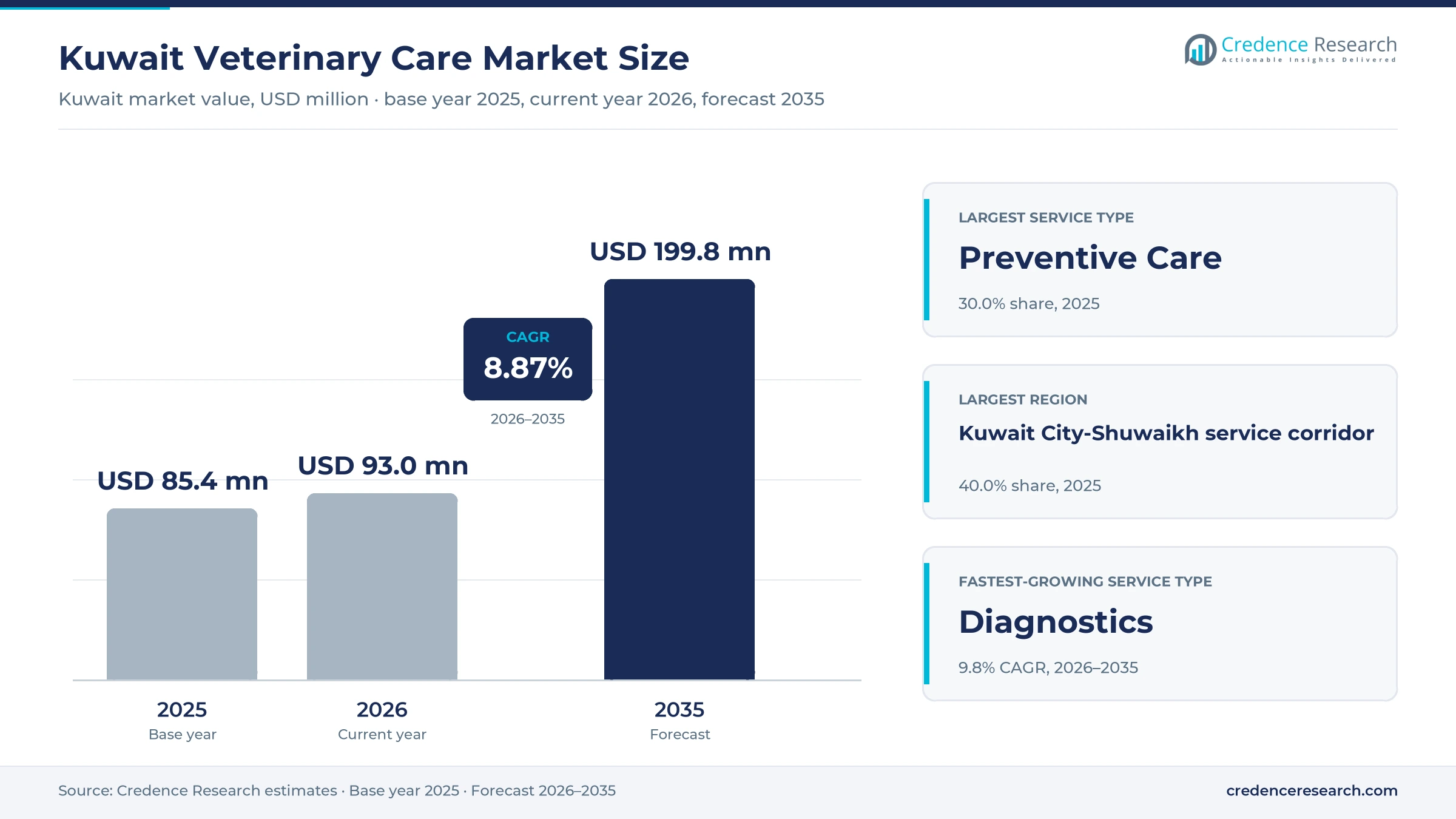
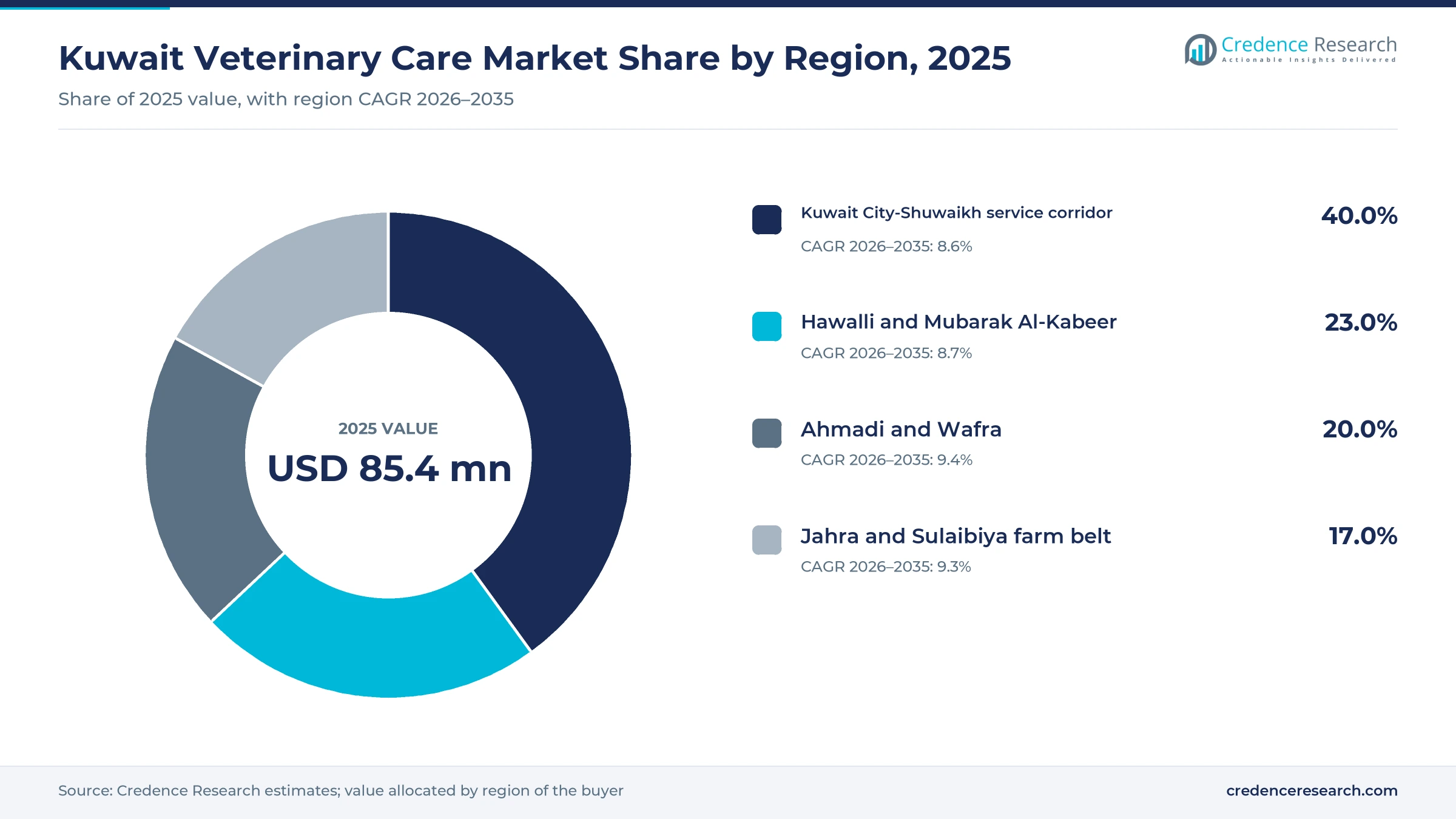
The Kuwait veterinary care market was valued at USD 85.4 million in 2025 and is projected to increase from USD 93.0 million in 2026 to USD 199.8 million by 2035, registering a CAGR of 8.87% during 2026–2035. Demand comes from cat and dog owners, dairy and sheep farms, horse stables and government animal-health programs that pay for consultations, vaccination, diagnostics, surgery and emergency treatment. The Kuwait City-Shuwaikh service corridor held the largest regional share, 40.0% in 2025, because the Shuwaikh Industrial and Al-Rai districts host the densest cluster of private hospitals and late-opening clinics. Ahmadi and Wafra is the fastest-growing region at 9.4% a year, as clinic chains open southern branches and farm-area hospitals serve herds near Wafra. The main commercial change is regulatory, because tighter dog licensing, annual rabies boosters and a ban on commercial dog and cat imports now route more animals through licensed clinics.
Which animals and services make up clinical spending in Kuwait?
The report counts fees paid for consultations, vaccination, laboratory and imaging work, medical treatment, surgery, hospitalization, dental work and home visits for companion animals, livestock, horses, birds and exotic pets, plus the clinical services of government and agricultural veterinary facilities. Owners pay mostly per visit and out of pocket, and Kuwait had about 5.10 million residents in mid-2025, 70% of them expatriates, according to the Public Authority for Civil Information.
Pet food, grooming, boarding outside a clinical stay, retail sales of animal drugs and livestock feed are excluded. The value chain runs from importers of vaccines, drugs and equipment through licensed hospitals, clinics and mobile vets to owners and farms, with the Public Authority for Agriculture Affairs and Fish Resources (PAAAFR) acting as the competent veterinary authority under Decree Law No. 32 of 1987.
Kuwait Veterinary Care Market Insights
- The market reached USD 85.4 million in 2025 and should grow from USD 93.0 million in 2026 to USD 199.8 million by 2035, at an 8.87% CAGR during 2026–2035.
- The Kuwait City-Shuwaikh service corridor held 40.0% of 2025 value, because the industrial districts host the full-service hospitals and late-opening clinics that draw clients nationwide.
- Preventive care led service spending with 30.0% of 2025 value, supported by import vaccination rules and annual rabies boosters for licensed dogs.
- The 2025 foot-and-mouth outbreak reached 12,854 of 22,673 cows at Sulaibiya farms by May 21, before PAAAFR declared it over on Sept. 8, 2025.
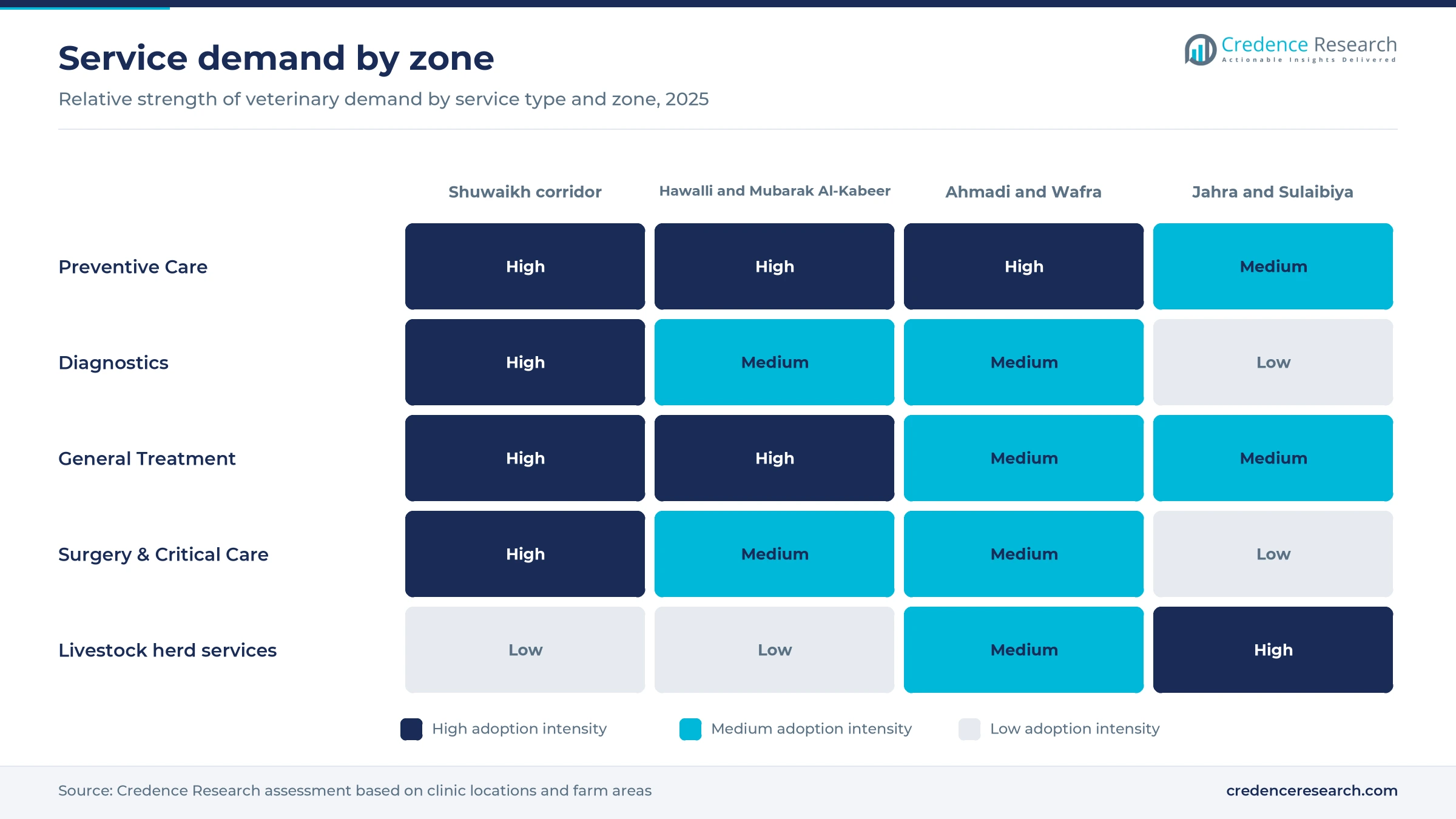
- Kuwait gained its first pet insurance in July 2025, when International Veterinary Hospital and GIG Takaful launched cat plans from KD 79 a year.
Preventive care leads while diagnostics grows fastest
Why does preventive care lead service spending?
Based on service type, the market is categorized into preventive care, diagnostics, general treatment, surgery & critical care and dental & specialty care. Preventive Care led with 30.0% of 2025 value because every imported cat or dog needs rabies vaccination and core shots, with parvovirus, distemper, hepatitis and leptospirosis for dogs, under the Kuwait import health certificate published by the U.S. Department of Agriculture. Diagnostics grows fastest at 9.8% a year, as HOD Pet Animal Hospital opened in November 2026 with AI-assisted X-ray machines and high-end laboratory analyzers, according to 248am, extending diagnostic imaging beyond the largest hospitals. Clinics without imaging are most exposed, because they must refer the cases that carry the higher fees.
Why do companion animals dominate the caseload?
Based on animal type, the market is categorized into companion animals, livestock, equine and exotic & avian. Companion Animals led with 64.0% of 2025 value because private hospitals are built around cats and dogs, and Bazaar magazine reported that cats made up about 65% of patients at International Veterinary Hospital. Exotic & Avian grows fastest at 10.1% a year, as hospitals widen their species range, and Hope Animal Hospital lists exotic and avian medicine and is recruiting a full-time avian veterinarian. Hospitals that recruit avian and exotic specialists gain a less contested caseload, while general clinics that see only cats and dogs face more price competition.
Why do hospitals capture most of the value?
Based on care setting, the market is categorized into veterinary hospitals, standalone clinics, mobile & home veterinary services and government & agricultural veterinary facilities. Veterinary Hospitals led with 46.0% of 2025 value because imaging, surgery and inpatient care sit under one roof, and Hope Animal Hospital lists abdominal and cardiac ultrasound, digital X-ray, endoscopy and minimally invasive surgery on one site. Mobile & Home Veterinary Services grow fastest at 10.4% a year, as the PawApp directory lists Q8.VET and 2 individual veterinarians offering home visits and telephone consultations, although no count of mobile practices is published, an evidence gap in this estimate. Small clinics are most exposed to home-visit competition for routine work.
Why do direct visits remain the main route to care?
Based on channel, the market is categorized into direct clinic visits, emergency & after-hours, referral care, mobile & home visits and teleconsultation & digital booking. Direct Clinic Visits led with 58.0% of 2025 value because most clinics still take walk-ins and phone calls, and the PawApp directory lists hours, phone numbers and map links rather than live booking. Teleconsultation & Digital Booking grows fastest at 10.5% a year, as that directory claims more than 30 partner clinics and Petbook Kuwait, released in July 2024, offers appointment scheduling alongside grooming and pet sitting. Clinics listed on booking apps reach new owners first, while practices relying on phone calls and walk-ins risk losing them.
| Segment Group | Leading Sub-segment | Share, 2025 | Fastest-growing Sub-segment | CAGR, 2026–2035 |
|---|---|---|---|---|
| By Service Type | Preventive Care | 30.0% | Diagnostics | 9.8% |
| By Animal Type | Companion Animals | 64.0% | Exotic & Avian | 10.1% |
| By Care Setting | Veterinary Hospitals | 46.0% | Mobile & Home Veterinary Services | 10.4% |
| By Channel | Direct Clinic Visits | 58.0% | Teleconsultation & Digital Booking | 10.5% |
Per-visit fees dominate as insurance enters the market
Pricing is set per visit and per procedure, with owners paying clinics directly and insurance still new. Clinics publish few fee schedules, a gap in the evidence, while microchipping costs KD 5 to KD 15 per cat or dog, according to Kuwait Times. Insurance entered through a hospital, as International Veterinary Hospital and GIG Takaful priced cat plans from KD 79 a year and dog plans from KD 99, with CT scans and surgery included. Vaccination and microchipping are low-ticket services that clinics price competitively, while imaging, surgery and inpatient stays carry the higher fees, so hospitals with that equipment earn most per case.
| Offer or segment | Typical price or fee | Basis |
|---|---|---|
| Microchipping, cat or dog | KD 5–15 per animal | Kuwait Times, July 2026 |
| Pet insurance, cat plan | From KD 79 per year | IVH and GIG Takaful launch, July 2025 |
| Pet insurance, dog plan | From KD 99 per year | IVH and GIG Takaful launch, July 2025 |
| Listed pet insurance quotes | About KWD 8 per month | Giraffy comparison listing, 2026 |
Request a Free Sample
Fill in your details and we'll send you a free sample report.
- Sample data tables & charts
- Research methodology
Species mix, new branches and FMD response lift demand
Livestock imports and quarantine add a non-pet caseload
Demand no longer rests on household cats and dogs alone, because the livestock trade, horse stables and bird keepers also need licensed veterinary work. Kuwait imports hundreds of thousands of sheep and goats a year, with sharp peaks before Ramadan and Eid al-Adha, according to a January 2026 country paper for the WOAH regional office. Those animals pass through 7 approved veterinary quarantine facilities at the Shuwaikh and Doha ports, the airport and land crossings, where each consignment needs clinical examination and document checks. Companion animals still carry the largest share, 64.0% of 2025 value, while the Exotic & Avian group grows at 10.1% a year. Practices that treat several species fill more appointment hours, while single-species clinics face more seasonal and volatile caseloads.
New branches and late hours turn emergencies into routine visits
Access has widened as private operators add branches and longer hours, which turns occasional emergency trips into routine visits. Late-evening opening has become common, as the PawApp directory lists several Shuwaikh Industrial clinics open until midnight and 1 open around the clock. Zoo Care runs four branches in Shuwaikh, Mahboula, Wafra and Salmiya, so owners in the south and in coastal suburbs no longer need to drive to the industrial districts for routine work. Bait Al Emnaa lists 5 farm-area veterinary hospitals in Abdali, Wafra, Kabd and Jahra, bringing treatment closer to sheep, camel and cattle holdings. Wider coverage favors multi-branch groups that can share imaging and senior staff, while single clinics compete mainly on location and opening hours.
The 2025 FMD outbreak left a stronger herd-health system
The 2025 foot-and-mouth outbreak forced faster detection, vaccination and movement control, and that capacity now supports steadier public and farm spending. The first SAT1 outbreak was detected on April 6, 2025, on a farm in Al Jahrah, and eight more followed by April 20 in a national herd of about 23,000 cattle on 44 farms, according to a U.K. government outbreak assessment. By May 21, PAAAFR counted 12,854 cases among 22,673 cows at Sulaibiya farms and 192 deaths, Arab Times reported. The authority imported vaccine directly, closed the Kabd livestock market on April 22 and declared the outbreak over on Sept. 8, 2025, after a WOAH final report. The episode favors suppliers and farms that keep routine herd vaccination and laboratory testing in place rather than buying crisis treatment.
Dog licensing rules route more animals through clinics
Regulation is creating recurring, compulsory veterinary contact for dog owners, lifting preventive visit volumes. New ownership rules issued by the Ministry of Interior require official licences, health checks at authorized veterinary centers and mandatory rabies vaccination with annual boosters, Gulf News reported in October 2026. Violations can bring up to one month in prison, a fine of more than KD 30, or both. A 1969 licensing law already set similar duties, but a legal source told Kuwait Times in July 2026 that it was no longer applied, so enforcement is the real change. Clinics authorized to certify dogs gain a steady stream of booster and registration visits, while informal breeders face higher compliance costs.
Herd surveillance, pet insurance, strays and stables
Shift from outbreak response to routine livestock surveillance
Animal-health authorities are shifting from outbreak response toward routine inspection and border surveillance, which creates steadier work for farm veterinarians and laboratories. The FAO rapid risk assessment published on March 4, 2026, rated the spread of FMD SAT1 to 17 unaffected neighboring countries within three months as very likely, with moderate to severe impact. PAAAFR took legal action in April 2025 against camel herders grazing outside designated zones along Kabd Road under Law No. 41 of 1988. Its Kabd livestock pen monitoring unit found several violations during inspection tours in January 2026 and opened legal proceedings. Farms that keep vaccination records and movement logs face fewer disruptions, while informal pens risk closures that interrupt sales.
Rise of insured pet treatment
Pet owners are shifting toward insured treatment, which raises the value of each illness or accident case that clinics can bill. International Veterinary Hospital and GIG Takaful launched what 248am described as Kuwait's first pet insurance in July 2025, covering consultations, surgery, hospital stays, blood tests and CT scans for cats and dogs. Comparison site Giraffy now lists five insurers, including AXA Insurance Kuwait, Gulf Insurance Group and Kuwait Insurance Company, with pet cover from about KWD 8 a month. Most of these policies focus on accident and illness rather than vaccinations or check-ups, according to Giraffy. Hospitals with CT and surgical capacity gain most, because insured owners are more willing to accept advanced work-ups.
Opportunity in stray control and shelter medicine
Stray-animal management offers a clear opening for clinics able to run sterilization, vaccination and quarantine at volume. PAAAFR banned commercial imports of dogs and cats in November 2025, allowed citizens 1 personal dog import a year, and said its teams had captured thousands of stray dogs over the previous year, Times Kuwait reported. The authority runs sterilization programs and has requested a 10,000-square-meter site for a shelter offering veterinary care, quarantine and adoption. No opening date had been published by November 2026, so until the shelter opens, sterilization volumes depend on private rescuers paying clinic fees, and a public contract would shift that work to whoever wins it. Microchipping at KD 5 to KD 15 per animal adds a second billable step, so clinics with sterilization capacity gain most.
Opportunity in equine and herd health programs
Horse stables and commercial herds offer an underserved specialty opening, because they need scheduled preventive work rather than walk-in visits. Kuwait counted 1,884 horses in 235 stables, and the chairman of the Supreme Authority for Horse Racing asked in August 2026 for a dedicated stable site, Kuwait Times reported. A single site would let one provider deliver vaccination, lameness and reproductive work across many stables in one visit. The farm-area hospital network described above shows the service model already exists, and the Jahra and Sulaibiya farm belt grows at 9.3% a year, a Credence Research estimate. Equine specialists and herd-health contractors with mobile ultrasound and laboratory links are best placed to win these contracts.
Dairy losses, staffing costs and air disruption weigh
Dairy losses squeeze farm spending on routine care
The 2025 outbreak cut farm income just as herds needed more veterinary work, which constrains routine herd spending. Daily milk and dairy output fell from 250 tons to 170 tons during the outbreak and recovered only to about 190 tons, Arab Times reported in August 2025, and the Kuwait Fresh Dairy Producers Union asked for compensation. Smaller Sulaibiya dairy farms are most exposed, and they may delay purchases of farm animal health products and elective herd programs.
Recruited clinicians raise staffing costs
Private hospitals depend on recruited clinicians, which raises payroll and limits how fast specialist services can grow. Royal Animal Hospital says its veterinarians come from Spain, Portugal, Italy, the U.K. and Tunisia, with nursing staff from South and Southeast Asia, according to a VetClick feature from August 2026. A VetClick listing for its medical director advertises a salary of 99,000 to 120,000 pounds a year. Smaller clinics that cannot match such packages are most exposed and risk losing senior vets.
Volunteers carry the cost of stray treatment
Most stray-animal care is still paid privately, which leaves clinics treating animals whose carers cannot pay full fees. Kuwait Times reported in January 2026 that private shelters and volunteers run most animal welfare work with personal funds and donations, while PAAAFR had confirmed plans for official shelters without a timeline. One rescuer told Kuwait Times in July 2026 that her work costs thousands of dinars a month. Clinics that discount stray treatment absorb margin pressure until public shelters open.
Regional strikes disrupt flights and supply lines
The 2026 regional conflict exposes clinics to supply and staffing interruptions, because imported drugs, equipment and recruited clinicians depend on air links. Iranian drones struck Terminal 1 at Kuwait International Airport on June 3, 2026, and Kuwait suspended commercial flights, The National reported. Kuwait closed its airspace again on June 11 and July 18, 2026, after further attacks, Khaleej Times and All India Radio reported. Hospitals with thin inventories and pet-shipping services are most exposed, while those holding larger stocks of animal vaccines cope better.
Shuwaikh corridor leads while Ahmadi grows fastest
| Region | Value, 2025 (USD million) | Share, 2025 | CAGR, 2026–2035 |
|---|---|---|---|
| Kuwait City-Shuwaikh service corridor | 34.2 | 40.0% | 8.6% |
| Hawalli and Mubarak Al-Kabeer | 19.6 | 23.0% | 8.7% |
| Ahmadi and Wafra | 17.1 | 20.0% | 9.4% |
| Jahra and Sulaibiya farm belt | 14.5 | 17.0% | 9.3% |
Shuwaikh and al-Rai host the referral hospitals
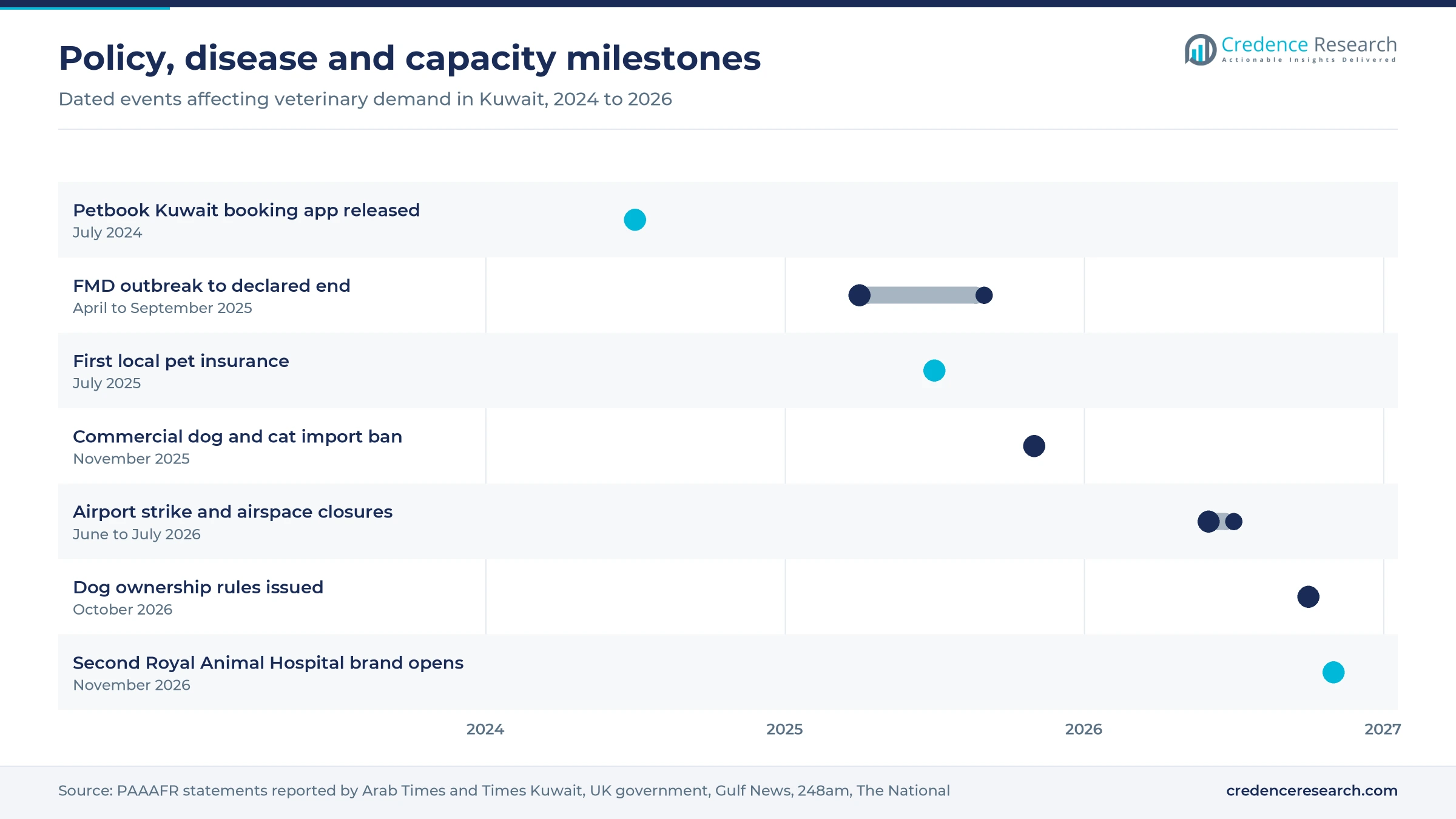
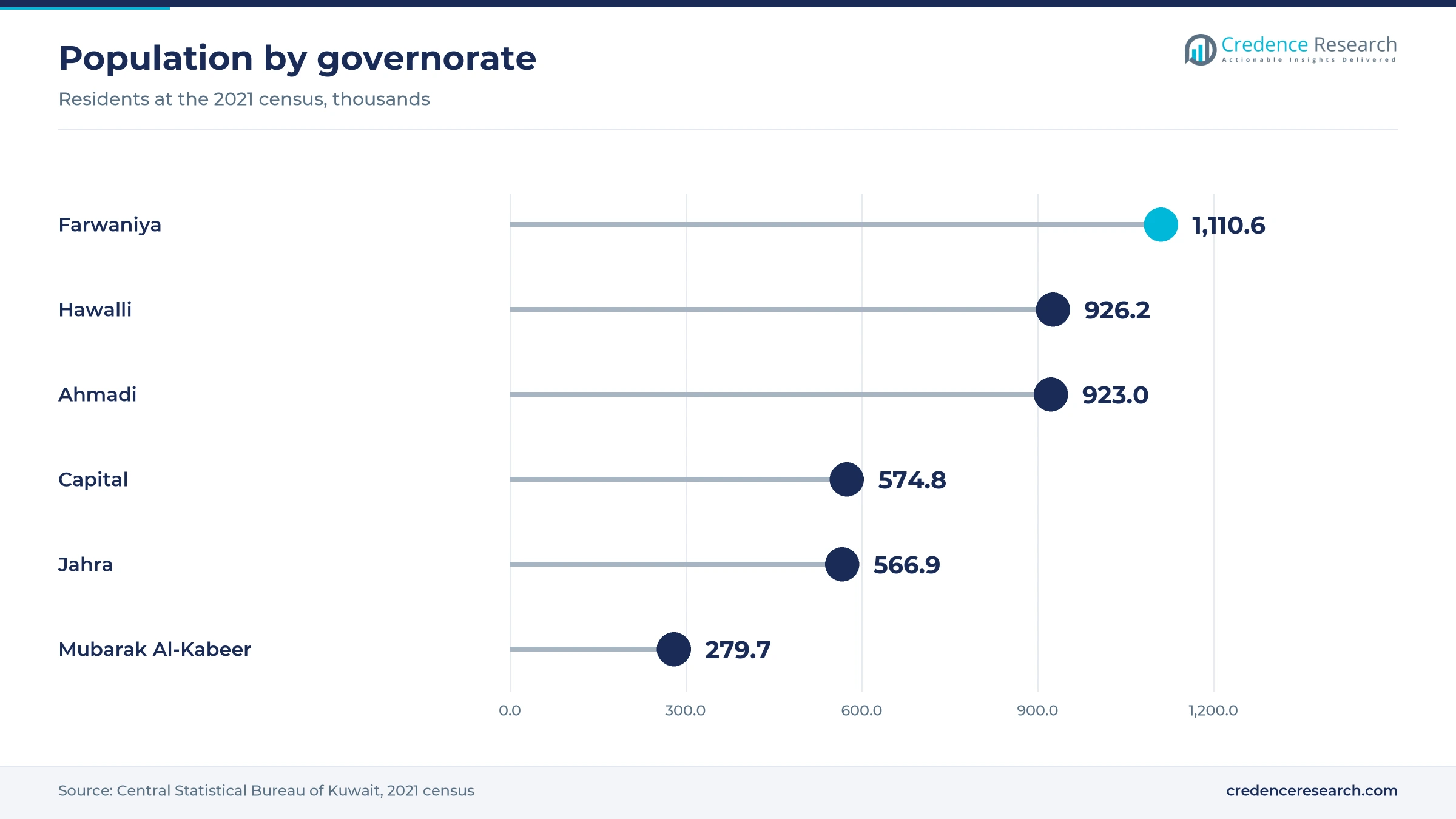
The Kuwait City-Shuwaikh service corridor held 40.0% of 2025 value and grows at 8.6% a year, the slowest of the four zones because its base is already large. Full-service hospitals with imaging and surgery cluster in Shuwaikh Industrial and neighboring Al-Rai, so referral, surgical and emergency cases from across the country end there. The Capital governorate had only 574,839 residents in the 2021 census, according to the Central Statistical Bureau, which shows that corridor demand comes from clients nationwide rather than nearby homes. Its routine caseload is most exposed as clinic chains open suburban branches.
Hawalli suburbs buy routine and home-visit care
Hawalli and Mubarak Al-Kabeer held 23.0% of 2025 value and grow at 8.7% a year. Hawalli had 926,170 residents in the 2021 census, and Salmiya was the most populous area with 321,190 people, Arab Times reported from PACI data in April 2025. Dense apartment districts generate frequent vaccination and minor-treatment visits, so suburban practices such as Universal Veterinary Hospital in Salmiya gain from proximity. Home-visit vets compete for the same owners, which limits the fees standalone clinics in the zone can charge.
Southern branches and farm work lift Ahmadi and Wafra
Ahmadi and Wafra held 20.0% of 2025 value and grow fastest at 9.4% a year. The zone had 923,043 residents in the 2021 census, and International Veterinary Hospital at Mina Abdullah, the partner in the first local pet insurance plan, gives southern owners a hospital with surgery, imaging and boarding without driving to Shuwaikh. Zoo Care branches in Mahboula and Wafra add routine capacity, and Wafra farms add livestock work, so southern providers combine pet and herd caseloads. Corridor hospitals are most exposed, as southern owners stop driving north for routine visits.
Jahra and Sulaibiya carry the livestock caseload
The Jahra and Sulaibiya farm belt held 17.0% of 2025 value and grows at 9.3% a year. Jahra had 566,861 residents in the 2021 census, but its value comes mainly from dairy farms, sheep pens and camel herds rather than households. The 2025 outbreak described above began on Jahra farms, and the zone hosts the Abdali land crossing and the Abdaliyah cattle quarantine named in the WOAH country paper, so border checks add steady public veterinary work. Herd-health contractors gain most, while dairy farms awaiting compensation are most exposed to further disease shocks.
Insurance, import ban and dog rules since 2025
| Development | Status and market relevance |
|---|---|
| In July 2025, International Veterinary Hospital and GIG Takaful launched pet insurance plans for cats and dogs in Kuwait. | Launched; the first local pet insurance product, covering consultations, surgery and CT scans |
| In September 2025, PAAAFR announced the end of the foot-and-mouth disease outbreak after a WOAH final report. | Completed; outbreak declared over, with prompt reporting to the Animal Health Department required |
| In November 2025, PAAAFR banned commercial imports of dogs and cats and requested a site for a stray dog shelter. | Ban in force; shelter planned, no opening date published |
| In October 2026, the Ministry of Interior issued dog ownership rules requiring licences, health checks and annual rabies boosters. | Issued; enforcement runs through authorized veterinary centers |
| In November 2026, the company behind Royal Animal Hospital opened HOD Pet Animal Hospital near The Warehouse Mall. | Operational launch; adds an affordable general-care tier and a stray examination wing |
Microchips, titer tests and in-house labs raise standards
- Microchip identification gives each imported cat or dog a 10 to 15 digit number recorded on its health certificate, supporting registration and lost-pet recovery.
- Rabies antibody titer testing confirms an imported animal reaches at least 0.5 IU/ml in a sample taken 3 to 12 months before entry, so laboratory work keeps flowing to local clinics.
- In-house laboratory analyzers let hospitals run blood work, biochemistry, urine culture and allergy tests on site, as Hope Animal Hospital lists among its services.
- CT scanning now falls within the first local pet insurance plans, which makes cross-sectional imaging affordable for more insured owners.
Need a Custom Version of This Report?
Tailor the scope, geography, or segments to your exact requirements.
- Custom geography or segment scope
- Direct access to our analyst team
Hospital groups compete on imaging, hours and branches
Competition in the Kuwait veterinary care market splits into three tiers. Full-service hospitals such as International Veterinary Hospital, Royal Animal Hospital and Hope Animal Hospital compete on imaging, surgery, boarding and recruited European specialists, and International Veterinary Hospital adds pet export services and the first local insurance partnership. Clinic chains and late-opening practices such as Zoo Care, Universal Veterinary Hospital, Safari Vet Clinic, VETZOO Clinic, Gulf Pets Clinic and All Vet Clinic compete on hours and location, mostly in Shuwaikh Industrial and Salmiya, and Royal Animal Hospital added a lower-priced second brand in 2026 for price-sensitive owners and stray cases. Farm-area hospitals such as Bait Al Emnaa serve herds near the farm belts, while PAAAFR leads outbreak control and border checks. Home-visit vets and online directories add pressure on routine visit prices.
Who supplies veterinary care and where do margins sit?
Supply is fragmented among a few full-service hospitals, multi-branch clinic chains, single-doctor practices, home-visit vets and PAAAFR public veterinary services. Decree Law No. 32 of 1987 governs who may practice and prescribe veterinary products, so licensing and recruited staff are the main entry barriers rather than land or capital. Hospital operators hold most imaging, surgery and boarding capacity, which makes them the referral point for complex cases. Margins sit in hospitalization, imaging and surgery, while vaccination and microchipping are competitive, low-ticket services.
Companies profiled and their roles in this market
| Company | Type | Role in the market |
|---|---|---|
| International Veterinary Hospital | Full-service hospital | Mina Abdullah hospital with surgery, imaging, boarding, pet export and insurance partnership |
| Royal Animal Hospital (HOD Pet Animal Hospital) | Hospital group | Al-Rai hospital with surgery and diagnostics, plus a lower-priced second hospital brand |
| Zoo Care Veterinary Clinic | Clinic chain | Four branches in Shuwaikh, Mahboula, Wafra and Salmiya for routine pet care |
| Hope Animal Hospital | Full-service hospital | Ultrasound, endoscopy, minimally invasive surgery and exotic and avian medicine |
| Universal Veterinary Hospital | Veterinary hospital | Salmiya hospital serving companion animals in dense suburbs |
| Safari Vet Clinic | Emergency clinic | Shuwaikh Industrial clinic handling emergency and after-hours cases |
| VETZOO Clinic | Standalone clinic | Shuwaikh Industrial clinic offering general pet treatment |
| Gulf Pets Clinic | Standalone clinic | Shuwaikh Industrial clinic offering routine and late-evening pet treatment |
| All Vet Clinic | Standalone clinic | Shuwaikh Industrial clinic offering general companion animal treatment |
Compliance visits and herd programs set the pace
Credence Research's view is that compulsory contact, not discretionary spending, will drive most volume growth over the forecast. Dog licensing and annual rabies boosters create repeat preventive visits, while the 2025 outbreak showed farms and the regulator that routine herd vaccination costs less than crisis control. The strongest positions belong to hospital groups that combine imaging and surgery with several branches and insurer links. The main uncertainties are enforcement of the 2026 rules, the timing of public stray shelters, air links during regional conflict and the absence of an official count of pets or clinics.
Clinic fees, herd counts and licensing anchor the estimate
The report uses 2025 as the base year and 2026 to 2035 as the forecast period. Market values come from the Credence Research model, checked against resident population, published cattle and horse counts, clinic locations, posted fees and insurance prices. Regional and segment splits are Credence Research estimates based on clinic locations from public directories, 2021 census population by governorate and farm areas. Sources include PAAAFR statements reported in the press, U.K. government and FAO disease assessments, a WOAH country paper, U.S. Department of Agriculture import certificates, company pages and news reports. No interviews or surveys were conducted, and no official count of pets or veterinary clinics was available.
Enforcement and specialist capacity drive growth to 2035
Demand growth to USD 199.8 million by 2035 rests on three conditions holding across all four zones. Licensing and rabies rules must be enforced through authorized centers, so that booster and registration visits become routine for dog owners. Herd programs must keep livestock disease contained after the 2025 outbreak, which protects farm budgets for preventive work. Specialist capacity must keep expanding, as new hospital brands and companion animal health suppliers add diagnostics, surgery and insured care. If these hold, the Ahmadi and Wafra zone gains share, while the Shuwaikh corridor keeps most referral and emergency value.
Enforcement and air links decide the range of outcomes
The range of outcomes depends mainly on how strictly the 2026 dog rules are enforced, on whether livestock disease stays contained, and on how stable air links remain after the 2026 strikes. The base case assumes licensing drives steady booster visits and that the planned stray shelter opens within the forecast. The downside assumes renewed airspace closures, a fresh livestock outbreak and weak enforcement, while the upside assumes wider insurance cover and new specialty hospitals.
| Scenario | CAGR, 2026–2035 | Value, 2035 | What has to hold |
|---|---|---|---|
| Downside | 7.1% | USD 172.0 million | Repeated airspace closures and a new livestock outbreak cut farm and clinic budgets |
| Base | 8.87% | USD 199.8 million | Dog licensing drives booster visits and herd programs stay routine |
| Upside | 10.3% | USD 224.2 million | Insurance spreads and new specialty hospitals lift advanced diagnostics and surgery |
Frequently Asked Questions
How big is the Kuwait veterinary care market?
Which service type leads veterinary spending in Kuwait?
Where are veterinary clinics concentrated in Kuwait?
How did the 2025 foot-and-mouth outbreak affect Kuwait?
Is pet insurance available in Kuwait?
What do the 2026 dog ownership rules require?
Which companies lead veterinary care in Kuwait?
Why did Kuwait ban commercial imports of dogs and cats?
Table of Content
Chapter 1 Market Segmentation
- 1.1 Segmentation Framework
- 1.1.1 Product and Service Classification
- 1.1.2 Application and End-Use Classification
- 1.1.3 Technology and Solution Classification
- 1.1.4 Customer and Distribution Channel Classification
- 1.1.5 Geographic Segmentation
- 1.1.6 Market Segment Definitions and Boundaries
- 1.2 By Service Type
- 1.2.1 Preventive Care
- 1.2.2 Diagnostics
- 1.2.3 General Treatment
- 1.2.4 Surgery & Critical Care
- 1.2.5 Dental & Specialty Care
- 1.3 By Animal Type
- 1.3.1 Companion Animals
- 1.3.2 Livestock
- 1.3.3 Equine
- 1.3.4 Exotic & Avian
- 1.4 By Care Setting
- 1.4.1 Veterinary Hospitals
- 1.4.2 Standalone Clinics
- 1.4.3 Mobile & Home Veterinary Services
- 1.4.4 Government & Agricultural Veterinary Facilities
- 1.5 By Channel
- 1.5.1 Direct Clinic Visits
- 1.5.2 Emergency & After-Hours
- 1.5.3 Referral Care
- 1.5.4 Mobile & Home Visits
- 1.5.5 Teleconsultation & Digital Booking
Chapter 2 Introduction
- 2.1 Report Objectives and Scope
- 2.2 Product Definition and Industry Terminology
- 2.3 Market Inclusions and Exclusions
- 2.4 Research Process
- 2.4.1 Primary Research and Expert Interviews
- 2.4.2 Secondary Research and Source Review
- 2.4.3 Top-Down and Bottom-Up Estimation
- 2.4.4 Data Triangulation and Verification
- 2.5 Market Size Measurement Basis
- 2.5.1 2025: USD 85.4 million → 2035: USD 199.8 million
- 2.6 Historical and Forecast Reference Periods
- 2.6.1 Historical Period: 2018-2025
- 2.6.2 Base Year: 2025
- 2.6.3 Forecast Period: 2025-2035
- 2.7 Research Assumptions and Limitations
Chapter 3 Executive Summary
- 3.1 Market Snapshot and Key Findings
- 3.2 Base-Year Market Size, 2025
- 3.3 Forecast Market Size, 2035
- 3.4 Revenue and Volume Growth Outlook
- 3.5 Key Demand and Supply Indicators
- 3.6 Leading Market Segments
- 3.7 Fastest-Growing Market Opportunities
- 3.8 Regional Performance Highlights
- 3.9 Technology and Industry Transformation
- 3.10 Competitive Landscape Summary
- 3.11 Analyst View and Strategic Implications
Chapter 4 Kuwait Veterinary Care Market Trends and Developments
- 4.1 Historical Industry Development, 2018-2025
- 4.2 Recent Market Trends and Developments
- 4.3 Demand and Customer Behavior Trends
- 4.4 Technology and Product Innovation
- 4.5 Artificial Intelligence, Automation and Digitalization
- 4.6 Local Manufacturing and Supply Chain Realignment
- 4.7 Industry Partnerships, Mergers and Acquisitions
- 4.8 Sustainability and Circular Economy Developments
- 4.9 Government and Private Sector Investment Trends
- 4.10 Emerging Business Models and Commercialization
- 4.11 Industry Developments and Announcements
Chapter 5 Kuwait Veterinary Care Market Production, Supply and Demand Analysis
- 5.1 Demand Trend and Consumption Analysis, 2018-2025
- 5.2 Demand Forecast, 2025-2035
- 5.3 Production and Output Trend, 2018-2025
- 5.4 Production and Output Forecast, 2025-2035
- 5.5 Installed Capacity and Capacity Utilization
- 5.6 Company-Wise Production Plants and Statistics
- 5.6.1 Installed Production Capacity
- 5.6.2 Actual Production
- 5.6.3 Planned Capacity and Expansion Targets
- 5.7 Supply Chain Structure and Procurement Trends
- 5.8 Supply-Demand Gap and Bottlenecks
- 5.9 Import Dependence and Sourcing Structure
- 5.10 Contract Manufacturing and Outsourcing
- 5.11 Regional Supply and Demand Concentration
Chapter 6 Kuwait Veterinary Care Market Pricing Analysis
- 6.1 Pricing Structure and Measurement
- 6.2 Historical Pricing Trends, 2018-2025
- 6.3 Pricing Outlook, 2025-2035
- 6.4 Average Selling Price and Unit Economics
- 6.5 Pricing by Product and Market Segment
- 6.6 Geographic Pricing Differences
- 6.7 Key Input, Energy, Labor and Logistics Costs
- 6.8 Contract Pricing and Purchasing Models
- 6.9 Pricing Sensitivity and Competitive Positioning
- 6.10 Price, Margin and Profitability Implications
Chapter 7 Kuwait Veterinary Care Market Dynamics
- 7.1 Market Growth Drivers
- 7.1.1 Demand-Side Drivers
- 7.1.2 Technology and Innovation Drivers
- 7.1.3 Infrastructure and Investment Drivers
- 7.1.4 Regulatory and Policy Drivers
- 7.2 Market Restraints
- 7.2.1 Cost and Affordability Constraints
- 7.2.2 Technology and Adoption Barriers
- 7.2.3 Supply Chain and Operational Constraints
- 7.3 Market Challenges
- 7.3.1 Competitive Pressure and Margin Erosion
- 7.3.2 Skills, Infrastructure and Implementation Gaps
- 7.4 Emerging Market Opportunities
- 7.5 Market Dynamics Impact and Time-Horizon Assessment
Chapter 8 Kuwait Veterinary Care Value Chain Analysis
- 8.1 Industry Value Chain Overview
- 8.2 Upstream Suppliers and Critical Inputs
- 8.3 Technology and Component Providers
- 8.4 Manufacturing or Service Delivery
- 8.5 Distribution, Channel Partners and Integrators
- 8.6 Downstream Applications and End Users
- 8.7 Value Addition and Profit Pools
- 8.8 Vertical Integration and Outsourcing
- 8.9 Supplier Concentration and Risk
- 8.10 Supply Chain Localization and Resilience
Chapter 9 Kuwait Veterinary Care Market Regulations and Policies
- 9.1 Relevant Laws, Standards and Compliance Frameworks
- 9.2 Product, Service, Safety and Quality Requirements
- 9.3 Government Policies, Incentives and Subsidies
- 9.4 Imports, Exports and Trade Barriers
- 9.5 Public Procurement and Local Content Requirements
- 9.6 Environmental and Sustainability Compliance
- 9.7 Upcoming Policy Changes and Market Implications
Chapter 10 Kuwait Veterinary Care Market Hotspots and Opportunities
- 10.1 Market Opportunity Mapping and Growth Hotspots
- 10.2 High-Growth Applications and Customer Groups
- 10.3 Underserved Markets and White-Space Opportunities
- 10.4 Emerging Technology and Product Opportunities
- 10.5 New Capacity and Investment Hotspots
- 10.6 Market Entry and Expansion Opportunities
- 10.7 Distribution and Partnership Opportunities
- 10.8 Near-Term and Long-Term Commercial Potential
- 10.9 Opportunity Attractiveness and Execution Risks
Chapter 11 Kuwait Veterinary Care Market Outlook, 2025-2035
- 11.1 Market Size and Analysis
- 11.1.1 Revenue (Market Measurement: 2025: USD 85.4 million → 2035: USD 199.8 million)
- 11.1.2 Market Volume and Quantity Sold
- 11.1.3 Historical Market Size, 2018-2025
- 11.1.4 Base-Year Market Size, 2025
- 11.2 Market Forecast, 2025-2035
- 11.2.1 Revenue Forecast to 2035
- 11.2.2 Volume Forecast to 2035
- 11.2.3 CAGR and Year-on-Year Growth
- 11.2.4 Incremental Revenue Opportunity
- 11.3 Forecast Assumptions and Scenario Analysis
- 11.3.1 Base-Case Forecast
- 11.3.2 Optimistic and Conservative Scenarios
- 11.3.3 Technology, Pricing and Policy Sensitivities
- 11.4 Market Attractiveness and Growth Outlook
Chapter 12 Kuwait Veterinary Care Market Segmentation and Outlook
- 12.1 Segmentation Summary and Market Shares, 2025
- 12.2 Largest and Fastest-Growing Segments
- 12.3 By Service Type - Market Size and Forecast, 2025-2035
- 12.3.1 Segment Definition and Scope
- 12.3.2 Historical Market Size, 2018-2025
- 12.3.3 Revenue Forecast, 2025-2035
- 12.3.4 Volume Forecast, 2025-2035
- 12.3.5 Base-Year Market Share, 2025
- 12.3.6 Segment CAGR and Growth Drivers
- 12.3.7 Subsegment Market Size and Forecast
- 12.3.7.1 Preventive Care
- 12.3.7.2 Diagnostics
- 12.3.7.3 General Treatment
- 12.3.7.4 Surgery & Critical Care
- 12.3.7.5 Dental & Specialty Care
- 12.3.8 Subsegment Pricing and Adoption Trends
- 12.3.9 Leading Suppliers and Competition
- 12.3.10 Regional Demand and Opportunities
- 12.4 By Animal Type - Market Size and Forecast, 2025-2035
- 12.4.1 Segment Definition and Scope
- 12.4.2 Historical Market Size, 2018-2025
- 12.4.3 Revenue Forecast, 2025-2035
- 12.4.4 Volume Forecast, 2025-2035
- 12.4.5 Base-Year Market Share, 2025
- 12.4.6 Segment CAGR and Growth Drivers
- 12.4.7 Subsegment Market Size and Forecast
- 12.4.7.1 Companion Animals
- 12.4.7.2 Livestock
- 12.4.7.3 Equine
- 12.4.7.4 Exotic & Avian
- 12.4.8 Subsegment Pricing and Adoption Trends
- 12.4.9 Leading Suppliers and Competition
- 12.4.10 Regional Demand and Opportunities
- 12.5 By Care Setting - Market Size and Forecast, 2025-2035
- 12.5.1 Segment Definition and Scope
- 12.5.2 Historical Market Size, 2018-2025
- 12.5.3 Revenue Forecast, 2025-2035
- 12.5.4 Volume Forecast, 2025-2035
- 12.5.5 Base-Year Market Share, 2025
- 12.5.6 Segment CAGR and Growth Drivers
- 12.5.7 Subsegment Market Size and Forecast
- 12.5.7.1 Veterinary Hospitals
- 12.5.7.2 Standalone Clinics
- 12.5.7.3 Mobile & Home Veterinary Services
- 12.5.7.4 Government & Agricultural Veterinary Facilities
- 12.5.8 Subsegment Pricing and Adoption Trends
- 12.5.9 Leading Suppliers and Competition
- 12.5.10 Regional Demand and Opportunities
- 12.6 By Channel - Market Size and Forecast, 2025-2035
- 12.6.1 Segment Definition and Scope
- 12.6.2 Historical Market Size, 2018-2025
- 12.6.3 Revenue Forecast, 2025-2035
- 12.6.4 Volume Forecast, 2025-2035
- 12.6.5 Base-Year Market Share, 2025
- 12.6.6 Segment CAGR and Growth Drivers
- 12.6.7 Subsegment Market Size and Forecast
- 12.6.7.1 Direct Clinic Visits
- 12.6.7.2 Emergency & After-Hours
- 12.6.7.3 Referral Care
- 12.6.7.4 Mobile & Home Visits
- 12.6.7.5 Teleconsultation & Digital Booking
- 12.6.8 Subsegment Pricing and Adoption Trends
- 12.6.9 Leading Suppliers and Competition
- 12.6.10 Regional Demand and Opportunities
- 12.7 Segment Growth Comparison
- 12.8 Segment Attractiveness and Priority Matrix
Chapter 13 Kuwait Veterinary Care Geographic Market Outlook, 2025-2035
- 13.1 Domestic Market Distribution and Demand Clusters
- 13.2 State- or Province-Wise Market Size and Forecast, 2025-2035
- 13.3 City and Metropolitan Market Outlook
- 13.4 Industrial, Manufacturing and Commercial Clusters
- 13.5 Geographic Concentration of Key End Users
- 13.6 Local Pricing and Purchasing Differences
- 13.7 Domestic Production Facilities and Capacity Map
- 13.8 Local Infrastructure and Project Pipeline
- 13.9 State-Level Policy and Incentive Differences
- 13.10 Subnational Investment Hotspots and Opportunities
- 13.11 Distribution and Logistics Networks
- 13.12 Domestic Competitive Footprint
Chapter 14 Kuwait Veterinary Care Technology, Innovation and Sustainability Outlook
- 14.1 Technology Landscape and Maturity
- 14.2 Product, Process and Service Innovation
- 14.3 AI, Automation and Digital Tools in the Industry
- 14.4 Technology Adoption and Performance Benchmarking
- 14.5 Innovation Pipeline and R&D Investment
- 14.6 Patent and Intellectual Property Trends
- 14.7 Energy Efficiency and Resource Management
- 14.8 Sustainability, Recycling and Circularity
- 14.9 Technology Roadmap, 2025-2035
- 14.10 Risks of Obsolescence and Technology Substitution
Chapter 15 Kuwait Veterinary Care Market Key Strategic Imperatives
- 15.1 Growth and Market Entry Priorities
- 15.2 High-Return Products and Segments
- 15.3 Pricing, Profitability and Cost Optimization
- 15.4 Technology Investment and Product Differentiation
- 15.5 Supply Chain Localization and Resilience
- 15.6 Distribution and Customer Acquisition
- 15.7 Partnership, Acquisition and Capacity Strategy
- 15.8 Regional Expansion Priorities
- 15.9 Short-, Medium- and Long-Term Actions
Chapter 16 Competition Outlook
- 16.1 Industry Competition Characteristics
- 16.2 Market Structure and Concentration
- 16.3 Market Share and Competitive Positioning, 2025
- 16.4 Company-Wise Revenue and Product Benchmarking
- 16.5 Production and Service Capacity Benchmarking
- 16.6 Technology, Pricing and Differentiation
- 16.7 Regional Footprint and Distribution Strength
- 16.8 Mergers, Acquisitions and Strategic Alliances
- 16.9 New Entrants and Competitive Threats
- 16.10 Porter's Five Forces and Industry Attractiveness
- 16.11 Competitive Outlook, 2025-2035
Chapter 17 Company Profiles
- 17.1 Company Coverage and Selection Criteria
- 17.2 International Veterinary Hospital
- 17.2.1 Business Description
- 17.2.2 Company Ownership and Geographic Presence
- 17.2.3 Product and Service Portfolio
- 17.2.4 Manufacturing and Operating Footprint
- 17.2.5 Production Capacity and Expansion Plans
- 17.2.6 Financial Performance and Investment
- 17.2.7 Market Share and Competitive Position
- 17.2.8 Technology and Innovation Capabilities
- 17.2.9 Strategic Alliances or Partnerships
- 17.2.10 Recent Developments
- 17.2.11 Growth Strategy and Outlook
- 17.3 Royal Animal Hospital (HOD Pet Animal Hospital)
- 17.4 Zoo Care Veterinary Clinic
- 17.5 Hope Animal Hospital
- 17.6 Universal Veterinary Hospital
- 17.7 Safari Vet Clinic
- 17.8 VETZOO Clinic
- 17.9 Gulf Pets Clinic
- 17.10 All Vet Clinic
- 17.11 Other Relevant Market Participants
Note: Every listed company is profiled on the structure shown under the first company. The company list is preliminary and may change based on research findings, market developments, data availability and client requirements.
Chapter 18 Disclaimer
- 18.1 Research and Forecast Disclaimer
- 18.2 Data Source and Estimation Limitations
Note: The depth of individual sections depends on data availability for this market. Volume, capacity, trade and other unit-based metrics are included where applicable.

