
Market Overview:
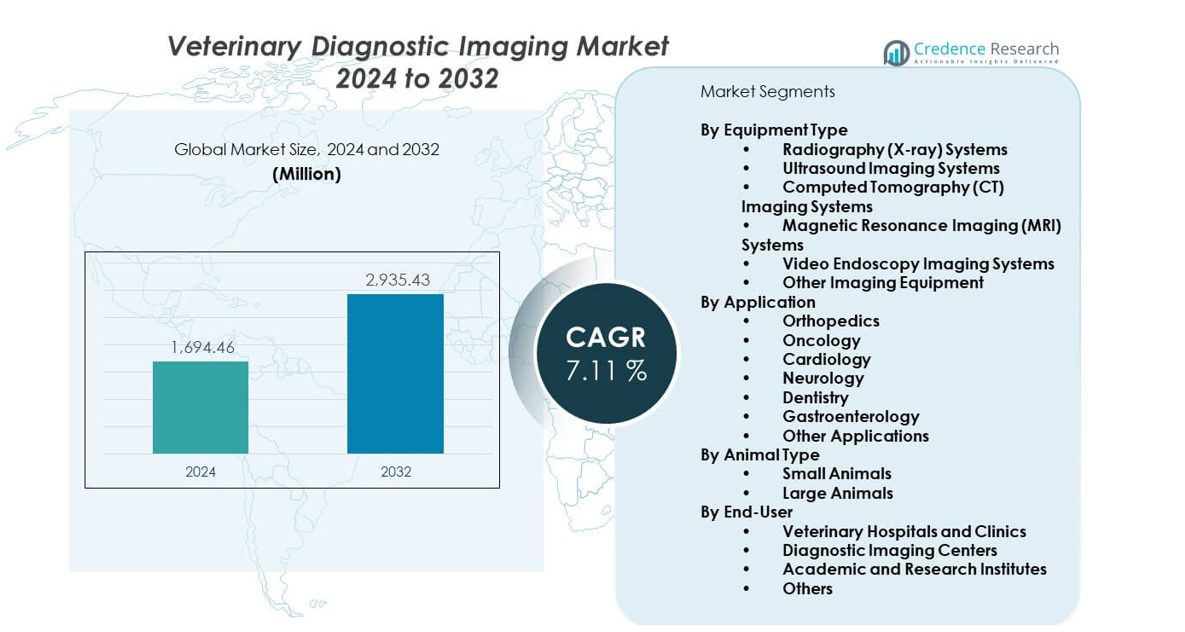
The Veterinary Diagnostic Imaging Market is projected to grow from USD 1,694.46 million in 2024 to an estimated USD 2,935.43 million by 2032, with a CAGR of 7.11% from 2024 to 2032.
| REPORT ATTRIBUTE | DETAILS |
|---|---|
| Historical Period | 2020-2023 |
| Base Year | 2024 |
| Forecast Period | 2025-2032 |
| Veterinary Diagnostic Imaging Market Size 2024 | USD 1,694.46 million |
| Veterinary Diagnostic Imaging Market, CAGR | 7.11% |
| Veterinary Diagnostic Imaging Market Size 2032 | USD 2,935.43 million |
Growth continues as veterinarians adopt digital imaging tools that deliver fast and clear results. Clinics upgrade older systems to improve workflow and reduce manual steps during routine exams. Rising awareness of preventive care encourages pet owners to seek early diagnosis for chronic and acute conditions. The shift toward minimally invasive treatment increases the need for detailed imaging. Manufacturers also release portable and AI-driven devices that support accurate decisions during field visits.
North America leads due to strong veterinary infrastructure and high adoption of digital systems. Europe shows steady progress as clinics modernize and expand diagnostic capabilities across major countries. Asia Pacific emerges fast with growing pet ownership, rising income levels, and expanding animal health services. The region gains from new diagnostic centers opening in urban pockets. Latin America and the Middle East strengthen adoption as awareness of advanced imaging increases among pet owners and livestock handlers.
Market Insights:
- The Veterinary Diagnostic Imaging Market reached USD 1,694.46 million in 2024 and is projected to hit USD 2,935.43 million by 2032, expanding at a 11% CAGR, supported by strong demand for digital and cross-sectional imaging.
- North America (41.83%), Europe, and Asia-Pacific lead the global landscape due to advanced veterinary infrastructure, high technology adoption, and rising investment in modern diagnostic systems.
- Asia-Pacific, posting a 32% CAGR, stands as the fastest-growing region, driven by rising pet ownership, expanding urban clinics, and strong demand for digital imaging upgrades.
- Radiography (X-ray) Systems hold 35.64% of the equipment segment in 2024, driven by frequent use in routine assessments and structural evaluation.
- Small Animals account for 68.56% of the animal-type segment, supported by high companion-animal visits and growing preventive care demand across developed and emerging markets.
Market Drivers:
Growing Need For Early And Accurate Disease Detection In Modern Veterinary Settings
Clinics invest in advanced tools to support early diagnosis and clearer case evaluation. Pet owners seek rapid answers for chronic and acute conditions across companion animals. Rising awareness of preventive care strengthens adoption of imaging systems. The Veterinary Diagnostic Imaging Market benefits from higher demand for reliable screening tools. Digital units improve workflow and support consistent output across busy facilities. It helps veterinarians review internal structures with higher clarity. Better image quality improves case management for complex disorders. Growing caseloads push clinics to upgrade outdated machines. Demand for thorough diagnostic support stays strong across urban regions.
- For instance, Esaote S.p.A. offers the MyLab™ X90VET ultrasound platform that uses XCrystal probes and its “Augmented Insight™” AI-powered software for deeper tissue penetration and sharper imaging, enabling veterinarians to detect internal abnormalities earlier.
Rising Shift Toward Digital Platforms And Improved Workflow Efficiency Across Clinics
Veterinarians choose digital platforms that remove film handling and long setup steps. Digital systems support faster capture, lower repeat scans and smoother case reviews. Workflow efficiency improves when clinics reduce manual work across routine exams. The Veterinary Diagnostic Imaging Market gains support through rising upgrades in small and mid-size centers. It gives stronger consistency during peak hours and busy operating days. Digital storage improves record accuracy and reduces space needs. Cloud access helps teams review images across multiple offices. Portable units give field teams higher flexibility during farm visits. Clinics replace older film systems to improve reliability.
- For instance, GE Healthcare highlights how in-clinic ultrasound reduces wait times compared with external referrals, often enabling lifesaving intervention within hours rather than days. Digital systems support faster capture, lower repeat scans and smoother case reviews.
Higher Demand For Portable And Point-Of-Care Imaging Equipment Across Field Services
Rural veterinarians adopt portable devices to support livestock care. Units with lighter frames offer easy movement across barns and outdoor areas. The Veterinary Diagnostic Imaging Market benefits from wider demand for mobility. Handheld systems help teams respond faster to time-sensitive cases. It improves response speed when managing injuries or sudden illness. Portable ultrasound devices support reproductive checks across farms. Compact designs help new clinics start imaging services with lower investment. Field workers gain better accuracy during primary screening. Demand rises across regions with strong livestock populations.
Growing Use Of AI-Driven Tools To Improve Interpretation Accuracy And Clinical Confidence
AI systems support clear interpretation across dense image sets. Automated suggestions help reduce variation across users. The Veterinary Diagnostic Imaging Market integrates tools that guide clinicians toward reliable outcomes. It strengthens diagnostic confidence during complex assessments. Cloud-based AI platforms help teams monitor trends across repeated scans. Machine learning tools detect patterns that support early intervention. Smart alerts improve awareness during risk evaluation. Clinics use AI to support faster decision cycles. It improves case planning across multi-branch networks.
Market Trends:
Expansion Of Multi-Modality Suites In Clinics To Offer Complete Diagnostic Coverage
Clinics expand multi-modality zones to deliver broad diagnostic support. Growth in patient load encourages investment in X-ray, CT and ultrasound units. The Veterinary Diagnostic Imaging Market supports wider adoption across referral centers. Multi-modality spaces help teams solve complex cases with higher clarity. It improves decision quality during emergency care. Integrated setups reduce patient movement and lower stress for animals. Clinics use unified controls to manage multiple systems in one workflow. Demand grows for hybrid rooms in large hospitals. Multi-modality models attract specialist teams across regions.
- For instance, some referral hospitals combine X-ray, CT and ultrasound systems to provide orthopedic, soft-tissue and trauma diagnostics in one location. Growth in patient load encourages investment in such broad imaging suites. The market supports wider adoption across referral centers.
Rise Of Subscription-Based Imaging Platforms And Predictive Maintenance Services
Vendors launch subscription plans that lower upfront costs for clinics. Plans include upgrades, training and periodic machine checks. The Veterinary Diagnostic Imaging Market shifts toward predictable ownership models. It reduces financial risk for new practices. Predictive maintenance tools detect early signs of wear. It helps clinics cut downtime during high-pressure hours. Remote diagnostics support faster problem resolution. Service bundles improve system life across heavy-use facilities. Clinics adopt support plans to stabilize operational budgets.
- For instance, providers now offer service contracts including routine maintenance, remote diagnostics and periodic system calibration, making high-end imaging more accessible to new or small practices. Plans include upgrades, training and periodic machine checks.
Increasing Integration Of Tele-Imaging Networks For Cross-Clinic Collaboration
Tele-imaging networks help clinics send images to specialists within minutes. It expands access to expert review across rural regions. The Veterinary Diagnostic Imaging Market gains traction through rising cross-clinic cooperation. Remote access helps teams solve rare cases with better guidance. It improves access to specialist care during emergency hours. Cloud transfer tools help maintain secure image sharing. Clinicians use remote dashboards to track patient history. Networks support faster coordination between treatment teams. Tele-imaging strengthens referral pathways across regions.
Shift Toward User-Friendly Interfaces Designed For Faster Learning And Higher Accuracy
Manufacturers design simple screens that shorten training time for staff. The Veterinary Diagnostic Imaging Market adopts systems that guide users through each step. Clear menus reduce errors during busy hours. It supports consistent results when multiple staff members handle scans. Touchscreen panels help users navigate controls with ease. Automated presets improve output during dense workloads. Clinics adopt guided interfaces to support new technicians. Systems with simple workflows improve patient handling time. Ease of use drives steady upgrades across mid-size facilities.
Market Challenges Analysis:
High Cost Of Advanced Imaging Systems And Limited Access For Small Practices
The Veterinary Diagnostic Imaging Market faces pressure from high equipment prices. Large systems require strong capital budgets and long approval cycles. It limits access for smaller clinics with restricted cash flow. Maintenance costs add further strain for developing regions. Complex installation steps extend setup time for first-time buyers. Staff training needs increase operational burden during early adoption. Limited reimbursement restricts financial comfort for some providers. Cost barriers slow modernization across rural areas. Smaller units struggle to match the output of premium systems.
Shortage Of Skilled Imaging Technicians And Uneven Training Quality Across Regions
Many facilities report limited availability of skilled technicians. The Veterinary Diagnostic Imaging Market depends on trained staff to ensure scan accuracy. It becomes difficult for clinics to maintain quality across peak hours. Training programs offer uneven standards across regions. Limited specialization restricts interpretation quality in complex cases. Staff turnover weakens workflow stability. New graduates take time to adapt to advanced systems. Clinics invest in internal programs to fill skill gaps. Rural teams struggle to access expert mentors.
Market Opportunities:
Rising Adoption Of Imaging Tools In Emerging Veterinary Networks And Growing Pet Care Demand
Emerging markets open strong avenues for wider imaging use. The Veterinary Diagnostic Imaging Market gains new users through expanding urban clinics. It supports demand from regions with rising pet ownership. Networks plan new facilities that include imaging from the start. Portable systems help new clinics offer services at low entry cost. Growth in livestock screening creates further opportunity. Clinics with limited tools shift toward digital upgrades. More owners seek proactive care for aging animals.
Development Of AI-Enabled Devices And Remote Collaboration Models Across Modern Clinics
AI-enabled solutions create wider prospects for smart imaging. The Veterinary Diagnostic Imaging Market benefits from rising interest in automated tools. It helps clinics scale diagnostic accuracy without heavy staffing needs. Remote review platforms expand collaboration with specialists. Predictive models guide treatment planning with faster insight. Smart software improves triage speed for emergency cases. Growth in cloud networks supports broader image sharing. Clinics adopt hybrid systems to manage both routine and advanced cases.
Market Segmentation Analysis:
By Equipment Type
Radiography systems hold strong demand due to wide use in primary assessments. Ultrasound units support soft-tissue evaluation and reproductive exams across clinics. CT systems gain traction for trauma and complex internal cases. MRI platforms serve neurological and musculoskeletal studies in referral centers. Video endoscopy expands use across gastrointestinal and respiratory checks. Other imaging tools, such as fluoroscopy and nuclear units, support advanced workflows. The Veterinary Diagnostic Imaging Market benefits from broader shifts toward high-clarity diagnostic tools. It supports stronger case accuracy across multi-modality environments.
- For instance, Carestream Health offers its Vita Flex CR System with throughput options of 30/45/60 plates per hour, making it suitable for small to mid-size veterinary clinics that need affordable, compact digital radiography.
By Application
Orthopedics dominates due to frequent bone injuries and joint disorders across companion animals. Oncology grows with rising cancer detection and the need for deeper internal mapping. Cardiology gains steady demand from rising heart-related issues in aging pets. Neurology relies on CT and MRI for seizure and spinal assessments. Dentistry uses digital X-ray systems for oral disease detection. Gastroenterology expands through higher use of endoscopy. Other applications support routine and specialty diagnostic needs across clinics.
- For instance, many vets rely on high-resolution digital X-rays from Carestream systems to assess fractures and joint alignment quickly. Oncology grows with rising cancer detection and deeper internal mapping needs. Veterinary oncologists frequently combine CT and MRI-offered by vendors like GE HealthCare-to locate internal tumors.
By Animal Type
Small animals lead due to high pet ownership and frequent clinical visits. Large animals use portable units for farm and field assessments. It supports reproductive checks, injury evaluation and routine herd health screening.
By End-User
Veterinary hospitals and clinics hold the largest share due to strong diagnostic demand. Imaging centers expand their role through specialized services. Academic and research institutes support equipment use in training and innovation. Other users adopt systems for targeted diagnostic support across field operations.
Segmentation:
By Equipment Type
- Radiography (X-ray) Systems
- Ultrasound Imaging Systems
- Computed Tomography (CT) Imaging Systems
- Magnetic Resonance Imaging (MRI) Systems
- Video Endoscopy Imaging Systems
- Other Imaging Equipment
By Application
- Orthopedics
- Oncology
- Cardiology
- Neurology
- Dentistry
- Gastroenterology
- Other Applications
By Animal Type
- Small Animals
- Large Animals
By End-User
- Veterinary Hospitals and Clinics
- Diagnostic Imaging Centers
- Academic and Research Institutes
- Others
By Region
- North America
- U.S.
- Canada
- Mexico
- Europe
- Germany
- France
- U.K.
- Italy
- Spain
- Rest of Europe
- Asia Pacific
- China
- Japan
- India
- South Korea
- South-east Asia
- Rest of Asia Pacific
- Latin America
- Brazil
- Argentina
- Rest of Latin America
- Middle East & Africa
- GCC Countries
- South Africa
- Rest of the Middle East and Africa
Regional Analysis:
North America
North America leads the market with a 41.83% share in 2024, driven by strong veterinary infrastructure and high adoption of digital tools. The region benefits from wide availability of advanced imaging systems across clinics and hospitals. The Veterinary Diagnostic Imaging Market gains steady growth through rising pet care spending. It strengthens its position through early technology uptake and strong specialist networks. Diagnostic centers expand service capacity to meet rising demand for precise case evaluation. Manufacturers launch upgraded platforms across the United States and Canada. Referral hospitals invest in multi-modality suites to improve complex case handling.
Europe
Europe holds a significant portion of global demand and maintains broad use of diagnostic platforms across major countries. The region benefits from strong regulations supporting animal health. It receives steady growth from Germany, the United Kingdom, France, Italy and Spain. Rising chronic disease detection drives higher need for accurate imaging. The market gains traction through wider modernization of clinical equipment. Europe’s diverse veterinary ecosystem supports growth across both companion and farm sectors. It improves service quality through wider training and structured clinical workflows.
Asia-Pacific, Middle East & Africa, and South America
Asia-Pacific posts strong momentum with a 9.32% CAGR supported by rising pet ownership, expanding urban clinics and fast digital adoption. It gains volume growth through China, Japan, India, Australia and South Korea. The Veterinary Diagnostic Imaging Market advances across APAC due to wider demand for advanced tools in developing healthcare systems. Middle East & Africa see steady progress through investments in premium veterinary facilities. South America grows through rising awareness of preventive care and expansion of diagnostic centers. It benefits from growing interest in modern imaging across Brazil and Argentina. Broader upgrades across emerging markets improve long-term growth potential.
Key Player Analysis:
- IDEXX Laboratories, Inc.
- Esaote S.p.A.
- General Electric Company (GE Healthcare)
- Canon Inc.
- FUJIFILM Holdings Corporation
- Siemens Healthineers
- Carestream Health
- Hallmarq Veterinary Imaging Ltd.
Competitive Analysis:
The Veterinary Diagnostic Imaging Market shows strong competition among established global manufacturers and technologically driven mid-size firms. Leading players focus on product upgrades, wider digital integration and stronger software features to retain clinical adoption. It gains steady momentum through firms expanding multi-modality portfolios and portable system lines. Companies pursue global expansion through regional partnerships and targeted distribution models. They strengthen customer retention through service contracts and training programs. Smaller innovators enter niche areas such as advanced ultrasound and endoscopy. It helps create a balanced landscape with both high-end and mid-range solutions.
Recent Developments:
- In July 2025, Esaote presented the Vet-MR Grande ELITE, the next generation of veterinary MRI technology, at the ECVS 2025 conference in Antwerp, Belgium. Developed in close collaboration with top veterinary clinics worldwide and in partnership with AIRS Medical, the Vet-MR Grande ELITE is specifically tailored for both small animals and equines. The system features the advanced AI-powered platform e-SPADES, which enhances image reconstruction and scan efficiency, enabling shorter examination times compared to conventional methods while delivering exceptional image quality. The inclusion of Diffusion Weighted Imaging (DWI) sequences significantly enhances neurological examinations by improving detection of cerebral infarction, stroke, and brain tumors.
- In July 2025, Carestream Health finalized a strategic partnership with VISTACOM (Vietnam South East Asia Joint Stock Company), a leading distributor of advanced medical equipment solutions established in 2006. VISTACOM serves more than 2,000 hospitals and clinics across Vietnam and brings significant market expertise to the partnership. Through this collaboration, VISTACOM will distribute Carestream's complete suite of veterinary and medical imaging solutions, including the Horizon X System, Focus and Focus HD Detectors, and Image Suite Software. With the addition of VISTACOM, Carestream now maintains over 200 committed partners globally, significantly strengthening its international distribution network.
- In January 2025, IDEXX unveiled IDEXX Cancer Dx™, a groundbreaking first-of-its-kind diagnostic panel specifically targeting early detection of canine lymphoma. This affordable blood test can be integrated into annual wellness screenings for as low as $15, delivering actionable results within 2-3 days. Early data demonstrates that IDEXX Cancer Dx can detect lymphoma before clinical signs appear, supporting its use in routine preventive care for the estimated 20 million dogs at higher risk for cancer in North America. Lymphoma accounts for nearly a quarter of new cancer diagnoses in dogs, and the panel expansion is planned over the next three years to cover the majority of canine cancer cases. IDEXX Cancer Dx with canine lymphoma became available at IDEXX Reference Laboratories in the United States and Canada in late March 2025.
Report Coverage:
The research report offers an in-depth analysis based on By Equipment Type, By Application, By Animal Type, By End-User, and By Region. It details leading market players, providing an overview of their business, product offerings, investments, revenue streams, and key applications. Additionally, the report includes insights into the competitive environment, SWOT analysis, current market trends, as well as the primary drivers and constraints. Furthermore, it discusses various factors that have driven market expansion in recent years. The report also explores market dynamics, regulatory scenarios, and technological advancements that are shaping the industry. It assesses the impact of external factors and global economic changes on market growth. Lastly, it provides strategic recommendations for new entrants and established companies to navigate the complexities of the market.
Future Outlook:
- Rising demand for digital platforms will push clinics to replace older film-based systems.
- Wider use of portable imaging will support strong adoption in mobile and rural services.
- AI software integration will improve scan interpretation and support faster decision cycles.
- Growing veterinary specialization will expand the need for advanced CT and MRI systems.
- Tele-imaging networks will strengthen collaboration between clinics and referral centers.
- Preventive care uptake will increase routine imaging for chronic and age-related conditions.
- Multi-modality suites will expand in high-volume hospitals to improve complex case handling.
- Training programs will grow to address shortages of skilled imaging technicians.
- Subscription-based service plans will reduce upfront costs for small practices.
- Manufacturers will expand global distribution to meet rising demand in emerging regions.

Request a Free Sample
Fill in your details and we'll send you a free sample report.
- Sample data tables & charts
- Research methodology
Market Dynamics
Growing Need for Early and Accurate Disease Detection
Veterinary clinics are investing in advanced imaging tools to enable early diagnosis and clearer evaluation of both chronic and acute conditions, driven by pet owners' increasing focus on preventive care and rapid answers for companion animals.
Shift Toward Digital Platforms and Workflow Efficiency
The transition from film-based to digital imaging systems is streamlining clinical workflows, reducing manual steps, and enabling faster, more consistent diagnostic output, which is especially valuable in busy veterinary practices.
Rising Demand for Portable and Point-of-Care Imaging
Portable and handheld imaging devices are increasingly adopted by rural and field veterinarians, supporting livestock care and enabling rapid response to time-sensitive cases, thus expanding the market's reach beyond urban clinics.
Integration of AI-Driven Tools for Enhanced Interpretation
AI-powered imaging platforms are being integrated to improve diagnostic accuracy, reduce user variability, and support faster clinical decisions, which is particularly important for complex or high-volume case management.
Expansion of Multi-Modality Suites and Tele-Imaging Networks
Veterinary hospitals and referral centers are investing in multi-modality imaging suites and tele-imaging networks, enabling comprehensive diagnostics and cross-clinic collaboration, which enhances service quality and access to specialist expertise.
Need a Custom Version of This Report?
Tailor the scope, geography, or segments to your exact requirements.
- Custom geography or segment scope
- Direct access to our analyst team
Frequently Asked Questions
What is the current market size for the Veterinary Diagnostic Imaging Market, and what is its projected size in 2032?
At what Compound Annual Growth Rate is the Veterinary Diagnostic Imaging Market projected to grow between 2025 and 2032?
Who are the major players in this market?
What are the primary factors fueling the growth of the Veterinary Diagnostic Imaging Market?
Who are the leading companies in the Veterinary Diagnostic Imaging Market?
Table of Content
Chapter 1 Market Segmentation
- 1.1 Segmentation Framework
- 1.1.1 Product and Service Classification
- 1.1.2 Application and End-Use Classification
- 1.1.3 Technology and Solution Classification
- 1.1.4 Customer and Distribution Channel Classification
- 1.1.5 Geographic Segmentation
- 1.1.6 Market Segment Definitions and Boundaries
- 1.2 By End-User
- 1.2.1 Veterinary Hospitals and Clinics
- 1.2.2 Diagnostic Imaging Centers
- 1.2.3 Academic and Research Institutes
- 1.2.4 Others
- 1.3 By Animal Type
- 1.3.1 Small Animals
- 1.3.2 Large Animals
- 1.4 By Application
- 1.4.1 Orthopedics
- 1.4.2 Oncology
- 1.4.3 Cardiology
- 1.4.4 Neurology
- 1.4.5 Dentistry
- 1.4.6 Gastroenterology
- 1.4.7 Other Applications
- 1.5 By Equipment Type
- 1.5.1 Radiography (X-ray) Systems
- 1.5.2 Ultrasound Imaging Systems
- 1.5.3 Computed Tomography (CT) Imaging Systems
- 1.5.4 Magnetic Resonance Imaging (MRI) Systems
- 1.5.5 Video Endoscopy Imaging Systems
- 1.5.6 Other Imaging Equipment
Chapter 2 Introduction
- 2.1 Report Objectives and Scope
- 2.2 Product Definition and Industry Terminology
- 2.3 Market Inclusions and Exclusions
- 2.4 Research Process
- 2.4.1 Primary Research and Expert Interviews
- 2.4.2 Secondary Research and Source Review
- 2.4.3 Top-Down and Bottom-Up Estimation
- 2.4.4 Data Triangulation and Verification
- 2.5 Market Size Measurement Basis
- 2.5.1 2024: USD 1,694.46 million → 2032: USD 2,935.43 million
- 2.6 Historical and Forecast Reference Periods
- 2.6.1 Base Year: 2024
- 2.6.2 Forecast Period: 2024-2032
- 2.7 Research Assumptions and Limitations
Chapter 3 Executive Summary
- 3.1 Market Snapshot and Key Findings
- 3.2 Base-Year Market Size, 2024
- 3.3 Forecast Market Size, 2032
- 3.4 Revenue and Volume Growth Outlook
- 3.5 Key Demand and Supply Indicators
- 3.6 Leading Market Segments
- 3.7 Fastest-Growing Market Opportunities
- 3.8 Regional Performance Highlights
- 3.9 Technology and Industry Transformation
- 3.10 Competitive Landscape Summary
- 3.11 Analyst View and Strategic Implications
Chapter 4 Global Veterinary Diagnostic Imaging Market Trends and Developments
- 4.1 Historical Industry Development
- 4.2 Recent Market Trends and Developments
- 4.3 Demand and Customer Behavior Trends
- 4.4 Technology and Product Innovation
- 4.5 Artificial Intelligence, Automation and Digitalization
- 4.6 Local Manufacturing and Supply Chain Realignment
- 4.7 Industry Partnerships, Mergers and Acquisitions
- 4.8 Sustainability and Circular Economy Developments
- 4.9 Government and Private Sector Investment Trends
- 4.10 Emerging Business Models and Commercialization
- 4.11 Industry Developments and Announcements
Chapter 5 Global Veterinary Diagnostic Imaging Market Production, Supply and Demand Analysis
- 5.1 Demand Trend and Consumption Analysis
- 5.2 Demand Forecast, 2024-2032
- 5.3 Production and Output Trend
- 5.4 Production and Output Forecast, 2024-2032
- 5.5 Installed Capacity and Capacity Utilization
- 5.6 Company-Wise Production Plants and Statistics
- 5.6.1 Installed Production Capacity
- 5.6.2 Actual Production
- 5.6.3 Planned Capacity and Expansion Targets
- 5.7 Supply Chain Structure and Procurement Trends
- 5.8 Supply-Demand Gap and Bottlenecks
- 5.9 Import Dependence and Sourcing Structure
- 5.10 Contract Manufacturing and Outsourcing
- 5.11 Regional Supply and Demand Concentration
Chapter 6 Global Veterinary Diagnostic Imaging Market Pricing Analysis
- 6.1 Pricing Structure and Measurement
- 6.2 Historical Pricing Trends
- 6.3 Pricing Outlook, 2024-2032
- 6.4 Average Selling Price and Unit Economics
- 6.5 Pricing by Product and Market Segment
- 6.6 Geographic Pricing Differences
- 6.7 Key Input, Energy, Labor and Logistics Costs
- 6.8 Contract Pricing and Purchasing Models
- 6.9 Pricing Sensitivity and Competitive Positioning
- 6.10 Price, Margin and Profitability Implications
Chapter 7 Global Veterinary Diagnostic Imaging Market Dynamics
- 7.1 Market Growth Drivers
- 7.1.1 Demand-Side Drivers
- 7.1.2 Technology and Innovation Drivers
- 7.1.3 Infrastructure and Investment Drivers
- 7.1.4 Regulatory and Policy Drivers
- 7.2 Market Restraints
- 7.2.1 Cost and Affordability Constraints
- 7.2.2 Technology and Adoption Barriers
- 7.2.3 Supply Chain and Operational Constraints
- 7.3 Market Challenges
- 7.3.1 Competitive Pressure and Margin Erosion
- 7.3.2 Skills, Infrastructure and Implementation Gaps
- 7.4 Emerging Market Opportunities
- 7.5 Market Dynamics Impact and Time-Horizon Assessment
Chapter 8 Global Veterinary Diagnostic Imaging Value Chain Analysis
- 8.1 Industry Value Chain Overview
- 8.2 Upstream Suppliers and Critical Inputs
- 8.3 Technology and Component Providers
- 8.4 Manufacturing or Service Delivery
- 8.5 Distribution, Channel Partners and Integrators
- 8.6 Downstream Applications and End Users
- 8.7 Value Addition and Profit Pools
- 8.8 Vertical Integration and Outsourcing
- 8.9 Supplier Concentration and Risk
- 8.10 Supply Chain Localization and Resilience
Chapter 9 Global Veterinary Diagnostic Imaging Market Regulations and Policies
- 9.1 Relevant Laws, Standards and Compliance Frameworks
- 9.2 Product, Service, Safety and Quality Requirements
- 9.3 Government Policies, Incentives and Subsidies
- 9.4 Imports, Exports and Trade Barriers
- 9.5 Public Procurement and Local Content Requirements
- 9.6 Environmental and Sustainability Compliance
- 9.7 Upcoming Policy Changes and Market Implications
Chapter 10 Global Veterinary Diagnostic Imaging Market Hotspots and Opportunities
- 10.1 Market Opportunity Mapping and Growth Hotspots
- 10.2 High-Growth Applications and Customer Groups
- 10.3 Underserved Markets and White-Space Opportunities
- 10.4 Emerging Technology and Product Opportunities
- 10.5 New Capacity and Investment Hotspots
- 10.6 Market Entry and Expansion Opportunities
- 10.7 Distribution and Partnership Opportunities
- 10.8 Near-Term and Long-Term Commercial Potential
- 10.9 Opportunity Attractiveness and Execution Risks
Chapter 11 Global Veterinary Diagnostic Imaging Market Outlook, 2024-2032
- 11.1 Market Size and Analysis
- 11.1.1 Revenue (Market Measurement: 2024: USD 1,694.46 million → 2032: USD 2,935.43 million)
- 11.1.2 Market Volume and Quantity Sold
- 11.1.3 Historical Market Size
- 11.1.4 Base-Year Market Size, 2024
- 11.2 Market Forecast, 2024-2032
- 11.2.1 Revenue Forecast to 2032
- 11.2.2 Volume Forecast to 2032
- 11.2.3 CAGR and Year-on-Year Growth
- 11.2.4 Incremental Revenue Opportunity
- 11.3 Forecast Assumptions and Scenario Analysis
- 11.3.1 Base-Case Forecast
- 11.3.2 Optimistic and Conservative Scenarios
- 11.3.3 Technology, Pricing and Policy Sensitivities
- 11.4 Market Attractiveness and Growth Outlook
Chapter 12 Global Veterinary Diagnostic Imaging Market Segmentation and Outlook
- 12.1 Segmentation Summary and Market Shares, 2024
- 12.2 Largest and Fastest-Growing Segments
- 12.3 By End-User - Market Size and Forecast, 2024-2032
- 12.3.1 Segment Definition and Scope
- 12.3.2 Historical Market Size
- 12.3.3 Revenue Forecast, 2024-2032
- 12.3.4 Volume Forecast, 2024-2032
- 12.3.5 Base-Year Market Share, 2024
- 12.3.6 Segment CAGR and Growth Drivers
- 12.3.7 Subsegment Market Size and Forecast
- 12.3.7.1 Veterinary Hospitals and Clinics
- 12.3.7.2 Diagnostic Imaging Centers
- 12.3.7.3 Academic and Research Institutes
- 12.3.7.4 Others
- 12.3.8 Subsegment Pricing and Adoption Trends
- 12.3.9 Leading Suppliers and Competition
- 12.3.10 Regional Demand and Opportunities
- 12.4 By Animal Type - Market Size and Forecast, 2024-2032
- 12.4.1 Segment Definition and Scope
- 12.4.2 Historical Market Size
- 12.4.3 Revenue Forecast, 2024-2032
- 12.4.4 Volume Forecast, 2024-2032
- 12.4.5 Base-Year Market Share, 2024
- 12.4.6 Segment CAGR and Growth Drivers
- 12.4.7 Subsegment Market Size and Forecast
- 12.4.7.1 Small Animals
- 12.4.7.2 Large Animals
- 12.4.8 Subsegment Pricing and Adoption Trends
- 12.4.9 Leading Suppliers and Competition
- 12.4.10 Regional Demand and Opportunities
- 12.5 By Application - Market Size and Forecast, 2024-2032
- 12.5.1 Segment Definition and Scope
- 12.5.2 Historical Market Size
- 12.5.3 Revenue Forecast, 2024-2032
- 12.5.4 Volume Forecast, 2024-2032
- 12.5.5 Base-Year Market Share, 2024
- 12.5.6 Segment CAGR and Growth Drivers
- 12.5.7 Subsegment Market Size and Forecast
- 12.5.7.1 Orthopedics
- 12.5.7.2 Oncology
- 12.5.7.3 Cardiology
- 12.5.7.4 Neurology
- 12.5.7.5 Dentistry
- 12.5.7.6 Gastroenterology
- 12.5.7.7 Other Applications
- 12.5.8 Subsegment Pricing and Adoption Trends
- 12.5.9 Leading Suppliers and Competition
- 12.5.10 Regional Demand and Opportunities
- 12.6 By Equipment Type - Market Size and Forecast, 2024-2032
- 12.6.1 Segment Definition and Scope
- 12.6.2 Historical Market Size
- 12.6.3 Revenue Forecast, 2024-2032
- 12.6.4 Volume Forecast, 2024-2032
- 12.6.5 Base-Year Market Share, 2024
- 12.6.6 Segment CAGR and Growth Drivers
- 12.6.7 Subsegment Market Size and Forecast
- 12.6.7.1 Radiography (X-ray) Systems
- 12.6.7.2 Ultrasound Imaging Systems
- 12.6.7.3 Computed Tomography (CT) Imaging Systems
- 12.6.7.4 Magnetic Resonance Imaging (MRI) Systems
- 12.6.7.5 Video Endoscopy Imaging Systems
- 12.6.7.6 Other Imaging Equipment
- 12.6.8 Subsegment Pricing and Adoption Trends
- 12.6.9 Leading Suppliers and Competition
- 12.6.10 Regional Demand and Opportunities
- 12.7 Segment Growth Comparison
- 12.8 Segment Attractiveness and Priority Matrix
Chapter 13 Global Veterinary Diagnostic Imaging End-Use and Application Market Outlook
- 13.1 End-Use Industry and Customer Demand Structure
- 13.2 Leading Applications and Customer Groups
- 13.3 End-Use Market Size, Share and Forecast
- 13.4 Major End-Use Industry Deep Dives
- 13.4.1 Customer Requirements and Use Cases
- 13.4.2 Demand and Replacement Cycles
- 13.4.3 Technical and Regulatory Considerations
- 13.4.4 Purchasing and Procurement Models
- 13.4.5 Leading Vendors and Distribution Channels
- 13.4.6 Forecast and Commercial Opportunities
- 13.5 Emerging Applications and Cross-Segment Demand
- 13.6 End-Use Industry Investment Priorities
Chapter 14 Global Veterinary Diagnostic Imaging Geographic Market Outlook, 2024-2032
- 14.1 Regional Market Size and Share, 2024
- 14.2 Regional Market Forecast, 2024-2032
- 14.3 Regional Pricing, Production and Demand Differences
- 14.4 North America
- 14.4.1 United States
- 14.4.2 Canada
- 14.4.3 Mexico
- 14.5 Europe
- 14.5.1 Germany
- 14.5.2 France
- 14.5.3 Italy
- 14.5.4 United Kingdom
- 14.5.5 Spain
- 14.5.6 Poland
- 14.5.7 Russia
- 14.5.8 Netherlands
- 14.5.9 Belgium
- 14.5.10 Sweden
- 14.5.11 Denmark
- 14.5.12 Norway
- 14.5.13 Rest of Europe
- 14.6 Asia Pacific
- 14.6.1 China
- 14.6.2 India
- 14.6.3 Japan
- 14.6.4 South Korea
- 14.6.5 Thailand
- 14.6.6 Indonesia
- 14.6.7 Vietnam
- 14.6.8 Malaysia
- 14.6.9 Australia
- 14.6.10 Rest of Asia Pacific
- 14.7 Latin America
- 14.7.1 Brazil
- 14.7.2 Argentina
- 14.7.3 Colombia
- 14.7.4 Chile
- 14.7.5 Rest of Latin America
- 14.8 Middle East
- 14.8.1 Saudi Arabia
- 14.8.2 United Arab Emirates
- 14.8.3 Turkey
- 14.8.4 Israel
- 14.8.5 Iran
- 14.8.6 Rest of the Middle East
- 14.9 Africa
- 14.9.1 South Africa
- 14.9.2 Egypt
- 14.9.3 Nigeria
- 14.9.4 Morocco
- 14.9.5 Rest of Africa
- 14.10 Regional Investment, Policy and Supply Chain Differences
- 14.11 Regional Competitive Landscape
- 14.12 Geographic Growth Hotspots
Chapter 15 Global Veterinary Diagnostic Imaging Technology, Innovation and Sustainability Outlook
- 15.1 Technology Landscape and Maturity
- 15.2 Product, Process and Service Innovation
- 15.3 AI, Automation and Digital Tools in the Industry
- 15.4 Technology Adoption and Performance Benchmarking
- 15.5 Innovation Pipeline and R&D Investment
- 15.6 Patent and Intellectual Property Trends
- 15.7 Energy Efficiency and Resource Management
- 15.8 Sustainability, Recycling and Circularity
- 15.9 Technology Roadmap, 2024-2032
- 15.10 Risks of Obsolescence and Technology Substitution
Chapter 16 Global Veterinary Diagnostic Imaging Market Key Strategic Imperatives
- 16.1 Growth and Market Entry Priorities
- 16.2 High-Return Products and Segments
- 16.3 Pricing, Profitability and Cost Optimization
- 16.4 Technology Investment and Product Differentiation
- 16.5 Supply Chain Localization and Resilience
- 16.6 Distribution and Customer Acquisition
- 16.7 Partnership, Acquisition and Capacity Strategy
- 16.8 Regional Expansion Priorities
- 16.9 Short-, Medium- and Long-Term Actions
Chapter 17 Competition Outlook
- 17.1 Industry Competition Characteristics
- 17.2 Market Structure and Concentration
- 17.3 Market Share and Competitive Positioning, 2024
- 17.4 Company-Wise Revenue and Product Benchmarking
- 17.5 Production and Service Capacity Benchmarking
- 17.6 Technology, Pricing and Differentiation
- 17.7 Regional Footprint and Distribution Strength
- 17.8 Mergers, Acquisitions and Strategic Alliances
- 17.9 New Entrants and Competitive Threats
- 17.10 Porter's Five Forces and Industry Attractiveness
- 17.11 Competitive Outlook, 2024-2032
Chapter 18 Company Profiles
- 18.1 Company Coverage and Selection Criteria
- 18.2 IDEXX Laboratories, Inc.
- 18.2.1 Business Description
- 18.2.2 Company Ownership and Geographic Presence
- 18.2.3 Product and Service Portfolio
- 18.2.4 Manufacturing and Operating Footprint
- 18.2.5 Production Capacity and Expansion Plans
- 18.2.6 Financial Performance and Investment
- 18.2.7 Market Share and Competitive Position
- 18.2.8 Technology and Innovation Capabilities
- 18.2.9 Strategic Alliances or Partnerships
- 18.2.10 Recent Developments
- 18.2.11 Growth Strategy and Outlook
- 18.3 Esaote S.p.A.
- 18.4 General Electric Company (GE Healthcare)
- 18.5 Canon Inc.
- 18.6 FUJIFILM Holdings Corporation
- 18.7 Siemens Healthineers
- 18.8 Carestream Health
- 18.9 Hallmarq Veterinary Imaging Ltd.
- 18.10 Other Relevant Market Participants
Note: Every listed company is profiled on the structure shown under the first company. The company list is preliminary and may change based on research findings, market developments, data availability and client requirements.
Chapter 19 Disclaimer
- 19.1 Research and Forecast Disclaimer
- 19.2 Data Source and Estimation Limitations
Note: The depth of individual sections depends on data availability for this market. Volume, capacity, trade and other unit-based metrics are included where applicable.

