
Private injections carry value as public care lags
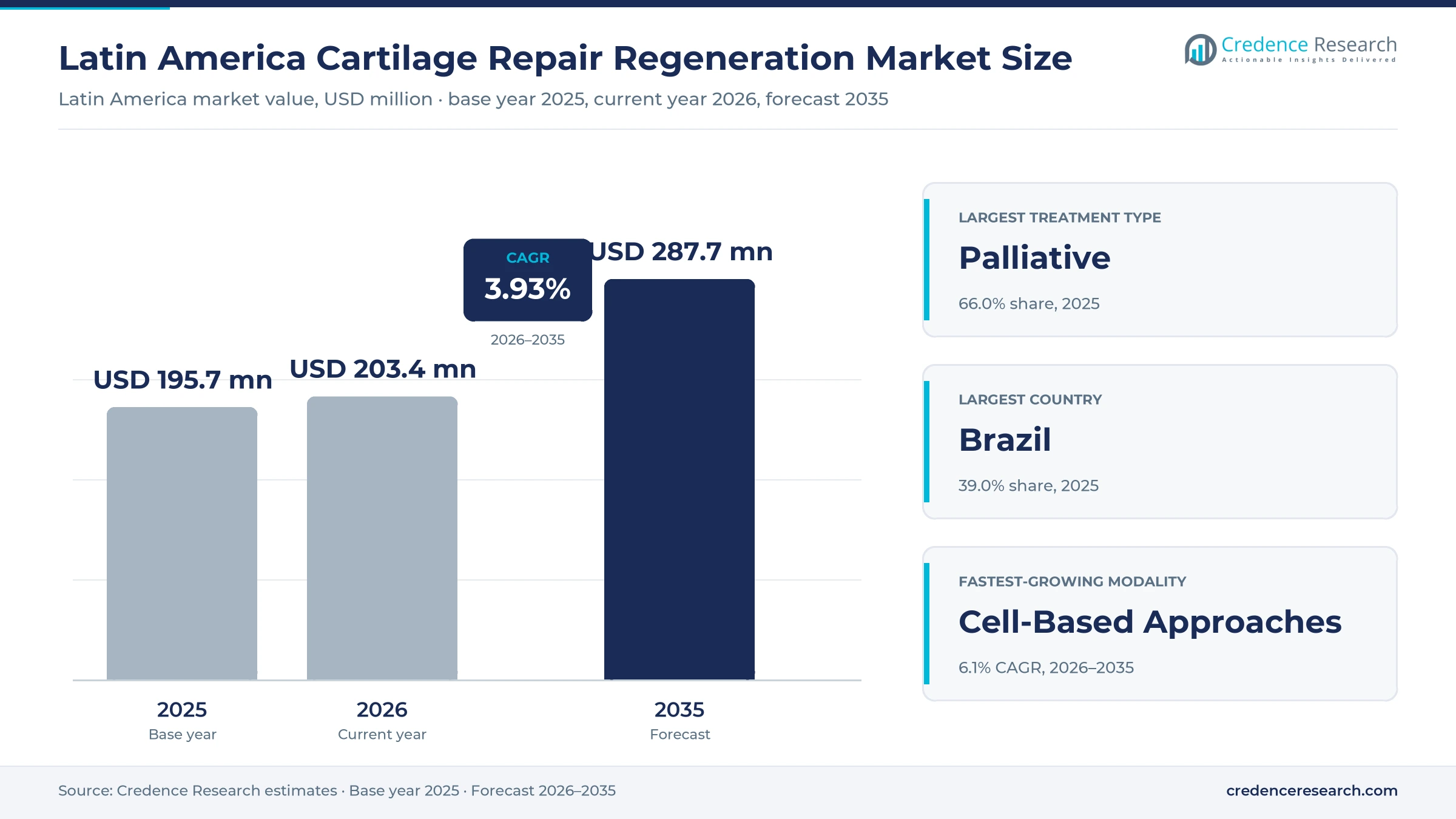
The Latin America cartilage repair regeneration market was valued at USD 195.7 million in 2025 and is projected to increase from USD 203.4 million in 2026 to USD 287.7 million by 2035, registering a CAGR of 3.93% during 2026–2035. Demand comes from orthopedic and sports medicine surgeons in private hospitals, from social security institutes such as Mexico’s IMSS, and from older adults with knee osteoarthritis who pay for hyaluronic acid injections. Brazil held the largest share, 39.0% in 2025, because it has the region’s largest population aged 65 and older, while Colombia is the fastest-growing country at 4.5% a year as its older population expands quickly. Device regulators in Brazil and Mexico now accept abbreviated reviews for high-risk products already cleared by reference authorities, which shortens the path for imported scaffolds and implants. Most spending remains out of pocket or with private plans, because public systems fund few restorative cartilage products.
Injections, grafts and implants bought for damaged joints
The estimate covers products used to relieve or restore damaged articular cartilage and fibrocartilage in Latin America, including intra-articular hyaluronic acid injections, debridement and chondroplasty disposables, osteochondral allografts, matrix and hydrogel scaffolds, and cell-based treatments. It counts purchases by private hospitals, social security hospitals, orthopedic clinics and patients who buy injections at retail pharmacies.
The estimate excludes surgeon fees, total joint replacement implants and oral pain drugs. Imported implants reach hospitals through local subsidiaries of global suppliers and specialist distributors, while injections move through pharmacy chains, so retail pricing and currency moves shape value in both channels.
Latin America Cartilage Repair Regeneration Market Insights
- The Latin America cartilage repair regeneration market was valued at USD 195.7 million in 2025 and is projected to reach USD 287.7 million by 2035, registering a CAGR of 3.93% during 2026–2035.
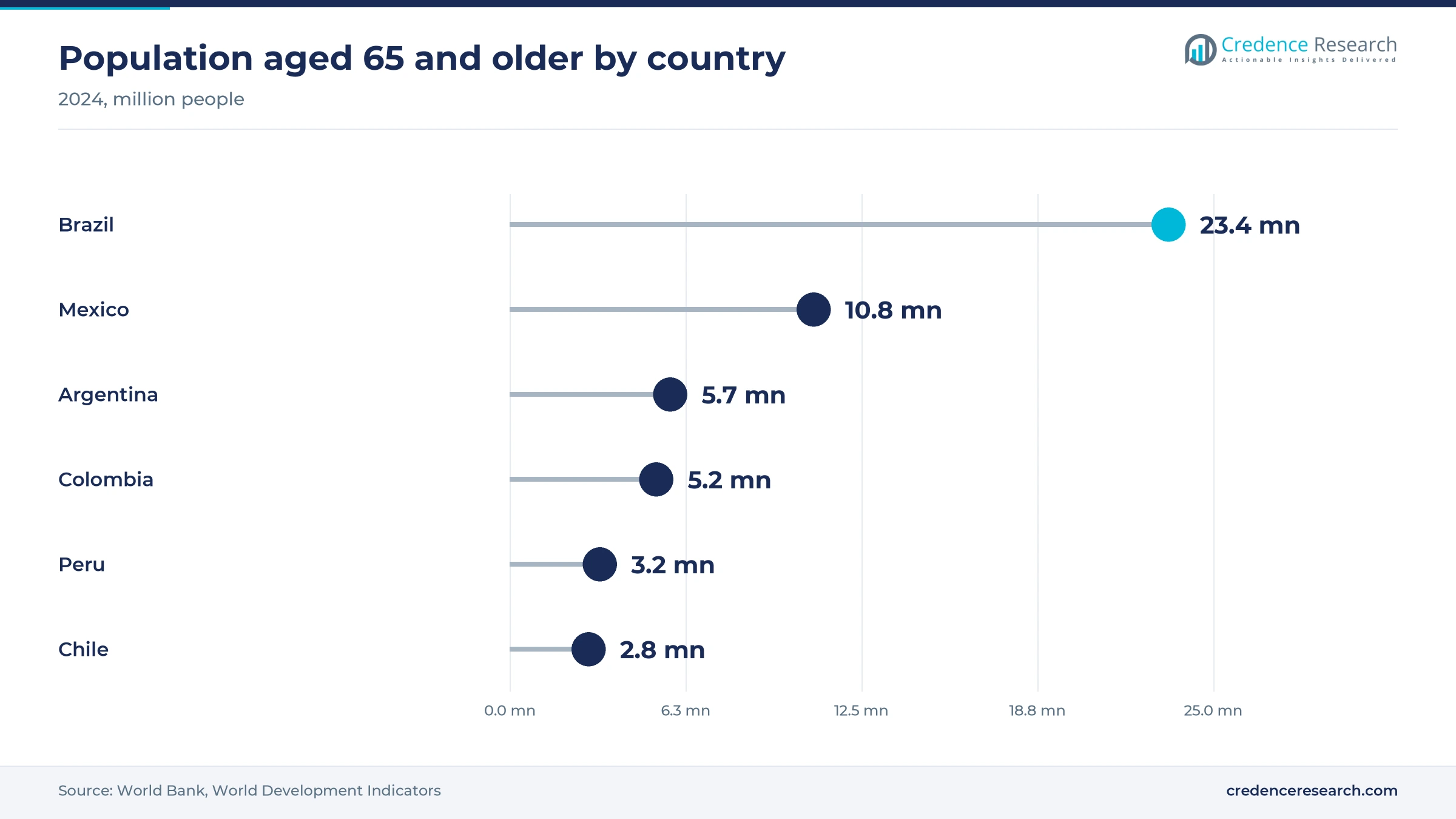
- Brazil held a 39.0% share of 2025 value, because it had 23.4 million residents aged 65 and older in 2024, the largest older population in the region.
- Palliative treatment led with a 66.0% share of 2025 value, because one IMSS orthopedic hospital alone gave viscosupplementation to 1,480 patients in 2024.
- Brazil’s abbreviated review route for high-risk devices already cleared by the FDA and three other reference regulators began applying on June 3, 2024.
- Cell-based approaches grow fastest at 6.1% a year during 2026–2035, although regulated supply remains small and unlicensed clinics still compete for the same patients.
Palliative care leads while cell-based care grows fastest
Non-cell products lead while cell-based care grows fastest
Based on treatment modality, the market is categorized into non-cell-based approaches and cell-based approaches. Non-Cell-Based Approaches led with 91.0% of 2025 value, because injections, allografts and scaffolds need no cell culture, and Brazil’s national tissue bank at INTO in Rio de Janeiro processes cartilage, bone and meniscus grafts for the whole country, Correio reported in November 2025. Cell-Based Approaches grow fastest at 6.1% a year, as Mexican clinics sell packaged stem cell knee treatments to self-paying patients, including foreign visitors. Simpler platelet-rich plasma injections compete for the same patients at lower prices.
Palliative care leads while intrinsic repair grows fastest
Based on treatment type, the market is categorized into palliative and intrinsic repair stimulus treatments. Palliative treatment led with a 66.0% share of 2025 value, because viscosupplementation and infiltrations are the first line for older patients, and IMSS’s Dr. Victorio de la Fuente Narváez orthopedic hospital at Magdalena de las Salinas gave viscosupplementation to 1,480 patients and 6,240 pain infiltrations in 2024. Intrinsic Repair Stimulus treatments grow fastest at 4.9% a year, as osteochondral grafts enter public care, and Bahia’s state orthopedic hospital performed its first osteochondral transplant through Brazil’s SUS in 2025, Correio reported.
Knees lead while hip use grows fastest
Based on application, the market is categorized into knee, spine, ankle, hip and others. Knee procedures led with a 72.0% share of 2025 value, because knee osteoarthritis affects 10.5% of Mexico’s population and 85% of people older than 65, according to an IMSS bulletin from June 2025. Hip applications grow fastest at 4.7% a year, as Anvisa approved Bioventus’s Durolane for both knee and hip osteoarthritis. Public data on hip cartilage procedure volumes in the region are not available, so this rate is a Credence Research assumption, and spine is the most assumption-heavy estimate, because disc cartilage products remain largely investigational.
| Segment Group | Leading Sub-segment | Share, 2025 | Fastest-growing Sub-segment | CAGR, 2026–2035 |
|---|---|---|---|---|
| By Treatment Modality | Non-Cell-Based Approaches | 91.0% | Cell-Based Approaches | 6.1% |
| By Treatment Type | Palliative | 66.0% | Intrinsic Repair Stimulus | 4.9% |
| By Application | Knee | 72.0% | Hip | 4.7% |
Retail injection prices sit far above local incomes
Most cartilage spending in the region is a retail purchase, because public systems fund few products and Brazil registers hyaluronic acid injections as health products without a CMED price cap. Pharmacy chains and online sellers therefore set retail prices themselves, with no public reference price. Dollar-linked import costs move these prices with the currency, and single-injection products carry the highest price per visit. Packaged stem cell treatments in Mexico are priced per course, which favors clinics serving self-paying foreign patients. High retail prices limit volume among patients without private plans.
| Product | Typical price or fee | Basis |
|---|---|---|
| Durolane, single 60 mg injection, Brazil | R$3,888.70 to R$4,084.50 per syringe | CliqueFarma price comparison, November 2026 |
| Synvisc-One, single 48 mg injection, Mexico | MXN 14,763.24 per syringe | WeCare Pharma online listing, November 2026 |
| Stem cell knee treatment package, Mexico | From USD 3,335 per course | PlacidWay listing for ProgenCell, November 2026 |
Request a Free Sample
Fill in your details and we'll send you a free sample report.
- Sample data tables & charts
- Research methodology
Aging, faster device reviews and surgery drives lift use
An older and heavier population widens the treated pool
Cartilage loss tracks age and body weight, so demographic change sets the floor for treatment volume across the region. Latin America and the Caribbean had 65.1 million residents aged 65 and older in 2024, up from 62.7 million a year earlier, according to the World Bank. Brazil’s Vigitel survey, released by the health ministry in January 2026, found that the number of adults with obesity grew 118% between 2006 and 2024. Excess weight loads the knee and moves osteoarthritis to younger ages, which lengthens the years a patient spends on injections before any replacement. Injection makers gain most from this base, which is why palliative care holds a 66.0% share in the Credence Research estimate.
Reliance routes shorten approval for imported devices
Most scaffolds and implants used in the region are imported, so the speed of device registration decides when surgeons can use them. Anvisa’s Normative Instruction 290, dated April 4, 2024, allows an abbreviated review for class III and IV devices already authorized by the FDA, Health Canada, Australia’s TGA or Japan’s health ministry, law firm Machado Meyer noted. Mexico’s COFEPRIS published a new equivalence agreement on June 11, 2025, that recognizes decisions from reference regulators and sets a 30-business-day resolution target, Emergo by UL reported. The same firm warned that reviews in practice often take months. Faster entry favors suppliers with products already cleared in the United States, while local makers gain no comparable shortcut.
Public surgery drives in Mexico widen orthopedic access
Public institutes are adding surgical capacity, which brings more patients to the orthopedic clinics that diagnose cartilage damage and prescribe injections. IMSS completed 1.78 million surgeries in 2025, 29% more than in 2024, director Zoé Robledo said in January 2026, according to El Imparcial. Its special surgical drives performed 54,611 procedures in 1,044 sessions in 2025 and 16,067 more from January to August 2026, Crónica reported in October 2026. Trauma and orthopedics, including joint replacement, ranked among the specialties with the highest demand in those drives. More orthopedic consultations raise volume for injections and debridement first, while restorative products depend on institutional tenders.
Supplier training hubs build surgeon capability
Restorative cartilage work depends on arthroscopic skill, so supplier training capacity limits how quickly techniques spread beyond a few academic centers. Arthrex runs its Latin American head office in São Paulo, with further locations in Mexico, Colombia and Chile and ArthroLab training centers in Brazil and Mexico, the company says. Arthrex Brasil opened an expanded 3,500-square-meter warehouse in São Paulo in August 2025 to support demand. Arthrex opened a new warehouse and office in Bogotá on May 14, 2026, expanding its Colombia subsidiary’s distribution capacity. Zimmer Biomet lists five offices in São Paulo, Rio de Janeiro, Mexico City, Chile and Costa Rica. Training centers that teach surgeons with arthroscopy instruments create repeat demand for the biologics and grafts the same suppliers sell, which reinforces their lead in private hospitals.
Cell-free implants and regional trials reshape the pipeline
Cell-free implants are entering Brazilian practice
Brazilian private hospitals are beginning to shift toward single-stage, cell-free implants to avoid the biopsy and second surgery that cell culture requires, creating openings for hydrogel scaffolds in knee defects. Anvisa has approved CaReS-1S, an Austrian-developed 3D hydrogel implant that stimulates hyaline cartilage regrowth, the Federal Pharmacy Council announced in August 2025. The council said that most Brazilian patients still cannot obtain it, because health plans and public systems resist adding new therapies. It also cited economic analyses that found the implant cost-effective against repeated injections, repeated surgeries and prostheses. Private hospitals that win plan coverage first gain a premium procedure, while the intrinsic repair segment grows at 4.9% a year in the Credence Research estimate.
Regional hospitals are hosting first-in-human implant trials
Developers are running early clinical work in Latin American hospitals, which gives local surgeons hands-on use of devices years before any commercial launch. Sparta Biomedical said on Sept. 17, 2024, that it had treated the first patients with Ormi, a synthetic cartilage implant on a titanium base, at Clínica de la Mujer in Bogotá and HOMS in Santiago de los Caballeros, Dominican Republic. The device holds FDA Breakthrough Device Designation but is not approved or sold commercially, the company said. Argentina’s ANMAT already regulates tissue engineering products under Disposition 179 of 2018, which requires 30 years of donor-to-patient traceability. Trial sites gain surgeon experience before launch, which could make Colombia an early market once products are approved.
Public tissue banks open a graft supply opportunity
Osteochondral allografts are an underserved opening, because Brazil’s public system has only begun to offer cartilage transplants and tissue supply is limited. Brazil passed 30,000 organ and tissue procedures in 2024, according to the health ministry, Correio reported in November 2025. The SUS began offering knee osteochondral transplants in 2025, as the Bahia case in the segment analysis shows. Each new regional bank needs donor screening, cold storage and sterile processing before it can release grafts to surgeons. Lesions wider than 30 to 40 millimeters are usual candidates for these grafts. Suppliers of graft processing, sizing instruments and fixation devices gain as regional banks expand, while younger patients gain an option before replacement.
Joint preservation can shorten replacement queues
Long waits for joint replacement in public hospitals create an opening for products that delay surgery in younger patients with early disease. IMSS’s Magdalena de las Salinas hospital bought 3,568 knee prostheses in 2026, 328 more than in 2025, and still had more than 3,700 pending operations, Crónica reported in September 2026. The IMSS bulletin cited above lists bone-alignment procedures for younger early-stage patients and repeat intra-articular injections every 4, 6 or 12 months. Tender bundles that pair injections and osteotomy hardware with knee replacements let suppliers serve the whole care pathway, and patients avoid years of untreated pain while they wait.
Coverage gaps, a weak real and grey clinics restrain sales
Public systems do not fund viscosupplementation
Brazil’s SUS does not supply hyaluronic acid injections, which pushes the largest product group into private payment. A Rio de Janeiro court health opinion of Sept. 9, 2025, said the SUS infiltration procedure covers only anesthetic, corticosteroid and contrast, according to the NATJUS opinion. It cited a CONITEC review that found hyaluronic acid no more effective than anti-inflammatory drugs. The burden falls hardest on lower-income patients, and many turn to the courts, as the lawsuit behind this opinion shows.
A weaker real raises the cost of imported implants
Most implants, scaffolds and branded injections are imported and priced in dollars, so currency swings move local prices quickly. The Brazilian real weakened from 4.84 to 6.19 per U.S. dollar between the end of 2023 and the end of 2024, according to Banco Central do Brasil PTAX rates. Distributors with fixed-price hospital contracts absorb the gap until contracts reset, which squeezes their margins first. Patients paying out of pocket respond by delaying treatment or choosing cheaper corticosteroid infiltrations.
Unlicensed stem cell clinics erode patient trust
Unregulated stem cell clinics in Mexico compete with licensed suppliers for self-paying patients and create serious safety risks. The CDC reported in May 2024 that three patients developed Mycobacterium abscessus infections after stem cell injections in Baja California and Guadalajara in 2022, one of them for osteoarthritis. Such cases make surgeons and patients wary of all cell-based offers, so licensed products bear a reputational cost they did not cause. Clinics serving foreign visitors are the most visible part of this trade, and they operate largely outside the tender and pharmacy channels that licensed suppliers use.
Public surgical targets still fall short of demand
Public hospitals remain the main entry point for most patients, and their capacity still lags demand. The 2025 IMSS surgery total noted above fell about 220,000 short of the institute’s target of 2 million, El Imparcial reported in January 2026. Specialty consultations also missed their 30 million target by about 700,000. Patients without private plans wait longest, because diagnosis and arthroscopy depend on a surgical slot, and suppliers of restorative products reach these patients only through tenders.
Brazil leads on size while Colombia grows fastest
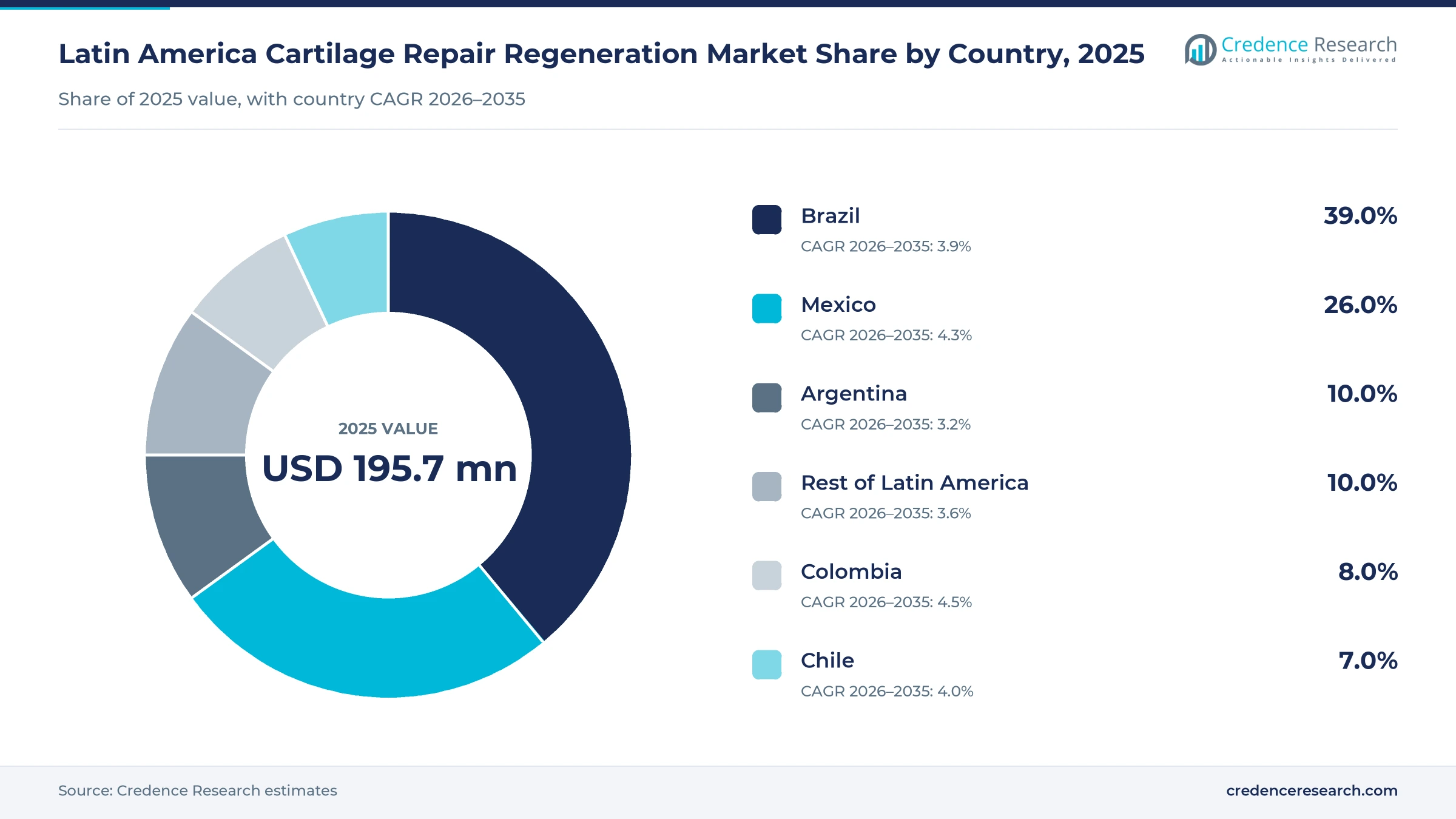
The Latin America cartilage repair regeneration market is split into Brazil, Mexico, Argentina, Colombia, Chile and the rest of the region. Country shares and growth rates are Credence Research estimates based on World Bank data on the population aged 65 and older, health spending per person and the location of supplier operations.
| Country | Value, 2025 (USD million) | Share, 2025 | CAGR, 2026–2035 |
|---|---|---|---|
| Brazil | 76.3 | 39.0% | 3.9% |
| Mexico | 50.9 | 26.0% | 4.3% |
| Argentina | 19.6 | 10.0% | 3.2% |
| Rest of Latin America | 19.6 | 10.0% | 3.6% |
| Colombia | 15.7 | 8.0% | 4.5% |
| Chile | 13.7 | 7.0% | 4.0% |
The largest older population keeps Brazil in front
Brazil held a 39.0% share of 2025 value and grows at 3.9% a year in the regional model. Its population aged 65 and older reached 22.2 million in the 2022 census, or 10.9% of residents, up 57.4% from 2010, according to IBGE, and World Bank data put the group at 23.4 million in 2024. Health spending averaged about USD 1,010 per person in 2023. Private health plans and São Paulo supplier hubs concentrate restorative procedures in the Southeast, while SUS patients rely on corticosteroid infiltrations.
Social security hospitals shape Mexico’s demand
Mexico held a 26.0% share of 2025 value and grows at 4.3% a year. The same IMSS hospital performed 3,280 knee prosthesis surgeries in 2024, the bulletin cited earlier reported, which shows how much joint care flows through institutional tenders. Mexico had 10.8 million residents aged 65 and older in 2024, 8.2% of its population, the youngest profile of the five largest markets. Health spending of about USD 761 per person in 2023 keeps private purchases concentrated in Mexico City, Guadalajara and Monterrey.
Argentina has an older population but slower growth
Argentina held a 10.0% share of 2025 value and grows at 3.2% a year, the slowest rate in the regional model. Residents aged 65 and older made up 12.4% of its population in 2024, World Bank data show, although that group grew only 2.1% from 2023. Health spending reached about USD 1,457 per person in 2023. ANMAT’s rules for tissue engineering products, noted above, give a defined route for cell-based products, but import controls and inflation limit purchases of dollar-priced implants.
Fast aging makes Colombia the growth leader
Colombia held 8.0% of 2025 value and grows fastest at 4.5% a year. Its population aged 65 and older rose 5.4%, from 4.91 million in 2023 to 5.17 million in 2024, the fastest increase among the five largest markets in World Bank data. Health spending of about USD 571 per person in 2023 is the lowest of the five, so growth starts from a small base. Bogotá’s role as an implant trial site gives local surgeons early experience with new devices.
Chile pairs the oldest profile with high spending
Chile held a 7.0% share of 2025 value and grows at 4.0% a year. Residents aged 65 and older made up 14.1% of its population in 2024, the highest share among the five largest markets, and health spending reached about USD 1,737 per person in 2023, World Bank data show. Private clinics in Santiago buy imported scaffolds and injections, and Arthrex and Zimmer Biomet both run local operations there.
Smaller markets depend on distributors
The rest of Latin America held a 10.0% share of 2025 value and grows at 3.6% a year. Peru had about 3.2 million residents aged 65 and older in 2024, World Bank data show, and Central American and Caribbean demand runs through distributors and a few private hospitals. Zimmer Biomet’s Costa Rica office and the Dominican Republic trial site are among the few direct supplier footprints in these markets.
Reliance rules, trials and approvals mark 2024 to 2026
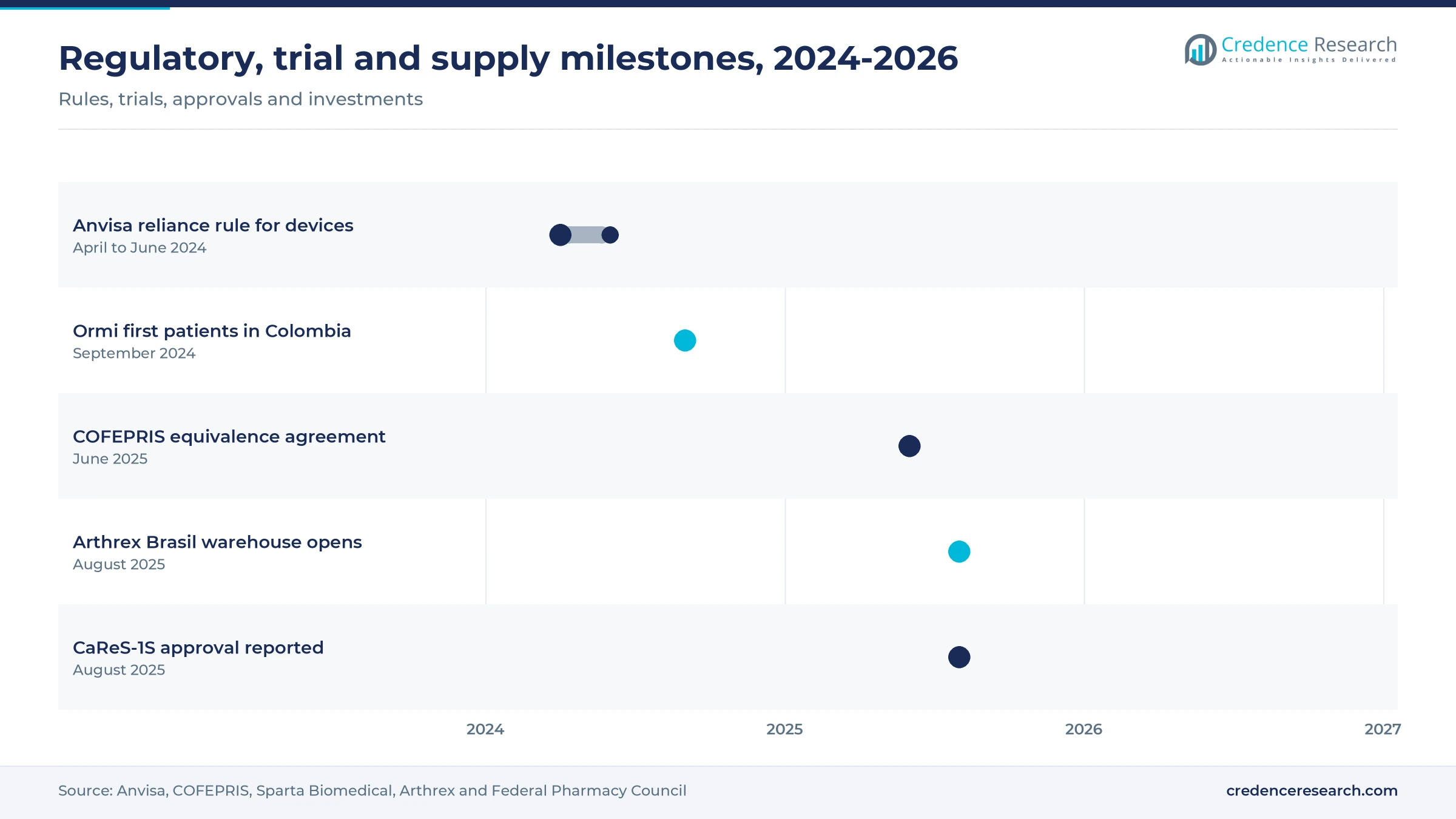
| Development | Status and market relevance |
|---|---|
| In April 2024, Anvisa issued Normative Instruction 290, allowing abbreviated registration reviews for class III and IV devices cleared by four reference regulators. | Regulation adopted, applying from June 3, 2024 |
| In September 2024, Sparta Biomedical treated the first patients with its Ormi synthetic cartilage implant in Colombia and the Dominican Republic. | Testing milestone, first-in-human trial ongoing |
| In June 2025, COFEPRIS published a new equivalence agreement for registering medical devices already authorized by reference regulators. | Regulation published in the Official Gazette |
| In August 2025, Arthrex Brasil moved its logistics operations to a new 3,500-square-meter warehouse in São Paulo. | Completed investment, operational |
| In August 2025, the Federal Pharmacy Council reported that Anvisa had approved the CaReS-1S hydrogel cartilage implant. | Approval reported, limited patient availability |
Injections, allografts and scaffolds compete for knees
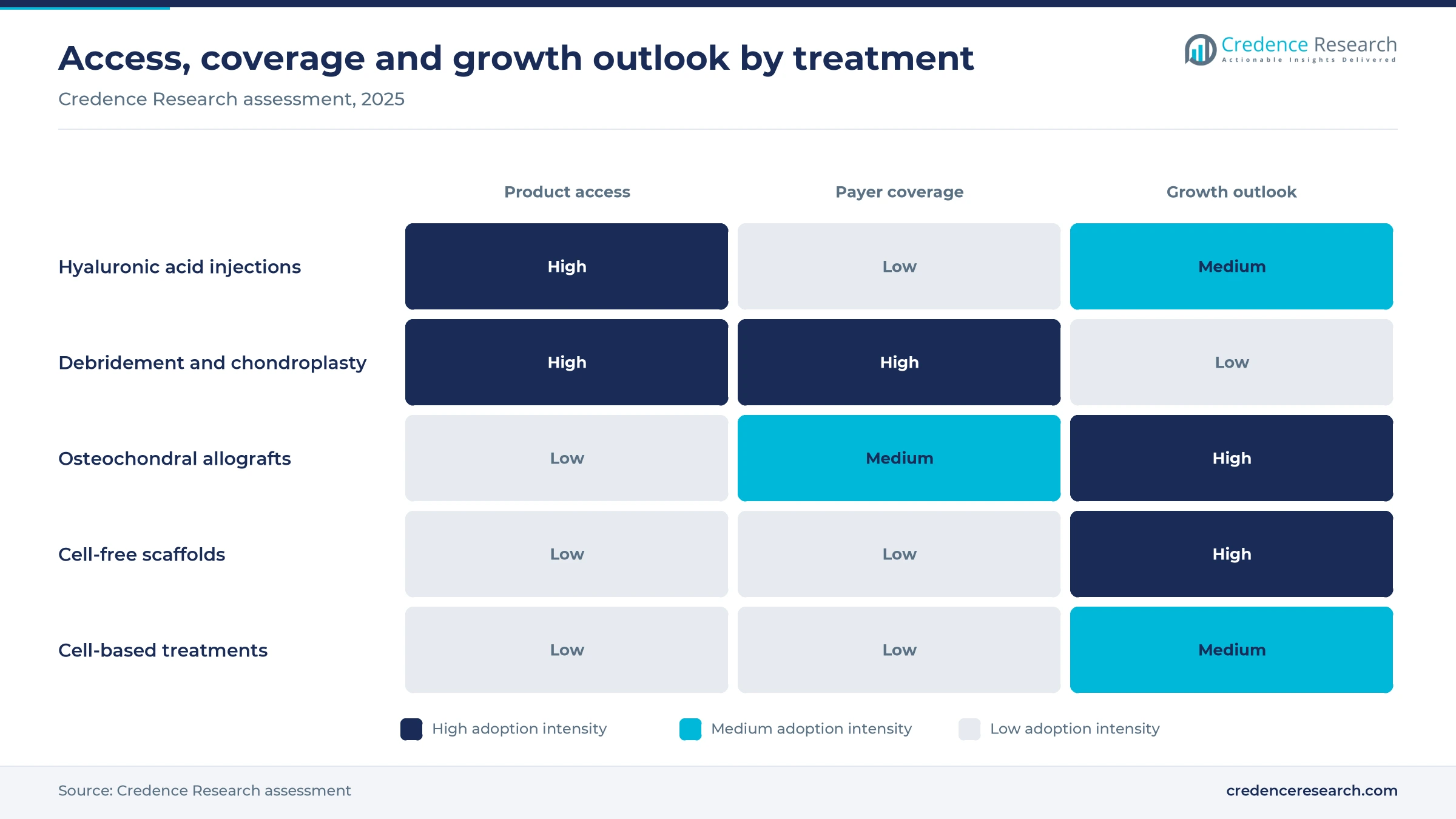
- Hyaluronic acid injections relieve osteoarthritis pain for months and are sold at retail as single or multi-dose syringes.
- Osteochondral allografts replace a damaged area with donor cartilage and bone processed by public and private tissue banks.
- Cell-free hydrogel and matrix scaffolds fill a defect in a single surgery and guide the patient’s own cells to form new tissue.
- Cell-based treatments use cultured or concentrated cells, a route regulated for industrial products in Argentina but often unlicensed elsewhere.
Need a Custom Version of This Report?
Tailor the scope, geography, or segments to your exact requirements.
- Custom geography or segment scope
- Direct access to our analyst team
Global sports medicine firms lead through local hubs
Competition in the Latin America cartilage repair regeneration market is shaped by surgeon training, registration speed and pharmacy reach rather than by price alone. Arthrex leads in arthroscopic biologics through its São Paulo head office and training centers in Brazil and Mexico. Smith+Nephew, Zimmer Biomet, Stryker and Johnson & Johnson MedTech compete with sports medicine and orthobiologics portfolios bundled with arthroscopy hardware, and Zimmer Biomet runs subsidiaries in five countries. Injection brands compete on retail visibility, with Sanofi’s Synvisc-One in Mexico, Bioventus’s Durolane in Brazil and Futerman’s Argentine-made Cientific Synovial. Regional trial sites and pending approvals could bring new entrants after 2028, while unlicensed cell clinics remain an informal competitor in Mexico.
How is the supplier base organized?
Supply splits into imported restorative products and a crowded injection tier. Arthrex, Smith+Nephew, Zimmer Biomet, Stryker and Johnson & Johnson MedTech sell arthroscopy systems, grafts and scaffolds through local subsidiaries in Brazil and Mexico and through distributors elsewhere. Injections come from Sanofi, Bioventus, Futerman and others through pharmacy chains. Entry barriers are device registration, surgeon training and tender qualification. Margins sit with restorative implants, while injections compete on retail price.
Companies profiled and their roles in this market
| Company | Type | Role in the market |
|---|---|---|
| Arthrex | Sports medicine supplier | Sells arthroscopic cartilage instruments, matrix grafts and allografts through Latin American subsidiaries |
| Smith+Nephew | Sports medicine supplier | Sells arthroscopy systems and cartilage repair implants for knee defects |
| Zimmer Biomet | Full-line orthopedic supplier | Sells biologics and joint preservation products through offices in five countries |
| Stryker Corporation | Full-line orthopedic supplier | Sells sports medicine and arthroscopy instruments used in cartilage procedures |
| Johnson & Johnson MedTech (DePuy Synthes) | Full-line orthopedic supplier | Sells arthroscopy and sports medicine products used in cartilage procedures |
| Sanofi | Pharmaceutical supplier | Sells Synvisc-One hylan injections for knee osteoarthritis pain in Mexico |
| Bioventus | Orthobiologics specialist | Makes Durolane hyaluronic acid injections approved by Anvisa for knee and hip |
| Futerman International Products | Regional manufacturer | Makes Cientific Synovial hyaluronic acid injections sold in Argentina and Brazil |
Why restorative care gains slowly in the region
Credence Research’s view is that the Latin America cartilage repair regeneration market will stay injection-led through most of the decade, with restorative products gaining share slowly from private hospitals. Cell-based approaches grow fastest because they start from a small base, but unlicensed clinics and the absence of public coverage cap their regulated volume. Faster device registration matters more than any single product, because most implants are imported. The largest uncertainty is currency, and evidence on procedure volumes outside Mexico’s social security system is thin.
Population, spending and price data anchor the estimate
The report uses 2025 as the base year and forecasts to 2035. The 2025 value is the Credence Research model value, cross-checked against World Bank population and health spending data, retail injection prices, public hospital activity reports and regulatory decisions. Country, segment and application splits are Credence Research estimates based on the older population, spending per person and product labels. The analysis does not rely on interviews or surveys of any kind.
Restorative products gain share through 2035
The Latin America cartilage repair regeneration market is expected to grow from USD 203.4 million in 2026 to USD 287.7 million by 2035, a CAGR of 3.93%. Hyaluronic acid injections will keep the largest share, while cell-free implants and osteochondral grafts gain ground in private hospitals and public tissue programs. Faster device registration in Brazil and Mexico should shorten launch delays for imported products. Colombia and Mexico offer the fastest growth, although currency swings and public surgery capacity will decide how much of that growth reaches restorative care.
What decides the range of outcomes to 2035?
The base case assumes steady injection volume, gradual private uptake of cell-free implants and stable currencies. The downside case follows renewed currency weakness and slower public surgery growth, which would leave restorative products confined to a few private hospitals. The upside case needs private plan coverage for new implants in Brazil and faster device registration in Mexico under the 2025 equivalence route.
| Scenario | CAGR, 2026–2035 | Value, 2035 | What has to hold |
|---|---|---|---|
| Downside | 2.4% | USD 252.4 million | The real and peso weaken again and public surgery growth stalls after 2026 |
| Base | 3.93% | USD 287.7 million | Injection volume holds and private plans adopt cell-free implants gradually |
| Upside | 5.4% | USD 327.3 million | Brazilian plans cover new implants and Mexican registrations meet the 30-day target |
Frequently Asked Questions
How big is the Latin America cartilage repair regeneration market?
Which country leads the market?
Which country grows fastest?
Does Brazil’s SUS pay for hyaluronic acid knee injections?
What does a hyaluronic acid injection cost in the region?
Which share of the market is knee treatment?
What restrains growth in the market?
Who are the leading companies?
Table of Content
Chapter 1 Market Segmentation
- 1.1 Segmentation Framework
- 1.1.1 Product and Service Classification
- 1.1.2 Application and End-Use Classification
- 1.1.3 Technology and Solution Classification
- 1.1.4 Customer and Distribution Channel Classification
- 1.1.5 Geographic Segmentation
- 1.1.6 Market Segment Definitions and Boundaries
- 1.2 By Treatment Modality
- 1.2.1 Non-Cell-Based Approaches
- 1.2.2 Cell-Based Approaches
- 1.3 By Treatment Type
- 1.3.1 Palliative
- 1.3.2 Intrinsic Repair Stimulus
- 1.4 By Application
- 1.4.1 Knee
- 1.4.2 Hip
- 1.4.3 Ankle
- 1.4.4 Spine
- 1.4.5 Others
- 1.5 By Country
- 1.5.1 Brazil
- 1.5.2 Mexico
- 1.5.3 Argentina
- 1.5.4 Colombia
- 1.5.5 Chile
- 1.5.6 Rest of Latin America
Chapter 2 Introduction
- 2.1 Report Objectives and Scope
- 2.2 Product Definition and Industry Terminology
- 2.3 Market Inclusions and Exclusions
- 2.4 Research Process
- 2.4.1 Primary Research and Expert Interviews
- 2.4.2 Secondary Research and Source Review
- 2.4.3 Top-Down and Bottom-Up Estimation
- 2.4.4 Data Triangulation and Verification
- 2.5 Market Size Measurement Basis
- 2.5.1 2025: USD 195.7 million → 2035: USD 287.7 million
- 2.6 Historical and Forecast Reference Periods
- 2.6.1 Historical Period: 2018-2025
- 2.6.2 Base Year: 2025
- 2.6.3 Forecast Period: 2025-2035
- 2.7 Research Assumptions and Limitations
Chapter 3 Executive Summary
- 3.1 Market Snapshot and Key Findings
- 3.2 Base-Year Market Size, 2025
- 3.3 Forecast Market Size, 2035
- 3.4 Revenue and Volume Growth Outlook
- 3.5 Key Demand and Supply Indicators
- 3.6 Leading Market Segments
- 3.7 Fastest-Growing Market Opportunities
- 3.8 Regional Performance Highlights
- 3.9 Technology and Industry Transformation
- 3.10 Competitive Landscape Summary
- 3.11 Analyst View and Strategic Implications
Chapter 4 Latin America Cartilage Repair Regeneration Market Trends and Developments
- 4.1 Historical Industry Development, 2018-2025
- 4.2 Recent Market Trends and Developments
- 4.3 Demand and Customer Behavior Trends
- 4.4 Technology and Product Innovation
- 4.5 Artificial Intelligence, Automation and Digitalization
- 4.6 Local Manufacturing and Supply Chain Realignment
- 4.7 Industry Partnerships, Mergers and Acquisitions
- 4.8 Sustainability and Circular Economy Developments
- 4.9 Government and Private Sector Investment Trends
- 4.10 Emerging Business Models and Commercialization
- 4.11 Industry Developments and Announcements
Chapter 5 Latin America Cartilage Repair Regeneration Market Production, Supply and Demand Analysis
- 5.1 Demand Trend and Consumption Analysis, 2018-2025
- 5.2 Demand Forecast, 2025-2035
- 5.3 Production and Output Trend, 2018-2025
- 5.4 Production and Output Forecast, 2025-2035
- 5.5 Installed Capacity and Capacity Utilization
- 5.6 Company-Wise Production Plants and Statistics
- 5.6.1 Installed Production Capacity
- 5.6.2 Actual Production
- 5.6.3 Planned Capacity and Expansion Targets
- 5.7 Supply Chain Structure and Procurement Trends
- 5.8 Supply-Demand Gap and Bottlenecks
- 5.9 Import Dependence and Sourcing Structure
- 5.10 Contract Manufacturing and Outsourcing
- 5.11 Regional Supply and Demand Concentration
Chapter 6 Latin America Cartilage Repair Regeneration Market Pricing Analysis
- 6.1 Pricing Structure and Measurement
- 6.2 Historical Pricing Trends, 2018-2025
- 6.3 Pricing Outlook, 2025-2035
- 6.4 Average Selling Price and Unit Economics
- 6.5 Pricing by Product and Market Segment
- 6.6 Geographic Pricing Differences
- 6.7 Key Input, Energy, Labor and Logistics Costs
- 6.8 Contract Pricing and Purchasing Models
- 6.9 Pricing Sensitivity and Competitive Positioning
- 6.10 Price, Margin and Profitability Implications
Chapter 7 Latin America Cartilage Repair Regeneration Market Dynamics
- 7.1 Market Growth Drivers
- 7.1.1 Demand-Side Drivers
- 7.1.2 Technology and Innovation Drivers
- 7.1.3 Infrastructure and Investment Drivers
- 7.1.4 Regulatory and Policy Drivers
- 7.2 Market Restraints
- 7.2.1 Cost and Affordability Constraints
- 7.2.2 Technology and Adoption Barriers
- 7.2.3 Supply Chain and Operational Constraints
- 7.3 Market Challenges
- 7.3.1 Competitive Pressure and Margin Erosion
- 7.3.2 Skills, Infrastructure and Implementation Gaps
- 7.4 Emerging Market Opportunities
- 7.5 Market Dynamics Impact and Time-Horizon Assessment
Chapter 8 Latin America Cartilage Repair Regeneration Value Chain Analysis
- 8.1 Industry Value Chain Overview
- 8.2 Upstream Suppliers and Critical Inputs
- 8.3 Technology and Component Providers
- 8.4 Manufacturing or Service Delivery
- 8.5 Distribution, Channel Partners and Integrators
- 8.6 Downstream Applications and End Users
- 8.7 Value Addition and Profit Pools
- 8.8 Vertical Integration and Outsourcing
- 8.9 Supplier Concentration and Risk
- 8.10 Supply Chain Localization and Resilience
Chapter 9 Latin America Cartilage Repair Regeneration Market Regulations and Policies
- 9.1 Relevant Laws, Standards and Compliance Frameworks
- 9.2 Product, Service, Safety and Quality Requirements
- 9.3 Government Policies, Incentives and Subsidies
- 9.4 Imports, Exports and Trade Barriers
- 9.5 Public Procurement and Local Content Requirements
- 9.6 Environmental and Sustainability Compliance
- 9.7 Upcoming Policy Changes and Market Implications
Chapter 10 Latin America Cartilage Repair Regeneration Market Hotspots and Opportunities
- 10.1 Market Opportunity Mapping and Growth Hotspots
- 10.2 High-Growth Applications and Customer Groups
- 10.3 Underserved Markets and White-Space Opportunities
- 10.4 Emerging Technology and Product Opportunities
- 10.5 New Capacity and Investment Hotspots
- 10.6 Market Entry and Expansion Opportunities
- 10.7 Distribution and Partnership Opportunities
- 10.8 Near-Term and Long-Term Commercial Potential
- 10.9 Opportunity Attractiveness and Execution Risks
Chapter 11 Latin America Cartilage Repair Regeneration Market Outlook, 2025-2035
- 11.1 Market Size and Analysis
- 11.1.1 Revenue (Market Measurement: 2025: USD 195.7 million → 2035: USD 287.7 million)
- 11.1.2 Market Volume and Quantity Sold
- 11.1.3 Historical Market Size, 2018-2025
- 11.1.4 Base-Year Market Size, 2025
- 11.2 Market Forecast, 2025-2035
- 11.2.1 Revenue Forecast to 2035
- 11.2.2 Volume Forecast to 2035
- 11.2.3 CAGR and Year-on-Year Growth
- 11.2.4 Incremental Revenue Opportunity
- 11.3 Forecast Assumptions and Scenario Analysis
- 11.3.1 Base-Case Forecast
- 11.3.2 Optimistic and Conservative Scenarios
- 11.3.3 Technology, Pricing and Policy Sensitivities
- 11.4 Market Attractiveness and Growth Outlook
Chapter 12 Latin America Cartilage Repair Regeneration Market Segmentation and Outlook
- 12.1 Segmentation Summary and Market Shares, 2025
- 12.2 Largest and Fastest-Growing Segments
- 12.3 By Treatment Modality - Market Size and Forecast, 2025-2035
- 12.3.1 Segment Definition and Scope
- 12.3.2 Historical Market Size, 2018-2025
- 12.3.3 Revenue Forecast, 2025-2035
- 12.3.4 Volume Forecast, 2025-2035
- 12.3.5 Base-Year Market Share, 2025
- 12.3.6 Segment CAGR and Growth Drivers
- 12.3.7 Subsegment Market Size and Forecast
- 12.3.7.1 Non-Cell-Based Approaches
- 12.3.7.2 Cell-Based Approaches
- 12.3.8 Subsegment Pricing and Adoption Trends
- 12.3.9 Leading Suppliers and Competition
- 12.3.10 Regional Demand and Opportunities
- 12.4 By Treatment Type - Market Size and Forecast, 2025-2035
- 12.4.1 Segment Definition and Scope
- 12.4.2 Historical Market Size, 2018-2025
- 12.4.3 Revenue Forecast, 2025-2035
- 12.4.4 Volume Forecast, 2025-2035
- 12.4.5 Base-Year Market Share, 2025
- 12.4.6 Segment CAGR and Growth Drivers
- 12.4.7 Subsegment Market Size and Forecast
- 12.4.7.1 Palliative
- 12.4.7.2 Intrinsic Repair Stimulus
- 12.4.8 Subsegment Pricing and Adoption Trends
- 12.4.9 Leading Suppliers and Competition
- 12.4.10 Regional Demand and Opportunities
- 12.5 By Application - Market Size and Forecast, 2025-2035
- 12.5.1 Segment Definition and Scope
- 12.5.2 Historical Market Size, 2018-2025
- 12.5.3 Revenue Forecast, 2025-2035
- 12.5.4 Volume Forecast, 2025-2035
- 12.5.5 Base-Year Market Share, 2025
- 12.5.6 Segment CAGR and Growth Drivers
- 12.5.7 Subsegment Market Size and Forecast
- 12.5.7.1 Knee
- 12.5.7.2 Hip
- 12.5.7.3 Ankle
- 12.5.7.4 Spine
- 12.5.7.5 Others
- 12.5.8 Subsegment Pricing and Adoption Trends
- 12.5.9 Leading Suppliers and Competition
- 12.5.10 Regional Demand and Opportunities
- 12.6 By Country - Market Size and Forecast, 2025-2035
- 12.6.1 Segment Definition and Scope
- 12.6.2 Historical Market Size, 2018-2025
- 12.6.3 Revenue Forecast, 2025-2035
- 12.6.4 Volume Forecast, 2025-2035
- 12.6.5 Base-Year Market Share, 2025
- 12.6.6 Segment CAGR and Growth Drivers
- 12.6.7 Subsegment Market Size and Forecast
- 12.6.7.1 Brazil
- 12.6.7.2 Mexico
- 12.6.7.3 Argentina
- 12.6.7.4 Colombia
- 12.6.7.5 Chile
- 12.6.7.6 Rest of Latin America
- 12.6.8 Subsegment Pricing and Adoption Trends
- 12.6.9 Leading Suppliers and Competition
- 12.6.10 Regional Demand and Opportunities
- 12.7 Segment Growth Comparison
- 12.8 Segment Attractiveness and Priority Matrix
Chapter 13 Latin America Cartilage Repair Regeneration End-Use and Application Market Outlook
- 13.1 End-Use Industry and Customer Demand Structure
- 13.2 Leading Applications and Customer Groups
- 13.3 End-Use Market Size, Share and Forecast
- 13.4 Major End-Use Industry Deep Dives
- 13.4.1 Customer Requirements and Use Cases
- 13.4.2 Demand and Replacement Cycles
- 13.4.3 Technical and Regulatory Considerations
- 13.4.4 Purchasing and Procurement Models
- 13.4.5 Leading Vendors and Distribution Channels
- 13.4.6 Forecast and Commercial Opportunities
- 13.5 Emerging Applications and Cross-Segment Demand
- 13.6 End-Use Industry Investment Priorities
Chapter 14 Latin America Cartilage Repair Regeneration Geographic Market Outlook, 2025-2035
- 14.1 Regional Market Size and Country-Level Shares, 2025
- 14.2 Country Market Size Comparison, 2025
- 14.3 Country Market Forecasts, 2025-2035
- 14.4 Subregional Industrial and Demand Clusters
- 14.5 Intra-Regional Pricing and Cost Differences
- 14.6 Cross-Border Trade and Supply Networks
- 14.7 Regional Supply and Demand Balances
- 14.8 Country Opportunity Comparison and Prioritization
Note: Every listed country is covered on the structure shown under the first country.
Chapter 15 Latin America Cartilage Repair Regeneration Technology, Innovation and Sustainability Outlook
- 15.1 Technology Landscape and Maturity
- 15.2 Product, Process and Service Innovation
- 15.3 AI, Automation and Digital Tools in the Industry
- 15.4 Technology Adoption and Performance Benchmarking
- 15.5 Innovation Pipeline and R&D Investment
- 15.6 Patent and Intellectual Property Trends
- 15.7 Energy Efficiency and Resource Management
- 15.8 Sustainability, Recycling and Circularity
- 15.9 Technology Roadmap, 2025-2035
- 15.10 Risks of Obsolescence and Technology Substitution
Chapter 16 Latin America Cartilage Repair Regeneration Market Key Strategic Imperatives
- 16.1 Growth and Market Entry Priorities
- 16.2 High-Return Products and Segments
- 16.3 Pricing, Profitability and Cost Optimization
- 16.4 Technology Investment and Product Differentiation
- 16.5 Supply Chain Localization and Resilience
- 16.6 Distribution and Customer Acquisition
- 16.7 Partnership, Acquisition and Capacity Strategy
- 16.8 Regional Expansion Priorities
- 16.9 Short-, Medium- and Long-Term Actions
Chapter 17 Competition Outlook
- 17.1 Industry Competition Characteristics
- 17.2 Market Structure and Concentration
- 17.3 Market Share and Competitive Positioning, 2025
- 17.4 Company-Wise Revenue and Product Benchmarking
- 17.5 Production and Service Capacity Benchmarking
- 17.6 Technology, Pricing and Differentiation
- 17.7 Regional Footprint and Distribution Strength
- 17.8 Mergers, Acquisitions and Strategic Alliances
- 17.9 New Entrants and Competitive Threats
- 17.10 Porter's Five Forces and Industry Attractiveness
- 17.11 Competitive Outlook, 2025-2035
Chapter 18 Company Profiles
- 18.1 Company Coverage and Selection Criteria
- 18.2 Arthrex
- 18.2.1 Business Description
- 18.2.2 Company Ownership and Geographic Presence
- 18.2.3 Product and Service Portfolio
- 18.2.4 Manufacturing and Operating Footprint
- 18.2.5 Production Capacity and Expansion Plans
- 18.2.6 Financial Performance and Investment
- 18.2.7 Market Share and Competitive Position
- 18.2.8 Technology and Innovation Capabilities
- 18.2.9 Strategic Alliances or Partnerships
- 18.2.10 Recent Developments
- 18.2.11 Growth Strategy and Outlook
- 18.3 Smith+Nephew
- 18.4 Zimmer Biomet
- 18.5 Stryker Corporation
- 18.6 Johnson & Johnson MedTech (DePuy Synthes)
- 18.7 Sanofi
- 18.8 Bioventus
- 18.9 Futerman International Products
- 18.10 Other Relevant Market Participants
Note: Every listed company is profiled on the structure shown under the first company. The company list is preliminary and may change based on research findings, market developments, data availability and client requirements.
Chapter 19 Disclaimer
- 19.1 Research and Forecast Disclaimer
- 19.2 Data Source and Estimation Limitations
Note: The depth of individual sections depends on data availability for this market. Volume, capacity, trade and other unit-based metrics are included where applicable.

