
Market Overview
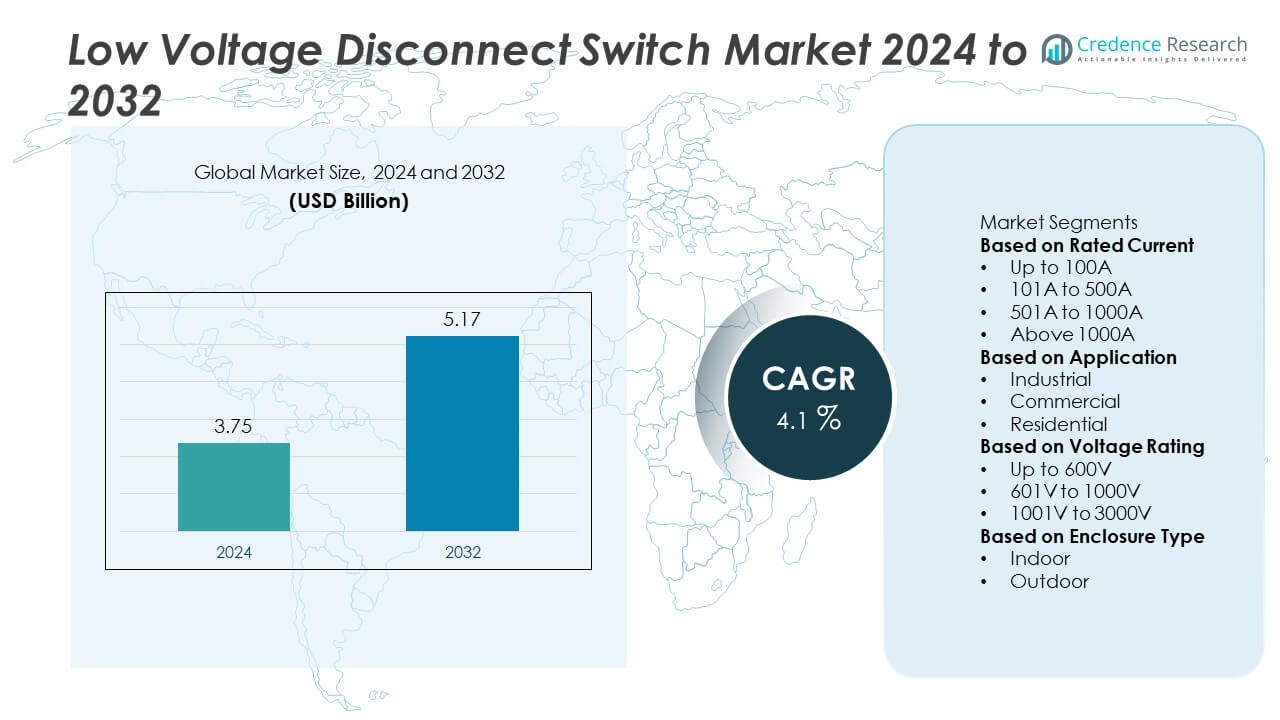
The Low Voltage Disconnect Switch Market was valued at USD 3.75 billion in 2024 and is projected to reach USD 5.17 billion by 2032, growing at a CAGR of 4.1% during the forecast period.
| REPORT ATTRIBUTE | DETAILS |
|---|---|
| Historical Period | 2020-2024 |
| Base Year | 2024 |
| Forecast Period | 2025-2032 |
| Low Voltage Disconnect Switch Market Size 2024 | USD 3.75 Billion |
| Low Voltage Disconnect Switch Market, CAGR | 4.1% |
| Low Voltage Disconnect Switch Market Size 2032 | USD 5.17 Billion |
The Low Voltage Disconnect Switch Market is driven by rising demand for safe and reliable power distribution across residential, commercial, and industrial sectors, supported by infrastructure modernization and rapid urbanization. It gains momentum from increasing integration into renewable energy projects, smart grids, and transportation networks.
The Low Voltage Disconnect Switch Market demonstrates strong geographical presence across North America, Europe, Asia Pacific, Latin America, and the Middle East & Africa, with growth shaped by infrastructure development, industrial expansion, and rising energy security needs. Asia Pacific shows high demand supported by rapid urbanization, manufacturing growth, and renewable energy deployment in countries like China and India. North America benefits from advanced electrical infrastructure, grid modernization, and strong adoption in data centers and industrial facilities, while Europe emphasizes safety compliance, sustainable energy, and compact switchgear designs. Latin America and the Middle East & Africa continue to expand with investments in construction, oil and gas, and electrification projects. Prominent players such as Siemens, Schneider Electric, Eaton Bussmann, Rockwell Automation, and Emerson strengthen their positions through product innovation, durability, and wide distribution networks, while also aligning with global trends in smart energy and renewable integration.
Market Insights
- The Low Voltage Disconnect Switch Market was valued at USD 3.75 billion in 2024 and is projected to reach USD 5.17 billion by 2032, growing at a CAGR of 4.1% during the forecast period.
- Rising demand for reliable and safe power distribution across residential, commercial, and industrial facilities drives market expansion in both developed and emerging economies.
- Trends show increasing integration of disconnect switches in renewable energy projects, smart grids, and transportation networks, along with adoption of compact and energy-efficient designs.
- Competitive dynamics are shaped by leading players such as Siemens, Schneider Electric, Eaton Bussmann, Rockwell Automation, and Emerson, who emphasize innovation, durability, and compliance with international standards.
- The market faces restraints from high compliance costs, stringent safety regulations, and competition from alternative technologies such as smart breakers and digital isolation systems.
- Asia Pacific leads demand with strong contributions from China, India, and Southeast Asia, while North America benefits from advanced infrastructure and Europe emphasizes regulatory compliance and sustainable energy.
- Latin America and the Middle East & Africa continue to present steady opportunities supported by construction projects, industrial expansion, and electrification programs, creating long-term prospects for market growth.
Market Drivers
Rising Demand for Reliable Power Distribution and Safety in Electrical Systems
The Low Voltage Disconnect Switch Market grows steadily due to increasing emphasis on safe and efficient power distribution. Industries and utilities depend on these switches to isolate circuits during maintenance and prevent electrical faults. It ensures operational safety in critical environments such as manufacturing plants, data centers, and healthcare facilities. The ability to quickly disconnect faulty sections minimizes downtime and reduces risk of equipment damage. Rising electricity consumption across residential and commercial sectors further accelerates the need for secure disconnection solutions. The Low Voltage Disconnect Switch Market continues to expand as safety remains a primary priority in modern power networks.
- For instance, Schneider Electric reported that its Square D VisiPacT heavy-duty safety switch, enhanced in June 2023, is deployed across more than 50,000 commercial and industrial sites in North America to support safe circuit isolation.
Expanding Applications Across Industrial and Commercial Sectors
Wider adoption of disconnect switches in industrial and commercial infrastructure supports market momentum. It plays a vital role in machinery protection, energy distribution panels, and renewable energy systems. The demand is increasing across sectors such as construction, transportation, and utilities where safe load isolation is essential. Growing urbanization amplifies investments in commercial complexes and industrial facilities, creating significant opportunities for reliable low voltage switches. Manufacturing processes also benefit from its ability to ensure uninterrupted and safe operations. The Low Voltage Disconnect Switch Market leverages diverse applications to strengthen its global footprint.
- For instance, Siemens launched its SENTRON ECPD in March 2024, a digital circuit protection device capable of switching electronically up to 1,000 times faster than conventional methods, with installations exceeding 10,000 units across industrial and commercial facilities within the first year.
Technological Advancements Enhancing Efficiency and Durability
The market benefits from consistent innovations aimed at improving performance, durability, and compactness of disconnect switches. It incorporates smart monitoring, arc suppression technology, and user-friendly designs to meet modern energy standards. Manufacturers invest in advanced materials and digital integration to improve reliability and reduce maintenance requirements. Technological upgrades also support compliance with stricter international safety and efficiency regulations. The integration of digital monitoring allows faster response to overloads and faults in real time. The Low Voltage Disconnect Switch Market evolves continuously as technology becomes central to operational efficiency.
Infrastructure Expansion and Renewable Energy Integration Driving Growth
Infrastructure development and renewable energy projects provide a strong platform for growth. It ensures safe disconnection in solar plants, wind farms, and distributed generation systems where voltage fluctuations pose challenges. Governments and private investors are accelerating spending on urban infrastructure, industrial parks, and energy-efficient grids, all of which require dependable switchgear. Rising investment in electrification of transport and smart city projects further increases demand for low voltage disconnect switches. Growing adoption of distributed renewable power sources amplifies the importance of efficient isolation solutions. The Low Voltage Disconnect Switch Market secures long-term relevance as infrastructure and clean energy continue to expand globally.
Market Trends
Growing Integration of Disconnect Switches in Renewable Energy Systems
The Low Voltage Disconnect Switch Market reflects rising demand from renewable energy applications such as solar and wind installations. It provides critical circuit isolation for safe operation, maintenance, and fault protection in distributed generation systems. Increasing renewable capacity in both developed and emerging economies strengthens reliance on disconnect switches for reliability. Utility-scale and rooftop solar projects integrate these devices to meet compliance and safety standards. Manufacturers focus on compact and durable designs suitable for harsh outdoor conditions. The Low Voltage Disconnect Switch Market continues to gain traction as renewable energy infrastructure expands globally.
- For instance, Siemens supplied over 15,000 units of its 3KF switch disconnectors with Sitor fuses in 2023 to protect semiconductor equipment in solar farms across Europe and Asia, each capable of handling up to 800 A at 690 V AC.
Rising Adoption of Smart and Digitally-Enabled Switchgear
Smart grid initiatives drive the incorporation of intelligent disconnect switches with remote monitoring and control features. It allows utilities and industries to improve efficiency, manage faults quickly, and enhance energy reliability. Growing focus on automation accelerates adoption of switches integrated with IoT and real-time diagnostics. These upgrades improve fault detection and reduce operational downtime in critical facilities. End-users value the combination of safety with digital connectivity in modern switchgear systems. The Low Voltage Disconnect Switch Market strengthens its position by aligning with smart infrastructure development.
- For instance, Rockwell Automation launched the FLEXLINE 3500 modular motor control center in April 2024, which incorporates smart diagnostics and supports more than 1,200 monitored connection points in a single system for real-time operations.
Sustained Demand from Industrial Modernization and Urban Expansion
Industrial modernization and rapid urbanization continue to create consistent demand for advanced disconnect solutions. It is widely deployed in commercial complexes, factories, and industrial plants where secure energy isolation is vital. Construction of smart cities, transportation hubs, and logistics centers expands the scope of adoption. Growth in residential developments with advanced electrical systems further supports integration. Continuous investment in industrial safety and reliability increases reliance on robust switchgear. The Low Voltage Disconnect Switch Market benefits from the dual push of industrial upgrades and expanding urban infrastructure.
Focus on Compact Design, Energy Efficiency, and Safety Compliance
Manufacturers respond to customer demand with smaller, energy-efficient, and more durable designs. It supports compliance with evolving international safety standards and regulatory requirements. Modern disconnect switches incorporate arc-flash protection and high mechanical endurance to improve reliability. Compact form factors also facilitate easier installation in space-constrained environments. Global emphasis on worker safety and equipment protection reinforces adoption of high-quality devices. The Low Voltage Disconnect Switch Market evolves through continuous improvements that balance efficiency, safety, and ease of operation.
Market Challenges Analysis
High Compliance Costs and Stringent Regulatory Standards Limiting Flexibility
The Low Voltage Disconnect Switch Market faces challenges from stringent safety and performance regulations across regions. Manufacturers must invest heavily in research, testing, and certification to meet evolving international standards, which raises production costs. It creates pressure on smaller players who struggle to compete with established firms that possess stronger compliance capabilities. High certification expenses often translate into increased product prices, affecting adoption in price-sensitive markets. Rapid regulatory changes in emission control, safety, and energy efficiency add complexity for global suppliers. The Low Voltage Disconnect Switch Market continues to adjust to these strict frameworks, which slow down innovation cycles and limit flexibility for new entrants.
Rising Competition from Alternative Technologies and Volatile Raw Material Costs
Growing preference for advanced switchgear technologies, such as smart circuit breakers and digital isolation devices, challenges the conventional use of disconnect switches. It reduces market opportunities in developed economies where end-users adopt integrated solutions with monitoring and automation features. Price-sensitive customers also consider substitutes when raw material costs for metals, plastics, and electrical components rise. Volatile input costs directly impact profitability and disrupt supply chains for manufacturers. Intense competition from both global leaders and regional suppliers intensifies pricing pressure. The Low Voltage Disconnect Switch Market must address these dual challenges of technological substitution and fluctuating cost structures to maintain long-term growth.
Market Opportunities
Expanding Infrastructure Projects and Renewable Energy Deployment Creating Strong Demand
The Low Voltage Disconnect Switch Market holds significant opportunities in large-scale infrastructure development and renewable energy projects. Governments and private investors continue to fund urban expansion, transportation networks, and smart city initiatives, all of which require reliable switchgear. It provides essential protection and circuit isolation in solar, wind, and distributed energy systems that are rapidly expanding worldwide. Growth in electrification of transport and modern grid upgrades further supports steady adoption. Rising demand for compact and durable devices in residential and commercial developments expands the customer base. The Low Voltage Disconnect Switch Market strengthens its relevance as global infrastructure and renewable integration accelerate.
Technological Advancements and Growing Demand for Smart Power Systems
Opportunities also emerge from integrating smart features and energy-efficient designs into modern disconnect switches. It benefits from innovations such as IoT connectivity, real-time monitoring, and advanced arc-flash protection, which enhance operational safety and efficiency. Industrial users value intelligent devices that support predictive maintenance and reduce downtime. Growing reliance on automation in manufacturing and commercial facilities creates further potential for adoption. Demand for compact, easy-to-install, and compliance-ready devices continues to expand across diverse industries. The Low Voltage Disconnect Switch Market positions itself strongly by aligning with technological upgrades and smart power system requirements.
Market Segmentation Analysis:
By Rated Current
The Low Voltage Disconnect Switch Market is segmented by rated current into categories that support diverse operational requirements across industries and commercial facilities. Lower-rated switches, often below 100 A, are widely used in residential and light commercial applications where loads are relatively small and safety remains a priority. Medium-rated switches in the range of 100 A to 400 A cater to retail, office buildings, and small industrial plants, offering robust protection for moderate electrical loads. High-rated switches above 400 A find strong demand in heavy industrial facilities, data centers, and utility operations where continuous power supply and circuit safety are critical. It ensures scalability across sectors by providing current ratings that align with energy distribution needs. The flexibility of rated current segmentation positions the Low Voltage Disconnect Switch Market as a versatile solution across multiple industries.
- For instance, Eaton Bussmann supplied more than 8,000 disconnect switch units rated between 100 A and 400 A to industrial customers in North America in 2023, with each unit designed to handle demanding operational loads in factory environments.
By Application
The market demonstrates broad adoption across residential, commercial, and industrial applications. In residential environments, low voltage disconnect switches safeguard households from overloads and ensure easy isolation during maintenance or emergency conditions. Commercial facilities such as shopping malls, hospitals, and data centers rely on it to manage energy distribution safely and reduce downtime risks. Industrial operations, including manufacturing plants, logistics hubs, and oil and gas projects, employ disconnect switches to secure heavy equipment and prevent power faults. Growing demand for safe electrical infrastructure in emerging economies further strengthens this segment. The Low Voltage Disconnect Switch Market supports critical operations across these diverse applications by ensuring reliability and safety.
- For instance, Hubbell introduced its PRO Motor Disconnect Switches in July 2025 in 30 A, 60 A, and 100 A variants, delivering IP67-rated durability tailored for both indoor and outdoor light industrial and commercial use.
By Voltage Rating
Segmentation by voltage rating highlights the importance of product customization to match different power distribution networks. Low voltage disconnect switches with ratings up to 240 V are widely used in residential and small office environments where electricity needs are limited but safety is crucial. Devices rated between 240 V and 690 V serve commercial buildings, renewable installations, and mid-size industrial facilities that demand consistent and secure load management. Higher-rated products above 690 V cater to larger industrial plants, mining operations, and utility infrastructure, ensuring safety in high-demand environments. It maintains a strong position by offering voltage flexibility to meet varying customer requirements. The Low Voltage Disconnect Switch Market grows steadily as voltage segmentation supports both basic and advanced power distribution needs.
Segments:
Based on Rated Current
- Up to 100A
- 101A to 500A
- 501A to 1000A
- Above 1000A
Based on Application
- Industrial
- Commercial
- Residential
Based on Voltage Rating
- Up to 600V
- 601V to 1000V
- 1001V to 3000V
Based on Enclosure Type
- Indoor
- Outdoor
Based on the Geography:
- North America
- U.S.
- Canada
- Mexico
- Europe
- UK
- France
- Germany
- Italy
- Spain
- Russia
- Belgium
- Netherlands
- Austria
- Sweden
- Poland
- Denmark
- Switzerland
- Rest of Europe
- Asia Pacific
- China
- Japan
- South Korea
- India
- Australia
- Thailand
- Indonesia
- Vietnam
- Malaysia
- Philippines
- Taiwan
- Rest of Asia Pacific
- Latin America
- Brazil
- Argentina
- Peru
- Chile
- Colombia
- Rest of Latin America
- Middle East
- UAE
- KSA
- Israel
- Turkey
- Iran
- Rest of Middle East
- Africa
- Egypt
- Nigeria
- Algeria
- Morocco
- Rest of Africa
Regional Analysis
North America
North America accounts for around 27% of the Low Voltage Disconnect Switch Market, driven by strong adoption across industrial, commercial, and residential applications. The region benefits from advanced electrical infrastructure, frequent upgrades in power distribution systems, and regulatory focus on safety compliance. The United States leads demand with widespread use in data centers, healthcare facilities, and manufacturing plants where uninterrupted power and secure load isolation are critical. Canada contributes significantly due to increasing investments in renewable energy integration and grid modernization projects. It also gains momentum from adoption in residential and commercial sectors where energy safety remains a priority. Strong presence of global players such as Eaton and ABB further consolidates market growth in the region. North America’s steady demand reflects a mature yet innovation-driven environment that continues to strengthen the Low Voltage Disconnect Switch Market.
Europe
Europe holds nearly 23% of the market, supported by strict regulations and advanced power distribution standards across the region. Countries such as Germany, France, and the United Kingdom are key contributors, with consistent investments in industrial safety and energy-efficient systems. Demand is also strong in Eastern European countries where infrastructure modernization remains a priority. It aligns with the region’s focus on reducing risks of electrical faults, promoting sustainable energy, and ensuring compliance with stringent EU regulations. Renewable energy installations, particularly wind and solar, increase the need for reliable low voltage disconnect switches to ensure system protection. Major European manufacturers emphasize compact designs and arc-flash protection to enhance operational safety. Europe continues to represent a competitive yet highly regulated landscape for the Low Voltage Disconnect Switch Market.
Asia Pacific
Asia Pacific dominates the global market with approximately 34% share, reflecting rapid industrialization, urbanization, and infrastructure expansion. Countries such as China, India, Japan, and South Korea drive strong demand for reliable switchgear to support manufacturing growth, commercial projects, and residential expansion. It plays a crucial role in ensuring safe power distribution in regions where grid reliability is often inconsistent. The renewable energy boom in China and India accelerates the adoption of low voltage disconnect switches in solar and wind projects. Southeast Asian countries including Indonesia, Vietnam, and Malaysia further contribute by investing in power infrastructure and smart city initiatives. Affordable production capabilities and growing demand across diverse sectors cement Asia Pacific as the leading contributor to the Low Voltage Disconnect Switch Market.
Latin America
Latin America represents around 9% of the market, supported by infrastructure development and rising demand for energy security. Brazil, Mexico, and Argentina remain primary markets due to ongoing investments in industrial parks, commercial buildings, and power distribution projects. It provides essential protection in regions with frequent electricity instability, supporting both households and small-scale industries. Growth in mining and oil and gas activities across the region further fuels adoption of robust disconnect switches. Governments continue to push rural electrification initiatives, which enhance demand for safe and affordable low voltage solutions. Latin America presents steady opportunities for the Low Voltage Disconnect Switch Market as modernization and energy infrastructure projects expand.
Middle East & Africa
The Middle East & Africa accounts for nearly 7% of the global Low Voltage Disconnect Switch Market, with demand shaped by infrastructure growth and off-grid energy needs. In the Middle East, the construction boom in countries such as the UAE and Saudi Arabia drives demand across commercial complexes, airports, and transportation projects. Africa’s share is primarily influenced by growing electrification programs in Nigeria, Egypt, and South Africa, where disconnect switches provide reliable safety in unstable grid conditions. It finds further applications in oil and gas projects and industrial facilities across the region. Seasonal reliance on backup power during extreme weather also enhances usage in both commercial and residential environments. The market continues to gain ground in this region as energy security and infrastructure development remain critical priorities.
Key Player Analysis
- Rockwell Automation
- Hubbell
- Schneider Electric
- Carlon
- Siemens
- Stanley Black Decker
- Eaton Bussman
- Emerson
- Erico International
- Leviton
Competitive Analysis
The competitive landscape of the Low Voltage Disconnect Switch Market is shaped by global leaders focusing on product innovation, regulatory compliance, and expanded distribution to meet diverse customer needs. Key players such as Siemens, Schneider Electric, Eaton Bussmann, Rockwell Automation, Emerson, Leviton, Hubbell, Erico International, Carlon, and Stanley Black Decker dominate through their strong brand presence and technological expertise. These companies invest in compact, durable, and energy-efficient designs that align with international safety standards and evolving energy infrastructure requirements. Siemens and Schneider Electric lead with advanced switchgear solutions integrated into smart grids and renewable projects, while Eaton Bussmann and Rockwell Automation emphasize efficiency and durability in industrial environments. Emerson and Hubbell expand their reach by focusing on reliable solutions for commercial and residential applications, whereas Leviton and Carlon strengthen their portfolios with cost-effective, easy-to-install devices. Competition remains intense as each company targets digital integration, sustainability, and strategic partnerships to retain relevance and capture growth in a market increasingly driven by safety, efficiency, and smart power systems.
Recent Developments
- In June 2025, Leviton launched its Enclosed Main Breaker Disconnect, designed to comply with NEC 2020 requirements for an exterior residential emergency disconnect, available with or without a 200 A main breaker.
- In April 2024, the company launched the FLEXLINE 3500 modular motor control center at Hannover Messe. This MCC integrates smart diagnostics, real-time operations, and IEC 61439-1&2-compliant motor control and power distribution systems.
- In March 2024, Siemens revealed its cutting-edge SENTRON ECPD (Electronic Circuit Protection Device), offering electronic switching up to 1,000 times faster than conventional methods and reducing space requirements in distribution setups by up to 80%
- In June 2023, Schneider Electric unveiled an enhanced version of its Square D VisiPacT heavy duty safety switch (30–200 A). The revamped model features a viewing window for visual verification, ergonomic handles compatible with hook sticks, QR codes for instant access to technical information, and touch-safe barriers.
Market Concentration & Characteristics
The Low Voltage Disconnect Switch Market demonstrates moderate concentration, with a balance between global manufacturers and regional suppliers competing across diverse applications. Leading players focus on innovation, safety compliance, and digital integration to strengthen their portfolios, while regional companies emphasize affordability and accessibility to capture price-sensitive segments. It reflects strong competition driven by evolving infrastructure needs, renewable integration, and stricter regulatory standards that demand continuous product upgrades. The market shows fragmented characteristics in emerging economies where low-cost solutions gain traction, while advanced economies prioritize compact, durable, and digitally enabled switchgear. It supports widespread adoption across residential, commercial, and industrial sectors due to versatility, ease of installation, and critical role in ensuring circuit safety. The Low Voltage Disconnect Switch Market continues to evolve as technological advancements, sustainability initiatives, and urban infrastructure projects define both growth opportunities and competitive dynamics.
Report Coverage
The research report offers an in-depth analysis based on Rated Current, Application, Voltage Rating, Enclosure Type and Geography. It details leading market players, providing an overview of their business, product offerings, investments, revenue streams, and key applications. Additionally, the report includes insights into the competitive environment, SWOT analysis, current market trends, as well as the primary drivers and constraints. Furthermore, it discusses various factors that have driven market expansion in recent years. The report also explores market dynamics, regulatory scenarios, and technological advancements that are shaping the industry. It assesses the impact of external factors and global economic changes on market growth. Lastly, it provides strategic recommendations for new entrants and established companies to navigate the complexities of the market.
Future Outlook
- Demand for low voltage disconnect switches will increase with further expansion of renewable energy systems requiring safe circuit isolation.
- Smart grid transition will drive demand for disconnect switches featuring remote control and real-time diagnostics.
- Manufacturers will emphasize compact and modular designs to meet installation needs in urban and space-constrained environments.
- Industrial automation growth will sustain demand for more advanced disconnect switches in manufacturing and logistics sectors.
- Rising adoption in telecom and data center infrastructure will support steady market growth for reliable isolation solutions.
- Electrification of remote and off-grid regions will drive uptake of durable, cost-effective disconnect switches in developing economies.
- Regulatory emphasis on electrical safety and fault prevention will spur technology upgrades and product reliability improvements.
- Transition to digital protection systems will create room for disconnect switches with integrated IoT sensing and smart features.
- Growing interest in microgrids and distributed energy resources will embed disconnect switches as essential isolation components.
- Infrastructure resilience initiatives and urbanization efforts in Asia Pacific and Latin America will expand market demand for affordable disconnect solutions.

Request a Free Sample
Fill in your details and we'll send you a free sample report.
- Sample data tables & charts
- Research methodology
Market Dynamics
Emphasis on Electrical Safety and Reliable Power Distribution
Growing concerns over electrical safety and the need for reliable circuit isolation in residential, commercial, and industrial environments are driving adoption of low voltage disconnect switches. These devices are critical for preventing electrical faults, minimizing downtime, and ensuring safe maintenance procedures.
Infrastructure Modernization and Urbanization
Rapid urbanization and ongoing infrastructure upgrades, especially in Asia Pacific and emerging markets, are increasing the demand for advanced power distribution systems. Low voltage disconnect switches are essential components in new construction, smart city projects, and modernized grid networks.
Integration with Renewable Energy and Smart Grids
The expansion of renewable energy installations such as solar and wind farms, along with the development of smart grids, requires reliable disconnect switches for safe circuit isolation and compliance with safety standards. This trend is accelerating market growth as distributed generation becomes more prevalent.
Technological Advancements and Digitalization
Innovations such as smart monitoring, IoT integration, and compact, energy-efficient designs are enhancing the performance and appeal of low voltage disconnect switches. These advancements support predictive maintenance, real-time diagnostics, and compliance with stricter international regulations, further boosting market adoption.
Industrial Automation and Expansion of Data Centers
The rise of industrial automation and the proliferation of data centers demand robust and reliable disconnect solutions to ensure uninterrupted operations and equipment protection. This sector-specific growth is fueling steady demand for advanced low voltage disconnect switches.
Need a Custom Version of This Report?
Tailor the scope, geography, or segments to your exact requirements.
- Custom geography or segment scope
- Direct access to our analyst team
Frequently Asked Questions
What is the current market size for Low Voltage Disconnect Switch, and what is its projected size in 2032?
At what Compound Annual Growth Rate is the Low Voltage Disconnect Switch market projected to grow between 2025 and 2032?
Which Low Voltage Disconnect Switch market segment held the largest share in 2024?
What are the primary factors fueling the growth of the Low Voltage Disconnect Switch market?
Who are the leading companies in the Low Voltage Disconnect Switch market?
Which region commanded the largest share of the Low Voltage Disconnect Switch market in 2024?
Table of Content
Chapter 1 Market Segmentation
- 1.1 Segmentation Framework
- 1.1.1 Product and Service Classification
- 1.1.2 Application and End-Use Classification
- 1.1.3 Technology and Solution Classification
- 1.1.4 Customer and Distribution Channel Classification
- 1.1.5 Geographic Segmentation
- 1.1.6 Market Segment Definitions and Boundaries
- 1.2 By Application
- 1.2.1 Industrial
- 1.2.2 Commercial
- 1.2.3 Residential
- 1.3 By Rated Current
- 1.3.1 Up to 100A
- 1.3.2 101A to 500A
- 1.3.3 501A to 1000A
- 1.3.4 Above 1000A
- 1.4 By Enclosure Type
- 1.4.1 Indoor
- 1.4.2 Outdoor
- 1.5 By Voltage Rating
- 1.5.1 Up to 600V
- 1.5.2 601V to 1000V
- 1.5.3 1001V to 3000V
Chapter 2 Introduction
- 2.1 Report Objectives and Scope
- 2.2 Product Definition and Industry Terminology
- 2.3 Market Inclusions and Exclusions
- 2.4 Research Process
- 2.4.1 Primary Research and Expert Interviews
- 2.4.2 Secondary Research and Source Review
- 2.4.3 Top-Down and Bottom-Up Estimation
- 2.4.4 Data Triangulation and Verification
- 2.5 Market Size Measurement Basis
- 2.5.1 2024: USD 3.75 billion → 2032: USD 5.17 billion
- 2.6 Historical and Forecast Reference Periods
- 2.6.1 Base Year: 2024
- 2.6.2 Forecast Period: 2024-2032
- 2.7 Research Assumptions and Limitations
Chapter 3 Executive Summary
- 3.1 Market Snapshot and Key Findings
- 3.2 Base-Year Market Size, 2024
- 3.3 Forecast Market Size, 2032
- 3.4 Revenue and Volume Growth Outlook
- 3.5 Key Demand and Supply Indicators
- 3.6 Leading Market Segments
- 3.7 Fastest-Growing Market Opportunities
- 3.8 Regional Performance Highlights
- 3.9 Technology and Industry Transformation
- 3.10 Competitive Landscape Summary
- 3.11 Analyst View and Strategic Implications
Chapter 4 Global Low Voltage Disconnect Switch Market Trends and Developments
- 4.1 Historical Industry Development
- 4.2 Recent Market Trends and Developments
- 4.3 Demand and Customer Behavior Trends
- 4.4 Technology and Product Innovation
- 4.5 Artificial Intelligence, Automation and Digitalization
- 4.6 Local Manufacturing and Supply Chain Realignment
- 4.7 Industry Partnerships, Mergers and Acquisitions
- 4.8 Sustainability and Circular Economy Developments
- 4.9 Government and Private Sector Investment Trends
- 4.10 Emerging Business Models and Commercialization
- 4.11 Industry Developments and Announcements
Chapter 5 Global Low Voltage Disconnect Switch Market Production, Supply and Demand Analysis
- 5.1 Demand Trend and Consumption Analysis
- 5.2 Demand Forecast, 2024-2032
- 5.3 Production and Output Trend
- 5.4 Production and Output Forecast, 2024-2032
- 5.5 Installed Capacity and Capacity Utilization
- 5.6 Company-Wise Production Plants and Statistics
- 5.6.1 Installed Production Capacity
- 5.6.2 Actual Production
- 5.6.3 Planned Capacity and Expansion Targets
- 5.7 Supply Chain Structure and Procurement Trends
- 5.8 Supply-Demand Gap and Bottlenecks
- 5.9 Import Dependence and Sourcing Structure
- 5.10 Contract Manufacturing and Outsourcing
- 5.11 Regional Supply and Demand Concentration
Chapter 6 Global Low Voltage Disconnect Switch Market Pricing Analysis
- 6.1 Pricing Structure and Measurement
- 6.2 Historical Pricing Trends
- 6.3 Pricing Outlook, 2024-2032
- 6.4 Average Selling Price and Unit Economics
- 6.5 Pricing by Product and Market Segment
- 6.6 Geographic Pricing Differences
- 6.7 Key Input, Energy, Labor and Logistics Costs
- 6.8 Contract Pricing and Purchasing Models
- 6.9 Pricing Sensitivity and Competitive Positioning
- 6.10 Price, Margin and Profitability Implications
Chapter 7 Global Low Voltage Disconnect Switch Market Dynamics
- 7.1 Market Growth Drivers
- 7.1.1 Demand-Side Drivers
- 7.1.2 Technology and Innovation Drivers
- 7.1.3 Infrastructure and Investment Drivers
- 7.1.4 Regulatory and Policy Drivers
- 7.2 Market Restraints
- 7.2.1 Cost and Affordability Constraints
- 7.2.2 Technology and Adoption Barriers
- 7.2.3 Supply Chain and Operational Constraints
- 7.3 Market Challenges
- 7.3.1 Competitive Pressure and Margin Erosion
- 7.3.2 Skills, Infrastructure and Implementation Gaps
- 7.4 Emerging Market Opportunities
- 7.5 Market Dynamics Impact and Time-Horizon Assessment
Chapter 8 Global Low Voltage Disconnect Switch Value Chain Analysis
- 8.1 Industry Value Chain Overview
- 8.2 Upstream Suppliers and Critical Inputs
- 8.3 Technology and Component Providers
- 8.4 Manufacturing or Service Delivery
- 8.5 Distribution, Channel Partners and Integrators
- 8.6 Downstream Applications and End Users
- 8.7 Value Addition and Profit Pools
- 8.8 Vertical Integration and Outsourcing
- 8.9 Supplier Concentration and Risk
- 8.10 Supply Chain Localization and Resilience
Chapter 9 Global Low Voltage Disconnect Switch Market Regulations and Policies
- 9.1 Relevant Laws, Standards and Compliance Frameworks
- 9.2 Product, Service, Safety and Quality Requirements
- 9.3 Government Policies, Incentives and Subsidies
- 9.4 Imports, Exports and Trade Barriers
- 9.5 Public Procurement and Local Content Requirements
- 9.6 Environmental and Sustainability Compliance
- 9.7 Upcoming Policy Changes and Market Implications
Chapter 10 Global Low Voltage Disconnect Switch Market Hotspots and Opportunities
- 10.1 Market Opportunity Mapping and Growth Hotspots
- 10.2 High-Growth Applications and Customer Groups
- 10.3 Underserved Markets and White-Space Opportunities
- 10.4 Emerging Technology and Product Opportunities
- 10.5 New Capacity and Investment Hotspots
- 10.6 Market Entry and Expansion Opportunities
- 10.7 Distribution and Partnership Opportunities
- 10.8 Near-Term and Long-Term Commercial Potential
- 10.9 Opportunity Attractiveness and Execution Risks
Chapter 11 Global Low Voltage Disconnect Switch Market Outlook, 2024-2032
- 11.1 Market Size and Analysis
- 11.1.1 Revenue (Market Measurement: 2024: USD 3.75 billion → 2032: USD 5.17 billion)
- 11.1.2 Market Volume and Quantity Sold
- 11.1.3 Historical Market Size
- 11.1.4 Base-Year Market Size, 2024
- 11.2 Market Forecast, 2024-2032
- 11.2.1 Revenue Forecast to 2032
- 11.2.2 Volume Forecast to 2032
- 11.2.3 CAGR and Year-on-Year Growth
- 11.2.4 Incremental Revenue Opportunity
- 11.3 Forecast Assumptions and Scenario Analysis
- 11.3.1 Base-Case Forecast
- 11.3.2 Optimistic and Conservative Scenarios
- 11.3.3 Technology, Pricing and Policy Sensitivities
- 11.4 Market Attractiveness and Growth Outlook
Chapter 12 Global Low Voltage Disconnect Switch Market Segmentation and Outlook
- 12.1 Segmentation Summary and Market Shares, 2024
- 12.2 Largest and Fastest-Growing Segments
- 12.3 By Application - Market Size and Forecast, 2024-2032
- 12.3.1 Segment Definition and Scope
- 12.3.2 Historical Market Size
- 12.3.3 Revenue Forecast, 2024-2032
- 12.3.4 Volume Forecast, 2024-2032
- 12.3.5 Base-Year Market Share, 2024
- 12.3.6 Segment CAGR and Growth Drivers
- 12.3.7 Subsegment Market Size and Forecast
- 12.3.7.1 Industrial
- 12.3.7.2 Commercial
- 12.3.7.3 Residential
- 12.3.8 Subsegment Pricing and Adoption Trends
- 12.3.9 Leading Suppliers and Competition
- 12.3.10 Regional Demand and Opportunities
- 12.4 By Rated Current - Market Size and Forecast, 2024-2032
- 12.4.1 Segment Definition and Scope
- 12.4.2 Historical Market Size
- 12.4.3 Revenue Forecast, 2024-2032
- 12.4.4 Volume Forecast, 2024-2032
- 12.4.5 Base-Year Market Share, 2024
- 12.4.6 Segment CAGR and Growth Drivers
- 12.4.7 Subsegment Market Size and Forecast
- 12.4.7.1 Up to 100A
- 12.4.7.2 101A to 500A
- 12.4.7.3 501A to 1000A
- 12.4.7.4 Above 1000A
- 12.4.8 Subsegment Pricing and Adoption Trends
- 12.4.9 Leading Suppliers and Competition
- 12.4.10 Regional Demand and Opportunities
- 12.5 By Enclosure Type - Market Size and Forecast, 2024-2032
- 12.5.1 Segment Definition and Scope
- 12.5.2 Historical Market Size
- 12.5.3 Revenue Forecast, 2024-2032
- 12.5.4 Volume Forecast, 2024-2032
- 12.5.5 Base-Year Market Share, 2024
- 12.5.6 Segment CAGR and Growth Drivers
- 12.5.7 Subsegment Market Size and Forecast
- 12.5.7.1 Indoor
- 12.5.7.2 Outdoor
- 12.5.8 Subsegment Pricing and Adoption Trends
- 12.5.9 Leading Suppliers and Competition
- 12.5.10 Regional Demand and Opportunities
- 12.6 By Voltage Rating - Market Size and Forecast, 2024-2032
- 12.6.1 Segment Definition and Scope
- 12.6.2 Historical Market Size
- 12.6.3 Revenue Forecast, 2024-2032
- 12.6.4 Volume Forecast, 2024-2032
- 12.6.5 Base-Year Market Share, 2024
- 12.6.6 Segment CAGR and Growth Drivers
- 12.6.7 Subsegment Market Size and Forecast
- 12.6.7.1 Up to 600V
- 12.6.7.2 601V to 1000V
- 12.6.7.3 1001V to 3000V
- 12.6.8 Subsegment Pricing and Adoption Trends
- 12.6.9 Leading Suppliers and Competition
- 12.6.10 Regional Demand and Opportunities
- 12.7 Segment Growth Comparison
- 12.8 Segment Attractiveness and Priority Matrix
Chapter 13 Global Low Voltage Disconnect Switch End-Use and Application Market Outlook
- 13.1 End-Use Industry and Customer Demand Structure
- 13.2 Leading Applications and Customer Groups
- 13.3 End-Use Market Size, Share and Forecast
- 13.4 Major End-Use Industry Deep Dives
- 13.4.1 Customer Requirements and Use Cases
- 13.4.2 Demand and Replacement Cycles
- 13.4.3 Technical and Regulatory Considerations
- 13.4.4 Purchasing and Procurement Models
- 13.4.5 Leading Vendors and Distribution Channels
- 13.4.6 Forecast and Commercial Opportunities
- 13.5 Emerging Applications and Cross-Segment Demand
- 13.6 End-Use Industry Investment Priorities
Chapter 14 Global Low Voltage Disconnect Switch Geographic Market Outlook, 2024-2032
- 14.1 Regional Market Size and Share, 2024
- 14.2 Regional Market Forecast, 2024-2032
- 14.3 Regional Pricing, Production and Demand Differences
- 14.4 North America
- 14.4.1 United States
- 14.4.2 Canada
- 14.4.3 Mexico
- 14.5 Europe
- 14.5.1 Germany
- 14.5.2 France
- 14.5.3 Italy
- 14.5.4 United Kingdom
- 14.5.5 Spain
- 14.5.6 Poland
- 14.5.7 Russia
- 14.5.8 Netherlands
- 14.5.9 Belgium
- 14.5.10 Sweden
- 14.5.11 Denmark
- 14.5.12 Norway
- 14.5.13 Rest of Europe
- 14.6 Asia Pacific
- 14.6.1 China
- 14.6.2 India
- 14.6.3 Japan
- 14.6.4 South Korea
- 14.6.5 Thailand
- 14.6.6 Indonesia
- 14.6.7 Vietnam
- 14.6.8 Malaysia
- 14.6.9 Australia
- 14.6.10 Rest of Asia Pacific
- 14.7 Latin America
- 14.7.1 Brazil
- 14.7.2 Argentina
- 14.7.3 Colombia
- 14.7.4 Chile
- 14.7.5 Rest of Latin America
- 14.8 Middle East
- 14.8.1 Saudi Arabia
- 14.8.2 United Arab Emirates
- 14.8.3 Turkey
- 14.8.4 Israel
- 14.8.5 Iran
- 14.8.6 Rest of the Middle East
- 14.9 Africa
- 14.9.1 South Africa
- 14.9.2 Egypt
- 14.9.3 Nigeria
- 14.9.4 Morocco
- 14.9.5 Rest of Africa
- 14.10 Regional Investment, Policy and Supply Chain Differences
- 14.11 Regional Competitive Landscape
- 14.12 Geographic Growth Hotspots
Chapter 15 Global Low Voltage Disconnect Switch Technology, Innovation and Sustainability Outlook
- 15.1 Technology Landscape and Maturity
- 15.2 Product, Process and Service Innovation
- 15.3 AI, Automation and Digital Tools in the Industry
- 15.4 Technology Adoption and Performance Benchmarking
- 15.5 Innovation Pipeline and R&D Investment
- 15.6 Patent and Intellectual Property Trends
- 15.7 Energy Efficiency and Resource Management
- 15.8 Sustainability, Recycling and Circularity
- 15.9 Technology Roadmap, 2024-2032
- 15.10 Risks of Obsolescence and Technology Substitution
Chapter 16 Global Low Voltage Disconnect Switch Market Key Strategic Imperatives
- 16.1 Growth and Market Entry Priorities
- 16.2 High-Return Products and Segments
- 16.3 Pricing, Profitability and Cost Optimization
- 16.4 Technology Investment and Product Differentiation
- 16.5 Supply Chain Localization and Resilience
- 16.6 Distribution and Customer Acquisition
- 16.7 Partnership, Acquisition and Capacity Strategy
- 16.8 Regional Expansion Priorities
- 16.9 Short-, Medium- and Long-Term Actions
Chapter 17 Competition Outlook
- 17.1 Industry Competition Characteristics
- 17.2 Market Structure and Concentration
- 17.3 Market Share and Competitive Positioning, 2024
- 17.4 Company-Wise Revenue and Product Benchmarking
- 17.5 Production and Service Capacity Benchmarking
- 17.6 Technology, Pricing and Differentiation
- 17.7 Regional Footprint and Distribution Strength
- 17.8 Mergers, Acquisitions and Strategic Alliances
- 17.9 New Entrants and Competitive Threats
- 17.10 Porter's Five Forces and Industry Attractiveness
- 17.11 Competitive Outlook, 2024-2032
Chapter 18 Company Profiles
- 18.1 Company Coverage and Selection Criteria
- 18.2 Siemens
- 18.2.1 Business Description
- 18.2.2 Company Ownership and Geographic Presence
- 18.2.3 Product and Service Portfolio
- 18.2.4 Manufacturing and Operating Footprint
- 18.2.5 Production Capacity and Expansion Plans
- 18.2.6 Financial Performance and Investment
- 18.2.7 Market Share and Competitive Position
- 18.2.8 Technology and Innovation Capabilities
- 18.2.9 Strategic Alliances or Partnerships
- 18.2.10 Recent Developments
- 18.2.11 Growth Strategy and Outlook
- 18.3 Schneider Electric
- 18.4 Eaton Bussmann
- 18.5 Rockwell Automation
- 18.6 Emerson
- 18.7 Leviton
- 18.8 Hubbell
- 18.9 Erico International
- 18.10 Carlon
- 18.11 Stanley Black Decker
- 18.12 Other Relevant Market Participants
Note: Every listed company is profiled on the structure shown under the first company. The company list is preliminary and may change based on research findings, market developments, data availability and client requirements.
Chapter 19 Disclaimer
- 19.1 Research and Forecast Disclaimer
- 19.2 Data Source and Estimation Limitations
Note: The depth of individual sections depends on data availability for this market. Volume, capacity, trade and other unit-based metrics are included where applicable.

