
| REPORT ATTRIBUTE | DETAILS |
|---|---|
| Historical Period | 2019-2022 |
| Base Year | 2023 |
| Forecast Period | 2024-2032 |
| Smart Grid Market Size 2023 | USD 44512.2 Million |
| Smart Grid Market, CAGR | 19.50% |
| Smart Grid Market Size 2032 | USD 221202.5 Million |
Market Insights
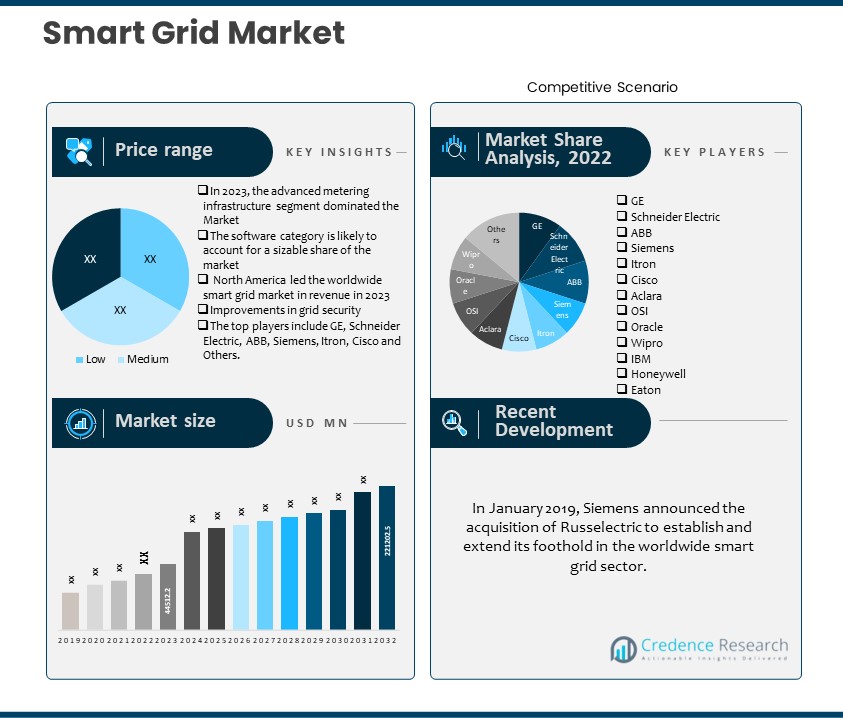
- The global demand for Smart Grid was valued at USD 44512.2 Million in 2023 and is expected to reach USD 221202.5 Million in 2032, growing at a CAGR of 19.50% between 2024 and 2032.
- The software category is projected to account for a substantial share of the industry, while the hardware sector is predicted to develop as governments throughout the world
- In 2023, the advanced metering infrastructure sector dominated the global smart grid market, while distribution is likely to be the most opportunistic category over the forecast time.
- The government and public sectors are predicted to grow greatly, while the Residential Customers sector is projected to rise.
- North America dominated the global smart grid market in revenue in 2023, with Asia-Pacific projected to develop at the quickest CAGR between 2023 and 2032.
- Increased demand for energy-efficient products propels market expansion.
- High costs of adopting smart grid technology solutions are projected to impede industry expansion.
Executive Summary
Market Definition
A Smart Grid is an electrical grid with advanced automation, communication, IT, and IOT systems that can control power flow or curb load to match generation and monitor power flows from generation to consumption in real-time or near real-time. It can be accomplished by developing efficient transmission and distribution systems, system operations, consumer integration, and renewable integration. Smart grid solutions aid in the real-time monitoring, measurement, and management of power flows, which can help to identify losses and take appropriate technical and administrative actions to mitigate them.
Market Overview
The global Smart Grid Market has witnessed steady growth in recent years and is expected to grow at a CAGR of 19.50% between 2024 and 2032. The market was valued at USD 44512.2 million in 2023 and is expected to reach USD 221202.5 million in 2032.
The smart grid uses technologies to detect faults and facilitate the network's automatic self-healing during power outages. The entire smart grid system consists of enhanced controls with new technologies, computers, automation, and gear designed to improve operational performance. Furthermore, these systems are designed to overcome the limits of old and conventional electric grids, which use more energy. Furthermore, the growing requirement to digitize the energy and power sectors, as well as the widespread need to upgrade electric infrastructures, are expected to have a beneficial impact on this industry.
The development is typically led by one of two major ideas for improving electric power connections for both users and utilities: the European Union and the United States models. The European Union's vision appears to be primarily driven by environmental concerns, whereas US planning has been mostly motivated by a need for increased reliability. In the United States, desirable smart grid features include distribution power architectures and self-healing transmission that are resistant to deliberate attacks and natural disasters, as well as very high power quality levels and a wide range of metrics that go beyond outage numbers.
Segmentation By Component
- The software category is likely to account for a sizable share of the market due to increased efforts to modernize the power grid and reduce T&D losses.
- In addition, the hardware market is predicted to develop as governments throughout the world take measures to install smart electricity meters in their respective countries.
Segmentation by Technology
- In 2023, the advanced metering infrastructure segment dominated the worldwide smart grid market in terms of revenue. This is due to the growing implementation of smart meters around the globe. Smart meters offer a consistent, reliable, and efficient power supply, which promotes market growth.
- On the other hand, the distribution is expected to be the most opportunistic segment during the projected period. The increasing adoption of cloud computing and advances in management systems are driving the expansion of this category.
Segmentation by End-User
- The government and public sectors are likely to grow significantly when grid technologies are deployed. Furthermore, the government's favorable policies and fiscal incentives are likely to stimulate strong growth in the corporate sector.
- The Residential Customers sector is expected to rise due to increased awareness of the benefits of these technologies, such as lower energy usage and cost savings for end-users.
Segmentation by Region
- North America led the worldwide smart grid market in revenue in 2023.
- Asia-Pacific is expected to grow at the fastest CAGR between 2023 and 2032.
- The rest of the world, including Latin America, the Middle East, and Africa, supplies the remaining demand for Smart Grid.
North America dominated the global smart grid market in terms of revenue in 2023, and it is expected to maintain its dominance during the forecast period. Countries such as the United States and Canada have seen a rise in government concentration on developing appropriate and supporting regulatory frameworks for the region's adoption of smart grid technology. The region's early adoption of the smart grid, owing to improved economic strength, has fueled the expansion of the smart grid market in North America, with the region emerging as a market leader.
Moreover, The Asia-Pacific smart grid market is predicted to develop at the quickest CAGR between 2023 and 2032. This is owing to the widespread use of these technologies and a strong emphasis on the expansion of renewable energy. Furthermore, China's smart grid market had the highest market share, while India's smart grid market was the fastest-growing in the Asia-Pacific region.
Key Highlights of the Report
Component, Technology, End-User, and Region segment the global Smart Grid Market. The software category is expected to account for a large share of the market, and by 2023, the advanced metering infrastructure segment will lead the global smart grid market. In addition, the government and public sectors are expected to increase significantly and North America, leading the market growth.
The market is being driven by increased integration of renewable energy, a greater emphasis on energy efficiency, and the implementation of advanced metering infrastructure. Furthermore, high initial investment costs, data privacy and security issues, and regulatory constraints are major market barriers. Moroever, the integration of IoT technologies, the development of microgrids, and the expansion of electric car charging infrastructure are significant opportunities for the industry.
North America dominated the worldwide smart grid market in terms of revenue in 2023, and this dominance is likely to continue during the forecast period. Moreover, the Asia-Pacific smart grid market is expected to grow at the fastest CAGR between 2023 and 2032 due to the widespread use of these technologies and a significant emphasis on expanding renewable energy.
What Are The Main Drivers Of The Global Smart Grid Market?
The Smart Grid Market is being pushed by the increased integration of renewable energy sources, which is a critical component in the transition to a more sustainable energy landscape. Furthermore, there is an increasing emphasis on energy efficiency, which encourages both utilities and consumers to optimize their energy consumption. The use of modern metering infrastructure is also moving the industry forward by allowing for more effective monitoring and management of energy consumption.
What Are The Major Challenges Faced By The Global Smart Grid Market?
However, constraints like as high initial investment costs, worries about data privacy and security, and navigating complex regulatory frameworks impede industry expansion.
What Are The Growth Opportunities In The Global Smart Grid Market?
There are numerous opportunities in the Smart Grid Market, particularly in the integration of IoT technologies to improve grid operations, the development of microgrids for localized energy distribution, and the expansion of electric vehicle charging infrastructure to support the increasing adoption of electric vehicles.
Market Drivers
Several factors drive the global Smart Grid Market. The following are the key drivers of the global Smart Grid Market:
Increased Demand For Energy-Efficient Products
Manufacturers of smart grids are progressively manufacturing energy-efficient products to lower their carbon footprint and provide consumers with energy savings. The rise of energy-efficient appliances can be ascribed to strict government regulations on electric home appliances and technological improvements. The United States Department of Energy mandated that industrial makers employ new technologies to build energy-efficient meters graded based on thermal efficiency and standby losses. Energy-efficient appliances are designed to consume the least amount of energy possible. Over 80 countries have developed standards and labels for energy-efficient equipment.
For instance, in the United States, an ENERGY STAR-certified water meter saves $3500 during its lifespan. Manufacturers make more energy-efficient products as a result of BEE's Standards and Labelling Program, which includes Smart Grid technologies as an obligatory appliance, lowering energy costs and increasing demand for smart grids. As a result, an increased need for energy-efficient products will drive market demand between 2024 and 2032.
Market Restraints
The global Smart Grid Market faces some challenges that may hinder its growth. These include the following:
High Costs For Deploying Smart Grid Technology Solutions
The early phase of smart grid implementation necessitates a significant amount of cash when compared to conventional grids, which may impede the growth of the global smart grid market. Local and national governments play critical roles in the transformation of infrastructure. The smart grid technology necessitates significant investments to establish a transmission network between customers and the smart grid.
In addition, efficient implementation of the smart grid necessitates strong collaboration across traditional organizational boundaries, significant process transformation, and stringent governance. As a result, the significant investments required for successful smart grid deployment may increase the government's fiscal burden, as would the high operational and maintenance costs following deployment. These are also major concerns for utility providers and are expected to limit market expansion.
Opportunities
The global Smart Grid Market offers significant growth opportunities. These include the following:
Supportive Government Policies and Regulations
Government initiatives, as well as supportive laws and regulations, are projected to drive increasing global demand for smart grids. The growing need to combat climate change and expand renewable energy is expected to boost smart grid initiatives around the world. Furthermore, several governments have begun investing in smart grid technology, which is expected to help countries meet their carbon emission reduction targets and enable long-term economic development.
For instance, the United States deployed roughly 76 smart meters in 2019 through AMI (Advanced Metering Infrastructure) and is expected to install approximately 90 million meters by 2020. Furthermore, under the Smart City Initiative, the Indian government aims to install 130 million smart meters by 2021, which is expected to promote the growth of the smart grid market.
Competitive Landscape
Key Players
The global Smart Grid Market is highly competitive, with several key players. Some of the major players in the market and their market share are as follows:
- GE
- Schneider Electric
- ABB
- Siemens
- Itron
- Cisco
- Aclara
- OSI
- Oracle
- Wipro
- IBM
- Honeywell
- Eaton
- S&C
- Electric Company
- Kamstrup
- Trilliant Holdings
- Globema
- Tech Mahindra
- Enel X North America
These organizations prioritize product innovation, Technology expansion, and mergers and acquisitions to stay competitive.
The global Smart Grid Market's key players continually seek to stay ahead by offering new products and developments.
In June 2018, GE Power's Grid Solutions company has announced a new Advanced Distribution Management Solution (ADMS) in conjunction with Tata Power Delhi Distribution (Tata Power - DDL), which includes advanced capabilities such as monitoring, planning, security, and analysis.
In July 2018, ABB purchased GE Industrial Solutions to expand in North America and increase its product offering in the electrification sector.
Summary of Key Findings
- Supportive government policies and regulations to increase demand for smart grids.
- Market segmented By Component, Technology, End-User, and region.
- The software category is projected to account for a substantial share of the industry
- The Boxes & Cartons section is also predicted to rise the fastest.
- North America is leading in market growth; the market is highly competitive with key players, including GE, Schneider Electric, ABB, Siemens, Itron, Cisco and Others.
Future Outlook
- Increased emphasis on energy efficiency.
- Installation of modern metering infrastructure.
- Increase in demand response initiatives.
- Use of smart appliances.
- Improvements in grid security
How CXOs Can Benefit from the Credence Research Smart Grid Market Report
The Credence Research Smart Grid Market Report provides CXOs with a comprehensive overview of the market, including:
- Market size and growth forecast: The report provides detailed estimates of the global Smart Grid Market size, segmented By Component, Technology , End-User, and region. It also includes forecasts for the market through 2032 based on key trends and drivers.
- Market segmentation: The report segments the Smart Grid Market By Type, Technology , End-User, and region. This segmentation provides CXOs with a granular understanding of the market and the opportunities in each segment.
- Competitive Landscape: The report profiles the key players in the Smart Grid Market and provides insights into their strategies, product offerings, and financial performance. This information can help CXOs to identify and assess their competition.
- Key trends and drivers: The report identifies and analyzes the key trends and drivers that are shaping the Smart Grid Market. This information can help CXOs to make informed decisions about their investments and strategies.
CXOs can use the insights from the Credence Research Smart Grid Market Report to:
- Identify growth opportunities: The report can help CXOs to identify new growth opportunities in the Smart Grid Market. For example, it can pinpoint emerging trends in industries like aerospace and automotive, helping executives make informed decisions on expanding their product lines or entering new market segments where Smart Grid's properties can be leveraged for success.
- Make informed investment decisions: The report can help CXOs make informed investment decisions about Smart Grid. For example, it can provide crucial insights into market trends, competitive landscape, and potential growth areas, empowering executives to allocate resources strategically and seize opportunities for maximizing returns on investments in the Smart Grid sector.
- Develop competitive strategies: The report can help CXOs develop competitive strategies for their Smart Grid businesses. For example, it can offer valuable insights into market trends, competitor analysis, and innovative End-user industries of Smart Grid, enabling executives to stay ahead of the competition and drive business growth in this dynamic industry.
- Track market developments: The report can help CXOs monitor market developments and stay ahead of the curve. For example, it provides insights into the latest trends and innovations in the Smart Grid Market.
Overall, the Credence Research Smart Grid Market Report is a valuable resource for CXOs who are looking to gain a deeper understanding of the market and identify opportunities for growth.
Segmentation
- By Component:
- Hardware
- Software
- Services
- By Technology:
- Advanced Metering Infrastructure (AMI)
- Distribution Automation
- Demand Response
- Grid Optimization
- Renewable Energy Integration
- Electric Vehicle (EV) Integration
- By End-User:
- Utilities
- Commercial and Industrial (C&I) Customers
- Residential Customers
- Government and Public Sector
- By Region
- North America
- The U.S.
- Canada
- Mexico
- Europe
- Germany
- France
- The U.K.
- Italy
- Spain
- Rest of Europe
- Asia Pacific
- China
- Japan
- India
- South Korea
- South-east Asia
- Rest of Asia Pacific
- Latin America
- Brazil
- Argentina
- Rest of Latin America
- Middle East & Africa
- GCC Countries
- South Africa
- Rest of the Middle East and Africa
- North America

Request a Free Sample
Fill in your details and we'll send you a free sample report.
- Sample data tables & charts
- Research methodology
Market Dynamics
Integration of Renewable Energy
The increasing adoption of renewable energy sources such as solar and wind requires advanced grid management and real-time monitoring, which smart grid technologies provide, enabling utilities to balance supply and demand efficiently.
Government Policies and Regulatory Support
Supportive government initiatives, mandates for smart meter installations, and incentives for grid modernization are accelerating the deployment of smart grid solutions, particularly in North America, Europe, and Asia Pacific.
Advanced Metering Infrastructure Deployment
The widespread rollout of advanced metering infrastructure (AMI) allows for real-time data collection and analytics, improving grid reliability, reducing losses, and enabling dynamic pricing models that benefit both utilities and consumers.
Rising Demand for Energy Efficiency
Growing awareness and regulatory pressure to reduce energy consumption and carbon emissions are driving utilities and end-users to adopt smart grid technologies that optimize energy usage and minimize waste.
Expansion of Electric Vehicle Infrastructure
The increasing penetration of electric vehicles necessitates robust grid management and integration solutions, with smart grids enabling efficient charging, load balancing, and support for distributed energy resources.
Need a Custom Version of This Report?
Tailor the scope, geography, or segments to your exact requirements.
- Custom geography or segment scope
- Direct access to our analyst team
Frequently Asked Questions
What is the current size of the global Smart Grid Market?
What is the expected growth rate of the Smart Grid Market between 2024 and 2032?
Which segment is leading the market share in terms of Technology?
Which Component segment governs the demand for Smart Grid in the world?
Who are the major players in the global Smart Grid Market?
Table of Content
Chapter 1 Market Segmentation
- 1.1 Segmentation Framework
- 1.1.1 Product and Service Classification
- 1.1.2 Application and End-Use Classification
- 1.1.3 Technology and Solution Classification
- 1.1.4 Customer and Distribution Channel Classification
- 1.1.5 Geographic Segmentation
- 1.1.6 Market Segment Definitions and Boundaries
- 1.2 By End-User
- 1.2.1 Utilities
- 1.2.2 Commercial and Industrial (C&I) Customers
- 1.2.3 Residential Customers
- 1.2.4 Government and Public Sector
- 1.3 By Component
- 1.3.1 Hardware
- 1.3.2 Software
- 1.3.3 Services
- 1.4 By Technology
- 1.4.1 Advanced Metering Infrastructure (AMI)
- 1.4.2 Distribution Automation
- 1.4.3 Demand Response
- 1.4.4 Grid Optimization
- 1.4.5 Renewable Energy Integration
- 1.4.6 Electric Vehicle (EV) Integration
Chapter 2 Introduction
- 2.1 Report Objectives and Scope
- 2.2 Product Definition and Industry Terminology
- 2.3 Market Inclusions and Exclusions
- 2.4 Research Process
- 2.4.1 Primary Research and Expert Interviews
- 2.4.2 Secondary Research and Source Review
- 2.4.3 Top-Down and Bottom-Up Estimation
- 2.4.4 Data Triangulation and Verification
- 2.5 Market Size Measurement Basis
- 2.5.1 2023: USD 44512.2 Million → 2032: USD 221,202.5 Million
- 2.6 Historical and Forecast Reference Periods
- 2.6.1 Base Year: 2023
- 2.6.2 Forecast Period: 2023-2032
- 2.7 Research Assumptions and Limitations
Chapter 3 Executive Summary
- 3.1 Market Snapshot and Key Findings
- 3.2 Base-Year Market Size, 2023
- 3.3 Forecast Market Size, 2032
- 3.4 Revenue and Volume Growth Outlook
- 3.5 Key Demand and Supply Indicators
- 3.6 Leading Market Segments
- 3.7 Fastest-Growing Market Opportunities
- 3.8 Regional Performance Highlights
- 3.9 Technology and Industry Transformation
- 3.10 Competitive Landscape Summary
- 3.11 Analyst View and Strategic Implications
Chapter 4 Global Smart Grid Market Trends and Developments
- 4.1 Historical Industry Development
- 4.2 Recent Market Trends and Developments
- 4.3 Demand and Customer Behavior Trends
- 4.4 Technology and Product Innovation
- 4.5 Artificial Intelligence, Automation and Digitalization
- 4.6 Local Manufacturing and Supply Chain Realignment
- 4.7 Industry Partnerships, Mergers and Acquisitions
- 4.8 Sustainability and Circular Economy Developments
- 4.9 Government and Private Sector Investment Trends
- 4.10 Emerging Business Models and Commercialization
- 4.11 Industry Developments and Announcements
Chapter 5 Global Smart Grid Market Production, Supply and Demand Analysis
- 5.1 Demand Trend and Consumption Analysis
- 5.2 Demand Forecast, 2023-2032
- 5.3 Production and Output Trend
- 5.4 Production and Output Forecast, 2023-2032
- 5.5 Installed Capacity and Capacity Utilization
- 5.6 Company-Wise Production Plants and Statistics
- 5.6.1 Installed Production Capacity
- 5.6.2 Actual Production
- 5.6.3 Planned Capacity and Expansion Targets
- 5.7 Supply Chain Structure and Procurement Trends
- 5.8 Supply-Demand Gap and Bottlenecks
- 5.9 Import Dependence and Sourcing Structure
- 5.10 Contract Manufacturing and Outsourcing
- 5.11 Regional Supply and Demand Concentration
Chapter 6 Global Smart Grid Market Pricing Analysis
- 6.1 Pricing Structure and Measurement
- 6.2 Historical Pricing Trends
- 6.3 Pricing Outlook, 2023-2032
- 6.4 Average Selling Price and Unit Economics
- 6.5 Pricing by Product and Market Segment
- 6.6 Geographic Pricing Differences
- 6.7 Key Input, Energy, Labor and Logistics Costs
- 6.8 Contract Pricing and Purchasing Models
- 6.9 Pricing Sensitivity and Competitive Positioning
- 6.10 Price, Margin and Profitability Implications
Chapter 7 Global Smart Grid Market Dynamics
- 7.1 Market Growth Drivers
- 7.1.1 Demand-Side Drivers
- 7.1.2 Technology and Innovation Drivers
- 7.1.3 Infrastructure and Investment Drivers
- 7.1.4 Regulatory and Policy Drivers
- 7.2 Market Restraints
- 7.2.1 Cost and Affordability Constraints
- 7.2.2 Technology and Adoption Barriers
- 7.2.3 Supply Chain and Operational Constraints
- 7.3 Market Challenges
- 7.3.1 Competitive Pressure and Margin Erosion
- 7.3.2 Skills, Infrastructure and Implementation Gaps
- 7.4 Emerging Market Opportunities
- 7.5 Market Dynamics Impact and Time-Horizon Assessment
Chapter 8 Global Smart Grid Value Chain Analysis
- 8.1 Industry Value Chain Overview
- 8.2 Upstream Suppliers and Critical Inputs
- 8.3 Technology and Component Providers
- 8.4 Manufacturing or Service Delivery
- 8.5 Distribution, Channel Partners and Integrators
- 8.6 Downstream Applications and End Users
- 8.7 Value Addition and Profit Pools
- 8.8 Vertical Integration and Outsourcing
- 8.9 Supplier Concentration and Risk
- 8.10 Supply Chain Localization and Resilience
Chapter 9 Global Smart Grid Market Regulations and Policies
- 9.1 Relevant Laws, Standards and Compliance Frameworks
- 9.2 Product, Service, Safety and Quality Requirements
- 9.3 Government Policies, Incentives and Subsidies
- 9.4 Imports, Exports and Trade Barriers
- 9.5 Public Procurement and Local Content Requirements
- 9.6 Environmental and Sustainability Compliance
- 9.7 Upcoming Policy Changes and Market Implications
Chapter 10 Global Smart Grid Market Hotspots and Opportunities
- 10.1 Market Opportunity Mapping and Growth Hotspots
- 10.2 High-Growth Applications and Customer Groups
- 10.3 Underserved Markets and White-Space Opportunities
- 10.4 Emerging Technology and Product Opportunities
- 10.5 New Capacity and Investment Hotspots
- 10.6 Market Entry and Expansion Opportunities
- 10.7 Distribution and Partnership Opportunities
- 10.8 Near-Term and Long-Term Commercial Potential
- 10.9 Opportunity Attractiveness and Execution Risks
Chapter 11 Global Smart Grid Market Outlook, 2023-2032
- 11.1 Market Size and Analysis
- 11.1.1 Revenue (Market Measurement: 2023: USD 44512.2 Million → 2032: USD 221,202.5 Million)
- 11.1.2 Market Volume and Quantity Sold
- 11.1.3 Historical Market Size
- 11.1.4 Base-Year Market Size, 2023
- 11.2 Market Forecast, 2023-2032
- 11.2.1 Revenue Forecast to 2032
- 11.2.2 Volume Forecast to 2032
- 11.2.3 CAGR and Year-on-Year Growth
- 11.2.4 Incremental Revenue Opportunity
- 11.3 Forecast Assumptions and Scenario Analysis
- 11.3.1 Base-Case Forecast
- 11.3.2 Optimistic and Conservative Scenarios
- 11.3.3 Technology, Pricing and Policy Sensitivities
- 11.4 Market Attractiveness and Growth Outlook
Chapter 12 Global Smart Grid Market Segmentation and Outlook
- 12.1 Segmentation Summary and Market Shares, 2023
- 12.2 Largest and Fastest-Growing Segments
- 12.3 By End-User - Market Size and Forecast, 2023-2032
- 12.3.1 Segment Definition and Scope
- 12.3.2 Historical Market Size
- 12.3.3 Revenue Forecast, 2023-2032
- 12.3.4 Volume Forecast, 2023-2032
- 12.3.5 Base-Year Market Share, 2023
- 12.3.6 Segment CAGR and Growth Drivers
- 12.3.7 Subsegment Market Size and Forecast
- 12.3.7.1 Utilities
- 12.3.7.2 Commercial and Industrial (C&I) Customers
- 12.3.7.3 Residential Customers
- 12.3.7.4 Government and Public Sector
- 12.3.8 Subsegment Pricing and Adoption Trends
- 12.3.9 Leading Suppliers and Competition
- 12.3.10 Regional Demand and Opportunities
- 12.4 By Component - Market Size and Forecast, 2023-2032
- 12.4.1 Segment Definition and Scope
- 12.4.2 Historical Market Size
- 12.4.3 Revenue Forecast, 2023-2032
- 12.4.4 Volume Forecast, 2023-2032
- 12.4.5 Base-Year Market Share, 2023
- 12.4.6 Segment CAGR and Growth Drivers
- 12.4.7 Subsegment Market Size and Forecast
- 12.4.7.1 Hardware
- 12.4.7.2 Software
- 12.4.7.3 Services
- 12.4.8 Subsegment Pricing and Adoption Trends
- 12.4.9 Leading Suppliers and Competition
- 12.4.10 Regional Demand and Opportunities
- 12.5 By Technology - Market Size and Forecast, 2023-2032
- 12.5.1 Segment Definition and Scope
- 12.5.2 Historical Market Size
- 12.5.3 Revenue Forecast, 2023-2032
- 12.5.4 Volume Forecast, 2023-2032
- 12.5.5 Base-Year Market Share, 2023
- 12.5.6 Segment CAGR and Growth Drivers
- 12.5.7 Subsegment Market Size and Forecast
- 12.5.7.1 Advanced Metering Infrastructure (AMI)
- 12.5.7.2 Distribution Automation
- 12.5.7.3 Demand Response
- 12.5.7.4 Grid Optimization
- 12.5.7.5 Renewable Energy Integration
- 12.5.7.6 Electric Vehicle (EV) Integration
- 12.5.8 Subsegment Pricing and Adoption Trends
- 12.5.9 Leading Suppliers and Competition
- 12.5.10 Regional Demand and Opportunities
- 12.6 Segment Growth Comparison
- 12.7 Segment Attractiveness and Priority Matrix
Chapter 13 Global Smart Grid End-Use and Application Market Outlook
- 13.1 End-Use Industry and Customer Demand Structure
- 13.2 Leading Applications and Customer Groups
- 13.3 End-Use Market Size, Share and Forecast
- 13.4 Major End-Use Industry Deep Dives
- 13.4.1 Customer Requirements and Use Cases
- 13.4.2 Demand and Replacement Cycles
- 13.4.3 Technical and Regulatory Considerations
- 13.4.4 Purchasing and Procurement Models
- 13.4.5 Leading Vendors and Distribution Channels
- 13.4.6 Forecast and Commercial Opportunities
- 13.5 Emerging Applications and Cross-Segment Demand
- 13.6 End-Use Industry Investment Priorities
Chapter 14 Global Smart Grid Geographic Market Outlook, 2023-2032
- 14.1 Regional Market Size and Share, 2023
- 14.2 Regional Market Forecast, 2023-2032
- 14.3 Regional Pricing, Production and Demand Differences
- 14.4 North America
- 14.4.1 United States
- 14.4.2 Canada
- 14.4.3 Mexico
- 14.5 Europe
- 14.5.1 Germany
- 14.5.2 France
- 14.5.3 Italy
- 14.5.4 United Kingdom
- 14.5.5 Spain
- 14.5.6 Poland
- 14.5.7 Russia
- 14.5.8 Netherlands
- 14.5.9 Belgium
- 14.5.10 Sweden
- 14.5.11 Denmark
- 14.5.12 Norway
- 14.5.13 Rest of Europe
- 14.6 Asia Pacific
- 14.6.1 China
- 14.6.2 India
- 14.6.3 Japan
- 14.6.4 South Korea
- 14.6.5 Thailand
- 14.6.6 Indonesia
- 14.6.7 Vietnam
- 14.6.8 Malaysia
- 14.6.9 Australia
- 14.6.10 Rest of Asia Pacific
- 14.7 Latin America
- 14.7.1 Brazil
- 14.7.2 Argentina
- 14.7.3 Colombia
- 14.7.4 Chile
- 14.7.5 Rest of Latin America
- 14.8 Middle East
- 14.8.1 Saudi Arabia
- 14.8.2 United Arab Emirates
- 14.8.3 Turkey
- 14.8.4 Israel
- 14.8.5 Iran
- 14.8.6 Rest of the Middle East
- 14.9 Africa
- 14.9.1 South Africa
- 14.9.2 Egypt
- 14.9.3 Nigeria
- 14.9.4 Morocco
- 14.9.5 Rest of Africa
- 14.10 Regional Investment, Policy and Supply Chain Differences
- 14.11 Regional Competitive Landscape
- 14.12 Geographic Growth Hotspots
Chapter 15 Global Smart Grid Technology, Innovation and Sustainability Outlook
- 15.1 Technology Landscape and Maturity
- 15.2 Product, Process and Service Innovation
- 15.3 AI, Automation and Digital Tools in the Industry
- 15.4 Technology Adoption and Performance Benchmarking
- 15.5 Innovation Pipeline and R&D Investment
- 15.6 Patent and Intellectual Property Trends
- 15.7 Energy Efficiency and Resource Management
- 15.8 Sustainability, Recycling and Circularity
- 15.9 Technology Roadmap, 2023-2032
- 15.10 Risks of Obsolescence and Technology Substitution
Chapter 16 Global Smart Grid Market Key Strategic Imperatives
- 16.1 Growth and Market Entry Priorities
- 16.2 High-Return Products and Segments
- 16.3 Pricing, Profitability and Cost Optimization
- 16.4 Technology Investment and Product Differentiation
- 16.5 Supply Chain Localization and Resilience
- 16.6 Distribution and Customer Acquisition
- 16.7 Partnership, Acquisition and Capacity Strategy
- 16.8 Regional Expansion Priorities
- 16.9 Short-, Medium- and Long-Term Actions
Chapter 17 Competition Outlook
- 17.1 Industry Competition Characteristics
- 17.2 Market Structure and Concentration
- 17.3 Market Share and Competitive Positioning, 2023
- 17.4 Company-Wise Revenue and Product Benchmarking
- 17.5 Production and Service Capacity Benchmarking
- 17.6 Technology, Pricing and Differentiation
- 17.7 Regional Footprint and Distribution Strength
- 17.8 Mergers, Acquisitions and Strategic Alliances
- 17.9 New Entrants and Competitive Threats
- 17.10 Porter's Five Forces and Industry Attractiveness
- 17.11 Competitive Outlook, 2023-2032
Chapter 18 Company Profiles
- 18.1 Company Coverage and Selection Criteria
- 18.2 GE
- 18.2.1 Business Description
- 18.2.2 Company Ownership and Geographic Presence
- 18.2.3 Product and Service Portfolio
- 18.2.4 Manufacturing and Operating Footprint
- 18.2.5 Production Capacity and Expansion Plans
- 18.2.6 Financial Performance and Investment
- 18.2.7 Market Share and Competitive Position
- 18.2.8 Technology and Innovation Capabilities
- 18.2.9 Strategic Alliances or Partnerships
- 18.2.10 Recent Developments
- 18.2.11 Growth Strategy and Outlook
- 18.3 Schneider Electric
- 18.4 ABB
- 18.5 Siemens
- 18.6 Itron
- 18.7 Cisco
- 18.8 Oracle
- 18.9 IBM
- 18.10 Honeywell
- 18.11 Eaton
- 18.12 Other Relevant Market Participants
Note: Every listed company is profiled on the structure shown under the first company. The company list is preliminary and may change based on research findings, market developments, data availability and client requirements.
Chapter 19 Disclaimer
- 19.1 Research and Forecast Disclaimer
- 19.2 Data Source and Estimation Limitations
Note: The depth of individual sections depends on data availability for this market. Volume, capacity, trade and other unit-based metrics are included where applicable.

