
Server rectifiers and UPS trains anchor Canadian spending
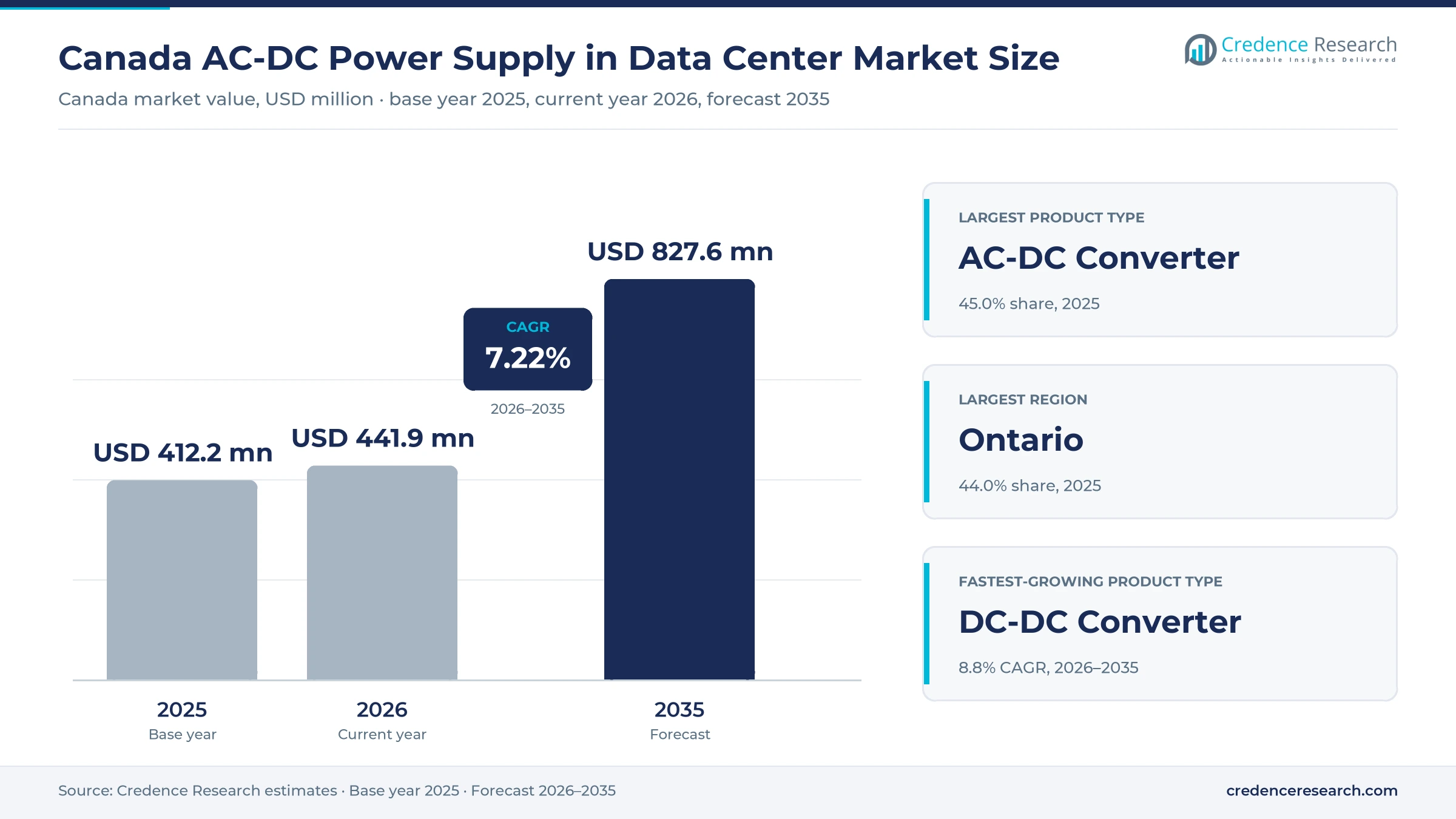
The Canada AC-DC power supply in data center market was valued at USD 412.2 million in 2025 and is projected to increase from USD 441.9 million in 2026 to USD 827.6 million by 2035, registering a CAGR of 7.22% during 2026–2035. Demand comes from hyperscale, colocation, enterprise and carrier facilities that buy server power supplies, rack power shelves, board-level converters and double-conversion UPS systems for new AI halls and for refreshes of older server fleets. Ontario held the largest regional share, 44.0% in 2025, because the Toronto area hosts the densest cluster of colocation and cloud capacity, while Alberta is the fastest-growing region at 8.7% a year as new campuses near Calgary take grid allocations. The most important technical change is the move toward 48-volt rack power and higher-voltage direct current distribution for AI racks, which shifts value from room-level UPS toward rack-level conversion. Grid connection limits in Ontario, Quebec, British Columbia and Alberta are the main restraint on how quickly orders arrive.
Conversion from utility feed to server rail is counted
The market counts what Canadian data center owners, tenants and server buyers spend on AC-DC front-end supplies, rack power shelves, DC-DC converters and UPS systems that turn utility power into the low-voltage direct current that processors use. Hyperscale and colocation operators buy UPS trains and shelves by the hall under project contracts, while enterprises buy server supplies inside servers from OEMs and rack UPS units through IT resellers.
Generators, switchgear, transformers, busways, cooling and batteries sold apart from a UPS are excluded, as are supplies for PCs and consumer chargers. The chain runs from power semiconductor and magnetics makers through supply and UPS manufacturers to server OEMs, electrical distributors and integrators, and margins are widest where a supplier pairs equipment with field service, monitoring and battery replacement contracts.
Canada AC-DC Power Supply in Data Center Market Insights
- The Canada AC-DC power supply in data center market was valued at USD 412.2 million in 2025 and is projected to reach USD 827.6 million by 2035, growing at a 7.22% CAGR during 2026–2035.
- Ontario held 44.0% of 2025 value, because the Toronto area hosts the largest cluster of colocation and cloud capacity in Canada.
- AC-DC converters held 45.0% of 2025 value, because every server, storage array and switch ships with redundant front-end supplies.
- Microsoft said in December 2025 that it will invest CAD 19 billion in Canada from 2023 to 2027, with new capacity coming online from the second half of 2026.
- Alberta assigned 1,200 MW of data center load to three projects in its first allocation phase, against requests above 20,000 MW, according to the grid operator.
Front-end converters lead while board-level stages grow
Front-end converters lead while board-level converters grow fastest
Based on product type, the market is categorized into AC-DC converters, DC-DC converters and UPS systems. AC-DC converters led with 45.0% of 2025 value because every server, storage array and switch ships with redundant front-end supplies, and Advanced Energy lists new 3.6 kW and 1.8 kW Titanium-efficiency M-CRPS server supplies in its October 2025 release, which shows front-end ratings rising with each server generation. DC-DC converters grow fastest at 8.8% as AI racks add conversion stages between the rack bus and the processor, and Delta showed a 90 kW power shelf in October 2025 that steps 800 volts down to 50 volts at up to 98.5% efficiency.
Rack-mounted systems lead while micro sites grow fastest
Based on application, the market is categorized into rack-mounted, blade, standalone and micro data centers. Rack-mounted systems led with 52.0% of 2025 value because 1U and 2U servers, rack shelves and rack UPS units make up most installed equipment, and CDW Canada lists Eaton's 9PX online UPS at 6 kVA and 5.4 kW, a size bought for single server racks. Micro data centers grow fastest at 8.5% as small sites avoid the heaviest grid rules, since the data center rate that Hydro-Québec proposed in February 2026 applies only to facilities above 5 MW, leaving smaller edge rooms on existing rates.
The IT industry leads while carriers grow fastest
Based on end user, the market is categorized into government and healthcare, IT industry, telecommunication industry and others. The IT industry led with 55.0% of 2025 value because cloud and colocation operators order power trains by the hall, and more than 6,500 MW of data center projects were seeking grid connection in Ontario alone by July 2025, according to Torys. The telecommunication industry grows fastest at 8.3% as carriers turn network real estate into AI hosting, and TELUS says it is the first North American service provider in the NVIDIA Cloud Partner network.
| Segment Group | Leading Sub-segment | Share, 2025 | Fastest-growing Sub-segment | CAGR, 2026–2035 |
|---|---|---|---|---|
| By Product Type | AC-DC Converter | 45.0% | DC-DC Converter | 8.8% |
| By Application | Rack-Mounted | 52.0% | Micro Data Centers | 8.5% |
| By End User | IT Industry | 55.0% | Telecommunication Industry | 8.3% |
Retail UPS and supply prices set the enterprise ceiling
Buyers pay for UPS capacity per kVA and for server supplies per unit, and battery chemistry and efficiency grade move both prices. CDW Canada lists Eaton's 9PX 6 kVA online UPS at about CAD 8,134 with lead-acid batteries and about CAD 13,004 with lithium-ion, a premium of about 60% that buyers weigh against battery replacement cycles. Dell Canada lists an 1,800-watt Titanium hot-plug supply at CAD 1,675.50, close to CAD 0.93 per watt at retail. Hyperscale and colocation buyers pay project prices that are not published, an evidence gap, so these list prices mark the ceiling that smaller enterprise buyers face.
| Offer or segment | Typical price or fee | Basis |
|---|---|---|
| Eaton 9PX 6 kVA online UPS, lead-acid (9PX6KG2) | CAD 8,133.99 per unit | CDW Canada list, November 2026 |
| Eaton 9PX 6 kVA online UPS, lithium-ion (G2) | CAD 13,003.99 per unit | CDW Canada list, November 2026 |
| Dell 1,800 W Titanium hot-plug supply built by LiteOn | CAD 1,675.50 per unit | Dell Canada list, November 2026 |
Request a Free Sample
Fill in your details and we'll send you a free sample report.
- Sample data tables & charts
- Research methodology
AI campuses, carrier builds and rack density lift orders
Hyperscale and colocation builds add whole power trains
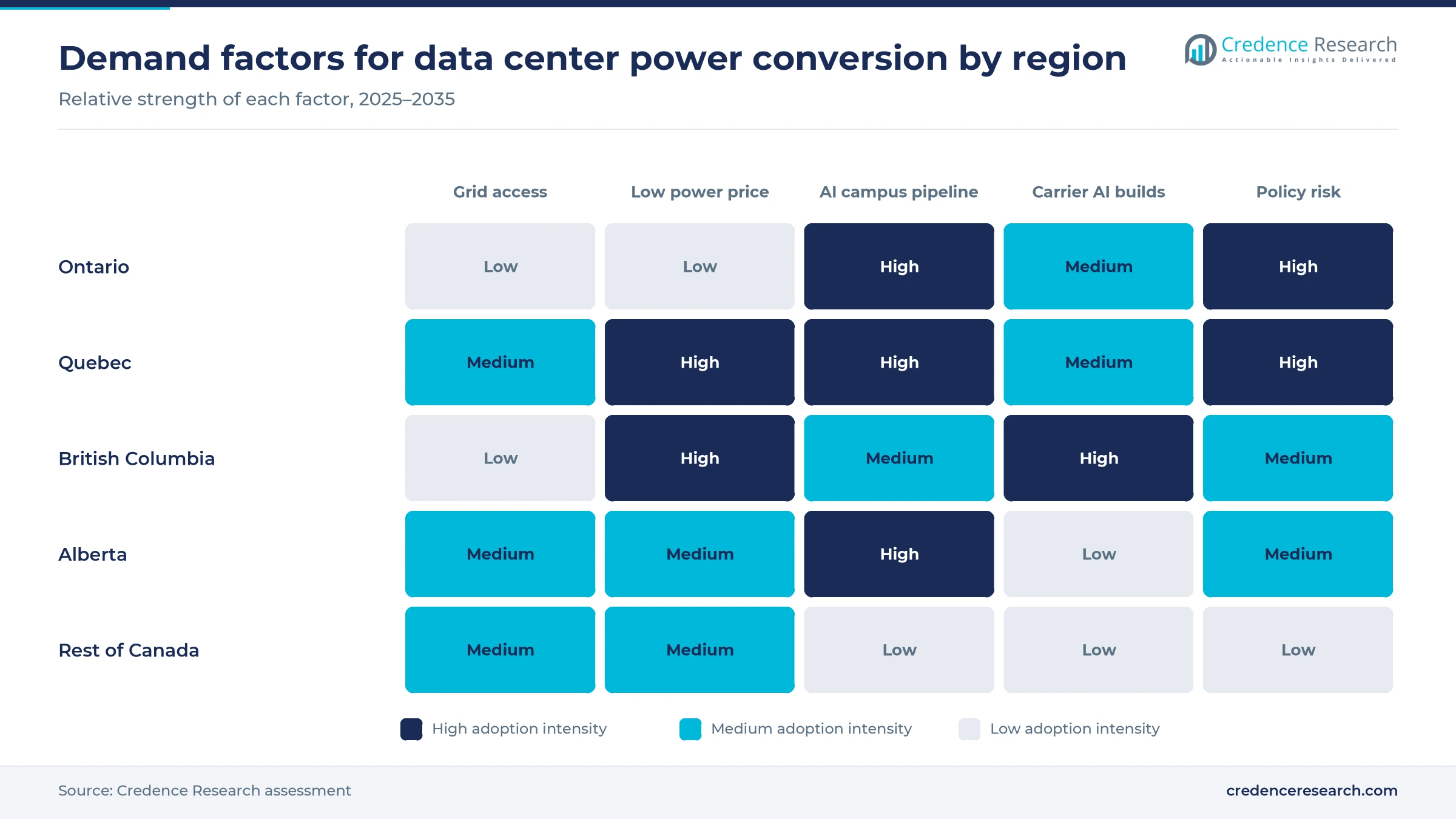
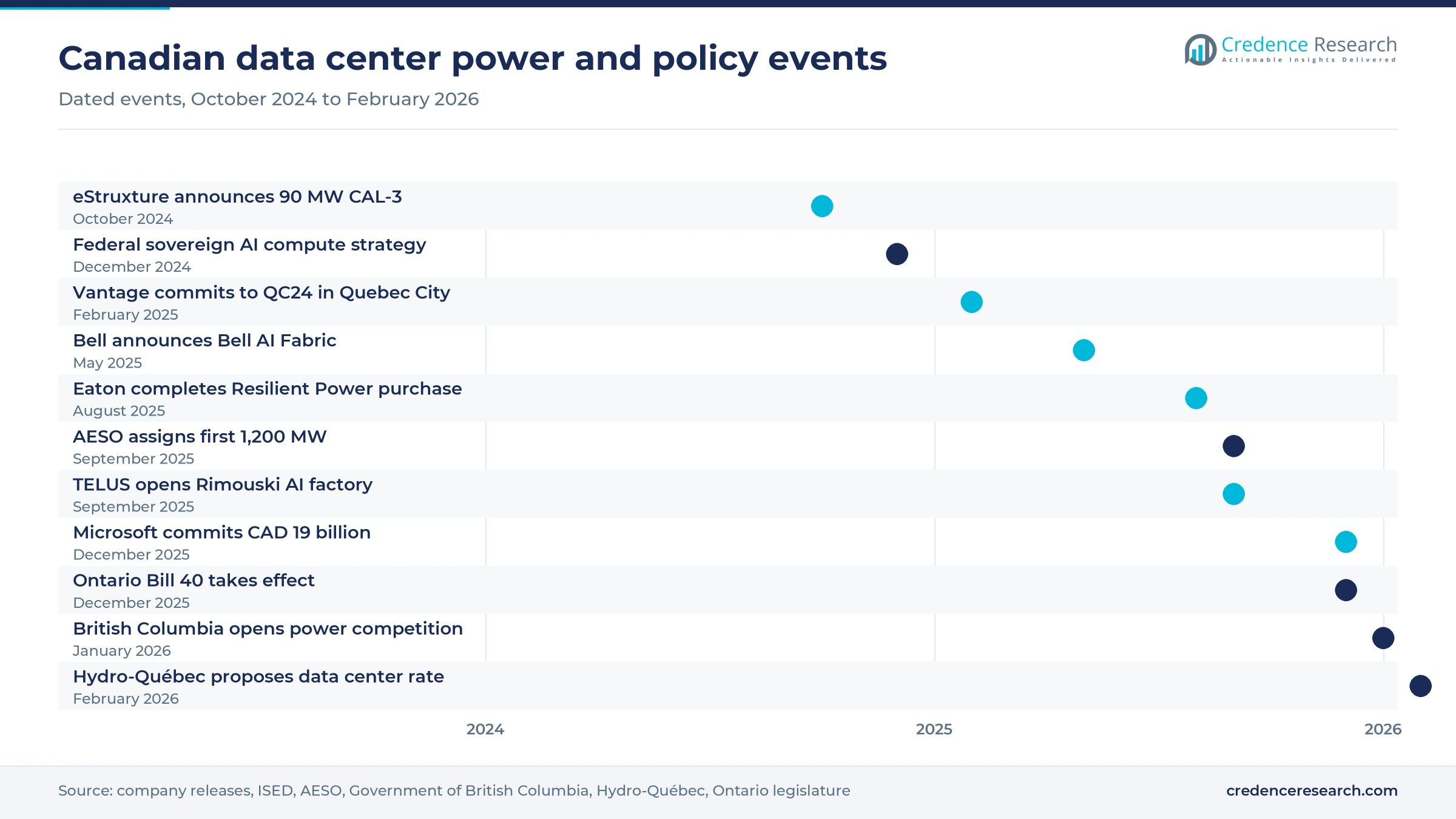
New hyperscale and colocation halls lift demand because each megawatt of IT load needs its own UPS modules, rack shelves and server supplies before the first tenant goes live. Microsoft said in December 2025 that it will invest CAD 19 billion in Canada from 2023 to 2027, with more than CAD 7.5 billion in the next two years and new capacity coming online from the second half of 2026. Vantage Data Centers committed CAD 500 million in February 2025 to a 32 MW building that lifts its Quebec City campus to 86 MW, with operation expected in early 2027. These hyperscale campuses buy redundant power in large blocks, which favors suppliers with UPS stock and service crews in Toronto and Quebec City.
Carrier AI builds bring telecom operators into the buyer pool
Telecom operators are becoming large buyers of data center power equipment because they are converting network sites and land into AI inference capacity. Bell announced Bell AI Fabric on May 28, 2025, a plan for upward of 500 MW across six facilities in British Columbia, according to BCE. The first 7 MW site in Kamloops, built with Groq, was scheduled to come online in June 2025, and a 26 MW facility with Thompson Rivers University is due in 2026. The telecommunication industry segment grows fastest at 8.3% a year in Credence Research estimates, and suppliers that already sell 48-volt rectifiers to carriers can extend those accounts into UPS systems and rack power.
Higher rack densities raise the value of each power shelf
AI racks raise spending per rack because each GPU server draws several kilowatts, which moves buyers from single supplies toward shared rack shelves with higher ratings and better efficiency. Advanced Energy showed an ORv3 power shelf in October 2025 that delivers 100 kW from six 18 kW supplies at more than 97.5% efficiency, according to the company. The same release lists NDQ1600 board-mounted converters with efficiency of up to 98%, which shows how converter value is moving onto the server board. Canada had 1.4 GW of live data center capacity in September 2025, according to law firm BLG, and refreshing that base with dense AI servers lifts power content per megawatt.
Efficiency rules and power prices reward low-loss conversion
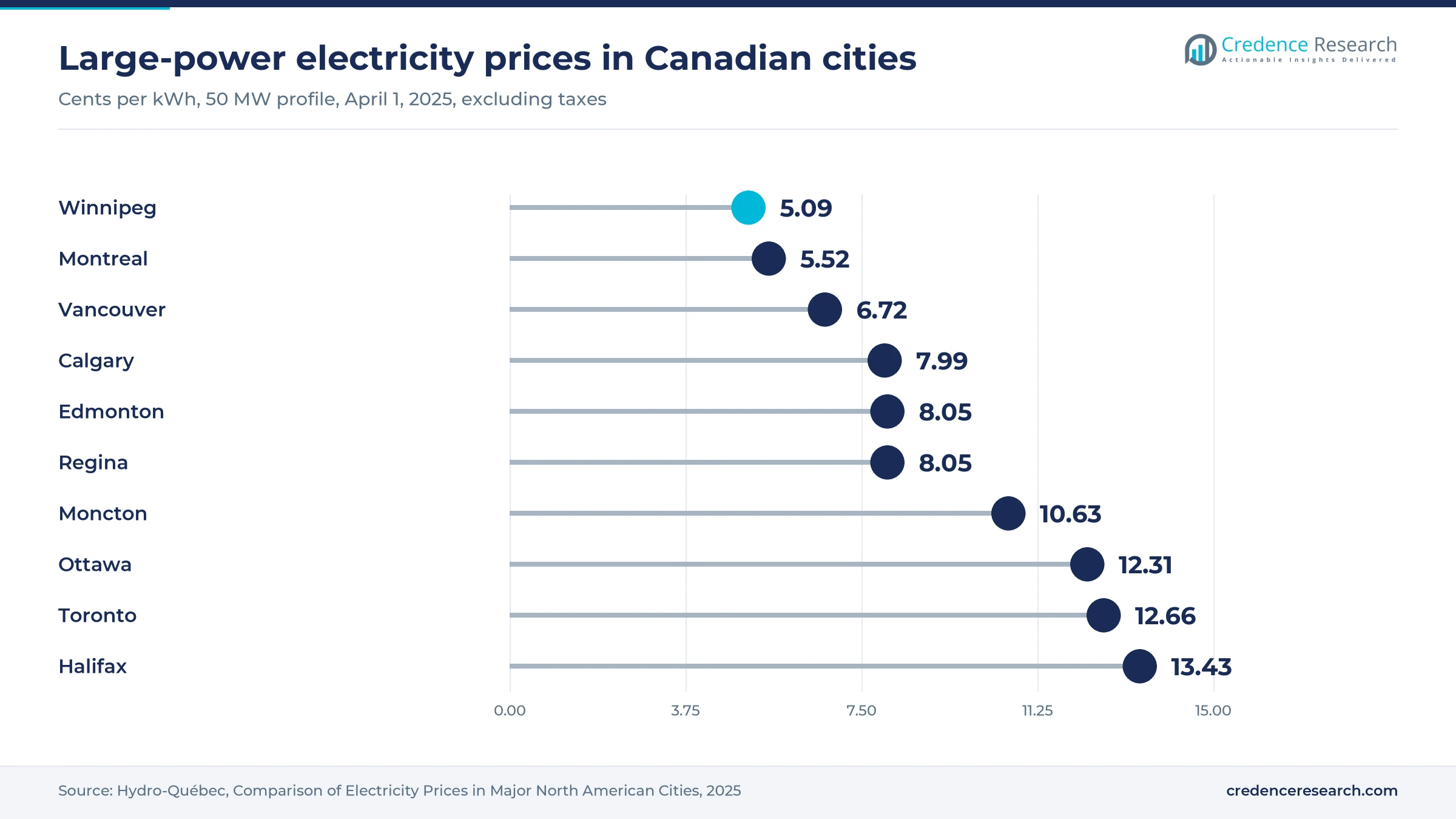
Energy prices and pending efficiency rules push buyers toward lower-loss conversion, because every point lost in a UPS or rectifier becomes heat that the site also pays to remove. Natural Resources Canada began consulting in May 2024 on efficiency and test standards for UPS units aligned with United States rules, and said it intended to pre-publish a proposal in the Canada Gazette in 2025. An ENERGY STAR certified UPS uses 52% less energy on average than a standard model, according to the department. Large-power customers paid 12.66 cents per kWh in Toronto against 5.52 cents in Montreal on April 1, 2025, according to Hydro-Québec, so Ontario operators gain the most from high-efficiency equipment.
Sovereign compute and 800-volt designs reshape buying
Buyers are shifting toward sovereign, Canadian-hosted AI capacity
Public and private buyers are shifting toward AI capacity hosted and controlled in Canada, which moves power equipment orders from foreign cloud regions into domestic halls. The federal government launched the Canadian Sovereign AI Compute Strategy on Dec. 5, 2024, with up to CAD 2 billion, including up to CAD 700 million for new or expanded Canadian AI data centers, according to Innovation, Science and Economic Development Canada. A further CAD 300 million AI Compute Access Fund helps firms buy domestic compute. TELUS says its Rimouski AI factory runs on 99% renewable energy and is three times more energy efficient than the industry average, which sets an efficiency bar that UPS and rack power suppliers must meet to win sovereign projects.
Designers are moving toward 800-volt distribution for AI racks
Data center designers are moving toward 800-volt direct current distribution to cut copper and conversion losses as rack loads approach one megawatt. Delta said in October 2025 that its 800 VDC power ecosystem, developed with NVIDIA, targets megawatt-class racks and includes a board that converts the bus to 12 volts at up to 98.5% efficiency. Eaton completed its purchase of Resilient Power Systems, a developer of solid-state transformer technology, in August 2025, which gives it a front-end converter that could feed such buses. DC-DC converters already grow fastest at 8.8% in Credence Research estimates, and suppliers that qualify 800-volt shelves early are best placed for Canadian AI campuses that commission later in the decade.
Aging UPS fleets open a retrofit opportunity
Older UPS fleets are an opportunity because many halls built before the AI cycle run lead-acid systems and legacy rectifiers that cost more to operate than current double-conversion designs. Schneider Electric Canada opened a new head office and EcoFit center in Milton, Ontario, in February 2026, offering switchgear and UPS retrofits from more than 20 locations nationwide. The 1.4 GW installed base noted above gives retrofit suppliers a large pool of equipment approaching mid-life upgrades. Natural Resources Canada also plans to align UPS rules with United States standards first published in the Federal Register on Jan. 10, 2020. Retrofits of the installed UPS base cut losses without new grid capacity, which matters where connections are rationed.
Alberta's allocated campuses need full power trains
Alberta's first grid allocations are a near-term opportunity because each assigned project must buy UPS modules, rectifiers and rack power before it energizes. The Alberta Electric System Operator received requests for more than 20,000 MW of data center load, qualified 15 projects totaling 4,800 MW and assigned 1,200 MW to three projects from two developers in its first phase, according to its September 2025 update. Any megawatts left unassigned within the 1,200 MW interim limit carry over into Phase II, according to the same update. eStruxture's 90 MW CAL-3 facility north of Calgary is expected to go live in the second half of 2026, according to the company. Suppliers with stock and field engineers in Calgary and Edmonton can win these orders against crews based in Ontario.
Grid gating in four provinces slows new power orders
Ontario connection rules delay Toronto-area power orders
Ontario's connection rules delay equipment orders because builds cannot energize until the province and grid operator approve them. The 6,500 MW of Ontario connection requests noted above equal almost 30% of 2024 peak demand, according to Torys. Bill 40 took effect on Dec. 11, 2025, letting the province set connection requirements, and loads above 10 MW face impact studies that can exceed 12 months. Suppliers whose order books depend on Toronto-area colocation projects are most exposed to slipped delivery dates.
A doubled Quebec rate could slow hyperscale expansion
A proposed power rate could slow new large halls in Quebec, where cheap hydroelectricity has been the main draw. Hydro-Québec proposed on Feb. 19, 2026, an average rate of 13 cents per kWh for data centers above 5 MW, about double the current large-power rate, according to Hydro-Québec. The utility expects sector load to rise from about 200 MW to about 1,000 MW by 2035, and the proposal still needs approval from the Régie de l'énergie. Hyperscale tenants weighing Quebec against Ontario, and UPS suppliers with Quebec-heavy backlogs, are most exposed.
British Columbia rations clean power through a competition
British Columbia's competitive power process limits how many AI projects can buy equipment in the next two years. The province opened a selection process on Jan. 30, 2026, offering as much as 400 MW to AI and data center projects for the first two years, with successful applicants expected to hear in September 2026, according to the provincial government. Projects are scored on price, community benefits and data sovereignty, so suppliers to unsuccessful bidders lose orders, and carriers with planned Kamloops sites face timing risk.
Fast architecture changes shorten supplier product cycles
Rapid changes in rack architecture shorten the commercial life of each power supply platform, which raises qualification costs for suppliers and stranded-asset risk for buyers. Advanced Energy said its new ORv3 shelf, noted above, is designed for a future move to high-voltage direct current, and rival higher-voltage designs appeared at the same October 2025 summit. Integrators that hold large stocks of 12-volt supplies, and operators that commit to 48-volt shelves for halls opening after 2027, are most exposed if high-voltage distribution arrives sooner.
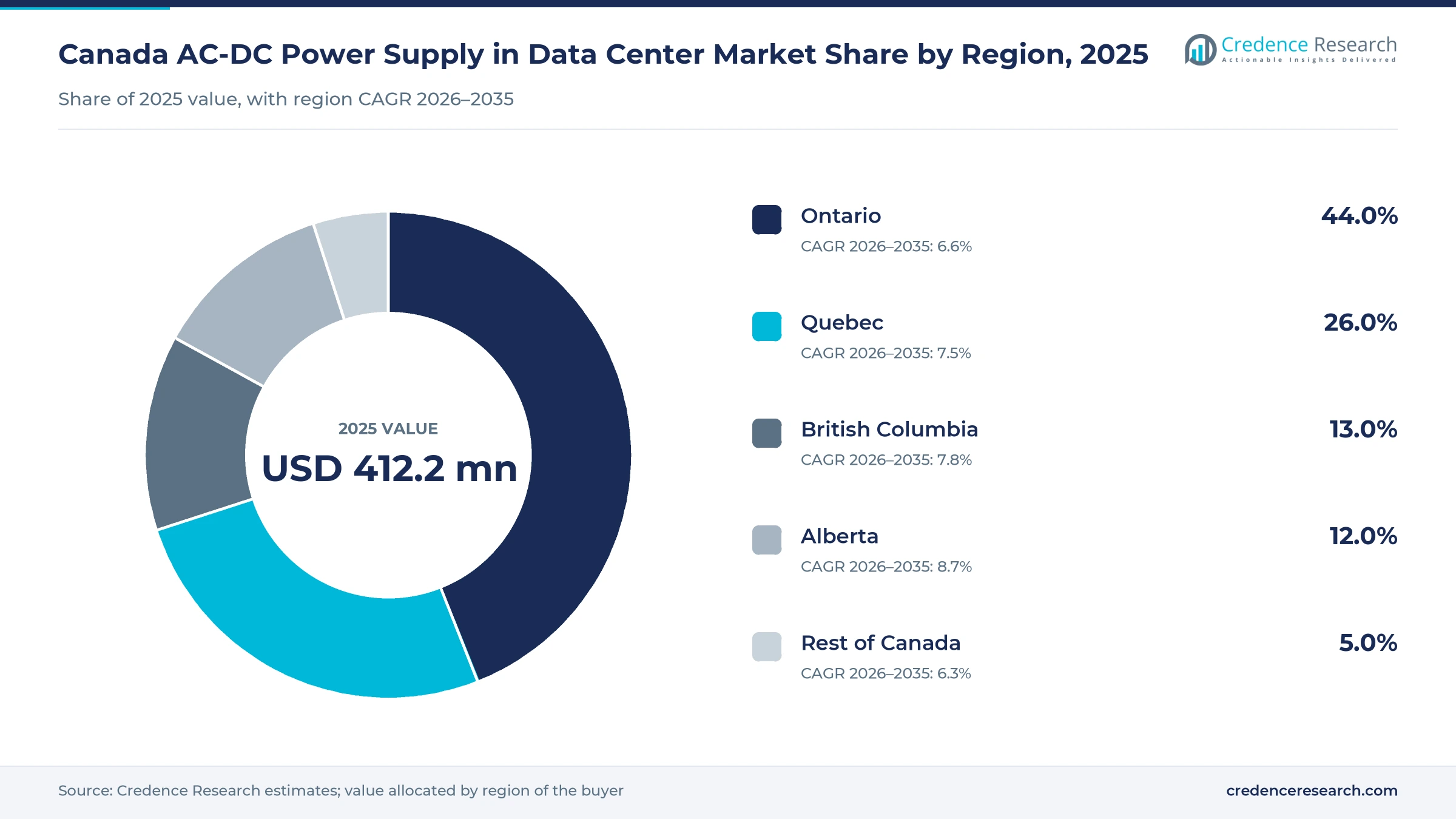
Ontario leads while Alberta grows fastest on new campuses
| Region | Value, 2025 (USD million) | Share, 2025 | CAGR, 2026–2035 |
|---|---|---|---|
| Ontario | 181.3 | 44.0% | 6.6% |
| Quebec | 107.2 | 26.0% | 7.5% |
| British Columbia | 53.6 | 13.0% | 7.8% |
| Alberta | 49.5 | 12.0% | 8.7% |
| Rest of Canada | 20.6 | 5.0% | 6.3% |
Ontario leads on Toronto colocation and cloud capacity
Ontario holds 44.0% of 2025 value and grows at 6.6% a year because the Toronto area hosts the largest cluster of colocation operators and one of Microsoft's two original Canadian cloud sites. Data centers are expected to make up 13% of new Ontario electricity demand by 2035, according to BLG. Locational marginal prices replaced the hourly Ontario energy price on May 1, 2025, which ties power cost to location and rewards efficient conversion. High power prices and the connection rules described above hold Ontario growth below the national rate.
Quebec gains on hydroelectric power and AI factory builds
Quebec holds 26.0% of 2025 value and grows at 7.5% a year, as low-cost hydroelectricity and sovereign AI builds add capacity. The Quebec City campus build described in the driver analysis and the TELUS AI factory in Rimouski add large orders for UPS systems and rack power. Schneider Electric Canada opened a new production line for power distribution devices in Brossard on June 4, 2025, which gives Quebec buyers a nearby source of electrical equipment. The proposed data center rate is the main risk to this growth.
British Columbia grows on carrier AI sites and local telecom power
British Columbia holds 13.0% of 2025 value and grows at 7.8% a year as Bell's Kamloops sites and clean hydroelectric power attract AI inference loads. The provincial competition noted above offers as much as 400 MW in its first two years, which caps how many new halls order UPS and rack power before 2028. EnerSys builds telecom DC power systems at its Alpha Technologies plant in Burnaby, according to the company. That local base gives carriers short lead times on rectifiers for their new AI inference sites in the interior.
Alberta grows fastest as Calgary campuses take grid allocations
Alberta holds 12.0% of 2025 value and is the fastest-growing region at 8.7% a year, as assigned grid allocations bring new AI campuses near Calgary. Large-power customers paid 7.99 cents per kWh in Calgary and 8.05 cents in Edmonton on April 1, 2025, according to Hydro-Québec, below Toronto but above Montreal. The eStruxture build north of Calgary, noted in the opportunity analysis, is the largest dated project in the province. The interim grid limit means growth comes in phases, so orders cluster around each allocation round.
Rest of Canada remains a small enterprise market
Rest of Canada holds 5.0% of 2025 value and grows at 6.3% a year, with demand from provincial governments, hospitals, universities and carrier sites in Manitoba, Saskatchewan and Atlantic Canada. Large-power customers in Winnipeg paid 5.09 cents per kWh on April 1, 2025, the lowest of the cities in the Hydro-Québec comparison. Published data on data center capacity in these provinces is an evidence gap, so this estimate rests on population and enterprise server use.
Campus, carrier and supplier moves, 2025–2026
| Development | Status and market relevance |
|---|---|
| In February 2025, Vantage Data Centers committed CAD 500 million to QC24, a 32 MW building at its Quebec City campus. | Investment under construction; operation is expected in early 2027, which brings a large UPS and rack power order. |
| In May 2025, Bell announced Bell AI Fabric, a network of AI data centers in British Columbia. | Announced plan; the first Kamloops site was due in June 2025 and further sites follow through 2027. |
| In August 2025, Eaton completed its acquisition of Resilient Power Systems, a solid-state transformer developer. | Completed acquisition; it adds front-end conversion technology suited to higher-voltage data center designs. |
| In December 2025, Microsoft committed CAD 19 billion to Canadian AI and cloud infrastructure for 2023 to 2027. | Investment plan; new capacity starts coming online in the second half of 2026, adding hyperscale power demand. |
| In February 2026, Schneider Electric Canada opened a new head office and EcoFit center in Milton, Ontario. | Operational launch; the center offers UPS retrofits that extend the life of installed power equipment. |
Conversion stages decide losses from grid to processor
- Titanium-grade front-end supplies convert utility AC to 12 or 54 volts inside each server with very low losses, which cuts heat in racks where two supplies run in parallel for redundancy.
- 48-volt ORv3 power shelves pool several hot-swappable supplies into one rack-level unit, which lets dense AI racks draw far more power from one shared bus.
- High-voltage direct current distribution carries power from a solid-state transformer or rectifier to the rack at high voltage, which reduces copper and conversion steps for megawatt-class racks.
- Double-conversion UPS systems rectify and invert all incoming power to protect loads, and multi-mode designs switch to a more efficient mode when grid power is clean, often paired with liquid cooling in AI halls.
Need a Custom Version of This Report?
Tailor the scope, geography, or segments to your exact requirements.
- Custom geography or segment scope
- Direct access to our analyst team
UPS majors and server supply makers compete on service
Competition splits between UPS majors that sell complete power trains with service and component makers whose products reach Canada inside servers. Schneider Electric, Vertiv and Eaton compete for hyperscale and colocation halls with large three-phase UPS systems, rack power distribution and national service teams, while ABB and Mitsubishi Electric bid on large modular UPS projects. Delta Electronics, Lite-On Technology and Advanced Energy supply front-end server supplies and rack shelves to OEMs, and Vicor sells 48-volt power modules for AI processors. EnerSys competes in telecom DC power from its Burnaby plant. Efficiency at partial load, lead time and field service decide most contracts, and the move toward higher-voltage designs gives component makers more say in facility design. Grid-limited provinces favor suppliers that can phase deliveries to each allocation round.
Three supplier tiers serve different buyers
Supply splits into three tiers that rarely overlap in the Canadian market. Server supplies and board converters come from a few makers such as Delta, Lite-On and Advanced Energy, and reach Canada inside servers from Dell, HPE and other OEMs, so operators rarely buy them directly. Room-level UPS systems come from Schneider Electric, Vertiv, Eaton, ABB and Mitsubishi Electric through direct sales and electrical distributors, and service contracts carry the widest margins. Telecom rectifiers form a third tier, where EnerSys builds in Burnaby. Entry is hardest in large UPS systems, where buyers demand installed references and round-the-clock field service.
Power suppliers serving Canadian data halls
| Company | Type | Role in the market |
|---|---|---|
| Schneider Electric | Full-line supplier | Galaxy three-phase UPS, rack UPS and EcoFit UPS retrofits across Canada |
| Vertiv Holdings Co. | Full-line supplier | Liebert UPS systems, rack power and service for Canadian data centers |
| Eaton Corporation plc | Full-line supplier | Three-phase and rack UPS, including 9PX units sold through Canadian resellers |
| ABB Ltd. | UPS specialist | Large modular UPS systems for hyperscale and colocation halls |
| Delta Electronics, Inc. | Power supply maker | Server front-end supplies, rack shelves and high-voltage DC power systems |
| Lite-On Technology Corporation | Power supply maker | Titanium-grade server supplies sold inside OEM servers in Canada |
| Advanced Energy Industries, Inc. | Power supply maker | ORv3 rack power shelves, server supplies and board-mounted converters |
| EnerSys (Alpha Technologies) | Telecom power specialist | Telecom DC power systems and rectifiers built in Burnaby, British Columbia |
| Mitsubishi Electric Corporation | UPS specialist | Large three-phase UPS systems for data center projects |
| Vicor Corporation | Converter specialist | 48-volt power modules for AI processor boards |
Value moves toward rack-level and higher-voltage stages
Credence Research's view is that conversion value in Canada will move from room-level UPS toward rack shelves and board-level converters through 2035, as AI racks push loads toward one megawatt. Grid access, not tenant demand, decides when orders land, so suppliers with stock and crews in Calgary, Kamloops and Quebec City will gain share as each province releases capacity. The Canada AC-DC power supply in data center market rewards vendors that can certify efficiency, phase deliveries and service installed UPS fleets. Carriers turning into AI hosts are the buyer group to watch.
2025 value rebuilt from capacity and equipment prices
The report uses 2025 as the base year and forecasts to 2035. Market values in this report come from the Credence Research model. This edition carries forward the previous 2023 estimate at its own growth rate and checks the result against a bottom-up build from installed and new data center capacity, redundancy levels and published list prices for UPS systems and server supplies. Segment and regional shares are Credence Research estimates based on grid operator and utility publications, government releases, company announcements and price lists. Regional shares weight each province's operating capacity with its 2025–2026 build activity, so Quebec's 26.0% share exceeds its roughly 200 MW of current data center load because of the Quebec City and Rimouski projects. No interviews or surveys were carried out for this edition.
Grid access, not demand, sets the pace to 2035
In the base case the Canada AC-DC power supply in data center market grows at 7.22% a year through 2035, as hyperscale, colocation and carrier AI sites add capacity in phases set by provincial grid rules. AC-DC converters keep the largest product share, while DC-DC converters gain as higher-voltage and 48-volt rack designs spread. Ontario keeps the largest regional share, and Alberta gains fastest as allocation rounds release capacity. A doubled Quebec rate and slow Ontario approvals are the main risks to that path.
Grid allocations decide the range of outcomes
The outcome depends on how fast provinces release grid capacity, whether the Quebec rate is approved as filed, and how quickly higher-voltage designs replace older rack power. Slow allocations in Ontario and Alberta and an approved Quebec rate would hold growth near the downside case. Faster Alberta phases, a softer Quebec rate and early sovereign AI awards would move the market toward the upside case.
| Scenario | CAGR, 2026–2035 | Value, 2035 | What has to hold |
|---|---|---|---|
| Downside | 5.6% | USD 722.9 million | Ontario approvals stall and the Quebec data center rate is approved as filed |
| Base | 7.22% | USD 827.6 million | Provinces release capacity in phases at the pace seen in 2025 and 2026 |
| Upside | 9.0% | USD 961.4 million | Alberta Phase II and sovereign AI awards bring forward several large campuses |
Frequently Asked Questions
How big is the Canada AC-DC power supply in data center market?
Which region leads the market?
Which product type holds the largest share?
How much does a data center UPS cost in Canada?
How much data center capacity does Canada have?
How will the Hydro-Québec data center rate affect demand?
What are the main challenges for suppliers in Canada?
Which companies lead the market?
Table of Content
Chapter 1 Market Segmentation
- 1.1 Segmentation Framework
- 1.1.1 Product and Service Classification
- 1.1.2 Application and End-Use Classification
- 1.1.3 Technology and Solution Classification
- 1.1.4 Customer and Distribution Channel Classification
- 1.1.5 Geographic Segmentation
- 1.1.6 Market Segment Definitions and Boundaries
- 1.2 By Product Type
- 1.2.1 AC-DC Converter
- 1.2.2 UPS Systems
- 1.2.3 DC-DC Converter
- 1.3 By Application
- 1.3.1 Rack-Mounted
- 1.3.2 Standalone
- 1.3.3 Blade
- 1.3.4 Micro Data Centers
- 1.4 By End User
- 1.4.1 IT Industry
- 1.4.2 Telecommunication Industry
- 1.4.3 Government & Healthcare
- 1.4.4 Others
Chapter 2 Introduction
- 2.1 Report Objectives and Scope
- 2.2 Product Definition and Industry Terminology
- 2.3 Market Inclusions and Exclusions
- 2.4 Research Process
- 2.4.1 Primary Research and Expert Interviews
- 2.4.2 Secondary Research and Source Review
- 2.4.3 Top-Down and Bottom-Up Estimation
- 2.4.4 Data Triangulation and Verification
- 2.5 Market Size Measurement Basis
- 2.5.1 2025: USD 412.2 million → 2035: USD 827.6 million
- 2.6 Historical and Forecast Reference Periods
- 2.6.1 Historical Period: 2018-2025
- 2.6.2 Base Year: 2025
- 2.6.3 Forecast Period: 2025-2035
- 2.7 Research Assumptions and Limitations
Chapter 3 Executive Summary
- 3.1 Market Snapshot and Key Findings
- 3.2 Base-Year Market Size, 2025
- 3.3 Forecast Market Size, 2035
- 3.4 Revenue and Volume Growth Outlook
- 3.5 Key Demand and Supply Indicators
- 3.6 Leading Market Segments
- 3.7 Fastest-Growing Market Opportunities
- 3.8 Regional Performance Highlights
- 3.9 Technology and Industry Transformation
- 3.10 Competitive Landscape Summary
- 3.11 Analyst View and Strategic Implications
Chapter 4 Canada AC-DC Power Supply in Data Center Market Trends and Developments
- 4.1 Historical Industry Development, 2018-2025
- 4.2 Recent Market Trends and Developments
- 4.3 Demand and Customer Behavior Trends
- 4.4 Technology and Product Innovation
- 4.5 Artificial Intelligence, Automation and Digitalization
- 4.6 Local Manufacturing and Supply Chain Realignment
- 4.7 Industry Partnerships, Mergers and Acquisitions
- 4.8 Sustainability and Circular Economy Developments
- 4.9 Government and Private Sector Investment Trends
- 4.10 Emerging Business Models and Commercialization
- 4.11 Industry Developments and Announcements
Chapter 5 Canada AC-DC Power Supply in Data Center Market Production, Supply and Demand Analysis
- 5.1 Demand Trend and Consumption Analysis, 2018-2025
- 5.2 Demand Forecast, 2025-2035
- 5.3 Production and Output Trend, 2018-2025
- 5.4 Production and Output Forecast, 2025-2035
- 5.5 Installed Capacity and Capacity Utilization
- 5.6 Company-Wise Production Plants and Statistics
- 5.6.1 Installed Production Capacity
- 5.6.2 Actual Production
- 5.6.3 Planned Capacity and Expansion Targets
- 5.7 Supply Chain Structure and Procurement Trends
- 5.8 Supply-Demand Gap and Bottlenecks
- 5.9 Import Dependence and Sourcing Structure
- 5.10 Contract Manufacturing and Outsourcing
- 5.11 Regional Supply and Demand Concentration
Chapter 6 Canada AC-DC Power Supply in Data Center Market Pricing Analysis
- 6.1 Pricing Structure and Measurement
- 6.2 Historical Pricing Trends, 2018-2025
- 6.3 Pricing Outlook, 2025-2035
- 6.4 Average Selling Price and Unit Economics
- 6.5 Pricing by Product and Market Segment
- 6.6 Geographic Pricing Differences
- 6.7 Key Input, Energy, Labor and Logistics Costs
- 6.8 Contract Pricing and Purchasing Models
- 6.9 Pricing Sensitivity and Competitive Positioning
- 6.10 Price, Margin and Profitability Implications
Chapter 7 Canada AC-DC Power Supply in Data Center Market Dynamics
- 7.1 Market Growth Drivers
- 7.1.1 Demand-Side Drivers
- 7.1.2 Technology and Innovation Drivers
- 7.1.3 Infrastructure and Investment Drivers
- 7.1.4 Regulatory and Policy Drivers
- 7.2 Market Restraints
- 7.2.1 Cost and Affordability Constraints
- 7.2.2 Technology and Adoption Barriers
- 7.2.3 Supply Chain and Operational Constraints
- 7.3 Market Challenges
- 7.3.1 Competitive Pressure and Margin Erosion
- 7.3.2 Skills, Infrastructure and Implementation Gaps
- 7.4 Emerging Market Opportunities
- 7.5 Market Dynamics Impact and Time-Horizon Assessment
Chapter 8 Canada AC-DC Power Supply in Data Center Value Chain Analysis
- 8.1 Industry Value Chain Overview
- 8.2 Upstream Suppliers and Critical Inputs
- 8.3 Technology and Component Providers
- 8.4 Manufacturing or Service Delivery
- 8.5 Distribution, Channel Partners and Integrators
- 8.6 Downstream Applications and End Users
- 8.7 Value Addition and Profit Pools
- 8.8 Vertical Integration and Outsourcing
- 8.9 Supplier Concentration and Risk
- 8.10 Supply Chain Localization and Resilience
Chapter 9 Canada AC-DC Power Supply in Data Center Market Regulations and Policies
- 9.1 Relevant Laws, Standards and Compliance Frameworks
- 9.2 Product, Service, Safety and Quality Requirements
- 9.3 Government Policies, Incentives and Subsidies
- 9.4 Imports, Exports and Trade Barriers
- 9.5 Public Procurement and Local Content Requirements
- 9.6 Environmental and Sustainability Compliance
- 9.7 Upcoming Policy Changes and Market Implications
Chapter 10 Canada AC-DC Power Supply in Data Center Market Hotspots and Opportunities
- 10.1 Market Opportunity Mapping and Growth Hotspots
- 10.2 High-Growth Applications and Customer Groups
- 10.3 Underserved Markets and White-Space Opportunities
- 10.4 Emerging Technology and Product Opportunities
- 10.5 New Capacity and Investment Hotspots
- 10.6 Market Entry and Expansion Opportunities
- 10.7 Distribution and Partnership Opportunities
- 10.8 Near-Term and Long-Term Commercial Potential
- 10.9 Opportunity Attractiveness and Execution Risks
Chapter 11 Canada AC-DC Power Supply in Data Center Market Outlook, 2025-2035
- 11.1 Market Size and Analysis
- 11.1.1 Revenue (Market Measurement: 2025: USD 412.2 million → 2035: USD 827.6 million)
- 11.1.2 Market Volume and Quantity Sold
- 11.1.3 Historical Market Size, 2018-2025
- 11.1.4 Base-Year Market Size, 2025
- 11.2 Market Forecast, 2025-2035
- 11.2.1 Revenue Forecast to 2035
- 11.2.2 Volume Forecast to 2035
- 11.2.3 CAGR and Year-on-Year Growth
- 11.2.4 Incremental Revenue Opportunity
- 11.3 Forecast Assumptions and Scenario Analysis
- 11.3.1 Base-Case Forecast
- 11.3.2 Optimistic and Conservative Scenarios
- 11.3.3 Technology, Pricing and Policy Sensitivities
- 11.4 Market Attractiveness and Growth Outlook
Chapter 12 Canada AC-DC Power Supply in Data Center Market Segmentation and Outlook
- 12.1 Segmentation Summary and Market Shares, 2025
- 12.2 Largest and Fastest-Growing Segments
- 12.3 By Product Type - Market Size and Forecast, 2025-2035
- 12.3.1 Segment Definition and Scope
- 12.3.2 Historical Market Size, 2018-2025
- 12.3.3 Revenue Forecast, 2025-2035
- 12.3.4 Volume Forecast, 2025-2035
- 12.3.5 Base-Year Market Share, 2025
- 12.3.6 Segment CAGR and Growth Drivers
- 12.3.7 Subsegment Market Size and Forecast
- 12.3.7.1 AC-DC Converter
- 12.3.7.2 UPS Systems
- 12.3.7.3 DC-DC Converter
- 12.3.8 Subsegment Pricing and Adoption Trends
- 12.3.9 Leading Suppliers and Competition
- 12.3.10 Regional Demand and Opportunities
- 12.4 By Application - Market Size and Forecast, 2025-2035
- 12.4.1 Segment Definition and Scope
- 12.4.2 Historical Market Size, 2018-2025
- 12.4.3 Revenue Forecast, 2025-2035
- 12.4.4 Volume Forecast, 2025-2035
- 12.4.5 Base-Year Market Share, 2025
- 12.4.6 Segment CAGR and Growth Drivers
- 12.4.7 Subsegment Market Size and Forecast
- 12.4.7.1 Rack-Mounted
- 12.4.7.2 Standalone
- 12.4.7.3 Blade
- 12.4.7.4 Micro Data Centers
- 12.4.8 Subsegment Pricing and Adoption Trends
- 12.4.9 Leading Suppliers and Competition
- 12.4.10 Regional Demand and Opportunities
- 12.5 By End User - Market Size and Forecast, 2025-2035
- 12.5.1 Segment Definition and Scope
- 12.5.2 Historical Market Size, 2018-2025
- 12.5.3 Revenue Forecast, 2025-2035
- 12.5.4 Volume Forecast, 2025-2035
- 12.5.5 Base-Year Market Share, 2025
- 12.5.6 Segment CAGR and Growth Drivers
- 12.5.7 Subsegment Market Size and Forecast
- 12.5.7.1 IT Industry
- 12.5.7.2 Telecommunication Industry
- 12.5.7.3 Government & Healthcare
- 12.5.7.4 Others
- 12.5.8 Subsegment Pricing and Adoption Trends
- 12.5.9 Leading Suppliers and Competition
- 12.5.10 Regional Demand and Opportunities
- 12.6 Segment Growth Comparison
- 12.7 Segment Attractiveness and Priority Matrix
Chapter 13 Canada AC-DC Power Supply in Data Center End-Use and Application Market Outlook
- 13.1 End-Use Industry and Customer Demand Structure
- 13.2 Leading Applications and Customer Groups
- 13.3 End-Use Market Size, Share and Forecast
- 13.4 Major End-Use Industry Deep Dives
- 13.4.1 Customer Requirements and Use Cases
- 13.4.2 Demand and Replacement Cycles
- 13.4.3 Technical and Regulatory Considerations
- 13.4.4 Purchasing and Procurement Models
- 13.4.5 Leading Vendors and Distribution Channels
- 13.4.6 Forecast and Commercial Opportunities
- 13.5 Emerging Applications and Cross-Segment Demand
- 13.6 End-Use Industry Investment Priorities
Chapter 14 Canada AC-DC Power Supply in Data Center Geographic Market Outlook, 2025-2035
- 14.1 Domestic Market Distribution and Demand Clusters
- 14.2 State- or Province-Wise Market Size and Forecast, 2025-2035
- 14.3 City and Metropolitan Market Outlook
- 14.4 Industrial, Manufacturing and Commercial Clusters
- 14.5 Geographic Concentration of Key End Users
- 14.6 Local Pricing and Purchasing Differences
- 14.7 Domestic Production Facilities and Capacity Map
- 14.8 Local Infrastructure and Project Pipeline
- 14.9 State-Level Policy and Incentive Differences
- 14.10 Subnational Investment Hotspots and Opportunities
- 14.11 Distribution and Logistics Networks
- 14.12 Domestic Competitive Footprint
Chapter 15 Canada AC-DC Power Supply in Data Center Technology, Innovation and Sustainability Outlook
- 15.1 Technology Landscape and Maturity
- 15.2 Product, Process and Service Innovation
- 15.3 AI, Automation and Digital Tools in the Industry
- 15.4 Technology Adoption and Performance Benchmarking
- 15.5 Innovation Pipeline and R&D Investment
- 15.6 Patent and Intellectual Property Trends
- 15.7 Energy Efficiency and Resource Management
- 15.8 Sustainability, Recycling and Circularity
- 15.9 Technology Roadmap, 2025-2035
- 15.10 Risks of Obsolescence and Technology Substitution
Chapter 16 Canada AC-DC Power Supply in Data Center Market Key Strategic Imperatives
- 16.1 Growth and Market Entry Priorities
- 16.2 High-Return Products and Segments
- 16.3 Pricing, Profitability and Cost Optimization
- 16.4 Technology Investment and Product Differentiation
- 16.5 Supply Chain Localization and Resilience
- 16.6 Distribution and Customer Acquisition
- 16.7 Partnership, Acquisition and Capacity Strategy
- 16.8 Regional Expansion Priorities
- 16.9 Short-, Medium- and Long-Term Actions
Chapter 17 Competition Outlook
- 17.1 Industry Competition Characteristics
- 17.2 Market Structure and Concentration
- 17.3 Market Share and Competitive Positioning, 2025
- 17.4 Company-Wise Revenue and Product Benchmarking
- 17.5 Production and Service Capacity Benchmarking
- 17.6 Technology, Pricing and Differentiation
- 17.7 Regional Footprint and Distribution Strength
- 17.8 Mergers, Acquisitions and Strategic Alliances
- 17.9 New Entrants and Competitive Threats
- 17.10 Porter's Five Forces and Industry Attractiveness
- 17.11 Competitive Outlook, 2025-2035
Chapter 18 Company Profiles
- 18.1 Company Coverage and Selection Criteria
- 18.2 Schneider Electric
- 18.2.1 Business Description
- 18.2.2 Company Ownership and Geographic Presence
- 18.2.3 Product and Service Portfolio
- 18.2.4 Manufacturing and Operating Footprint
- 18.2.5 Production Capacity and Expansion Plans
- 18.2.6 Financial Performance and Investment
- 18.2.7 Market Share and Competitive Position
- 18.2.8 Technology and Innovation Capabilities
- 18.2.9 Strategic Alliances or Partnerships
- 18.2.10 Recent Developments
- 18.2.11 Growth Strategy and Outlook
- 18.3 Vertiv Holdings Co.
- 18.4 Eaton Corporation plc
- 18.5 ABB Ltd.
- 18.6 Delta Electronics, Inc.
- 18.7 Lite-On Technology Corporation
- 18.8 Advanced Energy Industries, Inc.
- 18.9 EnerSys (Alpha Technologies)
- 18.10 Mitsubishi Electric Corporation
- 18.11 Vicor Corporation
- 18.12 Other Relevant Market Participants
Note: Every listed company is profiled on the structure shown under the first company. The company list is preliminary and may change based on research findings, market developments, data availability and client requirements.
Chapter 19 Disclaimer
- 19.1 Research and Forecast Disclaimer
- 19.2 Data Source and Estimation Limitations
Note: The depth of individual sections depends on data availability for this market. Volume, capacity, trade and other unit-based metrics are included where applicable.

